
Archived decisions
POSITION STATEMENT | ||
Service Review Title: |
ENVIRONMENT GROUPING POLICY DEVELOPMENT | |
Review Team Leader: |
Stuart Roberts, ext 6782 | |
Review Project Manager: |
Paul Mason, ext 6763 | |
Date: |
17 September 2001 |
Ref: 6678 |
Departmental Lead Officer for Best Value: |
D K J Ekins | |
1. Aims of the Service
1.1 The service aims to develop a policy framework for meeting the sustainable development and transportation needs of Hampshire residents, communities and businesses whilst safeguarding and improving the quality of the environment.
2.The Scope of the Service
2.1 The Policy Development `service' encompasses policy development carried out within the Environment Grouping (Planning and Surveyor's departments). Although referred to as a `service' within this document and the Project Brief, it is in reality a function and not a discrete service in organisational terms. It covers some of the work undertaken by Transport Policy in the Surveyor's Department and by Strategy, Minerals and Waste, Research and Intelligence, Environment and Landscape groups within the Planning Department. It will also embrace emerging new initiatives such as Natural Resource Management.
2.2 Policy development in the Environment Grouping can be summarised as the preparation of policies, advising on their implementation (by other County Council services and external organisations) and monitoring their implementation. The latter, in turn, informs the review of the policies and the preparation of new ones.
2.3 Policy Development does not include the design/delivery of transport network improvements and maintenance; passenger transport; waste management. Nor does it cover development control, cultural heritage (including historic environment), and corporate strategies such as the Urban Living Strategy and Corporate Water Action Plan. All these are covered by other best value reviews.
3.
Objectives of the Service
3.1 The objectives are to develop and monitor strategic long term policies which will help:
(i) achieve economic and social aims whilst protecting and enhancing the environment;
(ii) guide and coordinate the provision of necessary development in a sustainable way, including employment, housing, retailing, recreation, mineral extraction and waste disposal;
(iii) guide and coordinate the management and improvement of the transport network in order to encourage sustainable transport systems; and
(iv) encourage the prudent management of natural resources including water, air, soil, energy, minerals and waste*.

* Although waste is not in itself `natural', it is derived from natural resources and the creation/disposal of waste has implications for natural resource consumption. Moreover, the Government's Strategy for Sustainable Development uses the term `natural resources' to cover air, water, soil, energy, minerals, waste, landscape and wildlife.
4. The Service's Main Outputs
4.1 Policy development within the Environment Grouping comprises the preparation of, provision of advice/support to the implementation of, and monitoring of the following:
Activity |
Statutory Obligation or Discretionary |
Structure Plan |
Statutory |
Local Transport Plan and daughter documents such as |
Statutory |
Car Parking Strategy and Standards |
Discretionary |
Road Traffic Reduction Act Report |
Statutory |
Area Transport Strategies |
Discretionary |
The Hampshire Landscape Strategy |
Discretionary |
Landscape Assessments and Management Plans for Area of Outstanding Natural Beauty (AONB) |
Statutory |
Biodiversity Action Plan |
Discretionary |
Forest of Bere and Eversley Strategy |
Discretionary |
Minerals and Waste Local Plan |
Statutory |
Supplementary Planning Guidance |
Discretionary |
Waste Management Strategy |
Discretionary |
Municipal Waste Management Strategy |
Discretionary (but expected to become a statutory obligation) |
Other strategic environmental/planning policies relating to landscape, nature conservation, archaeology, public transport, energy, air and water quality |
Discretionary (although many are pre-requisites for statutory policy preparation) |
4.2 Some of the above, eg the structure plan, the waste management strategy, AONB management plans, are prepared in partnership with other local authorities. A brief description of those specifically named in the list above is set out in the glossary (Appendix 1). The latest versions of which are available in the Planning and Surveyor's Library.
4.3 As well as setting a framework for County Council decisions on individual projects and proposals, the policies also guide and influence the policies and actions of other agencies, developers and investors, eg house builders, public transport operators, mineral extraction companies. The service therefore provides advice to other County Council departments and agencies on how to interpret and use the policies in order to help those who are making decisions on individual land use or transport proposals.
4.4 Monitoring of the effectiveness of the policies in influencing change `on the ground' is long established for some topics but for others is ad-hoc or yet to be started. The extent to which policies are monitored is often governed by whether the policies are statutory ones and whether there is a statutory requirement to monitor them. All the monitoring activity however is currently limited to assessing the effectiveness of individual policies relating to particular topics, and does not monitor the effectiveness of policies in achieving the services overall objectives (set out in paragraph 3.1 above).
4.5 All policies are reviewed from time to time to ensure they remain relevant, appropriate and effective. That review process takes account of the results of monitoring of the effectiveness of policies. There is a statutory requirement to regularly review some policies but no set requirement in relation to others. The frequency of reviews also varies: Local Transport Plans for instance must be reviewed every five years; while for others, such as Structure Plans, no frequency is prescribed. The review process often leads to changes being made to the policies or replacement ones formulated.
4.6 The Service also contributes to the development of policies by other County Council departments and external organisations, including national and regional governmental agencies, Hampshire district councils, adjoining local authorities and statutory agencies. This is to ensure consistency between policies and, in the case of adjoining local authorities, to safeguard the interests of Hampshire residents and businesses.
5. Internal Links
5.1 The work of the Service is steered by the County Council's Cabinet and the Executive Member for Environment, the Service Plan (approved by the former Planning and Transportation Committee in February 2001) and the Business Plans of the County Planning and County Surveyor's departments.
5.2 The Structure Plan and the Local Transport Plan together with other strategies are cornerstones of the County Council's activities and have strong links with the Corporate Strategy. The links between the various parts of the policy development service and the Corporate Aims are shown in Appendix 2.
5.3 Policies developed by the Environment Grouping will help deliver the emerging Community Strategy. Corporate policies for Community Health, Crime and Disorder, Sustainability, Equalities and E-government will also influence the content and means of delivery of the policies. (The latter four are explored in more detail below.)
5.4 The Service seeks to influence, and is influenced by, the plans and policies of other departments of the County Council - particularly Chief Executive's; Education; Social Services; Property, Business and Regulatory Services; and Arts, Countryside and Community.
6. External Links
6.1 There is informal and continuing liaison on a regular basis and also strong links between a considerable number of stakeholders and partners, including central and regional government agencies, district and adjoining local authorities, business interests and environmental/amenity groups. These are listed in Appendix 1 of the Project Brief.
7. How is Policy Developed?
7.1 Although the precise process of developing policy varies according to the nature of the plan/strategy and differing statutory requirements, they are all prepared to a broadly common framework. This is explained diagrammatically in figure one. An analysis is made of relevant information about the natural, human and social geography of the area covered, future trends and forecasts, European, national and regional policies, and the expectations of the public and interested organisations. Draft policies are then prepared, on which views are sought from appropriate organisations. For some policies this stage will include an open consultation with the public. The policies are then revised in the light of the comments received and adopted in their final form.
7.2 In the case of the structure plan and minerals and waste local plan, a public inquiry is held into key policies following public consultation. The conclusions of the Government appointed inquiry inspector/panel must be taken into account in finalising the policies.
7.3 Elected Members have a major role to play at various stages in the process; they make all decisions on the content of the policies with advice from officers. Plans are not required to be approved by the Secretary of State, though he has power to intervene during the preparation of certain plan/strategies listed as statutory in paragraph 4.1.
7.4 The policies developed by the Service are set out in published documents. It is the policy of both the Planning and Surveyor's departments to provide information and advice free to all enquirers, although a charge is made for significant documents, set at levels which essentially cover administration and printing costs only.
Figure 1: The Policy Preparation Process
This diagram shows the generic process involved in policy development. The steps within dashed lines apply only to the preparation of some types of policy.
Collection and analysis of information and
initial dialogue with stakeholders


Public consultation on key issues
Preparation of draft policies

Consultation with partners and perhaps others on draft policies

Revisions to draft policies

Opportunity for organisations and the public to make objections/representations

Public Inquiry
Inquiry Inspector/Panel recommend changes to policies
Finalise and adopt the policies
Monitor the effectiveness of the policies

8. Resource Inputs
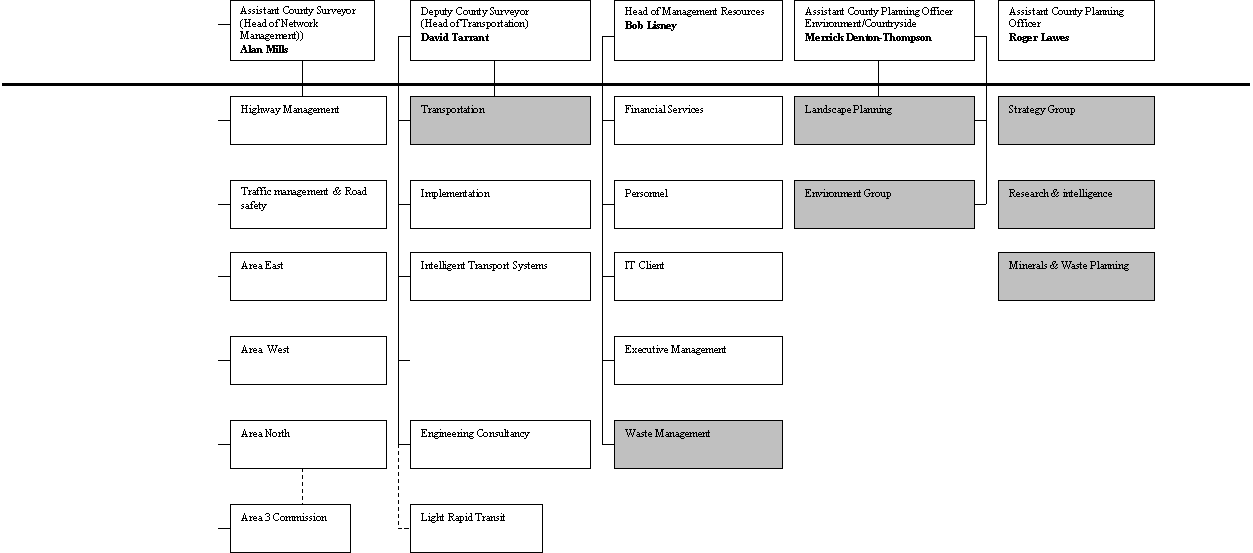
8.1 During the year 2000/01 policy development involved contributions from about 60 staff across the Environment Grouping. Appendix 3 explains diagrammatically which sections and groups are involved. The following table details the resources used during 2000/01:
Element |
Staff FTE |
£'000 |
Other Costs £'000 |
Structure Plan |
12.2 |
360 |
40 |
Local Transport Plan |
36 |
1,070 |
130 |
Supplementary Planning Guidance |
0.7 |
20 |
- |
Minerals and Waste Local Plan |
0.6 |
20 |
- |
Regional planning |
0.9 |
30 |
90 |
Non-statutory plans and policies |
1.6 |
46 |
100 |
Inputs to policy development by other County Council departments and outside agencies |
4.2 |
120 |
- |
Total |
56.2 |
1,666 |
360 |
9. Performance Data
9.1 Paragraph 4.4 explained that monitoring of the effectiveness of policies is established in some parts of the service. Less well developed is the monitoring of the cost efficiency and effectiveness of the Service in terms of national benchmark standards and in comparison with other authorities.
9.2 There is only one national Best Value Performance Indicator (BVPI) which relates to policy development: BVPI 112 which comprises a checklist of land use planning best practice. The Service satisfied 4 of the 6 criteria in the year 2000/01. (Appendix 4 gives details of the criteria and shows which are currently satisfied by the Service.) It is anticipated that during the current year 2001/02, the service will improve its score against this BVPI by satisfying 5 of the 6 criteria.
9.3 Currently, the only cost comparison information is that supplied to CIPFA on the cost per head of population of the Planning and Surveyor's departments as a whole. As the Policy Development Service comprises only part of each department, those figures do not give any guide as to how the Service compares to its equivalents in other local authorities.
9.4 To fill those information gaps, the Planning Department is a member of a best value benchmarking network of ten strategic planning authorities, mainly in the South East of England, which is compiling information to compare the performance and costs of policy development services of their services.
9.5Benchmarking relating to transport is being explored by the South East Counties Service Improvement Group (SECSIG). It has established a series of performance indicators for the South East following an exercise comparing and challenging processes and targets proposed for each local authority.
9.6 The high quality work of the service has been recognised in several ways. Hampshire has been accredited by the Government as a centre of excellence for transport while the Hampshire Local Transport Plan led to Government approval for spending of £110 million plus £200 million for the Light Rapid Transport system over the period 2001 to 2006. The Waste Management Strategy is regarded by the Government as an example of best practice, while the County Council (and its other partners in the strategy) has been awarded Beacon Council status. The summary of the Landscape Strategy and the Supplementary Planning Guidance "Implementing Policy H4" have both been accredited as meeting the Clear English Standard. In addition to these official commendations, the quality of many other policy documents has generated positive feedback from other organisations and members of the public, while possibly the greatest accolade arises from their emulation by local authorities elsewhere in the country.
10. Sustainability, Equalities, Crime and Disorder, E-government
10.1 The Environment Grouping initiated the concept of the Corporate Sustainable Development Strategy and played the lead role in its preparation. Sustainable development is a cornerstone of all Environment Grouping policies. While every effort is made to follow sustainable principles in the Grouping's work, eg seeking to hold meetings wherever possible at venues which are highly accessible by public transport, the best value review will assess what more can be done, as required by the corporate strategy's action plan.
10.2 The Government has set targets for e-government: the availability of all government services by electronic means by 2005. The current position in the policy development service is mixed. Some policies can be viewed on the internet: the Structure Plan, the Waste Management Strategy together with detailed information on waste management practice, and summaries of the Landscape Strategy and the Local Transport Plan. Other policies, eg the Minerals and Waste Local Plan, have yet to be added to the County Council's web site. A few are available on other electronic media: the Local Transport Plan is on CD rom, while the Historic Towns Project results are available in digital form on disc or CD. Consultation on the new Car Parking Strategy was undertaken by electronic means. The Grouping intends to expand the number of policies, documents and other information which is on the internet, and is currently exploring how the medium can be used most effectively for consultation. In line with Government guidance the best value review will examine these plans and the timetable for their implementation.
10.3 The County Council's Crime and Disorder and Community Safety Strategy has been in place since June 1999. The Policy Development Service contributes to the implementation of the Strategy through taking account of public safety and security in policies for the management of waste facilities, for public transport services, for urban design and for support to rural communities.
10.4 The County Council has adopted a Corporate Equalities Strategy. Part of this is an obligation on each service to produce an action plan for introducing equalities into service delivery. An action plan has been agreed for the Environment Grouping. One of the areas which the Grouping and the County Council in general is looking at is `Hard to Reach Groups'. Larger print and audio summary versions of the Structure Plan and the LTP are made available on request. The preparation of documents to the Clear English Standard, eg the summary of the Landscape Strategy, also helps maximise their accessibility. The best value review will examine what more needs to be done to improve the accessibility of the Service, especially to hard to reach groups.
11. Competition and Other Providers
11.1 Consultants are engaged from time to time on limited duration contracts to provide specialist knowledge/skills not available in-house or to provide additional staff resources to cope with peaks in workload. These consultancy services, as well as graphic design and printing of documents are procured through competitive tender, except where minimal work and cost is involved.
11.2 The development of planning and transport policy was not included within the Compulsory Competitive Tendering regime and no moves were made in Hampshire to voluntarily subject the service to competition. (In that regard it should be noted that only one county council in England - Berkshire - ventured down that route.)
11.3 The interest of consultants in providing a wider part of the planning policy development activities is being explored in conjunction with district councils through the Hampshire and Isle of Wight Chief Planning Officers' Group (HIPOG). This work is currently ongoing. Partnership is long established in transportation scheme implementation through the agency arrangements and the Term Consultancy (covered by a separate Best Value review). This expertise can be drawn on in exploring opportunities for partnering within policy development.
12. Current Issues facing the Delivery of the Service
12.1 There are currently a number of issues facing the Service arising from changes in the external business environment on which action is already being taken by managers. These issues - which include better access to information for the public, improved methods of consultation during policy preparation, and measures to recruit skilled and high quality staff - will be fed into the Best Value review.
|
APPENDIX 1 |
Glossary | |
Area Transport Strategy |
Sets out local transport policies, aims, objectives and targets. |
Local Plan |
A land use plan for a local area or specific topic. A local plan for a local area (normally a district) is prepared and adopted by a local planning authority. It sets out detailed policies to guide development, including proposals for specific sites, and must accord with the Structure Plan. |
Local Transport Plan |
The Local Transport Plan (LTP) sets out policies and strategies covering all modes of transport, which are fully integrated together. It includes an outline ten year and detailed five year investment programme for transport infrastructure and services. Each county and unitary council in England was required to produce an LTP and submit to the Government by July 2000. Another LTP will need to be prepared for submission in 2005. |
Minerals and Waste Local Plan |
A Local Plan (see above) prepared and adopted by a strategic planning authority which sets out detailed policies to guide mineral working and waste disposal, including any proposals for specific sites. The Hampshire Minerals and Waste Local Plan is prepared and adopted jointly by Hampshire County Council, Portsmouth City Council and Southampton City Council. |
Municipal Waste Management Strategy |
A strategic framework for the management of municipal waste prepared jointly by the waste collection and disposal authorities in an area in partnership with other stakeholders, including objectives and standards for the waste management service, policies and plans for achieving these, and a framework for monitoring and evaluating progress (but not including land use policies and site proposals). The Government intends to make them a statutory requirement. |
Planning Policy Guidance Note (PPG) |
A PPG sets out Government policy guidance to guide local authorities in preparing structure plans and local plans. There are PPGs for various topics, of which PPG3: Housing and PPG13: Transport are of considerable importance for this Best Value review. In England, PPGs are issued by the Department for Transport, Local Government and the Regions. |
Regional Planning Guidance (RPG) |
RPG sets out broad strategic policies for land use and development that apply across a region or parts of the region. A separate RPG is issued by Secretary of State for Transport, Local Government and the Regions for each region in England. |
Road Traffic Reduction Act Report (RTRA) |
This is a report to the DTLR to show how the County Council is achieving RTRA targets and how it intends to continue to achieve them. |
SEEDA |
South East England Development Agency. |
SEERA |
South East England Regional Assembly. |
Strategic Planning Authority |
A local authority that prepares a structure plan. Hampshire County Council, Portsmouth City Council and Southampton City Council are strategic planning authorities. |
Structure Plan |
A Development Plan produced by county councils, some unitary authorities and national park authorities (in many cases on a joint basis) which sets out key, strategic policies and provides a framework for local plans. |
Supplementary Planning Guidance |
Planning guidance which supplements the policies and proposals set out in a plan. It is issued separately from the plan and must be made publicly available; consultation should be undertaken during its preparation. |
Waste Management Strategy |
A strategy covering all waste that sets out how the waste expected to arise over a period within the area should be managed and what action should be taken to achieve the desired pattern of waste management (but not including land use policies and site proposals). |
APPENDIX 2
Key Links between the Policy Development Service and the Corporate Aims
Area of Environment Grouping Corporate Aim
Policy Development
Quality of Life Stewardship of the Economic Strong High Quality
Environment Prosperity Communities Accessible Services
County Structure Plan * * *
Local Transport Plan * * *
Car Parking Strategy and *
Standards
Road Traffic Reduction * *
Act Report
The Hampshire Landscape Strategy
Landscape Assessments and Management
Plans for Area of Outstanding Natural
Beauty (AONB)
Biodiversity Action Plan
Forest of Bere and Eversley Strategy
Area transport strategies * *
Minerals and Waste Local Plan *
Waste Management Strategy *
Area of Environment Grouping Corporate Aim
Policy Development
Quality of Life Stewardship of the Economic Strong High Quality
Environment Prosperity Communities Accessible Services
Municipal Waste Management *
Strategy
Other strategic environmental/planning
policies relating to landscape, nature,
conservation, archaeology, public transport,
energy, air and water quality
APPENDIX 3
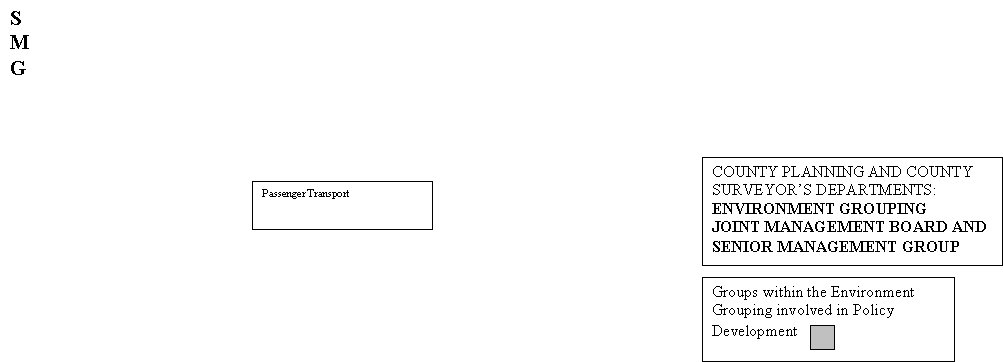
Groups/Sections involved in Policy Development



APPENDIX 4
Comparative Data
National Indicators
Of the Audit Commission's Best Value Performance Indicators (BVPIs) only one is relevant to the policy development service: BVPI 112 which comprises a checklist of land use planning best practice. There are no BVPIs for transport policy development. The Service's performance in relation to that indicator is as follows:
Local Indicators
The HCC Corporate Strategy sets local performance indicators, some of which are related to policy development. Although these are essentially indicators relating to the content of policies rather than the process of policy development, they provide a useful context for this best value review. Current performance against these is as follows:
Description |
1989/99 Actual |
1999/00 Actual/ forecast |
2000/01 Target |
Benchmark eg national |
Notes |
Percentage of Hampshire land with national environmental designations |
37.8% |
41.5% |
42% |
||
Percentage of new houses on previously developed land |
33% |
60% over 5-10 years |
60% by 2008 |
||
Percentage growth in waste per household |
4.5% |
4.06% |
3.12% |
3.8% in 1999/00 |
|
Percentage of household waste recycled |
22.75% |
24.4% |
25% |
10.3% in 1999/00 |
|
Percentage of household waste going to landfill |
81.2% |
75.6% |
74.7% |
81% in 1999/00 |
|
Percentage traffic growth per year |
4% |
- |
3.5% |
3% |
|
Number of local commuter plans |
- |
- |
- |
Not available |
New indicator |
Local bus services (passenger journeys per year |
- |
- |
- |
Data collection commenced April 2000 |
New indicator |
1. Goal
1.1 To carry out a fundamental review of the Service to ensure the Environment Grouping is equipped to respond to changing internal and external factors and challenges by January 2003. The review is to be carried out over two years due to the complexity of the Service and because it is fundamental to the operations of the Environment Grouping.
2. Objectives
(i) To identify how the policy development function should adapt to meet challenges of sustainable development, increased community aspirations, equalities, e-government and other emerging agendas, and whether there is scope for closer coordination of policies within the function.
(ii) To consult with managers, staff and external stakeholders to establish their perceptions of the Service and ideas for how it might be improved.
(iii) To compare the Service with that of other local authorities and the private sector, to identify good practice elsewhere which could be adopted within the Service, and to identify any opportunities for additional partnership working with external agencies.
(iv) To formulate an action plan for Service improvements incorporating challenging targets.
3. Scope
3.1 This review covers a key function of the County Council which cuts across the Planning and Surveyor's departments. Policy development can be summarised as the preparation of policies, advising on their implementation (by other County Council services and external organisations) and monitoring their implementation. The latter, in turn, informs the review of the policies and the preparation of new policies. This is explained in more detail in the Position Statement.
3.2 The review will consider the Environment Grouping's policy development functions in the context of the Government's modernising agenda and the County Council's corporate policy framework. It will assess the generic processes involved and the effectiveness of the way in which policies and plans are developed, monitored and subsequently reviewed.
3.3 Transport network improvements and maintenance, development control, passenger transport, waste management, cultural heritage (including the historic environment) and corporate strategies, such as the Urban Living Strategy and Corporate Water Action Plan, are the subject of other best value reviews. So this review will not cover those areas except where aspects are of relevance to policy development.
3.4 The Corporate Policy, Planning and Performance Best Value review will cover the community strategy and corporate policies/strategies. These have close links to land use and transport policies prepared by the Environment Grouping. That review will be undertaken in 2002/03 (the second year of this review). Two officers are members of both review teams to ensure there are good links between the two reviews and to deal with any implications of one review for the other.
4. Approach
Organisation of the Review
4.1 A Best Value Review Team has been established. The core team, consisting of six officers (mostly directly affected staff), will coordinate the review and ensure it follows both corporate guidance and the approach outlined in this document. An extended team, comprising additionally of two officers from other County Council departments and two from other local authorities, maintains the external challenge necessary to achieve objectivity, credibility and creativity. The extended team has met twice already and has helped substantially to shape this Project Brief and the Position Statement.
4.2 The core review team has been kept relatively small in order to create a close knit working group. This means however that not every section involved in policy development is represented on it. To remedy this, a wider network has been established comprising an officer from every section who can be called on as needed to contribute particular knowledge and expertise. The network is being kept informed by e-mail of the review team's deliberations and general progress on the review.
Consultation - Internal Stakeholders
4.3 The draft versions of this Project Brief and the Position Statement were sent to the wider network and managers for comment. All service staff were briefed by e-mail on the overall timetable and scope of the review, with an invitation to make comments on the draft papers.
4.4 A representative group of staff is being established to contribute on matters of staff interest. The staff representative on the core review team is ensuring that it is representative of grades, gender and the range of disciplines across the policy development service. A workshop will be held for staff in the autumn to identify issues to be considered during the review.
4.5 Members are involved through the formal mechanism of the Environment Policy Review Committee. The Committee is asked to nominate one of its members to join the extended team (paragraph 4.1 above). There will also be other invitations to Members to participate in the stakeholders workshops and informal events throughout the review.
Consultation - External Stakeholders
4.6 A substantial number of organisations and individuals have a stake in the policy development service - see Appendix 1. In view of the numbers, the consultation with external stakeholders needs to be carefully managed, ensuring all have an opportunity to comment, but with a deeper engagement for those with a broader, cross-cutting interest in the review.
4.7 External stakeholders with a broader interest in the review will be invited to workshops; all other external stakeholders will be invited to express their views on the Service and contribute ideas for improvements through a questionnaire survey. Appendix 1 lists the external stakeholders and how each will be involved.
4.8 The first workshop will be held in the autumn to identify the issues to be considered in the review. Questionnaire respondents will then be asked to state whether they agree that these are the key issues. The second workshop will be held in early 2002 to identify solutions and service improvements.
4.9 The views of a representative sample of the public will be asked if they are satisfied with the Service and invited to suggest any desirable improvements.
5. Comparison
5.1 Some information comparing Hampshire's performance with that of other county councils has already been obtained - see the Position Statement. The review team will refine and extend this comparator information through the Strategic Planning Authorities Benchmarking Network and the South East Counties Service Improvement Group (SECSIG) benchmarking club. The data obtained will be used to inform this review. Examples of good practice in these other authorities will also be fed into the review.
5.2 The review team will seek to establish an exchange arrangement with another comparable county council, under which officers of that council will undertake a peer review of this service.
6. Competition and Collaboration
6.1 The review team will explore the scope for greater collaboration with alternative provision by external agencies including the private sector, and the benefits and disbenefits associated with this.
7. Challenge
7.1 A meeting of all senior managers in the Environment Grouping (the Joint Senior Management Group) in October will test the Service's current strengths and areas for improvement. The European Foundation for Quality Management (EFQM) model for business excellence will be used for this purpose. The resulting areas for improvement will be fed into the challenge process.
7.2 The model will also be used to establish perceptions and views from the key stakeholders and staff representatives. The extended review team will have a particular role to play here.
7.3 The information will be fed into the stakeholder workshops (see paragraph 4.7). These workshops will also cover the relevance and applicability of corporate guidance on sustainable development, equalities, e-government, and crime and disorder.
8. Resource Requirements
8.1 £10,000 has been allocated to cover external costs in this financial year. This excludes the cost of staff time involved in the review. The amount of staff time involved in preparing the Position Statement and this Project Brief indicates that the time required by the review itself will be significant and so may mean delays to some actual policy development.
8.2 Estimates are being prepared for the proposals set out in this Project Brief and a bid for additional funding will be made if the sum already allocated is insufficient.
9. Timetable
9.1 A project plan for this review is attached. To date the review is on target but will require firm management to ensure deadlines are met as the work involves many people with competing priorities.
APPENDIX 1
External Stakeholders
Stakeholders to be invited to workshops shown in bold underlined.
Stakeholders to be invited through a questionnaire are all others listed below.
Sector |
Sub-sector |
Organisation |
Government: |
Central Government: |
Government Office for the South East Hampshire MPs |
Government Agencies: |
Countryside Agency Environment Agency English Nature English Heritage Forestry Commission Highways Agency Strategic Rail Authority Civil Aviation Authority Health Authority Post Office Met Office Sport England Ministry of Defence Crown Estate South East England Development Agency | |
Regional Government: |
South East England Regional Assembly South East Forum for Sustainability | |
Local Government: |
Portsmouth City Council Southampton City Council Hampshire District Councils Parish/Town Councils Hampshire Association of Parish and Town Councils New Forest Committee East Hampshire AONB JAC Adjoining authorities Police Fire Service North Wessex Downs AONB |
Industry & Commerce: |
Business Interests: |
Chambers of Commerce Major Employers Property Industry Retail Industry Utilities Companies Tourist Board Landfill Tax Env. Bodies Hants Economic Partnership Minerals Industry Waste Industry Consultants to developers/ industry Stagecoach First Bus Other operating companies Train operating companies Ferry operators Associated British Ports Other port/harbour authorities Southampton International Airport |
Trade Organisations: |
Confederation of British Industry Institute of Directors House Builders Federation Quarry Products Assoc. Southern Brick Federation Oil & Gas Producers Group Environmental Services Association Trades Unions | |
Agriculture/Forestry: |
Country Landowners' Association National Farmers' Union Timber Growers' Assoc. Wessex Coppice Group Farming and Wildlife Advisory Group | |
Media: |
Local Press Local Radio & Television | |
Suppliers |
eg Sterling Associates | |
Potential competitors/partners |
WS Atkins Mott MacDonald Baptie Adams Hendry Other Consultants | |
Interest/Amenity Groups: |
National Organisations: |
National Trust Woodland Trust Royal Society for the Protection of Birds World Wildlife Fund-UK British Trust for Conservation Volunteers Council for the Protection of Rural England Friends of the Earth National Playing Fields Association British Horse Society Ramblers' Association Cyclists Touring Club Civic Trust Transport 2000 Hampshire Cyclists Learning through Landscapes Trust Automobile Association Royal Automobile Club Road Haulage Association Rail Users Consultative Committee - Southern England Freight Transport Association Railtrack |
Regional County Organisations: |
Hampshire Wildlife Trust Hampshire Gardens Trust Committee for Rural Hampshire Sane Planning in the South East | |
Local Organisations |
Local Action/Amenity Groups Civic Societies Forest of Eversley Trust | |
Community/Residents' Groups |
Residents' Associations |
Hampshire Federation of Residents' Associations Individual residents associations Local community groups |
Community/Disabled Groups |
Hampshire Association for the Care of the Blind Hampshire Coalition of Disabled People | |
Individuals: |
Hampshire residents |
Different social groups |
(socially inclusive) |
Working in Hampshire |
|
Visitors to Hampshire |
||