Archived decisions
Hampshire County Council Cabinet 29 October 2001 Natural Resource Management Initiative Report of the County Surveyor and County Planning Officer |
Item 7 |
Contact: Bob Lisney, ext 6647, Roger Lawes, ext 6743
1. Summary
1.1 The following decisions are sought:
(i) That the Natural Resource Management Initiative be agreed and implementation commenced, subject to funding being met from within existing resources and/or from external sources.
(ii) That the external and internal organisational structures be endorsed and accountabilities allocated and implemented to enable detailed business plans to be prepared.
2. Reason
2.1 The sustainable use of natural resources is a key part of achieving the County Council's vision for 'Lifestyles and the Environment', as set out in the Hampshire Greenprint. This objective cannot be achieved by the current practice nor by the County Council acting alone. There is therefore a need for the County Council to lead the development of a new approach, based on a community owned vision, and adopt a new way of working internally to deal with this issue. The new approach, which has been included as a service area in the County Council's Public Service Agreement (PSA) bid, would focus initially on material resources (waste and minerals) but eventually embrace the full range of natural resources (water, energy, soil, etc). It has strong links to the Community Strategy process and Local Strategic Partnerships.
2.2 If the decisions above are approved, this will enable the necessary organisational structures to be implemented and detailed business plans prepared.
3. Other Options Considered and Rejected
3.1 Carry on as existing.
4. Conflicts of Interest Declared by the Decision Maker or a Member or Officer consulted - Not applicable.
5. Dispensation granted by the Standards Committee - Not applicable.
6. Reason(s) for the Matter being dealt with if Urgent - Not applicable.
Approved by: Date:
Councillor T K Thornber
7. Executive Summary
Objectives
7.1 The aim of the Natural Resource Management (NRM) initiative, which forms part of the County Council's PSA bid, is to achieve over time a step-change in Hampshire's performance in the sustainable use of natural resources (materials, energy, water, soil, etc). Specific objectives are:
(i) to mitigate against climate change and the depletion of non-renewable natural resources;
(ii) to influence more sustainable consumption of natural resources in the community;
(iii) to make material (waste) recycling, recovery and treatment a more important part of the economy (by creating new business opportunities);
(iv) to minimise future increases in the waste management budget;
(v) to reduce the need for mineral working and waste disposal sites in Hampshire; and
(vi) to contribute to Best Value and make the County Council a centre of excellence in NRM.
7.2 These objectives cannot be achieved by the current approach nor by the County Council acting alone. The basic concept for moving forward is therefore the development of a community owned vision for the sustainable use of natural resources, to provide a focus for a range of coordinated actions by the public sector, commerce and industry, and voluntary bodies. This process will build on existing successes (eg Project Integra, which has already been recognised by the Government as a Beacon service) and link with existing processes such as the Community Strategy, with an initial focus on materials which are dug as minerals or disposed of as waste.
Delivery Mechanism
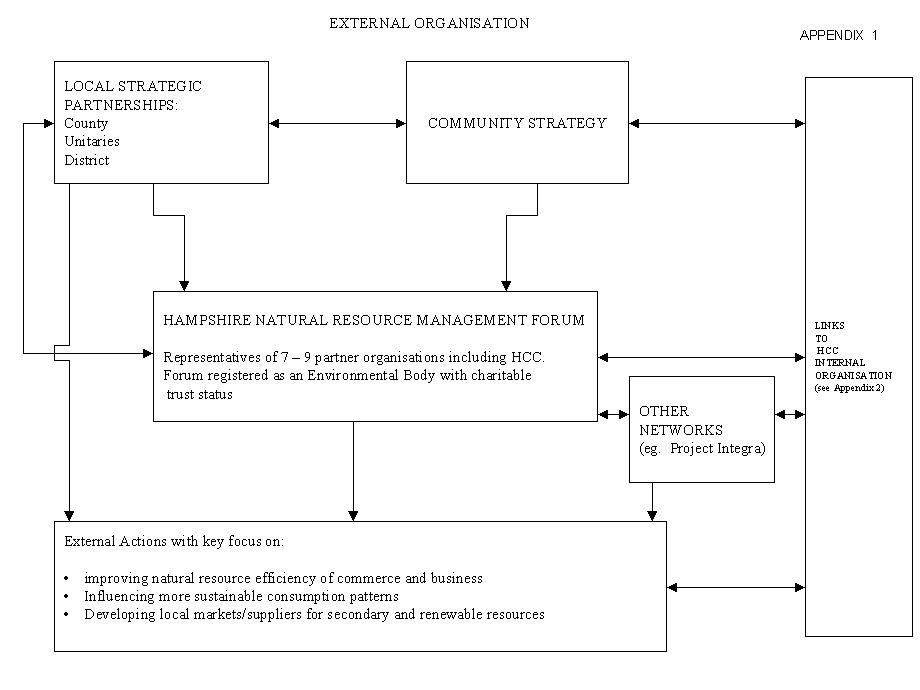
7.3 The proposed delivery mechanism has external and internal dimensions. Community ownership is vital and it is proposed to establish a cross-sector Hampshire Natural Resource Management Forum to lead the initiative. The work would be steered by a small group of 7-9 community representatives (including the County Council) who would oversee the development of a community based action plan and establish linkages with local strategic partnerships and other existing networks. This group could also be constituted as a charitable trust so as to attract external funding (eg Landfill Tax environmental monies) for community based actions such as:
(i) improving the natural resource efficiency of commerce and industry;
(ii) influencing more sustainable consumption patterns; and
(iii) developing local markets/suppliers for secondary and renewable resources.
The external organisation is set out diagrammatically in Appendix 1. If the concept is accepted, the next stage will be to form the group and develop a detailed business plan.
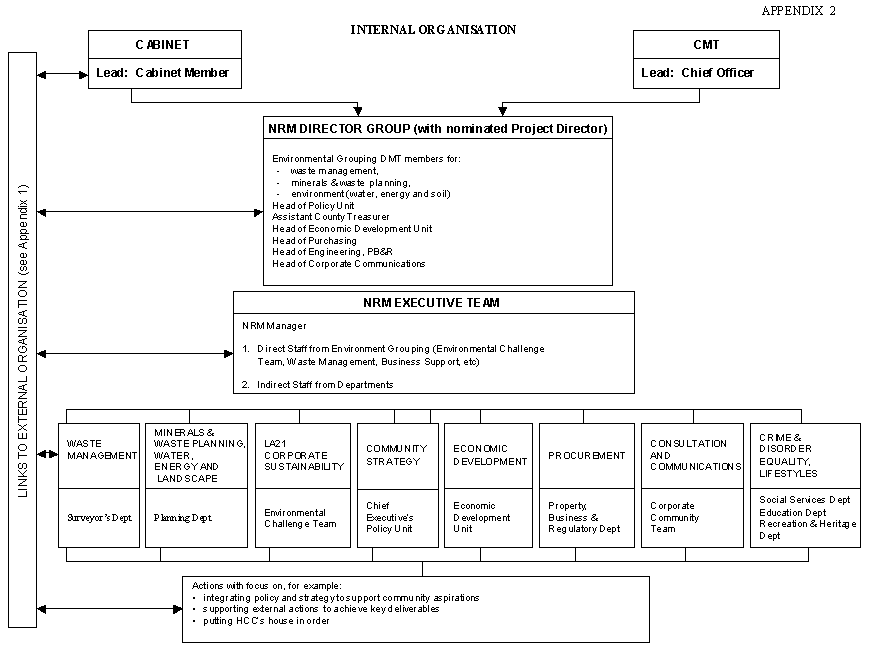
7.4 The County Council needs to implement an internal response which establishes a clear corporate focus for NRM. This needs to cross traditional departmental responsibilities and functional areas, and establish clear lines of accountability from the Cabinet down. The suggested internal organisation is shown diagrammatically in Appendix 2. Key elements are the establishment of a Director Group and an Executive Team with the initial task of developing an internal business plan which is likely to focus on:
(i) integrating policy and strategy to support community aspirations;
(ii) supporting external actions to achieve key deliverables; and
(iii) putting the County Council's house in order over natural resource usage.
Resource Implications
7.5 An initial three years' duration is proposed for the initiative. Much of the internal work in implementation does not represent new activity but rather involves carrying out existing functions in a more joined-up and coordinated way. However, there are certain `added value' services that are not currently resourced and a small staff and consultancy resource is needed for this purpose. This need will be met initially from within existing resources.
7.6 It is intended to maximise the use of external funding for external work with businesses and the wider community. There are a range of potential sources, including Landfill Tax environmental monies and the New Opportunities Fund. To this end the Onyx Environmental Group (parent company of Hampshire Waste Services Limited) has agreed in principle to directly fund, via the Landfill Tax credits scheme, an environmental body set up under the auspices of the proposed Hampshire Natural Resource Management Forum.
7.7 The following resourcing plan is therefore proposed:
Stage 1: Initiate and set up the initiative using existing resources by reviewing priorities in relevant areas of the Environment Grouping. This work will enable detailed business plans to be developed.
Stage 2: Commence implementation of business plans using external funding via PSA, Landfill Tax credits, New Opportunities Fund, etc.
8. Introduction
8.1 There is a need for a new approach to managing natural resources to achieve the County Council's vision for `Lifestyles and the Environment', as set out in the Hampshire Greenprint:
"A county where the principles of sustainable development are at the heart of both corporate and personal decision making so that:
(i) factors contributing to climate change, such as the creation of greenhouse gases from the use of fossil fuels (eg oil) to produce energy and power vehicles, are fully taken into account and meaningful reductions achieved;
(ii) the creation of waste is minimised and the waste that is created is dealt with in accordance with the hierarchy of reuse, recycling, recovery of resources and final disposal as a last resort;
(iii) with increased public awareness travel decisions are made having regard to the environmental implication of different modes;
(iv) the finite nature of many of the world's resources is recognised;
(v) greater emphasis is given to renewable and recyclable resources; and
(vi) impacts on water, air and the soils are minimised."
8.2 The nub of the issue is that this vision cannot be achieved by our current approach nor by the County Council acting alone. The point can be made by the example of increasing recycling in its widest sense, which includes the construction, minerals and agricultural sectors. Recycling is important not only to conserve virgin resources but also to mitigate against climate change. The key to success is not only in the traditional waste management area, but importantly in working with producers and manufacturers to achieve more from less in minimising the use of non-renewable resources, encouraging people to switch to the consumption of more sustainable materials and products, and identifying and assisting new local business opportunities in providing sustainable raw materials, goods and services. If an approach along these lines were developed on business principles, it would create wealth by making waste and resource recycling and treatment a more important part of the economy. That said, this is not an easy option nor a quick fix but the agenda has to be grasped if progress in a sustainable way is to be made.
8.3 The basic concept is that if a community owned vision for the sustainable use of natural resources were to be developed, this would provide a focus for a range of coordinated actions by public sector authorities, commerce and industry and the voluntary sector to advance achievement of the vision. In doing this it is important not to reinvent the wheel but to build on current strengths and successes (eg Project Integra) and link with existing processes, eg the Community Strategy process in a similar way to Crime and Disorder and Health.
8.4 A detailed background paper setting out the thinking and rationale behind the initiative has been previously circulated and further copies are available on request.
9. The Way Forward
9.1 In the past year several process workshops have been held with a core of external partners to help shape a programme to meet the challenge. The conclusion is that the County Council can play a key leadership role in this area and that the response needs to have an external and an internal focus. There is general agreement that the initial priority should be materials (ie minerals and waste) but with the scope to include other natural resources (eg energy, soil, water) in due course. It is considered important to embrace existing programmes, such as the Water Strategy, and link with the Community Strategy and Local Strategic Partnerships. The thinking on the external and internal dimensions is summarised below.
External
9.2 Whilst the County Council is a major player in the initiative, it is important that it is not seen to `own' the external dimension. Community ownership is vital and what has emerged is the idea of a Hampshire Natural Resource Management Forum, a cross-sector network that could lead the initiative and provide a technical input to the Community Strategy. The initial task in the materials area would be to shape a consensus vision and action plan on measures that need to be taken to address issues such as:
(i) Working with producers and manufacturers in Hampshire to maximise resource and business efficiency through more sustainable resource use, more efficient product design, using less hazardous materials, maximising the use of recycled materials and avoiding unnecessary waste.
(ii) Encouraging the Hampshire community to adopt sustainable consumption patterns, eg purchasing products made of recycled or renewable materials. The County Council has an important role in leading by example in this area.
(iii) Ensuring that efficient waste collection and processing systems are in place to recover materials at the end of their lives in all sectors, including commerce and industry. Raising awareness of the need for separation in the home, office, factory, etc and translating this into action is a key part of the task.
(iv) Developing reprocessing industries locally to feed materials that are currently discarded back to industry, thus creating opportunities for local manufacturing and consultancy services.
9.3 The proposal is that the external focus be guided by a small steering group of 7-9 community representatives (on which the County Council would be represented) which would establish links with local strategic partnerships and other existing networks. Organisations who have expressed an interest in being involved are the Chambers of Commerce, SEEDA, Project Integra, the Churches Working with the Economy, the Environment Agency, Friends of the Earth, Hampshire Waste Services Limited and Southampton City Council. As well as steering the external dimension, this group could be constituted as a charitable trust so that it could attract external funding (eg from Landfill Tax environmental monies) to support the implementation of community based actions which it is envisaged would focus on:
(i) improving natural resource efficiency of commerce and business;
(ii) influencing more sustainable consumption patterns; and
(iii) developing local markets/suppliers for secondary and renewable resources.
9.4 The external organisation is set out diagrammatically in Appendix 1. It is important that the remit of the group be established around a business case and, if the principle were accepted, the next stage would be to form the group and develop a business plan.
9.5 The County Council has to date made the running in setting up initial discussions and it is clear that it will have to provide ongoing input and support if the Forum concept is to get off the ground. This will have resource implications in the short term (referred to in Section 12) but there is potentially a very major payback in the long term through minimising increases in the Waste Management budget by impacting on waste growth and the amounts requiring final disposal, as well as other benefits in terms of meeting Government targets in respect of social and economic well-being and Best Value.
Internal
9.6 The external organisation outlined above will provide a context and framework for the County Council's own activities in the natural resource management area. There are two aspects to this:
(i) The County Council's policy and service provision roles in service areas which impact on NRM. For example, a community vision and action plan for materials management could be the catalyst for documents like the Waste Strategy and Minerals and Waste Local Plan becoming part of the delivery mechanism for a much bigger agenda, ie the process of shifting the emphasis from meeting the need for minerals extraction and waste disposal to ensuring the efficient use of material resources.
(ii) The County Council itself being a major procurer and consumer of natural resources in the course of its business activities. The need for improvement in our performance in the sustainable use of natural resources has already been identified in the Corporate Sustainable Development Strategy and progress on this is vital to meet the commitments made when the County Council signed the Nottingham Declaration on Climate Change in February 2001.
9.7 Various initiatives have over the last few years achieved a range of successes and there is a trend of gradual improvement in the way the County Council deals with natural resources. However, achieving a step-change in performance requires a new approach with more integrated working, different ways of taking decisions and, over time, changes in the way services are provided and greater consideration of the County Council's external influence in the community. These issues impact not only on the departments and sections directly involved with waste, minerals, energy, water, etc but also on economic development, purchasing, corporate communications and other services within the County Council.
10. Internal Organisation and Accountability
10.1 The initiative can be seen as a corporate one crossing traditional departmental responsibilities and functional areas. It is therefore important to establish a clear corporate focus within the County Council for NRM, with clear lines of accountability from the Cabinet and Corporate Management Team (CMT) at the top level to responsibility for implementing specific actions at the other. The suggested internal organisation is shown diagrammatically in Appendix 2. The key elements are allocation of specific responsibilities at Cabinet and CMT levels, the establishment of a Corporate Director Group for Natural Resource Management, together with an Executive Team to progress implementation. The latter will need a small direct staff resource to support the external work and provide overall coordination, but with indirect input via existing staff in the departments. The concept is one of a virtual team where indirect staff would retain existing line management structures in relation to core function and professional matters, but have a dual reporting line via the Director Group in respect of NRM. As with the external focus, it is proposed to form the Director Group and Executive Team with the initial task of developing a corporate NRM business plan with a focus on:
(i) integrating policy and strategy to support community aspirations;
(ii) supporting external actions to achieve key deliverables; and
(iii) putting the County Council's house in order regarding NRM issues.
10.2 The Executive Team will support the Hampshire Natural Resource Management Forum, coordinate research and interpretation of information, provide professional advice, foster partnership working, procure external funding and develop networking, influencing and outreaching to the wider community. Importantly, it will also provide coordination in ensuring that the County Council's own activities comply with best practice in NRM. The team will require a range of skills, including expertise in waste and land use strategy development/implementation, business liaison and economic development, purchasing and procurement, community planning and Local Agenda 21, public consultation and stakeholder dialogue.
11. Targets and Tasks
11.1 The following Local Service Target is proposed as the baseline performance indicator for NRM under the PSA submission:
Achieving the following additional household, commercial and industrial waste diversions (over and above existing plans) from landfill:
End of Year 1: 10,000 tonnes per annum
End of Year 2: 25,000 tonnes per annum
End of Year 3: 40,000 tonnes per annum
11.2 In addition, the NRM initiative will contribute to the following national PSA performance targets:
Target 6 Over the 3 years to 2004 increase the employment rates of the listed disadvantaged groups and areas.
Reprocessing of recycled materials will locally increase employment opportunities in the manufacturing sector for those disadvantaged areas through the widespread community participation and reprocessing opportunities that the resource management forum offers.
Target 20 Reduce the rate of reconviction of all re-offenders punished by imprisonment or by community supervision by 2004 compared to the previous rate.
Dismantling and manufacturing of waste materials offers excellent training and development opportunities for convicted offenders, and is a major area we would be looking to expand in partnership with the Prison Service.
Target 21 Reduce the rate of re-convictions of all young offenders by 5% by 2004 compared to the predicted rate.
As Target 20.
Target 22 Enable 17% of household waste to be recycled or composted by 2004.
Project Integra in Hampshire has already achieved a 25% recycling rate. The NRM initiative goes beyond the waste management aspects of recycling by looking at materials resource managed without discriminating between household and commercial waste, and will offer the UK guidance on how to meet and go beyond the 17% recycling target.
A relevant aspect is a skills exchange with the Wales Environment Trust, whereby it will provide market development advice in return for support on partnership working and integration on its own area.
Target 23 Reduce road congestion on the inter urban road network and large urban areas in England below current levels by 2010 by promoting integrated transport solutions and investing in public transport and the road network.
It has been estimated that 8% of road movements are waste related. By reducing waste production and increasing recycling and re-processing of waste materials, coupled with an increased use of port and sea traffic within the Hampshire area, a reduction in road movements will be achieved.
Target 30 Overall annual improvements in cost-effectiveness of 2% or more.
A key aspect of NRM is procurement. Using the purchasing power of the County Council and community sectors which will become involved there are opportunities to purchase goods from recycled materials, closing the loop, with potential savings in costs as products made from secondary resources become mainstream.
11.3 The following specific tasks and targets are proposed for the period to March 2003:
(i) NRM Director Group and Executive Team established by November 2001.
(ii) Business plans for external and internal aspects prepared by December 2001.
(iii) Links to Community Strategy and Corporate Strategy firmed up December 2001.
(iv) Initial tranche of external funding secured by April 2002.
(v) Hampshire Natural Resource Management Forum formally established and launched April 2002.
(vi) Links established with other organisations (SEEDA, counties in South East, Project Integra, etc) by April 2002.
(vii) Internal Hampshire County Council NRM implementation plan developed by April 2002.
(viii) External focus on Materials Sector - action plan agreed by May 2002 with initial implementation and outcomes achieved by March 2003.
(ix) Linkages with other sectors established July 2002.
(x) Progress reports to Cabinet/Executive Member/CMT as appropriate.
12. Resource Implications
12.1 An initial three years' duration of the initiative is proposed to link in with the PSA agreement. Much of the internal work involved in implementing the initiative does not represent `new activity' but rather involves carrying out existing functions in a more coordinated and joined-up way such that synergies can be maximised. The internal responsibility for these activities rests currently in various service areas in the Environment Grouping and elsewhere in the County Council. However, there is a need for input to organise, facilitate and support the proposed Hampshire Natural Resource Management Forum and pursue external funding opportunities and provide overall coordination. These are added value services that are not currently resourced and a small staff and consultancy resource is needed for this purpose. This need will be met initially from existing resources by reviewing priorities within relevant areas of the Environment Grouping.
12.2 It is intended to maximise the use of external funding for work with businesses and the wider community. There is a range of potential sources and the Onyx Environmental Group (parent company of Hampshire Waste Services) has already agreed in principle to directly fund, via the Landfill Tax environmental credits scheme, an environmental body established under the auspices of the steering group referred to in paragraph 9.3 to further NRM objectives.
12.3 In summary, the following resourcing plan is proposed:
Stage 1: Initiate and set up the initiative using existing resources by reviewing priorities in relevant areas of the Environment Grouping. Develop detailed business plans.
Stage 2 Commence implementation of business plans using external funding via PSA, Landfill Tax credits, New Opportunities Fund, etc.
13. Conclusions
13.1 The proposals set out in this report for a Corporate Natural Resource Management initiative fully accord with the County Council's vision and strategy objectives, as well as EC and Government policy. They link with Best Value, Community Strategies and the County Council's community leadership role by building on community aspirations through joint working both inside and outside the County Council. However, the route proposed is not an easy option nor a quick fix. It is about embarking on a journey that will engage the Hampshire community in a process that will progressively lead to a step-change in the more sustainable use of natural resources.
13.2 The initial focus of the work will be on the high priority area of material resources, ie those which are dug as minerals and/or end up as waste. However, the intention would be to apply the concept to other natural resources (eg energy, water, soil, etc) in due course.
13.3 There will be no additional direct funding implications in setting up the initiative as it will aim to improve efficiency by maximising the use of existing resources. Business plans will be prepared for both external and internal activities and the aim will be to maximise the use of external funding opportunities for implementation.
Recommendations
(i) That the Natural Resource Management Initiative be agreed and implementation commenced, subject to funding being met from within existing resources and/or from external sources.
(ii) That the external and internal organisational structures be endorsed and accountabilities allocated and implemented to enable detailed business plans to be prepared.
Section 100 D - Local Government Act 1972 - background papers | |
The following documents disclose facts or matters on which this report, or an important part of it, is based and has been relied upon to a material extent in the preparation of this report. | |
NB the list excludes: | |
1. |
Published works. |
2. |
Documents which disclose exempt or confidential information as defined in the Act. |
TITLE |
LOCATION |
Background Paper on Natural Resource Management (NRM) Notes of Stakeholder Workshops on NRM - 28.6.01 and 4.10.01 |
County Surveyor's Department Environmental Challenge Team Environmental Challenge Team |
6755/IA