Archived decisions
Hampshire County Council Schools' Monitoring Panel 5 February 2002 Progress towards 2004 targets for 14 and 16 year olds. Analysis of 2001 results at Key Stage 3 and Key Stage 4. Report of the County Education Officer |
Item 3 |
Contact: Alan Rawlings, Senior Inspector/Adviser (Secondary). Tel: 01962 846917
1. Summary
1.1. This report provides an analysis of the Key Stage 4 examination results for 2001 in the light of LEA targets for Key Stage 4 agreed with the former Department for Education and Employment (DfEE). It also provides a commentary on the new targets for Key Stage 3 and Key Stage 4 that were set by the Department for Education and Skills (DfES) in October 2001.
1.2. The performance targets at Key Stage 4 that were originally agreed for the lifetime of the Education Development Plan (1999-2002) were very challenging. Whilst these targets were largely met up to 2000, the results in 2001 faltered although the LEA retains its favourable ranking in relation to similar LEAs. The targets that have been set for 2004 at Key Stage 3 and Key Stage 4 present more of a realistic challenge except for the target for the percentage of pupils gaining 5+A*-G grades (to include English and mathematics). This may be missed although the LEA will do all that it can in working with schools to prevent this happening.
2. Key Stage 4
2.1. Confirmed results for secondary mainstream schools in 2001 are as provisionally indicated in the report of 9 October 2001 to Education Policy Review Committee, namely:
Percentage of Year 11 pupils achieving five or more A*-C grades at GCSE
All pupils - 56%: boys - 51%: girls - 61%
2.2. Although these figures are slightly higher than 2000, the rounded values represent no change from 2000. LEA targets for 2001 in the Education Development Plan (1999-2002) were particularly challenging and the result for 5+A*-C grades in 2001 missed the target by 3 percentage points. The following table shows the trend in GCSE results against two indicators and compared with the national average. These are the data that are published in national school performance tables and, because they include all pupils in special schools, the values are lower.
|
No passes at GCSE | ||||||||
51.2% |
53.1% |
54.9% |
54.9% |
3.7% |
3.5% |
3.6% |
3.3% | ||
46.3% |
47.9% |
49.2% |
50.0% |
6.6% |
6.0% |
5.6% |
5.5% | ||
2.3. This table confirms the pattern described earlier. Whilst it is true that the improvement from 2000 to 2001 is less than nationally, it is also the case that the LEA average in 2001 is as much above the national average as in 1998 and that the 2000 results were relatively strong.
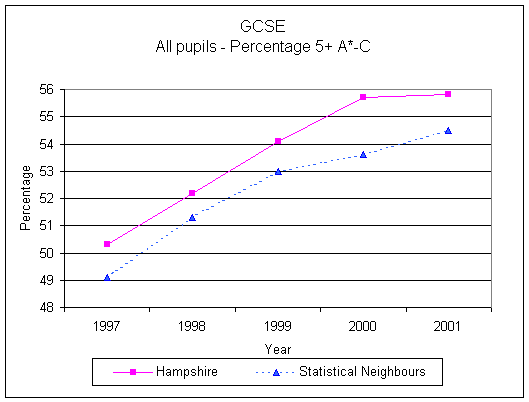
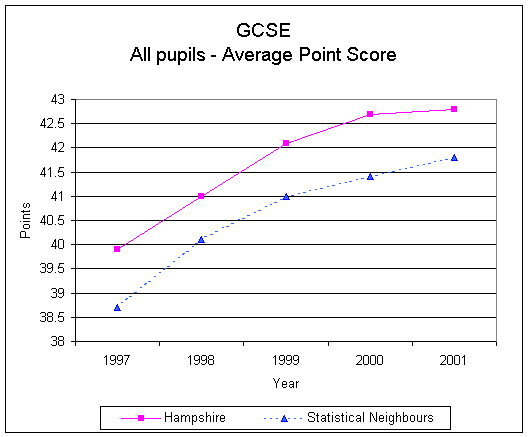
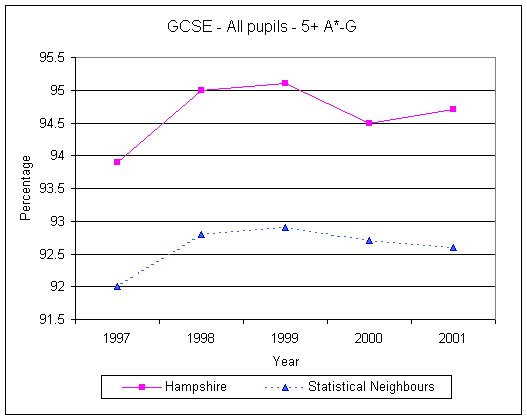
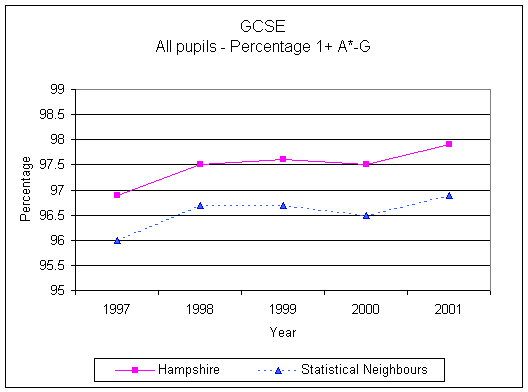
2.4. Appendices 1 and 2 compare Hampshire results for mainstream schools with those other LEAs that are statistically most like Hampshire. Notwithstanding the faltering of the 5+A*-C indicator this year it can be seen that other indicators have improved and LEA results generally remain higher than statistical neighbours, especially in respect of 5*A*-G grades.
3. Key Stage 3
3.1. The percentage of pupils achieving level 5 or above in Key Stage 3 tests in 2001 is shown in the following table:
1999 |
2000 |
2001 |
England 2001 | |
English |
69 |
70 |
69 |
64 |
Mathematics |
69 |
71 |
73 |
66 |
Science |
63 |
67 |
74 |
66 |
3.2. The trend in test results in mathematics and science is upwards. The jump in science results is not significant because in 2001, national results in science also increased by seven percentage points, the same as in Hampshire. Both these sets of results have continued to rise broadly in line with the national trend but from a higher base and therefore remain above the national average. By contrast, results in English have shown least improvement, nationally and in Hampshire over the same period. Although the English figure of 69% in 2001 is still above the national average, this performance has caused the LEA's position in relation to similar LEAs to slip from the top half to near the middle of its comparator group.
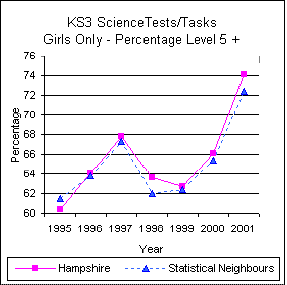
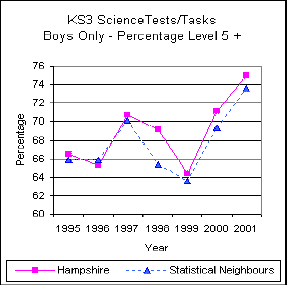
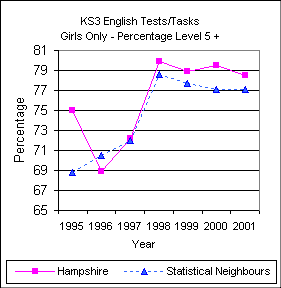
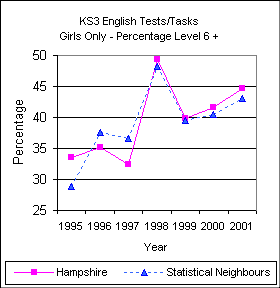
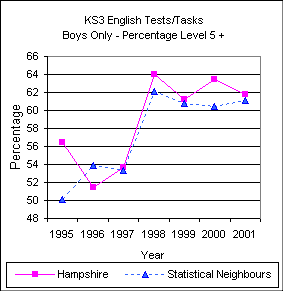
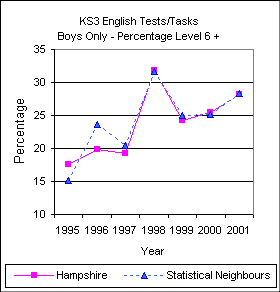
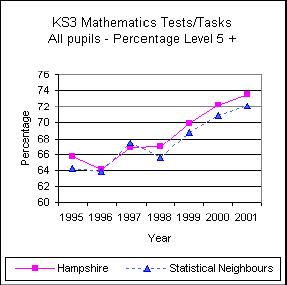
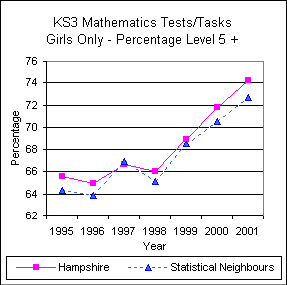
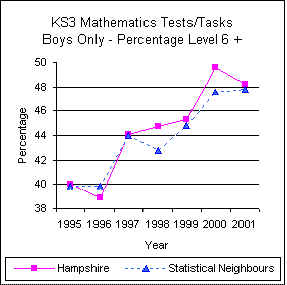
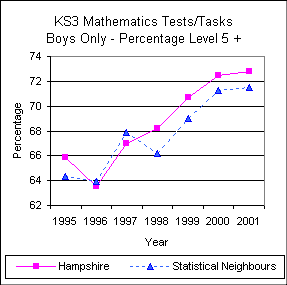
3.3. National test results provide an important barometer of trends in pupil performance and the LEA is thorough in its process of scrutiny. However, at Key Stage 3 some care is needed in deciding on a possible response because of fluctuations in these results compared with those at GCSE; this is especially the case with English. Appendices 4, 5 and 6 show the trend in Key Stage 3 results in each of English, mathematics and science, including gender and level 6 data, since 1995.
3.4. The English graphs show the fluctuating pattern of test results but also the quite close mirroring of the LEA's performance with that of its statistical neighbours. It is apparent that, for example, the level 5 and above percentages in 2000 increased when the equivalent statistics for neighbours fell slightly. Whilst the level 5 and above figures for this year have not improved significantly, both boys and girls achieving level 6 or above have improved in line with neighbours.
3.5. The graphs for mathematics and science confirm that all pupils continue to achieve at, or in the case of mathematics, slightly above that of neighbours. These analyses and the more detailed individual school results are being used to determine how the LEA plans its differential support programme during implementation of the National Key Stage 3 Strategy which is now in its first year. Elements within the new EDP also reflect the outcomes of the audit from these analyses.
4. LEA Targets for Key Stage 3 and GCSE
4.1 In October 2001, the LEA started discussions with the DfES prior to the setting of targets for 2004. Internal targets have also been set for 2003 as milestones towards the 2004 targets. The 2004 targets that will be published in the EDP are as follows:
GCSE
Pupils achieving 5+A*-C grades - 63%
Pupils achieving 5+A*-G grades - 96%
(to include English and mathematics)
Average total points score - 45
Key Stage 3
Percentage of pupils achieving level 5 or above in:
English - 80% mathematics - 80%
science - 75%; ICT - 77%.
(`Stretched' targets have also been agreed linked to a bid for additional funds for the county council in respect of Local Public Service Agreements. These are not shown here).
4.2. The LEA has agreed 2003 targets for GCSE with schools and has been informed of Key Stage 3 targets set by governing bodies. In the latter case the LEA does not yet have a statutory role in respect of target setting at Key Stage 3.
4.3. A preliminary analysis of the aggregated data from these targets suggests that the LEA is on track to meet its milestone targets for 2003 at Key Stage 3 and GCSE with one exception - that of the 5+A*-G target for GCSE. This has been the subject of considerable debate with the DfES who set a target range for this indicator between 97% and 99%. At the time of writing the DfES had not yet confirmed whether it would accept a very challenging target of 96%.
5. Recommendations
5.1. That the panel notes this report and the proposed action through the Key Stage 3 strategy and EDP in respect of targets for 2004.
That the difficulties over agreeing a target for 5+A*-G grades at GCSE be also noted.
Section 100D - Local Government Act 1972 - Background Papers
The following documents disclose facts or matters on which this report, or an important part of it, is based and has been relied upon to a material extent in the preparation of this report.
N.B. the list excludes:
1. Published works
2. Documents, which disclose exempt or confidential information as, defined in the Act.
None
Appendix 1
Appendix 2
Appendix 3
|
|
|||||||||
|
|
|||||||||
Appendix 4
|
||||||||||
| ||||||||||
|
||||||||||
| ||||||||||
Appendix 5
|
||||||||||
|
||||||||||