
Archived decisions
 APPENDIX



The County Surveyor City Engineer Director of Development
Hampshire County Council Portsmouth City Council and Sustainability
The Castle Civic Offices Southampton City Council
Winchester Guildhall Square Marland House
Hampshire Portsmouth Southampton
SO23 8UD PO1 2AS SO14 7PQ
1 Introduction
1.1 Car parking is important to Hampshire as it is a key factor in determining travel choices, and is a major user of land resources. This document sets out a revised strategy and a set of parking standards for Hampshire. The need for parking restraint has been recognised by Central Government in the Transport White Paper, Regional Planning Policy and Planning Policy Guidance. The Road Traffic Reduction Act (1997) requires local authorities to assess traffic conditions and set targets for future traffic levels. The Hampshire County Structure Plan policy T2 states that:
· Within the integrated transportation strategies, parking policies will be promoted with the aim of reducing the dependency on car use and encouraging the use of alternative modes of transport.
· Development proposals will be required to conform to parking policies and standards which will take into account strategic and local objectives.
1.2 All car journeys start and end at a parking space. It is useful to consider them as three main types:
· On-street. This may be controlled either by the Police or by Council Enforcement Officers.
· Public off-street spaces. These are parking areas available to the general public, usually at a cost related to the length of stay. The facility may be controlled either by the local authority or by a private company.
· Private off-street spaces. These are privately owned parking areas, either private residential spaces or non-residential spaces, often associated with employment, retail or leisure locations.
1.3 The Local Transport Plans (LTPs) for Hampshire, Southampton and Portsmouth provide a framework for policies and set targets to tackle traffic congestion problems. For example, the Hampshire LTP seeks to halve the rate of traffic growth by 2020. The achievement of this target relies upon a modest shift in travel behaviour, and the implementation of a package of restraint measures. Car parking is just one such measure. If the provision of parking spaces is balanced by the availability of alternative transport modes, then car use can be reduced.
1.4 There are also considerable pressures for new housing and commercial developments in Hampshire that will add to road traffic problems. If development can be located where its impact can be minimised, shorter journeys can be made by means other than the car, such as by walking or cycling, with high quality public transport providing for longer trips.
1.5 Parking provision has, until recently, been quoted in terms of the minimum number of spaces required. In the new Hampshire Parking Strategy and Standards, the number of spaces is quoted as a maximum to avoid an over provision. The actual numbers are to be determined by the accessibility by alternative modes (for example, public transport) for a given site. An accessibility map of Hampshire, showing public transport levels at different times or days of the week can be found on the County Council's web site (url to be confirmed). This provides a guide to accessibility, but local planning authorities may choose to measure relative accessibility by other means.. Generally, developments that are well served by alternative modes, or which are planned to be well served, can expect a lower provision of car parking. The Strategy and Standards should not be used as a perverse incentive to seek development in less accessible areas where a higher level of car parking might be felt appropriate. For example, in PPG6 (Town Centres and Retail Development) a sequential approach is applied to all retail proposals with a preference for town centre locations, rather than out of town development. Developments remain subject to designations in the Local Plan and advice on accessibility levels can be provided by the local planning authority.
2 Background Information
The Roles of the Different Organisations involved in Parking
2.1 These are:
· Department of Transport, Local Government and the Regions (DTLR). This department advises Central Government on setting a framework of national policy.
· South East England Regional Assembly (SEERA). The regional planning body responsible for producing regional planning guidance, including advice to local authorities in preparing policies and standards for car parking.
· Hampshire County Council (HCC). As the transport and strategic planning authority for the county, HCC prepares the Hampshire County Structure Plan, (in conjunction with Southampton and Portsmouth City Councils), draws up the LTP and maintains the fabric of the county's road network.
· The City Councils of Southampton and Portsmouth. These are unitary authorities with similar policy commitment to the County Council and district councils.
· District Councils. Control parking provision through the planning process. Manage public car parks and enforce parking law in decriminalised parking areas.
· Hampshire Constabulary. Enforces on-street parking law in traditional parking areas except where district councils have taken on the function (see above).
· Private Parking Operators of Public Car Parks. These provide parking spaces for public use as a commercial enterprise.
· Private Parking Space Owners. Generally provide private parking facilities for their own customers and staff.
3 Time for Change
3.1 The 1991 Parking Standards are out of date with current transport planning practice, while these have generally been adopted by district councils as local planning authorities. These set out a minimum level of provision. In practice, this provided larger car parks than were needed and was wasteful of the land resource. Since then, transport policy has changed considerably, most notably with the introduction of LTPs.
3.2 The first LTPs were published in July 2000 and cover a five-year period from April 2001 to March 2006. LTPs represent one of the cornerstones of the Government White Paper, which emphasises a new direction for transport. Central Government guidance on producing an LTP stated "...planning policies on parking need to minimise the level of parking associated with development and through the adoption of maximum standards in development plans, and through lower provision (and in certain circumstances no parking) in locations more accessible by other modes or which can be made more accessible..." The publication of Planning Policy Guidance 13 - Transport (March 2001), strengthened Central Government guidance on the management of parking provision in relation to public transport accessibility.
3.3 Within Hampshire there are ten separate Area Transport Strategies that are coordinated in the LTP, each of which includes parking proposals. Care has been taken to establish a framework for a parking policy which can assist in consistency across the county and yet be flexible to local circumstances.
3.4 The County Council, Unitary Authorities and District Councils are working together to tackle traffic congestion and pollution, reduce the need for travel, improve travel choice, reduce the growth in road traffic and improve alternative modes of transport that are less environmentally damaging than the car. These authorities have developed a consistent parking policy and parking standards as set out in this document.
Pedal cycle and motorcycle parking
3.5 As well as an updated standard for cars, a minimum allocation of parking should be provided for pedal cycles and motorcycles. The proposed parking standards for pedal cycles are assessed by land use to ensure that adequate spaces and facilities are provided to encourage travel by cycle. In addition to adequate cycle parking facilities, provision should be made for the parking of motorcycles in all non-residential developments. Further advice on pedal cycle and motorcycle parking may be found at the end of this document. Parking facilities for pedal cycles and motorcycles should be located close to pedestrian access points to buildings.
3 Parking Strategy: Policies and Proposals
4.1 The parking strategy generally aims to contribute towards tackling congestion as part of a sustainable transport system. This aim can be achieved by the following seven main parking policies.
Policy 1: Effectively manage and coordinate the existing on- and off-street public car parking stock through measures including the supply of spaces, maintenance, charging and enforcement:
Proposal 1a: Manage the publicly owned on- and off-street public parking stock to the best effect. Work with private and public owners of public off-street car parks to assist in achieving the objectives of the relevant Area Transport Strategy.
The balance of the supply and demand of the total number of spaces and the maintenance of these are important factors in providing for local transport needs.
Proposal 1b: Apply levels of parking charges that assist in meeting the Area Transport Strategy objectives.
Parking charges need to be set at appropriate levels for the local area to assist in the balance of parking supply and demand, with reference to the Area Transport Strategies and charges as a whole within Hampshire. The parking authorities will seek to ensure a consistency of approach to charging levels.
Proposal 1c: Enforce parking regulations effectively and where appropriate introduce measures to assist in enforcement such as Special Parking Areas and decriminalisation of parking.
Without enforcement of parking regulations both Parking and Area Transport Strategies could be undermined.
Proposal 1d: Reduce long stay parking for the workplace and provide greater priority for adequate parking for shorter stay purposes such as shopping and visiting.
As part of the Area Transport Strategy proposals, include more capacity for shorter stay users such as shoppers whilst restricting commuter long stay parking, particularly in urban centres where alternative modes of transport are available. The demand for longer-term parking is acknowledged at transport interchanges, notably rail stations.
Proposal 1e: Implement park and ride facilities where appropriate to the Area Transport Strategy.
This applies to both bus and rail-based park and ride and informal car sharing locations where overall car trip mileage is reduced.
Policy 2: Promote reductions in existing privately owned non-residential car parking spaces and/or the usage of these spaces:
Proposal 2a: Introduce Company Travel Plans, School Travel Plans and other initiatives to reduce the need for parking spaces or the usage of them.
Encourage a voluntary reduction of car usage and parking demand, through community and public involvement.
Proposal 2b: Consider the introduction of workplace parking charges at an appropriate time.
This may provide an opportunity to influence travel costs to those private non-residential parking spaces which form the majority of parking stock in most urban centres, with the aim of encouraging alternative modes of travel. This is likely to be linked with Company Travel Plans as part of an integrated strategy.
Policy 3: Introduce Hampshire Parking Standards to car parking associated with land use development:
Proposal 3a: Apply `Hampshire Parking Strategy and Standards', the local maximum car parking standards, to developments.
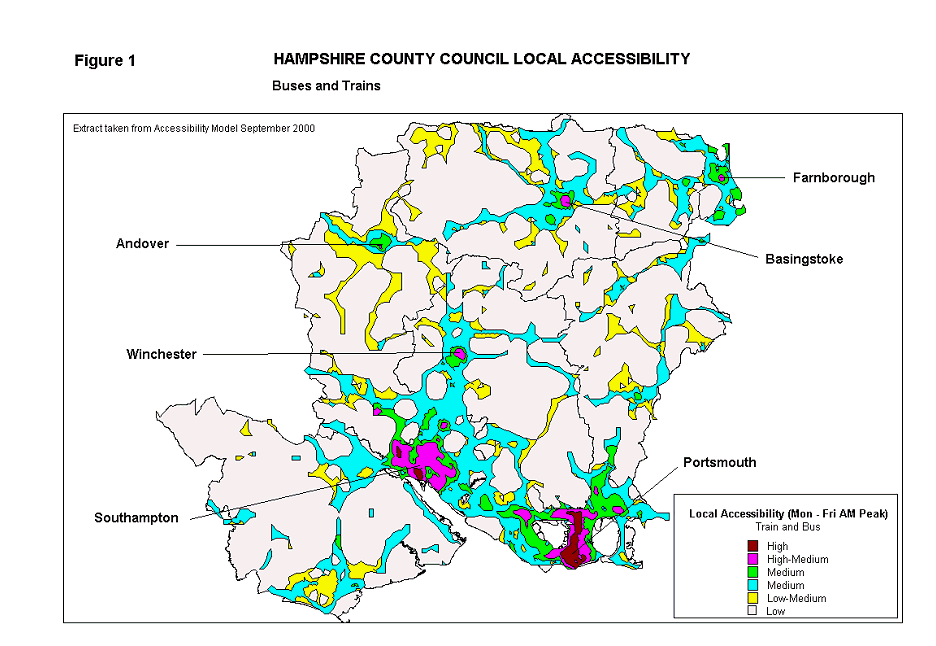
New parking standards are proposed for all new developments and are defined in Appendix 1. Hampshire Parking Strategy and Standards aims to provide a robust but flexible approach to setting standards for the county and the two unitary cities. For example, more stringent parking standards are proposed for developments that enjoy better access by public transport and other non-car modes. Figure 1 provides an illustration of public transport accessibility, and the accessibility level will be used in conjunction with a number of secondary influences, such as economic or environmental conditions, to reflect the varied nature of Hampshire. In the medium to long term this approach is expected to have a significant influence on travel behaviour, particularly in the Major Development Areas.
Proposal 3b: New development areas should assist in achieving the Area Transport Strategy objectives and the developer will normally be required to provide financial support for alternative transport provision.
This should be read in conjunction with proposal 3a and guidance in producing a Transport Assessment for new development proposals as indicated in Section 23 of Planning Policy Guidance (PPG) 13. Contributions will normally be sought from developers in order to make the development work effectively by providing for new transport facilities alongside a more balanced parking level. Private funds may be required to contribute to public transport, cycling, pedestrian facilities and other elements of the appropriate Area Transport Strategy.
Proposal 3c: Existing public parking stock with spare capacity within a reasonable walking distance of development proposals will be taken into account in the overall maximum parking provision.
This is mainly an issue in urban areas, and ensures that additional parking spaces are not needlessly added where existing public parking stock is available. Similarly, where a parking area can be shared without conflict (eg where uses are clearly separated in terms of time of day/day of week), it is beneficial to avoid duplication and apply only the standard that will provide the greater single number of spaces.
Proposal 3d: Where an existing non-residential land use is extended or there is a change of use `Hampshire Parking Strategy and Standards' apply to the entire site.
Proposal 3e: When considering the parking requirements of additional development on a site, subject to an application for planning permission, it is necessary to take into account the entire parking stock on the site. Where the additional development is more than 10% of existing floorspace, and the number of employees on the entire site will exceed 50, the whole site will become subject to a Company Travel Plan.
These proposals require that a developer seeking planning permission on an existing site for, say, an extension, would have to take into account all parking already available on the site. The existing site is expected to be subject to a Company Travel Plan if it is an appropriate land use and exceeds the thresholds in Appendix 1, Table B.
Proposal 3f: Developers are required to commit to the production and implementation of Company Travel Plans with development proposals to reduce car travel to work and journeys in the course of work.
For non-residential uses Company Travel Plans or Site Travel Plans will be required for sites above the thresholds specified in Table B of the Hampshire Parking Standards. The Local Planning Authority may also require a plan for smaller sites below those thresholds.
Policy 4: Provide adequate cycle parking provision and facilities for cyclists:
Proposal 4a: Apply the cycle parking standards specified in `Hampshire Parking Standards'.
New developments are required to include at least the level of cycle parking provision and facilities specified by land use in the Hampshire Parking Strategy and Standards (short stay and long stay). For workplaces and some other land uses secure covered spaces combined with lockers and changing facilities will also be expected, subject to the Transport Assessment.
Proposal 4b: Introduce more cycle parking.
This can be achieved through voluntary means such as Company and School Travel Plans as referred to in Policy 2 above. Local cycle policies and proposals from the Area Transport Strategy should also be referred to in conjunction with the provision of additional cycle facilities in public places.
Policy 5: Ensure changes to parking provision do not undermine the economic viability of areas or adversely affect local roads and the environment:
Proposal 5a: Parking provision and charges should be set not to undermine the vitality and economic viability of cities, towns and villages.
The effect of parking provision and charges on the local economy is a `local factor' identified in Hampshire Parking Standards. The level of parking is principally based on levels of accessibility to non-car modes, but this can be modified for local factors such as economic conditions. This allows the local planning authorities some flexibility to increase or reduce the maximum parking provision according to economic conditions within their area. This will normally only apply to retail and employment land uses.
Proposal 5b: Parking facilities to be designed to have minimal adverse impact on the physical environment.
The environmental characteristics of a location, for example, a conservation area, can reduce the maximum number of parking spaces identified in the Hampshire Parking Strategy and Standards. This allows the local authorities some flexibility to reduce the maximum parking provision to take account of environmental conditions within the area, for example, air quality, surface water run-off or flooding and visual quality.
Proposal 5c: Apply suitable enforcement measures for existing users where the restriction of on-site car parking is likely to result in an unacceptable overspill onto neighbouring streets.
It is possible that the application of Hampshire Parking Standards could prompt drivers to park in neighbouring residential or other streets. Where appropriate, developers will be required to monitor potential parking difficulties and if necessary contribute to funding the introduction of parking controls to maintain existing arrangements. Enforcement techniques may include the establishment of residents' parking areas, controlled parking zones or waiting restrictions enforceable by traffic regulation orders.
Policy 6: Promote high quality facilities for people with mobility impairments in all parking areas:
Proposal 6a: Within parking areas provide facilities for people with mobility impairments for whom the private car is necessary.
It is recognised that for many people with disabilities community transport can provide an acceptable door-to-door service. Where this is not available and the car is used, suitable facilities are required at the car parking location.
Proposal 6b: All new parking areas to provide for mobility impaired people as set out in national standards.
Parking spaces for people with disabilities should be designed to take account of best practice and guidance (see Appendix 1).
Policy 7: Improve safety and personal security standards in parking areas:
Proposal 7a: The layout and design of parking areas to be laid out in a safe manner to minimise personal injury accidents.
This applies to all users of parking areas, notably car drivers, pedestrians, motorcyclists and pedal cyclists. Facilities for service vehicles or those delivering or removing goods from premises should be segregated from the parking areas as far as possible to avoid conflict and prevent their use as overflow parking areas. Reference should be made to the Hampshire Design Guide for residential areas and best practice elsewhere.
Proposal 7b: The layout and design of parking areas to be laid out with regard to personal security and security against theft.
Refer to guidance on `Personal Security in the Pedestrian Journey' by the DTLR and best practice elsewhere. Personal security considerations are important and measures such as good lighting and video surveillance are strongly recommended.
5 Parking Standards
5.1 The Hampshire Parking Standards are tabulated in Appendix 1. These parking standards apply to new provision and aim to encourage the use of other modes of transport. The process does not seek to be retrospective and therefore will not affect existing levels of parking except in cases covered by proposals 3d and 3e.
5.2 The approach seeks to apply a different set of standards for new developments, depending on the availability of alternative means of transport to the car and on local characteristics. However, in those areas where there are few realistic alternatives, it is inevitable that the car will remain the dominant means of transport. In settlements where public transport, cycling or walking are available as a choice, more restrictive parking provision will be applied. For example, the Major Development Areas will be planned with high public transport accessibility and more stringent parking limits.
5.3 A detailed and extensive public transport accessibility model has been developed for the County Council, districts and unitary authorities. In situations where the model is not used, it may be appropriate to deploy other means of measuring accessibility. This will assist in determining the level of parking provision, in conjunction with the maximum standard. Other secondary factors that will influence the parking limit include the availability of existing public car parking spaces nearby, environmental effects, the local economy and pedestrian and cycle access.
The scope for reducing the maximum parking limit depends on the type of land use and these are listed in Appendix 1. The highest percentage reduction is for employment land use, since this has the greatest scope for tackling regular, peak hour traffic congestion.
Reduction in car parking for levels of accessibility by land use
Land Use |
Parking Standard for least accessible location |
Reduced Parking Standard for highly accessible location |
Retail |
100% |
75% |
Residential, Education, Health, Leisure |
100% |
50% |
Employment |
100% |
30% |
5.4 The car parking limits shown in Appendix 1 assume the lowest level of accessibility as a standard. However, it will be expected that parking levels will be reduced at locations where better levels of accessibility are provided, or can be delivered as a result of the development. The land uses are to be reduced by different degrees to take account of their ability to be served by non-car modes and contribute to traffic reduction. For example, employment land use has the greatest range to 30% of the maximum, since it can generally assist peak hour travel conditions and conforms with the recommended range specified in Regional Planning Guidance (RPG 9) for the South East Region (March 2001), Policy T3. In the very highest range of accessible locations (close to public transport interchanges), it is appropriate that zero parking may be provided.
5.5 Where any development includes two or more land uses to which different parking standards apply, each use should be assessed in proportion to the extent of the respective use. Developers are encouraged to make best use of any shared parking areas (eg by time of day/day of week) where these can be achieved without difficulty.
6 Conclusion
6.1 The position of the County Council and the Unitary City Councils fully accords with national guidance and has been developed through partnership with the District Councils working on Area Transport Strategies and development plans. These policies are regularly consulted upon with the community.
6.2 The future management of parking facilities in Hampshire should be seen as part of a balanced transport strategy. In some cases this will include minimising parking provision and, where appropriate, setting charges at a level that could influence modal choice, but only as part of an integrated transport strategy.
6.3 This strategy was the subject of consultation with agencies who have an interest in the role of parking as part of a sustainable economy and environment for Hampshire. Hampshire Parking Strategy and Standards will be issued as Supplementary Planning Guidance to the Hampshire County Structure Plan (Review). The strategy will continue to be reviewed from time to time in order to reflect circumstances as they may change in the future.
04/02/02
Hampshire Parking Standards 2002 APPENDIX 1
NOTES FOR APPLYING PARKING STANDARDS
1. The Parking Standards 2002 are detailed in the following tables:
Table Number |
|
A |
Percentage of Parking Limit Reduction by Land Use |
B |
Summary of Thresholds for Transport Assessments and Site Travel Plans |
1 |
Residential |
2 |
Commercial Development |
3 |
Retail |
4 |
Educational Establishments |
5 |
Health Establishments |
6 |
Care Establishments |
7 |
Leisure Facilities |
8 |
Miscellaneous Commercial Developments |
2. Car Parking - How to calculate the parking allocation for a development
The application of maximum parking standards conforms to the requirements of PPG 3, para.51 and 60; and PPG 13 para.51.
The principal determinant will be accessibility of the site, upon completion, by non-car modes. An indication of current levels of accessibility (prior to any development related enhancement) can be found on the Hampshire County Council web site. As a general rule, areas of high accessibility are served by at least six buses per hour within 500 metres and good cycling and pedestrian facilities. Developments in such accessible locations warrant less car parking than is shown under the maximum parking limit. For more guidance, please refer to your local planning authority.
A number of local factors can also influence the calculation of the parking allocation. For example:
1. Area of economic regeneration or constraint. Reduced parking will apply in constraint areas whilst regeneration areas may warrant a slight increase in parking.
2. Zone characteristics. Historic town centres, other environmentally sensitive locations, or specific locations that have particular Road Traffic Reduction Act targets will warrant reduced parking allocations.
3. Self-containment. Reduced parking may be justified in highly self-contained areas, whereas a reduction may be inappropriate where it is low, eg a competing location with a neighbouring area.
4. Cycle accessibility. Where there is high cycle accessibility planned or in use, reduced parking will apply.
Other parking in the locality must also be considered.
The calculation of parking spaces to be allocated for a development should take account of two further factors:
1. Existing public parking stock with spare capacity within walking distance of the development site should be included in the overall maximum parking provision.
2. Additional development on a site will require that the entire parking stock is taken into account.
3. Levels of adjustment in the parking allocation
The reduction in parking allocation varies at different rates according to land use.
Table A: Percentage of Parking Limit reduction by land use
Land Use |
Maximum parking limit |
Reduced parking in areas of high accessibility |
Retail |
100%
|
75% |
Residential, Education, Health, Care, Leisure |
100%
|
50% |
Employment (inc. non-residential care staff) |
100% |
30% |
In locations of the prime accessibility (close to transport interchanges), zero parking will be encouraged where local circumstances permit.
4. Parking for Pedal Cyclists and Motorcyclists
Minimum cycle parking standards are indicated on the attached tables by land use. It is expected that at least the specified level should be provided. For more details on cycle provision, in particular short and long stay facilities, refer to 'Cycle Parking Standards-Accompanying Advice' at the end of this document. In respect of motorcycles, as a general rule, except for residential land uses, 1 space is to be provided for every 25 car parking spaces.
5. Parking for People with Disabilities
Suitable parking spaces should be provided for people with disabilities. As a general rule, except for residential land uses, disabled persons car parking spaces should be taken as 5% of the total allocation. General advice is included in 'Parking for Disabled People' (Traffic Accident Leaflet 5/95) published by the DTLR. Available later this year will be 'Accessible Transport Infrastructure: A Guide to Good Practice', by the DTLR. Hampshire County Council's Accessible Transport Strategy and the new Movement, Access, Streets and Spaces document (July 2001) should also be taken into consideration.
6. Heavy Commercial Vehicle Parking Standards
Where required, an operational number of spaces for HCV parking will be allowed, which will be considered on an individual application basis.
7. Design
The layout and design of car parks should take account of the 'Secured by Design' initiative in order to reduce crime and maximise personal safety.
8. Thresholds for Parking Standards, Transport Assessments and Site Travel Plan
The parking standards apply to developments of all sizes. However, for larger developments a Transport Assessment and a Company or Site Travel Plan will be required.
Table B below indicates the thresholds above which a Transport Assessment and a Company or Site Travel plan is submitted. For further guidance on Travel Plans refer to PPG 13 paras. 87-91.
Table B:
Land Use |
Threshold above which Transport Assessment required |
Residential |
50 units |
Commercial: B1 and B2 |
2500 sqm |
Commercial: B8 |
5000 sqm |
Retail |
1000 sqm |
Education |
2500 sqm |
Health Establishments |
2500 sqm |
Care Establishments |
500 sqm or 5 bedroom |
Leisure: general |
1000 sqm |
Leisure: Stadia, Ice Rink |
All (1500 seats) |
Miscellaneous Commercial |
500 sqm |
Note: Where appropriate the Local Planning Authority can require a Transport Assessment or Company/Site Travel Plan below the thresholds specified, for example where there are potential cumulative impacts.
10. Definition of Gross External Area (GEA)
This definition of floor area is used to calculate the car parking standards in the following tables:
- Gross External Area (GEA): The total external area of a property (including the thickness of the external wall)
Notes:
1 It is acknowledged that residential parking is different in nature to non-residential parking, being a trip origin for home-based trips. However, local planning authorities will monitor planning permissions and review the residential parking standards with a view to achieving an average residential provision of no more than 1.5 spaces per dwelling in accordance with Planning Policy Guidance Note 3 - Housing (PPG3) paragraph 62.
· Where a garage is provided, each garage will be designated as one car space plus one cycle space. Standard garage size should allow for sufficient space for a car and cycle (recommended at least 6m x 3m internal dimensions). It is also acknowledged that garages are not always used for the storage of cars.
· On-street parking in association with residential development should generally be discouraged through good design. However, parking lay-bys may be designed into the road layout in accordance with current local design guidance.
· The above standards take into account visitors' parking.
· Where part spaces result from a development proposal, these should be rounded up to the nearest whole number.
· Where warden or staff spaces are identified these apply to full time equivalent staff.
· In locations of prime accessibility (close to transport interchanges), zero parking will be encouraged where local circumstances permit.
Table 3: Retail Development | ||||
Type General Retail |
Car Parking Standard |
Cycle Standard (minimum) | ||
Maximum parking limit |
Parking in highly accessible locations (75% of maximum permitted standard) |
Long stay |
Short stay | |
Non-food retail and general retail (Covered retail areas)
|
1 space per 20 sqm covered areas |
1.5 spaces per 40 sqm |
Greater of 1 space per 6 staff or 1 per 300 sqm GEA
|
1 stand/ 200 sqm GEA
|
Non-food retail and general retail (Uncovered retail areas)
|
1 space per 30 sqm uncovered areas |
1.5 spaces per 60 sqm |
Greater of 1 space per 6 staff or 1 per 300 sqm GEA
|
1 stand/ 200 sqm GEA
|
Food Retail
|
1 space per 14 sqm covered areas |
1.5 spaces per 28sqm |
Greater of 1 space per 6 staff or 1 per 300 sqm GEA
|
1 stand/ 200 sqm GEA
|
Note: · A company or site travel plan will be required for stores over 500 sqm GFA, with the GEA including uncovered areas subject to the discretion of the Local Planning Authority in conjunction with the Highway Authority. · Petrol stations with a shop will be considered under the appropriate retail category but with petrol pump spaces counting as one space each. | ||||
Table 4: Education Establishments | ||||
Type
|
Car Parking Standard |
Cycle Standard (minimum) | ||
Maximum parking limit |
Parking in accessible locations (50% of maximum permitted standard) |
Long stay |
Short stay | |
Schools |
1.5 space per classroom |
1.5 spaces per 2 classrooms |
(Note 1) |
(Note 1) |
16+ Colleges and Further Education Colleges |
1 space per 2 full time staff |
(Note 1) |
(Note 1) |
(Note 1) |
Day nurseries/playgroups (private) and crèches |
1.5 space per 2 full time staff |
1.5 spaces per 4 full time staff |
1 stand per 6 full time staff |
At least 2 stands per establishment |
Notes: 1. All new educational establishments or major expansions of more than 500 sqm will require a Transport Appraisal and School or College Travel Plan to determine provision and facilities. The Plan and Transport Appraisal or Assessment is required to identify and justify any allocation to staff, students or community users. 2. The parking allocation caters for staff, visitors and parents. 3. There will be a requirement for a bus/coach loading area, provided either on- or off-site, for primary-age education and above, unless otherwise justified. 4. Accessibility of the catchment area will be taken into account for schools.
| ||||
Table 6: Care Establishments - Public and Private | ||||
Type
|
Car Parking Standard |
Cycle Standard (minimum) | ||
Maximum parking limit |
Parking in accessible locations (50% of maximum permitted standard) |
Long stay |
Short stay | |
Day Centres for Older People, Adults with Learning/ Physical Disabilities |
1 space per 2 staff, visitor: 1 space per 2 clients, (Notes 1 & 2) |
staff: 3 spaces per 10 staff visitor: 1 space per 4 clients (Notes 1 & 2) |
1 space per 6 staff (min 1 space) |
At least 2 stands per establishment |
Homes for children |
1 space per residential staff, 0.5 space per non-res staff, visitor: 0.25 space per client (Note 3) |
res staff: 1space per 2 res staff, non-res staff: 1space per 7 non-res staff visitor: 1 space per 8 clients (Note 3) |
1 space per 6 staff (min 1 space) |
At least 2 stands per establishment |
Family Centre |
1 space per 2 staff, visitor : 1 space per 2 clients, (Note 1) |
staff: 3 spaces per 10 staff visitor: 1 space per 4 clients (Note 1) |
1 space per 6 staff (min 1 space) |
At least 2 stands per establishment |
Residential Unit for adults with learning or physical disabilities |
1 space per residential staff, 0.5 space per non-res staff, visitor: 0.25 space per client (Note 3) |
res staff: 1 space per 2 staff non-res staff: 1 space per 7 non-res staff visitor: 1 space per clients (Note 3) |
1 space per 6 staff |
1 loop/hoop per 2 bedrooms |
Nursing and rest homes |
See Residential Standards (Table 1)
| |||
Day Nurseries/playgroups (private) |
See Education Standards (Table 1) | |||
Hostels for the Homeless |
No standard set |
No standard set |
1 space per 6 staff |
1 loop/hoop per 2 bedrooms |
Notes:
1. Staff applies to full time equivalent member of staff.
2. Plus space for dropping off people.
3. Applies to non-residential staff on duty at the busiest time.
The figures are based on the maximum number of children for which group is licensed or the client capacity of the centre (and are rounded to the nearest whole number where appropriate).
Cycle Parking Standards/Motorcycle Parking Standards - Accompanying Advice
1. Introduction
1.1 The local authorities aim to ensure adequate cycle parking provision and facilities for cyclists and motorcyclists in all types of new development.
1.2 Parking standards for motorcycle parking reflect the advantages they have over the car and single occupancy vehicles. Government transport statistics show that the ratio between car and motorcycle ownership is 1:35. Guidance on providing for parking for motorcycle or PTW (powered two-wheeled) users is available from motorcycle industry groups.
1.3 The Parking Standards tables indicate at least the number of bicycle parking spaces required by each land use. The level of parking provision should fully complement cycle access opportunities to the development to encourage more cycling. A thorough and early examination of cyclists' needs is recommended to assist in defining cycle requirements.
1.4 The following guidance is intended to assist developers or their agents in providing suitable cycle parking and storage facilities. For the first time in Hampshire, recommended cycle provision is specified for each main land use. The standards distinguish, where appropriate, between short stay (mainly visitor) cycle parking and long stay cycle parking, as associated with residential overnight use or employment activity.
2. General Requirements for Pedal Cycle/Motor Cycle Parking
2.1 Cycle/motorcycle parking or storage facilities for all types of development should be designed with the following key objectives in mind:
· conveniently located towards the trip origin and destination. Cycling/motorcycling activity competes better with car access where its location is clearly more convenient than equivalent car parking. It may also be preferable, where possible, to have small groups of cycle parking facilities spread around a development, rather than clustered at a central location and which may prove less convenient for some users;
· easy to use, where the cycle can be secured quickly and easily to the parking device;
· secure, where the cycle parking site is overlooked by nearby occupied developments, is situated close to well used thoroughfares or comes under the coverage of a local security camera system. Sites should be located in well-lit and maintained locations, where the likelihood of vandalism or theft will be reduced and a greater degree of personal security can be offered to cyclists at the time of cycle parking or collection. This is crucial where the facilities are expected to be used by children, older people or women;
· covered, especially important for overnight and long term (all day) parking at places of employment and at transport interchanges.
·
3. Types of Facility (applicable to pedal cycles only)
Short Stay Provision
3.1 For periods of between a few minutes and a few hours, parking stands may offer the most appropriate form of facility. Whatever form the stands take, they should aim to meet the following objectives:
· have the ability to secure the frame and both wheels;
· be high enough to hold the cycle upright and securely located, even in high winds;
· avoid damage to the cycle whilst attached or when being secured;
· be clearly visible and contrast with their surroundings, to aid their likelihood of usage and assist local pedestrians with visual impairments;
· have low ongoing maintenance requirements and avoid the need for staffed management of the parking (which can create practical difficulties with public sites, if integral locking mechanisms or coin operated devices are a feature);
· enable cycles to be readily secured using popular `D' locks carried by many cyclists.
3.2 A popular choice of cycle parking stand in the UK is known as the "Sheffield" stand - a metal frame (often an inverted `U'), secured to a fixed base. This meets the objectives above, at a potentially low unit cost per stand. If a space of around one metre is maintained between adjacent stands, up to two cycles can be attached to each stand. If these siting arrangements are achieved, up to ten cycles can be accommodated in a space that would otherwise be occupied by one car.
3.3 The associated reference list and, in particular, detailed installation guidance published by the London Cycling Campaign (Reference 2) provides further advice regarding siting requirements.
3.4 For new residential dwellings, adequate short stay parking security can be achieved by some form of secure ring or loop attached at a convenient point near to the front entrance of the dwelling. The cycle parking standards 2001 require one such device to be provided for each dwelling unit and developers are encouraged to consider a design of device that suitably complements the dwelling design.
Long Stay Provision
3.5 This applies to longer stays of 6 hours or more, particularly associated with residential overnight use or employment locations.
3.6 Cycle parking stands are likely to prove more attractive to cyclists in inclement weather if some form of cover is added. Protection from wind and rain can take many forms and parking space and other storage and shower facilities may even be provided fully integrated into the building infrastructure of a development. A number of manufacturers supply prefabricated external shelter units, but consultation should be undertaken with the District Council's planning liaison officers over any proposed separate structures of this kind.
3.7 For industrial, office, higher education and transport interchange developments, very secure longer term storage can also be offered with various forms of cycle locker. Again, a number of types are available from leading suppliers and manufacturers. It is important to give careful consideration to the nature of management arrangements for "dedicated" locker facilities early in the planning stage. It is unlikely such devices will work well in public areas without failsafe management systems, which can cope with the eventuality of lost keys or jammed locks. Another important consideration with the use of locker facilities is the need to avoid personal security problems. For example, child play accidents, the potential attractiveness of such facilities to vagrants in town centre areas, vandalism and issues of terrorist security (especially at transport interchanges and in close proximity to military establishments) may each pose problems and should be carefully considered early in the planning stage.
3.8 Within residential developments, the associated cycle parking standards provide guidance on levels of overnight cycle storage provision for different types of residential dwelling. Garages adjacent to housing will often provide suitable secure long-term security for pedal cycles, but need to conform in size to the dimensions specified for a garage. Separate provision should be made for visitor cycle parking at convenient locations, as discussed above under `Short Stay' provision.
3.9 For flats, multi-occupancy dwellings and student accommodation, long term cycle parking provision should be considered, either as integral to the building at ground floor level (and within the security of the main entrance) or as part of a separate structure. It will be important for management arrangements to ensure that provision is directly associated with each individual residential unit.
4. References and Sources of Further Guidance
1. Cycle Friendly Infrastructure - Guidelines for Planning and Design. IHT/ DoT.
2. Cycle Parking Equipment and Installation Standards. London Cycling Campaign.
3. The National Cycling Strategy. Department of Transport 1996 (Appendix).
4. Acknowledgement is made to Essex County Council: "Designing for Cyclists - Guide to Good Practice".
6938A