
Archived decisions
Information and Communications Technology:
a Hampshire Education Strategy (Draft)
Introduction
Information and Communications Technology (ICT) continues to develop at a phenomenal speed. Recent emphasis on the `C' of ICT, the establishment of widespread electronic communications networking, opens up a vast array of new opportunities. For managers throughout Hampshire County Council's education service, whether they be managers of learning, of schools or of the County Council, the challenge of maximising the benefits afforded by the use of ICT within the financial and human resources available is enormous.
The task
The task for Hampshire's education professionals and for the ICT support and development communities is easily stated. We must, wherever appropriate, use ICT to:
_ provide better access to learning;
_ improve the quality and effectiveness of learning opportunities and resources;
_ support more effective teaching;
_ prepare learners( with the life skills they need to survive and prosper in a technology- dominated world;
_ improve the efficiency and effectiveness of the administration and management of learning, of educational establishments and of Hampshire County Council.
A high quality, robust, sustainable, secure, easily supportable but flexible ICT infrastructure which meets these wide-ranging business needs, and achieves best value is an essential foundation. The task is easy to state - achieving it is extremely complex.
Working in partnership with others
Emphasis on electronic networking requires an holistic approach to planning across the education service and beyond. The full potential of ICT to establish a connected learning society for Hampshire's citizens will only be realised through establishing and working towards shared goals with partners both within and beyond the traditional educational structure, in both public and private sectors. Individual establishments such as schools and larger entities like Hampshire County Council can no longer work in isolation. This document is intended to provide a framework through which collaborative working can be realised.
ICT now infiltrates almost every facet of the education service. Resources being used to support and develop ICT for education, both financial and human, exist in many hundreds of budgets and locally-managed organisations. This document is intended to set a strategic direction for managers of those resources. It will directly impact on planning and use of resources within the direct control of Hampshire County Council, but the intention is that it should have a much wider influence.
Probably the most important facet of Hampshire's Education ICT strategy is not deciding what to do today, but being clear about how technological change will be accommodated and exploited tomorrow. Clear management and consultative processes are essential. They must bring together education professionals to focus on the curriculum and pedagogy, and ICT professionals able to identify opportunities afforded by technological advance. Change must be driven by an understanding of the benefits for learners, not simply in order to chase the leading edge of the technology. Hampshire County Council will continue to build on its tradition of open and consultative working with all relevant partners.
Measuring success
ICT's infiltration into almost every facet of activity in schools, other educational establishments and Hampshire County Council makes the identification of easily measured, meaningful success criteria almost impossible. The tendency is to measure what is measurable rather than that which is useful. For example: counting the number of computers in schools gives no real indication of their impact on pupil's standards of achievement. Hampshire County Council's Education Department intends to establish an ICT evaluation methodology based on the use of a structured `perception' survey - the Hampshire Education ICT Perception Survey. The intention is to establish a baseline for future progress measurement by collecting the current views of professionals throughout the service on a wide range of aspects of ICT. The baseline work will be undertaken in the year commencing April 2002 with repeat exercises in subsequent years.
Spiralling costs of ICT are of major concern to all managers. An intention of this strategy is to bring those costs under greater control. Hampshire County Council has already undertaken preliminary work to identify the full costs of ICT across key elements of the service, particularly in schools and in the Education Department. These costs are often referred to as the total cost of ownership of computers. The intention is to refine that work with a view to seeing a reduction in, or at least a levelling of the total cost of ownership of ICT across the service.
Key development strands
Six interrelated development strands form the focus for Hampshire's Education ICT strategy. The strands are developed in the following pages. Each has an explanatory narrative, a statement of intent, and a set of aims. The intention is that these aims will be progressed through activities defined in the many action plans produced by schools, Hampshire County Council and other agencies. For example: many activities defined within Hampshire County Council's Education Development Plan (EDP), the statutory plan which focuses on school improvement, contribute directly to these aims.
If you wish to contribute to the on-going development or implementation of this strategy, or feel that there would be advantages in closer working partnership, please contact:
David K Woodward
Head of Education ICT
Education Department
Hampshire County Council
Castle Avenue
Winchester
Hampshire
SO23 8UG
telephone: 01962 846359
e-mail: [email protected]
Development strand 1 - Emphasis on the curriculum and the needs of learners
For education managers and teachers there must be a shift of balance away from concerns for the ICT infrastructure and more towards the curriculum and the needs of learners. The focus should be the interests of learners, and the need to raise standards, by applying ICT and grasping opportunities afforded by the existing and emerging infrastructure, particularly extensive networking.
Much of what has happened with ICT in Education to date has tended to enhance rather than replace, and to automate rather than innovate traditional education or administrative practice. The result is a `bolting on' of ICT at considerable additional cost. How can we radically exploit ICT in ways that would bring both effectiveness and efficiency gains?
This strand of activity requires professional debate of questions that strike at some of the very foundations of the education service.
_ Is the curriculum maintaining pace with technological change?
_ Are we trying too hard to automate what has gone on in classrooms for the past one hundred years?
_ How much time are learners spending on activities that will have little or no relevance to them in the technological world in which they live?
_ What are the survival skills that should now be at the core of the curriculum?
_ Does it make sense to continue to transport school aged learners many miles every day when many aspects of learning can be delivered electronically more locally?
_ Does the current system of local management and individual school governance militate against the shared planning necessary for us to exploit the power of ICT fully?
_ How do schools and classrooms need to change because of ICT?
Fundamental to this development strand is the need to ensure that all those working in the Education service, and particularly teachers, have appropriate access to ICT and the training and development opportunities to understand its potential.
Statement of intent 1: Enable learners to achieve maximum benefit from the use of ICT, and be well prepared to operate in a technology-dominated world, by facilitating and encouraging professional debate, continuing professional development, and curriculum and organisational change. |
Aims: 1.1 Raise and maintain the awareness of teachers, education managers and advisers of the potential of ICT. 1.2 Raise the ICT capability of learners, teachers, and advisory and support staff. 1.3 Work locally, regionally and nationally to ensure that the views and practice of Hampshire education professionals influence future curriculum change. 1.4 Explore and support innovative approaches to organisational management, and the delivery of learning opportunities, facilitated by ICT. 1.5 Develop educational buildings and classrooms to achieve maximum advantage from technological change. |
Development strand 2 - The administration and management of learning
Learning resources will increasingly be available in a digital form. The volume of such resources already presents a management problem for teachers and learners and this problem will increase. ICT systems have the potential to support the workflow processes associated with the administration and management of learning. These include the assigning of resources and tasks to learners, monitoring progress, and marking, assessing, recording and reporting outcomes. Such systems would facilitate a more individualised approach to learning.
The phrase learning management system will be used to describe an ICT system that supports the administration and management of the teaching and learning process.
Learning management systems, often referred to as Managed Learning Environments or Virtual Learning Environments, have been developed over many years in the Higher Education sector (and aspects of these are well known, for example, to Open University students). Elements of Further Education are rapidly implementing comparable systems. Within the school sector little progress has been made - there are significant current difficulties in doing so. Almost every educational software and resources producer is creating their own learning management system tailored to their own resources. From the learner, parent and teacher perspective a single open framework is required within which all digital learning resources and work-flow processes can be managed. Educational software and resources suppliers should be judged on their ability to improve learning gains, not on the quality of their Internet site or management framework.
Statement of intent 2: Ensure that ICT is developed and used effectively in order to enable learners and teachers to manage the almost limitless digital learning resources now available, and to manage and administer the learning process for each individual learner. |
2.1 Explore options for developing/procuring a common learning management system for Hampshire school pupils and adult learners. 2.2 Ensure integration of any chosen learning management system with school and other administrative ICT systems. 2.3 Facilitate opportunities for teachers, and advisory and support staff, to develop information handling skills and to become effective users of the learning management system and digital learning resources. |
Development strand 3 - Anytime, anywhere, any age learning
The distinction of learners by age group or location will become less important. ICT systems and infrastructure should increasingly facilitate and encourage anytime, anywhere, any age learning - a breaking down of barriers created by existing educational establishment structures.
An effective learning management system (see Strand 2) is an essential prerequisite for achieving anytime, anywhere, any age learning.
There will inevitably be at least short-term restrictions on what is possible. For example, a learner or teacher working at home in the evening is unlikely to have access to communications capacity able to handle video based resources in the same way as a school equipped with a broadband communication network. However, a principle of openness should be adopted wherever possible and systems developed to minimise restrictions. Learning resources should be designed so that, wherever possible, they are scalable to an individual or to a large establishment. Account must be taken of a wide range of current and emerging hardware used for access.
This strand has massive implications for the design of the underpinning infrastructure, the use of the Internet and intranets and for network security policies.
Statement of intent 3: Ensure that Hampshire learners, and where appropriate their teachers, parents or other mentors, can access their learning resources, programmes of study and learning management tools whether they be in the classroom, at home, in a library, at a homework club, at specialist education provision (eg Pupil Referral Units) in hospital or elsewhere. |
3.1 Ensure that learning management system developments and the use of the Internet and intranets provide for learning opportunities outside of traditional education establishment structures. 3.2 Develop partnerships to ensure widespread access to locally developed/procured digital learning resources. 3.3 Work with schools, libraries, other public service providers and other partners to ensure easy and affordable access to on-line learning resources by all members of the Hampshire community. 3.4 Ensure that ICT infrastructure security policies provide the right balance between openly accessible systems and system protection. |
Development strand 4 - Managing data and information
Improved management of data and information are required in order to lead to greater efficiency, reduced bureaucracy and more effective performance management.
Information is an extremely expensive resource unless managed effectively. Hampshire LEA has already made significant steps towards the adoption of a `data warehousing' approach to the management of information. In essence this means that all available data is envisaged to be placed in one vast `pool' with complex reporting and analytical ICT tools used to draw out information as needed.
The implementation of the Department for Education and Skills' Information Management Strategy is already demonstrating benefits of a shared and consistent approach to data and information handling.
Hampshire has a long history of developing on-line information systems but the Internet can now offer much more, and in particular can be far more interactive. Service users, for example parents, will expect to be able to carry out transactions with the Education Department through the Internet.
Through more effective use of web-based information systems it will be possible to establish a virtual filing cabinet for the whole LEA with significant savings in storage and retrieval costs.
Statement of intent 4: Develop whole service approaches to the use of data, data collection, storage, information handling and communication in order to lead to greater efficiency, reduced bureaucracy and more effective management. |
4.1 Further develop Hampshire education's use of the Internet and intranets to maximise the availability of high quality information, reduce information management overheads and offer interactive services to users. 4.2 Continue to develop executive information systems to support managers, inspectors and other staff. 4.3 Ensure that all system development supports a data warehousing approach and minimises the need for constant ad hoc information requests to staff throughout the service. 4.4 Ensure integration of Hampshire information systems with government information management strategies. 4.5 Provide staff with opportunities to understand the need for changed working practices and attitudes towards information handling. |
Development strand 5 - Improve administrative and service delivery processes
Further opportunities exist to use ICT to improve the effectiveness and efficiency of administrative and service delivery processes throughout the education service.
Hampshire County Council is well advanced in the implementation of new finance, procurement and personnel management systems. These are firmly based on the principle of distributed management and administration of work functions, with centralised system management. With over 500 educational establishments, distributed system management carries very high overheads. As these establishments are connected to high quality communications systems it becomes possible to review the extent to which existing management information systems performing other functions are cost-effective.
For support service providers, both within Hampshire County Council and the private sector, electronically connected education sites provide new opportunities to reduce the costs associated with travel in a large County.
Hampshire County Council must ensure that its staff providing support services are equipped with the appropriate ICT tools and training to enable them to maximise the efficiency and effectiveness of their work.
The electronic delivery of services to the public wherever possible is now a requirement for both national and local government.
Statement of intent 5: Use ICT to improve the efficiency and effectiveness of administrative and service delivery processes. |
5.1 Complete the implementation of Hampshire County Council corporate Finance, Procurement and Personnel systems in educational establishments. 5.2 Complete the replacement programme for systems currently requiring a mainframe computer. 5.3 Evaluate options for future school management information systems to ensure that they meet the full range of needs and that maintenance costs are reduced. 5.4 Ensure that all Hampshire provided or procured services exploit the increasingly sophisticated ICT infrastructure. 5.5 Ensure that all staff have access to appropriate ICT and associated training to enable them to work effectively and efficiently. |
Development strand 6 - Developing and maintaining the ICT infrastructure.
A more standardised approach to the education service's ICT infrastructure is required if:
_ computer based systems are to work effectively beyond the confines of an educational establishment and open access is to be achieved;
_ ICT is to be sustainable beyond current grant funding.
Education users of ICT, particularly learners and teachers, are extremely demanding in their requirements. Traditional corporate approaches to the management of ICT are too inflexible to meet these needs. It is vital that the infrastructure is designed from the user perspective, not the ICT specialist perspective.
A critical issue for the education service is to focus on the total cost of ownership of the ICT infrastructure, not just its initial capital cost. This includes, for example, the costs of management, procurement, training, user support, upgrades, technical support and hardware maintenance.
The ICT infrastructure must therefore meet a number of easily stated but complexly interrelated requirements. It must:
_ be capable of delivering a wide range of applications software and systems;
_ facilitate the use of a wide range of peripheral equipment;
_ provide access to systems and services to employees, learners and parents from a range of locations;
_ be capable of interoperating with emerging national and regional systems and services;
_ deliver services within appropriate response times;
_ be easy to use;
_ protect users from inappropriate material;
_ be robust - have minimum downtime;
_ be secure - restrict access to data and information to those who have access rights;
_ require the minimum of management, maintenance and technical support;
_ be flexible - facilitate change and the use of non-standard products when necessary;
_ represent best-value;
_ be sustainable within revenue budgets.
Achieving these requirements demands a more standardised approach to the development of ICT than has been the case to date. Sustainability through a reduction in the total cost of ownership is more likely to be achieved through:
_ a reduction in the differences between ICT provision at different educational sites;
_ collaborative approaches to:
_ the management of ICT;
_ the procurement of ICT - exploiting economies of scale;
_ research and development eg: with respect to new third-party products
_ hardware and software evaluation;
_ user support;
_ maintenance;
_ technical support;
_ training;
_ the avoidance of proprietary products wherever possible;
_ prevention of the development of monopoly suppliers - including the County Council;
_ carefully managed change control systems - some limitations on user flexibility;
_ managing the inclination to `chase' leading edge technology;
_ the use of `thin-client' approaches wherever possible;
_ using browser software as the `thin client' wherever possible;
_ setting up software systems so that they can be automatically rebuilt when problems occur rather than spending time diagnosing faults;
_ increased use of remote support;
_ modular systems design which facilitates supplier competition;
_ managed partnerships with a limited number of private sector suppliers;
_ maximising the usage time, eg: the use of school based ICT by the wider community.
The following is a schematic view of the proposed ICT infrastructure strategy:
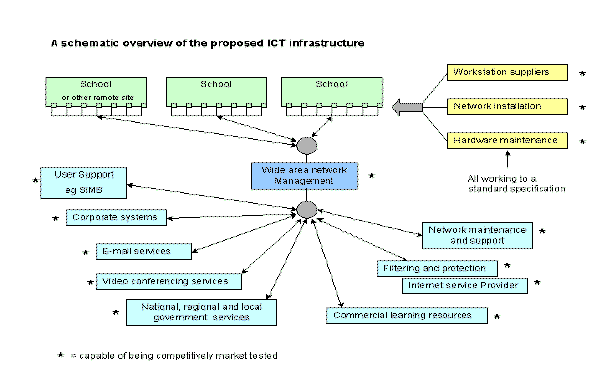
It is recognised that such a model will not be achieved quickly, nor will all managers of educational establishments choose to follow it. By setting a clear direction, Hampshire County Council is:
_ responding to the wishes of the many managers of primary schools who want to reduce the time they spend on ICT infrastructure issues;
_ developing a model that can be adopted at a time appropriate to the establishment, for example when equipment needs replacing, rather than requiring immediate and expensive wholesale change;
_ defining clear boundaries for Hampshire procured support services.
Statement of intent 6: Develop and maintain, in partnership with schools, other educational establishments and suppliers, an ICT infrastructure that is capable of delivering the needs of the whole education service at minimum overall cost. |
Aims: 6.1 Consolidate the use of the Hampshire Public Service Network (HPSN) as the means of inter-connecting all Hampshire education establishments. 6.2 Develop, in partnership with school representatives and commercial suppliers, specifications of a limited number of standard school network configurations. 6.3 Identify a number of commercial suppliers able to supply workstations, install networks and maintain hardware on school sites working to Hampshire Education standards. 6.4 Adjust the work of Hampshire Education ICT Support and Development Services to focus more on the development of standards, provision of independent advice, management of suppliers, systems integration and support for users, and less on hardware installation and maintenance. 6.5 Continue to develop a range of services capable of being delivered via HPSN. |