
Archived decisions

THE ANNUAL REPORT
DEALING WITH THE OPERATION
OF THE
COMPLAINTS PROCEDURE
FOR THE YEAR APRIL 2000 - MARCH 2001
CONTENTS
1. |
Introduction |
Page 1 |
2. |
The Complaints Procedure in Outline |
Page 1 |
3. |
Independent Persons |
Page 4 |
4. |
Training and Preparation |
Page 4 |
5. |
Statistics |
Page 5 |
6. |
Costs |
Page 11 |
7. |
Discussion |
Page 12 |
8. |
Best Value Review |
Page 14 |
8. |
Future Developments |
Page 15 |
1. Introduction
1.1 A complaints procedure is mandatory under the Children Act 1989 and the National Health Service and Community Care Act 1990, and the relevant guidance, directions and regulations. The current complaints procedure for adults and children was introduced in 1991 and last revised on January 1997.
1.2 Under the guidance and regulations referred to above an annual report should be presented to the relevant members' committee of the county council., to include a summary of statistical information and a review of the effectiveness of the procedure.
1.3 During the period covered by this report the Best Value Review of the Complaints Service was undertaken, the outcomes of which are summarised later in this report.
2. The Complaints Procedure in Outline.
2.1 The following Statement of Purpose has been adopted for the complaints section:
"to ensure that users of services and others with a concern about the quality of service provided for an individual have their complaints courteously and efficiently addressed in accordance with a clear published procedure."
2.2 Complainants may be users of our services, whether adults or children, or may be carers, relatives or others acting on their behalf. The informal procedure is flexible and extends to most persons wishing to complain. The formal procedure is available to those who fulfil the criteria as set out in the relevant legislation (primarily those using our services and their parents or carers) and includes recourse to an independent investigation followed if requested by a review panel.
2.3 During the period covered by this report there was a designated Complaints Officer and a halftime Assistant Complaints Officer, providing a direct response to the public on most working days. Both staff were located within the Quality Performance Management Unit and responsible to the Assistant Director, (Performance Management). They were supported by full time clerical assistance. In the absence of both the Complaints Officer and Assistant Complaints Officer, other members of the QPMU have provided cover.
2.4 At the `nformal' stage of the complaints process, every effort is made to resolve complaints, queries, or concerns locally in accordance with the Department of Health guidance. Most complaints received by the Director were passed to the appropriate Area Director to deal with locally ( see 2.5 for exceptions). Any complaint is acknowledged in writing, emphasising the opportunity for conciliation and mediation and a "Tell us what you think: Compliments, Comments and Complaints" booklet is sent. An external conciliator or mediator can be brought in at this stage if it is thought that this would facilitate resolution and avoid escalation.
2.5 During the time covered by this report the complaints officers became more active in managing complaints. Letters or calls coming into the office were filtered before being sent to the areas for a response. By considering each complaint and where possible seeking additional information it was possible to identify a number of communications which should be more appropriately dealt with using a different process. For example, a complaint may come in saying that the individual had not received a visit from a care manager for some time. Letters to the Director from Councillors and Members of Parliament and Central Government concerning possible complaints from the public and passed to the Complaints Officer are counted as complaints. The Director replies after he has received a draft response from the local senior manager.
2.6 The next, and first `formal' stage, enables complainants who are not satisfied with the local response to take their complaint further by having it investigated by an Independent Person. The Independent Person will see the complainant, relevant staff and files as necessary before preparing a report. Any recommendations would be considered seriously by the Department but are not binding. They were responded to by the local Area Director. In practice the Department has accepted the majority of recommendations made by Independent Persons since the procedure's inception in 1991.
2.7 The final and second "formal" stage gives the right to eligible complainants, if they are not satisfied, to be heard by a Review Panel of three people. Usually the Review Panel would comprise an independent chairperson, a Council Member and a member of staff not associated with the complaint The Director would respond to the complainant when he receives the recommendations of the Review Panel and includes a copy of the Ombudsman's leaflet with his reply.
2 Independent Persons
3.1 The department has access to a number of independent people who are willing to carry out investigations and serve on review panels. Independent Persons have been nominated by a range of external organisations, such as Mencap and Age Concern or were members of the Hampshire Panel of Guardian Ad Litems and Reporting Officers.
3.2 The Complaints Officer allocates work to individual Independent Persons, taking into account the situation and the skills and availability of the person.
3.3 During the period covered by this report two Independent Persons were commissioned to carry out a review of the operation of the Independent Person's Panel which produced recommendations relating to the support of Independent Persons and quality assurance systems to ensure high standards of investigation and report writing which were incorporated into the Best Value Review of the Complaints Service.
4. Training and Preparation.
4.1 The complaints procedure is in all staff induction course programmes. There have been four half-day complaints awareness courses for staff and presentations to the "Introduction to Care Management" and Receptionist and Telephonist courses.
4.2 Two courses of two days have been given on Conciliation and Mediation, attended by a range of staff and Independent Persons interested in using this approach to resolving complaints. As the background of those attending this course has changed, the course itself has evolved and was renamed `Effective Complaints Handling' to reflect an emphasis on the use of conciliation at all stages of the procedure rather than being a discrete activity. All these courses are facilitated by the complaints officer and or the assistant complaints officer.
5. Statistics
5.1 The number of complaints as identified in this report is not a reliable measure of the quality of the work of the department. Staff of the department are often performing difficult tasks in times of stress for users and others; such as joint investigations of child abuse; approval of foster or adoptive parents and removal of liberty under mental health legislation.
5.2 Users and carers cam also have unrealistic expectations of what social care workers can achieve. For example, parents who have been unable to get their child to attend school regularly may expect a social worker to be able to `persuade' the child to attend. Or an older person may have an expectation that a home carer will perform domestic tasks. Some complaints can also be regarded more appropriately as requests for help or information than expressions of concern.
5.3 There may also be occasions when social care staff do make mistakes, such as forgetting to return a call or giving out the wrong information. Thus the Department can receive complaints both with good cause and without good cause: individuals have the right to complain whether or not they are in the right. The consequence is that the number of complaints is not necessarily a measure of quality. Indeed, it may indicate the reverse: members and staff enabling individuals to make their voices heard. Complaints can also be seen as a reflection of increased expectations against the background of limited resources.
5.4 During the year April 2000 to March 2001 the Department received 830 complaints, 421 to Headquarters and 409 to the Areas direct. These figures and those of the previous three years are shown in Table 1. Overall there is a increase of 29% compared to a decrease of 20% the previous year. At headquarters there was an increase of 23% (compared to a decrease of 13% the previous year) and in the areas there was an increase of 27% ( compared to a decrease 28% the previous year. )
Table 1. Number of Complaints Over Four Years. | |||||
97- 98 |
98 - 99 |
99 - 00 |
00-01 |
||
Received at HQ |
303 |
412 |
357 |
462 | |
Received in Areas |
274 |
402 |
288 |
368 | |
Total |
577 |
814 |
645 |
830 | |
5.5 This increase in complaints occurred during a period when there was an increase of 2% in the number of referrals to the department. 98% of complaints were resolved locally (compared to 97.2% the previous year). The Formal investigations followed 1 in 4133 referrals or 0.024% (compared to 1 in 3373 referrals or 0.3% the previous year.)
5.6 Table 2 and Figure 1 show how complaints were distributed across areas over three years. There was an increase in complaints in all areas, except for Havant and Petersfield where there was a decrease in both complaints made to headquarters and direct to the area. However, last year this same area was the only area to have an increase in the number of complaints and the decrease this year may just be a reflection of the atypical high number the previous year.
Table 2. Number of Complaints by Area Over Three Years. | |||||||||
1998-1999 |
1999 - 2000 |
2000-2001 | |||||||
Area |
Via HQ |
Area Direct |
Total |
Via HQ |
Area Direct |
Total |
Via HQ |
Area Direct |
Total |
Aldershot/Alton |
52 |
60 |
112 |
56 |
38 |
94 |
94 |
54 |
148 |
Basingstoke |
59 |
105 |
164 |
45 |
44 |
89 |
72 |
97 |
169 |
Eastleigh/Romsey |
41 |
38 |
79 |
40 |
44 |
84 |
48 |
50 |
98 |
Fareham/Gosport |
45 |
56 |
101 |
39 |
41 |
80 |
54 |
59 |
113 |
Havant/Petersfield |
69 |
31 |
100 |
75 |
40 |
115 |
53 |
52 |
105 |
New Forest |
50 |
43 |
93 |
48 |
27 |
75 |
63 |
20 |
83 |
Winchester/Andover |
83 |
69 |
152 |
49 |
54 |
103 |
78 |
28 |
106 |
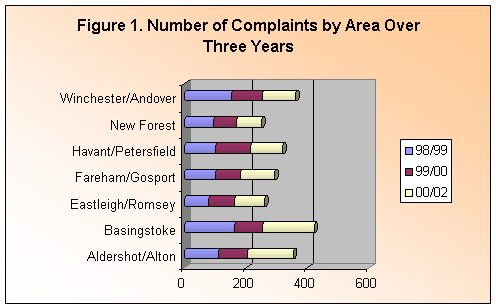
5.7 Figure 2. (below) shows the proportion of complaints from each of the client groups. The largest number of complaints came from the older person's client group, a change from previous years when the greatest proportion has come from children and families. The smallest number of complaints came from the mental health user group (28 in number compared to 30 for children with disabilities). This is consistent with previous years.
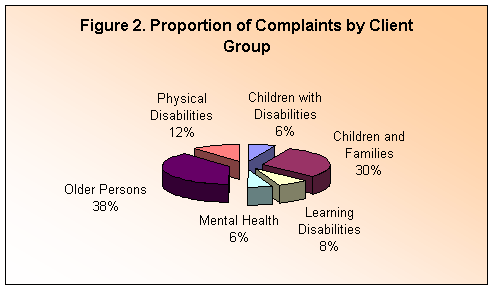
5.8 Table 3. (over) shows the number of complaints by client group over two years and the percentage difference. This shows that there was an increase in all client groups, the greatest being the mental health group.
Table 3. Complaints by Client Group Over Two Years. | |||
Client Group |
1999-00 |
2000-01 |
% Diff |
Children and Families |
266 |
296 |
11% |
Older People |
259 |
311 |
20% |
Learning Disability |
59 |
65 |
10% |
Mental Health |
20 |
49 |
140% |
Physical Disability. |
85 |
97 |
14% |
5.9 Table 4. (below) shows whether the complaint was made by the service user (self) or the relationship between the person making the complaint and the service user. There has been a drop of 5% in complaints directly from service users. The proportion of complaints from parents went up by 3%, as did the proportion of complaints from `others' which includes friends and neighbours.
Table 4. Relationship between the Service User and The Person Making the Complaint. | ||||
|
Number |
% |
% |
|
Self |
208 |
25 (30) |
25 (30) |
|
Parent |
192 |
23 (20) |
49 (50) |
|
Spouse/Partner |
46 |
6 (6) |
||
Son/Daughter |
125 |
15 (12) |
||
Other Relative |
27 |
3 (10) |
||
Foster Parent/Carer |
18 |
2 (2) |
||
MP/Councillor |
98 |
12 (11) |
26 (20) |
|
Other Professional |
52 |
6 (4) |
||
Other |
64 |
8 (5) |
||
Last year's % in brackets |
||||
5.10 Table 5. (over)) gives some examples of complaints which were received during 2000 - 2001 and the outcome.
Table 5. Some Examples of Outcomes. | |
Description |
Outcome |
Foster carer complains about not being reimbursed money owed without substantial delay |
Apology and explanation given, monies paid. |
Daughter complains about delay in assessment for OT equipment |
Explanation of reasons for the delay. . |
Adult son complains about care given to his mother whilst in residential care |
Complaint investigated and son advised of outcome |
An adult friend of a looked after child complained that a letter he had written to her had been opened by the social worker. |
Explanation of department's responsibilities to a looked after child regarded as at risk. |
Orange badge application turned down |
Application reviewed and explanation for refusal given. |
Mother complained of processes followed leading to a child protection conference on her son. |
Explanatory letter sent by Area Director. |
Daughter concerned that her mother is on a waiting list for residential care and feels she should be given a place. |
Explanation that no places currently available in area. |
The needs of a child with disability have not been reassessed since they changed following a stay in hospital. |
Reassessment arranged. |
Letter from MP questioning the level of support being given to a constituent. |
Explanation of amount of care being given and reasons why additional care not possible at that point in time. |
Hospital consultant complains of delay in discharge from hospital owing to lack of funding |
Explanation of funding situation given. |
Husband complains that his wife's carer did not turn up. |
Apology given and number to call if happens again. |
Child complained about being moved from foster care to a children's home. |
Situation reconsidered and alternative plans made. |
Complaint from district councillor regarding monitoring of service users with mental health problems |
Explanation of support given. |
5.11 The majority of complaints are resolved locally. In 2000-2001 there were fifteen reports completed (with a further two `put on hold' at the complainants request or because court proceedings were pending). This is the same number of reports as the previous year, although there was an increase in total number of complaints by 29%. This means that 98.2% of complaints were resolved locally.
5.12 Table 6 (below) gives brief details of the 15 independent investigations completed during the year.
Table 6. Independent Investigations 1999-2000 | |||
Client Group |
Brief Description |
Area |
Outcome |
C&F |
Quality of foster care given to grandchild |
AA |
5 |
C&F |
Support to children |
AA |
5 |
C&F |
Response to a complaint about CP Procedures |
NF |
4 |
C&F |
Social work management of contact arrangements for children on care order. |
HP |
5 |
C&F |
Actions taken following CP concerns expressed by father. |
BA |
5 |
C&F |
Father maintained that department failed to investigate his allegations of abuse by mother. |
NF |
5* |
C&F |
Adoption process |
WA |
4 |
MH |
Quality of social work support and residential contract. |
AA |
2 |
OP |
Complaint about domiciliary carers involvement in injury to service user. |
AA |
2 |
OP |
Funding of residential care |
AA |
1 |
OP - (Res) |
Funding of residential care |
NF |
3 |
LD |
Funding of residential care |
NF |
3 5 |
OP (Res) |
Use of personal monies in residential care. |
AA |
2 |
OP (Res) |
Care of mother following an accident |
WA |
2 |
5.13 The outcome measure is based on the findings of the investigation with 1 being totally in favour of the complainant and 5 being totally in favour of the department.
5.14 As in previous years the highest number of investigations involved children and families. However it is notable that in five of the investigations no complaints were upheld and in the remaining two only a small part of the complaint was upheld.
5.15 There was only one review panel held during the year as compared to 8 the previous year. This panel considered the complaint asterisked in Table 7 and the findings of the Independent person's report were upheld. This complainant was not satisfied with the decision pf the panel and took his concerns to the Local Government Ombudsman. However, the Ombudsman did not agree to carry out any further investigations.
6. Costs
6.1 The complaints section has two budgets, one used primarily for paying the costs of Independent persons and holding Review Panels and the second a compensation budget.
6.2 The average cost of an investigation was £559 during this year, a reduction of £281 on the previous year. The costs ranged from £165 to £1139. Table 7 (below) shows the range of costs.
Table 7 Range of Payments to Independent Persons. | ||||
Up to £500 |
£500 - £1,000 |
£1,000 - 1,5000 |
Over £1,500 | |
1999-00 |
2 |
8 |
4 |
1 |
2000-01 |
6 |
7 |
1 |
0 |
6.3 The one Review Panel held cost £983 which is a much higher cost than the average for the previous year, which was £579. There were two reasons for the relatively high cost of this panel, which only had two Independent Persons., firstly the very large amount of background reading submitted by the complainant and the cost of a neutral venue.
6.4 There was three occasions when the budget was used to pay Independent Persons to work with complainants outside of the formal complaints procedure. One of these involved direct conciliation at the cost of £90. The other two were more complex as in both situations neither complainant qualified as a complainant under the relevant Acts but both felt that they had a genuine grievance with the department. Although conciliation was initially offered both resulted in an investigation and report, at an average cost of £614.
6.5 The `cost' of each formal investigation does not include the hidden costs, which include councillor's (when sitting on Review Panels), staff and complaints officer's time; expenses and administrative costs, including clerical support to take notes of Review Panels.
6.6 These costs are incurred to a certain extent with all complaints, formal or informal. A further and even harder `cost' to measure is that of staff stress when involved in a complaint. A long period of absence from a stress related illness by one member of staff closely involved in a particularly difficult complaint cannot be attributed to coincidence.
7. Discussion
7.1 Interpretation of complaints statistics has to be carried out with caution. An increase in the number of complaints made is not necessarily indicative of a reduction in the quality of service. There are several factors which may have led to this year's increase. The first could simply be that the comparative figures for the preceding year were artificially low, although it is not possible to identify any single reason why this should be so. Compared to the figures for 1998 -1999 the number of complaints is very similar.
7.2 One reason for the increase could be changes made in the recording process. This year saw the first full year of operation of the new complaints database. In order to use the database effectively all `new' communications requiring follow up are logged on the database, even if the `concern' could not be strictly defined as a complaint. An example of this was given earlier in this report, where a `concern' after cursory investigation, was found to be a request for help. Communications are `logged' under four categories, `complaint', `referral', `advice' and `'help' but it is not currently possible to analyse the database on that basis. Staff at both headquarters and in the areas were also encouraged to record all matters which could be construed as complaints as a means of ensuring that workloads could be realistically quantified.
7.3 A further explanation for the increase in the number of complaints could be an increased awareness by service users and their carers of their right to raise concerns, brought about by improvements in the way information about the complaints procedure is communicated. During the year the majority of residential homes for looked after children were visited by the complaints officer to raise the profile of the complaints procedure and to consult with the children as to how the procedure could be made more accessible to them.
7.4 It is, however, possible to identify trends in complaints. Throughout the year the number of complaints which arose in connection with funding were monitored and these reached a peak when stringent measures were having to be taken to ensure that the available budget was used to meet the highest priorities in terms of need. It is also possible to make a connection between the greatest number of complaints being made in the areas where the staff recruitment problems were the most severe.
7.5 Despite the increase in the overall number of complaints there has been no change in the number of formal investigations. This indicates that staff are being more effective in resolving complaints locally using timely and appropriate intervention. There is a lot of anecdotal evidence to suggest that more and more staff are regarding complaints as `problems' to be solved rather than `complaints to be resolved'. For example, a daughter telephoned the complaints office to `complain' that increased care could not be arranged for her father for five days until a funding panel was held. The father was terminally ill and did not want to die in hospital but at home with his family,. The daughter was concerned that he did not have five days to wait. The `problem' of funding the care the father needed was `solved' by the family agreeing to fund a small amount of additional care (which they did not realise they could do) until the panel and the service manager agreed to give the father's additional care the highest priority. This averted what could have been both a very sad and serious complaint.
7.6 When a number of service users were asked, as part of the Best Value Review , why they did not complain, a number said that it was not worth it as it would not make a difference. There is, however, evidence that raising a concern can make a difference. Procedures have been changed in line with recommendations from investigations so that for example, guidance to staff in homes for older people about going with residents to hospital has changed, as has the use of `catalogue' shopping for older people in residential care. Other complaints have highlighted the need for care managers to ensure that contracts for residential care are clearly understood by those concerned.
7.7 The reduction in the number of review panels may be accounted for in several ways. Firstly requests for panel have been carefully scrutinised and there is a greater willingness to `negotiate' with complainants as to whether holding a panel is the most effective way to achieve their desired outcome. Secondly it needs to be recognised that Independent Persons are consistently producing reports of a high standard which are acceptable to the complainant and therefore do not lead to a need for panels. Independent Persons are now routinely clarifying the nature of the complaints and reaching agreement with the complainant on the parameters of the complaint; using evidence based investigation techniques; being very clear about whether or not complaints are upheld and writing realistic recommendations. The complaints officer will also now read all reports before they are distributed in draft form and negotiate changes with the Independent Person if there are ambiguities or a lack of clarity.
7.8 During the year one complainant was refused a Review Panel. This was however, a unique situation in that the complainant was already considered a `vexatious complainant' by the county council and had a history of verbal and physical abuse to staff. He had been convicted of an assault to a social worker. During the course of the investigation the Independent Person was threatened by the complainant, whose complaints were not upheld. The complaints officer made the decision not to hold a panel on the basis of the potential risk to staff, the Independent Person and the Panel. The Local Government Ombudsman ruled that the decision was a reasonable one to make.
8. The Best Value Review of the Complaints Service
8.1 The Best Value Review of the Complaints Service was carried out during the year covered in this report. The review recommended a number of changes to the complaints service which will enable the service to build upon the start already made in using the information gained from user feedback in the form of complaints to improve practice.
8.2 In order to maximise the potential of the service to effect change it was recommended that the range of the service be expanded to include the management of other forms of organisational learning, including formal inquiries and `Speak Out'.
8.3 The review also recognised the role and value of the panel of Independent Persons and made recommendations about the support and development of Independent Persons and the need to develop quality standards and guidelines for reports.
9. Future Developments
9.1 A further recommendation of the Best Value Review was the development of clear objectives for the service and such objectives will need to be built into a revision of the complaints procedure. There has been no new information from the Department of Health about revisions to national guidelines although as statutory agencies work more and more in partnership there needs to be a greater congruence in complaints procedures across agencies.
9.2 The small decrease in complaints direct from service users, rather than their carers or advocates is disappointing and highlights the need for continued efforts to increase the accessibility of the process to all service users, whatever their abilities, age, race or cultural background. .
9.3 The key development over the next year will, however be the implementation of the recommendations of the Best Value Review.