Archived decisions
Hampshire County Council
Executive Member, Policy & Resources Item 10
11 April 2002
Corporate Risk Assessment for the Built Estate - Update
Report by the Director of Property, Business and Regulatory Services
Contact: Mike Fitch Ext: 7846
Paula Crompton Ext: 5454
1. Summary
1.1 The following decisions are sought:
1. That approval be given to the current review of risks affecting the Built Estate and the achievements made
2. Progress with tackling hot surface safety be noted and that further work be implemented as resources are made available and priorities assessed.
3. Work to raise the premises health and safety awareness amongst local managers be endorsed and the proposals to establish property health and safety audits with local managers be agreed subject to the arrangements being agreed with CMT.
4. The proposal to develop programmes of electrical safety be worked up for inclusion, where appropriate in future Landlord programmes.
2. Reason
2.1 To ensure that buildings are safe to occupy and that the County Council as
landlord, has a means to tackle health and safety improvements and guide
future investment decisions.
3. Other options considered and rejected
3.1 None.
4. Conflicts of interest declared by the decision-maker or a member for
officer consulted
4.1 Not applicable
5. Dispensation granted by the Standards Committee
5.1 Not applicable
6. Reason(s) for the matter being deal with if urgent
6.1 Not applicable
Approved by: ..................................... Date of decision: ...................
Councillor T K Thornber
EMP&R0402R
Contact: Mike Fitch Ext: 7846
Paula Crompton Ext: 5454
1. Introduction
1.1 This reports updates the Executive Member on the progress with the implementation of the corporate risk assessment and associated improvement plans. The report highlights the need for a partnership approach with other Council departments to manage many of the corporate risks.
2. Background Information
2.1 Established in 1998, the annual Corporate Risk Assessment (CRA) for the Built Estate was approved by the Executive Member for P & R on 12 December 2001. The CRA focuses on the objectives identified in the Strategy for the Built Estate. Its principle purpose is to ensure that buildings are safe to occupy and that the County Council as landlord, has a means to tackle health and safety improvement and guide future investment decisions.
2.2 A summary from the Corporate Risk Assessment approved in December 2001 is attached as Appendix 1, together with a summary of the key actions for the current year as appendix 2.
2.3 The Corporate Risk Assessment is reviewed annually to measure progress, review investment programmes, legislative changes, serious incidents and experience through the year. The activities categorised as "high risk" will move down the list, following implementation of risk controls. The report provides a commentary on the proposed action in relation to the highest risks, and assesses the impact on departments and services.
3. CRA Progress
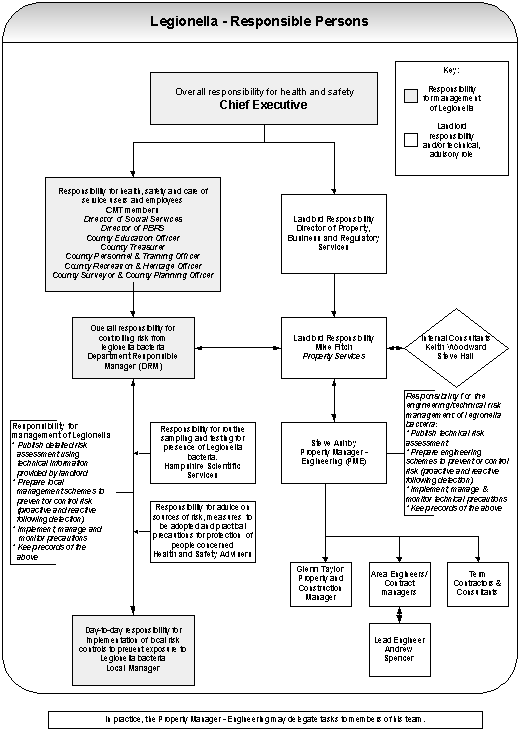
3.1 Investment in health and safety improvements, funded through capital and revenue repairs programmes and proactive maintenance regimes are illustrated in appendix 2. The main achievements so far this year are the publication of revised management arrangements for Legionella in respect of a New Code of Practice recently issued by the Health and Safety Commission and a review of Fire Precautions associated with Social Services core business strategy to cater for more highly dependent elderly persons. A report to a future meeting of the Executive Member, Policy and Resources will be prepared detailing the outcomes and implications of the fire precaution surveys. Both these initiatives will help inform strategic decisions on older person service provision. It is proposed that the framework for Legionella risk management will be adapted and implemented for the remaining corporate risks. A copy of the framework is attached for information at Appendix 3. Using this framework the legionella testing regimes will be developed and a further report prepared on risk controls.
3.2 Control of Contractors:
Local delegation of budgets has transferred some of the highest corporate risks associated with contractors to local managers who may not be fully conversant with best practice requirements. The Department also raises a large number of reactive orders in response to breakdowns, and relies very much on the local manager to safely induct small works contractors onto site. Minimal investment can potentially return a marked improvement in corporate performance if local managers discharge their day-to-day responsibilities for managing sites and buildings. Following the meeting on 12 December 2001, it is now proposed to introduce a Risk Management tool to enable local managers to agree with contractors a safe site/working practice for managing small works. The Risk Management tool is in draft form and the next steps will be to engage local managers in this development and introduction as an aid to help manage contractors safely at a local level.
3.3 Hot Surface Protection:
The report last December indicated that further phases of hot surface safety work were planned in Special schools, Nursery schools and for other Social Services premises such as children's homes and Family centres. The survey of Special Education Schools is nearing completion. The survey will identify the extent of unguarded hot surfaces and this technical information will be used to feed into the Education Department's risk assessments, following the framework referred to in 3.1 above.
Following the scalding incidents at Pier House in 1999 and Green Meadows in 2001, HSE have served a summons on Hampshire County Council for a criminal offence under the Health and Safety at Work act 1974. Namely that the Council failed to manage their residential homes to protect elderly residents from risk to their health and safety. Pending the final wording of the summons which is subject of legal argument, the Council will decide on the plea, and the case will be heard at Aldershot Magistrates Court.
3.4 Electrical Safety:
Many of the electrical systems within buildings are the original installations and close to the end of their design life. Systems are at, or near, capacity as a result of the installation of site developments and new IT infrastructures, especially at schools. Since the last Corporate Risk Assessment report a review of the electrical test and inspection reports have been carried out and the main areas of concern are:
· Obsolete mains electrical switchgear
· Worn out lighting units
· Inadequate earth bonding
An opportunity new exists with the new NDS Condition Fund to begin to establish an electrical safety programme which will make real progress at reducing the risk associated with existing systems. Such programmes should be seen as long term, over the next 5 to 10 years.
3.5 Asbestos:
HSE have deferred the launch of the new regulations from June to October 2002, following issues raised during the consultation which require serious consideration and action. For example, employers highlighted that the definition of duty holder would encourage confusion particularly for leased premises and property management agents. Until the requirements of the new duties are known, it is foreseeable that little progress can be made to improve our asbestos management arrangements, leaving time and resources to manage other corporate risks.
3.6 Other high priority corporate risks:
These include gas safety, temporary buildings, fire precautions and contractor small projects. Within existing resources, limited progress has been made in these areas during the past three months. A review of the current action plan has identified the need to review these activities in the medium to long term.
4. Local Risk Management:
4.1 Initiatives with schools:
A health and safety audit tool has been developed to assist head teachers with their wide ranging health and safety management responsibilities with a focus on property related hazards. Launched in February 2002, the programme for secondary schools is scheduled for completion in April 2003. A self- assessment audit tool is under development to provide primary head teachers with a framework to assess health and safety performance. Assuming the pilot programme is successful, the service will be launched in 2003. This service has received overwhelming support from secondary and primary school head teachers.
4.2 Local Premises Management Initiatives:
Consultants have been instructed to develop "Managing Premises Safely Campaign" to assist the Council to raise awareness of local responsibilities and support local managers to appoint and induct contractor onto their sites. The principles need to be agreed with CMT.
5. Conclusions
5.1 The Corporate Risk Assessment enables assessment of competing priorities and provides a guide to the highest priorities for health and safety investment. Financial investment alone will not eliminate the risks, and so they must be controlled with available resources and involvement of local managers wherever possible.
5.2 While much has been done by the County Council in relation to health and safety, particularly in relation to the Built Estate, the scale, function, age and liabilities associated with the estate suggests that health and safety management of the estate remains a long term strategy.
5.3 In the short term, the following activities should be kept under review:
· Control of contractors and development of Risk Management tool for local managers as item 3.2
· Hot surface protection
· Electrical safety
· Legionella Management*
· Fire Safety in Residential Premises
5.4 While in the medium term programme of risk assessment and management need to be developed for :
· Fire prevention, management and risk
· Local risk/premises management
· Asbestos management*
* the action plans have been adjusted for these risks as outlined in sections 3.1 & 3.5.
6. Recommendations
5. That the current review of risks affecting the Built Estate and the achievement made be approved.
6. That progress with tackling hot surface safety be noted and that further work be implemented as resources are made available and priorities assessed.
7. That a further report following the review of fire precautions in Elderly Persons' Homes, highlighting the building and financial implications, be submitted to a future meeting of the Executive Member, Policy and Resources.
8. That work to raise the premises health and safety awareness amongst local managers be endorsed and the proposals to establish property health and safety audits with local managers be agreed subject to the arrangements being agreed with CMT.
9. That the proposal to develop programmes of electrical safety be worked up for inclusion, where appropriate in future Landlord programme.
Section 100D - Local Government Act 1972 - Background Papers:
The following documents disclose facts or matters on which this report, or an important part of it, is based and has been relied upon to a material extent in the preparation of this report.
NB the list excludes:
1. Published works.
2. Documents which disclose exempt or confidential information as defined in the Act.
File Location
None.
EMP&R0402R
APPENDIX 1 | ||
CORPORATE RISK ASSESSMENT FROM THE BUILT ESTATE RISK PRIORITY ORDER - 2002/2003 | ||
Priority |
Area of Risk |
Risk Category |
2001/2 | ||
1 |
Control of contractors (small works) |
High |
1 |
Fire in residential homes |
High |
1 |
Fire in daytime use premises |
High |
1 |
Legionella |
High |
1 |
Asbestos identification and management |
High |
1 |
Gas Regulations |
High |
1 |
Control of contractors (large projects) |
High |
1 |
Temporary buildings |
High |
2 |
Structural Collapse |
Medium |
2 |
Heating surfaces high temperature management |
Medium |
2 |
Hot water management |
Medium |
2 |
Passenger lifts |
Medium |
2 |
Condition assessment of buildings |
Medium |
2 |
Grounds maintenance |
Medium |
2 |
Electrical services (fixed equipment) |
Medium |
2 |
Plant/pressure testing |
Medium |
2 |
Swimming pools |
Medium |
3 |
Fire Access |
Low |
3 |
Mature trees |
Low |
3 |
Electrical (portable equipment) |
Low |
3 |
Window safety |
Low |
3 |
Oil Pollution |
Low |
3 |
Glazing |
Low |
APPENDIX 2
Summary Of Risk Management Controls For The Built Estate
Area of risk |
Controls to manage risk |
Action Plan 2002/3 |
Control of contractors |
_ Implement the revised Approved List of Contractors _ Staff training and development _ Procedures for monitoring and inspecting on-site _ Establish CDM operating procedures _ Assessment of contractor performance _ Monitoring systems to check that staff follow the procedures |
_ Investigate passport to work systems. _ Identify further improvements to the systems |
Fire precautions residential properties |
_ Assist other departments to carry out their fire risk assessments and ensure that they are acted upon _ Ensure that fire alarms are maintained adequately. |
_ Appoint a fire safety manager to support customers and monitor risk management arrangements. |
Fire precautions daytime premises | ||
Legionella |
_ Implement risk screening for all properties. _ Provide training for engineers _ Monitor effectiveness of risk controls for high risk premises _ Improve systems for compliance with new ACoP _ Commence data-logging / engineering surveys where risk assessment suggests it is necessary. |
_ Publish new management arrangements _ Identify further improvements to the systems _ Reduce detection of Legionella bacteria. _ Revise the sampling programme to ensure compliance with best practise. |
Area of risk |
Controls to manage risk |
Action Plan 2002/3 |
Asbestos |
_ Maintain the current asbestos register _ Continue to improve quality of asbestos register through second stage surveys for significant projects _ Monitor the performance of asbestos removal companies and provide testing thorough HSS |
_ Appoint an Asbestos safety Co-ordinator to support technical staff and customers, and monitor risk management arrangements. _ Launch an awareness campaign for local managers to ensure greater understanding of the asbestos register and its use. _ Commence planned programme of stage 2 asbestos surveys. _ Reduce the number of locations of asbestos containing material, prone to disturbance _ Launch asbestos register using IT systems to ensure information is accessible and up to date for building users and contractors in occupied premises. |
Gas safety |
_ through new term contracts, monitor the regular servicing of plant and appliances and flues _ complete the upgrading of gas schematics _ ensure that all tenants have an up to date gas certificate. |
_ Monitor performance of term contractor to identify further improvement to management systems |
Control of contractors - small works |
_ See section on control of contractors for large projects. |
_ involve local premises managers through CMT _ set up an awareness campaign |
Temporary Buildings |
_ Continue regular inspections _ Ensure high risk work is acted upon _ use capital programme to reduce the numbers of old temporary buildings |
_ Monitor performance using implementation programme to identify further improvement to management systems |
Appendix 3
Control of Legionella Bacteria - Strategic Position Statement
Introduction
The HSE have published a reference document "Legionnaires' Disease - The control of legionella bacteria in water systems" known as L8. It provides practical advice on how to comply with the law. The County Council has developed an framework (attached to this document) to ensure that it complies with L8. Implementing the framework will demonstrate effective management of legionella and compliance with L8. This will protect the Council from prosecution, but more importantly, reduce the chance of any persons (associated with our undertaking) from contracting Legionnaire's Disease.
Key tasks for the Council include:
1. Identify and assess the risk
2. Prepare a scheme for preventing and controlling risk
3. Implement manage and monitor precautions
4. Keep records of actions
5. Appoint a person to be managerially responsible.
Purpose
The purpose of this framework is to identify, implement and assess the reasonably practicable steps for managers and staff to follow in the management of legionella. While recognising the lead responsibility lies with the senior managers for the services, this framework sets out the responsibility of the Landlord and the engineering tasks to be undertaken.
Implementation of the framework should be reviewed quarterly by the Head of Property Management and annually by the department's Health and Safety Executive Group.
Summary
Property, Business and Regulatory Services as the landlord for the Built Estate, has a key role in the management and control of legionella bacteria on behalf of their customers. The role of departmental and local managers in partnership with the landlord is defined in this paper.
A chart indicating the "responsible persons" is attached for information. The key tasks to carried out by nominated managers are defined in the attached framework.
Implementation Plan
Stage 1: Assessment of case history and current practise against the framework recognised by L8 for compliance. This will include:
· Bench marking exercise against L8
· Assessment of test results and history
· Review of documentation and current action plans
· Monitoring arrangements
· Formal communication channels
· Overall assessment of performance/compliance (using traffic light system)
Stage 2: Areas for development to improve compliance with L8, identify resources and priorities for implementation. This will include:
· Identification of actions
· Assessment of risk
· Bids for resources to implement improvements
· Using internal and external expertise to seek a second opinion
· Preparation of documentation eg assessments, scale drawings of plant etc.
· Implementation of action plan
Stage 3: Review and monitoring to maintain compliance with L8
· Review of action plan
· Reassessment of risk and compliance
· Identification of additional actions to improve performance
· Implementation of revised action plan
EMP&R0402R