Archived decisions
Hampshire County Council Education Policy Review Committee 21 May 2002 Consultation on Proposed Schools Forum Report of the County Education Officer |
Item 11 |
Contact: Roger Mead, Assistant County Education Officer, Resources and Planning Branch
PLEASE NOTE: The report is prepared using the latest draft consultation paper as the DfES website. The final version may therefore differ from the text included in this draft. |
1. Summary
1.1 The Department for Education and Skills published on 15 May 2002 a consultation paper on Schools Forums, addressing issues of the membership, proceedings, expenses and functions of the Forums. Responses to the consultation are invited by 28 June and will inform the Regulations and Guidance to be issued to local education authorities in late July 2002 prior to the commencement of the forums from the 31st October 2002.
1.2 The Schools Forum will be an important element influencing the new arrangements for funding education services from April 2003. The function of a schools forum is to advise the County Council, as local education authority, on matters relating to the schools budget. The forum will be made up mainly of representatives of headteachers and Governing Bodies of primary, secondary and special schools. In addition there is facility for non-school members to represent relevant organisations.
1.3 This report sets out the questions in the Consultation paper and offers a response for members to consider. In addition to consultation with the Education PRC this report will be shared with representatives of head teachers, governors and other bodies to facilitate the process establishing a Schools Forum in Hampshire and to enable as full a consultation locally as possible prior to a report being presented to the Executive Member for Education within the deadline set by the Department for Education and Skills.
2. Background
2.1 The Education Bill 2001, currently before Parliament, will require local
education authorities to establish Schools Forums under Clause 41.
The Schools Forum will be a non executive body making recommendations to the County Council. The Government intends that the Schools Forum should be operational by the end of October so that it can influence the setting of budgets for 2003/04 - the planned first year of the new funding system for LEAs.
2.2 The County Council has successful consultation arrangements in place covering the activities falling within the remit of the Schools Forum. The LEA OFSTED recognised the process as very effective and the Local Government Association acknowledged it as good practice. In several respects the working of the proposed Schools Forum will mirror current arrangements. However, the over prescription of the process proposed will remove local flexibility. This has been a strength of the arrangements in Hampshire.
2.3 The Schools Forum will replace some of the existing consultative groups e.g. the headteacher and officer groups that consider the local management in schools scheme and formula and the strategy and operation of Standards Fund allocations. It is suggested that management partnership service review groups will be retained to ensure the ongoing continuous improvement of support services since changes arising do not always impact upon the funding arrangements.
3. Schools Forum
This section of the report sets out in full the DfES Consultation document. Where the consultation asks a question, a draft of the county council's proposed response has been inserted for comment.
A copy of the Consultation paper with the attachments explaining the Statutory basis and proposed amendments to Statute are available in the Members Room and accessible through the DfES Web site as follows:-http:\www.dfes.gov.uk
" The Consultation Document
Membership
3.1 The Draft regulations set the broad parameters for membership of
the forums. They would still leave LEAs with a degree of flexibility as to membership, especially insofar as non-schools members are concerned.
3.2 The first issue dealt with in the regulations is the size of the forum. Because there is a very large variation in size of local education authority, the ideal size will also vary considerably. The draft regulations would establish a minimum size of 12 members. Even in very small authorities, a lower number than this would produce too narrow a representation. A maximum size is also specified, on a two step basis, using a formula related to the number of pupils in the LEA's schools in January 2002 (obtained by dividing total pupil numbers by 2,000) but subject to an absolute maximum of 50 members. For a medium sized authority, the formula will yield a maximum size of around 36 members. LEAs will however be able to have smaller total forum memberships if they wish.
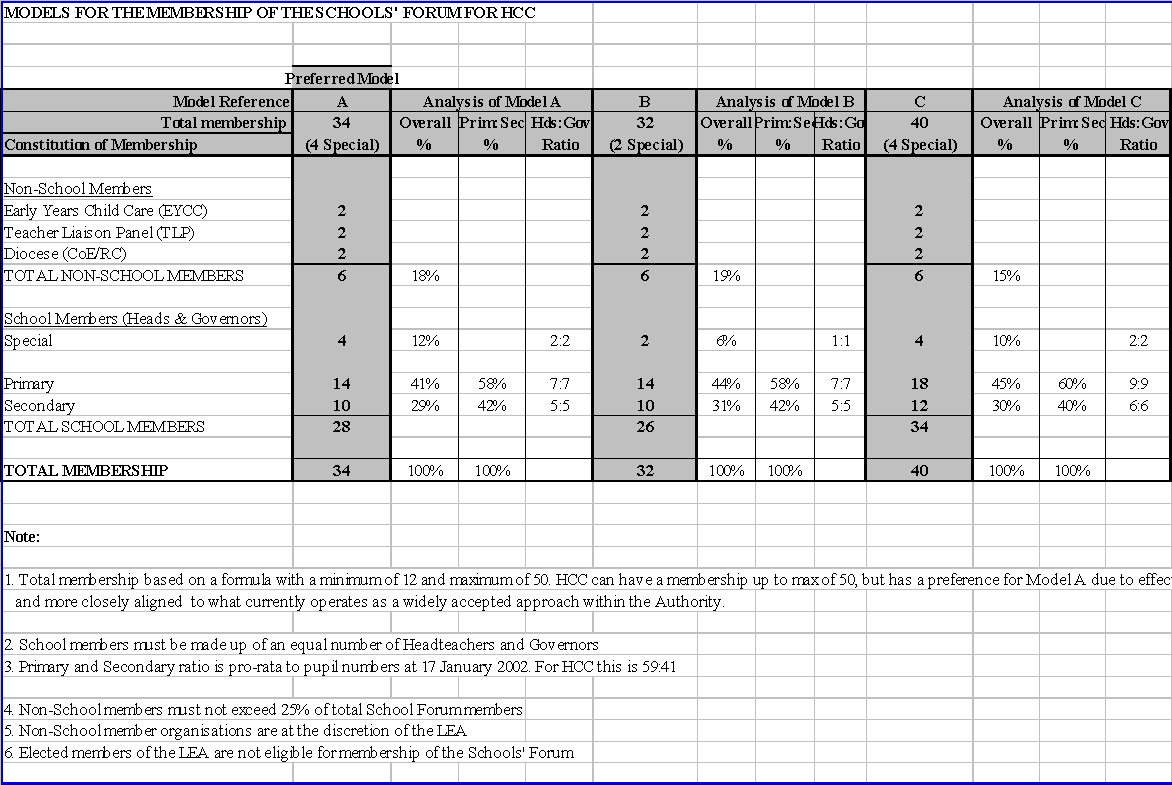
Consultation Question 1: Are the rules set out in the draft regulations for minimum and maximum forum size satisfactory? Hampshire County Council consulted with headteachers and governor conferences, Teacher Liaison Panel and Diocesan Education Authorities in preparing this response. Whilst acknowledging the need for a minimum and maximum forum size it is vital that LEAs are able to have smaller forum where agreed with partners locally. For example Hampshire is one of the largest LEAs in the country with over 170,000 pupils and is considering a schools forum of 34 comprising 6 non school members and 28 school members. For consultation purposes with partners in Hampshire prior to finalising the County Council's response four models are offered (see Appendix 1). The models vary from a minimum of 32 to a maximum of 50. |
3.3 The primary legislation provides for forums to have `schools members' representing schools and `non-schools members' representing other bodies. It will be for each LEA to decide whether to allocate places to non-schools members, and if so, how many, subject to a maximum proportion of 25% of the total. More detailed issues relating to non-schools members are dealt with below.
Consultation Question 2: is 25% an appropriate maximum proportion for non school member representation? Yes |
3.4 Another general provision in the draft regulations relates to elected members of LEAs. Ministers propose that such members should not be eligible for places on forums, whether as schools members or non-schools members. Although existing local consultative bodies sometimes have LEA councillors in membership, Ministers believe that on balance the role of schools forums is best preserved by keeping a distinct separation between them and the LEA. Such a separation is in the interests of the LEA as well as schools. However, persons who are elected members of other councils (including other LEAs) would be eligible for membership.
Consultation Question 3: Do you agree that elected members of the relevant LEA should not be eligible for membership for the schools forum? Agree that elected members should not be eligible for membership but key elected members will need to attend Forum meetings to receive recommendations on the Forward year's budget. |
3.5 LEAs would be able to end appointments of any member who ceased to hold the office by virtue of which he or she became eligible for appointment. This would arise if a headteacher ceased to be a head in that LEA; if a governor ceased to be a school governor of a school of the relevant category; or if a non-schools member ceased to work for or belong to the organisation which nominated him or her. The LEA would be able to make replacements under the appropriate procedure for that type of member. The general question of reappointments is not dealt with in this consultation paper but Ministers do not intend to bar reappointments to forums.
3.6 It should be borne in mind that the Secretary of State will have power to make Regulations specifying the memberships of particular LEA's schools forum if she concludes that the LEA has not made satisfactory arrangements for membership. It is not envisaged that it will be necessary to use this power; but it exists. In the autumn of 2002 the Department will be seeking for each LEA required to establish a schools forum, a report on the outcome of the establishment and membership appointment process.
3.7 Schools members would be appointed following elections in the following voter groups:
a. governing bodies of primary schools;
b. governing bodies of secondary schools;
c. headteachers of primary schools;
d. headteachers of secondary schools;
e. governing bodies and headteachers of special schools
Members representing these groups would be elected by the relevant constituents in each group: that is to say all primary school governing bodies for the first group, and so on. For this purpose the governing body of each school is the elector, not individual governors. There is a combined group for special schools.
3.8 Each `constituent' would have only one vote. Although it could be argued that
each should have as many votes as there are places allocated to the groups concerned (so as to obviate the risk that some places will be unfilled, or members elected only on their own vote), Ministers take the view that taking such a course risks `slates' of members being elected, increasing the risk of domination of membership by certain groups of schools.
Consultation Question 4: Should electing headteachers and governing bodies have one vote or as many votes as there are places for the relevant category? There are two elements to this question. Para 3.7 refers to the process by which school members would be appointed. As Hampshire has 437 primary schools, 71 secondary schools and 31 special schools with mature arrangements for electing representative headteacher and governors to existing consultative bodies the County Council has consulted with these groups and others, including Teachers Liaison Panel and Diocese. Unanimously they wish to retain that process for selection to the Schools Forum compared to an arrangement that requires every school to be involved in a formal selection process. The individual headteacher and governor conferences and other groups organise the existing arrangements to the satisfaction of their membership and that arrangement should be allowed to continue. |
3.9 In determining the number of places for the various groups the starting point would be the number of special schools maintained by the LEA: if there are between one and six such schools there would be one special school place; if more than six special schools, two such places. If there is no special school maintained by the LEA there would be no such place.
Consultation Question 5: Is proposed special school representation adequate? Hampshire proposes that for LEAs with more than six special schools representation should be a minimum of two such places. Hampshire's preferred model proposes four special school members (two heads and two governors) representing 31 special schools. |
3.10 It is proposed that the remaining number of school places (which will depend on decisions to be taken by the LEA on total size of the forum and the non-schools membership) should then be divided between primary and secondary phases according to the numbers of pupils in each phase on 17 January 2002, and the resultant numbers of places in each phase split equally between governing bodies and headteachers.
3.11 It may be that although school category does not greatly affect funding levels, an LEA would wish to further sub-divide places according to category of school (community, voluntary and foundation), and the regulations permit this, although some LEAs with small forums may find it impracticable. Other detailed arrangements for election of school members are for each LEA to decide according to their own circumstances.
Consultation Question 6: Are the proposed arrangements for allocating places between phases and `constituencies' satisfactory? The proposed arrangements are satisfactory. The County Council has no wish to see prescription to further sub divide places according to category of school (community, voluntary and foundation). A real concern lies with the need to achieve governor representation. The preferred model of 34 will need 14 governors, the maximum model of 50 will require 22 governors. The current demands on time of school governors is already having an impact on the recruitment and retention of new governors. Whilst it is vital that governors are involved in the consultations process securing 22 may be unrealistic An alternative would be to allow additional headteacher representation where governors were unable to recruit to their full quota. |
3.12 It is proposed that the term of office for schools members should be two, three or four years. All school members would have to be appointed for the same period.
3.13 Although it is envisaged that most schools forums will have non-schools members, there will be no obligation on LEAs to arrange for this. As noted above the maximum proportion of such members is proposed to be 25% of the total. It is envisaged by Ministers that amongst the organisations which would commonly be represented are trades unions; diocesan education authorities, and the local Learning and Skills Council. The local LSC would be entitled to claim observer status if it does not have `non-school' membership; Ministers believe that it is essential for the LSC's role in sixth form organisation in funding that it is aware of local school funding issues. The LEA might well wish to appoint an early years partnership representative as a non-schools member.
3.14 The proposed method for selecting such members is that the LEA will decide which organisations it wishes to fill the places, and seek nominations from those bodies. If the LEA does not find a person nominated acceptable it may tell the organisation concerned why that is so and seek an alternative nomination from the same body.
3.15 Under the draft regulations, LEAs would be required to give their schools details of non-schools members appointed to the forum. The Secretary of State proposes to reserve power within the regulations to require an LEA to end the appointment of particular non-schools members if she receives a complaint which leads her to conclude that the organisation concerned should not be represented on that forum. The Secretary of State would expect to use this power only in exceptional circumstances.
3.16 LEAs would be able to appoint non-schools members for initial periods of two, three or four years; these would not necessarily be for the same length for all such members.
Consultation Question 7: Are the proposed arrangements for non-schools members satisfactory? Hampshire's model would have non school members from the Early Years and Child Care community, the Teachers Liaison panel (representing teacher associations) and the Diocese Education Authorities. We assume the Forum would be able to identify other groups if they so wished up to the maximum permitted. |
3.17 It has been suggested that Parent Governor Representatives elected in accordance with Section 9 of the School Standards and Framework Act should be eligible for nomination. This could have the effect of enhancing their representative role. On the other hand it sits somewhat uneasily with the bar on elected members of the LEA being forum members; and some parent governors may well be elected anyway as schools members. Ministers would welcome views on this issue.
(The Department is still clarifying the legal basis of PGR membership of Forums. This section of the consultation paper is liable to change).
Consultation Question 8: Should Parent Governor Representatives be eligible for nomination as non schools-members? No. |
Proceeding of forums
3.18 The Government's starting point is that although regulations may set out requirements as to the proceedings of forums, there should be as much local discretion as possible, both for the LEA and for the forum itself.
3.19 The draft regulations at Annex A would therefore establish only very basic requirements. The first of these is a requirement as to the number of meetings to be held each year. No upper limit is proposed but there is a requirement that from their inception on 31 October 2002 until 31 March they should meet twice; and three times a year thereafter.
Consultation Question 9: Is three times a year an appropriate minimum requirement for the number of meetings for forums? It is questionable whether there is a need to define an appropriate minimum requirement but if one is needed then two would be appropriate. |
3.20 The second requirement relates to quorums. The draft regulations require that one half of the membership be present if the forum is to be quorate. This is a relatively high proportion, reflecting the importance of a collective view on the issues involved.
Consultation Question 10: Is a 50% quorum requirement appropriate? 50% quorum requirement seems high given the non executive nature of the forum. It is proposed that a 30% quorum is sufficient. |
3.21 Each forum would be required to elect its own chair, at inception and on an annual basis.
3.22 Guidance to be issued by DfES will cover other procedural matters, but the general expectation is that the LEA will draw up draft procedures to be adopted by its forum after discussion within the forum. The draft regulations are deliberately silent on issues of procedure such as opening meeting to the public, voting and decision-taking. Ministers believe that it is inappropriate for detailed central prescription on such matters, but intend that the guidance document will cover all these topics and other suggested in the consultation exercise.
Consultation Question 11: Are there any further procedural matters which should be dealt with in (a) regulations or (b) guidance? The only procedural matter which should be included is the opportunity for access to the forum by elected members especially the Executive Member for Education or the Scrutiny Committee Chair. Hampshire's current successful consultation arrangements on the budget for the forward year include two formal opportunities (one in December, one in January) for representatives of headteacher and governor conferences and TLP to present to the Executive Member their preferred budget strategy for the following financial year. This arrangement is vital to effective openness and communication, was acknowledged as good practice within the recent LEA OFSTED and continues to be recognised by all partners as a major contributor to strategic planning. |
3.23 The local Learning and Skills Council may be asked to nominate a non-schools member. If it is not, however, it will be entitled to nominate an observer to attend all meetings of the forum.
3.24 The LEA would be responsible for appointing a clerk. The duties of the clerk would include arrangements for meetings, recording meetings and general co-ordination between the forum, its chair and the LEA. Although not legally necessary, it would normally be the case that the clerk would be an LEA employee. Other access by LEA officers to meetings of the forum would be a matter for the chair of the forum to determine.
Expenses
3.25 Schools Forums will not be cost-free, and regulations may make provisions as to the expenses which arise in operating them. There is also the question of expenses payable to members of forums.
3.26 The initial set up and operating costs of forums in 2002/03 will be retainable by LEAs as a central item within the Local Schools Budget (LSB), and the Financing of Maintained Schools Regulations have been amended to permit this. From 2003/04, under the planned changes to LEA and school funding, the LSB will no longer exist and education costs will be met from either the Schools Budget or the LEA Budget of each authority. The first issue which arises is whether operating costs (including members' expenses) should be charged to the Schools Budget or to the LEA Budget. The main argument for the latter is that the forum is connected with the role of the LEA in budget management, and the overhead costs of that function are met from the LEA budget. It is also argued that the forum should not be a charge on schools because it reduces the funding available for pupils.
3.27 The arguments for charging costs to the Schools Budget are first, that it is right that schools should see the forums as theirs and that the scale of its activities, by impacting directly on schools, will be the concern of schools. Secondly, charging costs to the Schools Budget will remove any incentive for the LEA to starve the forum of necessary funding because reducing forum costs would produce no increase in resources available for LEA activities. As to the impact on pupils, the cost in an average sized LEAs would make no significant difference to the amount of funding per pupil.
3.28 The Government believes that the balance of advantage is for operational expenses to be charged to the Schools Budget and the draft Regulations are based on this approach.
Consultation Question 12: Do you agree that operating costs of the schools forum should be chargeable to the authority's Schools Budget? Yes. It is assumed that the cost of the operational expenses of the Schools Forum will be a first charge on the schools budget, agreed by the Schools Forum and not requiring consultation with all schools. Accountability will follow with the Annual Report from the Schools Forum which will include operating costs. |
3.29 The draft regulations also provide for the LEA to produce by 30 June each year two statements, one showing the cost of servicing the forum, which may be construed as the cost of the forum discharging its functions under the regulations as required by the LEA, and the other showing the cost of any additional work which the forum itself may initiate. The regulations do not prescribe the format or level of detail necessary for these statements.
Consultation Question 13: Do you think that there should be more specific requirements on LEAs to provide data on costs? No. |
3.30 The draft regulations provide that the LEA shall pay reasonable expenses for forum members. This would apply to both school and non-school members. It would be for the LEA to decide what expenses were reasonable, but the DfES guidance document is likely to indicate the general approach to be taken by LEAs.
Consultation Question 14: What should the guidance document to be issued by the DfES say about members' expenses? Members expenses should allow reimbursement of travel costs only. For headteachers supply cover costs should also be reimbursed where incurred. |
Functions
3.31 The Government believes that forums have an important role in helping LEAs manage the Schools Budget. However, their statutory role needs to be circumscribed: a forum should be a genuine conduit for schools' views, not an alternative power base which undermines the LEA's democratic mandate.
3.32 With this in mind, the Government intends that Regulations will stipulate four main functions for forums. However, LEAs will also be able to use them for other purposes; and the forums themselves will be able to initiate work on school funding.
3.33 The first of the four functions that will be required under regulations is to be consulted on changes to the LEA school funding formula. This is not a substitute for the statutory right of governing bodies and headteachers to be consulted on an individual basis - a right which will continue. Rather, it is intended to ensure that LEAs develop these changes in full knowledge of the forum's views on the best overall approach to the funding formula. Any LEAs funding formula has to make certain compromises between different priorities and pressures, and the forum is an ideal body to alert the LEA to those issues. Although the draft regulations are written in terms similar to those requiring consultation with individual schools, it is not axiomatic that consultation should take place with the forum at exactly the same time as that with individual schools. Indeed, there would often be advantage in earlier consultation.
3.34 Unlike the required consultation with individual schools, consultation on the formula with the forum would include proposed changes to the relative amounts of money applied to particular factors in the formula as well as changes in methodology, criteria, weightings, etc. `Consultation' does not imply any right of veto for the forum: but the LEA would be obliged to take account of its views in deciding whether to implement changes.
Consultation Question 15: Do you agree that consultation on the LEA school funding formula should be a required function of the forum? Yes. |
3.35 The second proposed function for forums is to be consulted annually on issues relating to the management of the Schools Budget. This is to allow the forum to influence LEA policy on these matters. The list included in the draft regulations is:
a) the arrangements to be made for the education on pupils with statements of special education need;
b) arrangements for the use of pupil referral units and the education of
children otherwise than at school;
c) arrangements for insurance;
d) prospective revisions to the relevant authority's scheme for the
financing of schools;
e) administrative arrangements for the allocation of central government
grants paid to schools via the relevant authority;
f) arrangements for free school meals.
3.36 All of these either affect maintained schools directly, or indirectly through
their impact on the School Budget. PRUs are an example of the latter; so is
the use made of special schools outside the LEA for pupils with statements.
3.37 The detailed arrangements for such consultation will be a matter for the LEA
to decide. The normal pattern would be that at a suitable point in each year the LEAs would present the forum with papers setting out the current policy, any proposed changes to that policy and the financial implications for the Schools Budget for the following financial year, for the subjects listed in the regulations. Again, the LEA would be obliged to take account of the forum's views rather than gaining the endorsement of the forum for proposed action.
Consultation Question 16: What matters additional to those listed at paragraph 3.35 should the forum be consulted on? The regulations should allow for matters not to be brought to the forum where they are subject to an arrangement agreed with schools for longer than a one year duration. For example current arrangements for insurance cover three years from April 2002 and follow upon consultation with all school governing bodies. It would be appropriate therefore to review those arrangements in year three prior to the successor arrangements but not to review the arrangements annually through the Schools Forum. |
Consultation Question 17: Are any matters listed in paragraph (b) above inappropriate for consultation with the forum? No. |
3.38 The third function envisaged in the draft regulations is to be consulted on the
terms of contracts to be let by the LEA for services to schools. As set out in the draft regulations, such consultation would have to take place at least a month before invitations to tender issued. The purpose of this is to ensure that the LEA has a collective school view of service needs before it finalises the specifications for the contract. Only contracts having a value equal to or exceeding the threshold specified from time to time as requiring advertisement in the EU Journal would be subject to this requirement (although there would be nothing to stop LEAs consulting their forums about contracts with smaller values). Only contracts funded from delegated budgets (on buyback) or from retained funds within the Schools Budget will fall within the scope of this requirement.
3.39 It has been said that this role would in some cases allow schools to have a say
in contracts which they have no direct concern with: for example, secondary schools which have delegated funding for meals and have made other arrangements for meals provision. In the Government's view, this need not represent a conflict of interest. On the contrary, it could well be that such schools would be able to bring to the forum's deliberations experience of the relevant issues and thus assist the LEA and other schools.
Consultation Question 18: Is the function of being consulted on terms of service contracts above a stipulated value, appropriate for Schools Forums? Yes. |
3.40 The fourth and final mandatory function envisaged by the regulations is the
taking of decisions on central retention of funds for a limited range of expenditure items. The regulations to be made under section 45A(3) of the School Standards and Framework Act (reproduced in partial draft at Annex C) will list the expenditure items which are in the Schools Budget but which may be centrally retained by LEAs. Some of these will involve expenditure on matters which the forums are to advise on (eg - PRUs and education otherwise), as outlined above. But Ministers believe that for a few items, including some where schools may already opt for delegation if they wish, it is appropriate for forums to have the final say. This means that LEAs would only be able to retain funding for the items in question if the forum agreed. If it did not, the LEA would have to delegate the funding to all schools. The expenditure items currently proposed for this function are:
a. primary/special meals
b. licence fees and subscriptions
c. museum and gallery services
d. primary/special library services
3.41 One consequence of treating certain items in this way is that de-delegation
might take place if a forum decides that delegation of one of the listed items is not in the interest of schools. Under the new School and LEA budgets system, it is not intended that there will be delegation targets.
Consultation Question 19: What expenditure items within the schools budget should be subject to forum agreement before they can be centrally retained. As a consultative group the Schools Forum should have total freedom to consider delegation or de-delegation of any item and for consultation with all schools. |
Other Functions
3.42 It is proposed that LEAs should be able to consult their schools forum on
other school funding matters. This would be at the discretion of the LEA.
Although Regulations would specifically authorise this for matters connected with the Schools Budget there would be no bar to consultation on expenditure funded from the LEA budget or other items (eg capital) outside both those budgets provided that this did not result in significant additional expenditure on forum activity.
3.43 It is proposed that from April 2003 a forum would be able to commission and
publish reports and research into school, funding issues within the LEA area. Once again these could only concern schools budget matters. The start date of April 2003 reflects the proposal to charge cost to the schools budget from that date.
3.44 It is proposed that the forum will be obliged to give schools an account of
consultations carried out in accordance with the regulations and action taken or not taken by the LEA in consequence. It will be for each forum to decide how such feedback to schools should be given. It addition, DfES guidance will recommend that individual members of forums should make arrangements to provide `feedback' for the `constituencies' which elected them.
Consultation Question 20: Are the proposals for other functions as described at paragraphs 3.43 to 3.44 satisfactory? " Yes. |
Consultation Question 21: Do you support the introduction of schools forums? No and this is the unanimous view of all stakeholders consulted in Hampshire. An emerging view during the consultation process was that the Government should consider requiring a Schools Forum where an LEA OFSTED inspection revealed weakness in the local consultation process. Having a reserved power to implement would achieve the Secretary of State's objective without disrupting existing proven successful arrangements. |
4. Conclusion
4.1 Members comment on the response to the consultation documents are invited at the meeting and thereafter up to the 14th June.