
Archived decisions
APPENDIX 1
EXECUTIVE SUMMARY
MENTAL HEALTH HOUSING STRATEGY
A FIVE YEAR COSTED PLAN - ROCC 2001
· This Report was commissioned by Hampshire County Council Social Services Department and was carried out by ROCC, the umbrella agency for supported housing in Hampshire and Isle of Wight.
· Objective
To provide a report to inform a strategic plan to address the current and projected housing and support needs of people with severe and/or enduring MH problems in Hampshire.
· Methodology
A consultative research process was undertaken which included the following areas of work.
· |
Mapping - local housing resources, data analysis and gap identification |
· |
Research - previous housing reports - National and local agenda; policy & legislation; financial issues |
· |
Consultation - Qualitative and quantitative: extensive series of individual interviews; Focus groups and a consultation event; involving staff in statutory and voluntary sector Mental Health services Local authorities, housing and users and carers |
· |
Findings |
· |
Recommendations |
· |
Costings |
· Constraints/Opportunities
The research was undertaken in a period of rapid change and restructuring within the NHS and Social Services including a major change in the commissioning and financing of supported housing due in 2003. However the thrust of the changing legislation and policy developments emphasise closer working relationships between Hampshire, Social Services and other agencies, such as Housing, thus offering an opportunity to deliver more effective services.
· Principle Findings
There are seven principle findings:
1. Practice in the context of change
2. Range of Provision & Quality mapping
3. Improved multi agency working
4. Assessment and Care Management, including purchasing practice, and workforce issues
5. User and Carer issues
6. Specialist groups agenda (black and ethnic minorities, women's issues; rural agenda; exclusion / isolation)
7. Financial issues
(c) No service available for:- Specialist floating support; specialist supported lodging schemes; women only, with or without children; particular ethnic groups |
Develop women only accommodation (with or without children) Improve quality of support available by developing flexible and responsive floating support schemes in all areas. |
(d) Scarcity in:- Specialist services for challenging behaviour or dual diagnosis; adult placement; rural provision. |
·Develop plan to improve number of specialist high support units particularly for clients with complex needs. |
(e) Inappropriate use accommodation:- Some Service Users housed in generic supported accommodation, hostels and night shelters; crisis accommodation in most areas is generic direct access or night shelter provision; majority of Care Homes for under 60s (MH) are Homes for Elderly. Fareham & Gosport have high number of homes in this category. |
·Improve quality of accommodation in line with Care Standards Act (April 2002). ·Ensure appropriateness of placement & location `as near to home as possible' ·Develop crisis houses |
(f) No uniform plan of provision and development. Provision based on:- Historical patterns and opportunities; central re-provisioning; local response to need and past location of Mental Health hospital and present location of Community Mental Health Teams. |
Improve planning mechanisms involving all stakeholders. |
(g) Future patterns of provision may be based on a more limited range. |
If this is correct, the range must include 24 hour care; services for those with complex needs; support to sustain ordinary accommodation. |
3. Improved Multi Agency Working: (a) to enable strategic planning & commissioning of services to be more efficient and effective. (b) Overcome difficulties in operational working between housing department and SSD and poor consultation between departments |
Best practice models of effective multi agency working such as Supported Housing Panels should be replicated across the county and aligned with Supporting People commissioning structure. Develop `move-on' panels in each LA area. Joint planning |
(c) Social Services need to maintain influence and ability to demonstrate that the social model of MH care has quantifiable outcomes with partners such as Health. |
·Consider employment of resettlement workers for and transition from hospital ·Development of rehabilitation services to include both long term and intensive fast track rehabilitation. |
(d) Need to consider value or otherwise of pooled budgets with Health |
·Consider pooled budgets where it is likely to result in more efficient & effective usage of finances. |
(e) Ensure shared practice agenda is a reality as there are few joint/shared posts. |
·Create more shared/joint posts with Health ·Build in time for preventative approach to save money later. ·Training for Health, Social Services and housing should include developments in supported housing and best practice examples. |
4. Assessment and Care Management, including purchasing practice and workforce |
|
(a) Need for consistent approach to good practice in effective housing and support model. |
Training programmes (National Service Framework implementation) should be designed for a multi agency audience and should include Supporting People and sharing knowledge and good practice. |
(b) Knowledge deficit in Social Services relating to supported housing and housing finance (c) Purchasing patterns need to reflect this use of effective model whilst allowing for local differences in need & service configuration. |
Regular review of client housing and support needs (minimum every 6 months). Regular review of client housing and support needs (minimum every six months) Change in level (intensity) of support should not involve a move of accommodation as far as possible. |
(d) Need for accurate assessment of need and care planning to inform future planning of supported housing. |
·Development of common electronic & paper recording & risk assessment systems for health & Social Services should be expedited as part of Care Management / CPA integration. ·Adult Mental Health Information system development must include accommodation details and choice list. |
(e) CMHT have insufficient, readily accessible data about housing & support needs of their clients. |
Routine collection of information about gender, ethnicity & client accommodation status. |
(f) Number of clients with immediate or acute housing problems are a small proportion (2-12%) of MH team caseloads, yet can take a disproportionate amount of staff time. |
Consider employment of specialist housing and support posts Mental Health teams or the development of a specialist county-wide services which clients can be referred to. |
(g) Ensure the potential conflict of drive for equity and investment in high support and specialist services is managed. |
Joint assessment procedures covering CPA & Supporting People with Housing Department to be in placed by 2003. |
Complexity of Benefit system |
Training and/or specialist benefits advisor available to teams. |
5. Users and Carers |
|
·Disparity in effectiveness of consultation processes for Users/Carers within both statutory and independent agencies |
·Create the infrastructure to improve user, carer consultation/involvement within Social Services, Health, Housing. ·Implementation of NHS Plan mental health targets will promote user and care involvement and improve assessment, care planning and review practices. |
6. Specialist groups Black and Ethnic minorities; Women issues; rural agenda; Exclusion/isolation |
|
(a) Stigmatisation of people with Mental Health problems identified |
Health promotion schemes to educate public about mental health. |
(b) Difficulty in accessing non `institutional' housing. |
Development of floating support in all areas. |
(c) Black and ethnic service users and carers in Hampshire are in low numbers and are in danger of being ignored due to few representatives to advocate on their behalf. |
Develop ways of involving/consulting people from Black and ethnic groups to plan the most appropriate ways of meeting their needs. Direct payments are being fully promoted in Hampshire. |
(d) Few services to support mental health carers in rural Hampshire. |
More sensitive allocation for social housing. |
(e) Poor transport infrastructure and high transport costs contribute to lack of choice. |
|
7. Financial Issues |
|
(a) Lack robust financial information for tracking financial contributions to housing and support services. |
Social Services to develop robust financial monitoring systems. |
(b) Absence of disaggregated costs from domiciliary care packages to establish eligibility for Transitional Housing Benefit (THB). |
In order to maximise the use of revenue funding at its disposal, Social Services should plan to:- ·Reduce use of Registered Care (considered stigmatising by many clients) or deregister ·Maximise opportunities presented by THB ·Clarify care tasks it will fund, alongside support task fundable from THB ·Develop risk strategy to manage the changeover period and post Supporting People start-up, when some change in services is anticipated. |
(c) Social Services Department dependent on Partnership arrangements to provide the full cost of developing schemes, particularly where this includes capital funding. |
To maximise capital funding for Mental Health, Social Services should ensure Internal partnerships (Supporting People team and Mental Health Service Managers) and external partnerships (with health, Local Authorities and registered social landlords) are given due attention.
|
APPENDIX 2
RESIDENTIAL AND SUPPORTED HOUSING
BEST VALUE REVIEW 2001/02 MENTAL HEALTH
(FINDINGS SO FAR FOR CONSULTATION - NOV 2001)
Outcome Required |
Performance Target |
Actions to achieve target |
Comments |
1. The full range of Mental Health residential services will meet need in each locality. |
Plan in place to meet identified need relating to:- ·people with complex needs ·crisis response ·respite ·floating support ·equitable/inclusive/diverse ·women with children ·gender specific |
1. LIT's to update mapping, validate and identify priorities |
|
2. An integrated planning process will incorporate NSF and Housing agenda (linked to Supporting People) |
1. Each LIT has named Housing Champion 2. Process in place (linked with Inclusive Forum) 3. Mental Health Task Force Champion |
||
3. Accurate, robust and consistent financial, resources and management information |
Target to be identified and agreed |
1. Develop and agree common risk assessment and review system to include housing by April 2002. 2. Agree baseline `passport' information. 3. Develop GIS or similar system (link to Supporting People?) to include genuine provision |
|
4. Develop and deliver at both Strategic and Operational levels joint information and training to ensure good housing practice exists |
Ensure Mental Health training Plan 02/03 includes opportunities for strategic and operational training. Joint assessments with Housing departments. |
1. Training and information for LIT about the opportunities both financial and quality of life of Supportive People. 2. Develop joint multi agency training (including housing) to cover:- ·user and carer involvement ·basic benefits ·developments in supported housing ·collate and disseminate Best Practice including Finance. 3. Secure multi agency funding 4. Regular review of Housing needs 5. Specialist Housing Worker attached to Community Mental Health Teams to give expertise and advice for individual Housing need. 6. Develop local agency `move on' panels. 7. Develop joint eligibility by March 2002. |
|
5. Ensure a responsive approach to meeting specific needs of people from black & ethnic minorities; in rural locations, gender specific groups. |
Regulation and monitoring of contracts to ensure:- ·explicit agenda is met ·contract compliance |
·Population needs analysis of black and ethnic minority service users and carers ·contracts specification details `inclusive' agenda which specifically meets needs of minority communities. ·contracts must comply with the new Care Standards Act from 2002. |
|
6. Effective user/cover involvement which underpins integrated planning process |
Ensure users/carers are involved in:- a) strategic planning through LIT's and Housing development at local level and specific project. b) individual care planning |
·Users involved in LIT's and through this to specific Housing developments ·Training for users/carers to include LITs and Housing ·Users empowered through own care plan in CPA process |
|
7. Maximise revenue and capital funding |
Target to be identified and agreed |
1. Maximise use of Transitional Housing Benefit with possible deregistering of social landlords. 2. Residential Purchasing Strategy in a partnership arrangement with Health who will contribute funding. 3. Analysis of benefits of pooled budgets 4. Investigate Sec 117 (Mental Health Act 1983) issues. |
|
8. Clear,shared and publicised standards exist |
Target to be identified and agreed |
1. Ensure process is in place to implement Care Standards Act (April 2002) and National Standards Supported Housing. 2. Safe, quality commissioning standards in light of deregistration |
APPENDIX 3
List of Information Available Upon Request |
o ROCC Report - Challenge and Change: Developing a Mental Health Housing Strategy for Hampshire County Council Social Services, Beth Taylor, ROCC, 2001. o Challenge Event Feedback, January 2002. o LIT Feedback. o Service Manager Feedback. o Sainsbury Centre for Mental Health, "Working for Inclusion", 2002. o Forensics Services, recommendations from ROCC Report and Sainsbury Centre. o Sainsbury Centre review, Building Better Mental Health Services Together. o West Hampshire Trust Review of NHS, 24hour Nursed Care, 2001. o West Hampshire Trust Rehabilitation Service consultation, 2002. o Supporting People. o Adult Mental Health Service Workforce Development Report, Dearden, 2001. o National Service Framework (NSF) for Mental Health. o NHS Plan (mental health element). o National Care Standards Act 2001. o Mary Rose Tarpey Report, 1996. o Race Relations Act, 2000. o Mental Health Act 1983, Section 117, aftercare. o Antisocial Behaviour in Housing, DTLGR. o Community Care Statistics 2001, Residential Personal Social Services for Adults, England. o National Statistics Publication 2000/01, Number of Supported Residents (by Local Authority). o Personal Social Services expenditure and unit cost, England 2000/01. o Internal comparison of Activity, Spend, and Community Resources 2001. o PAF Indicator 2000/01. |
APPENDIX 4
Service Gap Analysis by Area
SERVICE _ AREAS _ |
A / A |
B |
W / A |
F / G |
H / P |
E / R |
NF |
24 Hour Nursed Care |
_ |
_ |
_ |
_ | |||
24 Hour High Support Housing |
_ |
_ |
_ |
_ |
|||
Medium Supported Housing |
_ |
||||||
24 Hour Rehabilitation Long Stay |
_ |
_ | |||||
Intensive Rehabilitation |
_ |
_ |
_ | ||||
24 Hour Residential Care - Rehabilitation Focus |
_ |
_ | |||||
Provision for complex, dual diagnosis challenging behaviour |
_ |
_ |
_ |
_ |
|||
Emergency Crisis Beds |
_ |
_ |
_ |
_ |
_ | ||
Crisis Teams |
_ |
_ |
_ |
_ |
_ |
_ | |
Medium Secure |
_ |
_ |
_ |
_ |
_ |
||
Floating Support |
_ |
_ |
_ | ||||
Specialist Floating Support |
_ |
_ |
_ |
_ |
_ |
_ |
_ |
Supported Lodgings |
_ |
_ |
_ |
_ |
_ | ||
Accommodation for young men |
_ |
_ |
|||||
Resettlement worker - discharge hospital |
_ |
_ |
_ |
_ |
_ | ||
Adult Placement |
_ |
_ |
_ |
_ |
_ |
_ | |
Women Only |
_ |
||||||
Respite |
_ |
_ |
_ |
_ |
_ |
_ |
|
Nightshelter |
_ |
||||||
Hostel - Direct Access |
_ |
_ |
|||||
Home Support Worker - in house |
_ |
||||||
Domiciliary Care |
_ |
_ |
|||||
Low cost Residential placements / Joint funding |
_ |
_ |
_ | ||||
Alternative Hospital Admission |
_ |
A / A |
Alton and Aldershot |
H / P |
Havant and Petersfield |
B |
Basingstoke |
E / R |
Eastleigh and Romsey |
W / A |
Winchester and Andover |
N / F |
New Forest |
F / G |
Fareham and Gosport |
X |
Indicates insufficient or absence of service |
APPENDIX 5A
NET |
Cash Limit |
Out-turn |
% Total |
Net Budget 2001/02 |
AA |
358 |
527 |
47% |
352 |
WA |
178 |
205 |
15% |
150 |
B |
134 |
218 |
62% |
138 |
ER |
86 |
93 |
8% |
89 |
NF |
277 |
234 |
[15%] |
283 |
FG |
133 |
178 |
34% |
128 |
HP |
131 |
127 |
[3%] |
134 |
APPENDIX 5b
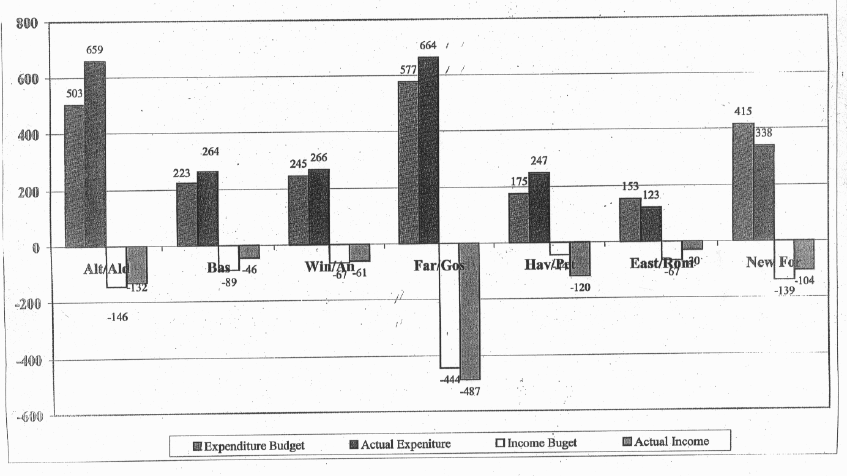
Mental Health Residential Services - 2000 / 2001 Budget Compared to Outturn
APPENDIX 6
Residential / Supported Housing Best Value Review 2000 / 01
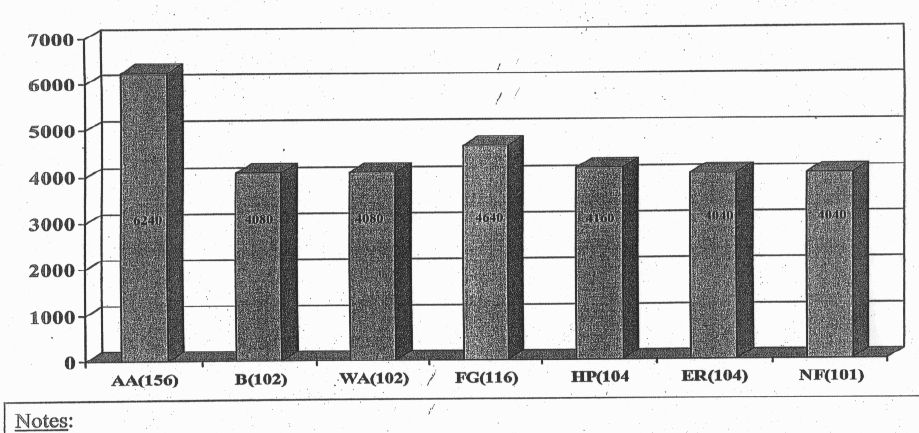
Number of Severely Mentally Ill Adults in Adult Population
Notes:
782,000 total adult population for Hampshire
Areas identified with their total adult population figure in thousands in brackets on baseline
Between 2.3 - 5.3% of adult population have severe mental illness with 4% used as an average
Number of SMI people on Enhanced CPA = 1,547
Number of SMI people on Standard CPA = unknown
APPENDIX 7
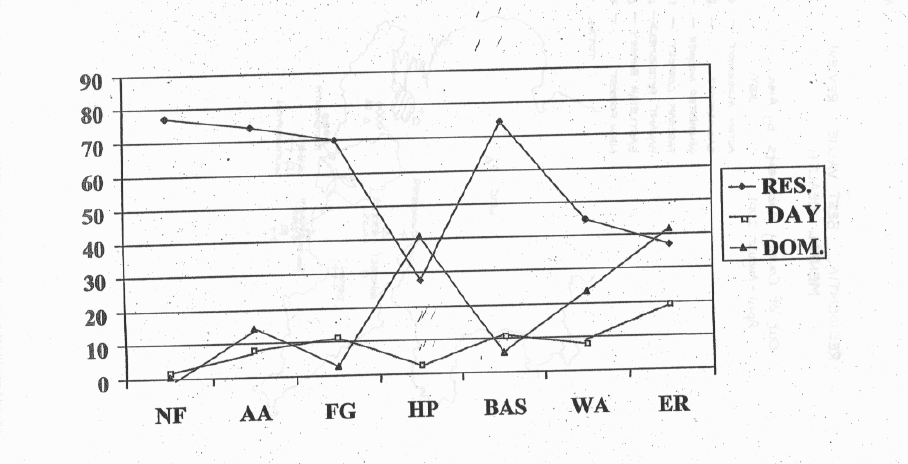
% Spend on Residential / Day / Domiciliary Care by Area
(1999 / 2000)
APPENDIX 8
APPENDIX 9
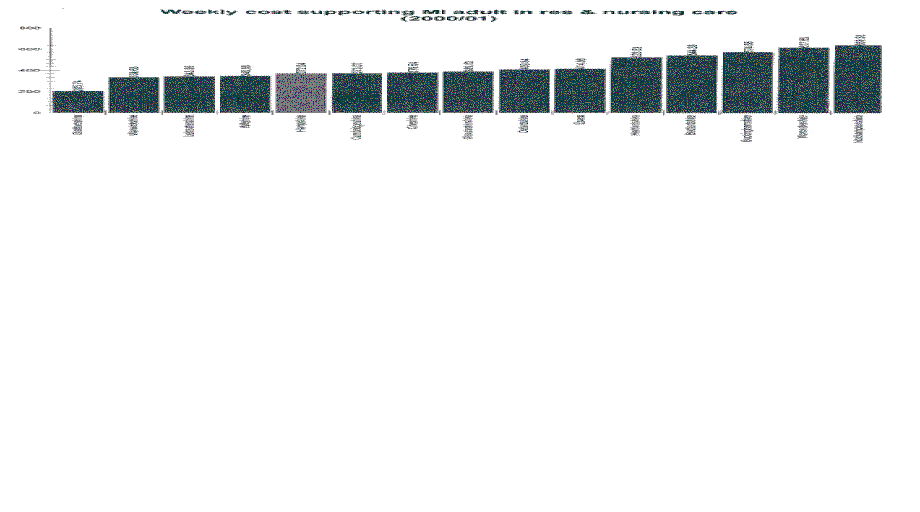
APPENDIX 10a
Analysis of Number of Providers of Registered Care by type of Accommodation, by Area (1st April - 31st August 2001)
Areas ® |
A / A |
B |
W / A |
F / G |
H / P |
E / R |
NF | |||||||
Type of Accommodation |
No. of providers |
No. of placements |
No. of providers |
No. of placements |
No. of providers |
No. of placements |
No. of providers |
No. of placements |
No. of providers |
No. of placements |
No. of providers |
No. of placements |
No. of providers |
No. of placements |
Nursing Homes |
2 |
4 |
1 |
1 |
1 |
1 |
5 |
6 |
0 |
0 |
3 |
3 |
0 |
0 |
Residential Homes |
7 |
21 |
6 |
14 |
11 |
14 |
18 |
23 |
8 |
11 |
4 |
4 |
13 |
20 |
Other |
1 |
1 |
0 |
0 |
1 |
1 |
1 |
8 |
1 |
6 |
1 |
2 |
1 |
5 |
Totals |
10 |
26 |
7 |
15 |
13 |
16 |
24 |
37 |
9 |
17 |
8 |
9 |
14 |
25 |
Type of Provider |
No. of Providers |
In County |
Out of County |
Nursing Homes |
12 |
9 |
3 |
Residential Homes |
67 |
42 |
25 |
Other Providers |
6 |
5 |
1 |
Totals |
85 |
56 |
29 |
APPENDIX 10b
Main Providers of Supported Housing / Accommodation by Area 2001/2
AREAS ® |
A / A |
B |
W / A |
F / G |
H / P |
E / R |
NF |
Stonham |
_ |
_ |
_ |
_ |
_ |
_ | |
Basingstoke Churches (Homeless Hostel Generic) |
_ |
||||||
MACA |
_ |
_ |
_ |
||||
Quality Care |
_ |
||||||
MJB |
_ | ||||||
Carr Gomm |
_ |
_ |
_ |
||||
Advanced Housing (Reg.) |
_ |
||||||
Lodden |
_ |
||||||
Downlands Health Authority |
_ |
||||||
Alpha House |
_ |
||||||
Southern Focus Trust |
_ |
_ |
|||||
Winchester Churches Housing (Generic Nightshelter) |
_ |
||||||
2 Saints |
_ |
_ |
|||||
Christian Alliance |
_ |
||||||
Ashley Homes (Homeless) |
_ |
||||||
Victoria Housing Project (Temp. Accommodation) |
_ |
||||||
Family Support Service |
_ |
||||||
NSF |
_ |
||||||
London Quandrant |
_ |
||||||
Thames Valley Health Authority |
_ |
||||||
Pavillion Health Authority |
_ |
||||||
Area Housing Association |
Hyde HA |
Hyde HA Havant HA |
Eastleigh HA |
Hyde HA | |||
Winchester City Council (Floating Support) |
_ |
||||||
Social Services Department (Domiciliary care) |
_ |
APPENDIX 11
Glossary
CMHT Community Mental Health Team
CPA Care Programme Approach
CSA Care Standards Act
GIS Geographical Information System
GOSE Government Office of the South East
HA Health Authority
HCC Hampshire County Council
LA Local Authority
LIT Locality Implementation Team
MACA Mental Aftercare Association
NSF National Service Framework
PAF Performance Assessment Framework
PCT Primary Care Trust
ROCC Voluntary Sector umbrella housing organisation
SHMG Supported Housing Management Grant
THB Transitional Housing Benefit
WAP Working Age Population
WHT West Hampshire Trust
Option Appraisal Best Value Review, Residential and Supported Housing, Mental Health, 2001/2002 APPENDIX 12
|
Option 1 |
Option 2: A combination of all three elements which are not mutually exclusive. | ||
CRITERIA |
Status Quo |
Develop a mixed economy of provision which: _ Meets demands where private and voluntary sectors cannot or do not provide, within county _ Ensures the most vulnerable are provided for. |
Reduce the number of residential placements by developing a viable range of community services to meet diverse needs. |
Prevent admission to NHS and Social Care, Residential Care by developing jointly with health a range of alternatives. |
Deploy Hampshire County Council capital resources to provide care which would: _ Meet NSF for Mental Health Standards _ Be as close to home as possible _ Have equality of access _ Be inclusive and help reduce suicide _ Be in the least restrictive environment _ Be safe and secure _ Optimise quality of life _ Be economic, effective, efficient _ Offer respite facilities _ Reduce the demands upon MH service and in patient beds. _ Comply with National Care Standards Act 2001 |
The range of community services needed would include development in the following areas: _ A Range of Services in each area which includes meeting complex needs. _ Systems: Multi Agency Partners to agree eligibility, a housing pathway and responsibility for implementation. _ Practice: Specialists expertise regarding accommodations and benefits and employment available to each CMHT with joint training involving users and careers and move on panels. _ Finance: Local mechanisms to secure joint funding in place e.g. Housing Champion in each LIT. _ Involvement: Ensure users are routinely involved in LITS/ housing developments and offer appropriate training. Collation of feedback and unmet needs. _ Quality: A process in place to implement and review. National Standards. _ Information: Ensure IMHER (Integrated Mental Health Election Record)includes housing related information training for best practice interim arrangements e.g. e-CPA |
Develop a Residential purchasing strategy which includes: _ Short term intensive rehabilitation _ Long term rehabilitation _ Links with access to leisure, education and employment services. _ Access to appropriate accommodation, income/benefits _ Appropriate level of health and social care support _ Other components of the West Hampshire Trust strategy and other NHS facilities. | ||
 OPTIONS
|
Option 1 |
Option 2: A combination of all three elements which are not mutually exclusive. | ||
CRITERIA |
Status Quo |
Develop a Mixed Economy of provision |
Reduce number of residential placement by developing available range of community services |
Prevent admission to NHS and Social Care Residential Care by developing jointly with Health a range of alternatives. |
Strategic Objectives |
||||
1. Ensure effective arrangements are in place for strategic planning and operational delivery that engages all relevant stakeholders, users and carers |
Not Met |
Not Met without parallel community development |
Fully met over time provided that savings are reallocated/funding available and partnership working becomes a reality _ _ |
Fully met over time provided that the community services as outlines in Option 3 are developed and funded _ _ _ |
2. Ensure equality of access to a range of Residential and supported housing schemes in accordance with local need and priority and within available resources. |
Not Met |
Not Fully Met without parallel community development |
Fully met over time provided that savings are reallocated/funding available and partnership working becomes a reality _ _ |
Met over time if partnership vision of redeveloping services achieved _ _ _ |
3. The service provided conforms to national standards |
Not Met |
Improved in terms of residential provision |
Met provided funding available for necessary developments and improvements _ _ |
As Option 3 _ _ |
4. To maximise resources through effective collaboration with partner agencies |
Not Met |
Not Met |
Met _ _ |
Fully met through holistic redevelopment of services. _ _ _ |
 OPTIONS
|
Option 1 |
Option 2: A combination of all three elements which are not mutually exclusive. | ||
CRITERIA |
Status Quo |
Develop a Mixed Economy of provision |
Reduce number of residential placement by developing available range of community services |
Prevent NHS and Social Care Residential Care by Development Jointly with Health a range of alternatives. |
Benefits/disadvantages to service users/carers and other stakeholders |
Little scope for improved satisfaction |
Some improvement in service delivery but in limited area of need _ |
Improvements in access, quality satisfaction and range of services realised only if funding is available to ensure savings on residential care are made. Savings must then be reinvested to gain maximum benefit _ _ |
Significant benefit, empowerment and independence would be realised if an holistic community focused services was developed jointly with health and included maximum user participation in planning and development _ Increased scope to provide full crisis service to prevent readmission to acute care. _ _ _ |
Benefits/disadvantages to staff |
Lack of development would lead to reduction in morale worsening recruitment and retention |
Partial improvement ion service would do little to alleviate staff P & R problems |
Deploying specialist expertise in accommodation benefits employments e.g. specialist workers available to each CMHT would improve job satifaction, accountability and consistency |
Multi Professional/agency working using specialist roles and responsibilities (as option 3) plus rehabilitation workers would improve practice, motivation and outcomes significantly _ Training would be needed including addressing cultural change/psycho social approach necessary for implementation |
Risks increased or decreased, risk of failures _'s indicate a positive situation i.e. less risk |
Risks increased, service quality could deteriorate over time |
Risk lessened in part of service only. Inadequate community range and provision will increase risk of need for residential care_ |
Risk lessened but service development could be confined by lack of additional resources to start the process _ _ |
Reshaping the delivery and funding of accommodation and community services by linking with option 3 would significantly reduce risk _ _ _ |

|
Option 1 |
Option 2: A combination of all three elements which are not mutually exclusive. | ||
CRITERIA |
Status Quo |
Develop a Mixed Economy of provision |
Reduce number of residential placement by developing available range of community services |
Prevent NHS and Social Care Residential Care by Development Jointly with Health a range of alternatives. |
Cost/efficiency + = savings/improved efficiency _ = Increased cost/less efficient |
+/_ _ No Cost change immediately but in time decrease in efficiency of service may lead to increased demand on Health and Social Care. Residential Services |
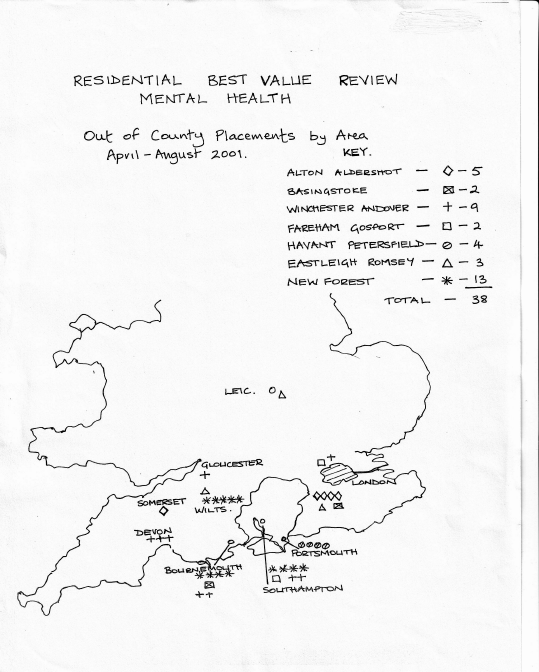
+/_ _ Savings and efficiency could be realised if out of county placements provided for within Hampshire, 38 (of 145) at a cost of £643,544 were reinvested. Possible costs incurred in providing In House resident care unknown at present. |
+/_ _ Cost/saving on reduction in residential care placements should be reinvested in community services BUT some investment would need to be made to initiate the process. _ Training costs in relation to staff/users _ Outsourcing specialist workers would significantly improve efficiency and may have cost implication _ Opportunity Costs |
+/_ Saving in relation to high cost NHS in patient residential care/social care beds must be reinvested in new comprehensive community services programme to ensure availability of resources, staff, training, expertise, quality and compliance with National standards. _ Work has commenced with WHT and SHA to develop and cost options. |
Impact on equalities |
Negative |
Partial _ |
User empowerment, involvement, independence equality of access. Staff knowledge and skill and therefore outcomes would improve _ _ |
As option 3 plus added benefit of holistic service delivery. _ _ _ |
Ease of implementation and timescales |
Present situation |
Congruent upon partnership arrangements with health |
||
|
Option 1 |
Option 2: A combination of all three elements which are not mutually exclusive. | ||
CRITERIA |
Status Quo |
Develop a Mixed Economy of provision |
Reduce number of residential placement by developing available range of community services |
Prevent NHS and Social Care Residential Care by Development Jointly with Health a range of alternatives. |
Contribution to e-government |
None |
None |
_ _ _ Integrated IMHER (Planned implementation April 2004) will have a great impact Upon _budget monitoring _ Performance Management _ Assist Integration _ Reduce risk and improve care |
_ _ _ As Option 3 |
Substainability |
Overtime, decrease in satisfaction level of users and carers will lead to negative impact on health and well being increasing demands on health and social services |
_ Some improvement if accommodation closer to home? |
_ _ Users and carers well being increases accordingly |
_ _ _ As option 3 with added sustainability through joint arrangements |
Impact on criminal disorder / community safety |
Poor access to an adequate range of appropriate accommodation will have negative impact. |
Met in terms of residential provision only _ |
Met provided funding available for necessary adjustments and development _ _ |
As Option 3 _ _ |
 OPTIONS