
Archived decisions
Hampshire County Council Social Care Policy Review Committee Item 4b 31st May 2002 Outcome Report of the Mental Health CPA/Care Management Best Value Review Report of the Director of Social Services |
Contact: Yvonne Le Brun / Paula Hallam, ext 7790 / 7718
1. Summary
1.1 The Best Value Review of Mental Health Services, covers assessment and care management as they are carried out within the Care Programme Approach (CPA). Mental health services are shaped by the CPA framework of access to specialist mental health care and CPA is operated jointly by health and social services.
1.2 The National Service Framework for Mental Health is the major influence on the current development of mental health services, introduced by the Government in 1999 and backed up by the NHS Plan.
1.3 Adult mental health services in Hampshire are in a period of transition as they move towards an integrated line management structure between social services and health by April 2003. Three elements of the service are included in this review: integrated CPA/care management as operated within mental health teams, the approved social work service and services for mentally disordered offenders.
1.4 The total budget for mental health services for 2001/02 was £8.5 million, of which about 35% was staffing costs. However there was an underspend in mental health staffing in 2001/02 due to problems with recruitment, reflecting the national shortage of qualified social workers. In 2002/03 the Government has channelled additional `earmarked' funding for mental health through Primary Care Trusts but the indication is that very little of this investment will reach mental health services. However there is funding available for development of integrated mental health information systems from Supplementary Credit Approval.
1.5 Performance management indicators and returns to the Department of Health (DOH) indicate some improvements in services, however there are problems with collecting sufficient relevant data across health and social services and a joint approach is needed.
1.6 The review was undertaken with an integrated team involving representatives from health, social services, independent sector and service user group. The four C's of Best Value were addressed through a range of challenge and consultation exercises, comparison with relevant other bodies and by using a partnership approach to the review and its' outcomes.
1.7 Review objectives were set at an early stage, focusing on integration through care co-ordinator training and development, recruitment and retention of staff particularly Approved Social Workers (ASWs), out of hours services and involvement of carers and service users in mental health services.
1.8 The review confirmed the need to improve access to training and development for care co-ordinators and to address the cultural differences between health and social services through an integrated approach to the care co-ordinator role.
1.9 It was clear from the review findings that recruitment and retention for ASWs must be improved, with a clear strategy, in order to meet the service objectives to provide effective assessment for adults with mental health problems and to carry out the Department's duties under the Mental Health Act 1983.
1.10 The review findings supported the need to review out of hours provision of the ASW service in the light of integration of mental health services in general. However further consultation is needed with health partners to establish the model for out of hours ASW provision, since resources have not yet been identified to develop out of hours services in health.
1.11 It was clear that the provision of carers assessments needs to improve in both quality and quantity to be able to meet the service objective of providing all carers of people on CPA with an assessment of their needs, a written care plan and fair access to services.
1.12 The review findings confirmed that in order to meet the service objective to achieve meaningful involvement for service users and carers in planning, development and monitoring of services, there must be improvements in the provision of information and relevant training - both for service users and carers and for mental health service staff - to achieve empowerment and full involvement.
1.13 Having completed the main body of work for the review, options for service improvement were developed and appraised. Taking into account the findings from the review, preferred options were identified and presented to the Social Care Policy Review Committee in November 2001, where they were accepted.
1.14 The preferred options have been developed into an action plan for improvement of mental health services in line with the review findings described above:
i. training and development programme for care co-ordinators
ii. recruitment and retention strategy for ASWs
iii. development of a model of service out of hours
iv. improvements in carers assessments
v. empowerment and involvement for service users and carers through training for them and for staff
vi. integrating the forensic services strategy with health
vii. integrating the REMIT (Race Equality Monitoring and Implementation Team) approach with health
viii. developing a joint approach to performance management to aid the scrutiny of CPA.
1.15 The report contents are as follows:
Section Title |
Page |
Summary |
1 |
The service under review (policy, structure, aims, objectives, budget, staffing numbers, service delivery outputs |
3 |
The review process (team membership, scoping, objectives, four C's, findings, associated projects, sustainability, equalities, e-government, cost of the review) |
12 |
Member input |
24 |
Lessons Learnt |
24 |
Conclusions |
25 |
Summary Recommendations |
28 |
Glossary |
29 |
Appendices List |
29 |
2. The service under review
2.1 Policy Context
2.1.1 The following paragraphs summarise the major policy initiatives that shape current mental health services.
2.1.2 Care Programme Approach - in mental health services, assessment and care management are carried out within the Care Programme Approach (CPA). The CPA was introduced in 1991 to provide a framework for access to specialist mental health care, and it encompasses assessment of health and social needs, care planning, access to care provision, monitoring and review (this process is know as care co-ordination). CPA is operated jointly by health and social services.
2.1.3 National Service Framework - the major influence on current development of mental health services is the National Service Framework (NSF) for Mental Health and the NHS Plan. The NSF was introduced by the Government in 1999 and it sets out the following standards for mental health services:
1. promote mental health for all, combat discrimination
2. primary care access to assessment, treatment and care for mental health needs
3. access to services round the clock, use of NHS direct
4. everyone on CPA to receive care encompassing engagement, crisis, risk, have a written care plan and access services 24 hours/day, 365 days/year
5. where care is needed away from home, timely access to an appropriate bed/place, least restrictive, with written care plan on discharge
6. carers providing regular and substantial care for someone on CPA should have an assessment of needs and their own written care plan
7. prevention of suicide, to achieve target in Our Healthier Nation
2.1.4 NHS Plan - in 2000 the introduction of this plan confirmed mental health as a core national priority, in particular to ensure that people with severe and enduring mental illness received services that were more responsive to their needs. the NHS plan announced additional specific resources to speed up the implementation of the Mental Health NSF as follows:
a) primary care: to establish graduate primary care mental health workers and community mental health staff in primary care teams
b) early intervention in psychosis: to establish early intervention teams to that by 2004 all young people with a first episode of psychosis receive the support they need
c) additional assertive outreach teams so that by 2003 all people in need of this service receive it
d) services for women: women only day centres in each health authority area
e) support for carers: additional staff by 2-4 to increase breaks for carers
f) high secure hospitals: additional long term secure beds and community staff
g) prison services: additional staff for screening and treatment, to ensure that all people with severe mental illness in prison receive treatment and have a care plan and a care co-ordinator when they leave prison.
2.1.5 Reforming the Mental Health Act - a new Act is required to be compliant with the Human Rights Act 1998 and to keep up with advances in care and treatment. Proposals include:
i. compulsory care and treatment in the community where appropriate as an alternative to detention in hospital
ii. independent tribunals to determine longer-term use of compulsory powers
iii. right to independent advocacy
iv. safeguards for children and young people
v. safeguards for people with long-term mental incapacity
vi. a new Commission for Mental Health
vii. statutory requirement to develop care plans.
The new Act may be included in the Queen's speech in the autumn 2002, in which case it would be likely to be enacted in 2005.
2.1.6 Joint Adult Mental Health Information Systems - the NHS plan identifies the following targets:
1) costed Mental Health Information Strategy (2002)
2) connectivity - all staff with access to information technology networks (2002)
3) implementation of electronic CPA care plans (2002)
4) local service directories (2003)
5) quality and management information, including implementation of the Mental Health Minimum Dataset (2003)
6) integrated service user information across health and social care boundaries in an Integrated Mental Health Electronic Record (IMHER) (2004)
2.1.7 Workforce Planning, Education & Training - the final report of the Workforce Action Team (WAT) has identified the following key work areas to be addressed:
a. development of single agreed set of competencies to deliver each NSF standard
b. regional maps of current education and training provision
c. programme of engagement with professional and regulatory bodies
d. development of models to assess the number and mix of staff to deliver the NSF
e. development of occupational standards
f. tackling the stigma of working in mental health services
g. recruiting more professionally non-affiliated people into the mental health workforce
h. employing skill mix solutions to provide adequate workforce
i. addressing primary mental health care workforce issues
j. improving recruitment and retention of staff.
2.1 Structure of the service
2.2.1 Adult mental health services in Hampshire are in a period of transition, aiming for integrated line management between social services and health by April 2003. An integration project board was established in July 2001, chaired by the Assistant Director (Adults) Hampshire County Council Social Services and with representation from Southampton City Council/Southampton City Primary Care Trust (PCT), West Hampshire NHS Trust, Surrey Hampshire Borders NHS Trust, Portsmouth Health Care NHS Trust, Portsmouth City PCT/Social Services, East Hampshire PCT, New Forest PCT, and Blackwater Valley and Hart PCT. The progress of this project will be reported later.
2.2.2 The adult mental health services under review are provided mainly through community mental health teams (CMHTs, also called locality mental health teams LMHTs), which are integrated teams of health and social services mental health professionals. Currently health trusts manage the teams on a day to day basis, whilst social services retains line management responsibility for the social workers. There is a mental health team manager for social workers for each social services area and there are four specialist service managers.
2.2.3 The integration project described above will have significant implications for how these services undertake their responsibilities: for instance, two of the specialist service managers have recently been jointly appointed as locality managers for West Hampshire Trust (WHT), the first stage of structural integration. These operational staff will be managed jointly by the social services operational county manager and the trusts' general managers. Social service operational staff report to the operational county manager, who is also project manager for the integration project. The strategic county manager, supported by two strategic service managers, leads policy and strategic direction of mental health services and has particular responsibility for mental health care management/CPA.
2.2.4 Three elements of the mental health services were included in this review:
i. Integrated CPA/care management, as operated within mental health teams across the county
ii. The approved social work service provided by Hampshire County Council
iii. Services for mentally disordered offenders.
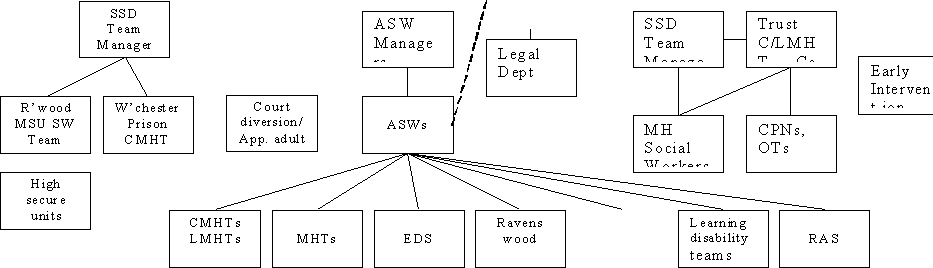
See diagram in Appendix 2.
2.2.5 Mental health teams:
2.2.6 There are currently 14 integrated C/LMHTs in Hampshire, as follows:
· Alton/Aldershot: Elizabeth Dibben Centre, Conifers, The Hollies
· Basingstoke: Bridge Centre, Mulford Hill Centre
· Winchester/Andover: Connaught House, Junction Road
· Eastleigh/Romsey: Desborough House, Little Brew House, Southampton East LMHT (covers Eastleigh Southern Parishes)
· New Forest: Anchor House, Waterford House
· Fareham/Gosport: Osborne Centre, Hewatt House
· In Havant/Petersfield the teams are not yet integrated and operate with separate social services and health teams - however it is hoped that integrated CMHTs will be achieved here within the next year or two.
2.2.7 There are social services care managers in each team, holding caseloads alongside community psychiatric nurses (CPNs) and occupational therapists (OTs). Under the CPA title of care co-ordinator, they undertake assessments, plan care packages, monitor and review, as well as offering therapeutic intervention and support to their clients. They take part in duty rotas for intake of referrals and crisis situations, and they are also mainly approved social workers (or will become so after training) - see below. Care co-ordinators liaise closely with inpatient psychiatric units, community services, primary care teams and care manager colleagues in other care groups.
2.2.8 In addition to C/LMHTs there are an increasing number of specialist mental health teams such as the Rapid Assessment Service in Basingstoke and assertive outreach teams. There is also a move towards extended hours operation of these teams.
2.2.9 Approved Social Work service:
2.2.10 Local authorities have a duty to appoint a sufficient number of approved social workers (ASWs) to discharge the functions conferred on them by the Mental Health Act 1983 (section 114). The main function of ASWs is to co-ordinate and undertake formal assessments to determine whether individuals require compulsory admission to hospital. They carry out these assessments with medical colleagues, although the ASW makes the final decision, and they are required to use the least restrictive alternative in deciding the outcome of such assessments. They consider the whole range of the client's needs during the assessment and make initial arrangements for care packages to be in place, when hospital admission is not the outcome of the assessment. As part of the process, ASWs will liaise closely with the client, relatives and carers, health colleagues, and police and ambulance services. See Appendix 3 for further details. Training to become an ASW involves a 100-day course and placement, which can be undertaken once the social worker has been qualified and completed the first stage of their post qualifying award (PQ1).
2.2.11 Hampshire County Council operates seven ASW rotas during office hours, and between 5pm and 9am and at weekends the ASW service is provided by the Out of Hours Service (OOHS).
2.2.12 Forensic services (services for mentally disordered offenders):
2.2.13 Hampshire County Council is a member of the Wessex Consortium, a planning and commissioning body for addressing the needs of mentally disordered offenders (MDOs), made up of Health Authorities, Social Services, Probation Service, HM Prison Service, Hampshire Constabulary, Medium and Low Secure and Forensic Learning Disability Services. The Consortium has an ongoing strategy to improve MDO services.
2.2.14 Social services currently has a service manager managing forensic services, a part time team manager for the Prison CMHT and a senior practitioner at Ravenswood medium secure unit (MSU), and they oversee the following:
· Social work team at Ravenswood MSU - a major local resource for MDOs. It has four social workers employed by Hampshire County Council, who also work with high secure units and the special hospitals. They work mainly with MDOs, linking with the medical and nursing teams and liaising with the mental health teams in the areas where the clients ordinarily reside.
· The team manager manages the CMHT for Winchester Prison, a developing project intended to bridge the gap between prisoners and community mental health services.
2.2.15 In December 2000, a joint forensic strategy was developed between Hampshire Social Services and Probation Service (see Adult Services Sub Committee report of 1st December 2000 entitled `Joint Social Services/Probation Forensic Strategy'). This strategy will be reviewed in light of integration with health services, however the main points are as follows:
· Hampshire County Council and Hampshire Probation Service will work together -
· to implement CPA into HMP Winchester and subsequently other Hampshire prisons
· to ensure court-based liaison schemes are developed in all areas of Hampshire
· to increase number of appropriate adult and bail information officers and ensure they receive relevant training
· to develop protocols regarding social care provision in special hospitals and medium secure units
· to keep the Social Supervision protocol under review
· to include a strong social care and offending perspective in the prisons' health improvement plans
· to develop and implement a jointly agreed information sharing protocol
· to develop relevant joint training for staff working with MDOs.
2.2.16 Recent and future developments in forensic services include:
2.2.17 Appropriate Adult service - funding secured from National MIND enabled pilot provision of a countywide Appropriate Adult service in 2001, building on the schemes already provided in some parts of the county - appropriate adults act as advocates for people with mental health problems when they are interviewed in police stations. However the funds are not secured beyond April 2003 and the pilot will be reviewed this summer. An annual investment of approximately £20,000 would be required to maintain the project.
2.2.18 National standards for the provision of social care services in high security hospitals were introduced in 2001 and will follow for medium secure units.
2.2.19 Child visiting protocols have been introduced for special hospitals and by all trusts, and there will also be one developed specifically for Ravenswood MSU.
2.2.20 As part of the integration project and trust reorganisations, there will be a WHT locality manager for Ravenswood MSU and links to high secure services, and the WHT locality manager for Winchester and Andover will manage the Prison CMHT and low secure services.
2.2.21 The planned new Mental Health Act will include measures for the care and treatment of people with dangerous personality disorders, which will have a significant impact on forensic services over the next few years and require closer working with community mental health services.
2.2 Aim of the service
2.2.1 To ensure that through the CPA people experiencing mental health problems, and their carers, receive effective and inclusive assessment, care planning and access to health and social care appropriate to their needs.
2.3 Objectives of the service
2.3.1 The following table shows the objectives of the services under review, based on the current policy and legislative context of mental health services:
Objectives of the service
Objective |
Targets |
1. To provide effective assessment for all adults referred to the secondary mental health services (NSF standard 2, 4) |
|
2. To provide effective care co-ordination for all adults with mental health problems who are eligible for care under CPA (NSF standards 2 - 5) |
NSF: 100% compliance by April 2001 with written care plan available electronically for all on CPA by April 2002 NHS plan: follow up all patients on discharge from hospital within seven days |
3. To provide all carers of people on CPA with an assessment of their needs, a written care plan and access to relevant services (NSF standard 6) |
NSF: 100% compliance with assessments by April 2001 for enhanced CPA, written care plans by Mar 2002 |
4. To achieve meaningful involvement for service users and carers in planning, development and monitoring of services (NSF standards 1 - 7) |
|
5. To simplify access to mental health services for service users and carers, and to improve efficiency and remove duplication, through greater integration between health and social services (NSF standards 2 - 5): · Fully integrated CPA and care management operating in integrated mental health teams · Joint information services · Joint commissioning of services (with pooled budgets), provision of services, monitoring and development of quality of services, including regular service user and carer based outcome information |
MH Commissioning Plan: systems in place April 2001 NSF: prison in-reach workers recruited by March 2002 NSF: strategy in place by April 2001, software and information sharing protocols available by April 2002 |
6. To improve mental health services by introducing evidence based and government-led developments (NSF standards 2 - 6) : · Assertive outreach teams · Crisis intervention teams (24-hour) & early intervention teams · Women's services · Carers' services |
NHS plan: Dec 2003 NHS plan: set up teams by 2004 |
7. To recruit and retain sufficient numbers and quality of personnel to provide an effective service, to meet the NSF standards, and duties under the NHS and Community Care Act 1990 and the Mental Health Act 1983, through workforce development plans (NSF standards 1 - 7) |
NSF: strategy in place by April 2001, impact monitored by April 2002 NHS plan: increased capacity nationally - 500 more CMHT staff, 700 more carer support staff, 300 more staff in prisons, 1000 primary care mental health workers |
2.4 Budget
2.4.1 The total budget for mental health services for 2001/02 was £8.5 million. Staffing costs would represent about 35% of total expenditure if the establishment was fully recruited, however there was an underspend in mental health staffing in 2001/02 due to problems with recruitment, reflecting the national shortage of qualified social workers. For a breakdown of expenditure for 2001/02 see Appendix 4.
2.4.2 Resources: over £1 million additional mental health grant has been invested by the Social Services Department since 1999 to develop social care services as part of NSF implementation. However, in 2002/03 the Government has channelled additional mental health modernisation funds, `earmarked funding' for mental health, through PCTs to fund the NHS plan priorities contained in the joint investment plans of mental health Local Implementation Teams (LITs). In spite of stated Government intentions to invest an additional £80 million (approximately £300,000 per PCT was expected in Hampshire) the indication both nationally and locally is that very little of this additional investment will reach mental health services. Investment of earmarked money in social care by PCTs will be insignificant.
2.4.3 In the absence of additional mental health grant and earmarked funding for social care, the County Council has agreed to fund a £50,000 recruitment and retention package for Approved Social Workers to enable minimum statutory requirements to be met (see 3.9.2 below).
2.4.4 The implications of the recent budget settlement and new NHS implementation plan for mental health services (including proposals to charge Councils with Social Services Responsibilities for delayed discharges) are not known.
2.4.5 Capital: there are opportunities for the promotion of e-government through development of integrated mental health information systems from mental health Supplementary Credit Approvals (SCA) awarded by the DOH each year. Hampshire has been granted £205,000 for 2002/04.
2.5 Staffing numbers
2.5.1 Numbers for ASWs, mental health social workers including ASWs and CPNs - these figures do not include substance misuse services or services for mentally disordered offenders.
Area / Staff in CMHTs |
ASWs |
MHSWs |
CPNs * |
Alton/Aldershot |
4 |
13 (5 vacant) |
18 |
Basingstoke |
8 |
12 (3 vacant) |
39 |
Eastleigh/Romsey |
8 |
9 (0 vacant) |
14 |
Fareham/Gosport |
8 |
10 (0 vacant) |
13 |
Havant/Petersfield |
6 |
10 (0 vacant) |
30 |
New Forest |
8 |
10 (1 vacant) |
14 |
Winchester/Andover |
9 |
12 (1 vacant) |
23 |
* figures taken from Stage 3 NSF monitoring returns to DOH
2.6 Service delivery outputs
2.6.1 Performance Assessment Framework (PAF) returns 2001
Hampshire PAF Returns April 2001 |
South west: Winchester, Andover, Eastleigh, Romsey, Southern Parishes, New Forest |
South east: Havant, Petersfield, Fareham & Gosport |
North & mid: Alton, Aldershot & Basingstoke |
How many people are on enhanced level of CPA |
766 |
198 |
583 |
How many have a written care plan (%) |
95% |
100% |
100% |
How many carers are know to provide care to those on enhanced CPA |
Not known, target 397 |
36 |
Don't know |
% carers with their own care plan |
Less than 50% |
15% |
Don't know |
2.6.2 It was not possible to obtain more recent figures for these returns at this time. There is often difficulty in gathering information about CPA processes, as required for PAF and RAP (Referrals, Assessments and Packages of care) returns and for audit of CPA. Some information is held on the Department's ACMS system, and this will improve with the introduction of electronic CPA on to ACMS (see 3.7.11 below). However, most of the information is held on a variety of manual and electronic health systems and collection of data has not been rationalised or integrated to date across the county or between health and social services. Scrutiny of CPA processes and performance will be crucial to the scrutiny role of local authorities with regard to health partners and this issue is addressed in the recommendations of this report.
2.6.3 PAF indicators - the indicators relating to mental health performance are:
A6 - psychiatric readmission rates
B15 - unit cost of residential and nursing care
C31 - number of people helped to stay in own home (per 100,000 population)
C27 - number of people admitted to residential care (per 100,000 population)
2.6.4 Performance is shown in terms of ●'s, with one ● = investigate urgently, and five ● ● ● ● ● = very good performance. Hampshire received ● ● ● ● for most indicators in 2000/01 , indicating a good performance and significant improvement on previous years, particularly with the number of people helped to stay in their own home. See Appendix 5 for full details of PAF indicators.
2.6.5 ASW minimum dataset: every six months, data is collected to record the activity of ASWs, to identify trends and workloads and help for future planning of the service. Recent returns indicate a consistent level and content of work for ASWs in the last few years. Full details of the ASW minimum dataset are contained in the evidence for this review.
3. The review process
3.1 The Best Value Review of CPA/Care Management was undertaken within the multi-disciplinary/multi-agency context of mental health services. This was reflected in the membership of the Review team (see below). It was conducted within the structure of the four C's of Challenge, Compare, Consult and Compete and used the framework of the European Foundation Quality Management (EFQM) Excellence Model. The review evaluated the service against relevant standards for mental health services, scoped areas for improvement, developed options for service development and made recommendations for the future based on the preferred options.
3.2 Review team membership
Paula Hallam SSD Mental Health Strategic Service Manager
Richard Parry SSD Mental Health Operational Service Manager
Deirdre Farrell SSD Mental Health Team Manager
Sean Sanders SSD Mental Health Team Manager
Jacqui Lindsay SSD Forensic Care Manager
Barbara Evans SSD Interagency Training Project Manager Paul Thomas West Hants Trust Community Services Co-ordinator
Lesley Barrington Surrey Hants Borders Trust CPA Development Manager
Margot Mottershead West Hants Trust CPA Lead Officer
Jim Davison West Hants Trust (south east) CPA Lead Officer
Gwyneth Payne User-Led Monitoring Project Worker
Neil Luckett Consumer Audit Joint Co-ordinator, Southampton Centre for Independent Living
Councillor Gale Hampshire County Council
Councillor Dowden Hampshire County Council
Councillor Mrs Steel Hampshire County Council
Councillor Mrs West Hampshire County Council
3.3 Scoping the review
3.3.1 In order to establish the scope of this Best Value Review, i.e. the project boundaries, a consultation/challenge event was held in early April 2001. Representatives from social services, health authorities and trusts, service user and carer groups met to review the operation of CPA/care management in mental health services, to gather evidence of current strengths in the service and to identify areas for improvement. Once identified they were summarised and then prioritised according to importance, urgency and realistic capacity for achievement.
3.3.2 Key themes from recent consultation exercises and performance indicators were also identified at this stage, in terms of service strengths and service gaps (a summary of the information generated from these exercises can be found in Appendix 6 and in more detail in Appendix III of the Project Brief, Appendix 10 of this report).
3.3.3 Objectives for the review were then derived from the areas for improvement and the gaps in service identified during the scoping period.
3.4 Review objectives
1. To produce options for maximising integration of community, inpatient and forensic mental health services across health and social care at all levels, including implementation plans and realistic time scales e.g.:
· management and commissioning arrangements
· ownership of care co-ordinator role
· care pathways across inpatient/forensic/community/primary care services/other care and age groups.
Note: it was decided to focus on training and development of the care co-ordinator role in this review. The management and commissioning arrangements are being addressed by the major Integration Project between West Hampshire Trust and Hampshire County Council, referred to in section 3.7 below along with developments in joint information systems. It was felt that there were not enough resources within the review team to undertake any work on care pathways although this work is inevitably beginning anyway, and work to develop a carers pack in forensic services and to cost the forensic social work service provided to other local authorities is also referred to in section 3.7 below.
2. To develop recruitment and retention strategies and targets for mental health personnel, in particular Approved Social Workers, by the conclusion of the review.
Note: recruitment and retention issues across all mental health staff groups were addressed through the adult mental health services workforce development plan - brief details are included in section 3.7 below.
3. To research and present options for the model of the Approved Social Work service, particularly out of hours in the context of changes to the Out of Hours Service and developing extended hours, crisis and assertive outreach services.
4. To develop options for maximising service user and carer involvement in individual and service planning and development, with a particular focus on carers' views and carers' assessments.
Note: this focus was due in part to social services having the lead responsibility for standard 6 of the NSF, providing a carers assessment and care plan for all carers of people on CPA. In terms of service user involvement, the substantial number of existing consultation exercises in Hampshire were reviewed, along with the recent Sainsbury Centre review of services in West Hampshire and the Dearden report, and questionnaires were sent to service user projects about involvement in service planning and development (see section 3.6 below).
3.5 The four C's
3.5.1 The four C's of challenge, consultation, comparison and competition were addressed using the following methods (full details of the work undertaken for the review in connection with the four C's can be found in Appendix 7:
3.5.2 Challenge & consultation
a. consideration of national and local performance indicators
b. results of recent existing consultation exercises
c. Best Value review team meetings
d. consultation with staff, health and voluntary sector colleagues, service users and carers
e. consultation of carers conducted by Consumer Audit
3.5.3 Compare - the following comparison work was undertaken:
i. national and local performance indicators, benchmarking data and standards
ii. questionnaires sent to neighbouring and comparator local authorities
iii. analysis of ASW exit interviews, reasons for leaving, extra hours worked
iv. visits to other local authorities' out of hours services
3.5.4 Compete - there is no direct competition for provision of community mental health services, as social services have legal duties under the NHS & Community Care Act 1990 and the Mental Health Act 1983 to provide such services. However, health authorities and trusts also have duties to provide community mental health services and there is a strong move in Britain for mental health services to move towards maximum integration between health and social services (within the constraints of agency restrictions and responsibilities). Since the challenge of developing integrated services is equivalent to the challenge of competition in mental health services, the competition element of this review was met through various partnership initiatives (see Appendix 7).
3.6 Review findings
3.6.1 Summaries of the major findings will be included here, however the full evidence is held by the project manager, Paula Hallam, and is catalogued according to the list in Appendix 8. It is also cross-referenced in the Action Plan in Appendix 1.
3.6.2 Care co-ordinator role:
i) Staff :
_ dissatisfaction with role and workloads
_ gaps in training: risk, integrated user-centred working, carers needs including children, recording, holistic assessment
ii) Service users/carers:
_ need more information
_ need for holistic assessment
_ hope for greater involvement & expectations of their potential
iii) Workforce Action Team report:
_ competence-based integrated training & continual development to support NSF/NHS plan
_ user-centred approach
_ tackle stigma and raise profile of career in mental health
iv) Adult mental health services workforce development plan:
_ service pressures often block training
_ supervision and mentoring need improvement
_ access to electronic learning patchy
_ need to address health and social care cultural differences and the move to care co-ordinator role
_ lack of life-long learning culture
_ significant learning needs: CPA, risk, holistic assessment, early intervention, partnership with users and carers, IT skills
3.6.3 Recruitment & Retention:
i) Staff:
_ good peer support, varied workload, good ASW training, ASW forums work well
_ reduced numbers
_ long hours, lone working, difficult to take time back - feeling undervalued, need more flexibility and support
_ main reasons for extra hours: lack of beds, doctors, police, ambulance, late referrals, long assessments
_ need for better supervision & development/training opportunities
_ lack of career progression
_ need for workload weighting
_ increase in remuneration necessary
_ relationships with health colleagues strained as ASW work takes up availability for CMHT work, burden of tribunal reports increasing
_ reappointment procedure needs review
_ recruitment slow and poor adverts
_ accommodation expensive
_ main reasons for leaving: promotion in Hampshire, retirement, ASWs in older person's teams no longer able to contribute to a rota due to pressure of work, moving to posts outside Hampshire (or non-Mental Health senior practitioner posts within Hampshire) which offer promotion or a higher salary
ii) Other local authorities
_ Hampshire has lower than average number of ASWs amongst comparator and neighbouring authorities (see evidence)
_ range of remuneration options for ASWs, Hampshire salary considerably lower than Surrey, other authorities and equivalent health posts (see evidence)
_ some remuneration for ASW practice assessor
iii) Workforce Action Team report
_ creation of senior practitioner grade
_ flexible conditions
_ professional development
_ national pay scales
3.6.4 Out of hours ASW service:
i) Service users & carers:
_ more readily accessible services 24 hours
_ quicker response needed
_ alternatives to hospital admission, choice
_ preference for CMHT or GP as first point of contact, not hospital
_ help available before crisis reached
_ use of crisis plans, cards and advocacy
_ contact with someone who knows them or their case
_ support whole family
ii) Stakeholders:
_ good service but difficult to get past call centre to ASW
_ often only one ASW on duty, north of county experience delayed response
_ child protection issues seem to take precedence over mental health assessments
_ volume of service not sufficient, expansion would require additional resources
iii) Staff :
_ need for greater integration with health
_ local service preferable, additional resources needed
_ current OOHS provides emergency response only, long response times
_ similar level of service to daytime should be available out of hours
iv) Models of service identified in other areas:
_ ASW service part of generic OOHS (current)
_ Separate ASW team within OOHS
_ Locally provided ASW service as part of out of hours mental health teams - crisis resolution or CMHTs
_ 24-hour ASW service separate from other mental health teams
3.6.5 Carers Assessments:
3.6.6 The Consumer Audit consultation of carers of people with mental health problems highlighted the following issues1:
· Carers rated their most important needs as being for reassurance about the person they cared for, emotional and financial support to enable them to continue their caring role, professional immediate crisis response services and easier access to information
· Information about the carers assessment is generally well circulated, however where carers were not linked into services professionally or through support groups they remained less aware of what is available in the wider community to support them and the service user
· Information about the carers assessment does not provide all the detail that carers felt they needed to know
· The carers assessment procedure is being operated competently by professionals in the field and carers did feel respected, involved and listened to, however the overall quality rating of the `carer assessment experience' was wide-ranging and inconsistent and raised concerns where the experience was quoted as very poor
· Advocacy with objectivity may be a missing component in the assessment process for some carers
· Carers were confident with mental health services and the CPA and found professionals approachable at times when they needed help
· Some carers expressed dissatisfaction with the outcomes following a carers assessment
· Some carers expressed concerns that carer support workers had little experience and knowledge of the subject and were not being deployed by their managers in the most effective manner
· It was important to carers to be included in the overall `care picture' and to have the opportunity and recognition to share experiences first hand with professionals
· The carers assessment process was quoted as providing real added value and understanding to the way that the carer/service user relationship could move forward.
3.6.7 The Consumer Audit report1 made the following recommendations as a result of the consultation with carers:
i. Ensure that carers receive appropriate written information about the carers assessment process and its potential, to which they can make future reference. Impart early information and training to carers.
ii. Investigate and ensure that information regarding the carers assessment is easily available and in the right place for carers. Ensure the widest communication mechanisms (including traditional post) are used to communicate and reduce the isolation felt by some carers.
iii. Review the content of carers' information to ensure that it reflects what carers want to know and provides additional information about other useful services e.g. carers' benefits and direct payments.
iv. Set in place a training and development programme for carer support workers to improve their effectiveness and support their work practice. Investigate how the provision of worker development training can reduce quality inconsistencies in the operation of the carer assessment procedure.
v. Promote the carer support worker role by promoting the details of the programme to carer support groups with the aim of capturing the trust and confidence of carers.
vi. Ensure that any possible need for advocacy is explored with the carer prior to the assessment process.
vii. Examine how mental health services response times following initial carer contact with the service can be improved.
viii. Demonstrate and promote the positive outcomes from carers assessments.
ix. Provide more resources and services relevant to the assessed needs of carers.
1 These details are taken from the summary of Consumer Audit: Mental Health Carers Consultation Report - Carers Assessment, which also contains a full action plan. The report is available separately on request.
3.6.8 Other findings for carers:
i) Internal:
_ low numbers of carers' assessments recorded
_ no routine collection & evaluation of management information to inform services
ii) Carers (from other consultation exercises):
_ carers assessment should be routine, few carried out so far
_ easier and quicker access and response, continuity of care
_ need information about mental illness and services, support workers and groups
_ need training and education
_ concern about lack of holistic approach, and early/unplanned discharge from hospital
_ opportunity to express views and be heard, involvement in care planning, shared care model, information sharing policies
_ recognition and support to continue, access to respite care
_ one point of contact, services more integrated
iii) Other local authorities
_ most have mental health specific carer policy
_ most have integrated approach through CPA
_ most have mental health format of carers assessment, completed by care co-ordinators and/or support workers
_ most provide training and education for carers
_ all involve carers through fora, strategic involvement groups, consultation meetings
3.6.9 Service user involvement:
i) existing surveys:
_ more involvement needed in planning for hospital discharge
_ more information so that involvement is easier
_ more involvement in crisis planning and reviews
ii) Sainsbury Centre consultation:
_ felt left out of decisions
_ information needed to inform involvement
_ more involvement in CPA, should be consulted from beginning and skills better employed
_ user involvement should be promoted in recruitment to mental health services, through employment in mental health services and on management committees of services, in training staff
_ support to have aspirations and not be written off
_ self help groups, services to build confidence
The Sainsbury Centre review of West Hampshire Trust services set up a feeder group for service users and carers, as a reference group for the user and carer representatives on the steering group. The feeder group discussed issues being considered by the review and fed views back via their representatives. The members of the feeder group expressed a wish at the end of the review to remain involved in the Trust's development programme in future.
iii) Adult mental health services workforce development plan:
_ insufficient middle management support and general lack of enthusiasm for empowerment and employment of service users
_ professional staff had low expectations of service users
iv) Survey to service user projects:
_ Positive level of service user involvement in self help groups, LITs, service steering groups, patients' fora
_ Service users welcome involvement, although not at token level, want to see involvement increased and more effective, more encouragement from care co-ordinators to participate
_ Training is needed: NSF, assertiveness, minute taking, meeting processes, job descriptions for committee roles
_ Funding needed for participation in service development, and for administrative support
v) A recent survey of service users' views in Surrey and Hampshire formed part of the Surrey Hampshire Borders Trust CPA Audit. 1000 people were surveyed, 400 responded and 250 requested ongoing involvement with service monitoring and development. Results of the survey are not yet available but the response rate is very encouraging and will provide a good base for future involvement.
3.7 Associated projects
3.7.1 Adult mental health services workforce development plan: this report was commission from Dearden consulting as part of the Stage 3 monitoring of NSF progress by the north, mid, south-west Hampshire and Southampton health and social care communities.
3.7.2 The report made a number of recommendations, summarised here:
a) workforce development should be based on competency-based training which is multi-disciplinary, includes care co-ordinator role and involves voluntary sector, service users and carers
b) supervision, mentoring and coaching should be improved and staff should be released for training
c) access to electronic learning should be improved
d) develop joint campaign to improve profile of mental health service careers and recruit collaboratively
e) work to achieve a representative workforce
f) implement policies to improve staff's working lives, keep up with national pay developments
g) strengthen workforce information base
h) introduce multi-professional leadership and management development programme to facilitate integration.
3.7.3 Trusts and Local Implementation Teams have the lead to implement this workforce plan.
3.7.4 Section 117 of the Mental Health Act 1983: County Treasurers are in the process of completing a project to map the cost and distribution of section 117 aftercare services, on behalf of the Mental Health Commissioning Team. In addition to providing an accurate picture of the extent of section 117 aftercare provision in Hampshire, the work will help in calculating the impact of any changes to charging practices for mental health services in the light of the new charging policy.
3.7.5 Integration: the integration project for mental health services is seeking to achieve integrated locality management of services through a joint Strategy and Performance Board, a joint Management Board and integrated locality management with jointly appointed managers from NHS trusts and social services.
3.7.6 The integration project board was established in July 2001, chaired by the social services Assistant Director (Adults) with representatives from Southampton and Portsmouth City Councils and PCTs, West Hampshire Trust, Surrey Hampshire Borders Trust, East Hampshire PCT, New Forest PCT, and Blackwater Valley and Hart PCT.
3.7.4 The following progress has been made by the Integration Board:
(i) Commissioning of a consultation exercise by the Sainsbury Centre for Mental Health, leading to development of a project plan for the integration process
(ii) Draft proposals to establish joint operational management boards
(iii) Indicative timescales for integration
3.7.7 The integration process is going to need to progress at a different pace according to the NHS Trust concerned. West Hampshire NHS Trust is a new organisation covering Winchester, Andover, Eastleigh, Romsey, New Forest, Southampton City, Havant, Petersfield, Fareham and Gosport. It is in the process of appointing staff and implementing new arrangements. Surrey Hampshire Borders NHS Trust has an existing structure in place, but is subject to review and consequent uncertainty. Joint integration project groups are being established for each social services department and NHS Trust to develop a more detailed project plan.
3.7.8 It is hoped for West Hampshire Trust and Hampshire Social Services that a detailed joint organisational structure based on PCT localities, together with accountability and governance arrangements should be in place by April 2003 subject to the outcome of consultation, and possibly in advance of this timescale.
3.7.9 Surrey Hampshire Borders NHS Trust (SHBT) serves a Hampshire population whose NHS services are commissioned by North Hampshire PCT, and Blackwater Valley and Hart PCT. It also provides mental health services in West Surrey. Partnership arrangements with SHBT need special consideration, as it is increasingly being recognised that the needs of the Blackwater Valley population in Hampshire and Surrey could be better met by a more integrated approach to service. Options are currently being developed for the configuration of mental health services in Surrey, and those parts of Hampshire currently served by SHBT. Options are likely to include:
i) joint arrangements to manage services to the population of the Blackwater Valley with Surrey Hampshire Borders Trust, Hampshire County Council and Surrey County Council
ii) West Hampshire NHS Trust providing services for the residents served by North Hampshire PCT.
3.7.10 Further details about the integration project can be found in the Social Care Executive report of 26th March 2002 entitled `Integration of mental health services - progress report'.
3.7.11 Joint IT system: there have been major steps forward in developing joint mental health information systems between health and social services in Hampshire in the last two years. Initially there were three separate projects, in the north, south-east and west of the county. However, it has recently been agreed to develop one outline business specification and to work towards one joint system across the whole county in due course, in place in parts of the county by 2004. This system will meet all mental health information needs including the Minimum Dataset and the IMHER, and it will have an interface with the Social Care Information System. It will also meet the requirement for electronic CPA (eCPA) care plans. However, since eCPA had to be in place from this year, a joint WHT and social services project group agreed to use social services' ACMS to provide eCPA in most of the county until the new system is in place, as it is the only countywide IT system at present. The health PIMS system is being use in the north of the county to provide eCPA.
3.7.12 Ravenswood social work service: County Treasurers have completed a project to determine the feasibility of charging other local authorities for the use of the social care services at Ravenswood MSU, where the social workers are employed by Hampshire County Council but Hampshire residents provide only 30% of their work. The report concluded that it would be viable to charge for these services as it would provide in the region of £110,000 income for the year based on the 2001/02 budget. However this has not been taken forward at the present time because of concerns about the potential impact on the Departmental budget of reciprocal charges from other local authorities where there is shared use of services. There would also need to be considerable discussion and negotiation with health partners and the relevant other local authorities before introducing such a charging system.
3.8 Sustainability
3.8.1 This review has addressed the following aspects of sustainable development, in line with the Department's Sustainable Development Action Plan:
3.8.2 Social inclusion: the review has highlighted the need expressed by service users and carers for increased and meaningful involvement in planning their own care and in service planning and development, and to have opportunities for employment. Recommendations for action include methods for increased involvement and consultation.
3.8.3 Crime and disorder: the developments in forensic services relate directly to crime and disorder and community safety in their work with mentally disordered offenders. ASWs also have frequent contact with MDOs and an important role in maintenance of community safety. Recommendations include action to increase integration in forensic services.
3.8.4 Improving health and social well being: the review recommends a number of actions to improve services for service users and carers, hopefully improving their health and social well being. There are also recommendations to improve retention of staff through improved work environments and training and development opportunities.
3.8.5 Community co-operation: partnership and co-operation were approached through the various consultations for the review, an integrated review team, and the various recommendations regarding further integration of health and social care mental health services.
3.9 Equalities
3.9.1 Consultation with service users and carers highlighted the need to provide better information about assessments, mental illness, treatment and services, and to ensure that it is widely available. Mental health service users and carers can be hard to reach, and even more so if they are from a minority ethnic community, as evidenced by Consumer Audit's attempts to interview carers. It is therefore vital to provide and target relevant information, assessments and services and to make further attempts to involve service users and carers as suggested in the recommendations.
3.9.2 Recording of ethnicity data is improving in mental health services (see e.g. ASW minimum dataset in evidence) and the monitoring of services to ethnic minority communities continues through REMIT (race equality, monitoring and implementation team). The social services mental health REMIT report for 2001/02 highlighted significant gaps in assessment of ethnic minority community needs, representative workforce and cultural competence across Hampshire (as reported in trusts' self-assessments to DOH as part of stage 3 NSF monitoring). It is hoped to promote the use of the REMIT approach with health partners and to produce a joint REMIT action plan across health and social services during the following year. This will include an assessment of services using the Equalities Assessment Tool.
3.10 E-government
3.10.1 See details of joint IT system and electronic CPA in 3.7.11 above.
3.11 Cost of the review
Personnel |
Tasks |
Project meetings |
Challenge /Focus groups |
Project Mg't |
Total hours |
Cost £ |
Opportunity Costs Project Leader (most costs included in main Care Management review) |
- |
15 |
- |
15 |
500 | |
Project Manager |
- |
10 x ½ days |
2 days |
No. days per week |
540 |
10,500 |
Team managers x 2 |
- |
" |
1 day |
- |
42x2 |
1,600 |
Training manager |
10 days |
" |
1 day |
- |
120 |
2,500 |
Service manager |
- |
" |
1 day |
- |
42 |
1,000 |
Forensic social worker |
10 days |
" |
1 day |
- |
120 |
1,900 |
Consumer Audit project (contract) |
- |
- |
- |
- |
- |
5,000 |
Direct costs Meetings & refreshments, challenge event & carers event |
1,250 | |||||
Total: |
24,250 |
Note: Contributions of review team members from health and voluntary organisations present no cost to the review.
4. Member input
4.1 Members were involved in the initial scoping event in April 2001 and some members requested individual briefings during the review process. Members also gave feedback at the Social Care Policy Review Committee when the Options Report was presented in November 2001.
4.2 Integration of mental health services: Members highlighted the importance of integration and were pleased to see there was some progress. The proposed integrated training for Care Co-ordinators was commended for its modular approach and academic accreditation was seen as very important.
4.3 Out of Hours service: Members expressed concern that the one of the options to provide this service in local areas would need careful co-ordination as it would split up a familiar and established countywide service. However, they also felt that a local response could improve response times and provide more family-friendly opportunities for employees. Overall they highlighted the importance of out of hours mental health services, which are not generally well understood.
4.4 Recruitment and retention: Members expressed several ideas which could be helpful to recruitment and retention. Links could be made with university students, to offer them financial assistance during their studies and then recruit them into our employment. Financial rewards could be offered to staff for specific achievements. Local Planning Authorities could be approached to undertake more shared equity schemes for affordable housing for staff. Term time contracts could be offered to staff who are parents. Some of these ideas are already being taken up, and they will be fed into Corporate and Departmental recruitment and retention work.
5. Lessons learnt
5.1 There was a concerted effort to build a Best Value review team that included representatives from local mental health trusts, in light of the increasingly integrated nature of mental health service planning, development and provision. The integrated nature of the team (which also included service user and voluntary sector representatives in addition to social services staff) meant that the review was truly a joint effort and not just about social services. The team meetings provided a forum for networking and discussion of other joint issues and projects and also provided an element of challenge to social services from within the review team. The additional time and consultation required to operate an integrated review was far outweighed by the advantages. The structure of this review team could provide a model for future reviews where integration is relevant.
5.2 It was helpful to establish the focus of the review at an early stage, by identifying and prioritising areas for improvement at the scoping stage and thereby setting objectives for the review. This meant that the review had a tight focus throughout and was more manageable as a result, with an improved chance of achieving service improvements.
5.3 Consumer Audit were commissioned to undertake some research with carers of people with mental health problems, as part of the review. Approximately one hundred and fifty carers were approached to take part in the research, either contacted at carers groups or as contacts of carer support workers, and fifteen individuals took part. This number did not include any carers from minority ethnic communities or carers of mentally disordered offenders, despite attempts to make contacts. It seems likely that many carers are not in contact with any support services and may not be aware of what support is available to them. Both this review and the Carers Services and Respite Care Best Value Review have made recommendations about contacting, assessing, supporting and involving more carers.
6. Conclusions
6.1 Care co-ordinator role
6.1.1 The need for training and development for the care co-ordinator role was highlighted by the findings of the review. Staff expressed dissatisfaction with the role and identified gaps in training, which were echoed in the report completed for the adult mental health services workforce development plan. Service users reported a need for more information, holistic assessment and greater expectations of their potential from care co-ordinators.
6.1.2 The review confirmed the need to improve access to training, development and electronic learning for staff, in order to meet the service objectives of providing effective care co-ordination for all adults on CPA and recruiting and retaining sufficient staff to meet the NSF standards.. There is also a need to address the cultural differences between health and social services and to support an integrated approach to the care co-ordinator role. The Workforce Action Team report recommended competence-based, integrated training to support the NSF and NHS plan, to tackle the stigma of careers in mental health and to promote a user-centred approach.
6.2 Recruitment & retention
6.2.1 See section 3.7 above for details of the adult mental health services workforce development plan and recommendations for recruitment and retention across the whole mental health workforce.
6.2.2 In terms of ASWs, the review findings indicate that there have been problems in recruiting and retaining ASWs in Hampshire for several years, most recently in particular areas of the county - Aldershot and Havant and Petersfield. Reasons for leaving include promotion, higher salaries and retirement. Working hours seem to be increasing, with longer assessments contributed to by lack of resources (hospital beds, doctors, police and ambulance services).
6.2.3 Staff report increased workloads and impacts on relationships with health colleagues as ASW work takes up time available for CMHT work. They report a need for better supervision, more training and development opportunities, career progression, workload weighting, better recruitment and increase in remuneration. Hampshire has a lower than average number of ASWs and salaries are lower than a significant number of comparator and neighbouring authorities. The Workforce Action Team final report recommended creation of a senior practitioner grade, flexible conditions, increased professional development and national pay scales.
6.2.4 It is clear that recruitment and retention for ASWs must be improved, with a clear strategy, in order to meet the service objectives to provide effective assessment for adults with mental health problems and to carry out the Department's duties under the Mental Health Act 1983. The components of such a strategy are outlined in the action plan. Various suggestions were made for the strategy which would have corporate implications, such as use of paid overtime, additional annual leave, flexible hours and a benefits package. These suggestions will be fed back to the recruitment and retention team and will no doubt be addressed by the Pay and Benefits project.
6.3 Out of hours ASW service
6.3.1 The review findings supported the need to review out of hours provision of the ASW service in the light of integration of mental health services in general. It was viewed as a good service but with insufficient volume. Feedback indicated a need for quicker responses, alternatives to hospital admission and staff who knew the service users. There was a preference for local provision with contact through CMHT or GP, a similar level of service to that provided in the daytime and more integration with health.
6.3.2 Various models of out of hours services were identified in other areas, described in the options appraisal in Appendix 9.
6.3.3 Further consultation is needed with health partners to establish the model for out of hours ASW provision, building on the consultation already carried with staff, independent sector, service users and carers by both health and social services. The need for integration of out of hours services is paramount in order to meet the service objectives of simplifying access to services and improving efficiency. There is also an objective to improve mental health services through evidence based developments such as crisis intervention teams. However, further development of plans for crisis resolution teams and twenty four hour services has been severely restricted by the lack of additional funding from the DOH, which had been expected to provide for this expansion in service. Since resources have not yet been identified to develop these services it has not been possible to conclude which model of service will be adopted, during the timescale of this review.
6.3.4 It should be noted that any plans to provide the out of hours service more locally would have a significant impact on the countywide generic Out of Hours Service as ASWs in that team also carry out duties with children and other adults. There will need to be full involvement of all relevant parties in making decisions about the future of this service.
6.4 Carers assessments
6.4.1 The review findings indicate that carers do not have enough information about mental health, availability of support, services and how they work and the process of carers assessments. Carers report that they need more emotional and financial support to continue caring and training and education. Some lack confidence in the provision of carers assessments and support and are dissatisfied with the outcomes of carers assessments. They favour a more holistic approach and quicker responses. Insufficient numbers of carers assessments are being conducted or recorded in a way that impacts service development. Most of all, carers want the opportunity to express their views and to be recognised and involved.
6.4.2 The remit of this review was to consider carers assessments, whilst the Best Value Review of Carers & Respite Care addressed involvement, information, training, promotion and provision of services to carers.
6.4.3 It is clear that the provision of carers assessments needs to improve in both quality and quantity to be able to meet the service objective of providing all carers of people on CPA with an assessment of their needs, a written care plan and fair access to services.
6.5 Service user involvement
6.5.1 Various consultations indicated that service uses generally did not feel involved in planning their care, or in wider service development. They reported that they need information and training to participate fully and with confidence and realistic opportunities to become involved. They felt user empowerment and employment of service users is not promoted sufficiently by mental health services.
6.5.2 The Best Value Review of Employment Services in 2000 addressed issues of employment for service users.
6.5.3 In order to meet the service objective to achieve meaningful involvement for service users and carers in planning, development and monitoring of services, there must be improvements in the provision of information and relevant training both for service users and carers and for mental health service staff to achieve empowerment and full involvement.
6.6 Option appraisal
6.6.1 Having completed the main body of work for the review, options for service improvement were developed and appraised (see option appraisal in Appendix 9). Taking into account the findings from the review, preferred options were identified and presented to the Social Care Policy Review Committee in November 2001, where they were accepted. The preferred options are represented in the summary of recommendations for the review that follows.
7. Summary recommendations
7.1 Approval is sought for the following recommendations, described in more detail in the action plan in Appendix 1:
7.2 Development of a competency-based modular training and development programme for CPA care co-ordinators, linked to progression and personal development, with academic accreditation and if possible linked to professional qualification courses. This initiative is likely to develop and promote the care co-ordinator role, leading to greater integration, a better service for users and carers, and improved workforce development and recruitment and retention.
7.3 Implementation of a recruitment and retention strategy for ASWs in Hampshire. At this stage the package focuses on recruitment in the Aldershot area of the county where there have been most problems, with retention measures for the whole county including an increase in senior practitioner posts, honoraria for ASW practice assessors and a number of improvements to the working environment for ASWs. The package will be reviewed after six and twelve months to see whether it has had sufficient impact.
7.4 Development of a model of mental health services out of hours, including the ASW Service - it has not been possible to agree a model of service during the course of this review, as discussed in 6.3.3 above. Whichever model is adopted, it must ensure that out of hours mental health services are integrated, responsive, with simple access and available equitably across the county.
7.5 Improvements in the carer assessment process, including countywide assessment format agreeable to carers, choice of assessor (care co-ordinator or carer support worker), all assessments fully counted and full management information collected and analysed to allow for development of carers services. These improvements would benefit carers and service users in terms of access, choice and service development. See the Carers & Respite Care Best Value Review for recommendations concerning involvement, information, training, promotion and provision of services to carers.
7.6 Empowerment and involvement for service users and carers is improved through training for service users and carers, and by involving service users and carers in training for staff, which will promote a user/carer-centred approach to mental health services.
7.7 Integration of the REMIT approach, working towards a joint mental health remit action plan across health and social services.
7.8 Development of an agreement between social services and health concerning the data set that needs to be collected for CPA management information and DOH returns, and how it will be gathered and shared, aiming to reduce duplication and make information more readily available. Scrutiny of CPA processes and performance will be crucial to the scrutiny role of local authorities with regard to health partners.
8. Glossary
ACMS Assessment and Care Management System
ASW Approved Social Worker
C/LMHT Community/Locality Mental Health Team
CPA Care Programme Approach
CPN Community Psychiatric Nurse
DOH Department of Health
eCPA Electronic Care Programme Approach
GP General Practitioner
IMHER Integrated Mental Health Electronic Record
IT Information Technology
LIT Local Implementation Team
MDO Mentally Disordered Offender
MH Mental Health
MSU Medium Secure Unit
NSF National Service Framework
NHS National Health Service
OOHS Out of Hours Service
OT Occupational Therapist
PAF Performance Assessment Framework
PCT Primary Care Trust
REMIT Race Equality Monitoring and Implementation Team
SHBT Surrey Hampshire Borders NHS Trust
WAT Workforce Action Team
WHT West Hampshire NHS Trust
9. Appendices List
1) Action Plan
2) Diagram of mental health services
3) ASW role description
4) Budget table
5) PAF indicators
6) Scoping summary
7) The 4 C's
8) Evidence list
9) Option Appraisal
10) Project Brief
APPENDIX 1 - ACTION PLAN
Outcome 1: CPA Care co-ordinators are equipped to provide an integrated, holistic mental health service through accredited modular training and development programme |
Outcome 2: The mental health workforce is fully staffed to provide an effective, professional, integrated service - focus on Approved Social Workers |
Outcome 3: An integrated model of mental health services including the ASW service is available to service users and carers out of hours, equitably across the county |
Outcome 4: Carers needs are assessed, risks reduced, crises planned for, consistency & choice for carers and service development informed, thereby promoting carer involvement in service planning and delivery |
Outcome 5: Empowerment and involvement for service users and carers is improved through training for service users, carers and staff |
CPA/Care Management Service









Older persons teams
APPENDIX 3: The Role of the Approved Social Worker
9 Legal framework
Section 114 of the Mental Health Act 1983 states that Approved Social Workers (ASWs) must be appointed by Local Authorities in sufficient numbers to discharge their functions as defined by the Act.
ASW responsibilities
ASWs are responsible for co-ordinating formal assessments under the Act, where it is thought that someone suffering with a mental disorder may need admission to hospital and that use of compulsory powers may be necessary. Having received a referral and established that a formal assessment is indeed required, the ASW is responsible for the following tasks:
· Securing the attendance of two medical practitioners for the assessment
· Interviewing the person concerned to assess their needs and situation, jointly with one or both doctors wherever possible
· Explaining to the person and their relatives or carers the process of an assessment under the Mental Health Act 1983, and their rights under the Act
· Arranging for the presence of police officers during the assessment if necessary and/or for assistance with transport
· Making the final decision about whether compulsory admission to hospital is necessary, having considered:
the person's views and needs & those of their relatives and carers
the risks to the health or safety of the person and the protection of others
the views of the doctors and other involved professionals
all possible alternatives to compulsory admission
the impact of not admitting to hospital
The final decision should be based on the least restrictive method of providing the
care and treatment that the person needs.
· Informing or consulting the nearest relative about the outcome of the assessment
· Completing the legal paperwork for an application for compulsory admission, if appropriate
· Arranging for ambulance transport to hospital when compulsory admission is necessary
· Attending the hospital to hand over the legal paperwork, having scrutinised it for accuracy
· Completing a full report of the assessment
· Putting an alternative care plan into action if admission is not pursued.
ASW duties
In carrying out the above role, ASWs have a unique position among social workers in that the duty to make applications under the Act is placed on the ASW personally and not on his/her employing authority. The ASW is therefore personally liable for their decisions and actions in this process.
Generally, each ASW is `on duty' at least one day per week, as part of their local area's ASW rota. Whilst on duty they will be responsible for co-ordinating any assessment that arises, and this often involves managing complex and emotive situations and working additional hours in order to bring assessments to a conclusion in the least distressing or disruptive manner for the person being assessed - to maintain continuity and to complete the co-ordination role effectively, often dealing with long delays in the availability of other personnel (e.g. doctors, police officers) or resources involved in the assessments (such as ambulance transport or hospital beds).
ASW Training
The Local Authority should only appoint someone to act as an ASW if they are judged to have appropriate competence in dealing with people who are suffering from mental disorder. Social workers can train to become ASWs once they have completed two years post-qualifying experience. They undergo a 3 - 4 month full time training course, studying the Mental Health Act 1983, mental health theory and practice, and a relevant practice placement, before achieving ASW status. They have to provide sufficient evidence of competence to be appointed as an ASW initially and then at the end of every following 3 - 5 year period in order to retain that appointment.
Appendix 4: MH Actual Expenditure 2001/02 (to Period 13)
Appendix 5: PAF indicators
The returns for 1999-2000 and 2000-2001 indicate: o B15 (unit cost of residential and nursing care) - GOOD. Hampshire Residential placement costs although slightly higher in 2000-1 than previously still remain acceptable and within the bottom two fifth of comparator Counties. Band ● ● ● ● - good performance. NOTE - Within Hampshire there is significant variation in costs per area with Winchester/Andover, Basingstoke and Alton/Aldershot showing significantly higher than other areas in both gross and net terms. Also, there is a relationship between cost and quality which needs to be balanced to achieve high standards together with efficient use of resources. o C27 (number of people admitted to residential care) - GOOD. Hampshire is shown as successful in keeping people out of residential care with a rating of ● ● ● ● - good performance 1999/0 and 2000/1. o C31 (number of people helped to stay in own home) - GOOD. Hampshire has improved significantly in 2000/01, the indicator moving from ● ● - low performance at 1.0, to ● ● ● ● - good performance at 2.8. o A6 (psychiatric readmission rates) - This indicator is in the Health domain and data is collected for the three (previous) Health Authorities covering Hampshire. In 1999/0 only Portsmouth and South East Hampshire HA were rated ● ● ● ● - good performance, with Southampton and South West Hampshire HA and North and Mid Hampshire HA rated ● ● - question performance. | |
Appendix 6: Summary of scoping exercise
Area for Improvement |
Level of Importance |
Risk assessment |
|
EDS/ASW role etc (link to staffing below) |
|
Workload weighting |
* |
Dual diagnosis & transitions: mental health/ learning disability/physical disability/substance misuse/older people/children and families |
|
Information systems - duplication; procedures (e.g. health and safety, complaints etc); reporting to SERO |
|
Primary care/ intake /discharge |
*** |
Training/updates - joined up approach? |
* |
Integrated services |
*********** |
Copy of CPA care plan for service user |
*** |
User & carer focused review |
**** |
Section 117 (Aftercare provision under Mental Health Act 1983) |
* |
Carers assessments |
* |
Care pathways: inpatient/community/forensic |
*** |
Staffing: recruitment/retention, ownership of care co-ordination, ASW role/ location |
******* |
Key themes from recent consultation exercises and performance indicators also identified at this stage, in terms of service strengths and service gaps:
Service strengths:
· Some service users and carers expressed satisfaction with the service they received, with support in the community, their keyworker and care plans and some involvement
· Clear targets were set for NSF implementation
· There was development of some assertive outreach services
· There was recognition of need for further integration
· There were links with police, housing, probation
· There was improved ethnic recording and directories of services
Service gaps:
· Better links were needed between inpatient and community services on discharge, and between community and forensic services
· There was a large gap in provision of carers assessments
· Some carers and service users felt they needed more information and a greater level of involvement.
· Need for greater integration with health at strategic and operational levels
· Development of crisis and early intervention services
· Integrated information systems
· Recruitment and retention of staff
· Workforce mapping with reference to ethnicity
· Need for greater sharing of policies, procedures and training
· Single point of access
· Protocols for transitions between age groups
User view of service, especially for MDOs and ethnic minorities
Appendix 7: Four C's
Challenge & consultation - these factors were addressed through the following exercises:
a. consideration of national and local performance indicators and the gaps in service they identified
b. results of recent existing consultation exercises
c. Best Value review team meetings (representatives from health, social services, service user group, Consumer Audit)
d. participation in Sainsbury Centre review of West Hampshire Trust mental health services - workshops with health and voluntary sector colleagues, service users and carers on all aspects of service
e. care co-ordinators requested to complete self assessments of training and development needs
f. feedback from care co-ordinator training to date
g. consultation with universities about accreditation possibilities
h. recruitment & retention - ASWs consulted at practice development days, team and service managers, union and personnel consulted at regular meetings
i. external consultation event about out of hours services involving Police and Ambulance services, Health Authorities, Primary Care Trusts, Provider Trusts; ASWs ( including OOHS service), team and service managers also consulted
j. consultation of carers conducted by Consumer Audit
k. carer consultation events and Carers Week consultation
l. consultation with carer support workers, managers, carers strategic manager
m. presentations and discussion at Clinical Governance Forums and NSF Local Implementation Teams
Compare - the following comparison work was undertaken:
i. consideration of national and local performance indicators and benchmarking data and the gaps in service identified
ii. examination of current care co-ordinator training against training and development needs identified in the NSF, NHS plan and the WAT report
iii. researching `off the shelf' training packages and those implemented by other authorities
iv. questionnaires sent to neighbouring and comparator local authorities regarding ASW recruitment and retention, and carers assessments
v. research of national standards for carers assessments issued through NSF, Carers & Disabled Children Act 2000
vi. pay scales of comparable health employees and other local authorities researched
vii. seeking national guidance about numbers of ASWs through British Association of Social Workers, National Institute for Social Work and Training Organisation for the Personal Social Services (none found to date)
viii. analysis of ASW exit interviews, reasons for leaving
ix. analysis of extra hours worked by ASWs
x. visits to other local authorities' out of hours services
xi. research of nationally recognised out of hours service models and standards.
Compete - there is no direct competition for provision of community mental health services, as social services have legal duties under the NHS & Community Care Act 1990 and the Mental Health Act 1983 to provide such services. However, health authorities and trusts also have duties to provide community mental health services. The NHS Plan (2000) and the Health Act 1999 offer greater opportunities for integration of health and social care services and indeed, Government has stated that they will intervene where integration is not satisfactory. There is a strong move in Britain for mental health services in particular to move towards maximum integration between health and social services (within the constraints of agency restrictions and responsibilities). Since the challenge of developing integrated services is equivalent to the challenge of competition in mental health services, the competition element of this review was met through:
a) use of partnership in the review team itself
b) participation in the Sainsbury Centre review of West Hampshire Trust mental health services
c) development of options for maximised integration of services and partnership
d) consideration of accessing funds for integrated training through the Workforce Development Confederation (WDC).
APPENDIX 8: List of Supporting Evidence
1. General evidence
1.1 PAF indicators
1.2 RAP returns
1.3 Mental Health Benchmarking
1.4 SAFF returns
1.5 Stage 3 NSF monitoring returns
2. Care Co-ordinator Role
2.1 Surveys of staff training needs
2.2 Service user/carer & other stakeholder feedback from Sainsbury Centre review of South West Hants MH services: `Building better mental health services together'
2.3 Recommendations from Workforce Action Team final report
2.4 Recommendations from Dearden Consultants MH Workforce Development Plan for North/Mid/South West Hants health/social care communities
2.5 Recommendations from the Capable Practitioner
2.6 NSF/NHS plan priorities
2.7 Consultation with ASWs
3. ASW Recruitment & Retention
3.1 Dearden workforce planning workshop with ASWs
3.2 Consultation with ASWs, team & service managers
3.3 Comparison with neighbouring/comparator local authorities
3.4 ASW exit interviews
3.5 Survey of extra hours worked by ASWs Sept/Oct 2001
3.6 Recommendations from Workforce Action Team final report
3.7 ASW Recruitment & Retention in Hampshire paper Sept 2001
3.8 Adult mental health services workforce development report: Dearden
Consulting Ltd September 2001
3.9 Local Government Association workforce task group
3.10 Evaluation of Mental Health Recruitment November 1999
3.11 Report on Basingstoke/Alton ASW service 1999/2000
3.12 Report to Adult Sub Committee 02.02.96: `ASWs - Staffing levels and
organisation'
3.13 Report to Personnel Sub Committee 13.09.99: `Recruitment and retention
issues in the social services department'
3.14 Report to Social Services Committee 26.03.99: `Modernising Mental Health
Services
3.15 Aldershot ASW Report January 2002
3.16 Adverts & details of other salaries
3.17 ASW Minimum dataset
4. Out of Hours EDS service
4.1 MIND & ROCC Crisis Resolution Survey October 2001
4.2 Consultation with external stakeholders 24.10.01
4.3 Consultation with ASWs, team & service managers
4.4 Service user/carer & other stakeholder feedback from Sainsbury Centre review
of South West Hants MH services: `Building better mental health services
together'
4.5 Out of Hours: Mental Health Provision Discussion Paper 2000
4.6 NSF/NHS plan priorities
5. Carers Assessments
5.1 Consumer Audit spreadsheet
5.2 Consumer Audit questionnaire feedback sheet
5.3 Mental Health Carers Consultation Report - Carers Assessment: Consumer
Audit February 2001
5.4 Report on Carers in Mental Health Care conference 12th June 2001
5.5 Comparison with neighbouring/comparator local authorities
5.6 New Forest Carers survey
5.6 111 Leigh Road Carers survey
5.7 Eastleigh Assertive Outreach Team carers survey
5.8 Consultation with Carers Support Workers, managers
5.9 NSF/NHS plan priorities
6. Service Users
6.1 Survey of service user involvement with service user groups
6.2 Anchor House survey of outpatient clinic
6.3 Personal Social Services User experience Survey 2000 - 2001
6.4 CPA Audit - New Forest, Eastleigh/Romsey, Winchester/Andover,
Southampton City June 2000
6.5 New Forest Service User Survey
6.6 Service User evaluation of Eastleigh Assertive Outreach Team
6.7 User-led Monitoring survey of Inpatient Discharge
APPENDIX 9: Option appraisal
OPTIONS · Out of hours Approved Social Work (ASW) service (Note: `less service' not considered here as addressed in ASW recruitment & retention, App. 2) ®_CRITERIA |
Option One: No change - service run county wide from generic Social Services Direct (EDS) (alongside new extended hours services where SWs not `on ASW duty') |
Option Two: Similar service, rearranged - service run county wide as a separate specialist team within Social Services Direct (alongside new extended hours services where SWs not `on ASW duty') |
Option Three: Expanded service, differently resourced - service run locally e.g. 5pm - 12 midnight from: a) extended hours mental health teams (MHT) or b) crisis resolution teams (as new services develop) One pattern across county or local variations, 12 - 9am on-call ASW or much reduced service |
Option Four: Similar service, rearranged, possibly expanded - 24 hour specialist ASW service, separate from mental health teams/extended hours teams/Social Services Direct - either countywide or in local rotas dependent on needs analysis |
Strategic Objective: Simplify access to services, improve integration between health & social services; Recruit & retain sufficient numbers and quantity of personnel to meet legal duties under Mental Health Act 1983 |
· Simple access, not integrated but good connections with extended hours services |
· Simple access, not integrated but good connections with extended hours services |
· Potential for single point of access for integrated extended hours services in each area, but creates more boundaries within county |
· Simple access to same service 24 hours, not integrated but good connections with mental health teams. |
No current recruitment problems for emergency level of service |
May encourage or discourage staff retention, depending on preferences |
Potential for increased availability of ASWs out of hours, integrated team may be more attractive to some ASWs |
Recruitment/retention may be improved for those who prefer ASW-only workload | |
Benefits/ disadvantages to service user/carer & other stakeholders |
· Emergency service, may not meet all requests for ASW assessments but simple access, good connections |
· Emergency service, will meet more requests for ASW assessments, simple access, good connections, easier for countywide partners to contact one team |
· Single point of access, integrated co-ordinated service, more staff, quicker local response, but major reorganisation & adjustment for staff, more boundaries |
·(·) Simple access to same team 24 hours, good connections to mental health teams, may be expanded service, easier for countywide partners to contact one team |
Risks |
See benefits/disadvantages |
See benefits/disadvantages |
See benefits/disadvantages |
See benefits/disadvantages |
Cost/Efficiency + = savings/improved efficiency - = increased cost/less efficiency |
No change |
+/- No change to cost of ASWs, but cost to replace staff for rest of EDS, efficiency should improve |
+/- Cost of additional staff but may be funded through NSF development, better service |
++ Increased cost of additional SWs either for this service or to replace those who move from MHTs |
Impact on equalities |
· Limited access/availability |
· Improved access/availability |
· Improved access/availability |
· If expanded, improved access/availability |
Contribution to e-government |
· Social Services Direct |
· Social Services Direct |
· Improved as joint IT systems developed with health |
Would need to link with joint IT systems/Social Service Direct |
Impact on crime & disorder/community safety |
· Emergency service, deals with diversion from forensic services/community crises |
· Emergency service, deals with diversion from forensic services/community crises |
· Improved crisis service, more opportunity for prevention |
·(·) If expanded, improved crisis service, more opportunity for prevention |
Appendix 10: Project Brief
12 GOAL
The review team will review the Care Programme Approach (CPA)/Care Management in mental health services, assessing strategic objectives and service outcomes for quality, cost, efficiency, efficiency savings, sustainability and fair access, making sure that e-government and crime and disorder are fully addressed. It will make recommendations about future service models, service user and carer involvement and staffing, and ensure that these are consistently achieved in the future through a process of continuous improvement. The review will commence in May 2001 and conclude on submission of its final report in December 2001. Scoping and planning for the review has been underway since March 2001.
13 OBJECTIVES
These objectives are derived from the consultation exercise described later in this report, from assessing the current performance of mental health services against the objectives laid out in the service specification, and taking note of the gaps in service identified from current performance indicators.
1. To produce options for maximising integration of community, inpatient and forensic mental health services across health and social care at all levels, including implementation plans and realistic time scales.
2. To develop recruitment and retention strategies and targets for mental health personnel, in particular Approved Social Workers (ASWs), by the conclusion of the review.
3. To research and present options for the model of the ASW service, particularly out of hours in the context of changes to the Emergency Duty Service (EDS) and developing extended hours, crisis and assertive outreach services.
4. To develop options for maximising service user and carer involvement in individual and service planning and development, with a particular focus on carers' views and carers' assessments.
APPROACH
The Best Value Review of CPA/Care Management has to be undertaken within the multi-disciplinary/multi-agency context of mental health services. This is reflected in the membership of the Review Team (see below). It will be conducted within the structure of the four C's of Challenge, Compare, Consult, Compete and using the framework of the EFQM Excellence Model. The review will evaluate the service against relevant standards for mental health services, and make recommendations for the future as broadly outlined in Objectives above.
1. Review Team Membership
Paula Hallam SSD Mental Health Commissioning Officer
Richard Parry SSD Mental Health Team Manager
Deirdre Farrell SSD Mental Health Team Manager
Sean Sanders SSD Mental Health Team Manager
Barbara Swyer SSD Mental Health Forensic Service Manager
Jacqui Lindsay SSD Forensic Care Manager
Barbara Evans SSD Interagency Training Project Manager Paul Thomas West Hants Trust Community Services Co-ordinator
Lesley Barrington Surrey Hants Borders Trust CPA Co-ordinator
Margot Mottershead West Hants Trust CPA Lead Officer
Jim Davison Ports Trust CPA Co-ordinator
Gwyneth Payne User-Led Monitoring Project Worker
Neil Luckett Consumer Audit Joint Co-ordinator, Southampton Centre for Independent Living
Councillor Gale Hampshire County Council
Andrew Burton Union Representative
Robin Dixon Union Representative
2. Challenge
2.1 The Best Value Review will challenge why the service is being delivered, whether it is necessary, whether it could be delivered in different ways and whether an alternative service could deliver the aims and outcomes better.
2.2 The Review will consider the statutory framework for the service, future demands on the service, published evidence about effectiveness and performance and the use of new technology.
2.3 The Best Value Review Team has been formed in part to provide an element of external challenge, with members from health and user and carer groups.
2.4 Various challenge events will be organised, involving representation from some/ all of the following groups, as relevant for the different objectives outlined above:
· Relevant health and social services mental health and EDS personnel, union representatives
· Health trusts and Health Authorities
· Service users and carers
· Personnel from other care groups
· Primary Care
· Unitary Authorities - Portsmouth & Southampton
· Police and ambulance services
· NHS Direct
· County Treasurers, Financial Services Unit (FSU), Receivership Unit, Legal Department.
2.5 Challenge will also be enabled through regular presentations and discussions at the three National Service Framework (NSF) Local Implementation Teams (Health Authorities) and Clinical Governance Forums (Health trusts) across the County.
3. Comparison
3.1 The Best Value Review will compare performance across a range of indicators with the performance of other services and models of service in the same field.
3.2 The comparisons will identify performance gaps and necessary improvements.
3.3 Comparison with other organisations will include:
· comparator local authorities - immediate neighbours - Surrey, Portsmouth, Southampton, Shire Counties, South East Regional Office
· Health Authorities and trusts
· NSF Regional Implementation Team
· different schemes within the county.
3.4 Comparison with national data will include:
· national performance indicators
· benchmarking data
· publications and research into models of best practice
· beacon sites
· Social Services Inspectorate (SSI) & Central Council for Education and Training in Social Work (CCETSW) reports.
4. Consultation
4.1 The Best Value Review will include essential consultation, encompassing the views of service users and carers, staff, unions, other Best Value authorities, public bodies and departments, partner organisations, and the voluntary sector.
4.2 In particular, consultation will include the following stakeholders:
· Service users and carers, through their representative organisations
· ASWs and team managers
· Community Mental Health Team staff
· EDS
· Other care groups
· Trusts
· Health Authorities
· Portsmouth & Southampton Unitary Authorities
· Education Purchasing Consortium (health training)
· Primary Care
· Police
· Ambulance Service
· FSU, County Treasurers.
4.3 The review will include a specific consultation project with carers, carried out by Consumer Audit.
4.4 It is important not to engender `consultation fatigue' through over-consultation without visible results. The review team will therefore take full account of consultations that have already been undertaken, and ongoing consultation channels, when planning consultation exercises for the review. Plans for new consultation will be discussed with the Corporate Communications team for advice on who to consult and the most appropriate methods to use. Plans will include the purpose of consultation, how the information will be used, details of the timetable, decision-making processes and mechanisms for feedback of outcomes to consultees.
4.5 The review will aim to develop an appropriate range of consultation techniques that can be used to support the ongoing process of continuous improvement beyond the review itself.
5. Competition
5.1 Best Value reviews must ensure that fair competition is embraced as a means of securing efficient and effective service. They should identify competitors, and establish whether they could realistically offer an effective, efficient and economic service to clients.
5.2 There is no direct competition for provision of community mental health services, as social services have legal duties under the NHS & Community Care Act 1990 and the Mental Health Act 1983 to provide such services.
5.3 However, health authorities and trusts also have duties to provide community mental health services. The NHS Plan (2000) and the Health Act 1999 offer greater opportunities for integration of health and social care services and indeed, Government has stated that they will intervene where integration is not satisfactory. There is a strong move in Britain for mental health services in particular to move towards maximum integration between health and social services (within the constraints of agency restrictions and responsibilities).
5.4 Since the challenge of developing integrated services is equivalent to the challenge of competition in mental health services, the competition element of this review will be met through the objective of developing options for maximised integration of services and partnership. A number of integration options will be developed to enable consideration of best value, improved services and relative costs (and see challenge and comparison above).
6. Summary of methods/tools/techniques
The following methods, tools and techniques will be used during this Best Value Review:
· Workshops with social services and health managers and staff
· Consultation and challenge events with people and organisations listed above
· Questionnaires to relevant staff, service users, carers, members of public
· Comparison with benchmarking data, performance indicators, published research
· Reference to SSI and CCETSW reports
· Consumer Audit project.
7. Other aspects of Best Value
7.1 Continuous improvement
The Best Value Review will endeavour to produce objectives, outcomes, action plans and targets that are specific, measurable, achievable, realistic and timed, with a final review report which details a programme of work over a number of years. Implementation of this review's recommendations should therefore foster an approach of continuous improvement to mental health services within the framework of the Best Value Review programme.
7.2 Equalities/fair access
Issues of equalities and fair access will be addressed through the consultation element of the review, including the Consumer Audit consultation project with carers, and the objective to develop options for maximising service user and carer involvement in individual and service planning and development. Each of the objectives listed above should provide for a more accessible service to all service users and carers.
During the time span of this review, work will be in progress for the mental health REMIT report 2001, reporting on race equality, ethnic monitoring and implementation of services for ethnic minority clients. The targets for the year will be reviewed and new targets set for the year ahead (see service specification 8.12 for a brief summary of REMIT report 2000) and this work will be incorporated into the Best Value Review.
7.3 Sustainability
The review objectives will address sustainable development through the County Council's corporate strategy as follows:
· Quality of life in Hampshire: improving the mental health of the people of Hampshire through improved support and access to services for service users and carers, improved recruitment and retention strategies for staff
· Strong communities: promoting involvement and participation of service users and carers in operation and planning of services, strengthening partnership arrangements to achieve the development of strong communities in Hampshire
· Quality services: developing high-quality services for the public through integration - e.g. single point of access and extended hours services, with well trained, managed and motivated staff, and use of new technology.
7.4 E-government
The review will make maximum use of existing e-government systems, e.g. ACMS, health trusts information systems, internet, to research data for challenge, comparison and competition elements. It is anticipated that achievement of the objectives will have significant implications for data collection, use of management information and the development of joint information systems with health, and these will be monitored throughout the review and incorporated into the action plan.
7.5 Crime and disorder
Crime and disorder issues will be addressed through the inclusion of Forensic services and the ASW service in this review, both of which undertake work with Mentally Disordered Offenders (MDOs) - see objectives 1 and 3.
8. Project Plan
See Appendix I. The project plan relates directly to the review objectives. It is in draft format because it will be refined by the project team during their initial meetings.
SCOPE
In order to establish the scope of this Best Value Review, i.e. the project boundaries, a consultation/challenge event was held in early April 2001. Representatives from social services, health authorities and trusts, service user and carer groups met to review the operation of CPA/care management in mental health services, to gather evidence of current strengths in the service and to identify areas for improvement.
Those attending the event were given a presentation about Best Value Reviews, the service to be reviewed and current challenges to the service (see Appendix II). Two small groups then considered the service, one using the EFQM Excellence Model and one using brainstorming techniques. The information generated from these small group exercises can be found in Appendix III.
The whole group reconvened at the end of the session to combine the output from their discussions. Areas for improvement were summarised and then prioritised according to importance, urgency and realistic capacity for achievement:
1. Risk assessment
2. EDS/ASW role etc (link to staffing below)
3. Workload weighting *
4. Dual diagnosis & transitions: mental health/learning disability/physical disability/substance misuse/older people/children and families
5. Information systems - duplication; procedures (e.g. health and safety, complaints etc); reporting to SERO
6. Primary care/ intake /discharge ***
7. Training/updates - joined up approach? *
8. Integrated services ***********
9. Copy of CPA care plan for service user***
10. User & carer focused review ****
11. Section 117 (Aftercare provision under Mental Health Act 1983) *
12. Carers assessments *
13. Care pathways: inpatient/community/forensic ***
14. Staffing: recruitment/retention, ownership of care co-ordination, ASW role/ location. *******
* denotes level of importance to each item
It is proposed as a result of this consultation and scoping exercise that the Best Value review will focus on the following issues (see Objectives above):
· Integrated services - develop options for maximising integration of mental health services (within agency constraints) at all levels e.g.:
· management and commissioning arrangements
· ownership of care co-ordinator role
· care pathways across inpatient/forensic/community/primary care services/ other care and age groups
· Workforce issues -
· develop recruitment & retention strategies and targets (focus on ASWs for HCC)
· develop options for location and role of ASWs, especially out of hours in the context of EDS, assertive outreach and crisis intervention services
· User/carer involvement -
· Summarise all existing user/carer surveys
· Develop options for maximising user/carer involvement in individual and service planning & development
· Copy of CPA care plan for all service users?
· Carers assessments - S.C.I.L Consumer audit to survey carers' views; set targets, improve recording.
This Best Value review will not cover the following issues:
· Mental health day services
· Mental health residential care and supported housing
· Substance misuse
· Respite care, breaks for carers, support services for carers
· Information systems per se (covered by Joint Information Strategies) although impacts on them will be monitored and noted in the action plan
· Details of development of assertive outreach, crisis intervention and early intervention services - these are covered extensively in LIT plans
· The review will incorporate existing consultation exercises rather than repeating them unnecessarily.
CONSTRAINTS
· The review timeframe: start date May 2001, end date December 2001
· Availability of staff time on the review team, with no additional budget and significant contributions necessary from non-social services personnel
· Potential budget implications of integration issues and recruitment and retention
· Ongoing reconfiguration of health organisations
· Costs of Best Value review itself e.g. consultation/challenge events
DEPENDENCIES
· Commitment in time and effort from review team members, from social services, health and voluntary organisations
· Co-operation/availability of senior managers in health and social services - developing integration options is a huge undertaking and will require significant input from senior managers in terms of expertise, time and authority in order to move it forward beyond the Best Value Review
· Support of partner agencies
· Consumer Audit project
· Co-operation of service users/carers/staff in consultation events/exercises
· Accessibility of activity/financial/performance information, internally and externally
RESOURCE REQUIREMENTS/COSTS
Personnel |
Tasks |
Project meetings |
Challenge /Focus groups |
Project Mg't |
Total hours |
Cost £ |
Opportunity Costs Project Leader (most costs included in main plan) |
- |
- |
2 days |
- |
15 |
500 |
Project Manager |
- |
10 x ½ days |
2 days |
2 days per week |
540 |
9,000 |
Team managers x 3 |
10 days |
" |
" |
120x3 |
7,000 | |
Training manager |
" |
" |
" |
120 |
2,500 | |
Service manager |
" |
" |
" |
120 |
2,850 | |
Forensic social worker |
" |
" |
" |
120 |
1,900 | |
Consumer Audit project (contract) |
5,000 | |||||
Direct Costs Expenses / hospitality / conferences etc |
1,250 | |||||
Total: |
30,000 |
Note: Contributions of review team members from health and voluntary organisations present no cost to the review.
AGREED Signature Date Review Team Leader: Sponsor (on behalf of DMT): Corporate Best Value Team: |
Appendix I |
Mental Health Care Management and Assessment |
||||||||
� | |||||||||
Activity |
April |
May |
June |
July |
August |
September |
October |
November |
December |
|
|
|
|
|
|
|
|
|
|
Consultation for scoping report |
|
|
|
|
|
|
|
|
|
Write service specification |
|
|
|
|
|
|
|
|
|
Develop project brief |
|
|
|
|
|
|
|
|
|
Present scoping report to BV Panel |
|
|
|
|
|
|
|
|
|
Review team meetings |
|
|
|
|
|
|
|
|
|
Prepare project brief for Consumer Audit |
|
|
|
|
|
|
|
|
|
Consultation/challenge events - stakeholders |
|
|
|
|
|
|
|
|
|
Questionnaires and other consultation |
|
|
|
|
|
|
|
|
|
Comparison - data collection & analysis |
|
|
|
|
|
|
|
|
|
Consultation - senior managers - integration |
|
|
|
|
|
|
|
|
|
Develop options |
|
|
|
|
|
|
|
|
|
Interim report to BV Panel |
|
|
|
|
|
|
|
|
|
Option appraisal |
|
|
|
|
|
|
|
|
|
Present costed options to BV Panel |
|
|
|
|
|
|
|
|
|
Prepare final report to BV Panel |
|
|
|
|
|
|
|
|
|
Present final report to BV Panel |
|
|
|
|
|
|
|
|
|
Feedback to stakeholders |
|
|
|
|
|
|
|
|
|
|
|
|
|
|
|
|
|
|
|
APPENDIX II: PRESENTATION FOR CONSULTATION EVENT 12.04.01
CPA/Care Management Service









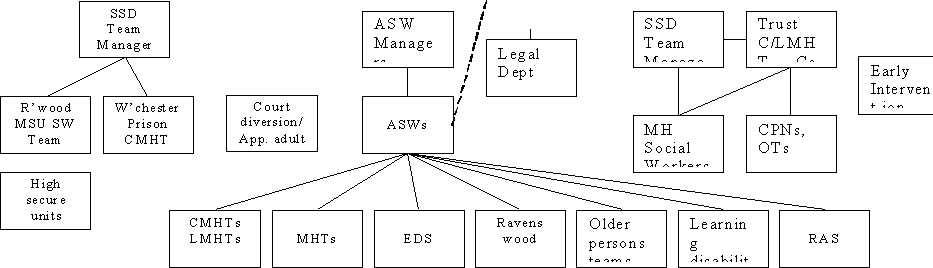
Integrated CPA/Care Management
Modernising CPA
· `Effective Care Co-ordination', `Still Building Bridges', `Safety First'
· Single care co-ordination approach
· Lead Officer for CPA
· Single point of access to service
· Access to service via vulnerability & risk rather than legal status or diagnosis - eligibility criteria & CPA levels integrated
· Joint assessment process & integrated professional records
· User/carer involvement at individual & service planning levels
· Joint information strategies involving users and carers
· Effective management of transitions from child & adolescent services, and to older person's services
· Standard & enhanced levels of CPA
· Improved risk assessment & training (every 3 years)
· Improved care plans - crisis & contingency plans (incl. non compliance & missed contact), culture, ethnicity, gender & sexuality, interventions & outcomes, timescales, housing, occupation
· Carers assessments - compliance with Carers Acts & NSF Standard 6, routinely carried out, training
· Routine monitoring of ethnicity, assessment of local needs and suitable services with regard to race, culture, gender & religion
· Variable review period
· Annual audit of reviews, quality & quantity, Improved data collection
· Discrete sec 117 register within CPA register
· Workload management & clinical supervision
· Urgent follow-up within one week of hospital discharge, 48 hours where high risk
· 24 hour service availability (especially crisis services), assertive outreach & `inreach'
· Local arrangements for information sharing with criminal justice agencies
APPENDIX III
Best Value Mental Health Initial Consultation 12/04/01
EFQM Group
1 People
- staff development "reasonably well planned"
- how well is this spread/consistent across 3 trusts?
- training gaps in care management e.g. finance & ACM
- lack of training in CPA in some trusts
- gap in training and knowledge in CPA in in-patient services
- Alton/Aldershot and SE still short of ASW's (we train, they then leave for unitaries & Surrey)
- G grades hard to recruit, therefore "standards lowered to fill the posts"
- the "decent" nurses leave the hospitals to work in community (more pay) - hard
to get specialist workers
- hard to fill lower grade posts in community
- there are mechanisms for self consultation but staff perception of lack of dialogue
- Health staff worried at becoming care manager/care co-ordinator
- staff consultation fatigue, because of so much change recently
- make distinction between fatigue and resistance to change/user consultation
- need for caseload weighting
- use of practitioner time for gatekeeping not best use
2 Policy & Strategy
- existing CPA policies not written from integration perspective therefore need to be re-written to combine two services into one
- Winchester have joint CM/CPA policy and strategy
- mainly references CM practice manual for CM specifics
- need to increase care plan section of CPA document to make it adequate for CM purposes
- dissemination - happens well and policy gets through the front line practitioners
- carers assessments still peripheral
3 Processes
- still serious problem in transition and MH users who have children, also C&F - adult MH
- adolescent ( 13/14 year olds wouldn't have CPA) support services and MH still problematic
- cultural difference C&F - MH - MH more long term and preventative
- transition MH- OP good within 1 health area
- harder between areas and noticeable reduction in service when someone hits 65 especially as MH have more internal provider services.
- dual diagnosis (LD/MH or sub abuse/MH are particularly problematic
- difference in culture and legislation MH-sub abuse
- duplication of assessments - feeding of the ACMS and CPA - duplication of info
- need joint info system - currently care co-ordinators have to duplicate info
- Systems still divorced e.g health and safety
- SSD information doesn't get into CMHT's from HQ/area offices
- ?role of medical staff in CPA highly variable
- involve GPs in CPA process (training need?)
- not enough `step down' through discharge process
4 Carers Assessments
- Practitioners do assess carers and refer to carers officers
- carers perspective, services could be greatly improved
- New Forest have completed users and carer survey
- Eastleigh carers - 111 Leigh road, worker did carer survey
- Lesley Barrington - audit of CPA in north
- Gwyneth Payne - user focused monitoring report in the north
5 Leadership & Partnership
- integrating 2 policies/approaches but separate management, priorities and demands
- recent 3rd tier reorganisation has increased clinical supervision and improved clarity of role (in W. Hants boundaries) would be positive to pool budgets and share management structure (i.e. creation of Community Support Co-ordinators)
6 EDS
- who you relate to affects service you get
- they're dependent on info they get from CMHTs
- EDS have narrowly defined role (section or nothing) therefore harder to get social and emotional support
- EDS frustrated CMHT's don't use ACMS as much as they'd like
- EDS send a fax and contact sheet to describe intervention
- info gets sent to wrong area sometimes or too much info (irrelevance)
- limited EDS scope means day team have to complete contact even if up to 11pm - health & safety issues
7 Forensic service
- Ravenswood need to use ACMS
- still feels a very separate service
- their expectations at discharge don't fit with operational priorities of areas
- introduction of diversion worker in NF , very positive should be extended countywide
8 Risk Assessment
- staff feel vulnerable - training issue
9 R & A
- compare area office R&A and CMHT direct self referral
Focus Group
Strengths
- integrated teams
- co-location
- future of integration
- joint recording
- work towards joint IT systems
- Audits: CPA in Loddon
- UFM: discharge procedure
- commitment
- new protocols 1st April
- CPA co-ordinators/lead officers
- probation/prisons - links to CPA
Winchester ok
- forensic:
- advocacy services
- users & carers?
- risk assessment competencies
- CPNs as care managers - works in some areas (care manager is helpful term)
- For user - getting the help etc most important, not who does it
- ASW - appreciation of role
- location in crisis teams - future role of ASW?
- CPA - aggregate numbers on
enhanced & standard good
Weaknesses
- south east Havant & Petersfield not in CMHTs
- need single line management
- integration not total
- need one professional record
- all users should have copy of CPA
- need user led audits, shared
ownership, enablement
- variations across areas/trusts/ localities
- Ravenswood - no CPA register
- sec 117 - discharge/who is on it
- but not others Haslar, IOW, Kington
- in reach model not agreed
- attitudes to users - them & us, users need to trust and vice versa
- carers assessments, disemination of information
- how well is it working
- "social work job" in some areas
- recruitment and retention, access to information
- conflict: care co-ordination + ASW role
- MHRT/managers hearing - doesn't have to be social worker, could be care co-ordinator
- variations in approach
- electronic systems not integrated
- role of primary care?
- no monitoring or review
- day service officers to act as care co-ordinators?