Archived decisions
Hampshire County Council | |||
Pension Fund Panel |
Item 5 | ||
10 July 2002 |
|||
Actuarial valuation of the Pension Fund as at 31 March 2001 | |||
Report of the County Treasurer | |||
Contact: David Wilson, ext 7407
1 Introduction
1.1 An actuarial valuation of the Hampshire Pension Fund is carried out every three years by the appointed actuaries, Hewitt Bacon & Woodrow. The Panel should note that the actuaries' name changed with effect from 7 May 2002 following the merger between Bacon & Woodrow and Hewitt Associates.
1.2 The work on the latest valuation as at 31 March 2001 was completed in March 2002. This report summarises the results of the valuation.
1.3 The actuaries have stipulated that the employers' contribution rates for scheduled and admitted bodies should increase from 195% over the next three years as follows:
Scheduled bodies % |
Admitted bodies % | |
2002/03 |
205 |
210 |
2003/04 |
215 |
210 |
2004/05 |
225 |
210 |
1.4 Scheduled bodies are those organisations which have a right to be in the Fund. These are the County Council, the two unitary councils, the 11 districts, Hampshire Police Authority, and other employers which were formally part of the member local authorities, for example the higher and further education colleges. Admitted bodies are those employers which have been allowed into the Fund at the County Council's discretion, for example independent schools.
1.5 These new contribution rates have been implemented with effect from April 2002, and the extra cost of £1m was met in the County Council's budget for 2002/03.
1 Results of the valuation as at 31 March 2001
1.1 The "funding level" (ratio of the Fund's assets to its accrued liabilities) at the 1998 valuation was 89%. The 2001 valuation has revealed a funding level of 88%. However, the Panel should bear in mind that these figures are not directly comparable. This is because the valuation method used by Hewitt Bacon & Woodrow has changed for the purposes of the latest valuation from a traditional actuarial approach to a market value-based approach.
1.2 The market value approach differs from the traditional approach in two main respects:
· The Fund's assets were valued by the actuary at their market value at 31 March 2001 instead of calculating the present value of estimated future investment income.
· Discount rates used for calculating the present values of future liabilities (pensions and other benefits) were based on market yields on fixed-interest stocks and index-linked Government stocks on the valuation date. The traditional approach used long-term smoothed assumptions, which were higher.
1.3 Hewitt Bacon & Woodrow switched to the market value method for several reasons:
· The traditional approach would have produced unrealistic figures for asset values, following the changes to tax credits on UK dividends in July 1997, and the alternative ways companies are rewarding investors.
· The market value approach is less subjective, based on the view of the market rather than a theoretical actuarial view.
· The new regulations which allow the admission of private contractors for short periods require full funding over the short term, so it is important to use assumptions based on current market conditions that can target full funding over the short as well as the long term.
· The market value approach is gaining acceptance internationally as the standard method.
1.4 The past-service deficit (the difference between the market value of the Fund's assets and the discounted present value of the Fund's accrued liabilities) was calculated by Hewitt Bacon & Woodrow at £271m, £109m higher than deficit of £162m revealed by the 1998 valuation. The main reason for this is that returns on the actuarial value of the assets have not matched those assumed at the 1998 valuation. Pensioners are also living longer. As in 1998, a past service adjustment to employers' contributions is necessary and has been set at a level of 40% of employees' contributions for scheduled bodies. This seeks to amortise the deficit over 40 years.
1.5 The cost of future service has also risen, mainly because of the lower investment return assumption used to calculate the present value of the Fund's future liabilities. Hewitt Bacon & Woodrow have set the future service rate at 185% of employees' contributions for all employers.
1.6 The recommended employers' contributions for scheduled bodies resulting from the actuarial valuations in 1998 and 2001 are compared in the table on the next page:
Valuation at 31 March 1998 |
Valuation at 31 March 2001 | |||
% of employees' |
% of pensionable pay |
% of employees' |
% of pensionable pay | |
Future service rate |
170 |
10.2 |
185 |
11.1 |
Past service adjustment |
25 |
1.5 |
40 |
2.4 |
Total |
195 |
11.7 |
225 |
13.5 |
1.7 To minimise disruption to the County Council's budget, and the budgets of other employers in the Fund, the increase in the employers' rate for scheduled bodies has been introduced in three steps as shown in the table below.
Scheduled bodies % |
Admitted bodies % | |
2002/03 |
205 |
210 |
2003/04 |
215 |
210 |
2004/05 |
225 |
210 |
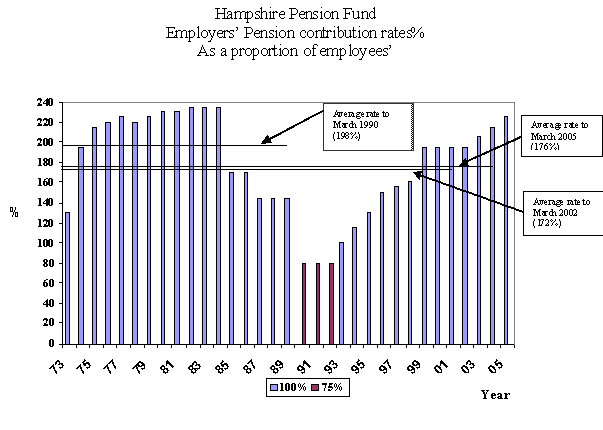
1.8 Only the scheduled bodies can implement rises in employers' contributions on a phased basis. This option was introduced as a result of the Government's imposition of a 75% funding target for scheduled bodies to be used in the 1989 actuarial valuation, savings from which would enable councils to levy a lower community charge. This did not apply to admitted bodies. The right to phase in increases was introduced to minimise budget disruption when the 100% funding target was re-introduced at the time of the 1992 actuarial valuation.
1.9 The Panel should bear in mind that:
· Although employers' contribution rates are increasing, they are still below the average for those pension funds administered by English county councils (223%, 239% and 253% in 2002/03, 2003/04 and 2004/05 respectively).
· They are also lower than they were in the early 1980s when they reached 235% (see graph in Appendix 1).
· The new rates are consistent with the Fund's aim of achieving stability of employers' rates at around twice employees' rates.
· Early retirement costs are now funded in full by employers, so they are under control.
1.10 These higher contribution rates will ensure the Fund remains solvent and there is no cause for concern. No further action by the Panel is required.
Recommendation
1 That this report be noted.
Section 100 D - Local Government Act 1972 - background papers
The following documents disclose facts or matters on which this report, or an important part of it, is based and has been relied upon to a material extent in the preparation of this report.
NB the list excludes:
1. Published works.
2. Documents which disclose exempt or confidential information as defined in the Act.
None.
TITLE FILE
Appendix 1