
Archived decisions
Hampshire County Council | |||
Pension Fund Panel |
Item 6 | ||
10 July 2002 |
|||
The future of the local government pension scheme | |||
Report of the County Treasurer | |||
Contact: David Wilson, ext 7407
1 Introduction
1.1 Pension schemes fall into two main categories: defined benefit (final salary) schemes and defined contribution (money purchase) schemes. The Local Government Pension Scheme is a defined benefit scheme. The main features of defined benefit schemes are:
· Benefits payable are based on a proportion of final salary determined by length of employment. They are not dependent on fund performance.
· Both employees and employers contribute but all the investment risk falls on the employer via the employers' contribution.
1.2 In a money purchase or defined contribution scheme employees and employers normally both contribute, but employers' contributions are often lower, and all the investment risk falls on the employee. On retirement the accumulated value of an employee's and his/her employer's contributions are used to purchase an annuity.
1.3 Because scheme benefits are defined in final salary-based schemes, regular actuarial valuations are needed to establish scheme funding levels and set employers' contributions so that accrued and future liabilities can be met. Defined contribution schemes cannot be in surplus or deficit, as benefits are directly dependent on fund performance.
1.4 Recent actuarial valuations of UK pension funds have revealed that funding levels are falling significantly amongst defined benefit schemes. The main reasons funding levels are falling are:
· Equity markets have been performing poorly over the last two years. Most funds have substantial investments in equities and their asset values have fallen as a result.
· Gilt and index-linked markets have generally performed well - this has led to declining yields. These yields are used to discount pension fund liabilities when assessing their present value. A lower discount rate means higher present values.
· Pensioners are living longer.
· Loss of advance corporation tax credit on dividends on UK shares.
1.5 Falling funding levels, and the implementation of Financial Reporting Standard (FRS) 17, have meant that private sector employers are reviewing their arrangements for pension provision.
2 Financial Reporting Standard 17
2.1 The implementation of FRS 17 this year has meant that deficits or surpluses on private sector defined benefit pension funds must be included in company balance sheets. As many private sector defined benefit schemes are in deficit, this has caused concern amongst many companies running such schemes that their creditworthiness and financial reputation will be jeopardised. Rising employers' contributions will lead to lower profits and hence falling share prices. This could lead to losses in investor confidence in those companies and difficulties in raising capital.
2.2 Companies sponsoring defined benefit schemes have a number of options if they wish to reduce their costs and the impact of FRS 17:
· Close their scheme both to current scheme members and new entrants.
· Close their scheme to new entrants.
· Switch from a final salary scheme to an averaged salary scheme.
· Offer a defined contribution or stakeholder scheme to new starters, or for all employees.
2.3 As a result of these concerns, in 2001 46 private sector defined benefit schemes were closed to new entrants, compared with only 18 in 2000. This process has continued in 2002. The National Association of Pension Funds (NAPF) Director General, David Cranston, believes that this process will almost certainly continue. 92% of employers expect the trend to continue according to the NAPF's latest annual survey of UK pension funds.
2.4 Trade unions have reacted adversely to the move away from defined benefit schemes, believing that employers are using FRS 17 as an opportunity to cut costs. They argue that employees' conditions of service are adversely affected, and that this is illogical at a time when unemployment is low and the recruitment market very tight.
3 The Local Government Pension Scheme
3.1 The LGPS is a statutory defined benefit scheme. The Society of County Treasurers survey of the results of the March 2001 actuarial valuation showed that, out of 35 funds administered by English counties, only seven were either fully funded or in surplus. The remaining 28 are all in deficit. The Hampshire Fund's funding level of 88% is around the average.
3.2 There has been some speculation that the LGPS should follow the trend in the private sector. It could reduce the cost of employers' contributions, but this would be likely to lead to recruitment and staff retention difficulties unless offset by improvements in pay and other conditions of service.
3.3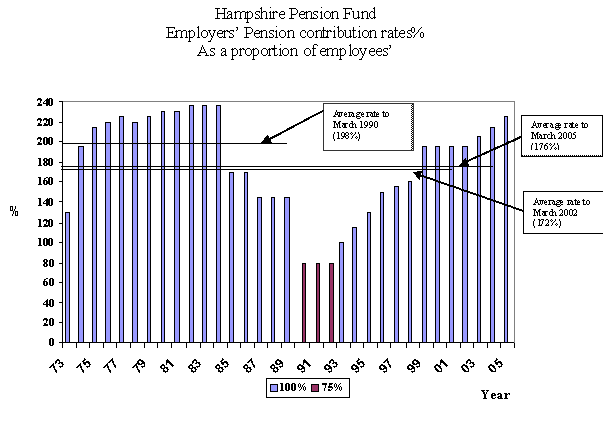 Although the Hampshire Fund is in deficit, current employers' contributions are not unusually high. The graph below shows the trends in employers' contributions paid to the Fund as a proportion of employees' since 1973:
3.4 The graph shows that current employers' contribution rates are now returning to the levels experienced in the 1970s and early 1980s. For three years employers' rates were below employees' when the Government decided to reduce the funding requirement from 100% to 75% to reduce costs resulting with their problems with the community charge. That period of underfunding has yet to be recovered fully.
3.5 Thus the current level of employers' contributions is not unprecedented. Indeed the Fund's Statement of Investment Principles specifies a target for the actuary of an employers' rate around 200% of employees' contributions.
4 Other considerations
4.1 The Local Government Pension Scheme has been subject to numerous reviews, the most recent of which was a stocktaking exercise initiated by the Department of Transport, Local Government and the Regions in September 2001. In May 2002, the DTLR wrote summarising its main findings. Their conclusions were:
· The LGPS continues to meet the needs of full-time local authority employees, but is too inflexible in its provision as employment patterns change.
· The legal framework could be clarified to help understanding of the Scheme.
· Elected members should focus more on resourcing and delivery of benefit administration.
· The results of the 2001 actuarial valuation suggests full compliance with the Scheme's solvency requirements.
4.2 Consultation papers will be published on these issues as appropriate. No major changes are planned by the Government in the nature of the scheme benefit package.
4.3 More generally, although pressure has built up in the private sector to move from defined benefit to defined contribution schemes, it does not mean it is necessary for the LGPS. Pension benefits are only a part of the public service package, and help to offset higher salary costs in the private sector. Clamping down on the LGPS is very likely to lead to problems with staff recruitment and retention and, ultimately, higher pay costs.
4.4 Another strain on the LGPS identified three years ago after an Audit Commission report was that posed by people taking early retirement. The Panel will recall that action has already been taken to address this. Additional contributions are paid to the Fund by service budgets from savings accruing from those early retirements.
5 Conclusions
5.1 LGPS is a national scheme controlled by statute. Nothing more can be done locally to reduce its cost other than improving investment returns. Any changes to its status, benefits or funding would have to be made nationally.
5.2 The DTLR has signalled that no major changes are likely and it is probable that the Office of the Deputy Prime Minister (ODPM), which has taken over responsibility for LGPS, will take the same line.
5.3 The current concentration on switching from defined benefit to defined contribution schemes, if implemented in the public sector, would be a short-term cost-cutting measure and ignore the long-term cost to the economy and the Government's costs of welfare and care for the elderly.
5.4 It would also go against what appears to be the trend in Government policy. A report by Alan Pickering, former chairman of the National Association of Pension Funds, which was commissioned by the Government as part of its current pensions review, has recommended that employers be given back the right to force staff to join pension schemes. This is a response to concerns that many people have made insufficient provision for their retirement and that welfare costs will rise as a result.
Recommendation
1 That the developments and concerns about pensions costs be noted, and that the results of the stocktaking exercise on the Local Government Pension Scheme be welcomed with further reports made when consultation papers are received or other changes are made.
Section 100 D - Local Government Act 1972 - background papers
The following documents disclose facts or matters on which this report, or an important part of it, is based and has been relied upon to a material extent in the preparation of this report.
NB the list excludes:
1. Published works.
2. Documents which disclose exempt or confidential information as defined in the Act.
TITLE FILE