
Archived decisions
Hampshire County Council
Executive Member, Policy & Resources Item
11 July 2002
Trading Standards National Performance Framework Report by the Director of Property, Business and Regulatory Services
|
Contact: Tony Langstone Ext: 6619
Approved by: |
.......................... |
Date of decision: |
......................... |
EMP&R0702B |
Councillor T K Thornber |
Hampshire County Council
Item
Executive Member, Policy and Resources
11 July 2002
Trading Standards National Performance Framework
Report by the Director of Property, Business and Regulatory Services
Contact: Tony Langstone Ext: 6619
1 Background
1.1 Following pilots in a number of authorities, including Hampshire, the Department of Trade and Industry has launched a National Performance Framework (NPF) for Trading Standards Services. The Framework has been introduced to address the inconsistencies in the service nationally, highlighted by the Audit Commission in its report `Measure for Measure' (December 1999). The Government's stated key aim is to improve the service provided to consumers and business. It is also a reaction to concerns that the Food Standards Agency has biased resources towards food enforcement, to the detriment of other areas.
1.2 The NPF is intended to:
· provide clear priorities and core standards for a modern TS service;
· support the role of TS in the community and in contributing to key
local authority priorities;
· improve performance of TS by developing a system of measurement
and sharing good practice;
· facilitate a more coherent and consistent approach to enforcement
and service delivery.
1.3 The NPF has no legal backing at this stage, although it is suggested that this
will come in due course. The DTI envisage a system of self and peer auditing, plus external accreditation and, eventually, government auditing of the plan. The NPF has three main elements:
· A Service Delivery Plan;
· A Set of Standards;
· An Information and Statistical Return.
1.4 The Service Delivery Plan falls into three parts:
· Core responsibilities; objectives; local structure; resources and
expectations of the community.
· Priorities for the year ahead and assessment or provisional aims
against each standard.
· Arrangements to review progress in delivering the plan.
1.5 The standards are aspirations rather than prescriptive and at this stage there are no performance targets, although these will be developed in the light of experience. Services can incorporate their own local standards. The overall intention is that the NPF will ensure delivery of the Government's national priorities for the service i.e.
· Informed confident consumers
· Informed successful business
· Enforcement of a Fair and Safe Trading Environment
· Efficient, Effective and Improving Trading Standards services.
1.6 The NPF seeks to achieve continuous improvement and the Best Value process will be an important means of accomplishing this. The service reports performance against Best Value Performance Indicator (BVPI) 166. The DTI plans to consult in 2002 on bringing BVPI 166 into line with the NPF.
1.7 The Performance Information Return will provide baseline data and is said to be experimental. Although this is not a legal requirement the return will incorporate the statutory annual return under Section 70 of the Weights and Measures Act. This has been greatly simplified. The first return will be required to be submitted for 2002/03 by 30 June next year. Results are likely to be published in league tables.
2. Member Approval and Presentation
2.1 A copy of the National Performance Framework for the County Council's Trading Standards Service is attached at Appendix 1.
2.2 The DTI requires the plan to be approved by the appropriate member forum
and published locally. The DTI state that it must be clear and obvious to consumers, staff and businesses what actions the local authority is planning. Although the plan may be part of a wider document it should be clearly identified in its own right.
3. Summary
3.1 The service has produced comprehensive Service Plans for some years and
should be able to meet most of the proposed standards. The weakest area is in relation to consultation with consumers and businesses together with user feedback. This aspect is being addressed as part of the current Best Value Review of Regulatory Services. Overall the County Council's Trading Standards Service is well ahead of the field in meeting the requirements of the NPF.
Recommendation
1. That the national Performance Framework for the County Council's Trading Standards service be approved.
Section 100D - Local Government Act 1972 - Background Papers:
The following documents disclose facts or matters on which this report, or an important part of it, is based and has been relied upon to a material extent in the preparation of this report.
NB the list excludes:
1. Published works.
2. Documents which disclose exempt or confidential information as defined in the Act.
File Location
None.
APPENDIX 1
National Performance Framework
for
Hampshire County Council Trading Standards Service
Part One: Context and Comparative Factors
A Trading Standards and the Community
1 Introduction
1.1 Hampshire County Council is the third largest shire county with a population of 1.25 million. Its economy is estimated at £16.3 bn, which makes it the second largest shire economy in the country behind only Surrey. The county is predominantly rural, with 87% of the population living in the 10% of the county classified as urban, mainly in the northeast and along the M3 and M27 corridors. Hampshire is generally affluent with higher than national average earnings and low unemployment levels. However, there are pockets of deprivation with a number of wards falling within the worst 20% of deprived areas nationally. The port cities of Portsmouth and Southampton, which became unitary authorities at local government re-organisation in 19997, also have a important effect on the local economy. Significant rural areas are subject to national and international environmental designations, including the proposed new National Parks for the New Forest and South Downs. These and the extensive coastline together with the historic city of Winchester, the ancient capital of England, make Hampshire a popular destination for tourists.
1.2 At local government re-organisation the opportunity was taken to form Regulatory Services by combining the Trading Standards Service with the authority's Science Services (Public Analyst), and the Registration and Coroners Services (together with the Rent Service until it became an agency). Regulatory Services is part of a larger Department known as Property, Business and Regulatory Services. The core responsibilities of the Service are shown on the attached form as Appendix 1.
2 Community and Corporate Objectives
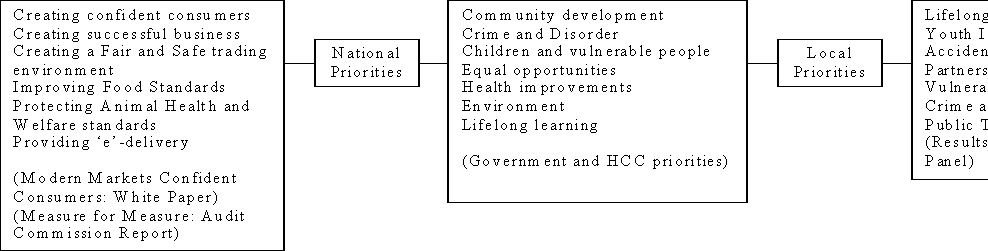
2.1 Service planning has been an integral part of Trading Standards management for many years and maps onto Corporate and Community objectives. The main aims of the Service and their linkages to Corporate and Community aims are shown in Figure 1.
In 2001 the Trading Standards Service was re-structured from nine teams, with a mix of geographic and specialist responsibilities, into four key functional teams:
· Advice, Community, Education and Business Support Team
Hampshire County Council Corporate Strategy
1. Developing the quality of life in Hampshire 3. Achieving Economic Prosperity
2. Stewardship of the Environment 4. Partnership for strong communities in Hampshire
5. Providing high quality, accessible services


Regulatory Services' Vision
To provide highly valued services with maximum impact that best protects and supports the public and businesses of Hampshire


· Fair Trading Team
· Food and Agriculture Team
· Safety and Standards Team
2.2 The aim of the restructure was to further improve performance by focusing resources on key areas and clarifying responsibilities and management accountability. It was also expected to help in meeting corporate and community expectations by providing a more customer orientated service. The need to respond to the challenge of the Food Standards Agency had already led to the formation of an embryo food team, and this was expanded and combined with Animal Health and Welfare to cover food from plough to plate. Streamlining responsibilities enables staff to concentrate on specific legislation and business sectors, which is considered more efficient and effective than endeavouring to cope with the full range of Trading Standards law. The restructure was also intended to meet anticipated demands from the DTI and the OFT and the issues raised in the Audit Commission report `Measure for Measure'. Two new posts were also created from existing resources, one to concentrate on Business Support and the other on Community Safety Projects.
2.3 Each functional team produces its own annual Service Plan, which also includes anticipated and planned developments over a three-year period. An umbrella Service Plan for Regulatory Services as a whole is also produced. Community and Corporate Objectives and their linkage to Trading Standards
Service aims are described in greater detail in the plans, which are attached as addenda as follows:
o Regulatory Services Service Plan
o Advice, Community, Education & Business Support Service Plan
o Fair Trading Service Plan
o Food and Agriculture Service Plan
o Safety and Standards Service Plan
3 Aims, Objectives, Strategic Thinking
3.1 Aims, objectives and strategic thinking are covered in detail in the main Regulatory Service Plan and the functional team Service Plans referred to in Section 2 above. In summary they are as follows:
Vision
· To provide highly valued services with maximum impact that best protects and supports the public and businesses of Hampshire
Mission Statements
· Provide an Advice Service to improve the quality of life through assisting and encouraging confident and knowledgeable consumers and business
· Provide a Trading Standards Service to achieve a fair, safe and equitable trading environment
Key Objectives
· To protect and support the public and businesses by promoting and enforcing Trading Standard laws and working in partnership to improve health and reduce accidents in Hampshire
· To provide advisory, business and education services to our clients
· To continuously improve our service
Member approval has been received for the Food and Agriculture Service Plan and is pending for the National Performance Framework and other Plans.
B Local Structure and Resources
4 Local Authority Organisation, accountability and wider links
4.1 The County Council is made up of nine main departments and the Corporate Management Team is comprised of the Chief Executive and the eight Chief Officers of the departments. The County Council has adopted a Cabinet with Leader structure, the nine members each having a portfolio covering a major service area. The Leader has the portfolio for the Property, Business and Regulatory Services Department, which includes Trading Standards. The organisational structure of the Trading Standards Service and how it fits into the Corporate Structure is shown in Section 3 of the Regulatory Services Service Plan (page 7).
4.2 Partnerships
4.3 Hampshire Trading Standards Service takes part in the following forums for the exchange of information and best practice etc.
· South East Trading Standards Authorities (SETSA) Regional Liaison Group. As part of this group Hampshire is the lead authority for food and metrology and provides the Chair and Secretary for both Focus Groups. The authority also provides the Chair for the Legal Procedures and Consumer Advice Focus Groups and takes part in all other Focus Groups.
· LACORS Food Labelling; Metrology and Product Safety Advisory Groups
· NWML/DTI Metrology Group
· Hampshire Charity Commission forum
· Government Agencies Information Network (GAIN)
· Gosport Citizens Advice Bureau Management Board
· Trading Standards Institute Southern Branch - provides Branch Executive representative
· South East Liaison Co-ordinating Group on Petroleum Licensing
· Petroleum Enforcement Liaison Group (National Body)
· Association of Petroleum Enforcement Agencies - authority provides Branch Secretary
· Regional Animal Health and Welfare Panel
· Memorandum of Understanding with Hampshire Constabulary for the exchange of information
· Officer participation in the European Commission's programme for EU enlargement
4.4 The Trading Standards Service is a member of Basingstoke and Deane and North Hampshire Local Business Partnerships and regularly contributes to their newsletters, which reach over 7,000 businesses. The Service was also instrumental in the establishment of Farmers Markets in the county and Hampshire Fare, an origin accreditation scheme for local food and products. It continues to support both these initiatives.
5 Local Authority Trading Standards Expenditure
5.1 The annual budget for the Service is shown on the attached profile form as Appendix 2.
5 Staffing Allocation
6.1 Staffing is shown on the attached profile form Appendix 2.
6 Accessibility
6.1 The following provides a summary of service provision and accessibility. Further details are provided in the Service Plans.
· Contact can be made in person, letter, telephone, fax, e-mail or via the internet. Offices are open from 8.30am to 5.00pm Monday to Friday.
· Consumer & Business Advice Service Contact Centre at HQ - Minimum of four officers available by telephone (Lo-call 0845 telephone number) - 9.00am to 5.00pm Monday to Friday. Fax and Mini-com also available. Answer phone message facility outside normal office hours.
· Comprehensive website with array of information, advice, fact sheets and leaflets for consumers and businesses together with links to related information and agency sites. Available 24/7.
· E-mail facility linked through to Advice Service for consumer and business advice. Also connected to Consumer Complaints national network.
· Trading Standards Officer available in two Divisional Offices to deal with personal callers; emergency enquiries and business advice.
· Specific telephone number for animal health and welfare enquiries and licences staffed from 8.30am to 5.00pm.
· 24 hour emergency service for animal health complaints; illegal landings (rabies).
· 24 hour emergency service in relation to petroleum licensing, leaks and spillages.
· Translation services are available 24/7 by means of a corporate contract with Language Line, a private company that provides the service directly over the phone if required urgently, or in writing. Large print fact sheets/leaflets etc are available on request.
C Assessment of Community Expectations and Feedback
8 Needs and expectations of consumers
8.1 Community expectation is assessed by a number of methods:
· Analysis of consumer complaints and OFT Code data
· Analysis of customer satisfaction questionnaires
· Corporate Community Surveys (conducted by MORI)
· Corporate Citizen Panel (1600 Hampshire residents)
· Best Value Consultation with staff, residents and business
· County Council Demographic Profile
· Consumer Support Network/Community Legal Services analysis
· Comparison with similar authorities and adoption of best practice
· Complaints relating to the service
· Software analysis of contacts made by telephone and hits on website
· Review of Service Plan projects
The needs and expectations of consumers are dealt with in detail in the Service Plans and are summarised in the following sections.
8.2 Demand for the Consumer Advice Service and Trading Standards Service enforcement advice and investigation has continued to grow. Although this is a non-statutory function the Service has endeavoured to meet this need by maintaining a core team of well trained, dedicated Advisory Officers. The work with the CSN will inform this area of the service as it is developed. The service deals with about 17,000 enquiries p.a. and there is an increasing demand to reach out and identify with local communities. The top three areas of complaint are:
· Second-hand cars
· Home improvements and repairs
· Personal computers
The public wants advice on which businesses are reliable, particularly in the area of home improvements and repairs. There is also a growing expectation for consumers to be educated on their rights and responsibilities. In addition there is a clear need for information and advice on when consumer rights change due to new legislation.
8.3 The majority of consumer complaints that are dealt with by enforcement staff related to fair trading issues. The Service expects to deal with over 2,000 enquiries in the current year. The majority of investigations and prosecutions usually fall to the Fair Trading team as enquiries relate to the wilfully non-compliant. Many complaints relate to second-hand cars and servicing; home improvements and repairs and misleading prices.
8.4 The service deals with approximately 400 consumer complaints p.a. relating to product safety and under-age sales, showing this to be a key area of public concern. In addition it is estimated that 320 complaints will be received in respect of food composition and labelling. Animal welfare is another area of public concern and a number of pressure groups are particularly vocal, which makes this a priority area of work.
9 Needs and expectations of local business
9.1 The Service aims to ensure a high level of compliance with Trading Standards legislation at the same time as supporting the Corporate Aim of Achieving Economic Prosperity. Our assessment of need is therefore based on advising and working with businesses, with progressive action for non-compliance. Business need and expectation is based on inspection and sampling results; enquiries and complaints from and about businesses; Hampshire Planning & Research Profile and Corporate and Government priorities. Direct consultation with businesses is due to take place in the summer of 2002 as part of Best Value. Business demand is dealt with in greater detail in the Service Plans attached and is summarised in the sections below.
9.2 Based on our assessment there is a need to meet demand for advice from Hampshire businesses and the Home Authority Principle is a core element of the service.. This is built into the Service Plans as specific projects and an appropriate number of officer days allocated. The assessment shows a need for:
· A range of leaflets and fact-sheets giving advice and information on legal requirements
· A regular dialogue with over 700 Home Authority businesses
· A business focused advice website
· Special support when new legislation is introduced
· A trader approval scheme to support local businesses
· A regular business newsletter to approved traders
· Presentations to business groups
· Support for Local Business Partnerships
9.3 Demand for metrology verifications and work related to new and re-developed petroleum storage sites continues to be heavy. Home authority requests for advice is strong in the fields of food labelling and composition; product safety and fair trading. A number of companies require officers with specialist knowledge e.g.
· Mineral water producers
· Cosmetic manufacturers
· National DIY chain
· National Internet Service Provider
· Consumer Credit companies
· Product Safety manufacturers and importers
· Horse markets
Counterfeit goods, particularly clothing and software, give rise to complaints from businesses and trade mark holders. Blackbushe market in particular is an area of concern in this respect. Sampling results demonstrate the need for continuing action on product safety and food. Inspections of weighbridges and bulk fuel meters also show a high percentage of equipment to be outside permitted tolerances. Livestock farmers require advice on ever changing licensing rules following foot and mouth and a responsive licensing system.
9.4 The Hampshire Planning and Research Profile shows the county to be close to the national average for large firms with over 100 employees. There are 31 businesses per head of population, slightly above the national average of 28. A high proportion of employees are in high technology, `knowledge based' industries, with twice the percentage of manufacturing employment than nationally. However, Hampshire is below the national average for knowledge based services. Taken together Hampshire is just above the national average. Further details are shown in the profile form - Appendix 2.
10 Local awareness of Trading Standards
10.1 A MORI survey of Hampshire's Citizens' Panel in 2001 showed that consumer awareness of the Trading Standards Advice Service is quite low at 41%. Groups significantly less likely to be aware of the service include:
· Young people, particularly those aged 16-24
· Those working full-time (60% not aware compared with 53% for those not working full-time)
10.2 Only 12% of residents had used the advice service - none aged 16-24. It must be pointed out that this survey was in relation to the Advice Service only rather than Trading Standards as a whole. This compares with the DTI Consumer Knowledge Survey 2000, which showed that 90% of people had heard of the CAB and 49% had used it. The DTI survey also showed that 73% of people knew of Trading Standards and 40% had used the service.
10.3 A small survey of advice service users was carried out in 2000 and a revised questionnaire piloted in 2001. The findings have been analysed with a view to carrying out a larger, regular survey of users. Further consultation, including non-users, is also being conducted in summer 2002 as part of Best Value. Awareness of the service is being promoted through press releases and articles in the County Council's residents' magazine, `Hampshire Now', which is sent to all households in the county at least three times a year.
10.4 Consultation with business is due to take place during 2002 as part of Best Value and relevant data is not currently available. Judging from demands made on the service by businesses it is generally well known. Awareness is believed to be particularly high at food premises and among farmers due to an extensive food inspection and sampling programme and foot and mouth licensing respectively. Among businesses targeted by the service or affected by licensing e.g. product safety premises and petroleum sites, awareness is again expected to be reasonably high. Knowledge of the service across the car trade is known to be high from inspection and investigation activities. Press releases; articles in LBP and Federation of Small Businesses newsletters and trade seminars aim to increase awareness of the service.
11 Demand for specialist services
11.1 The Weighbridge Test Unit is hired out to other authorities and commercial operators for approximately three quarters of the year. Demand from commercial users has grown steadily since new insurance arrangements released it for use by private companies two years ago. However, this has been balanced by reducing demand from local authorities. Including inspection and verification within Hampshire the Unit is in use throughout the year. The high level of weighbridges found to be incorrect on inspection in Hampshire (21%) makes this a priority area of metrology work.
11.2 The Bulk Fuel Unit is used by Southampton and Portsmouth Unitary authorities for six days a year and occasionally by the Isle of Wight. The use by other authorities declined to zero in 2001. Use of the unit within Hampshire is a priority metrology area due to past experience of fraud in this trade; lack of controls and checks available to consumers and relatively high failures found on inspection (13%).
11.3 Approved Body Status (NAWI). 64 scales were tested in 200/-1, the highest in the SETSA region. Demand reduced to 19 in 2001/02, again the highest in the region. Hampshire is leading a review of approved body status for SETSA with a view to rationalising provision across the region.
11.4 Last year was particularly difficult year due to the foot and mouth outbreak.
The Government restrictions on use of footpaths and various licence schemes for the movement of animals placed a heavy burden on managers; animal health and support staff. Considerable efforts were made to meet demand for movement licences from farmers. Hampshire was one of the first authorities to issue licences under the new scheme and a weekend service was provided for period of time. The Service worked in partnership with Emergency Planning and Countryside Services to risk assess County Council premises and footpaths throughout the county. A special call centre was set up to deal with enquiries following mail shots to landowners and farmers. Communications with District authorities and special interest groups e.g. New Forest Committee and outdoor Pop Festival promoters, were extensive and time consuming. The priority for the current year is to continue administering the latest licensing scheme on behalf of DEFRA and to agree a Service Level Agreement on future enforcement activities.
Part 2: National and Local Priorities
D Policies on National and Local Priorities
12 Informed Confident Consumers
12.1 All work, including reactive, is estimated from previous experience and allocated a project number and staff and financial resources. There is a heavy claim on officer time from consumer complaints, particularly on fair trading
and safety. Due to the demand on resources the Service is gradually moving towards an intelligence led approach to enforcement. Complaints from the public are risk assessed and those of a minor nature are only recorded for information and taken into account in future service planning. A close watch is kept on the top ten `problem' companies and projects are planned for known problem areas e.g. second-hand cars, which is regularly the top trade sector for consumer complaints.
Home repairs and improvements is the second highest category of consumer complaints and the Service has adopted a good trader scheme, focusing on such traders. Members of the scheme are promoted by the Service through press releases, publicity launches and our website under the banner of `Buy with Confidence'. The aim is to sign-post consumers to reliable traders and marginalize the poor ones, thus reducing consumer complaints. The scheme has over 300 members and is believed to be the largest of its kind in the country. The firms are vetted for compliance with consumer laws etc and promoted in a partnership with Age Concern and via general publicity and our website. Small job friendly firms are particularly welcome and promoted. The Service now has a fulltime member of staff to deal with the scheme and provide general business support. The aim is to also make links with trade associations and other bodies to provide a comprehensive, county wide scheme that covers the main areas of consumer concern. Demand for the scheme continues to grow.
12.3 Inspection is a another key element of the service to ensure high standards of compliance. The service expects to visit all high risk and half of medium risk premises during the year. The service also maintains a high level of food and product safety sampling as part of annual programme of work. The former is not only to meet Food Standards Agency requirements but also the general public concern over food safety, composition and labelling.
12.4 Under-age sales are considered to be a high priority area of work due to Government targets on health e.g. reducing the level of smoking; reducing accidents (solvent deaths). Such priorities are reflected in local concerns, particularly relating to alcohol, which links to other aims related to youth; crime and disorder; and educational attainments. The service plans to work closely with the police to enforce the new, shared duty in respect of the Licensing Act.
12.5 The Service Plans give details of planned projects, which cover all the work carried out by the service, targets and the resources allocated. Each project has a project leader who produces a project protocol setting out the links to Corporate Aims; methods to be adopted; details of premises to be visited and/or samples to be taken; performance indicators and anticipated outcome.
12.6 Full details and links to Corporate objectives are shown in the attached
Service Plans. Appendix 3 shows the full list of planned work in the form of
projects.
The following is a summary of planned service provision.
Provisions for educating, informing, advising and creating confident consumers. | |
Consumer Need as Assessed in Section 8 and NPF Standard |
Actions currently undertaken and planned to address consumer need |
Consumer Advice Service |
Advice Service responding to 18,000 enquiries and complaints. Improve call handling to deal with unmet demand. Maintain Community Legal Services (CLS) Standard to provide high quality service. Use Stop Now Orders where appropriate. |
Presentations and Talks |
Respond to approx 12 requests |
Provide fact sheets; leaflets and ensure wide distribution |
Ensure leaflets up-dated take account of new legislation and expected revision of Sale of Goods |
Internet Information and Access |
Continue development of website to provide consumer information and e-mail facility |
Information on trading activities and scams |
Press releases and advice with back-up fact sheets as appropriate. Continue to expand and promote the Buy with Confidence Scheme -in particular in area of home repairs and improvements. Aim to expand coverage of second-hand car dealers. Monitor and take appropriate action against main problem traders. |
E-commerce activity |
Fact sheet and Press release with advice and information on Distance Selling Regulations and buying on the Internet |
Developing and delivering pro-active education programmes to vulnerable groups |
Consumer education to Key Stage 2, 3 and 4 via Young Consumer Competition; Junior Citizen and Citizenship Education Package |
Joined up working with other organisations and regionally |
Active participation in SETSA Advice and Education Focus Group Continue to develop Citizenship Education Package with Education Service |
Participation in Consumer Support Network (CSN) |
Continue to develop CSN and achieve formal recognition |
Improve accessibility and availability of service and identify gaps and reach non-users |
Improve software monitoring call-handling and assess means to meet demand Consult with users and non-users Analyse results to improve service Develop links with vulnerable groups |
Measure use and effectiveness of education, advice and information services |
Continue to analyse feedback from education projects above. The response to all projects has been extremely positive. If extra resources become available Junior Citizen will be extended to the whole county. |
Encourage participation in consultation processes |
An initial survey of 100 users and a monthly survey of 30 users is planned. Further consultation will depend on the results of the Best Value consultation exercise |
13 Informed Successful Businesses
13.1 Full details and links to Corporate Objectives are shown in the various Service Plans. The following is a summary of planned service provision. A full list of projects covering all areas of work is shown in Appendix 3.
Key Tasks to ensure Informed, Successful businesses | |
Business Need as Assessed Part C and National Performance Standard |
Actions currently undertaken or planned to address business need |
Home Authority and local business advice & support |
Provide timely advice and guidance to 704 HA companies plus local businesses |
Home Authority and local business advice & support |
Provide officers with specialist knowledge to deal with specific firms. |
Information and guidance |
Provide up-to-date leaflets and fact sheets in hard copy and on website. |
Information and guidance |
Provide pro-active guidance by media releases and business seminars . |
Information and guidance |
Direct mail shots; seminars and press releases for new legislation. |
Improve compliance |
Develop Business Standards Partnership and provide a regular newsletter to members. |
Improve compliance and minimise non-compliance and failure |
Carry out a risk assessed programme of inspection and sampling - especially in area of food and product safety. |
As above |
Support Local Business Partnerships |
As above |
Investigate serious criminal breaches and take appropriate action, including prosecution. |
As above |
Use STOP Now Orders when appropriate |
Joint working |
Co-ordinate enforcement with neighbouring authorities, regional group and other agencies through joint projects. |
As above |
Enforce Licensing Act with police through a joint protocol |
As above |
Expand Responsible Tobacconist Award by joint working with Health Promotion Service and District Councils. |
As above |
Provide a livestock licensing service in conjunction with DEFRA |
Verification Service |
Provide responsive verification service for business |
Metrology Service - WBTU and Bulk Fuel Meter |
Provide specialist metrology services for other TS authorities |
Approved Body Status (NAWI) |
Provide service to business and other local authorities. Review regional provision of this service with view to rationalising it. |
Petroleum Licensing |
Provide a responsive service - in particular at new and re-developed sites |
Improve accessibility and identify gaps in service |
Analyse response to Best Value consultation |
Measure effectiveness of education, advice and information services |
Analyse feedback and response to BV consultation |
Encourage participation in consultation process |
Conduct BV consultation survey and consider future approaches |
14 Enforcement of a Fair and Safe Trading Environment
14.1 Principles of good enforcement
The Service is committed to following the principles of the Government's Enforcement Concordat as adopted by the County Council. We have an Enforcement Policy that links to the Code of Crown Prosecutors. We use examples of best practice in enforcement e.g. with our under-age sales and the LACORS Code of Practice. The Service also promotes fair and safe enforcement through its Responsible Tobacconist Award, Business Standards Partnership and Buy with Confidence scheme.
14.2 Home Authority Principle
Hampshire was the originator of the Home Authority Principle and is committed to following LACORS guidelines. We have over 700 businesses for which we act as Home Authority, including a number of large national firms. The Service has always made it a key objective to ensure high levels of compliance with goods and services emanating from the county. The provision of guidance and advice to local companies is therefore one of our top priorities. We support effective liaison between local authorities by meeting other TS services to discuss issues relating to Home Authority companies.
14.3 Programme of enforcement activity
The Service has a comprehensive programme of enforcement action that includes inspection, sampling and investigation and aims to balance reactive and pro-active work. The projects for the current year are outlined in Appendix 3.
14.4 Enforcement arrangements for e-business and e-commerce
We have developed and trained a senior officer with IT and computer forensics skills to assist in investigating cases involving Internet websites and e-commerce activities. The service has seconded the officer on a regular basis to the SETSA Computer Forensics laboratory. As part of the laboratory's work the officer has assisted other TS authorities with investigations. Enforcement activity in this area is primarily re-active but special projects are run periodically to examine trade sectors on the web. This includes the purchase of goods for testing under product safety legislation. We have also produced a leaflet for consumers on purchasing over the Internet and issued press releases relating the Distance Selling Regulations.
14.5 Targeting problem traders and business sectors
The Service regularly monitors its `top ten' problem traders in relation to consumer complaints received and takes progressive enforcement action to improve compliance. This will invariably include advice and written warnings except in the case of traders who have demonstrated that they are wilfully failing to comply, when legal proceedings are taken. In appropriate situations Stop Now Orders will be used to improve the conduct of traders. Problem business sectors are identified from consumer complaints; inspection and investigations. The top three sectors for complaints are:
· Second-hand cars
· Home Improvements and Repairs
· Personal Computers
We are carrying out a project on second-hand car dealers in the current year. Home improvements and repairs are being dealt with through our Buy With Confidence scheme. We have also produced a leaflet on buying computers.
14.6 Tackling practices which target vulnerable and socially excluded
A new Community Safety Officer is developing projects which will improve protection of vulnerable groups. This includes working with Neighbourhood Watch Groups and the police; developing an information booklet and assisting with a DTI funded initiative aimed at helping vulnerable people.
14.7 Arrangements with regional co-ordinators
Hampshire plays a key role in SETSA by providing Chairman and Secretaries to a number of Focus Groups and a member of the Executive.
14.8 Metrology inspection and verification
A verification service is provided by a dedicated team who also conduct petrol pump inspection. Due to the low rate of failures found pumps are generally only inspected every five years. Inspection is concentrated on equipment with the highest failure rate i.e. weighbridges and bulk fuel. Metrology inspection at production level is a high priority and the food team also carry out inspections at retail food premises.
E Efficient, Effective and Improving Trading Standards Service
15 Efficient, effective and improving Trading Standards Service
15.1 As stated in Section 2.1 the Service was reviewed and re-structured in October 2001 in order to meet stakeholder needs more effectively and efficiently. The benefits and any disadvantages of the new arrangements will be reviewed in September 2002. So far staff reaction has been very positive. During the spring and summer of 2002 the Service will conduct a Best Value review, which will include extensive consultation with the public and business. It will also hold a Challenge event by inviting key stakeholders to give their views on the Service and its priorities and how the service is delivered. Members are obviously an integral part of the review and are invited to attend all Best Value meetings and the two sub-groups dealing with Consultation and Comparison. Best Value will be the prime vehicle for improving the Service and a final report to the County Council is planned for October 2002. In addition where reviews of the Service Plan and projects identify areas for improvement or development these will be implemented as appropriate. Staff are encouraged to present ideas for improvement via a `Brainwave' suggestion scheme, the Performance Development Review process and staff meetings.
A key objective of the Service is to continually improve quality, effectiveness and efficiency. The following areas are planned for 2002 - 03.
Provisions for developing and modernising the service |
Relates to relevant feedback |
Links with other partnerships |
Links with Best Value Review |
Consultation with stakeholders |
Insufficient evidence of stakeholder needs |
DTI DEFRA SETSA LBPs Police LACORS F&RS CSN |
Yes |
Comparison with Best Practice and similar sized TS authorities |
Inadequate analysis of information and details of best practice |
As above |
Yes |
Challenge Workshop |
No available feedback |
As above |
Yes |
Compete with alternative service providers |
No evidence currently available |
Yes | |
Quality Audits |
Feedback from previous audits and Quality Review |
Yes | |
Develop website |
Increasing hits on website and e-mail contacts |
CSN SETSA LBPs |
Yes |
Develop communications to ensure information accessible and in Plain English |
Feedback from MORI surveys |
Yes | |
Maintenance and Calibration |
Feedback from ISO 9000 audit |
Unitary Authorities |
|
Health & Safety at work |
Internal Audits |
Yes |
Part 3 Review, Assessment and Improvement
16 Quality Assessment and Review
16.1 Provisions for ensuring the work of the service is assessed against the Service
Plan and ISO Standard include the following:
· To continue to work to an accredited ISO 9000 Quality System
· To continue to work to an accredited IIP Quality System
· To continue to work to an accredited CLS Quality System
· To continue to develop an approach that matches the EFQM Excellence model
· To monitor performance against BV 166
· To monitor Service Projects at team and management level on a quarterly basis
· To monitor projects leaders effectiveness at Performance Development Reviews
· To develop further consultation processes with stakeholders to inform future policies
· To continue with peer assessment of specific service aspects
· To compare performance by reference to CIPFA information; best practice reports and regional benchmarking
· To consider applying for Beacon Status and the OFT Excellence Award
Current Awards
As indicated on the Profile Form, Hampshire already holds the following awards:
IIP ISO 9000 CLS Quality Mark
Benchmarking and Peer Assessment
Hampshire is a member of SETSA, the regional Trading Standards liaison group of 10 neighbouring authorities , which operates benchmarking and focus groups to share best practice. It also undertakes peer assessment of metrology and health and safety issues with partners in this group. Benchmarking on CIPFA statistics against the six shire counties in England with a population exceeding 1 million, and English counties as a whole, is carried out. Best Practice and statistical comparison has also been conducted with four other county councils that have received the OFT Excellence Award or Beacon Status. Similar comparisons have been made with other agencies, including the police and AA. A comprehensive assessment against the EFQM model has been conducted as part of the Best Value Review. This work will continue to be developed.
Performance against Service Plan
Monitoring the progress of service plan projects is measured on a monthly basis by TS Managers and Team Leaders and at quarterly specialist officer team meetings. It is also reported to the Regulatory Services Management Group and an Annual Report produced. Quarterly reviews are used:
· To identify any significant variations from the plan and the reasons and action to be taken
· To analyse complaint statistics and trends and identify any amendments required to enforcement programmes or service delivery
· To take account of any external influences that were not considered when the plan was prepared e.g. changes in local or national policy; new opportunities etc
· To identify good practice and successful projects and build on these
· To identify additional non-planned work that has met objectives
· To review the balance of pre-planned and reactive work
· To ensure that the overall plan is achievable by resource planning
ISO 9000
As part of its Quality System the Service has procedures covering all aspects of its work. The Service Plan includes a programme of internal audits against the procedures with subsequent reporting and remedial action. TS Managers are responsible for ensuring that the Quality System is followed and kept up to date by specialist officers. The Quality System is subject to an annual Management Review and Action Plan.
All Teams and Specialist Officers have a copy of the Service Plan and are aware of how their individual work feeds into the aims and objectives of the Plan.
16.2 Identification of Variation from Plan
Due to the anticipated addition of an officer to deal with the new duties under the Licensing Act action in this area and on under-age sales in general will be increased. The Plan will also need to take account of changes necessary following any Service Level Agreement with DEFRA. The Service Plan was finalised in March and no other significant changes have been identified at this stage.
16.3 Areas for Improvement
An action plan is currently being drawn up from a recent Quality Management Review.
Appendix 1
CORE RESPONSIBILITIES OF THE TRADING STANDARDS SERVICE
Name of Authority |
HAMPSHIRE COUNTY COUNCIL | |||
Name of Chief Inspector of Weights and Measures |
ANTONY E LANGSTONE | |||
Status of Plan |
(yes or no?) | |||
Enforcement Responsibility |
Description |
Is this in your remit? (yes or no?) | ||
Weights and Measures |
Work relating to the accuracy of weighing and measuring equipment in use for trade and ensuring quantity of goods is within tolerance. Verification services. |
YES | ||
· Does your authority maintain local standards? (Ref: Section 4 Weights and Measures Act 1985) |
NO | |||
· Does your service hold Approved Body status? (Relates to the Non Automatic Weighing Instruments Directive and linked UK Regulations) |
YES | |||
Fair Trading |
Includes claims about prices, quality or description of goods and services. |
YES | ||
Product Safety |
Includes monitoring goods supplied to consumers are safe and correctly labelled. |
YES | ||
Food Standards |
Includes ensuring food is correctly described and labelled throughout the supply chain, and that applicable compositional standards are met. |
YES | ||
· Is this function shared with environmental health? |
NO | |||
Consumer Credit |
Includes monitoring licensing regime, ensuing transactions, documentation and adverts comply. |
YES | ||
Animal Health and Welfare |
Includes movement licences, monitoring welfare during transport and at markets |
YES | ||
Agricultural Standards |
Includes ensuring fertilisers and animal feeding stuffs are of correct composition and labelled. |
YES | ||
Age Restricted Sales |
Ensuring certain products are not supplied to children, e.g. tobacco, videos, butane lighter fuel fireworks. |
YES | ||
Road Traffic |
Includes supply of unroadworthy vehicles, overloaded goods vehicles, weight restriction areas. |
YES | ||
Explosives |
Ensuring fireworks and other explosives are safely stored on registered premises. |
YES | ||
Petroleum |
Ensuring petroleum is safely stored on licensed premises. |
YES | ||
Environmental Legislation |
Includes energy labelling, packaging disposal and motor fuel pollutants. |
YES | ||
Licensing |
List only the main duties: | |||
Petroleum | ||||
Explosives | ||||
Poisons | ||||
(Nurses Agencies) | ||||
Additional Functions. List any additional main duties which fall to your service (Do not include membership of enforcement forums and business partnerships as these fall into section 4 of the plan) | ||||
Specialist Services. List only the main services below (include services such as calibration services, public analyst and product testing, note any partners) |
Partners | |||
Regulatory Services includes the Trading Standards Service and Public Analyst service Weighbridge Test Unit Bulk Fuel Unit EC Notified Body |
Public Analyst Partnered with Kent County Council | |||
Advice Responsibility |
Description |
Is this in your remit? (yes or no?) | |||
Are you part of a Consumer Support Network? |
YES | ||||
Business Advice |
Provision of advice to business through means other than inspection and home authority. |
YES | |||
Consumer Advice |
Provision of advice & information to consumers. |
YES | |||
| Indicate the level of consumer advice you provide. (mark Y for yes where appropriate) (In terms of the Community Legal Services Quality Mark definitions) | |||||
Level |
Local tax payers |
Contract in area |
No local connection | ||
Information |
YES |
YES |
YES | ||
Assisted information |
YES |
YES |
NO | ||
General Help |
YES |
YES |
NO | ||
General help plus case work |
NO |
NO |
NO | ||
Information: The advice service must typically be able to supply information such as leaflets and other reference material relevant to trading standards | |||||
Assisted information: As well as offering information such as leaflets and other reference material will also provide someone to help find the information needed or to help decide on the most appropriate source of help | |||||
General Help: The advice service must typically be able to offer information and advice to consumers to help resolve the problem. The service will diagnose the problem, explain the options available to rectify the problem, identify further action and give basic assistance such as assisting in form filling, letter writing and by contacting other organisations for further information. | |||||
General help plus case work: As above but will take action on behalf of the consumer and puts their case to the other party in order to persuade them to make or change a decision in favour of the consumer. This might include negotiating by telephone, by letter or face to face. The service may provide advocacy in formal proceedings such as the Small Claims Procedure | |||||
Your council/business tax payers: Residents, local businesses, organisations based in the area | |||||
Contracts arising in your area: Complainant/enquirer may not be based in the area, but the goods or services causing concern were obtained in the area | |||||
All contacts helped: Advice is given regardless of origin | |||||
 Client
Appendix 2
COMMUNITY TRADING STANDARDS SERVICE DELIVERY PLAN
PROFILE FORM
Name of Authority |
Hampshire County Council | |||
Area in Hectares |
369,032 | |||
Local Authority Organisation | ||||
In what year will/was the Trading Standards service part of a Best Value review by your authority? |
2002/2003 | |||
Indicate if you have received, or are working towards, any of the following: |
Received |
Working towards | ||
· Charter Mark |
||||
· Investors in People |
_ |
|||
· OFT excellence award (scheme under review) |
_ | |||
· Beacon Status (what topic) |
||||
· CLS Quality Mark |
_ |
|||
· ISO 9000 |
_ |
|||
Do you use the EFQM ® model? (yes or no?) |
YES | |||
Do you have a service level agreement with the Office of Fair Trading? (Yes or no?) |
NO | |||
Others: (list below) |
Brief description | |||
Anti-counterfeiting Group Award |
Awards to authority and also senior officer for | |||
commitment to anti-counterfeit work. | ||||
DTI |
Specific Contract to check compliance with | |||
Recreational Craft Directive and Electro magnetic | ||||
compatibility Regs. | ||||
Please note that costs and expenditure have not been completed in this example because it is fictional and DTI does not want to suggest that there is an optimum resource level for this plan. Local Authority Expenditure
Column 1: where available give actual expenditure for last financial year, where figures are not yet available state estimated expenditure and send fully completed form to DTI when figures are confirmed. | ||
Column 2: give details of your budget allocation. | ||
1 Gross Expenditure (or forecast spend) 2001/2002 |
2 Budget allocated for coming year 2002/2003 | |
EMPLOYEE COSTS Include: basic pay, overtime, employer's superannuation, employer's national insurance SSP due, pay arrears, other allowances/payments, car allowances/mileage/leases/travel expenses and fares, subsistence, pension increases and other employee costs. |
NB Projected out-turn not actual 2,181,100 |
2,249,700 |
PROPERTY COSTS |
800 |
700 |
SUPPLIES AND SERVICES Include: computer equipment (purchase/rental/maintenance), furniture, equipment and other tools including protective clothing, publications, journals, newspapers and other supplies and services. |
140,600 |
141,300 |
SAMPLING COSTS Include: purchases made for the purposes of sampling/testing. |
424,100 |
423,700 |
TRANSPORT AND PLANT Include: hire of external vehicles |
85,400 |
85,300 |
ADMINISTRATION Include: Printing and stationery, telephones, advertising (recruitment), postages/couriers, insurance, medical costs, petty outlays, hospitality and other administration costs |
46,700 |
46,800 |
TRAINING AND CONFERENCES Include: training, conferences, membership fees/subscriptions and exam fees. |
31,600 |
31,600 |
PAYMENT TO OTHER BODIES For example, public analyst, test unit, cross-boundary projects |
- |
- |
PAYMENT TO CONTRACTORS |
- |
- |
TRANSFER PAYMENTS |
- |
- |
FINANCING CHARGES Include: central support costs |
294,800 |
300,900 |
GROSS COSTS (total of all above costs) |
3,205,100 |
3,280,000 |
INCOME |
212,800 |
204,900 |
Please note expenditure heads are based on CIPFA expenditure heads. From Audit Scotland's Self Assessment Guide | ||
FUNDING FOR LOCAL BUSINESS PARTNERSHIPS |
- |
- |
Staffing Allocation (Numbers to be expressed as full time equivalents to one decimal point as employed at the start of the financial year. Where staff are shared with other services or have mixed roles include the hours spent on Trading Standards roles to full time equivalents. Examples of mixed roles might be enforcement staff acting as consumer advisers on a regular duty rota or DTS trainees who additionally have an enforcement role. | ||
Role |
Description |
Number of staff |
Managerial |
Staff primarily concerned with the management of staff within Trading Standards. Include only the proportion of time spent on such duties. |
4.5 |
Administration |
Staff that support the service within the office |
8.2 |
Enforcement staff |
Staff such as Trading Standards Officers and Consumer Protection Officers authorised under criminal legislation |
39 |
Enforcement support staff |
Staff not authorised under criminal legislation but who support that aspect of the service, for example laboratory staff, technical assistants |
9 |
Consumer advice |
Include both full time staff dedicated to providing advice to consumers and the proportion of time other staff spend on such duties. |
8.6 |
DTS Trainees |
From degree or APEL routes |
1 |
Total Number of Staff |
Exclude vacant posts |
70.3 |
Current vacancies |
All roles |
1 |
Long term vacancies |
Note number of vacancies of more than 4 months duration |
|
Qualification |
Description |
|
DTS |
Diploma in Trading Standards or equivalent |
25 |
DCA |
Full Diploma in Consumer Affairs |
20 |
DCA Food paper |
Full Diploma in Consumer Affairs with Food qualification |
8 |
DCA Animal Health |
Full Diploma in Consumer Affairs with Animal Health qualification |
4 |
DMS & similar |
Diploma in Management Studies |
13 |
Others: |
List other relevant qualifications (include PC training for example ECDL, single DCA papers) |
30 |
Business Profile |
|||
Description |
Number | ||
Businesses registered for business rates |
This brings consistency to statistics between authorities. Give most recent figures. |
33,011 | |
Home Authority Firms: formal agreements |
Following LACOTS Home Authority principle guidance. Give estimate at end March 2002. |
||
Home Authority Firms: informal recognition |
Number of traders you recognised as being based in your area and about which you will take enquiries. Give estimate for end March 2002. |
704 | |
Enquiries received concerning your Home Authority firms. |
Include figures from other enforcement agencies. Exclude consumer complaints and enquiries and requests for business advice. Give estimate for end March 2002. |
620 | |
Risk Assessment: assessment of risk a business poses to consumers and competitors to determine frequency of inspection visits and appropriate enforcement | |||
High |
Follow LACOTS guidance on premises risk assessment (revised and issued early 2002). Give figures from your database for year end for the number of businesses based, or with physical premises, in your local authority area. This can include internet sites where the supplier is based in your area, stalls and other mobile traders as well as fixed premises. |
885 | |
Medium |
7071 | ||
Low |
14,652 | ||
No inspectable risk |
11,528 | ||
TOTAL |
34,136 | ||
Other Business Data |
|||
Description |
Number | ||
Business start ups |
Use figures based in VAT registrations. Give figures for end March 2002. Latest figures are for 2000 |
4,320 | |
Business failures |
3,740 | ||
Appendix 3
|
|
|
|
|
|
|
|
|
FAIR TRADING |
| |||||
|
| ||||||
Project no |
Project |
P.L. |
CORE |
SPECIAL |
TSO |
TO |
TOTAL |
|
| ||||||
2T1A |
Reactive work - Public |
AJS |
1000 |
800 |
200 |
1000 | |
2T1B |
Reactive work - Businesses |
AJS |
600 |
500 |
100 |
600 | |
2T2A |
Prosecutions & investigations |
AJS |
530 |
430 |
100 |
530 | |
2T3A |
Monitor licence renewals |
AJS |
15 |
15 |
15 | ||
2T3B |
Nurses agencies |
JRL |
30 |
30 |
30 | ||
2T3C |
Blackbushe Market |
MD |
85 |
35 |
50 |
85 | |
2A3 |
Consumer Education |
JF |
35 |
35 |
35 | ||
|
| ||||||
|
TOTAL |
|
2130 |
165 |
1845 |
450 |
2295 |
|
| ||||||
|
FOOD |
| |||||
|
| ||||||
Project no |
Project |
P.L. |
CORE |
SPECIAL |
TSO |
TO |
TOTAL |
|
| ||||||
2F1 |
Reactive/Prosec/Inv work |
NAS |
520 |
500 |
20 |
520 | |
2F2 |
High risk inspections |
NW |
303 |
243 |
60 |
303 | |
2F3 |
Medium risk inspections |
NW |
530 |
470 |
60 |
530 | |
2F4 |
Low risk inspections |
NW |
70 |
10 |
60 |
70 | |
2F5 |
Agriculture Inspections |
RS |
50 |
50 |
50 | ||
2F6 |
Other agriculture |
RS |
60 |
60 |
60 | ||
2F7 |
Special projects |
NW |
40 |
40 |
40 | ||
2A3 |
Consumer Education |
JF |
35 |
35 |
35 | ||
|
| ||||||
|
TOTAL |
|
1568 |
40 |
1408 |
200 |
1608 |
|
| ||||||
|
METROLOGY |
| |||||
|
| ||||||
Project no |
Project |
P.L. |
CORE |
SPECIAL |
TSO |
TO |
TOTAL |
|
| ||||||
2M1 |
Reactive/Prosec/Inv work |
PJT |
50 |
40 |
10 |
50 | |
2M3 |
Verification |
RIC |
285 |
195 |
90 |
285 | |
2M4 |
Standards |
RIC |
20 |
10 |
10 |
20 | |
2M5 |
Weighbridge & Heavies |
RIC |
60 |
50 |
10 |
60 | |
2M6 |
RTA Protocols |
RIC |
20 |
10 |
10 |
20 | |
2M7 |
Met Packers (non-food) |
MW |
120 |
40 |
80 |
120 | |
2M8 |
Bulk Fuel |
RIC |
55 |
25 |
30 |
55 | |
2M10 |
Pump inspection |
RIC |
90 |
50 |
40 |
90 | |
2M11 |
WBTU (Non Hants) |
RIC |
120 |
120 |
120 | ||
|
| ||||||
|
TOTAL |
|
675 |
145 |
420 |
400 |
820 |
|
| ||||||
|
PRODUCT SAFETY |
| |||||
|
| ||||||
Project no |
Project |
P.L. |
CORE |
SPECIAL |
TSO |
TO |
TOTAL |
|
| ||||||
2P1 |
Reactive/Prosec/Inv work |
PJT |
440 |
400 |
40 |
440 | |
2P3 |
High risk inspections |
RHK |
85 |
70 |
15 |
85 | |
2P4 |
Medium risk inspections |
RHK |
123 |
95 |
28 |
123 | |
2P6 |
Underage sales |
KBM |
150 |
100 |
50 |
150 | |
2P7 |
Child Car seats |
RHK |
16 |
11 |
5 |
16 | |
2P8 |
Tobacconist Award Scheme |
KBM |
70 |
60 |
10 |
70 | |
2P9 |
Safety sampling projects |
RHK |
115 |
90 |
25 |
115 | |
2P11 |
Electric blankets |
KBM |
55 |
35 |
20 |
55 | |
2P12 |
ERTS |
DWB |
90 |
50 |
40 |
90 | |
2P14 |
Recreational craft |
NR |
15 |
15 |
15 | ||
2A3 |
Consumer Education |
JF |
17 |
12 |
5 |
17 | |
|
| ||||||
|
TOTAL |
|
648 |
528 |
938 |
238 |
1176 |
|
|
|
|
|
| ||
|
|
|
|
|
|
|
|
|
ENVIRONMENTAL SAFETY |
| |||||
|
| ||||||
Project no |
Project |
P.L. |
CORE |
SPECIAL |
TSO |
TO |
TOTAL |
|
| ||||||
2E1 |
Reactive/Prosec/Inv work |
PJT |
400 |
400 |
0 |
400 | |
2E3 |
Petrol Licence Inspection |
DS |
80 |
70 |
10 |
80 | |
2E4 |
Explosive & Firework storage |
MW |
32 |
32 |
0 |
32 | |
2E6 |
Packaging regs |
DWB |
10 |
10 |
0 |
10 | |
2E7 |
Fuel pollution |
DS |
5 |
5 |
5 | ||
|
| ||||||
|
TOTAL |
|
480 |
47 |
517 |
10 |
527 |
|
| ||||||
|
ADVICE |
| |||||
Project no |
Project |
P.L. |
CORE |
SPECIAL |
TSO/AO |
TO |
TOTAL |
|
| ||||||
2A1A |
Enquiries & Complaints |
JE |
1200 |
1200 |
1200 | ||
2A1B |
Presentations & talks |
JE |
15 |
15 |
15 | ||
2A1C |
Publications |
JE |
10 |
10 |
10 | ||
2A1D |
Develop Hantsnet/www |
AS |
100 |
100 |
100 | ||
2A1E |
Develop CLS & CSN |
JW |
20 |
20 |
20 | ||
2A1F |
Stop Now orders |
JW |
30 |
30 |
30 | ||
2A2A |
Think Twice Booklet |
JF |
20 |
20 |
20 | ||
2A2B |
Neighbourhood watch |
JF |
30 |
30 |
30 | ||
2A2C |
Police links |
JF |
10 |
10 |
10 | ||
2A2D |
Community Initiatives - Las |
JF |
20 |
20 |
20 | ||
2A2E |
Community & CSN |
JF |
30 |
30 |
30 | ||
2A3A |
Lifesmart YCOY |
JF |
30 |
30 |
30 | ||
2A3B |
Junior Citizen |
JF |
50 |
50 |
50 | ||
2A3C |
Citizenship |
JF |
30 |
30 |
30 | ||
2A3D |
Safety magazine for Schools |
JF |
10 |
10 |
10 | ||
2A4A |
LBP |
JW |
10 |
10 |
10 | ||
2A4B |
BSP |
PP |
200 |
200 |
200 | ||
|
| ||||||
|
TOTAL |
|
1485 |
330 |
1815 |
0 |
1815 |
|
ANIMAL HEALTH |
| |||||
Project no |
Project |
P.L. |
CORE |
SPECIAL |
TSO (AH) |
TO |
TOTAL |
|
|||||||
2H1 |
Reactive/Prosec/Inv work |
NAS |
300 |
300 |
300 | ||
2H3 |
Targeted Inspections |
NAS |
100 |
100 |
100 | ||
2H4 |
Special Projects |
CA |
20 |
20 |
20 | ||
2H5 |
Other (Pony sales, Horse F, Police) |
NAS |
30 |
30 |
30 | ||
2H6 |
Foot & Mouth Licensing |
NAS |
75 |
75 |
75 | ||
|
|||||||
|
|
|
525 |
0 |
525 |
0 |
525 |
|
| ||||||
|
DEVELOPMENT PROJECTS |
| |||||
Project no |
Project |
P.L. |
CORE |
SPECIAL |
TSO |
TO |
TOTAL |
|
| ||||||
2D1 |
Best value meetings |
REA |
36 |
0 |
36 |
0 |
36 |
2D2 |
Health & Safety Activities |
JF |
20 |
0 |
20 |
0 |
20 |
2D3 |
Quality Audits |
REA |
130 |
0 |
130 |
0 |
130 |
2D4 |
Maintenance & calibration |
REA |
24 |
0 |
24 |
0 |
24 |
2D5 |
Communications |
AEL |
35 |
0 |
35 |
0 |
35 |
2D6 |
Information technology |
JF |
35 |
0 |
35 |
0 |
35 |
2D7 |
Personnel & PDR interviews |
JF |
60 |
0 |
60 |
0 |
60 |
|
| ||||||
|
TOTAL |
|
340 |
0 |
340 |
0 |
340 |
|
| ||||||
|
GRAND TOTALS (Days) |
|
7851 |
1255 |
7808 |
1298 |
9106 |
|
|||||||
% of TOTAL |
|
86 |
14 |
86 |
14 |
100 | |
|
| ||||||
|
Available days |
10032 |
1980 |
12012 | |||
|
Available FTE's |
45.6 |
9 |
54.6 | |||
|
| ||||||
|
% ALLOCATION |
|
|
|
78 |
66 |
76 |
EMP&R0702B