
Archived decisions
Hampshire County Council | ||
Cabinet |
Item 4 | |
22 July 2002 | ||
Review of Revenue Grant Distribution | ||
Report of the County Treasurer | ||
Contact: Jon Pittam, ext 7400
1. Summary
1.1 Following the Local Government Finance Green Paper in September 2000, working groups have been taking forward new proposals as part of the review of revenue grant distribution. The Government published a consultation paper on 8 July 2002 "Local Government Finance : Formula Grant Distribution".
1.2 Responses to the Office of the Deputy Prime Minister are required by
30 September 2002.
1.3 Initial consideration of the published options suggests that these proposed changes could be very detrimental to the County Council and a combination of cuts in services and very large council tax rises are possible if the options are pursued.
1.4 The following decisions are required:
· to note progress on the review of revenue grant distribution
· to review a more detailed report in September on the proposed County Council response to the Consultation
2. Reason
2.1 The Cabinet will need to consider how to oppose those consultation proposals which threaten the Council's existing, relatively low share, of existing revenue grant support.
3. Other options considered and rejected
3.1 Not applicable.
4. Conflicts of interest declared by the decision maker or a member or officer consulted
4.1 Not applicable.
5. Dispensation granted by the Standards Committee
5.1 Not applicable.
6. Reason for the matter being dealt with if urgent
6.1 Not applicable.
Approved by: Date:
Councillor T K Thornber
rjp2969
Hampshire County Council | ||
Cabinet |
Item 4 | |
22 July 2002 | ||
Review of Revenue Grant Distribution (RGD) | ||
Report of the County Treasurer | ||
Contact: Jon Pittam, ext 7400
1. Introduction
1.1 This report summarises the process and progress since July 2001 when the Government decided to:
· introduce formula grant from 1 April 2003
· place a moratorium on further changes in 2004/05 and 2005/06
· consider options through a revenue grant distribution (RGD) review group.
1.2 The Government published a consultation paper on 8 July 2002 "Local Government Finance : Formula Grant Distribution" and responses are required by 30 September 2002.
1.3 A further report will be made to the Cabinet in September to meet this deadline, but initial indications suggest that the proposed changes could be very detrimental to the County Council. A combination of cuts in services and very large council tax rises for the County Council will result in 2003/04 unless these proposals are modified.
2. Summary
2.1 Using the mid-point percentage change of the options, it can be seen that the consultation generally favours:
· Government offices of the North East, West Midlands, North West, East Midlands, Yorkshire and Humber at the expense of other regions, but particularly the South East (graph 1)
· Metropolitan authorities as opposed to counties (graph 2)
· counties outside the south east at the expense of the south east (graph 3)
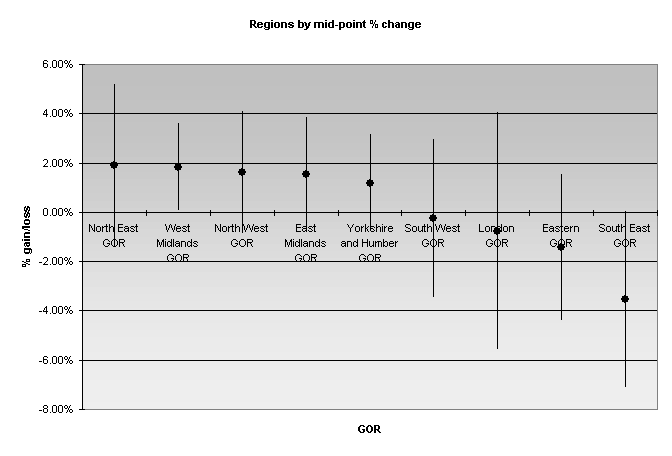
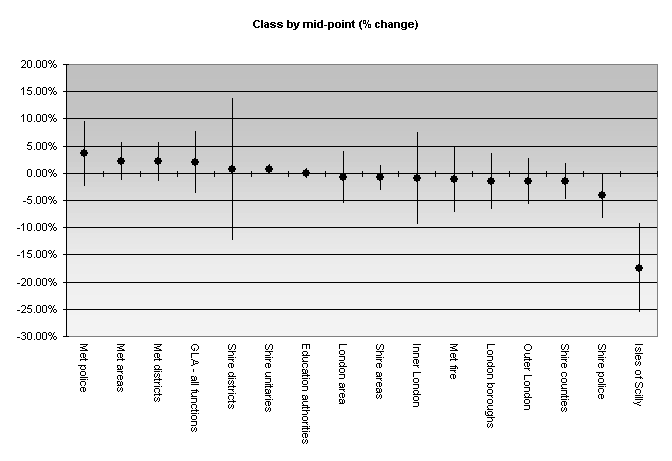
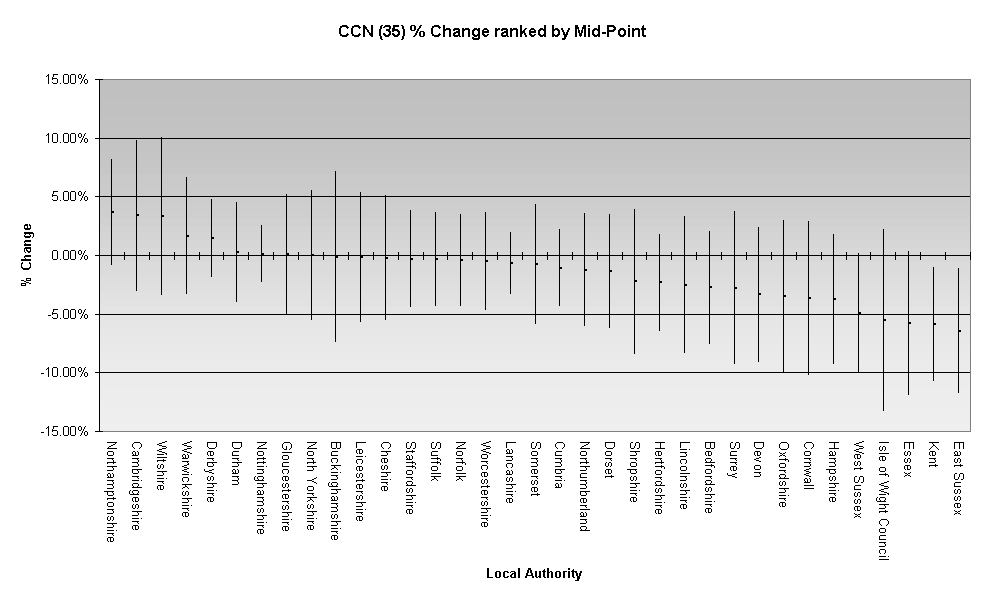
2.2 There are a large number of options and more work is required but for this County Council:
· best case options would result in an increase of £15.8m (1.8%) based on 2002/03 standard spending assessment (SSA) control totals, with a gain of £7.6m on education, £8.4m on social services and £7.1m on capital financing, offset by a loss of £8.4m on resource equalisation - other changes are all quite small
· worst case options would result in a loss of £80m (9.3%) - the Council would be heavily dependent on the floors regime. This involves losses on all the elements in the formula apart from social services (+£1.3m); £20.7m on education; £10.4m on environmental, protective and cultural services (EPCS); £4.8m on capital finance; £21.9m on area cost adjustment (ACA); £21.1m on resource equalisation
· on the basis of the options that are best and worst for all counties, Hampshire would have a best case of around nil and a worst case of a £71m loss. This is because of the impact of the ACA options where Hampshire and most counties are on different sides of the argument. Apart from a fairly small variation on Fire, the best and worst options match those of all counties on all other options
· all the options would provide some increase in the social services formula based on current control totals, but before allowing for the effect of area cost adjustment changes which have not been apportioned over services in the published options
· the area where all the options are pretty disastrous is in relation to resource equalisation, so this suggests that this is the area to concentrate on in looking at alternatives to what is currently proposed
· the Council will as expected have to mount a further campaign in defence of the existing area cost adjustment or by identifying alternative more appropriate options
· ignoring the damping effect of floors, council tax would need to go up by about 23% to recover a grant loss of £80m. The effect of the floor mechanism will be to phase the loss of grant over more than one year.
2.3 In common with all county councils other options which will need further work include:
· ensuring that other options that better defend the Council's interests are put forward as well as commenting on the options presented in the consultation
· seeking a separate formula block for waste management
· challenging the weight being given to deprivation and seeking options with larger basic entitlements, especially where there appears to be double counting with the use of targeted grants and where the resource equalisation proposals will also redistribute resources to many of the same authorities. This is particularly important with Education per pupil funding where additional educational needs are not necessarily synonymous with deprivation
· resource equalisation itself appears to be based on past spending as a measure of the need to spend, something the new system was supposed to avoid.
2.4 The impact of the options will also be determined by:
· overall size of the new formula grant to be distributed after spending review 2002 (SR2002)
· extent of ring-fenced (specific) and other targeted grants in addition to formula grant and how these will be distributed.
2.5 These factors will probably not be clear until the Council receives its provisional formula grant allocation in late November 2002.
3. Review of revenue grant distribution
3.1 As part of the Government's proposals to reform the current revenue grant distribution system, the main forum for the development of options has been the Revenue Grant Distribution (RGD) Review Group. This group is supplemented by three officer level groups made up of representatives from national and local government and a range of stakeholders, looking at the detailed options for each of the service blocks, as follows:
· the Formula Review Group - chaired by the Department of Transport, Local Government and the Regions (DTLR) - now the Office of the Deputy Prime Minister (ODPM). This has covered environmental, protective and cultural services (EPCS), personal social services (PSS), highways maintenance, fire and capital financing, together with some of the "cross cutting" issues like area cost adjustment, fixed costs, floors and ceilings, and data issues
· the Education Funding Strategy Group - led by the Department of Education and Skills (DfES) and developing options for the reform of education funding
· the Police Allocation Formula Working Group - led by the Home Office and developing options for changes to police funding
3.2 The work of these three groups has recently reached a key milestone, with each producing a progress report to Ministers on the options which have been considered. The Education and Police group reports have included comments and views expressed by the various stakeholders represented within the report itself, whereas the Formula Review Group report is more of an analysis of the options considered.
3.3 Representatives of special interest groups were asked to submit their specific views on the options considered to the DTLR so that Ministers could take these views into account with the report of the Formula Review Group. The points put forward by the County Councils Network (CCN) on the general principles are summarised in the following paragraphs.
Timing of the review
3.4 The timing of the review has been extremely tight with the Government apparently determined to see a new formula implemented for 2003/04. This may be at the expense of high quality supporting research and will probably mean that a considerable reliance will still have to be placed on past spending patterns (this seems to be the case with the options for resource equalisation which distribute resources away from the south to the north of the country).
3.5 Concern was also expressed that detailed examples, of the impact that many of the options put forward may have on funding for individual local authorities, were not provided in most cases. Government was asked to include full and detailed exemplifications in the options presented for consultation (this has now been delivered).
Freezing of the formula and data
3.6 Support was expressed for the freezing of changes to the new formula for a period of three years to aid stability. The need to continue with detailed research and consideration of new formula options during the freeze period was emphasised to ensure future changes were not subject to restricted timescales.
3.7 Proposals to freeze the updating of data within the formula were not supported, as this would merely magnify problems resulting from data changes when they are incorporated. The use of data which is smoothed or averaged over an agreed period, for example three years for more volatile data, was however supported.
Specific grants
3.8 The use of specific grants as a means for Government departments to direct funding to their preferred options or priorities was not supported.
Floors and ceilings
3.9 The use of a floor within the grant system to provide a minimum level of increase to all authorities was supported provided this was for a limited period. The use of a ceilings mechanism to limit the maximum level of grant increase was opposed, as this will penalise authorities with growing populations and needs.
Equalisation
3.10 The current allocation of revenue support grant is based upon a distribution so as to produce a common level of council tax for a band D property at a specific level of spend (currently standard spending assessment, SSA). This system is known as equalisation. Where authorities set budgets at levels other than SSA, differing levels of council tax for a band D property result.
3.11 It is fundamental principle that local authorities should not be rewarded through the grant distribution formula for deciding to apply a higher level of service provision as a matter of local policy. There should not be any changes to the current system of equalisation within the new grant distribution formula unless data is available to demonstrate higher spending levels are as a result of need rather than local policies (however the Government appears to have completely ignored this and resource equalisation will hit this Council and other county councils very hard if it is enacted).
Simplification of the formula
3.12 A simplification to the formula was supported provided that this is not at the expense of fairness. The combination of revenue support grant and national non domestic rates (NNDR) into a single sum within the formula was opposed. NNDR is fundamentally a local tax and any combination will remove what little transparency remains in the system. (The Government again seems to be ignoring this in its consultation proposals).
4. Education funding
4.1 Two funding blocks are proposed to match statutory responsibilities for:
· schools (about 88% of current spend)
· local education authority (about 12%)
4.2 These amounts are not the equivalent of the existing pupil related delegation targets. The schools block will include some items not currently delegated to schools but which are pupil related (exclusions and out-county special needs placements) and the non-schools block will need to meet the costs of home to school transport.
4.3 Each council's share will be its funding assessment. There is a danger that the schools block will be higher than current spending, and the non schools block lower than existing spending so producing a double impact on this Council's ability to finance such changes.
4.4 The schools block will consist of components for:
· under 5's, primary and secondary pupils
· plus a sub block for high cost (special educational needs) pupils
4.5 There is pressure to reduce the amount of ring-fenced or specific grants in the new system but the DfES continue to argue that it wishes to use these to fund specific initiatives.
4.6 The funding formula for the schools block at local authority level will consist of:
· a basic entitlement per pupil
· plus an additional educational needs allowance, above a specified threshold deemed to be within the basic entitlement
· plus for primary pupils only a sparsity factor, again above a threshold
· the sum of these will be multiplied by an index for an area cost enhancement.
4.7 The principle of area costs has been agreed but not the scale of the enhancement, its geographical extent or the methodology used to construct it (whether based on house prices, labour market information or specific costs, such as London allowances for teachers).
4.8 The funding formula will therefore be expressed as an amount per pupil that the Government supports in formula grant for schools. This will not be the same per pupil amount schools receive through their fair funding delegated budgets.
4.9 The Government will require a transparent account of school funding to council tax payers and schools - comparing the Government funding assessment with the Council's budget and sources of funding.
4.10 The Secretary of State will exercise a reserve power to ensure that all the schools block is spent on schools.
4.11 The Schools Forum will be introduced by legislation to ensure full consultation with schools on the allocation of the schools block and separate representations are being made about this.
4.12 The funding system for Education is summarised in Appendix 2.
5. Local Government Finance Formula Grant Distribution
5.1 The consultation paper was published on 8 July 2002. Paragraph 5.2-5.15 set out extracts from the consultation paper to illustrate the Government's thinking.
Aims
5.2 "Responses to the 2000 Local Government Finance Green Paper showed that a large majority of the local government respondents wanted the new system to continue to be based on formulae and to do the same basic job. The Government announced in the 2001 Local Government White Paper "Strong Local Leadership - Quality Public Services" that it agreed. It wants new formulae that are fairer, simple; more intelligible and more stable.
5.3 The Government is concerned to make sure that the new system is more easily understood than the old one. As such, it believes that it is important that it will improve transparency and accountability if people can see how much is allocated on that basis. Clearly, it will never be possible to grasp the system without some effort; the complexity of the issues it seeks to address see to that. But it should be possible to make improvements.
5.4 In considering how to reflect local authorities' relative circumstances, the Government will look at a range of factors when it comes to take decisions in the autumn. Three factors seem basic:
· the extent to which it makes sense to distribute grant as a basic amount per head of population (or other unit relevant to cost)
· giving an appropriate emphasis to the need to tackle deprivation
· how to reflect the variation in pay costs between different areas of the country.
5.5 Because deprivation and pay components are core drivers of the costs authorities face in most areas and the problems the system will need to address, the Government is particularly keen to see them separately identified in formulae. However, that is not to say that other components (for example sparsity) are unimportant. Indeed, they may be a key consideration in particular instances. They will be clearly identified where they form part of a formula.
5.6 Therefore, the Government is keen to see the new formulae follow the basic structure of
BASIC ALLOCATION + DEPRIVATION TOP-UP + PAY-COST TOP-UP + OTHER TOP-UPS
5.7 How the top-ups work may vary in practice : some may be additive (adding an amount to the basic allocation); some may be multiplicative (multiplying the basic allocation by an amount).
Principles
5.8 The working groups have suggested a number of principles that should guide the new system. The list below is based on that work:
· formulae should reflect all local authorities' relative circumstances
· formulae should not be treated as an infallible guide to how much local authorities should spend
· formulae should where possible be based on objective and factual evidence which relates to need to spend on services
· formulae should be constructed and applied in such a way that the resultant grant distribution is more predictable and more stable than the current system
· where possible the most recent available data should be used in constructing formulae and in underlying analyses
· data should be capable of being justified on a rational basis, and where it is particularly volatile from one year to another it should be `smoothed' (eg by taking an average over several years)
· formulae should not create perverse incentives or penalise authorities for improving efficiency; and
· control total, methodology and data changes ought to be provided to local government with as much advance notice as possible.
5.9 However, it has also recognised that there are frequent constraints on what can be achieved. These include:
· any system based on formulae cannot reflect all possible circumstances, so there will inevitably be an element of rough justice. This tends to be increased as formulae are made simpler
· the information necessary to develop wholly robust and objective formulae is not always available, so elements of judgement and reliance on complex statistical techniques are sometimes unavoidable; and
· since the system can only distribute the available resources, it must be based on comparisons between authorities rather than absolute measurements of their need to spend. This means that a balance will often need to be reached between competing pressures.
5.10 Clearly, the extremely technical nature of the issues means that there is frequently no clear-cut optimum solution. The Government recognises that pragmatic decisions will be needed to produce a workable system.
Options
5.11 The consultation document contains options for each of the components for the new system. These include the existing seven SSA blocks (Education, PSS, police, fire, EPCS, highways maintenance and capital finance) plus:
· how to recognise authorities' pay costs (currently done by the area cost adjustment)
· how to treat other types of costs (including fixed `cost of being in business'; and population change)
· how to recognise councils ability to raise revenue from council tax
· how the `floors and ceiling' mechanism to limit year-on-year grant changes should work
· how the system might be presented; and
· whether to merge revenue support grant and national non-domestic rates into a single grant stream (formula grant)
5.12 The consultation paper contains options on each of these issues, together with details of how each option would affect individual authorities. The Government believes that the options in the paper could provide the components for a new system. However, the options may be refined further following consultation. Respondents may also propose new options. Therefore, the components of the new system will not necessarily be drawn from the list contained in the consultation paper.
Construction of exemplifications
5.13 The exemplifications shown are constructed by re-running the 2002/03 settlement as though the particular formula option in question had been in place for that year. Other elements of the 2002/03 settlement such as the formula spending totals, the data used in the formula, and (in the case of the service blocks) the area cost adjustment are unchanged from 2002/03 except where stated.
Limitations of exemplifications
5.14 Constructing exemplifications by re-running the 2002/03 settlement gives the best possible illustration of the effects of each option at the present time. However, the detailed effects of options in the context of the 2003/04 settlement would be different. This is partly because the totals for the various formula spending blocks and grant may have changed in the Spending Review 2002 and due to transfers of funding. Updated data will also be used. The most important of these will be new Census data on population, new earnings data to feed into the area cost adjustment (though on any ACA option the Government would propose using an average of more than one years' data), and new secondary pupil counts.
5.15 The Government would like views on which of the options should go to make up the new system and would also welcome any alternative proposals."
5.16 Specific questions are proposed. In the time available it has not been possible to prepare such a response and a further report will be needed to this September's Cabinet to enable a considered response to be made.
5.17 Appendix 1 sets out the 47 options for changes to grant formulae, together with an indication of the best and worst options for the County Council. It is not possible to say conclusively what the outcome will be because of the number of permutations but some overall indication has been possible by taking the mid-point outcome in terms of percentage changes from the existing system for all the options. These are illustrated in the graphs in the summary.
6. Conclusion
6.1 It is clear that the outcome of these options could be very difficult for the County Council. The scale of potential losses and other main areas to challenge are shown in the summary. But more work is required to analyse and develop these themes.
6.2 The implications for 2003/04 may be even worse than feared when setting the 2003/04 budget. Some mitigation was made available for a variety of external pressures (totalling £10m) and for the change in the funding system by adding £3.5m to balances. This will be totally inadequate against the scale of losses indicated in the options.
6.3 Some of the immediate losses may be protected by transitional arrangements through the floors mechanism, but that does not help the long-run position. Reserve powers on schools funding and other pressures to passport social services increases will compound the pressure on other services and the potential level of the council tax increase.
6.4 Instead of the 7%-8% range previously produced if these options are pursued council tax rises of between 20%-30% are quite likely, if current service levels are to be maintained. Hampshire council tax payers will effectively be picking up an even bigger burden to redistribute Government largesse to the North and Midlands, whilst inner London remains largely protected.
6.5 Extensive consultation with the public will be required from September and representations made in concert with the County Councils Network and South East Counties in particular. Proposals will be brought to the September meeting.
6.6 The timescale for issues related to the 2003/04 budget is therefore:
· |
July |
- |
Draft proposals on Local Government Bill and Formula Review Consultation |
- |
Initial Spending Review 2002 (SR2002) announcement | ||
· |
August |
- |
Responses to draft Local Government Bill |
· |
September |
- |
Responses to Formula Review Consultation |
· |
October |
- |
SR2002 outcome for local government, including ring-fenced grants for revenue and capital |
· |
November |
- |
Provisional formula grant settlement for 2003/04 |
7. Budget consultation 2003/04
7.1 These developments mean that budget consultation will have even more importance with the Council's usual stakeholders:
· MPs
· business
· council tax payers and residents association
· school governors and headteachers
· voluntary organisations
· workforce.
7.2 It will also be necessary to have an appropriate media campaign, together with lobbying and proposal of necessary amendments during the Bill's passage through the Commons and Lords.
7.3 The Government has also issued new Guidelines for Local Authorities on council tax consultation. Key issues are:
· consultation is about providing councillors with more information in order to help them come to a judgement
· the public should not be required to become experts on local finances, but instead be given the opportunity of making choice within a framework informed by the political and technical judgement of their local authority.
7.4 The Government suggests consultation in two stages:
· first a wide set of discussions about priorities for different services. This is suggested for very early in the budget cycle (May/June) in which broad priorities and possible directions are discussed. The County Council has already carried out considerable research on these priorities for both 2001/02 and 2002/03 as part of its MORI public consultation exercises
· second consultation to determine the overall size of the spending cake by making the adjustment between the need for additional resources in the context of council taxpayers' willingness to pay.
7.5 The second stage is particularly difficult this year but also critical, given the potential scale of grant loss and resultant council tax posed by the options for formula grant for 2003/04 in the consultation paper. Nevertheless it would be appropriate to use the Citizens' Panel in the Autumn to develop the implications of the consultation paper and begin to inform the Council's response to the loss of grant on the overall level of its services and the extent of council tax rise that might become necessary.
Recommendations
1. To note the progress on the review of revenue grant distribution
2. To receive a more detailed report in September on the proposed County Council response to the consultation.
Section 100 D - Local Government Act 1972 - background papers
The following documents disclose facts or matters on which this report, or an important part of it, is based and has been relied upon to a material extent in the preparation of this report.
NB the list excludes:
Published works.
Documents which disclose exempt or confidential information as defined in the Act.
TITLE
Local Government Finance: Formula Grant Distribution
LGA briefing
rjp2969
Appendix 1
(Source LGA briefing
annotated with impact
on Hampshire County Council)
Education
The Education options draw on work in the Education Funding Strategy Group. All of the four options have a similar structure.
· Education Funding Assessment consists of two blocks: Schools Block and LEA Block. Approximately 88% of the funding assessment will be in the Schools Block, with the remaining 12% in the LEA block. Only one formula for the LEA block is exemplified; this is common to all four options;
· the Schools Block is divided into 4 sub-blocks, covering under 5s, primary, secondary and high cost pupils. Again, only one formula for the high cost pupil block is exemplified, this is common to all four options;
· the formulae for the primary, secondary and Under 5s blocks will have a similar structure; a basic per pupil entitlement; with top ups for `significant deprivation' (Additional Educational Needs or AEN) and for areas where it costs more to recruit and retain teachers (Area Cost Adjustment or ACA);
· all options contain a measure of English as an Additional Language (EAL) in the primary block and an ethnicity measure in the secondary block;
· The four options differ as to:
- |
the incidence of deprivation; whether income support alone is used as an indicator or also Working Families Tax Credit |
||
- |
the cost of the AEN component and whether or not it caters for `unmet needs', as identified in work carried out by PriceWaterhouseCoopers for the DfES |
||
- |
the level of an AEN `threshold' below which it is assumed that all authorities are funded equally |
||
- |
whether Education uses the same area cost adjustment as for other blocks (see below) or a variant which reflects house price differentials between areas as they affect the average teacher |
Impact on Hampshire County Council | ||||
· |
The four options are |
|||
- |
EDUI : Income Support only for Deprivation; Met and Unmet needs for AEN; low AEN threshold; current ACA |
-£20.7m |
Worst | |
- |
EDU2 : Income Support and Working Families Tax Credit for Deprivation; Met needs only for AEN; high AEN threshold; current ACA |
+£7.6m |
Best | |
- |
EDU3 : Income Support and Working Families Tax Credit for Deprivation; Met and Unmet needs for AEN; medium AEN threshold; current ACA |
-£6.4m |
||
- |
EDU4 : Income Support only for Deprivation; Met needs only for AEN; medium AEN threshold; house prices for ACA |
-£2.9m |
||
Personal Social Services
Children
Three options are presented. All of them keep the structure of the blocks similar to the way it is at present, but differ as to how the top up for fostering costs is treated. The options are: |
|||
· |
keep the existing foster care adjustment but increase its weight against other elements in the Children's formula in line with the results of analysis on more recent data SSC1 |
-£0.1m |
Worst |
· |
change the weights on the factors within the fostering care adjustment following analysis on more recent data SSC2 |
+£1.3m |
|
· |
use a new foster care adjustment, as recommended by the Thomas Coram Institute in their work for DoH. This would use two factors: social class and ethnicity SSC3 |
+£1.4m |
Best |
Younger Adults
Three options are presented. They are
· |
retain regression analysis of spending patterns but update expenditure data from 1990/91 to 2000/01. Keep the existing 12 indicators in two composite indices SSO1 |
+£2.5m |
Worst |
· |
as above, but reduce the existing 12 indicators to three: income support, single people living away from families and those living in public sector flats SSO2 |
+£3.3m |
|
· |
introduce a separate formula for Mental Health, as recommended in work done for the County Councils Network SSO3 |
+£3.8m |
Best |
Elderly people
Six options are presented. Three of them retain separate blocks for Elderly Residential and Elderly Domiciliary; the other three present a combined Elderly formula as developed in work for DoH by the University of Kent. The options are: |
|||
· |
update Elderly Residential Formula drawing on the 1998 as well as the 1994 General Household Survey. Include an estimate of income from charges, as opposed to actual data, as at present SSR1 |
-£0.9m |
Worst |
· |
as above; but change the basis of the population to include elderly people living in institutions as well as households SSR2 |
+£1.5m | |
· |
update the Elderly Domiciliary Formula in line with the 1998 General Household Survey, using more recent data for charges and double the weighting for sparsity from 0.5% to 1% SSD1 |
-£0.2m | |
· |
combined formula as recommended by the University of Kent excluding ethnicity SSE1 |
+£3.2m |
Best |
· |
combined formula but change the basis of the population to include elderly people living in institutions as well as households, as above SSE2 |
+£2.4m |
|
· |
combined formula as above, but including ethnicity SSE3 |
+£0.3m | |
Fire
Four options are included. All remove the current fire calls indicators, seen as a perverse incentive. Three of the options still rely on an analysis of past spending to set weights, but update the figures used from 1990/91 to 2000/01. The options are: |
|||
· |
Include a new `fire risk' index to replace the fire calls indicator, based on correlation of deprivation measures against fire calls FIR1 |
-£0.6m |
Worst |
· |
Include an element for fire risk assessments, instead of just `A risk' areas, in addition to the `fire risk' index FIR2 |
+£0.0m |
Best |
· |
As above, but with a sparsity top-slice, an increase in the proportion for fire education and a technical adjustment to the way pensions are dealt with in the expenditure database FIR4 |
-£0.4m |
|
· |
Radically simplifying the formula by giving each authority a flat rate increase each year based on control total increases; starting from authorities' actual spend on fire. This analysis would not use analysis of past spending FIR3 |
-£0.1m |
|
Highway Maintenance
It is proposed that the formula should consist of a basic amount per kilometre; with top-ups for traffic flow, winter maintenance and pay costs, much as at present, although the current threshold for traffic flows would be abolished. Weights would still be set by examination of past spending patterns, but figures would be updated from 1990/91 to 1998/99, the latest available. Average temperatures as opposed to number of days with snow lying would be used for the winter maintenance part of the formula. The two options presented differ as to whether or not to retain density as an explanatory factor. The options are: |
|||
· |
basic amount per km, with top-ups for traffic flow (with no threshold), winter maintenance (using average temperatures) and pay costs. Spending base updated to 1998/99. Population density retained as factor HM1 |
-£0.3m |
Worst |
· |
as above, but without population density HM2 |
+£0.7m |
Best |
Environmental, Protective and Cultural Services (EPCS)
The document envisages that EPCS should continue to have two main sub-blocks for upper tier (`County') and lower tier (`District') services. It proposes to abolish the concurrent services adjustment which recognises that some `county' services in two-tier areas are provided by districts and vice-versa and to adjust the control totals of the two blocks in recognition of this. Four options are presented. They are: |
|||
· |
elements for resident population, deprivation (drawing upon elements of the Indices of Deprivation), density and top-ups for day visitors, commuters, sparsity and ethnicity EPC1 |
-£6.8m |
|
· |
as above, but without adjustments for visitors and commuters and a smaller weight given to deprivation and with more allocated on the basis of unit costs EPC2 |
+£0.8m |
Best |
· |
as above but with higher weights for resident population, day visitors and sparsity and a lower weight for deprivation EPC3 |
-£1.7m |
|
· |
as above but with a higher weight for the deprivation elements and removing the adjustment for commuters and visitors EPC4 |
-£10.4m |
Worst |
The options assume that the other sub-blocks of EPCS (flood defence, coast protection, rent allowance payments, housing benefit administration and national parks) will remain as at present, even though a number of these are subject to reviews. |
|||
Capital Finance
The consultation document notes that the Government will be consulting during the summer on how it should support capital investment in future. However it is likely that existing borrowing will be funded by a similar mechanism to that used currently. All four options presented in the document discontinue the two `negative' sub-blocks; which take account of interest receipts and interest on reserved capital receipts. The options vary as to how this reduction is allocated among other blocks. |
· |
eliminate the two `negative' interest receipts sub-blocks, with the control totals for all non-capital financing sub-blocks reduced pro rata CF1 |
-£4.2m |
|
· |
as first option, but with a higher weighting attached to the lower tier EPCS sub-block for the Reserved Receipts control total than for the Other Interest Receipts control total CF2 |
-£4.8m |
Worst |
· |
as first option, but with higher proportions of both interest receipts control totals attached to the lower tier EPCS sub-block. Only the control total for the lower tier EPCS sub-block would change CF3 |
+£0.8m |
|
· |
as first option, but only the control total for the lower tier EPCS sub-block would change, leaving all other sub-blocks unchanged CF4 |
+£7.1m |
Best |
Area Cost Adjustment
Five options are presented. Each is based on three years of earnings data rather than one as a present, in order to reduce volatility in year on year changes. The options are: |
|||
· |
use New Earnings Survey (NES) data in the same way as at present but combine the Inner and Outer Fringe areas and extend the ACA to cover authorities in Cambridgeshire, Northamptonshire, Warwickshire, Gloucestershire, Avon and Wiltshire ACA1 |
-£16.0m |
|
· |
variant of the methodology recommended by the Elliott Review of 1996, as used in the NHS, taking more detailed account of differences in the structure of the labour market between authorities and incorporating a `lower limit'. ACA extended as in option 1 and Outer London divided into two areas ACA2 |
-£21.9m |
Worst |
· |
as above but basing evidence on private sector wages only, because it is argued they better reflect underlying market pressures ACA3 |
-£12.3m |
|
· |
as for option 2 but with no lower limit, so all areas receive an ACA factor ACA4 |
-£13.7m |
|
· |
as above, but based only on private sector wages ACA5 |
+£0.2m |
Best |
Fixed costs
Two fixed costs options are presented:
· |
a fixed costs element of £300,000 for each shire district and education / PSS authority and the EPCS block scaled down to reflect this FC1 |
-£0.5m |
Worst |
· |
a fixed cost element of £300,000 for each police and fire authority in addition to those above; with the EPCS, Police and Fire blocks scaled down to reflect this FC2 |
-£0.4m |
Best |
.
Population change
Sluggish costs / population decline
Introduce a `targeted' grant for authorities whose population is projected to decrease by more than 0.5% in the two year period between the population estimates used in the settlement and the settlement year. All other formula grant allocation are scaled down PC1 |
-£0.2m |
Best |
Rapid population increase |
||
Introduce a `targeted' grant for authorities whose population is projected to increase by more than 1.5% in the two year period between the population estimates used in the settlement and the settlement year. All other formula grant allocations are scaled down PC2 |
-£0.8m |
Worst |
.
Resource Equalisation
Three options are presented for dealing with the problem of the gap between total formula spending and budgets. Under each of these options total SSA would be uprated, with a compensating increase in the assumed amount contributed from the council tax (council tax at standard spending) |
|||
· |
uprate all blocks by a fixed national percentage to eliminate the gap between total SSAs and budgets RE1 |
-£15.3m |
|
· |
uprate each block separately to bring it into line with actual spending for that block RE2 |
-£21.1m |
Worst |
· |
uprate the control totals for Environmental, Protective and Cultural Services (EPCS) and Personal Social Services (PSS) only, by roughly half of the existing gap RE3 |
-£8.4m |
Least worst |