
Archived decisions
Hampshire House Completions Study
1. Introduction
1.1 Nationally, the year 2001 saw the lowest number of dwellings built since 1948. As a consequence, the issue of low completion rates has risen up the national political agenda.
· House building rates in Hampshire have generally reflected national trends and figures for the year 2000-01 represent one of the lowest completion rates for the Structure Plan area since the county boundary alterations in 1974.
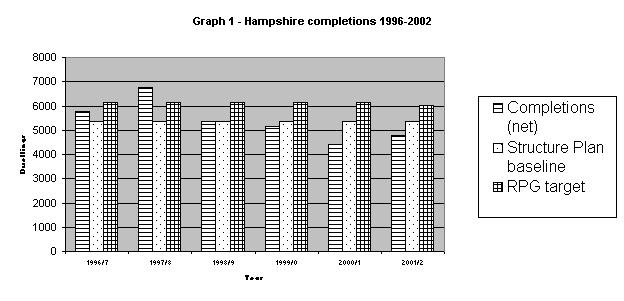
· In only one year since 1996 have completions in Hampshire exceeded the annual Regional Planning Guidance target (see Graph 1). The figure of 4,400 completions in 2000 - 01 was 28% below the target. Provisional returns for 2001-02 show only a modest improvement on the previous year.
1.2 In July 2002 Deputy Prime Minister stated that he would consider intervening in areas where targets for completions were not being met. As a consequence of his concern both his office and the South East England Regional Assembly have initiated work to identify what actions are required to ensure that the targets are delivered. It is against this background that the strategic planning authorities have investigated the reasons why rates in Hampshire have fallen, and the extent to which the planning system can be held responsible. The findings may assist planning authorities, and others, to address the causes and help deliver house building targets.
2. National Picture
2.1 Some housing analysts have argued that the consequences of Government policy decisions made in the past are now manifesting themselves in the recent levels of completion rates. Graph 2 shows house completion rates for England since 1967. House completions reached a post war peak in 1968 when 352,000 dwellings were built. There has been a general decline since then to 2001, when just 129,000 dwellings were built.
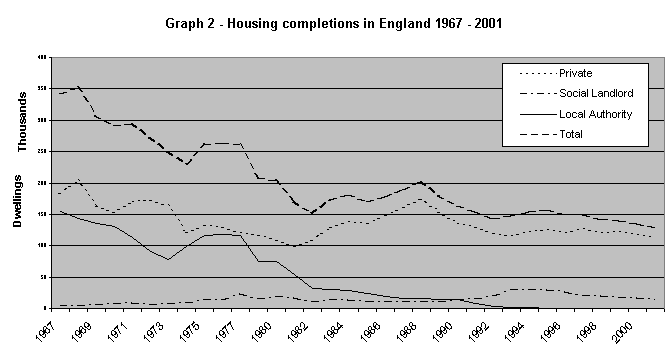
2.2 Apart from the overall fall in completions, the graph also shows the sharp fall in local authority completions over the same period.
· In 1967 local authority completions peaked at 154,000 dwellings. Completions by their successors, registered social landlords, reached a post war peak of 31,000 units in 1995. By 2001 this figure had fallen to only 15,000.
· Private completions peaked at 203,000 in 1968 and since 1974 (with the exception of a peak in the late 1980s) the sector has generally delivered between 115,000 and 140,000 dwellings per annum. It is interesting to note that the low point for private completions since 1967 was between 1980 and 1982, not 2001 (the low point in total completions1).
· Much of the national decline in house building since the 1960s is therefore attributable to the dramatic fall in social house building. The private sector has not made good the deficit.
2.3 Many commentators on the development industry believe that the planning system is the principal cause of low house building rates, often citing a failure of local planning authorities to properly plan for their areas since the introduction of the plan led system in 1991. Some 83% of house builders surveyed in June 20012 identified planning delays as their most significant constraint. Planning could contribute to a fall in completion rates through:
· The lack of an up-to-date Development Plan
· Low Development Control performance
· Consequences arising from the introduction of Planning Policy Guidance Note 3 (PPG3)
· Delays arising through the appeals system and intervention by the Government
· Delays caused by planning and other agreements
2.4 The house builders survey referred to above also identified non-planning factors as significant constraints. These include:
· Land prices
· Land availability
· Labour availability
2.5 There are other non-planning reasons that could influence house building rates. These include matters internal to the development industry and the weather. Another explanation could be low demand for houses - although in the present buoyant housing market this can be discounted as being a factor.
3. Findings
Housing supply
3.1 Although housing completions are used as a key measure of planning performance, it should be remembered that the planning system is not responsible for actually building houses. More appropriate indicators would be housing supply figures and the number of dwellings with planning consent.
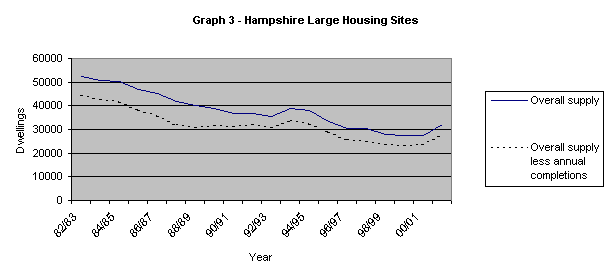
3.2 An analysis of large site3 supply and completions in Hampshire since 1982 (Graph 3 below) shows:
· A steady fall in overall supply4 from over 50,000 dwellings in the early 1980s to under 30,000 dwellings by 2001
· A steady fall in the numbers built annually from 9,700 dwellings in 1987/88 to 3,600 in 2000/01
· A correlation between overall supply and the numbers built annually
3.3 Contributions from small sites, as a proportion of overall supply, have remained fairly constant between 1996 and 2001 (20% - 24% of total completions)
3.4 Graph 4 below shows planning consents granted within the Structure Plan area between April 1998 and March 2001. Some 15,300 dwellings received planning consent, whereas a minimum of 18,090 dwellings (three years at 6,030 per annum) would have been required to deliver the current RPG target over the same period, thereby indicating that the planning system was not delivering sufficient number of dwellings to enable builders to deliver RPG targets. However, by April 2001 the number of dwellings with planning permission stood at 16,600, up 11% from a low of 15,000 two years earlier
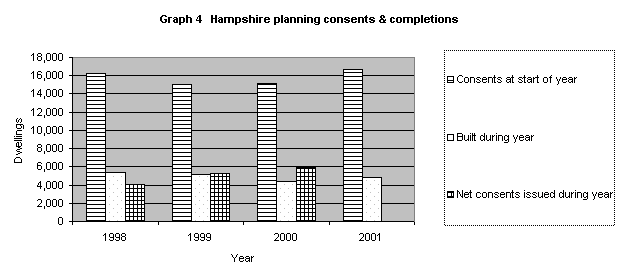
n.b. Net consent figures at end of 2001 monitoring period not yet available
3.5 One reason why planning consents have been low could be due to insufficient planning applications for residential development being submitted, due in part to uncertainty arising from the status of local plans.
· In the case of Basingstoke and Deane, the adopted Local Plan took six years from the publication of the deposit draft to adoption. This was for a number of reasons, including the need to ensure conformity with the Hampshire County Structure Plan which resulted in the need for major changes to the Local Plan, and the length of time for the Local Plan Inquiry report to be received. The delay to the Plan has resulted in delays to sites coming forward as consent could not be granted on most sites until after receipt of the Inspectors' Report in 1997.
· Some of the local plans in Hampshire are currently out of date, and only 7 of the 13 covering the Structure Plan area are expected to be adopted in conformity with the approved Structure Plan by the end of 2004
3.6 Another reason could be because too many applications have been refused.
· There is growing belief that housing proposals are becoming more contentious as residents express concerns regarding the capacity of sites, increased densities (fears of cramming), impacts on traffic generation, reduced parking standards and their effect on existing residents parking. In recognition of these concerns some applications have been refused by local planning authorities. However, there is insufficient evidence to conclude that this is a widespread occurrence across the Structure Plan area.
3.7 At the national level a 24 month supply of residential consents has, in the past, been generally accepted as the minimum necessary to maintain a given output. The Hampshire figure for April 2001 represented a supply of 33 months. However, returns for 2001-2002 show that this level of supply still failed to produce sufficient dwellings to satisfy RPG requirements. A consent bank of between 36 - 40 months would currently be necessary in Hampshire to deliver the number of completed dwellings required by RPG (based on the ratio between residential consents and completions 1998 - 2002).
3.8 Although it could be argued that the current level of residential supply in Hampshire appears to be more than sufficient for house building targets to be met, the fact that they have not been is a cause for concern. It may be necessary to increase housing land supply in order to allow for unexpected development delays arising from the factors outlined above.
Housing completions
3.9 Between April 1996 and March 2001 27,466 dwellings (net) were built in Hampshire, slightly above the Structure Plan baseline requirement, but some 3,200 below the summed RPG target for the period. Net completions exceeded the RPG target in only one year (1997/98).
3.10 There has been considerable variation in net housing completion rates 1996 -2001 across Hampshire compared to the Structure Plan requirements and the RPG target:
· The South East and South West of Hampshire have generally performed better than the North of the County. However, all three sub-areas contain wide variations in the number of dwellings built in each district
· The age of the adopted local plan does not appear to have affected completion rates
· Completion rates do not appear to have been affected by a reliance on developing particular types land (e.g. brownfield or greenfield)
· The size of site developed does not appear to have influenced completion rates
· Local planning authorities with a large bank of commitments (sites with planning permission or allocated for residential use) have generally delivered more dwellings than those with smaller reserves. This tends to support the findings highlighted in 3.2 above, namely that there is a correlation between overall supply and the numbers built annually
· The time required to bring forward proposals for the Major Development Areas (MDAs) has probably had a negative impact on the overall supply. Dwellings from this source account for 15% of the Structure Plan baseline requirement. If the anticipated contribution from MDAs had been delivered evenly throughout the 15 year period of the Structure Plan it is likely that Hampshire would not have undershot its RPG target. However, the most advanced MDA will not begin to provide completed dwellings until 2006, so together the MDAs will not be able to contribute the scale of housing envisaged in the Structure Plan. Development on brownfield sites has remained fairly constant since 1996 and have not made good the shortfall.
Development control performance
3.11 Nationally, in 2001 only 18% of residential planning applications of 10 or more units were determined within 8 weeks (compared with the Governments' target of 80% for all applications). This proportion has fallen steadily from just over one third in 1992 (around the time the plan led system was introduced).
3.12 In 2001 35% of applications for 10+ dwellings were decided within 13 weeks (down from 60% in 1992). A new Government target announced in March 2002 requires that 60% of this category of application be approved within this period.
3.13 Results from a small sample of Hampshire local planning authorities indicates that, although some performed well in 2001 in determining applications for large residential developments, overall performance in Hampshire was probably lower than the national average.
3.14 The decline in development control performance has been cited as one explanation for the fall in dwelling completions as it is taking longer to approve planning applications.
Consequences arising from the introduction of Planning Policy Guidance Note 3
3.15 PPG3 formally introduced the `plan, monitor and manage' approach to housing land release and has been supported by other changes in Government policy (such as the Greenfield Directive5). There is a view that these changes have contributed to the decline in house building rates through, for instance:
· Introducing uncertainty and delay arising from the shift in planning policy (e.g. there is no guarantee that greenfield sites allocated in adopted local plans will receive planning consent)
· The emphasis placed on developing brownfield sites has put a premium on greenfield sites with planning consent. Developers may slow down the rate of development on greenfield sites in recognition of their scarcity value.
· Brownfield sites can take longer to assemble than greenfield ones. They may also have more problems to overcome (e.g. contamination) and this may affect their overall viability.
· An increased reliance on contributions from urban capacity sources that may not deliver the numbers of dwellings within the timescale expected
3.16 In Hampshire there is anecdotal evidence of developers holding onto greenfield sites and also experiencing problems in bringing forward brownfield alternatives. There are also cases of allocated greenfield sites being refused planning consent on PPG3 grounds. This not only affects the number of dwellings that can be developed in the short term, but is also likely to impact on the business plans and confidence of developers who hold, or have options on, such sites as part of their portfolio.
3.17 Whilst it seems likely that PPG3 may have affected completion rates, it should be noted that the recent fall in Hampshire's house building rates had commenced before PPG3 was published in March 2000, and well before the Greenfield Directive came into effect in October 2000. PPG3 can therefore only be one contributing factor to account for the recent decline.
Intervention from the Government Office for the South East (GOSE)
3.18 Intervention by GOSE can be a source of delay in the planning system and impact on house building rates if a large residential application is involved. Two recent examples in Fareham took 12 and 18 months respectively between the time they were called-in and a decision being issued by GOSE. A further case in New Forest district took over 15 months before a decision was reached. All three sites were identified in an adopted local plan and were called in under the Greenfield Directive. Together these three involved a total of 750 dwellings.
3.19 The recent performance of GOSE in processing call-ins and recovered appeals6 has not been good and new targets have recently been set so that by March 2004 at least 80% of called in and recovered cases will be decided within 16 weeks after the close of the inquiry.
3.20 Although only a handful of housing applications in Hampshire have been called in by GOSE, they may involve a large number of dwellings and could therefore affect house building rates in the county.
Delays caused by concluding planning and other agreements
3.21 The scope and use of planning agreements has increased in recent years7. The expansion of the range of subjects covered by such agreements has drawn more county and district departments into the process, thereby increasing the complexity of negotiations with developers and the time required to resolve any problems. In addition, an increasing number of applications for residential development require a Section 106 agreement to be signed in respect of affordable housing provision.8
3.22 The June 2002 edition of Housing Today reported that developer Fairview Homes estimate that protracted negotiations with planning authorities mean that projects that usually take between six and nine months to agree are now taking between 12 - 18 months. Leading housing analysis John Stewart considers Section 106 negotiations to be the most serious source of delay in the planning system.
3.23 No national target has been set down for agreements to be concluded. They can involve drawn out discussions between the applicants agents and lawyers and the councils planning officers and lawyers.
3.24 There is also a widespread view that planners lack the experience and skills in development finance to maximise the opportunities for `planning gain'. Some of the additional Government funding announced in July 2002 is expected to be devoted to improved training for planners in this area.
3.25 In Hampshire there is a general recognition that it is taking longer to conclude Section 106 agreements, although some planning authorities have standard packages and clauses that can help shorten the time taken to negotiate9. The reasons for the extra time taken include staff shortages in legal services, increased complexity and (in the case of affordable housing provision) the need to involve Registered Social Landlords in the process. Basingstoke and Deane Borough Council is currently working with consultants engaged by the Government to investigate delays caused by planning agreements.
3.26 Hampshire County Council is currently preparing a protocol that should improve the quality and time taken to conclude Section 106 agreements. The protocol sets out what is expected from those involved in the negotiations and who to contact. It also proposes the use of dedicated staff to ensure one line of negotiation between the developer and the planning authorities. A draft version of the document is expected to be published for consultation before the end of the year.
Land prices and land availability
3.27 Land prices and land availability are two issues that have been cited by builders as important constraints on house building, with land owners and developers finding it harder to negotiate a price for land. This is a difficult area for third parties to investigate. However, there are a number of cases in Hampshire where these issues appear to be impacting on housing development.
3.28 A sample of 25 large sites in Hampshire that appear to have some impediment to development were examined. These either have planning permission for residential development or are allocated in an adopted local plan for housing (some for many years), but are not coming forward for development. Together they comprise more than 4,900 dwellings (16% of Structure Plan large site supply). The initial findings are:
· More than half of the sites were delayed by landowners not bringing sites forward. In some cases the reason was due to problems resolving access. A lack of agreement between developers and landowners (especially sites in multiple landownership) was also important in delaying some sites. However, in many cases it is unclear why the site is not being developed.
· Some of the delayed sites were owned by Government departments who seemed unwilling or unable to release the site for development, despite them being allocated for development. In a further case the district council wished to dispose of the site at less than market value (for social housing) but had to wait 9 months for the Secretary of State to decide whether they should be allowed to proceed.
· Only in four of the delayed sites investigated did the planning system play a role (two because the schemes proposed were considered to be of poor quality and the other two because the Deputy Prime Minister had `called-in' the applications).
3.29 There is also anecdotal evidence of sites with the benefit of planning permission or allocated in local plans being sold on to a new developer rather than be developed (in some cases having been sub-divided first).
3.30 Site assembly and owners not bringing forward land for development are important factors in explaining why some sites in Hampshire that have cleared planning hurdles are not being developed. However, this has been partially counterbalanced by increased developer activity in some parts of the County. Gosport, for instance, has reported a substantial take up of a number of `tricky' sites which had been allocated for anything up to 15 years, reflecting the current buoyancy of the housing market. In Southampton the total number of completions in 2002/03 is likely to approach 1,000. This is well above recent annual rates for the city and exceeds the targets set out the City Councils' First Deposit Local Plan. It is also in marked contrast to what is happening elsewhere in the Structure Plan area.
Labour availability
3.31 There is a general consensus that skills shortages and a lack of experienced management within the building industry is impacting on construction projects. A survey in 2001 by the Construction Industry Training Board (CITB) found employers reporting that:
· 55% were short of carpenters and joiners
· 45% were short of bricklayers
· 22% were short of professional staff (e.g. surveyors)
· 21% were short of plasterers and plumbers
· 19% were short of managers
3.32 The House Builders Federation reported that 35% of their members were experiencing shortages of site managers and design and technical staff, with other shortages in land, sales and marketing and surveying staff. Over 20% of house builders reported shortages of site operatives, with over 85% saying that had difficulties in recruiting bricklayers, carpenters and joiners, electricians, plumbers and roofers.
3.33 The CITB expects10 that the construction industry needs to recruit 15,500 people each year over the next five year period to meet anticipated demand in the South East region alone.
3.34 In addition to the numbers engaged in the construction industry, there is also concern over the skills level of new employees. The CITB report that employers are worried that new employees have poor basic skills and lack the variety required. An increase in poor quality workmanship is likely unless new staff receive better training and higher levels of supervision.
3.35 The causes of the shortages have been widely debated and include the rise in sub-contracting, the reduction of building and development related courses in higher education, and the lack of commitment to training within the industry itself. A related issue is traditional industry demarcation which is not suited to modern, flexible working practices.
3.36 One consequence of skills shortages is to delay construction programmes. Peter Cobb, Director of Planning and Architecture with Fairview New Homes, speaking to a committee of MPs looking into affordable housing this summer is reported as saying "As far as my company and the building industry is concerned, there is a profound skills shortage. To be blunt, we could build more if we could find people to do it. There's a complete lack of skills and it has become unfashionable to take up a skill rather than pursue something more academic, although with the (housing) market as it is, you can get a good income".
3.37 Skills shortages are not just confined to the construction industry. There is growing support for the view that local authorities' planning functions are under-resourced. This may go some way to explain the decline in development control performance and the time taken to conclude legal agreements. The announcement in July, by the Deputy Prime Minister, of additional resources to local planning authorities could assist in overcoming this problem, but these will be conditional on performance being improved first and no details are available yet on the performance levels which will trigger the additional resources.
3.38 Labour shortages may also partly explain the ever widening gap between housing starts and completions in recent years (although there are other possible explanations). According to official figures collected by Office of the Deputy Prime Minister:
· In the six years since 1995/96, starts in England have exceeded completions every year. During this period there were over 53,000 more dwellings started than have been completed.
· This picture is reflected at the regional level for the South East where each year since 1996/97 has seen more starts than completions. There have been over 11,000 more starts than completions between 1996/97 and 2001/02 (see Graph 5).
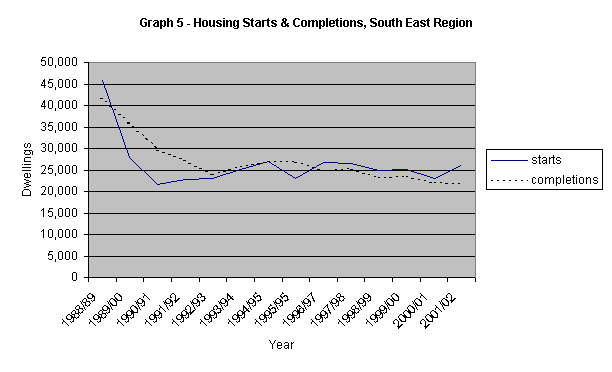
3.39 To date house building starts have not been systematically recorded for Hampshire by the County Council, and it is not therefore possible to provide a local comparison. This is something that should be addressed in future.
The housing industry
3.40 The housing industry is ultimately responsible for building and has been one of the loudest voices in blaming the planning system for the decline in house building rates. However, as has been shown above, planning is only one of a number of reasons that could explain the recent decline. It should also be remembered that the house building industry has a vested interest in securing more land for development, particularly in those areas that can be easily developed and good profits accrued.
3.41 There has been some concern that house builders are land banking and deliberately delaying bringing forward sites that could be developed (e.g. holding back development to take advantage of ever rising prices). A report by FDP Savills in 2001 showed that developers in the UK currently have landbanks containing 2 million housing plots, representing some 15 years worth of land supply. However, less than 300,000 plots had planning permission, representing about 2 years worth of output, probably the minimum required to enable business planning to be undertaken. Land without planning permission for a further 150,000 dwellings was also owned by developers. The rest of the land was held under option, much of which is unlikely to ever receive planning permission.
3.42 There is no comparative data available for Hampshire and there is little anecdotal evidence to support the view that the house building industry as a whole is land banking (although some companies may be holding onto prime greenfield sites).
3.43 The industry itself is ambivalent about increasing the supply of residential land. Rising house prices and acute shortages of land with planning permission have brought healthy profits. House builders share prices have significantly outperformed the FTSE all share index over the past 2 years.
3.44 The industry is currently restructuring itself through take-overs and mergers. Recent examples include Allison Homes (to Keir); Beazer (to Persimmon), Bryant (to Taylor Woodrow) and Wain Homes (to Wilson Connolly). Some of these have helped raise share prices. However, this process inevitably creates its own delays as the new organisation beds down and decides its priorities. For example, Wimpey (one of the largest companies) announced earlier this year that it is holding back on submitting planning applications as the group underwent restructuring following acquisition of McAlpine Homes.
3.45 In the current `plan, monitor and manage' regime forecasting future housing supply and house building rates has taken on a new importance as they help determine whether it is necessary to augment housing supply by releasing new development sites. The accuracy of such forecasts could be improved if all the major house builders operating within the County gave the strategic planning authorities information on their future intentions regarding the marketing and development of sites within their control.
Adverse Weather
3.46 Another possible contributory factor to explain low house completions is adverse weather. An analysis of monthly rainfall recorded for Southampton 1985-2001 showed that 2000/01 was by far the wettest year, with rainfall some 60% above the average. Rainfall for 1998/99 and 1999/00 was at or above average, with 1996/97 and 1997/98 recording levels below the average. An examination of rainfall during the April - September period (the most productive for construction work) showed that the wettest spring and summers over the 1985 -2001 period were:
1. 2000 (53% above average rainfall)
2. 1993 (37% above average rainfall)
3. 1999 (29% above average rainfall)
4. 1998 (18% above average rainfall)
3.47 The spring and summer of 2000 was particularly wet - in fact the third wettest in the past 50 years. The low house completion years of 1998,1999 and 2000 in Hampshire have coincided with higher than average levels of rainfall. It seems likely that adverse weather may have played a contributory role in explaining why rates have fallen.
4. Summary of findings
4.1 This report has considered some of the reasons why Hampshire is experiencing low house building rates. Key findings are:
· There is a correlation between the overall level of new housing supply and completion rates. The fall in supply has been reflected in the numbers of dwellings built
· There have been too few planning consents granted (for whatever reason) in recent years to deliver RPG targets
· Local planning authorities with high levels of land allocated for residential development, or with planning permission for housing, have performed better than those without
· The time taken to identify and bring forward the dwellings contribution from MDAs has had an adverse impact on the overall level of supply (and consequently, completions)
· Problems over site assembly and land ownership are important factors in delaying sites that could otherwise be developed
· Under resourced local planning authorities and shortages of skilled labour in the house building industry are slowing down the planning system and affecting house building rates
· It is possible that the introduction of PPG3 has impacted in a variety of ways and contributed to the current shortfall in completions
· Recent take-overs and mergers within the house building industry have probably introduced short-term delays to some company development programmes
· Inclement weather in recent years may have affected house building rates
5. Action to be taken
5.1 There are a number of measures that strategic and local planning authorities and others could undertake to help improve house building rates.
Strategic Planning Authorities
5.2 The strategic planning authorities should enhance residential development monitoring (e.g. record starts as well as completions, and set down targets for maintaining overall levels of supply alongside targets for completions). More monitoring should be undertaken at sub-area level to augment Structure Plan wide information. The intention would be to provide `early warning' of under supply, thereby enabling action to be taken to avoid it materialising into a shortfall of completions.
5.3 The bulk of new dwellings in Hampshire arise from large sites (10 or more dwellings). Based on Hampshire's housing supply and completions over the past 10 years, it is desirable to maintain a target supply of between 34,500 and 35,900 dwellings on large sites to have a realistic prospect of delivering an annual RPG target of 6,030 dwellings11. For comparison, in 2001/02 the overall large site supply was estimated to be under 32,200.
5.4 Based on the recent ratio between residential consents and completions, it is also proposed to set a target of maintaining a 36 month supply of dwellings with planning consent12. A fall below this target would provide an early warning that there is a likelihood that the RPG completion rate will not be met in future years13. For comparison, in April 2001 there was a 33 month supply of residential consents.
5.5 In the past 20 years the County Council's forecast of dwellings expected to be built on large sites have consistently overestimated actual completions. The table below shows the position for the last three years.
Year |
Average single year of two year forecast |
Built during year |
Built as a % of forecast |
1999/00 |
4,628 |
4,239 |
91.6 |
2000/01 |
3,981 |
3,657 |
91.9 |
2001/02 |
4,419 |
4,102 |
92.8 |
5.6 The main message from this analysis is that the forecasts of house completions on large sites have been over-optimistic, with slightly fewer dwellings being built in the short term than expected. It is accordingly proposed that a small discount (currently 8%) be applied to future forecasts of housing completions on large sites, to account for delays and non-completions. Future monitoring of completions may show that the discount figure should be changed.
5.7 When calculating future annual house building delivery rates the strategic planning authorities should account for the long lead in times required to develop MDAs by seeking to advance the development of other sites in order to maintain a steady phased flow of dwellings. Otherwise there is a likelihood that the latter period of the Structure Plan will see a very high rate of development. There must be some doubt as to whether the local house building industry could increase rates to the levels required due to labour and skills shortages.
Local Planning Authorities
5.8 There are a number of measures that local planning authorities could take to improve housing supply and completions. They could:
· Set local targets for housing supply along the lines advocated in paragraphs 5.2 to 5.6 as this will provide early warning of potential shortfalls in completions
· Place a high priority on adopting local plans in conformity with the current Structure Plan as this will introduce a degree of certainty about site releases in their area
· Ensure that their adopted local plan meets the Structure Plan baseline and reserve housing requirement
· Complete the planning stages of the baseline MDAs as soon as possible as they represent an important component of future supply
· Build in a contingency into calculations when using `plan, monitor and manage' approach to releasing housing sites to account for non or delayed starts (i.e. aim to have slightly more land available for development than is actually required)
· Consider `fast tracking' planning applications for large residential developments as this will help maintain overall levels of supply
· Support initiatives to provide more training for planners on negotiating planning gain as this should improve the time and quality of Section 106 agreements
· Consider supporting `job swap' initiatives between developers and planners to create a better understanding of each others perspective and constraints
· Consider putting more resources into drafting legal agreements and set a target time to conclude them. Monitor the time taken and draw attention to those developers who are tardy to complete
· Encourage developers to finish off sites by considering serving `completion notices' on those who fail to complete sites within a reasonable time scale
· Consider using Compulsory Purchase Powers to assemble sites allocated in adopted local plans for residential development to overcome land ownership and other constraints when monitoring indicates a future shortfall in land available for development.
· Ensure that there are sufficient staff resources to deliver planning outputs within the timescales and targets set down
Construction industry and training bodies
5.9 The construction industry and relevant bodies with responsibility for training should be encouraged to put in place measures and initiatives to address labour and skills shortages in the house building industry.
House builders
5.10 House builders can assist planning authorities by:
· Providing information on their forthcoming development programmes on an annual basis as this will help improve the accuracy of forecasts of future rates of development which in turn will feed into the `plan, monitor and manage' approach to new site releases.
· Consider supporting `job swap' initiatives between developers and planners to create a better understanding of each others perspective and constraints
· Building homes rather than stockpiling land
· Working with local authorities to overcome constraints that are holding back the development of residential sites
Central Government and the Government Office for the South East
5.11 Central Government has already identified a number of areas for action that, when implemented, should establish an improved framework for delivering higher rates of house building. These include:
· Proposals set out in `Sustainable Communities - Delivery through Planning' to reduce the period of planning permission to three years, implement changes to appeals, call-ins and recovered appeals procedures and processes, and streamline the planning obligations system
· Proposals to provide training and best practice for planners to develop `planning gain' skills
· Proposals set out in `Compulsory Purchase Powers, Procedures and Compensation: the way forward' which would enable pro-active planning authorities to speed up the time taken to assemble sites for development.
· New performance targets for GOSE in handling planning applications
5.12 Early implementation of the above is desirable. In addition, there are other actions that could be taken, such as:
· Reviewing the impact PPG3 has had on the planning process and house building rates
· Removing of the Greenfield Directive from sites that are allocated in local plans adopted post PPG3
· Requiring Government departments to justify, on an annual basis, why sites in their ownership that are allocated in local plans, or have permission for residential development, have not been sold for this purpose