
Archived decisions
Hampshire County Council | ||
Cabinet |
Item 8 | |
23 December 2002 | ||
2003/04 Provisional Local Government Finance Settlement and Budget Guidelines | ||
Report of the County Treasurer | ||
Contact: Jon Pittam, ext 7400
1. Introduction
1.1 Because of the timing and complexity of the settlement, there was insufficient time and information available to circulate the full report with the main agenda despatch.
1.2 Cabinet will already have received the recommendations (decision sheet) and summary report.
1.3 Attached are the remainder of this report and appendices as follows:
· main features of the grant settlement (paragraph 4 and appendix 1)
· suggested response to consultation on the provisional settlement (paragraph 5)
· history of financial statistics (paragraph 6 and appendix 2)
· provisional base budget 2003/04 (paragraph 7 and appendix 3)
· 2003/04 budget projection (paragraph 8)
· service funding issues (paragraph 9-13)
· efficiency improvements (paragraph 14)
· inescapable budget pressures (paragraph 15)
· annual review of charges and maximisation of income (paragraph 16)
· further savings exemplifications (paragraph 17)
· budget guidelines (paragraph 18)
· fire levy (paragraph 19)
· capital programme (paragraph 20)
· 2002/03 budget revision (paragraph 21)
· budget consultation 2003/04 (paragraph 22)
1.4 These paragraphs reflect the order of the recommendations in the summary decision sheet, previously circulated with the agenda. Paragraphs 1-3 were included in the summary report circulated with the agenda. Attached is the rest of the report from paragraph 4 onward.
4. Provisional local government finance settlement 2003/04
4.1 The summary (paragraph 3) sets out the main features and the details of the provisional settlement are contained in Appendix 1.
4.2 The Government says that the settlement "provides substantial real terms growth in the funding we are providing for local government". The overall national increase includes a 16.4% increase in specific grants - much of it targeted at deprived - areas and nationally allows for a higher increase in formula grant than the council tax increase.
4.3 The national increase in total assumed spending is 7.1%, the increase in formula grant (revenue support grant and business rates) is 6% and the increase in formula spending share (FSS) is 5.9% for County Council services.
4.4 Hampshire's increase in total is not yet known until all the details of specific grants are available. FSS has increased by 5.8%, but grant by only 3.7% in line with the floor.
4.5 The Government say that "the new grant distribution formula will, in the main, no longer rely on past spending patterns, one of the main criticisms of standard spending assessments". But that is precisely what they have done in rebasing FSS to reflect past spending nationally for resource equalisation purposes.
4.6 The Minister in making the announcement said that
· "I am pleased to be able to announce that I am setting the floor levels so that in 2003/04 all authorities will receive a grant increase on a like-for-like basis well ahead of inflation. That means a real terms increase in grant for all authorities"
· I am glad that today's announcement demonstrates that the fears and the scare-mongering about cuts in grants were unfounded and unjustified....and the decisions we have taken on the distribution of grant to local authorities, meant that there is no reason why councils cannot continue to improve services whilst sticking to reasonable council tax increases"
4.7 The 3.7% grant increase for Hampshire is not sufficient to match inflation, let alone other committed base budget increases (such as revenue financing costs of the capital programme). Inflation adds nearly 4% to the adjusted base budget - the full year effect of all nationally agreed pay awards (and assuming 3.5% for teachers next year) are more than 4%. In addition the increase in employers' national insurance contributions adds £4m to inflation costs.
4.8 The settlement is better than the Minister previously indicated it might be, as all that was guaranteed was that all councils would at least receive the same cash grant in 2003/04 as in 2002/03, equivalent to a 0% floor. The County Treasurer's assumption was a 2.5% increase. The Government has now announced a floor equivalent to a 3.5% cash increase. That reduces the projected council tax increase from 15% to 13% - it depends what is regarded as `reasonable'.
4.9 The floor however only protects the Council losing all its grant in the first year as a result of resource equalisation and the changes in formula. The provisional estimate is that about £40-45m of Government grant will be lost. This is between the mid case (£35m grant loss) and worse case (£80m grant loss) projected when the Government's consultation options were exemplified. This was not scare-mongering but it was a considerable cause for concern for the Council which has been borne out in the provisional settlement.
4.10 The principal damage has been done by the introduction of resource equalisation for spending above standard spending assessment (SSA) which the Council strongly protested against, and the changes in area cost adjustment and the education formula spending share, as set out in Appendix 1.
5. Response to the provisional settlement
5.1 The Government has asked that any representations by individual local authorities should be made in writing by 14 January 2003. This part of the report set out the issues, subject to Cabinet comments, which might form the basis of such a response.
5.2 Representations should also be made through the County Council's Network and Local Government Association. Copies of the response can also be sent to all Hampshire MPs.
5.3 It is suggested that a request be made to the Minister to meet the County Council as part of a delegation of south east counties adversely affected by the settlement, and possibly with the Hampshire and Isle of Wight Local Authority Association (HIOWLA) as Portsmouth and Southampton are also adversely affected.
5.4 The Government's aims for the new grant system were to make it:
· fairer
· simpler
· more intelligible
· more stable
than the SSA system.
5.5 The Government also wanted to improve transparency and accountability to make the new system more easily understood.
5.6 It is debatable if any of these aims, at least from the County Council's perspective, have been achieved.
5.7 The level of ring fenced specific grants has increased rather than reduced, and the analysis in Appendix 1 shows that many new specific grants, especially in Education, are targeted exclusively on deprived areas in addition to the switch away to deprived areas in the general formula grant.
5.8 Drawing on the analysis in Appendix 1, the County Council's written response might therefore cover the following:
· there was no evidence to suggest that the existing system was unfair - the switch of resources away from the south east does not fully recognise its additional costs or the level of double counting of deprivation already apparent in formula grant and specific grants.
· there is no evidence that the new system is simpler
· the new system is, if anything, less intelligible. Few people will understand why council tax will go up in Hampshire to allow the Government to redistribute grant to elsewhere in the country, or why spending shares expressed as amounts per pupil, per head, per child, per elderly person, per km road etc. vary so much between councils.
· the stability in the new system is undermined by further function and specific grant changes, and uncertainty about floors in forecasting grant and council tax increases in future years as a consequence of the change.
· expressing concern over the increase, rather the reduction in specific grants, and the introduction of new grants which are targeted towards deprivation in addition to the redistribution within formula grant.
· deploring the decision to go ahead with the worst option on resource equalisation, and pointing out again that it is not simply a matter of redistributing grant within the existing national total as gainers will be able to increase their spending without raising their council tax, whilst losers such as Hampshire will not be able to cut services to the same extent so that nationally there will be an unplanned rise in spending and taxation. There are significant shifts in resources based purely on past levels of spending despite the Government's assurance that the new system moves away from past spending. The Government has allowed the council tax to take all the strain from the re-basing of spending and it should re-think and commit central taxation to pick up its fair share of the burden if it wants to move the grant system more in line with actual spending.
· expressing concern that there is not a fair level of funding for the basic entitlement. Too much weight has been given to the top ups for deprivation rather than a fairer system of basic entitlement for all authorities, especially on Education where only 10 authorities are included in the threshold for levelling up of additional educational needs.
· expressing concern that whereas working families tax credit has been included as a wider measure of deprivation in the Education formula it has not been consistently adopted in other parts of the formula.
· pointing out that a floor of 3.5% is insufficient to match inflation from committed pay awards and the increase in national insurance contributions.
· explaining that the County Council receives no benefit in additional grant from the floor applied to the education FSS per pupil
· expressing concern over the large reduction in the area cost adjustment for Hampshire, pointing out the large `cliff edge' between the area cost adjustment for North-east Hampshire and neighbouring Berkshire and Surrey.
· urging the Government yet again to establish a separate waste management FSS and to provide support for the capital financing element of Hampshire's waste management contract. There is an unfair distribution of resources because waste costs are fundamentally related to population rather than the formula used in the EPCS FSS. The Government has also consistently under funded its share of the increased costs of waste disposal and recycling, assisted by the lack of transparency brought about by its inclusion in the EPCS block.
5.9 Given the tight timescale for analysing the provisional settlement, it is suggested that the Cabinet authorise the County Treasurer to finalise the response in consultation with the Leader, in line with the report and comments at the meeting.
5.10 A full analysis can be brought to the Cabinet meeting in February 2003 after the Government has announced the final grant settlement.
6. History of financial statistics
6.1 The trends in SSA, FSS, grant budgets and council taxes from 1993/94 to 2002/03 are set out in Appendix 2.
6.2 The first table in Appendix 2 shows that over that period the Council has gone from spending £36m (4%) below SSA to spending £57m (6.6%) over SSA. The second table shows the variations in budgets against each SSA/FSS block.
6.3 The trends in RSG settlements since 1997/98 are summarised in the next table. This shows the considerable step up in both SSA and grant support from 2000/01 onwards compared with previous years. `Crude and universal' capping was abandoned in 1999/00.
Table 1 - RSG settlements since 1997/98
97/98 |
98/99 |
99/00 |
00/01 |
01/02 |
02/03 |
03/04 | |
% |
% |
% |
% |
% |
% |
% | |
Revenue support grant |
6.4 |
-5.5 |
-4.0 |
-6.1 |
15.8 |
-1.0 |
8.4 |
Business rates |
-4.6 |
5.4 |
9.3 |
13.7 |
-1.4 |
10.0 |
0.0 |
Grant support |
0.5 |
-0.1 |
2.8 |
4.7 |
5.6 |
5.1 |
3.7 |
Council tax requirement |
5.9 |
9.0 |
6.1 |
6.0 |
6.3 |
5.9 |
9.6 |
SSA/FSS |
2.1 |
2.7 |
3.9 |
5.2 |
5.8 |
5.4 |
5.8 |
7. Provisional base budget 2003/04
7.1 Each year a base budget is prepared which reflects the current financial policies of the County Council, in order to provide a starting point from which decisions on the County Council's priorities can be made.
7.2 The definitions, assumptions and results were reported in November and Appendix 3 sets out the latest position.
Adjustments to the base
7.3 The base budget now has to be adjusted further for the specific grant and function changes included in the provisional settlement and set out in detail in table 6 of Appendix 1.
7.4 These include transfers into the base of responsibilities for:
· the pensions increase element of teachers pensions
· class size and nursery education grant
· building care capacity, promoting independence and residential allowance grants
· abandoned vehicles
7.5 Transfers out of the base are for
· free nursing care
7.6 The net effect of the adjustments is an addition of just under £35m to grant support.
Budget strategy
7.7 This was set out in detail in the November report and summarised in paragraph 2 of this report.
Summary of service base budgets - provisional figures
7.8 Details are in Appendix 3, but service base budgets can be illustrated in Table 2. At this stage general inflation assumptions have been allocated provisionally, but other contingencies, such as for waste, have been retained centrally until final budget decisions are determined, although anticipated allocations are reflected in the cash increases quoted for each service. The percentage changes are against the 2002/03 budget adjusted for the function changes referred to in paragraphs 7.4 and 7.5.
Table 2 - provisional base budgets - services
Nov 2002 |
Outturn |
Cash Increase | |
Prices |
Prices |
Over 2002/03 | |
£m |
£m |
% | |
Education |
587.2 |
608.4 |
4.2 |
Environment |
79.6 |
81.2 |
7.3 |
Policy and Resources |
40.7 |
42.0 |
3.8 |
Recreation and Heritage |
26.2 |
27.2 |
4.0 |
Social Services |
206.6 |
212.2 |
3.3 |
940.3 |
971.0 |
4.3 |
Summary of other provisional base budgets
7.9 Details are again in Appendix 3, but remaining budgets can be summarised as follows:
Table 3 - provisional base budgets - other services
Outturn |
Cash Increase | |
Prices |
Over 2002/03 | |
Revenue contributions to capital |
26.8 |
2.5 |
Capital financing |
29.3 |
9.0 |
Fire |
40.8 |
4.7 |
Specific grants |
-100.4 |
- |
Other, including central contingencies, flood protection, Magistrates' Courts, use of reserves, etc |
27.8 |
-2.5 |
24.3 |
5.3 |
Summary of overall budget projection
7.10 Taken together the provisional base budget projection is as follows:
Table 4 - provisional base budget - overall
Outturn |
Cash | |
prices |
Increase over 2002/03 | |
£m |
% | |
Service budgets |
971.0 |
4.3 |
Other budgets |
24.3 |
5.3 |
995.3 |
4.4 |
7.11 Again these increases are measured against the 2002/03 budget before adjustments.
8. 2003/04 budget projection
8.1 The overall budget projection needs to take account of the adjustments to the base from the changes in the settlement and to complete the budget strategy by passporting the cash increases for the Schools block (within the new Education Funding Assessments compared with the previous assumption of passporting the full Education SSA increase) and Social Services.
8.2 The result is as follows:
Table 5 - 2003/04 budget projection
Total |
Increase | |
£m |
% | |
2002/03 budget |
920.5 |
|
Adjustment for function and specific grant changes |
32.9 |
|
953.4 |
||
Inflation |
36.7 |
3.9 |
Base budget growth |
5.2 |
0.6 |
995.3 |
4.5 | |
Passported cash increases for schools' block and social services |
17.9 |
1.8 |
1013.2 |
6.3 |
8.3 The total cash increase for schools as a result is 5.9% and for social services is 7.3%.
9. Education funding
9.1 Some interesting disparities arise from the changes in Education formula funding, as shown in the next table.
Table 6 - Education funding shares
EFSS | ||
Government |
Per pupil |
Overall |
office |
Increase |
increase |
% |
% | |
North East |
6.6 |
5.9 |
North West |
6.0 |
5.9 |
Yorkshire/Humberside |
6.5 |
6.7 |
East Midlands |
5.6 |
7.3 |
West Midlands |
6.2 |
7.2 |
England |
5.2 |
6.5 |
South East |
3.5 |
6.1 |
Hampshire |
3.2 |
5.9 |
9.2 There is no benefit to the County Council in additional grant from the floor applied to the Education FSS per pupil or in grant towards the 5.9% passported cash increase for the schools block (see Appendix 1) because the County Council would have received equivalent protection from the general grant floor, had no Education floor been introduced.
9.3 The Government has increased both the local education authority (LEA) block and the new youth and community block by a similar 5.9%, but again without corresponding grant support as a result of Hampshire's position below the grant floor. The Government believe that the youth service makes a major contribution to promoting social inclusion and assisting young people at risk, as well as supporting Connexions. "The Government is clear that improving and expanding youth services should be a priority for all authorities". That pledge is at the expense of providing no transitional relief for resource equalisation or formula loss on other services.
9.4 The Government has increased schools standard grant, payable direct to schools, by 20% for all pupil bands over 2002/03 rates. It has indicated that it will increase primary pupil bands by another 11% in 2004/05, with other rates held flat. A further 2.5% increase in all bands will occur in 2005/06. This grant will no longer be part of schools' budget share and will therefore be outside the individual schools budget of the LEA. Nevertheless the Council would no doubt wish to take these increases into account in making its final budget decisions. The 20% increase is £3.0m and by comparison 0.5% on teachers pay is £1.7 m. This increase could provide some contingency against the 2003 teachers pay award being more than 3.5%.
9.5 Apart from the transfer of class size and nursery education grant, the Government has also withdrawn certain standards fund grants. Grants terminated include school improvements, pupil inclusion and performance management. Further reductions will be made in 2004/05.
9.6 Specific grants for Education have been increased nationally by 14.5%, despite the reduction in standards fund (£4.2m for the Councils). The main increases, as shown in table 9, Appendix 1, are for excellence in cities, leadership and children's grant which all appear to be targeted at deprived areas.
9.7 "Ministers continue to urge authorities as strongly as possible to issue three year indicative budgets for schools". Those LEA's which were willing to commit themselves to issuing three year budgets for schools would be able to introduce more detailed controls on school balances.
9.8 Section 42 of the Education Act 2002 gives the Secretary of State a reserve power to set a minimum level of schools budget for a local education authority. In previous years, the Department for Education and Skills (DfES) has written to local authorities, to encourage them to pass on increases in education SSA to their education budgets. The process will be different this year: the new LEA funding system separates out the funding intended for school provision, and that for LEA central functions; and the reserve power applies only to spending on items within an LEA's schools budget.
9.9 Under the new system of LEA funding, there are new names:
· Education SSA becomes Education Formula Spending Share (EFSS);
· EFSS is made up of Schools Formula Spending Share and the LEA Formula Spending Share
9.10 LEA's are still expected to pass on the increase in schools funding - both from the schools formula spending share and from specific formula grants to their schools budget, rather than setting schools budget at the schools formula spending share - but local authorities should also take this comparison into account when setting their budgets.
9.11 During the passage of the Act, Ministers gave a number of important assurances:
· the power would be used only in exceptional circumstances;
· if an authority increased its schools budget by the increase in its schools funding, the reserve power would definitely not be exercised; and
· if an authority failed to increase its schools budget by the increase in its schools funding, the reserve power would not be exercised in all cases.
9.12 If an authority fails to pass on the increase in schools funding, the Secretary of State will consider the following circumstances when deciding whether to exercise his reserve power:
· the authority's overall level of schools budget in relation to its schools formula spending share plus relevant specific formula grant;
· the extent to which the authority has failed to pass on the increase in schools funding;
· whether the authority faces particular pressures from other services; and
· the performance of an authority's schools.
9.13 The Council could therefore decide not to passport all the 5.9% increase as it is only matched by a 3.7% increase in grant. The same applies to social services. But the budget strategy continues to assume full passporting with extra cost being met by council tax.
9.14 Since 2003/04 is the first year of operation of the new system of school and LEA funding, the DfES will estimate figures for the schools budget for 2002/03 and the increase in schools funding, to compare with an authority's proposed level of schools budget for 2003/04.
9.15 The detailed calculations underlying both figures are derived as follows:
· the schools budget has been estimated from an LEA's 2002/03 section 52 statements.
· the increase in schools funding has been calculated as the difference between an LEA's education formula spending share in 2003/04 and its Education SSA for 2002/03 (net of Learning and Skills Council grant), multiplied by the schools formula spending share for 2003/04 as a proportion of the education formula spending share for 2003/04. Any relevant specific formula grants received by the authority have been added on top of this figure.
9.16 The estimated figure of the minimum schools budget consistent with passing on the increase in schools funding is then calculated by adding the above together.
9.17 The Education Act 2002 requires LEA's to notify the Secretary of State by 31 January 2003 of their proposed schools budget for 2003/04. DfES does not expect that authorities will have taken final decisions on their budgets by 31 January 2003; only the proposed schools budget. It is not necessary to calculate individual school budgets within this figure by 31 January, but the Act does require the LEA to inform the Governing body of each of its schools of their proposed overall schools budget. This may only be a statement of intention as it is possible that the final grant settlement will not have been confirmed in advance of 31 January.
9.18 There will be no delegation targets for 2003/04. DfES will publish tables of LEA expenditure data in June 2003, as in previous years: the purpose of these will be to enable LEA's and schools to benchmark expenditure in detail.
9.19 Despite the excellent rating for the County Council under the Comprehensive Performance Assessment it is not possible to remove the ring-fence from money "which has to be passed to schools".
9.20 The Education executive member will need to take all of these issues into consideration when setting overall and schools' budgets for 2003/04.
9.21 It is therefore recommended that the Education executive member reports back on:
· the implications of the new funding system for Education
· the extent to which passported increases in schools' funding , both from the schools' formula share, and from specific grants meet identified costs and pressures.
· taking account also of the withdrawal of part of the standards fund and any new standards fund grants, and of the increase in schools' standard grant and devolved capital direct to schools.
· notification of the proposed schools budget to the Secretary of State by 31 January 2003, including extent of passporting
9.22 It should be possible to provide indicative overall three year schools budgets at the February 2003 Cabinet meeting in line with three year indicative budget (and council tax) rises for the 2003/04, 2004/05 and 2005/06 financial years for all Council services.
10. Environment
10.1 The Highways Maintenance FSS actually reduces by 1.1% in cash terms for 2003/04. The budget strategy assumes an increase of around 3% (a combination of pay and price inflation). The net difference of over 4% is more than the 3.6% gap between budget and SSA in 2002/03. There is also a substantial increase in capital funding for highway maintenance in the Government's single capital pot announcement.
10.2 The rest of the Environment budget is considerably in excess of the EPCS as part of the Council's overall 75% gap over SSA in 2002/03, mainly on waste management, planning services and public transport.
10.3 Additional resources have been provided for fridges in 2002/03 by Government but not for 2003/04 where the cost is assumed to be within the overall settlement. Even in 2002/03 a funding gap remains. This should reduce in 2003/04 as more capacity becomes available to re-process fridges. If the shortfall is met from balances in 2002/03 it should be possible to absorb the pressure for 2003/04 within the existing budget forecast.
10.4 The additional cost of introducing the End of Life vehicles directive is likely to be introduced sometime in 2003/04. The Government has provided £0.4m toward the cost of abandoned vehicles in the settlement (see table 6, Appendix 1) which should cover this pressure within the forecast in 2003/04.
10.5 If a decision is made to use additional balances in 2002/03 to meet extra bus subsidy commitments, the forward pressure in 2003/04 can similarly be absorbed.
10.6 A central contingency will continue to be held to meet the commitments from inflation, landfill tax, additional volumes of waste and changes in infrastructure within the waste management contract.
10.7 Other pressures or changes are not included in the budget forecast.
11. Policy and Resources
11.1 Various one-off and continuing pressures are not included in the budget guidelines at this stage, but some allowance will be needed when the final budget is prepared.
11.2 These include extra one-off costs in 2002/03 from the restructuring of HTS, and Project Enterprise. Continuing pressures include for example new Health Service overview and scrutiny, price pressures on buildings repair and maintenance, legislative pressures on trading standards, leadership training and transitional funding cash for the Enterprise project.
11.3 These and other pressures will be reviewed and brought forward for final Cabinet decisions in February 2003, although decisions affecting services within the schools block will need to be made sooner to fit in with the new schools forum consultation arrangements.
12. Recreation & Heritage
12.1 Similar pressures beyond base budget exist to restructure, market and develop new initiatives including Discovery Centres, to meet continuing income shortfalls on Milestones, to implement the next phase of the CROW Act and to invest in the ICT infrastructure and low pay in certain parts of the service.
12.2 These pressures can also be reviewed in February 2003 in the light of the final flexibility available in making budget decisions.
13. Social Services
13.1 There are a whole range of issues and pressures to examine in Social Services. These include:
· changes in function (table 6, Appendix 1)
- residential allowances from Department of Work and Pensions
- free nursing care to health
· specific grant transferred into the passported cash increase (table 6, Appendix 1)
- building care capacity
- promoting independence
- residential allowances
· increased specific grants (table 9, Appendix 1)
- children's services
- access and systems capacity
- intermediate care
· the ability to remove the ring fence from all social services specific grants as a result of the excellent category in the Comprehensive Performance Assessment (although performance targets still need to be met)
· the introduction of bed blocking fines
13.2 The overall passported cash increase is 7.3% and the national increase in specific grants is 25%. Details of all the County Council's specific grants are not yet available, but taken together the additional formula and specific grant resources if pooled should meet most if not all of the local demands and pressures.
13.3 Accordingly it is recommended that the Social Care executive member reports back on:
· the scope for removing the ring-fence and using specific grants to meet local pressures and priorities as one of the new freedoms for the County Council from its excellent rating in the Comprehensive Performance Assessment.
· the overall implications of changes in specific grants, the impact of changes in function and the extent to which pressures and demands can be absorbed within specific grants and the adjusted 7.3% cash increase in social services formula funding share to be passported in line with the budget strategy.
14. Efficiency improvements
14.1 As has been the practice over the last three budgets it is recommended that all Executive members should identify efficiency improvements achieved in absorbing pressures and costs within the budget strategy. These include:
· increments
· increased workloads from external changes
· absorbing other costs
14.2 As part of the Local Public Services Agreement it will be necessary also to demonstrate at least a 2% efficiency improvement which measures improved performance in the various specified targets relative to increased budgets. Details of how this measure will be determined have just been released and will be reported to Cabinet in February 2003.
15. Inescapable budget pressures
15.1 The budget strategy assumes that
· schools block and social services meet all pressures and demands within the passported cash increase.
· all other services meet all pressures and demands within the base budget
15.2 It is therefore recommended that all Executive members report back on inescapable budget pressures and legislative requirements that cannot be absorbed within the budget guideline cash limits for their services, with proposals for redeployment of resources to offset these costs. As part of the process of linking budgets more closely with performance management, proposals for additional spending should indicate measurable improvements in performance anticipated and any significant savings proposals should include a plan of how the proposal will be implemented.
15.3 Some of these issues were identified in paragraphs 9 - 13, and there will be some scope within the final budget guidelines to absorb some extra costs without a further increase in the 15% council tax projection.
16. Annual review of charges and maximisation of income
16.1 Similarly as in previous years it is recommended that in order to continue meeting the Audit Commission's recommended best practice, Executive members should also:
· report on the annual review of all income and on decisions taken to raise charges, stating the previous date those charges were revised
· identify opportunities for maximising existing income streams, bring into budget all income flows and create new sources of income.
17. Further savings
17.1 This year it is also proposed to identify the scope for additional savings of 1% and 1.5% to provide some further flexibility in making final decisions on budget and council tax levels.
17.2 The Cabinet in November determined that it was impossible to make wholesale reductions in services in line with the potential loss of grant. That remains the case given the loss of up to £45m of grant in 2003/04 and 2004/05 as the floor unwinds. Considerable savings will be required to absorb additional costs, demonstrate the 2% efficiency improvement for the Local Public Services Agreement and to redeploy resources to meet other inescapable pressures and legislative requirements. The Cabinet has therefore agreed that such further savings should be identified and reviewed to ensure that all possibilities are considered before final decisions are made, despite the difficulties in meeting the earlier savings target thresholds.
17.3 It is therefore recommended that:
· The Education and Social Care executive members report back on the implications of 1% and 1.5% reductions in passported cash amounts in the schools block and social services
· Other Executive Members identify the scope for further savings and reductions in services of 1% and 1.5%
17.4 The targets for each service (excluding the committed waste contract) are:
Table 7 - Savings targets
1% |
1.5% | |
£m |
£m | |
Education |
||
School's block |
4.7 |
7.1 |
Other Education |
0.5 |
0.8 |
Environment |
0.5 |
0.7 |
Policy & Resources |
0.4 |
0.6 |
Recreation & Heritage |
0.3 |
0.4 |
Social Services |
1.8 |
2.7 |
8.2 |
12.3 |
18. Budget guidelines
18.1 Taking all these factors into account, the provisional budget guidelines for all services (excluding the exemplification of additional savings targets of 1% and 1.5%) are:
Table 8 - budget guidelines
2003/04 budget |
Increase on |
||
Guidelines |
2002/03 budget |
||
£m |
£m |
% | |
Education |
617.7 |
31.6 |
6.0 |
Environment |
81.2 |
5.7 |
7.3 |
Policy & Resources |
42.0 |
1.5 |
3.8 |
Recreation & Heritage |
27.2 |
1.0 |
4.0 |
Social Services |
219.8 |
13.4 |
7.6 |
Total cash limited services |
987.9 |
53.2 |
6.3 |
Other budgets |
25.3 |
6.6 |
6.2 |
Budget guidelines |
1013.2 |
59.8 |
6.3 |
18.2 The percentage increases reflect the passporting assumptions and the extra costs of the waste contract. The budget projection at this level can be summarised as follows:
Table 9 - budget guideline comparisons
Total |
Increase |
||
£m |
£m |
% | |
Government support |
627.7 |
22.6 |
3.7 |
Formula spending share |
996.1 |
54.8 |
5.8 |
Budget projection |
1013.2 |
59.8 |
6.3 |
18.3 This projection allows for final flexibility on growth and to maintain the council tax rise at 15% in 2003/04, so as to bring the 2004/05 council tax rise in line with the budget increase in that year, when the floor unwinds and further grant is lost. Final figures can be reported in February when more detailed budget, specific grant, final settlement and floor figures are available.
19. Fire levy
19.1 2003/04 could be the final year in which the Hampshire Fire & Rescue Authority (HFRA) levies upon the County Council. Under the Local Government Bill it will become a precepting authority responsible for its own decisions on reserves and balances. The disengagement will have to be closely monitored because of potential claims on shares of the Council's balances and reserves, but it is expected that a national protocol will be developed.
19.2 For 2003/04 the cost of the firefighter's pay award from November 2002 remains uncertain. The budget assumes a 4% increase. The Government has made it clear that it will not add further grant support to any settlement costing more than 4% in 2003/04, so real savings from "modernisation" will be required if a settlement of more than 4% does occur. HFRA in that context will need to secure such savings without any additional levy.
19.3 The fire budget was 15% over SSA in 2002/03 compared with an average for fire authorities as a whole of 13.7% above SSA. The full year cost of 2003/04 budget growth will add £0.4m to the budget in 2003/04.
19.4 The HFRA has exemplified a base budget increase of £1.8m (4.7%) over the 2002/03 levy. This compares with the 3.5% increase in both formula spending share and the grant increase at the floor for the County Council. At its meting on 4 December 2002, HFRA agreed to set up a cross-party working group of members to consider and assess priorities for growth beyond the increase in the levy. Growth options of up to £0.5m (1%) were suggested but it is understood that HFRA would not feel constrained by such a limit.
19.5 It is therefore recommended that:
· The Hampshire Fire & Rescue Authority, in the light of its budget growth over the last two years and the uncertainty surrounding the settlement of the firefighters' pay award should be asked in the context of the difficult grant settlement for the Council, to prepare its budget on the roll forward of current policies only, with no additional cost from new growth items.
20. Capital Programme
20.1 Decisions on the level of the capital programme are determined by the availability of Government borrowing approvals, capital grant, capital receipts and revenue contributions to capital. Estimated revenue contributions to capital and capital receipts remain unchanged in setting capital programme guidelines.
Capital Strategy
20.2 Capital strategy and asset management plans have been assessed in line with the criteria published in the "single capital pot guidance 2002". Both are rated good, the top rating and attract a small reward of £50,000 each. Transport and Social Services were rated well above average, Education is above average and the overall service performance score was consequently well above average.
Borrowing approvals
20.3 The total single capital pot basic credit approval (BCA) for 2003/04 is £43.1m, which includes a service element of £40.7m, plus a discretionary element of £2.4m (which includes the £100,000 reward identified in paragraph 20.2).
20.4 The overall increase is 27.5% which will provide a welcome ability to finance further capital investment. This is more than the average county council increase of 20.1% and for England on a whole of 15.7%. The figures are illustrated in the next table.
Table 10 - County Council BCA for 2003/04
2002/03 |
2003/04 |
Change | |
£m |
£m |
% | |
Annual capital guideline |
|||
Education |
8.9 |
12.5 |
39.4 |
Local Transport |
23.8 |
27.6 |
16.1 |
Social Services |
1.1 |
0.9 |
-15.2 |
EPCS |
0.2 |
0.1 |
-32.6 |
Total ACG's |
34.0 |
41.1 |
20.4 |
Less receipts taken into account |
-2.4 |
-0.4 |
-83.7 |
BCA for services |
31.6 |
40.7 |
28.7 |
Discretionary BCA |
2.2 |
2.4 |
10.3 |
BCA Total |
33.8 |
43.1 |
27.5 |
20.5 The council has benefited from the adjustment made to borrowing approvals from capital receipts taken into account. There remain some `prior year adjustments' caused by the use of estimated figures working their way through the system. The principal increases are in Education, Local Transport and the Discretionary BCA. The BCA for services can be taken into account in constructing capital programmes for 2003/04. The discretionary element remains outside the capital guidelines and can be allocated by the Cabinet in February to its priority scheme(s) remaining within the Capital Strategy. The discretionary element is the third biggest nationally after Devon and Birmingham.
Ring fencing
20.6 Basic credit approvals no longer have to be ring-fenced resources and "allow councils to borrow to invest in big capital projects in their area with the Government meeting most of the costs". The scope for using resources on other projects not included in the asset management and local transport plans is however still limited in practice if the council is to meet performance criteria and secure similar approval levels in future.
20.7 The Council will no longer have to submit annual asset management plans or capital strategies to Government because of its good rating, but in practice may still need to prepare these as evidence in the Comprehensive Performance Assessment.
20.8 After this year capital allocations will not include a discretionary element, so the Council's initial concern that the 5% pot would grow and be influenced by judgemental decisions will now be recognised.
20.9 The single capital pot has been expanded to cover all resources, which are no longer ring-fenced, including some capital grants and supplementary credit approvals as well as BCA's. The excellent status under the Comprehensive Performance Assessment means that the Council does not have to ring-fence any of its capital resource, except for that which has to be passported direct to Schools.
20.10 The private finance initiative (PFI) has been increased in each of 2003/04, 2004/05 and 2005/06, with supported schemes which are eligible for private finance revenue grant. Therefore it would be appropriate for the Council to seek support for relevant schemes which provide value for money. For example £300m in PFI credits will be made available in 2003/04 for street lighting with the aim of tackling the backlog in street lighting maintenance. PFI credits will be allocated through a bidding round:
· expressions of interest - by 31 March 2002
· outline business case
· decisions made by inter-departmental project review group by December 2003 - this group overseas the approval process for local authority PFI and PPP projects.
Capital programme guidelines
20.11 The programme for each year is to be prepared in two parts:
· schemes within the guidelines set by Cabinet for locally-resourced schemes, supplemented as appropriate by services' own resources including virements from revenue and contributions from developers, schools or other external bodies
· schemes supported by Government approvals, including borrowing approvals and grants.
20.12 The provisional cash limits at 2002/03 outturn prices for the locally-resourced schemes over the four years from 2002/03 to 2005/06 are shown in Table 11.
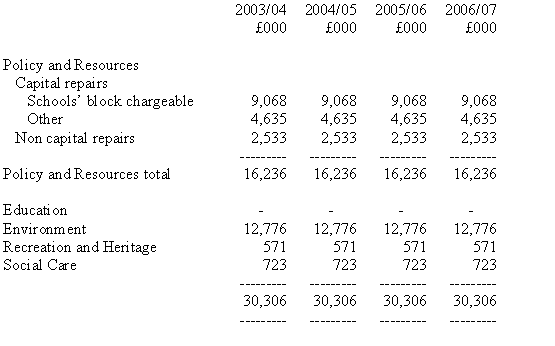 Table 11 - Capital cash limit - locally resourced schemes
20.13 The guidelines are based on the cash limits for the current programme, adjusted for virements to and from revenue, plus 2.5% for inflation in line with the non-pay inflation assumption for the revenue budget.
20.14 Executive members may propose supplementing their capital guidelines from their services' own resources, including virement from their revenue budgets or by using their share of capital receipts obtained in 2001/02 as allocated by the Cabinet in July 2001 (if not already used for the 2002/03 programme).
20.15 Executive members may also anticipate their share of capital receipts obtained in 2002/03 provided the receipt has actually been received and the share agreed.
20.16 Proposals for Executive members to retain more than the standard 25% share of capital receipts for `in and out' schemes should be put forward to the Executive Member for Policy and Resources for consideration, in line with the policy agreed in September 1998. Costs incurred on `in and out' schemes in advance of the capital receipt must be met initially from the committee's programme limits, unless other funding resources are available.
20.17 Within the guidelines, some flexibility between starts years is possible, provided the total four-year guideline for each service is not exceeded. Bunching of payments in any one year or front-loading must also be avoided.
20.18 A decision on the allocation of the Discretionary BCA for 2003/04 of £2.391m will be taken by the Cabinet in February 2003.
20.19 The report to Executive members should identify any possible capital projects which might be suitable for the private finance initiative (PFI) and attract revenue support from the Government towards their capital element in 2004/05 to 2006/07. In doing so Executive members should list:
· brief details of the scheme, including whether funding other by PFI is feasible
· the latest estimate of capital cost
· brief details of any discussions with the relevant Government department or the PFI advisers, 4Ps
· the year in which a fully prepared outline business case could be forwarded to the Government for consideration for support.
20.20 In summary Executive members are asked to bring forward proposals for:
· a locally-resourced capital programmes for the four-year period from 2003/04 to 2006/07 within the guidelines of the current capital programme adjusted for inflation, and
· capital schemes supported by scheme or programme specific Government grants and borrowing approvals for 2003/04 and those expected to be supported in 2004/05, 2005/06 and 2006/07, and
· possible capital projects which might be suitable for the private finance initiative (PFI) and attract revenue support from the Government towards their capital element in 2004/05 to 2006/07, subject to further reports on the outline business case for each scheme and the Government support being available.
21. 2002/03 budget pressures
21.1 These have been identified during the year when the accounts were closed (July) and again at the last Cabinet meeting in November. Final decisions on pressures and use of the additional £3.6m balances set aside to cover various risks during 2002/03 can be considered at the Cabinet meeting in February.
21.2 There is however a pressing need to determine the extent of additional support required for Social Services to avoid the penal cost of fines for bed-blocking, due to be implemented despite representations by councils and health authorities in April 2003. Exact timing will depend upon legislation. An extra £100m specific grant is said to be available nationally to help authorities cope with the targets and importance of fines. Details are awaited on the amount and method of distribution, which ought to take account of the 20% premium in fines for authorities in the south east, which cannot be reflected using the formula grant methodology. Such an extra grant will also be paid pro-rata if fines are implemented in practice part way through the year. Building care capacity grant of £4m is removed in 2003/04 and the continuing cost of existing nursing care places removed from hospitals have to be met with the passported cash increase for Social Services in 2003/04.
21.3 The Social services budget as usual is experiencing pressure during 2002/03 and attempts are being made to manage the outturn within the cash limits. There is limited scope to do this and reduce bed blocking to meet increasingly difficult monthly performance targets at the same time. There is also a need to measure the response in terms of beds blocked due to demand pressures on Social Services alone and to avoid space being created for GP's to refer further elderly to take up the capacity released in hospitals. As a result the Council will continue to work in close partnership with the strategic health authority and hospital trusts to ensure timely and effective action. In the longer run, additional capacity through the partnership to develop extra nursing home care places will help, but there is a need to bridge the transitional period for the remainder of 2002/03, through 2003/04 and into 2004/05.
21.4 The estimated cost of reaching the performance targets for bed blocking before fines are introduced and become effective is £2m. Because of the uncertain timing and the need to ensure effective targeting against a profiled business plan to achieve the targets it is proposed that:
· £2m be set aside in an earmarked reserve
· the reserve be used to meet targets for the reduction of beds blocked in hospital for the rest of 2002/03 and into 2003/04 prior to the introduction of fines by Government for exceeding the targets
· that £1.1m be taken from the additional revenue contributions to capital which were set aside from the interest on additional balances when the accounts were closed in July 2002
· that £0.9m be taken from the extra balances of £3.6m set aside when the 2002/03 budget was prepared to meet additional risks and pressures (leaving up to £2.5m for other pressures and risks)
· that the Leader approve the release of the resources against the profiled business plan to achieve the targets on the advice of the Chief Executive, County Treasurer and Director of Social Services
· that continuing costs and further achievements of the targets in 2003/04 be met with the passported cash increase and additional specific grant for this purpose allocated in the budget strategy to Social Services.
22. Budget consultation
22.1 The Cabinet has considered the need for additional consultation against new guidance on a number of occasions. Sufficient public opinion evidence exists on priorities between services for both increases and reductions, and on the importance and standards of these services.
22.2 The usual round of stakeholder budget consultation meetings will be held in February between the Cabinet and County Council budget decisions.
22.3 The `Hands off Hampshire' campaign has fully explained the dilemma from the loss of Government grant and the difficulty of offsetting that by cuts in services with the consequential impact on council tax.
22.4 The Cabinet may still with to consult further on views on council tax levels and further consideration might be given by the Leader to the use of:
· community workshop
· representation public telephone survey
· letter to media and responses
· website survey
· no further action
Recommendations
1 |
That a written response to the provisional settlement be submitted as set out in the report and that representations be made to the County Councils Network and the Local Government Association, and that copies of the response be sent to all Hampshire MPs |
2 |
That a request be made to meet the Minister as part of a delegation of south east counties adversely affected by the settlement |
3 |
That the 2003/04 budget strategy, as updated by the Cabinet in September and November 2002, and as set out in this report, be endorsed |
4 |
That service budgets be prepared in consultation with executive members within budget guidelines as set out in this report for consideration by policy review committees |
5 |
That executive members approve service budgets within the budget guidelines for submission to the Leader and Cabinet in February 2003 |
6 |
That the Education executive member reports back on the implications of the new funding system for Education and in particular the extent to which the passported increase in schools' funding, both from the schools' formula spending share and from specific grants meets identified costs and pressures, taking account also of the increases in schools' standard grant and devolved capital direct to schools. The Executive member will need to notify the Secretary of State by 31 January 2002 of the proposed schools' budget for 2003/04 and of the County Council's intention to passport the increase in schools' funding. |
7 |
That the Social Care executive member reports back on the scope for removing the ring-fence and using specific grants to meet local pressures and priorities as one of the new freedoms for the County Council from its excellent rating in the Comprehensive Performance Assessment. |
8 |
That the Social Care executive member also reports back on the overall implications of changes in specific grants, the impact of changes in function, and the extent to which pressures and demands can be absorbed within specific grants and the adjusted 7.3% passported cash increase in social services formula funding share, within the budget strategy |
9 |
That all executive members identify efficiency improvements achieved in absorbing pressures and costs within the budget guidelines |
10 |
That all executive members report back on inescapable budget pressures and legislative requirements that cannot be absorbed within the budget guideline cash limits for their services, with proposals for redeployment of resources to offset these costs |
11 |
That all executive members report back on their annual review of charges and maximisation of income |
12 |
That the Education and Social Care executive members report back on the implications of 1% and 1.5% reductions in passported cash amounts for the schools' block and social services, to provide some flexibility in making final budget decisions |
13 |
That other executive members identify the scope for further savings and reductions in services of 1% and 1.5% to provide some flexibility in making final budget decisions |
14 |
That the Hampshire Fire and Rescue Authority in the light of its budget growth over the last two years and the uncertainty surrounding the settlement of the firefighters' pay award should be asked, in the context of the difficult grant settlement for the Council, to prepare its budget on the roll forward of current policies only, with no additional cost from new growth items |
15 |
That executive members be asked to prepare proposals for a locally resourced four year capital programme within the current programme limits, adjusted for inflation |
16 |
That in addition, executive members be asked to submit capital schemes supported by Government grants and scheme-specific borrowing approvals for 2003/04 and those expected to be supported in 2004/05, 2005/06 and 2006/07 within the 27.5% increase in approvals received in the settlement |
17 |
That executive members should submit possible capital projects which might be suitable for private finance initiative revenue support from 2004/05 to 2006/07, subject to further reports on the outline business case for each scheme and the Government support available |
18 |
That £2m be set aside in an earmarked reserve to provide resources to assist Social Services meet targets for the reduction of beds blocked in hospital for the rest of 2002/03 and into 2003/04 prior to the introduction of fines by the Government for exceeding the targets |
19 |
That to create this reserve, £1.1m be taken from revenue contributions to capital (set aside from the additional income on balances when the 2001/02 accounts were closed) and £0.9m be taken from the additional balances of £3.6m set up with the 2002/03 budget |
20 |
That the Leader approves the release of resources from the reserve to match the profiled business plan to achieve the targets on the advice of the Chief Executive, County Treasurer and Director of Social Services |
21 |
That the usual round of budget consultation meetings be arranged in February |
22 |
That further consideration be given by the Leader in January to the use of a community workshop and/or a representative public telephone survey and/or a letter to the media inviting comments through the website. These approaches would allow the public to give its views on the balance between marginal increases or reductions in the projected 15% council tax rise and potential impacts upon service levels in the light of the Government's reduction in grant |
23 |
That the Leader and Cabinet in February recommend the budget and capital programme to the County Council, to include |
· agreement of the base budget for all services · confirmation of the ring-fenced schools' budget for Education and passported cash increases for Social Services · consideration of executive members' responses to the budget guidelines · assessment of the results of budget consultation with: partners (headteachers, governors, parent teachers organisations, the voluntary sector, trades unions); business interests; residents' associations and council tax payers · review of the outcome from any further public opinion polling and the website survey together with any comments received from other organisations such as Police, Fire and health authorities · recommendation of spending and council tax decisions within the flexibility available within the provisional projections and subject to the final local government finance settlement and the update of budget and council tax figures · agreement of the draft capital programme submissions and outline feasibility of possible private finance initiative (PFI) schemes supported by Government revenue grant. |
Section 100 D - Local Government Act 1972 - background papers
The following documents disclose facts or matters on which this report, or an important part of it, is based and has been relied upon to a material extent in the preparation of this report.
NB the list excludes:
Published works.
Documents which disclose exempt or confidential information as defined in the Act.
TITLE FILE
None