
Archived decisions
Regulatory Services Best Value Review
Analysis of Data
1. Consultation
1.1 The main findings from the Citizen's Panel 2002 were:
58% awareness of Advice Service and high satisfaction levels
Mainly use telephone directory to find out about Trading Standards
75% prefer to use the phone for advice
61% asked for more publicity about Trading Standards
Priorities for service:
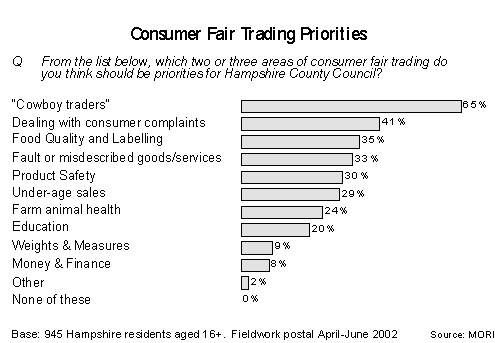
1.2 The main findings from the Interviews with Businesses, conducted by Lynne Miller Associates, were:
Trading Standards were customer focused, knowledgeable and helpful
Businesses valued the relationships built up with their nominated officer
Businesses praised the weights & measures calibration service
Visits following a complaint were seen as constructive
Home Authority companies were particularly appreciative of the advice and support received
Businesses were interested in "Legislation Seminars" to be introduced
New Trading Standards awards were of greater appeal to small businesses.
1.3 The Advice Service Customer Survey results:
· 127 returns representing 47% response rate
· High levels of customer satisfaction
· Difficulty in finding out how to access the service
· Difficulty in getting through to advisors using current telephone system
· Preference for speaking to advisor rather than listening to taped information.
1.4 The following results came from the survey of 300 members of the Buy with Confidence Scheme :
· 52 returns representing 17% response rate
· 80% found the officer they dealt with helpful or very helpful
· 72% were satisfied that there was a distinction made between what was the law, and what was good practice
· 56% had read the service's enforcement policy
· The most popular forms of receiving advice from the service were
o By telephone
o Factsheets
o One to one advice.
· The top priority areas for Trading Standards were seen to be
o Falsely described goods and services
o Underage sales
o Responding to consumer complaints
o Misleading pricing and credit
o Responding to complaints from businesses.
1.5 Summary of Scientific Service Customer Reviews
The customer interviews showed that customers were:
Happy with the quality of the Service
Generally satisfied with pricing
Dissatisfied with turnaround times
Pleased with relationships
Very satisfied with scientific advice
1.6 The findings from the five staff focus groups were:
Trading Standards Staff:
· saw themselves as professional and hard working
· colleagues were good to work
· main concerns centred around a perceived lack of resources, pay & benefits
· there was frustration at being led by Central Government targets.
Scientific Service Staff:
· Staff were customer focused and were aware of problems with delivery/turnaround times which they were keen to improve.
· A major issue was the cramped conditions at the Laboratory. (Originally built for 20 staff it now accommodates 40).
· There were also a few comments about pay and remuneration.
2. Comparison
2.1 For Trading Standards, a key source of data was the CIPFA statistics for 2001 which compares costs, staffing levels and workload for all Local Authorities.
Another key source for Food Standards work was the Food Standards Agency website which provides inspection and sampling levels for all Food Authorities.
These sources were supplemented by a series of visits to other Trading Standards Authorities classed as "award winning" and a number of private and voluntary sector organisations. This enabled qualitative comparisons to be made.
For Hampshire Scientific Service, a major benchmarking exercise was conducted which compared eight Public Analyst Laboratories from across England. (From a total of 20).
This was supplemented with comparisons made with 30 labs from 3 different sectors (food, environmental and medical) as part of a PhD thesis published in 2000.
2.2 Trading Standards Service Budget (Revised for 2002/2003):
£000's | |
Employees |
2,109 |
Premises |
1 |
Transport |
172 |
Supplies and Services |
678 |
Support Services |
44 |
Total expenditure |
3,004 |
Income |
-205 |
Net expenditure |
2,799 |
2.3 Key Findings from CIPFA Statistics
2.3.1. Costs
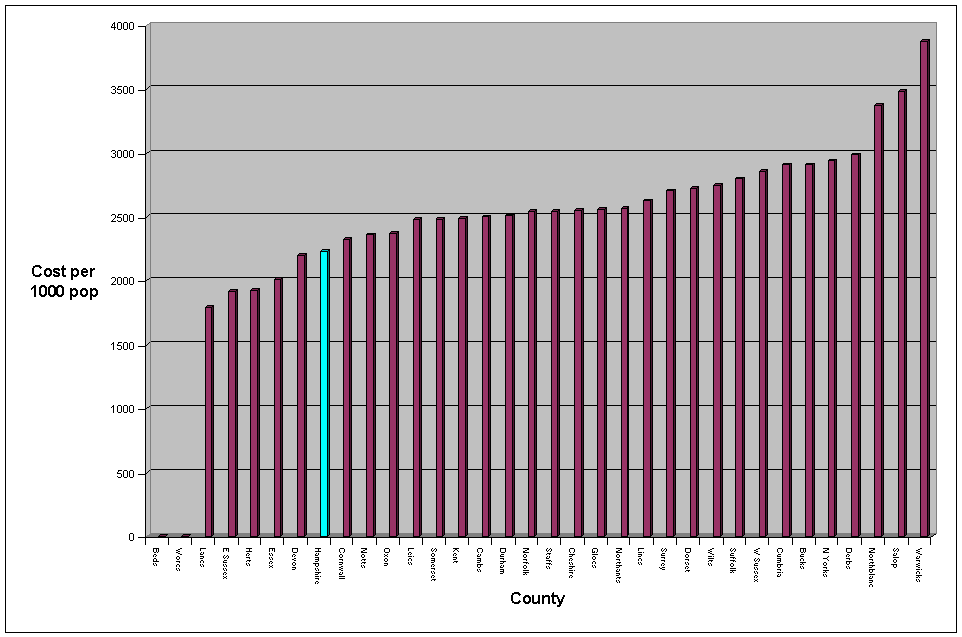
The Service costs £2.23 per head of population, which is in the lowest quartile of all Trading Standards Services. (National average for English counties is £2.51) See following graph.

2.3.2. Inputs
Total Staff of 70 = 5.6 per 100k population
Average of English counties = 7.1 per 100k population
(Based on the above average Hampshire would have 89.5 staff)
2.3.3. Workload
Consumer Complaints and enquiries 19,300 = 15.25 per 1,000 population
Average of English counties = 20 per 1,000 population
2.3.4. Business Premises.
Hampshire |
County National Average | |||
No of premises |
Number |
(% of total) |
Number |
(% of total) |
· High risk |
1165 |
(3.4) |
808 |
(3.8) |
· Medium risk |
7451 |
(22) |
5072 |
(24) |
· Low risk |
14156 |
(41) |
10146 |
(47) |
· No inspectable risk |
11590 |
(34) |
5398 |
(25) |
· Total |
34362 |
(100) |
21426 |
(100) |
No of inspections |
|
|||
· High risk |
1049 |
(90) |
331 |
(41) |
· Medium risk |
2047 |
(27) |
1171 |
(23) |
All visits* |
||||
· Total of all visits |
10170 |
(100) |
5665 |
(100) |
Average no of all visits per annum per direct service staff |
178 |
150 | ||
*Includes all types of visit, e.g. primary, secondary, verification, complaints and sample visits. |
||||
No of formal cautions per 10,000 business premises |
11.3 |
25 | ||
No of prosecutions per 10,000 business premises |
14.2 |
23.4 | ||
The key findings from the above statistics are that Hampshire:
· Is in the lowest quartile for cost per head of population
· Is significantly below the national average for number of staff per head of population (22% lower)
· Dealt with 25% fewer complaints per head of population than the national average
· Inspected far more of its High Risk premises (90% compared to 41%)
· Inspected more Medium risk premises
· Conducted more inspections per officer
· Dealt with fewer prosecutions and issued less cautions
2.4 The Food Standards Agency Statistics for 2000 showed that Hampshire had the highest levels of sampling for UK County Councils. This was also praised in the FSA Audit Report of Hampshire in September 2001. Over 40% of samples fail to meet legal standards with problems varying from quality to insufficient labelling. Some key outcomes from the food sampling programme include:
· A Hampshire project sampling children's birthday cakes showed very high levels of artificial colouring matter in the icing. As a direct result the Food Standards Agency have requested EU officials to change European Law.
· The Food Standards Agency (FSA) has commissioned Hampshire's Food Team to draw up national sampling protocols based on their best practice.
· Hampshire Scientific has published national sample storage guidelines for local authorities on behalf of the FSA.
2.5 To compare Hampshire in terms of innovation and best practice, in-depth visits were made to authorities that either have Beacon Status for aspects of Trading Standards work, or have received the Office of Fair Trading (OFT) Excellence Award:
· Devon - Beacon Status
· Dorset - OFT Commendation
· Surrey - OFT Commendation
· Warwickshire - OFT Excellence Award
2.6 The visits showed that as far as best practice was concerned none of the above authorities were operating very differently from Hampshire or performing at a higher level overall. On the question of innovation the approach taken is echoed by our own service and found to be most effective when an officer is given the responsibility and time to concentrate solely on a key project. For the most part Hampshire already has similar initiatives of equal merit, or has considered them and rejected them due to lack of resources or doubts as to their effectiveness.
2.7 Scientific Service Budget (Revised for 2002/2003)
£000's | |
Employees |
1,086 |
Premises |
49 |
Transport |
46 |
Supplies and Services |
444 |
Support Services |
8 |
Total expenditure |
1,633 |
Income |
-1,617 |
Net expenditure |
16 |
2.8 Summary of Scientific Service Comparisons
This exercise compared labs from West Yorkshire, Staffordshire, Liverpool, Bristol, Birmingham, Kent and Durham. The table below summarises the main findings from the benchmarking exercise.
Benchmarking data for 8 Public Analyst Laboratories.
Lab |
A |
B |
C |
D |
E |
F |
G |
Hants |
Staff no |
29.5 |
20.5 |
10 |
29.7 |
21 |
15 |
18.5 |
38.4 |
(of which food staff) |
6.5 |
5 |
2 |
6.3 |
7 |
7.5 |
8 |
11 |
Expenditure |
||||||||
Pay |
649991 |
458183 |
330900 |
785312 |
567221 |
388045 |
504000 |
877589 |
Equipment/supplies |
365000 |
100568 |
57700 |
135300 |
152173 |
66000 |
102820 |
332819 |
Other |
560009 |
42671 |
19400 |
237887 |
168260 |
132955 |
261180 |
268812 |
Total |
1575000 |
601422 |
408000 |
1158499 |
887654 |
587000 |
868000 |
1479220 |
% on pay |
41 |
76 |
81 |
68 |
64 |
66 |
58 |
59 |
% on Equip/supplies |
23 |
17 |
14 |
12 |
17 |
11 |
12 |
22 |
% on other |
36 |
7 |
5 |
21 |
19 |
23 |
30 |
18 |
Income |
||||||||
Internal |
1150000 |
111323 |
179000 |
245667 |
513400 |
305000 |
382000 |
893486 |
External |
462000 |
187567 |
102000 |
721010 |
376158 |
284000 |
416000 |
554188 |
Total |
1612000 |
298890 |
281000 |
966677 |
889558 |
589000 |
798000 |
1447674 |
% internal income |
71 |
37 |
64 |
25 |
58 |
52 |
48 |
62 |
Profit/ (loss), £ |
37000 |
-302532 |
-127000 |
-191822 |
1904 |
2000 |
-70000 |
-31546 |
% profit/ loss (-) |
2.3 |
-50.3 |
-31.1 |
-16.6 |
0.2 |
0.3 |
-8.1 |
-2.1 |
Income/person |
54644 |
14580 |
28100 |
32548 |
42360 |
39267 |
43135 |
37700 |
Income/payroll£ |
2.48 |
0.65 |
0.85 |
1.23 |
1.57 |
1.52 |
1.58 |
1.65 |
Average salary |
22034 |
22350 |
33090 |
26441 |
27011 |
25870 |
27243 |
22854 |
Samples |
||||||||
Food |
3453 |
1389 |
568 |
2502 |
2018 |
3050 |
4009 | |
other |
649 |
3504 |
7445 |
6790 |
8000 | |||
Total |
2038 |
6006 |
9463 |
9840 |
12009 | |||
Samples per person |
99 |
286 |
631 |
532 |
313 | |||
Food samps/food staff |
531 |
278 |
284 |
357 |
269 |
381 |
364 | |
Turnaround for Food Samples |
||||||||
Number in 4 wks |
1733 |
768 |
103 |
1439 |
1364 |
1217 |
1439 | |
% in 4 wks |
50.2 |
55.3 |
18.1 |
57.5 |
67.6 |
39.9 |
35.9 | |
Quality |
||||||||
UKAS |
yes |
yes |
yes |
yes |
yes |
yes |
yes |
yes |
ISO 9001 |
no |
no |
no |
no |
yes |
no |
no |
yes |
FAPAS |
20 |
36 |
15 |
33 |
39 |
35 |
38 |
46 |
Automation |
9 |
11 |
2 |
11 |
7 |
8 |
15 |
15 |
· The table shows that Hampshire's Lab is well staffed and reports the highest numbers of food samples. (The main Public Analyst function).
· However, although Hampshire reported the second highest number of foods within 4 weeks, its overall turnaround figure is second weakest. This indicates a work scheduling issue.
· Income is second highest, operating on a virtually breakeven basis. The proportion of income from internal customers is second highest as is income per payroll pound.
· On quality, Hampshire takes part in the most external proficiency tests (FAPAS) and benefits from ISO 9001 registration and the highest number of pieces of automated equipment.
· The comparisons across other laboratory sectors showed that Hampshire Scientific Service compared favourably across all three sectors, and was better at business planning than labs from the medical sector. The research showed that the critical success factor for laboratories is reliability of results. This supports Hampshire's adoption of UKAS accreditation and BSI quality management systems.
3. Competition - Key findings.
3.1 Summary of Trading Standards Competitiveness.
The UK Trading Standards Service is a statutory service provided entirely by the Local Government sector, so opportunities for competition are not generally available.
However, certain services are operated on a commercial basis including:
· Weighbridge Test Unit: Hampshire provides services to a number of local authorities other than Hampshire.
· Bulk Fuel Test Unit: Hampshire provides services to a number of local authorities other than Hampshire.
· Approved body for EC Verification: We stamp scales for Reading, Southampton, Portsmouth Councils on a fee paying basis. There is a limited market for these services.
At present, there are no private sector providers of Trading Standards Services (apart from staffing agencies such as Osborne-Richardson that provide Trading Standards Officers at enhanced salaries).
There are however opportunities to:
· Look at partnership working with other Local authorities. For example Hampshire provides animal health services for Southampton CC on a fee paying basis. (Animal passports etc). There is also a demand for good quality advice services so Hampshire could provide these services on a regional basis.
· In conclusion, the opportunities for market testing Trading Standards Services are currently limited but opportunities will be explored to start partnership arrangements with other authorities and possibly private and voluntary sector organisations.
3.2 Summary of Scientific Service Competitiveness.
· In January 2002, a new 5-year partnership arrangement between Hampshire and Kent County Councils' laboratories was signed.
· In 2001/2, the partnership shared approximately £250,000 of income from joint clients. In 2002/3, it is intended to increase this to £300,000 by targeting local authorities via competitive tenders, negotiations and targeted campaigns.
· At present, Hampshire's Scientific Service works in partnership with Kent Scientific Services to provide Public Analyst services to the following food authorities:
HSS's Public Analyst Appointments
Surrey * |
Southampton * |
Bracknell Forest |
Isle of Wight * |
Portsmouth * |
Cambridgeshire * |
Kent * |
London * |
Windsor & Maidenhead |
Dorset |
Bournemouth * |
Southend on Sea |
Devon |
Poole |
Reading |
Essex |
Swindon |
Oxfordshire |
West Berkshire |
Wiltshire * |
Medway |
Hertfordshire * |
Brighton & Hove * |
(* denotes contract secured) |
Recent tendering results.
Authority |
Method |
Result and Value |
Buckinghamshire CC |
Tender |
Not awarded |
Cambridgeshire CC |
Tender |
Awarded 2001 (£70,000 pa) |
East Sussex CC |
Tender |
Not awarded |
Hertfordshire CC |
Negotiation |
£15,000 contract secured |
Surrey CC |
Tender |
Awarded 1999 (£100,000 pa) |
Swindon BC |
Tender |
Awarded (£30,000 pa) |
West Sussex CC |
Tender |
Part awarded (£6,000 pa) |
Contracts with Brighton & Hove Council, Southampton CC., Portsmouth CC, Bournemouth BC, Isle of Wight Council and Wiltshire CC were all renewed in 2001.