
Archived decisions
Hampshire County Council Social Care Policy Review Committee Item 11 17 January 2003 Integration of Mental Health Services Report of the Director of Social Services |
Contact: Ruth Dixon (County Manager Operations), ext 7107
1. Summary
1.1 This report informs Members of the progress made by the Social Services Department in developing an integrated mental health service with West Hampshire NHS Trust and Surrey Hampshire Borders NHS Trust. It describes the organisational structure, the outcome of consultation and the proposals for formal partnership agreements under Section 31 Health Act 1999, the Health Act `flexibilities'. The current proposals are the most significant use of the `flexibilities' to date, involving £8.7 million of social services resources. Members are invited to comment on the proposed partnership arrangements.
2. Background
2.1 The proposals in this paper cover organisational arrangements for mental health and substance misuse services for adults of working age in Hampshire. Services for older people with mental health problems and people with learning difficulties are not included in the partnership arrangements to be described. The arrangements are for the joint management of operational services and do not include planning and commissioning.
2.2 The case for integrated management of mental health care arises from the need for service users and carers to receive coordinated and seamless care to meet both their health and social care needs. Community Mental Health Teams (CMHTs) that bring together a range of mental health professionals such as psychiatrists, mental health nurses, occupational therapists, psychologists and social workers into a single team have been a feature of mental health services in some parts of Hampshire for over ten years. There has also in recent years, and dependent on available resources, been further service developments nationally including the establishment of Assertive Outreach Teams (to engage with a hard to reach population of mental health service users), Crisis Resolution and Home Treatment Teams, and improved models of inpatient care. The overall service requirements for adults with mental health problems are described in the Mental Health National Service Framework. A parallel initiative, Models of Care, has recently been launched for substance misuse; this also describes the range of services required and emphasises the importance of integrated assessment and care processes.
2.3 The preferred organisational model for the delivery of services for people with severe mental health problems is a specialist Mental Health Trust and the current paper describes proposals for how Hampshire County Council intends to meet its statutory requirements for service delivery jointly with the specialist Mental Health Trusts.
2.4 It is increasingly recognised that for adult mental health services a joint and integrated approach to the management of services between NHS Trusts and Social Services delivers a number of benefits to service users, and increases the efficiency and effectiveness of partnership working. Further integration requires a formal legal framework to ensure an appropriate accountability framework is in place. The Health Act 1999 includes proposals for this including `flexibilities' under Section 31 of the Act. This allows for integrated provision (the subject of the current paper) and also lead commissioning or pooled budgets (which are not being proposed at the present time).
2.5 In 2001, outline proposals were developed between the NHS Trusts and Social Services' departments providing adult mental health services in Hampshire and Southampton for an integrated service and these were reported to Social Services Committee in July 2001. The model included:
i) A Joint Strategy and Performance Board with a performance management function.
ii) A Joint Management Board to oversee the operational management of a joint health and social care adult mental health service.
iii) Integrated locality management with jointly appointed managers from NHS Trusts and Social Services.
2.6 A Mental Health Integration Project Board was established, chaired by the Hampshire Social Services' Assistant Director (Adult Services) to oversee the project, with representation from Southampton City Council Social Services, Surrey Hampshire Borders NHS Trust and West Hampshire NHS Trust (Portsmouth Health Care NHS Trust was also represented prior to its dissolution). The initial work of the Board included:
i) Commissioning of a staff consultation exercise, proposals for governance arrangements and an outline project plan from the Sainsbury Centre for Mental Health.
ii) Appointment of County Manager (Operations) as project manager for the Board.
iii) Establishment of Partnership Project Teams between each NHS Trust and the Social Services Department to develop and implement a detailed project plan.
2.7 Since the establishment of the Integration Board there have been further organisational changes in the Mental Health Trusts:
i) West Hampshire NHS Trust assumed the management of adult mental health (but not substance misuse services) for Fareham and Gosport and East Hampshire.
ii) West Hampshire Trust established a locality structure based on PCTs and the first three joint locality managers (for New Forest Eastleigh/TVS and Mid Hampshire) were appointed in April 2002.
iii) Substance misuse services for Fareham and Gosport and East Hampshire transferred to Portsmouth City PCT, to be reviewed in Autumn 2003.
iv) There is work in progress on the future organisational arrangements for mental health services in North Hampshire, Blackwater Valley and Hart and Surrey. There is an emerging consensus, subject to consultation, that services for North Hampshire may be provided by West Hampshire Trust and services for the Blackwater Valley provided by a Surrey-based provider. The options should be available for public consultation early in 2003.
2.8 These organisational changes were considered by the Social Care Policy Review Committee in May 2002. Widespread support was expressed for the development of joint management arrangements for the Blackwater Valley population with Surrey Hampshire Borders Trust and Surrey County Council.
3. Progress
3.1 The following progress has been made since May 2002:
i) Agreement on the key features of a partnership agreement for integrated provision under Section 31 Health Act 1999. These include high-level features in a notification to the Directorate of Health and Social Care and the SSI, (Appendix 1), a draft partnership agreement, and Governance and Accountability arrangements (Appendix 2).
ii) Staff and stakeholder consultation on the requirements of an integrated mental health service (Appendix 3) and the development of a new joint organisational structure (Appendix 4).
iii) Development of a joint protocol on the management of change
iv) Recruitment to the remaining joint locality manager posts (December 2002 and January 2003).
3.2 The consultation process confirmed widespread support for the proposals. It also confirmed for the Social Services Department the importance of building into the joint organisational structure a number of features to support the Department's statutory functions. These include dedicated practice development support, including advice on the use of the Mental Health Act for Approved Social Workers; the importance of an adequate number of senior social work practitioners; and the need to build and sustain effective partnerships with housing, the voluntary sector and child protection services. To achieve the latter in the joint structure with West Hampshire Trust some social services team manager resources have been recycled to establish locality performance and development posts. The latter posts will also assist locality managers with contract development and monitoring and a range of other service developments to support the implementation of the National Service Framework.
4. Next Steps
The steps required by April 2003 are:
i) Formal acceptance of the Partnerships Agreement by all agencies.
ii) Recruitment to a range of joint posts e.g. locality managers, CMHT managers and performance and development posts.
iii) Delegation of responsibility for the management of some specialist services to NHS Trusts under Section 28B Health Act (e.g. Forensic Mental health and Substance Misuse budgets). There will also be an exploration of the potential for a pooled budget for training.
iv) Establishment of Partnership Boards to oversee implementation of the Agreement.
5. Issues for Consideration
5.1 The partnership arrangements for adult mental health services will be the first significant formal partnership agreements made in Hampshire under the `flexibilities' contained within Section 31 Health Act 1999. They are therefore an important source of learning for other developments in the future. Key issues arising out of the current project include:
i) Leadership
There was recognition at the outset of the integration project of a number differences in organisational culture between NHS and Social Services, ranging from the use of language to the approach to budgets and accounting systems. These differences have been addressed in a variety of ways, approaches assimilated, and new organisational cultures and styles developed. The success of this has been greatly dependent on leadership styles that allow for flexibility of approach. The importance of pre-existing good working relationships at a senior level in partner organisations has been critical. There is necessarily a high degree of trust required given the size of the resource involved (£8.7 million of social care resource) and the complexity of the project.
ii) Human Resources
Good progress has to a significant degree been made possible due to the goodwill of staff and middle managers arising from support for the overall objectives of the process. Most middle managers within health and social services have had existing posts deleted and have been required to apply for new posts. This has presented a number of challenges arising from different terms and conditions of service and existing organisational arrangements. There continues to be some anomalies, for example, with regard to remuneration which are not resolvable at local level. There has also been a need to develop a joint approach to Trades Union consultation, and this work in still in progress.
iii) Financial Systems
The implications for the joint management of financial resources have been greater that originally envisaged, both in terms of project support and the capacity of systems to support an integrated service and this will need to be taken account of in other partnership arrangements. A substantial contribution to this extra demand arises from a requirement to disaggregate budgets to seven localities, and to separate out specialist services e.g. forensic mental health and substance misuse. A number of options continue to be explored to limit additional demands on finance staff time including the transfer of resources to an NHS Trust and the pooling of budgets (see 4 iii above).
iv) Information Systems
Virtually all adult mental health practice is conducted from NHS bases and this has placed significant demands on the capacity of IT services to support joint working. Whilst there has been some significant investment from Mental Health Supplementary Credit Approvals in IT capacity, including the development of plans for a joint information system, there continues to be a significant amount of development required e.g. access to Hantsnet 2000 in NHS bases, and a joint approach to information and performance management.
v) Efficiency and Effectiveness
The success of an integrated service will be judged ultimately by its ability to deliver a better service to the public and make best use of available resources. The experience of other mental health partnerships e.g. in Somerset is that in the short term there may be a temporary decline in performance followed by recovery as a new service develops. With regards to the deployment of resources the integration project has already allowed for the reinvestment of some management costs into frontline services e.g. social care for mentally disordered offenders and senior practitioners, and joint investment with Southampton City Council to fund a practice development post. Other opportunities to share resources include access to the developing work with users and carers by West Hampshire Trust, access to joint training in risk assessment and management, and a joint approach to the use of occupational health resources from NHS Trusts.
6. Conclusion
This report describes in outline the progress made in developing proposals for the integrated management of adult mental health services, including draft formal agreements and lessons learnt from the process. The current development is an important milestone in the continuing development of partnerships between the County Council and the NHS and includes the first major example of a partnership agreement under the Health Act 1999.
7. Recommendations
1. Members are asked to consider and comment on the issues in this report, prior to the matter being referred to the Executive Member for Social Care.
Section 100 D - Local Government Act 1972 - Background Documents
The Following documents disclose facts or matters on which this report, or an important part of it, is based and has been relied upon to a material extent in the preparation of this report.
NB the list excludes:
1. Published works
2. Documents which disclose exempt of confidential information as defined in the Act.
NONE
Appendix 1
NOTIFICATION FORM
SECTION 31 PARTNERSHIP ARRANGEMENTS
(to be completed for each partnership arrangement and sent to appropriate NHS Regional Office)
1. NAMES OF THE STATUTORY PARTNERS West Hampshire Trust Hampshire County Council |
SIGNATURE OF THE REPRESENTATIVE OF EACH PARTNER |
2. DATE OF AGREEMENT To be inserted |
|
3. DATE WHEN PARTNERSHIP IS INTENDED TO START 1 April 2003 |
|
4. NAME OF OFFICER RESPONSIBLE FOR PARTNERSHIP Martin Barkley, Chief Executive, West Hampshire Trust Jill Stannard, Assistant Director, Hampshire County Council Social Services |
|
5. WHICH FLEXIBILITIES ARE BEING USED? Integrated provision |
6. What are the intended aims, outcomes and targets set by the partnership? AIM: To improve efficiency of Mental Health delivery through:- · Integrated line management · Deliver health and social care services via integrated (i.e. single) line management · Ensure service delivery is focused on meeting user and carers needs in a seamless way · Involve staff, provide support and value their individual contributions ensuring that there are good recruitment and retention practices · Both Health and Social Services will expect managers to operate within a balanced budget · Look for opportunities for added value e.g. pooled budgets OUTCOMES TARGETS Clinical Focus · CPA systems · Readmissions · Improve access to service for substance misuse To ensure the targets set out in the NHS plan are met in accordance to DoH guidance To achieve and improve upon the national target of 12.3% of emergency psychiatric readmissions of patients aged 12-64 within 90 days of discharge from the care of the psychiatric specialist To ensure the targets for access to substance misuse services set out in the NHS plan are met To reduce the waiting times for access to substance misuse treatment Patient Focus · User satisfaction · To improve carer satisfaction To improve year on year as measured by user surveys To improve number of carers of people on CPA who have had their needs assessed Capacity and Capability Focus · Improve recruitment and retention · Improve staff satisfaction · Improve information sharing Reduce turnover rates Reduce vacancy rates Reduce sickness absence rates each year Improve the level of staff satisfaction as measured by national NHS staff satisfaction survey and local surveys Every member of staff has annual appraisal and PDP To implement an AMH information system including substance misuse Key Targets · Increased efficiency in financial management · Improved implementation of NSF, NHS plan standards and models of care · Increased ability to maximise independence To achieve a balanced budget including a 2% efficiency saving To deliver the targets as set out in the NSF, NHS plan and models of care To perform well in CHAI, SSI and MHA Commission inspections To increase the number of people helped to live at home |
||||
7. How will the partnership lead to improvement in services as defined by the strategies in the Health Improvement Programme? It will underpin the delivery of fast, convenient and patient centred and the NHS plan across the geographical patch served by the partner agencies. |
||||
8. Who has been consulted, and how has this been done? If there is to be a movement of staff, have staff and their unions been consulted? This has been carried out by the Sainsbury Centre by consultation with staff and key agencies, members and the formal board. Further consultation is planned with Unions, particularly where staff may be moved.
|
||||
9. How is/are the local authority functions going to contribute to a health outcome through this partnership? The partner will promote the incorporation of the social model of care into service delivery. It promotes a strategic partnership between the regeneration and social inclusion functions of local authorities and the health improvement and modernisation programme |
||||
10. How does this promote existing local joint working? It builds on existing partnerships such as integrated CMHT's and the current arrangements within the LIT's. |
||||
11. Who will be the services users? Define in terms of e.g. client group, age range, PCG, PCT, LA, HA, NHS trust area. Adult Mental Health or substance misuse within ages 18-64 WHT, HCC, SCC, Southampton City PCT, New Forest PCT, Eastleigh TVS PCT, Mid Hants PCT, Fareham and Gosport PCT, East Hants PCT (Adult mental health only - excluding substance misuse) | ||||
12. In financial terms, how much resource is to be committed to the partnership by each partner? To be finalised | ||||
13. Are the signatories, following consultation, satisfied that arrangements for the following are robust? · Governance arrangements, including, decision-making processes, monitoring, accounting and auditing, operational and management arrangements · When the partnership arrangement will be reviewed · Human resources, including staffing, terms and conditions, policies · Information sharing · Identification of functions that are included in the arrangement · Eligibility criteria and assessment processes · Complaints · Financial issues such as Charging and VAT implications. Has the appropriate office of HM Customs and Excise been consulted on the arrangements to be adopted? Has the partnership arrangement been discussed with the relevant auditors? · How disputes will be resolved, and how will partners resolve changes in the arrangement, or dissolve it? Work in progress Yes Yes Yes High Level functions -Yes Work in progress Work in progress Work in progress Work in progress | ||||
Work in progress is dealt within the project plan and will be completed by April 2003
Appendix 2
Governance and Accountability Arrangements
Adult Mental Health Services
There is a need to establish formal arrangements for the development and monitoring of the partnership arrangements being established. It is therefore proposed that the following arrangements be adopted.
1. Four Partnership Boards will be established from April 2003, to maintain an overview of the governance arrangements and to ensure that key lines of accountability are maintained for all partners.
2. Each partnership board will be supported by an operational management team with responsibility for managing the day-to-day business of the partnership.
3. In additional local authorities will be represented on key management and governance bodies of each relevant NHS Trust.
4. The partnership boards will meet at least twice a year to ensure:
· Performance in respect of the aims and outcomes of the partnership arrangements as set out in the Partnership Agreement
· That the partnership complies with all statutory requirements and national and local guidance
· Operational objectives and priorities are agreed
· Proper and efficient use of public money
· Quality of service provided
· A forum for resolution of disputes
5. A detailed memorandum of agreement between the partners will be drawn up and agreed. This will include the delegation of powers from each partner agency, terms of reference, standards of conduct and process for review, resolution of disputes and termination of the partnership.
6. Membership of the Partnership Board will include:
Local Authority
- Director or Social Service
- Assistant Director Social Services - Adult Services/Head of Health and Community Care
- Lead Councillor
NHS Trust
- Chief Executive
- Medical Director
- Trust Board Chair
PCT - Nominated PCT Reps
Observers from
- Representatives the Voluntary Sector
- Representatives from Service User and Carer Organisations
7. Each Partnership Board will receive reports from joint operational management groups. These will be the Adult Mental Health Operational Management Team for Surrey Hampshire Borders NHS Trust and the Adult Mental Health Directorate Management Team for West Hampshire Trust. These groups have membership which includes senior managers from health and relevant social services departments.
8. In addition West Hampshire NHS Trust and Surrey Hampshire Borders NHS Trust will ensure relevant social services departments are offered representation on key decision making bodies within the trust such as policy and clinical governance committees. Social Services will offer appropriate representatives to take these positions.
The integration Board is requested to propose the chairs for each Partnership Board:
· Hampshire CC / WHT
· Southampton CC / WHT
· Surrey CC / HCC / SHBT
and that person is delegated to set up the first meeting by April 2003.
1 Appendix 3
Consultation Paper
Proposals for the Reconfiguration of Management Arrangements for the Delivery of Adult Mental Health Services
TOGETHER
Hampshire County Council
and
West Hampshire NHS Trust
October 2002
1. Introduction
1.1 This paper sets out proposals for the further integration of Health and Social Services provision of Adult Mental Health Services by the creation of a single line management structure. The objective of such a change is to improve services to create:
· A simplified and seamless service between health and social care providers at the point of delivery/access
· A cultural shift to a balanced model of care that gives equal value to the health and social needs of service users through a focus on the holistic needs of individuals and their carers instead of partial perspectives determined by historic funding patterns and the foci of different organisations and professions
· Greater understanding of the roles, their purposes and responsibilities of staff by other staff
· A better strategic approach to resource deployment and best value
· A positive climate of communication and co-operation between organisations and professions
(N.B. This paper refers only to the partnership between Hampshire County Council and West Hampshire NHS Trust. Separate consultation papers will be issued for Southampton City Council and West Hampshire NHS Trust and for Hampshire County Council and Surrey Hampshire Borders NHS Trust.)
2. Context
2.1 In April 2001 Hampshire County Council Social Services Department produced a discussion document to stimulate discussion on the possibilities of furthering the development of integrated Adult Mental Health Services. This document was produced in the context of a number of drivers of change that include:
· The Mental Health National Service Framework and the NHS Plan objectives. The National Service Framework strongly endorsed the development of specialist mental health trusts as a vehicle for delivering the improvements in mental health services and set out models of new services that require a high degree of collaboration between health and social care. The NHS Plan envisages further developments in breaking down the boundaries between health and social care and although the model of integration is not prescribed there is a clear requirement to make progress in this area.
· The desire of all those involved in the provision of local mental health services to develop services that are user and carer focussed, that effectively meet the needs of individuals as well as reducing social exclusion and creating healthier and safer communities.
· The reorganisation of NHS provided mental health services with the establishment of West Hampshire NHS Trust in April 2001 and the consultation of future arrangements for delivery of mental health services by Surrey Hampshire Borders NHS Trust in 2002 which has created the opportunity for further development of partnership and integration.
· The changes, not just in the organisation of mental health services but in the quality and culture of the services demanded by Government, service users and carers alike are of such a scale that there is a need to maximise all the resources available, particularly scarce human resources, to ensure the service is not only valued by service users and carers but is also a good environment for staff to work in.
2.2 Following the circulation of the discussion document a steering group was established of senior managers from:
· Hampshire County Council Social Services Department,
· Surrey Hampshire Borders NHS Trust,
· Southampton City Council Directorate of Social Services,
· West Hampshire NHS Trust,
· Portsmouth Health Care NHS Trust
· Portsmouth City PCT/Social Services.
2.3 All PCTs were invited to join this group and Blackwater Valley and Hart PCT, East Hants PCT and New Forest PCT sent representatives.
2.4 This group became the Integration Project Board which is steering the integration work supported by more locally based Partnership Project Teams.
3. Developments
3.1 Since April 2001 a number of developments have taken place. The Sainsbury Centre for Mental Health Development undertook a consultation on the principles of further integration. The key messages from this work identified that:
· There is a clear commitment and enthusiasm to engage positively in the development of greater integration
· There is considerable diversity across Hampshire and the change implications are bigger for some localities
· There is a need for a transparent process of change
· There is a need to effectively address a variety of human resource/personnel issues together with policies and procedures
3.2 Following this work, West Hampshire Trust developed a locality management structure and the opportunity was taken in April 2002 to appoint three Locality Managers within Hampshire with both health and social services responsibilities. The learning from these appointments has fed the development of proposals contained in this document.
3.3 In addition work has commenced jointly between West Hampshire Trust and Hampshire County Council Social Services on the development of a three year strategic and business plan for adult mental health services. This has included the development of an ambition statement (still in draft) and a set of key goals for improvement of the service.
Draft Ambition Statement;
By 2006
`We are the leaders in providing effective and accessible mental health services that make a positive difference to local peoples' lives.'
4. Principles
4.1 The Integration Project Board established some principles which under pin the process of change towards an integrated management structure:
· Maximum focus on service improvement
· Maintain focus on locality delivery
· Build on existing good partnerships
· Engage, value and support all staff
· Develop better partnership working rather than create a new organisation (Care Trust)
· Keep things as steady as possible - maintain terms and conditions by effective use of secondment
· Maximise the skills, resources and experience of staff - no redundancies as a consequence of integration
· Take the best and build on it
· Ensure form flows from function
· Create alliances and partnerships as part of the everyday function of organisations
5. Proposals
5.1 The proposals outlined in this paper for the new management arrangements have been developed out of a workshop held on 27th September 2002, attended by 38 key managers in Adult Mental Health Service from Health and Social Services. (A full write up of this workshop event is available from Gemma Chislett-Bruce. See address below). At this workshop, commitment to an integrated management structure based on localities reflecting PCT boundaries was fully endorsed.
5.2 There will be 5 Localities in Hampshire:
· East Hampshire (Havant and Petersfield)
· Fareham and Gosport
· New Forest
· Eastleigh and Test Valley South
· Mid Hampshire (Winchester and Andover)
5.3 The managers were asked to design new management structures for each locality that would cover both health and social services responsibilities and could be achieved within the current management resource available.
5.4 Whilst there are a number of local variations a common core for a locality structure emerged. This will form the basis of a new locality management structure and where possible and within resource limits, additional posts identified in localities will be created.
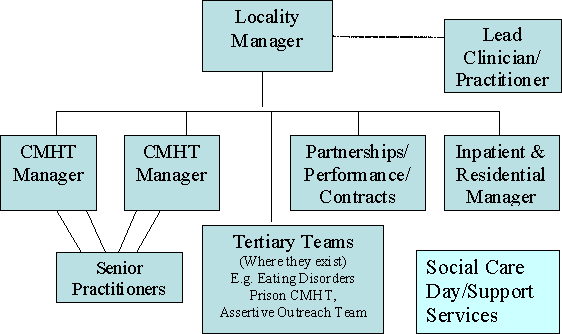
5.5 Locality Manager
The Locality Manager may come from either health or social services background and will:
_ Provide leadership and direction in local mental health services
_ Progress with the implementation of the service model and affect a shift in culture in line with expressed service user and carer wishes
_ Define and agree with staff and between organisations, management responsibilities, relationships to each organisation, and relationships to professional support and development structures
_ Develop an integrated team framework with clearly stated expectations of how the team will function i.e. detailed operational policies
_ Manage all staff and oversee supervision of all disciplines
_ Nourish and support effective interfaces with other mental health teams and wider services, within service models
_ Ensure local service development and contract monitoring
_ Manage health and social care budgets and work with both agencies to ensure the delivery of balanced budgets
_ Be accountable to senior managers in Health and Social Services in line with the protocol agreed between both agencies
_ Work in partnership with professional heads of service in all organisations
5.6 CMHT Managers
The Community Mental Health Team Manager, will be a full time manager with no clinical caseload and may come from a health or social services background. The CMHT manager will be:
_ Responsible for the detailed operational delivery of services that ensure that care co-ordination becomes a reality for service users
_ Manage the staff and the caseload of the team
_ Ensure the implementation of Personal Development Plans and that staff receive appropriate professional support
_ Manage and develop accessible duty services and systems of referral
_ Ensure effective operation of the Care Programme Approach
_ Manage care management budgets
_ Ensure effective liaison with Primary Care
5.7 Partnership/Performance/Contract Managers
These posts are new posts and have been variously described in the locality structures. These posts could be filled by Health or Social Services staff, and will include a range of Health and Social Services tasks, which will include some of the local service commissioning and contracting currently within the brief of Social Services Managers. The detailed scope and range of the tasks that fall within these posts will be identified by each Locality Manager but core tasks could include:
_ Development and contracting local Social Care Services in partnership with Local Implementation Teams
_ Liaison with PCTs
_ Management of service level agreements
_ Management of high cost residential and out of area placements
_ Project work
_ Performance management
5.7 Senior Practitioners
Senior Practitioner posts will be developed in each team. Senior Practitioners will hold caseloads but will have time allocated to contribute to management tasks within the team. Social Work Senior Practitioners will work with the CMHT Managers to ensure effective Approved Social Worker cover is provided and will take the lead on providing professional support and supervision to ASWs.
5.8 Inpatient/Residential Managers
These managers will be the `modern matrons' with a lead for managing acute inpatient services and other Trust based residential services such as rehabilitation units. They will work as part of the Locality Management Team, in partnership with CMHT managers and will be responsible for ensuring an effective interface between Community and Inpatient Services.
They will be specifically responsible for:
_ The day to day management of acute inpatient units and other in-house residential units in the locality
_ The development and maintenance of the Locality Acute Inpatient Forum
_ Implementation of the Department of Health guidance on improving standards of inpatient units
_ Ensuring, where they are in place, the provision of good quality rehabilitation inpatient services
5.9 Lead Clinician
The Lead Clinician may come from any Health or Social Services professional group and work within the given locality. They will be responsible for supporting and advising the Locality Manager on all relevant issues from a clinical perspective and for representing clinician and practitioner views within the locality.
5.10 Social Care Day Services.
Where Social Services Day Services exist they will be bought under the single line management structure within the locality. The arrangements for this will vary from locality to locality in line with current arrangements. The options include management within the CMHT management structure; management by the Partnerships/Contracts Manager or stand alone management accountable to the Locality Manager. Day Service Managers should not be affected directly by the proposed changes but may have their accountability and line management arrangements changed.
5.11 Directorate and Social Services Department Support
It is not expected that localities will be able to provide the total resource to cover all management tasks and it is expected that additional support will be provided via the Directorate Management Team and from Social Services.
_ A number of localities identified the need for project management support. The Adult Mental Health Directorate has a full time Project Manager who will contribute to locality projects by agreement with the Directorate General Manager
_ Social Services will provide professional support, training and access to evidence based information via a new post - Mental Health Social Care Practice Development Co-ordinator who will be accountable to the Mental Health County Manager (Operations)
_ The Directorate Lead Nurse will provide professional support and guidance to nursing staff as well as contributing to the overall management task of the whole Directorate
_ The Directorate Lead Occupational Therapist will have similar role to the Lead Nurse in providing professional support to Occupational Therapists and advice to Locality Managers
_ The Associate Medical Director will provide advice and support to medical staff, Lead Clinicians and to Locality Managers where needed
_ The Directorate will also have a dedicated Personnel Manager to support Locality Managers
_ Social Services will provide strategic service manager support to each Locality Manager working in Local Implementation Teams on the implementation of the National Service Framework
6. Policy for the Management of Change
6.1 This document should be read in conjunction with the `Policy for the Management of Organisational and Service Change' which is an agreed joint document between West Hampshire NHS Trust and Hampshire County Council Social Services Department. This document outlines the human resources and appointments procedure that will apply to the implementation of the proposed new management structure.
7. Comments and Feedback
Any comments, questions or feedback on this document or on the accompanying `Policy for the Management of Organisational and Service Change' should be sent to:
Gemma Chislett-Bruce, Integration Project Assistant, WHT AMH Directorate, Fairways House, Mount Pleasant Industrial Estate, Mount Pleasant Road, Southampton, SO14 0SP. Tel 023 80 241324. [email protected]
Deadline: 28 November 2002