Archived decisions
Hampshire Fire and Rescue Authority |
Item 7 |
5 February 2003 | |
E-government and the Authority's Implementing Electronic Government (IEG) Statement | |
Report of the Authority's `e-champions' | |
Contacts: |
Councillor Rod Baulk |
Member E-Champion | |
Malcolm Eastwood |
Chief Fire Officer and Officer E-Champion | ||
1 |
Summary | ||
1.1 |
This is a progress report on the action that the Authority has taken in response to the Government's plans to deliver public services electronically wherever and whenever this is considered possible. | ||
1.2 |
The Authority satisfied the Government's request to fire authorities by publishing its IEG statement by the deadline of 31 October 2002. The full Statement can be accessed on our website at: http://www.hantsfire.gov.uk/manage/egovt/egovernmentstatement251002.pdf | ||
It was important that the Statement was published on time if the Authority is to stand a realistic chance of being allocated any specific Government funding to assist in implementing Electronic Service Delivery (ESD). | |||
1.3 |
Mainly because of the very tight timescales involved, not all fire authorities managed to publish IEG Statements, so it is to the credit of the small team of `volunteers' that Hampshire succeeded in producing its Statement on time. | ||
2 |
Background to preparing the IEG Statement | ||
2.1 |
Fire authorities were not involved in the first round of producing IEG statements (IEG 1s), but when the Government announced that we would be expected to comply with the best value performance indicator `BV157' - which specifically deals with enabling electronic service delivery from 2002/03 - it became clear that IEG Statements would also become a requirement. | ||
2.2 |
The Chief and Assistant Chief Fire Officer's Association (CACFOA) - recognising that this might involve fire authorities in a very steep learning curve - decided to issue a set of guidelines to assist those involved in electronic service delivery and the preparation of IEG statements. The publication ` E-fire' was published at the end of 2001 and can be accessed at: http://www.fire-uk.org/Egovt.htm | ||
It is pleasing to report that Wendy Lambert, HFRS's Financial and Office Services Manager, was a member of the team that produced the publication which has since been commended by our District Auditor as a useful set of common guidelines for fire authorities. CACFOA subsequently produced a model format to assist fire authorities in the production of their IEG statements and we used this to good effect. | |||
2.3 |
The request to fire authorities from the Office of the Deputy Prime Minister to prepare an IEG statement (under the second-round `IEG 2' guidance) was received very late and the deadline for submission was considered to be unreasonable. Given this constraint, and the assumption that the level of funding to be allocated to individual fire authorities was likely to be only £25,000 for 2003/04, several fire authorities decided not to issue IEG statements at that time. Hampshire took the view that, on balance, it would prepare a statement because there remained a need to develop an action plan in response to BV157, and it is hoped that such compliance might unlock further funding opportunities to help improve service delivery in accordance with our Corporate Aims. | ||
2.4 |
A small working group was formed to steer the production of the Statement. The opportunity was taken - as a personal development opportunity - to second Paul Coates, a Rider-Station Officer based at Basingstoke Fire Station, to the group. | ||
2.5 |
From the outset, the group was keen to ensure that all ESD developments should be written in the context of, and fully support, the Authority's corporate aims. With this in mind, the following `e-government vision statement' was established: | ||
"To exploit information and communication technologies that will enable all our stakeholders to access and use our services more effectively and efficiently, especially where this helps us to make Hampshire safer" | |||
3 |
Key issues emerging from the IEG Statement | ||
3.1 |
The Statement highlighted the fact that we had already made excellent progress in delivering information about our services to the public and other stakeholders through the development of our web site. It was timely that we were able to mention our award for `accessibility' under the 2002 `Hantsweb Awards'. Our web site was commended for its general layout and making information easily accessible - especially for those with visual impairment. | ||
3.2 |
A significant amount of the short time we had available was spent in gathering information on the number and type of `transactions' we have with the public. This analysis showed that there were up to 197 types of transactions of which, it is estimated, 175 (89%) are already e-enabled. Although this level of achievement might seem high, it has to be borne in mind that a significant number of transactions are via telephone which is deemed to be an electronic access channel. | ||
3.3 |
The thorough analysis of transactions undertaken will be subject to audit in due course, but we are as confident as we can be that the approach and recording system put in place will meet with approval. | ||
3.4 |
While we can already demonstrate that we are in a good position relative to the government's targets for ESD (45% of transactions to be e-enabled by March 2003; 73% by March 2004; and 100% by March 2005), it is a fact that the more difficult and potentially costly developments will occur in delivering the final 5% to 10% of ESD. Hampshire is taking a leading role within the "Family Group 4" of fire authorities in trying to achieve an agreed common set of "transaction definitions" for benchmarking BV157 results. | ||
3.5 |
Much of the development work will focus on our `back office' procedures and applications. In many areas we will be relying heavily on the main supplier of our corporate office systems (Hampshire County Council) to deliver e-enabled business processes. Members will be aware that the County Council, through its `Enterprise' project, is developing a number of applications using `SAP' software. We hope that these developments will enable us to make major improvements particularly in the area of procurement. | ||
3.6 |
Another area requiring particular attention is our computerised fire safety database and management system. This was originally developed in the mid-1980's, and although there have been incremental improvements, the system is in need of replacement if it is to be able to successfully facilitate genuine ESD with customers and be capable of satisfying the major changes in fire safety enforcement procedures. | ||
3.7 |
Quite apart from e-enabling existing transactions with the public, the Statement includes one major development that would exploit further our use of interactive CD-ROM as a means of delivering fire safety training and awareness in schools. Members will be aware that the Service has already produced what is believed to be the first interactive (CD-ROM-based) package for use in the classroom, and it is felt that further development and use of this technology will provide innovative and exciting opportunities for ESD. It is hoped that this development might attract private sector or specific national funding. | ||
3.8 |
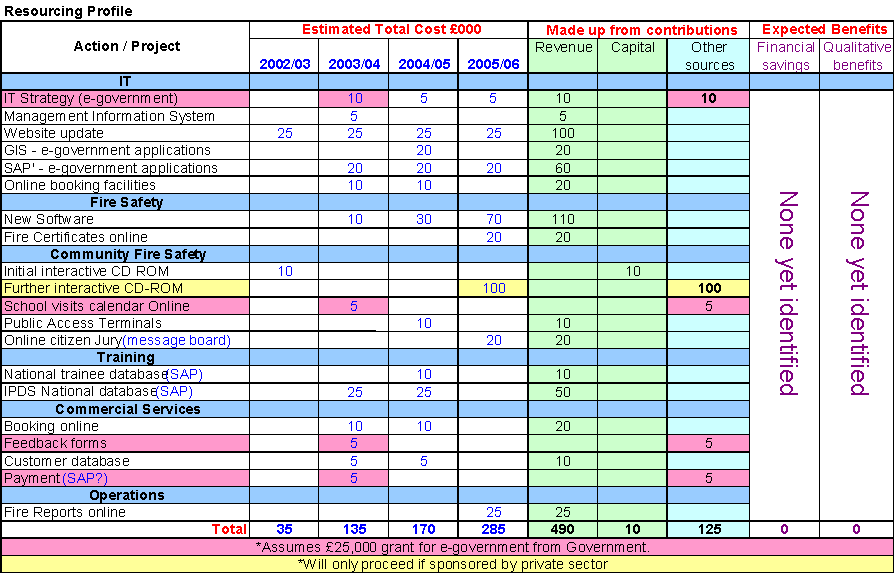
Attached as Appendix A is the `Resourcing Profile' from the Statement which provides a useful summary of the developments that need to take place if the Government's targets are to be met. Unfortunately, these will involve a significant investment. It is hoped that the grant of £25,000 will be forthcoming and that some sponsorship for innovative developments can be achieved, but there will need to be some revenue funding to support the back office and web site developments. Members will be aware from the Draft Budget Report for 2003/04 to 2005/06 that a growth bid has been made. | ||
3.9 |
Finally, it is worth recording that efforts are being made to collaborate with the developments being undertaken by the Hampshire and Isle of Wight Local Authorities E-government Partnership. It is realised that there are potential economies of scale in such collaborations, especially given our use of much of the Hantsnet/Hantsweb ICT infrastructure. | ||
4 |
European Convention on Human Rights and the Human Rights Act 1998 | ||
4.1 |
The proposals within this report are compatible with the provisions of the European Convention on Human Rights and the Human Rights Act 1998 and considered in the light of the Race Relations (amendment) Act 2000. | ||
Recommendation | |||
That the report be noted. | |||
Section 100D - Local Government Act 1972 - background papers | |||
The following documents disclose the facts or matters on which this report, or an important part of it, is based and has been relied upon to a material extent in the preparation of the report. | |||
None | |||
NB The list excludes: | |||
1 Published works | |||
2 Documents that disclose exempt or confidential information as defined in the Act | |||
Dir.fin: HFRA 5 2 2003 Egovernment DCH/JMW/24/1/2003 | |||
Appendix A