
Archived decisions
Hampshire County Council Environment Policy Review Committee 5 March 2003 Options Report of the Best Value Review of Policy Development in the Environment Department Report of the Director of Environment |
Item 9A |
Contact: Stuart Roberts, ext 6782
1. Summary
1.1 This report asks Members to consider options for service delivery (ranging from in-house provision to full externalisation) of policy development in the Environment Department. The chosen option will inform the basis for the preparation of a Best Value Improvement Plan for the Environment Department's policy development service. To that end, the report describes the work undertaken as part of the Best Value Review on the 4Cs (challenge, compare, compete, consult). It also sets out the preferences between the options which have been expressed by external stakeholders, managers, non-managerial staff and the extended review team (which includes three Members of this Committee).
1.2 The options were drawn up and sent to stakeholders prior to the restructuring of the Environment Department. The restructuring has invalidated parts of one of the options, but as stakeholders were consulted on all the options, this report presents them all, together with the stakeholders' views on them. The external context for the review is also rapidly changing, particularly with the radical changes to the town and country planning system proposed in the Planning and Compulsory Purchase Bill.
1.3 The Improvement Plan which will be presented to the May meeting of this Committee will need to be sufficiently flexible to adapt to this rapidly changing environment.
2. Introduction
2.1 The review has been undertaken by a core team comprising six officers from the policy development service and one officer from the Corporate Performance Team. An Extended Review Team - comprising additionally three Members of this Committee (Councillors House, Kimber and Roberts), two officers from other County Council departments and two officers from other local authorities - has helped to steer the review and maintain the external challenge necessary to achieve credibility and creativity.
2.2 This report concludes the second phase of the Best Value review of policy development in the Environment Department. The service position statement and review project brief were agreed by the Environment Policy Review Committee on 17 September 2001. A summary of these is attached as Appendix 1.
2.3 The outcomes of phase 1 of the review - the challenge phase - were reported to the Environment Policy Review Committee on 17 April 2002. That phase included a workshop with key external stakeholders, and separate workshops for managers and non-managerial staff. In the light of those internal and external stakeholders' comments, the Committee agreed that there were six main issues on which the review should focus:
(i) joined-up working and internal/external communications, including e-government;
(ii) speeding up the process of preparing policies;
(iii) community engagement, consultation methods and transparency of decision making;
(iv) monitoring and implementation of policy and monitoring of the service's performance;
(v) costs and comparisons with others, which leads on to the question of the standard of the policy development service which the County Council wants (e.g. a leading, innovating service or an adequate `follower'); and
(vi) external provision/working in partnership.
3. Vision for the Service
3.1 A vision for the review was agreed by the Environment Policy Review Committee on 4 December 2002. This is to secure by 2005 a policy development service which matches the following specification:
(i) The policy development service has a vision for a sustainable Hampshire which is clearly linked with the community and corporate strategies, and which is owned by Members, managers and staff.
(ii) In pursuit of that vision, the service undertakes a range of statutory and non-statutory work, striving for excellence and innovation.
(iii) Plans and policies are up to date, relevant, socially inclusive and provide an effective and positive framework for decision making. They explicitly state how they link with the vision, with each other, and with the relevant plans and policies of other agencies.
(iv) Residents, businesses and environmental organisations are kept informed and engaged in the process of policy making and review from the outset.
(v) There is a clear overall direction for the service and rigorous prioritisation within its work programme. Its managers are visible, approachable, responsive and performance-orientated.
(vi) The service is adequately resourced to undertake its tasks. Its staff are appropriately qualified, equipped, trained and rewarded.
(vii) The service provides good value for money and continually strives to evolve and improve to reflect changing priorities and good practice elsewhere.
3.2 This vision may at first glance appear to be self-evident common sense, but it must be said that currently the service does not match all elements of the vision. Improvements are needed to ensure the service does match the vision by 2005.
4. Progress in Phase 2
4.1 Phase 2 included the remaining three of the 4Cs: Compare, Compete and Consult.
Compare
4.2 The Counties of Essex, Hertfordshire, Kent, Lancashire and Surrey are regarded as appropriate comparators for Hampshire due to their physical, social and economic characteristics. A questionnaire was sent to each of these five authorities seeking information on policy areas for which plans are prepared; organisational structure; the ways in which different policy areas are coordinated and integrated; the costs of the service and numbers of staff involved; extent and nature of partnership working; methods of consultation/community engagement; time taken to prepare policy documents, reasons for any delays and changes which could be made to speed up procedures; policy areas for which monitoring is done and how it is undertaken; and how sustainable development is being addressed.
4.3 The response to the questionnaire was extremely disappointing. Only two authorities - Essex and Hertfordshire - replied. In neither case did the authority complete the questionnaire; rather published information was returned which only answered a few of the questions in the questionnaire. Overall, this initiative produced no information which could enable any rigorous or meaningful comparison of the performance of Hampshire County Council's policy development service with those of comparator authorities.
4.4 Hampshire, and four of the five comparator County Councils, are members of a benchmarking club known as the Strategic Planning Authorities Benchmarking Network (SPABN). This network has been collating statistics to compare expenditure on the various aspects of county planning. The differences in accounting practices in the authorities has made this task extremely complex and time consuming. It is hoped that data which is directly comparable between the authorities will be available this spring.
4.5 The SPABN has made greater strides in sharing good practice, in particular by publishing two good practice guides, of which the `Good Practice Guide to Strategic Planning' is relevant to some of the activities covered by this Best Value review. Good practice points in the Guide will feature as service improvements in the Improvement Plan. The meetings of the Network have also facilitated the informal sharing of good practice on a range of policy development matters.
4.6 The review team has also taken account of the Planning Officers' Society document `Moving Towards Excellence in Planning Policy' which will help shape the specific service improvements to be contained in the Improvement Plan.
4.7 The meetings of the Extended Review Team (see paragraph 2.1) have also contributed to the `compare' aspect of the review. That Team includes officers from Surrey County Council and East Hampshire District Council who have input first hand experiences of policy development in their authorities.
4.8 It is also worth mentioning that during the challenge phase workshop, external stakeholders made favourable comparisons between Hampshire and other authorities. The workshop facilitator reported that `innovative', `pioneering' and `leading edge' were words most often used by external stakeholders to describe the County Council's policy development service, whilst representatives of adjoining county councils regarded Hampshire's policy development work as `best practice'.
4.9 The conclusion to be drawn from the `compare' part of the review is that a questionnaire is not the means to secure comparative information but that informal networks of willing partners can achieve a valuable exchange of good practice, enabling service improvements to be made. The service's involvement in the Strategic Planning Authorities Benchmarking Network will continue; it will also play an active part in an emerging benchmarking club for transport policy.
Compete
4.10 Consultants currently undertake a limited amount of the policy development service's work; some surveys and data analysis, the provision of specialist advice not available in-house, and independent facilitation of consultation. Any Best Value review must test the competitiveness of current service delivery and whether consultants would deliver more efficiently and effectively the services which are currently undertaken in-house.
4.11 The planning and transport policy development service of a County Council is a varied, complex and wide ranging one. Only one county council - Berkshire - has ever sourced the whole of this service from consultants. Much of the work has subsequently been brought back in-house.
4.12 As part of this review, 38 local and national consultants were contacted to establish their ability and interest in providing some or all of the services currently provided by in-house staff. The consultants were also asked to state the advantages/benefits of such external provision. To enable some comparisons between the costs of consultants undertaking the work and the cost of in-house staff, the firms were asked to provide a charge per day for various grades of managerial, professional, technical and administrative staff.
4.13 Sixteen consultancies replied. Of these, only three could provide the full range of services currently provided by the policy development service. Two did not feel able to undertake any work for the County Council due to conflicts of interest with other clients' work. The other 11 were able to provide some or only a few of the services required.
4.14 The consultants identified the following particular benefits from using them for service provision instead of in-house staff: additional and flexible resources, additional expertise, cost effectiveness, delivery according to a brief and dedicated service, and an informed current knowledge base.
4.15 The day rates quoted by the consultancies for different levels of staff vary markedly from firm to firm. Comparative rates have been calculated for Hampshire County Council staff inclusive of all overheads. For principal consultant/principal officer, consultant/planning officer and technical/ research support levels, Hampshire County Council staff are `cheaper' than the lowest consultants' rates. For the project director/senior manager and project leader levels, County Council staff rates are similar to the middle of the range of consultants' rates.
4.16 It should be added, however, that the figures quoted by the consultants are day rates; firms stated that they would be prepared to negotiate on rates, particularly if a substantial amount of work was issued to them in a partnering arrangement rather than a series of one-off commissions.
4.17 Conversely, the calculated County Council staff day rates include time spent on corporate work and wider management matters such as Best Value reviews. They also include time spent on the `client role' which would remain with the County Council even if the service was completely externalised.
4.18 The conclusion emerging from the `compete' element of the review is that on the basis of cost, there is no case for transferring work from in-house staff to consultants. There may instead be opportunities for partnership working with consultants which would secure the best of both service delivery methods. Partnership working with other local authorities and governmental agencies is already established within the service - the draft Water Strategy and Area Transport Strategies for example - and the service is a partner in separate partnerships like the Hampshire Economic Partnership and Solent Forum. A public/private partnership with consultants Atkins is delivering Hampshire's transport capital programme. The Improvement Plan should consider the benefits of making greater use of consultants on a partnership basis.
Consult
4.19 The external stakeholders workshop and ensuing telephone survey of stakeholders were part of the consultation process and involved service users, businesses, adjoining local authorities and the voluntary sector.
4.20 The external stakeholders had considerable praise for the policy development service, regarding its work as professional, innovative and best practice. All aspects of the service were felt to be equally important, but implementation and monitoring were seen as weaknesses. The view was expressed that discretionary policies, although valuable, must be implementable. They said that although consultation with external organisations on draft policies had improved, there was still a tendency not to involve organisations early enough in the process and to leave some out. Policy documents needed to use simpler language, be more condensed and make more use of bullet points. They should also be more explicit about the vision.
4.21 Improvements sought by external stakeholders were more integration within the (then) Environment Grouping, better integration between different policy documents and more integration with other councils; increased resources; speeding up the policy development process whilst still retaining quality; improving the effectiveness of consultation, policy monitoring and review; and a political will to "turn the fine words of policy into actually doing things on the ground".
4.22 Managers within the service have been kept briefed and consulted throughout the review. A day-long workshop was held during the challenge phase which used the European Foundation for Quality Management (EFQM) self-assessment technique. Key themes from that workshop were: the need for greater transparency in policy development; insufficient consideration of whether the service is meeting external customers' and the community's expectation; lack of clear leadership; uncertainty on what internal management systems (eg IIP) are actually achieving; opportunities for better liaison between teams; the need for systematic focused monitoring of outcomes from which the organisation can learn; and the need for more (ongoing) liaison with stakeholders.
4.23 A challenge workshop for a representative sample of non-managerial staff was run by MORI as part of the review. MORI reported that most staff were positive about working in the (then) Environment Grouping and felt that improvements have been introduced in the last few years on staff training, consultation and sharing of information between teams. A `silo' culture was still felt to remain, however, which staff believed needs to be broken down by improved cooperation within and between the (then) two departments.
4.24 Improvements suggested by the staff workshop were (in order of frequency of mention): more focus by managers on managing and less on policy work coupled with clear lines of communication and accountability; more empowerment of and trust in staff, enabling people to stretch themselves to their maximum ability; more technical support and administrative staff, so as to relieve professional staff of this work; a directory of employees and their roles; and a local helpdesk for computer problems.
4.25 Consultation with local taxpayers was effected through the `Hampshire Listens' Panel; a representative panel of Hampshire residents. Their views were sought on the quality of policy documents published by the service and method used to engage them in the preparation of those documents.
4.26 Nearly half of the Panel had not heard of the Structure Plan, Local Transport Plan or any of the Service's other policy documents. This should not be a cause of undue concern, given that they are essentially intended to steer development and planning decisions by other organisations rather than to be read by individual members of the public. Even fewer had actually seen any of the service's policy documents, but those who had, thought the quality, length and balance of text and illustrations were `about right'. One in ten thought the documents were difficult to understand.
4.27 Articles in local newspapers and staffed exhibitions were the methods favoured by most Panel Members for them to put forward their views on draft policy documents. Evening public meetings and a representative sample of Hampshire's residents were techniques which Panel Members favoured more for consulting with the public at large, than as ways for them to put forward their own views.
4.28 In summary, the consultees indicated that the service is good in many respects, but that there is scope for further improvement, particularly in monitoring policy implementation, monitoring service outcomes, communication and integration within the service, leadership and management, and liaison and consultation with stakeholders.
4.29 More details of the views expressed by stakeholders during the challenge phase can be found in the report to the 17 April 2002 meeting of this Committee.
4.30 Consultation has continued during the subsequent stages of the review. External stakeholders, managers and non-managerial staff were consulted on the options (see below) and will be consulted in the spring on the Improvement Plan prior to it being presented to this Committee.
5. Identified Review Options
5.1 Last summer, based on the information gained through the review work, the Core Review Team developed four options for future delivery of the service:
(i) Service delivery by in-house staff plus improvements which do not involve structural change.
(ii) Service delivery by in-house staff plus structural change to secure substantial improvements.
(iii) Transfer to consultants of the areas of policy work most suited to external provision.
(iv) Externalisation of the whole service.
5.2 These options were developed before the amalgamation of the Planning and Surveyor's Departments into the Environment Department, and the associated restructuring of groups and managerial responsibilities. Part of Option 2 has been implemented by the restructuring, thereby rendering part of Option 1 redundant. However, as the external and internal stakeholders were consulted on all four options, all four are presented and discussed in this report.
5.3 The options are described in more detail below, together with some advantages and disadvantages. (These are the key advantages/ disadvantages and are not an exhaustive list.)
Option 1: Continue service delivery by in-house staff with improvements which do not involve structural change
5.4 In principle, this is to continue the method of service delivery which was in place prior to the Best Value review but with changes to improve the quality of service provided. These improvements would be detailed in the Improvement Plan and would include better information for staff within the service, systematic monitoring of the implementation of all policies, more time and resources being devoted to consultation, including a dedicated post to coordinate consultation and act as a `centre of excellence', development and monitoring of a customer charter, formulation and monitoring of service performance targets, and establishing a group to spearhead and drive continuous improvement.
5.5 Key Advantages:
- Can be readily implemented without major disruption or structural change.
- Establishes a mechanism for continuous improvement beyond the current Best Value review.
- Improved relationships with stakeholders/customers.
- Addresses many of the specific shortcomings identified by stakeholders, managers and staff.
5.6 Key Disadvantages:
- A minimalist option which only tinkers with the current service.
- Does not address all the issues identified through the challenge stage of the review.
- Might be seen as an inadequate level of improvement following a Best Value review.
Option 2: Service delivery by in-house staff with structural change to secure substantial improvements
5.7 This option would include all the improvements described in Option (1) and in addition, a restructuring of the organisation to address issues identified through this review. These changes could include the integration of policy development into one branch of the Environment Department, a reduction in the number of layers of management, and/or a switch from defined groups/teams to a flexible system of cross-department project teams in tandem with the use of formal project planning/ management techniques.
5.8 Key Advantages:
- More effective use of resources and better resource monitoring/redeployment by departmental management.
- Resource accounting on project basis will make easier comparison with private sector provision costs and help Councillors to prioritise resource deployment.
- Should lead to more joined-up working.
- Opportunity to put greater managerial attention on performance.
5.9 Key Disadvantages:
- Requires structural change with possible redundancy/ redeployment/ demotion.
- Disruption to service delivery and impact on staff morale.
Option 3: Transfer to consultants of the areas of policy work most suited to external provision
5.10 Use is already made of consultants for some work, but in this option, all surveys, information analysis and monitoring of policy implementation would be placed with external firms through competitive tender. Similarly, all public consultation on plans/strategies would be undertaken by specialist consultants and who would report to the authority the views expressed. This would build-on the externally facilitated `stakeholder dialogue' being used within the review of the Minerals and Waste Local Plan. Under this option, however, the task of preparing the draft plans themselves and presenting/defending them at their public inquiry stage would remain with in-house staff.
5.11 Key Advantages:
- Competitive tendering could drive down costs.
- Consultants bring wider knowledge gained from similar work done elsewhere.
- Guaranteed completion dates for tasks - no slippages.
- Consultants might be seen by the public as more objective and independent, especially in recording/reporting views expressed during consultation and may be more able to raise politically contentious ideas/proposals.
5.12 Key Disadvantages:
- Requires County Council staff time to prepare tight briefs and monitor consultants' work - time which would be spent on actual policy development if work done in-house.
- Less day-to-day control of work by the authority, with less immediate awareness if a project starts heading in the wrong direction.
- Possible conflicts of interest and concern about confidentiality of data, especially if the consultant has private sector clients who are challenging the authority's plan/policies.
- Consultants may lack historical knowledge of planning in Hampshire and be less `tuned' to elected Members' concerns/aspirations.
- Cost of possible redundancies and surplus office space.
Option 4: Externalise the whole service
5.13 Under this option, all of the policy development service would be transferred to external consultants either as a single contract or on an individual project/task basis. This would include the preparation of the draft plans and presenting/defending them at any public inquiry. A small core of in-house staff would remain to prepare and let contracts, monitor the work being done and receive/approve the completed work.
5.14 Key Advantages:
The same advantages as Option (3) and in addition:
- Greater transparency of decision-making resulting from consultants being more at arms length from the authority.
- More objective and independent policy advice to the Council.
5.15 Key Disadvantages:
The same disadvantages as Option (3) and in addition:
- Bigger redundancy costs.
- Difficult to reverse if desired at a later date.
- Policies may be seen as those of the consultants and not the County Council.
- Conflict of interest between the consultant devising the policies and advising private sector clients who are seeking to challenge/circumvent them.
- A largely untried option and a lack of evidence of its success elsewhere.
6. Appraisal of the Options
6.1 The appraisal of the options needs to include any preferences expressed by internal and external stakeholders, the cost of each option and the extent to which each would enhance the service's delivery on the corporate themes of e-government, equalities, crime and disorder and sustainable development.
6.2 An independently-facilitated workshop was held on 30 September 2002 for the same external stakeholders which attended the phase one challenge workshop. The stakeholders were briefed on the work undertaken since their previous meeting and asked to comment on, and express any preference between, the options. They expressed a preference for a combination of options 2 and 3. They felt this would improve joined-up working and that there would be cost advantages to outsourcing some (rather than all) work in appropriate areas, particularly those where additional staff would be needed.
6.3 Consultation with managers within the service has revealed a preference for option 2. The Core Review Team has also evaluated the extent to which each of the four options would address the issues which emerged from the managers EFQM workshop (summarised in paragraph 4.22).
6.4 The preferences of non-managerial staff were sought through an independently facilitated workshop which involved the same staff as the original challenge workshop. Those present did not choose an option but instead discussed their concerns about areas of work being transferred to consultants (options 3 and 4). Whilst they acknowledged that consultants are useful when a specialist or independent view is required, they felt it important that the in-house team should retain ownership. In-house staff have special knowledge too, which should be valued, they said. Fears were expressed that consultants would be given all the interesting projects and that there would be conflict of interest with the consultants' other clients.
6.5 The Core Review Team has interpreted these staff workshop views as indicative of a preference for option 1 or 2.
6.6 A workshop with the Extended Review Team (which in addition to the core team includes three county councillors, two officers from other County Council departments and two officers from other local authorities) identified option 2 as the preferred option, followed by option 1.
6.7 In addition, the core team has appraised the extent to which each option would improve service delivery in respect of the four corporate themes of equalities, sustainability, crime and disorder and e-government. In order to establish a score for each option in respect of each theme, it was necessary for the team to interpret the extent to which the option would deliver service improvements relating to that theme. These scores, together with the stakeholders preferences, are set out in Appendix 2.
6.8 Combining these preferences and scores together shows that overall option 2 is the preferred/best option.
6.9 The Executive Member for Environment has seen a copy of this report and has expressed his preference for option 2.
7. A Changing Context
7.1 As mentioned earlier, the options were prepared and sent to stakeholders for consultation prior to the restructuring of the Environment Grouping/Department. Consultees were aware of the emerging restructuring proposals when the consultation workshops took place, leading them to question whether option 1 was still a valid one for the future.
7.2 The timing of the structural changes associated with the creation of the Environment Department has been unfortunate in relation to the programme for this Best Value review. Ideally, this review would have been completed before the advent of the departmental reorganisation, or otherwise it should have followed it. Neither was possible however. Nevertheless, the views and information gained through the review have influenced the organisational structure of the new department which is now more in tune with the aspirations expressed by external stakeholders, service managers and non-managerial staff alike for greater integration of policies, closer integration between the policy makers and a clearer overall direction. The new Department has a Strategy Branch headed by the Deputy Director, which will undertake all land use, environmental and transport policy work. This will bring closer working between policy makers who were previously spread across three Branches, and provide a platform for more integrated policies and a clearer overall policy direction.
7.3 These structural changes have invalidated parts of Option 1 but leave the others as valid options for consideration.
7.4 The new departmental structure also has the benefit of making this Best Value review more `real' and more obviously relevant. It is now possible to relate this review to a `service' in organisational terms, whereas hitherto it has only related to a function. Responsibility for implementation of the review recommendations will also be more clearly defined; this will now lie with the Deputy Director as Head of the Strategy Branch, whereas under the old structure responsibility would have been shared between the heads of three Branches.
7.5 The external context for this review and the service is also rapidly changing. The County Council has been assessed as an `excellent authority' under the Government's Corporate Performance Assessment (CPA). In relation to the policy development service, this means that the County Council is no longer required to submit its Local Transport Plan to the Government for approval. Equally, the Planning and Compulsory Purchase Bill heralds a major change in the land use planning framework. It proposes that County Councils will no longer prepare a strategic land use plan (Structure Plan) but may instead contribute to plans prepared by their regional planning body and district councils.
7.6 The Improvement Plan (and the policy development service) will need to be sufficiently flexible to adapt to this rapidly changing environment.
8. Next Steps
8.1 The chosen option will inform the preparation of an Improvement Plan which will set out specific service improvements and the timescale in which they are to be implemented. This will be prepared by the Core Review Team with the involvement of the Extended Review Team and the new Strategy Branch Management Team. External and internal stakeholders will be consulted on the draft Improvement Plan, after which it will then be presented to the May meeting of this Committee.
Section 100 D - Local Government Act 1972 - background papers | |
The following documents disclose facts or matters on which this report, or an important part of it, is based and has been relied upon to a material extent in the preparation of this report. | |
NB the list excludes: | |
1. |
Published works. |
2. |
Documents which disclose exempt or confidential information as defined in the Act. |
TITLE |
LOCATION |
None. |
7709/SR
The Best Value review of Policy Development in Hampshire County Council's Environment Grouping
APPENDIX 1
The Environment Grouping comprises the Planning Department and the Surveyor's Department. Policies are formulated in the two departments to meet the sustainable development and transportation needs of Hampshire residents, communities and businesses whilst safeguarding and improving the quality of the environment.
Outputs
Policies are published in plans, strategies and other policy documents. The main existing areas of policy development are:-
· Structure Plan |
· Local Transport Plan and daughter documents such as |
o Car Parking Strategy and Standards |
o Road Traffic Reduction Act Report |
o Area Transport Strategies |
· The Hampshire Landscape Strategy |
· Landscape Assessments and Management Plans for Areas of Outstanding Natural Beauty (AONB) |
· Biodiversity Action Plan |
· Forest of Bere and Eversley Strategy |
· Minerals and Waste Local Plan |
· Supplementary Planning Guidance |
· Waste Management Strategy |
· Municipal Waste Management Strategy |
· Other strategic environmental/planning policies relating to landscape, nature conservation, archaeology, public transport, energy, air and water quality |
The policies guide decisions on individual projects and proposals by the County Council and by other organisations e.g. house builders and bus operators. The policies also influence other organisations such as district councils who prepare their own policies.
The effectiveness of some policies is monitored, but not all. This monitoring feeds into the review of policies, when some policies are amended or replaced. The frequency of such reviews varies.
Resource inputs
Last year, policy development involved all or some of the time of 60 county council staff at a cost of about £2 million. The approximate figures for each policy area are in the table below. These figures will be refined during the review.
Performance information
Last year, 4 of the 6 criteria in the national Best Value Performance Indicator (BVPI) 112 were satisfied; this is expected to rise to 5 out of 6 this year. The quality of several policy documents has been commended by Government and others. There is little other existing performance data for policy development or cost comparisons with other county councils.
Sustainability, Equalities, Crime and Disorder, E-government
Every effort is made to follow sustainable principles e.g. seeking to hold meetings wherever possible at venues which are highly accessible by public transport.
Some policies can be viewed on the internet; consultation on the new Car Parking Strategy was available by electronic means. The number of policies, documents and other information which is on the internet will be expanded over the coming years, together with more use of the medium for consultation.
Policy Development contributes to tackling crime and disorder through taking account of public safety and security in policies for the management of waste facilities, for public transport services, for urban design and for support to rural communities.
Larger print and audio summary versions of the Structure Plan and the LTP are made available on request. A few documents have been prepared to the Clear English Standard which helps maximise their accessibility.
Competition and Other Providers
The work associated with policy development is generally done by County Council staff. Consultants are engaged from time to time to provide specialist knowledge/skills or to provide additional staff resources to cope with peaks in workload. This work together with the design and printing of documents is done after competitive tender, except where minimal work and cost is involved.

The policy preparation process
(The steps within dashed lines apply only to preparation of some types of policy.)
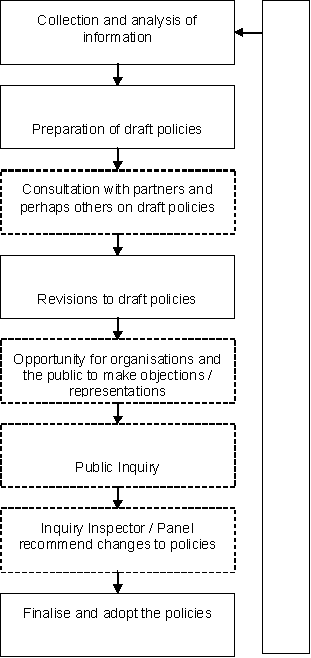
 This diagram shows the generic process involved in policy development. The steps within dashed lines apply only to the preparation of some types of policy.



Activity |
Person years 2000/1 (Approx) |
Cost £ thousands |
Structure Plan |
12.2 |
400 |
Local Transport Plan |
36 |
1200 |
Supplementary Planning Guidance |
0.7 |
20 |
Minerals and Waste Local Plan |
0.6 |
20 |
Regional planning |
0.9 |
120 |
Non-statutory plans and policies |
1.6 |
146 |
Inputs to policy development by other County Council departments and outside agencies |
4.2 |
120 |
Total |
56.2 |
2,026 |
Purpose of the Best Value review
The purpose of the Best Value review is to ensure the Environment Grouping's policy development function is equipped to respond to changing internal and external factors and challenges. The review is being carried out over two years (2001/2 and 2002/3) due to its complexity.
Review objectives
These are:-
· to identify how the policy development function should adapt to meet the challenges of sustainable development, increased community aspirations, equalities, e-government and other emerging agendas, and whether there is scope for closer co-ordination of policies within the function.
· to consult with staff and external stakeholders to establish their perceptions of the Service and ideas for improvement
· to compare the Service with others and identify good practice and opportunities for additional partnership working with external agencies.
· to formulate an action plan for service improvements incorporating
challenging targets.
Scope
This review covers a key function of the County Council that cuts across the Planning and Surveyor's departments. Policy development can be summarised as the preparation of policies, advising on their implementation and monitoring the success of the policies. The latter, in turn, informs the review of policies and preparation of new ones.
Transport network improvements and maintenance, development control, passenger transport, waste management, cultural heritage (including the historic environment) and corporate strategies such as Urban Living and the Corporate Water Action plan are the subject of other Best Value reviews.
The Corporate Policy, Planning and Performance Best Value review will cover the community strategy and corporate policies/strategies. That review will coincide with the second year of this review (2002/03) and close links will be maintained between them.
Organisation of the review
The Best Value review core team of six officers including a staff representative (listed overleaf), is co-ordinating the review and ensuring it follows both corporate guidance and the approach summarised here.
An extended team, comprising additionally two officers from other County Council departments, two from other local authorities and three County Councillors maintains the external challenge necessary to achieve objectivity, credibility and creativity.
Not every section involved in policy development is represented on the core team. To remedy this, a wider network has been established comprising an officer from every section who can be called on as needed to contribute particular knowledge and expertise.
Consultation - Internal Stakeholders
The draft versions of the Position Statement and this Project Brief were sent to the wider network and managers for comment. All service staff were briefed by e-mail and invited to comment.
The staff representative is establishing a representative group of staff who will be involved in a workshop in early 2002.
County Councillors have been briefed and three are involved in the extended team.
Consultation - External Stakeholders
A substantial number of organisations and individuals have a stake in the policy development service.
External stakeholders with a broad interest in the review have been invited to workshops; all other stakeholders will be invited to express their views on the Service and contribute ideas for improvements through a telephone survey.
The first workshop was held at the end of November 2001 to identify the issues to be considered in the review. Other stakeholders will be asked whether they agree these are the key issues. The second workshop will be held in 2002 to identify solutions and service improvements.
A representative sample of the public will be asked if they are satisfied with the Service and invited to suggest any desirable improvements.
Comparison
Some information comparing Hampshire's performance with that of other county councils has already been obtained. The core team will refine and extend this comparator information through benchmarking groups. Examples of good practice will also be fed into the review.
Competition and Collaboration
The core team will explore the scope for greater collaboration with, and alternative
provision by, external agencies including the private sector, and identify the issues this would raise.
Challenge
A group of senior and middle managers will test the Service's current strengths and areas for improvement using the European Foundation for Quality Management (EFQM) model for business excellence.
Timetable
The aim is to complete the review in autumn 2002. It is broadly on target.
Further information
This document summarises the Position Statement and the Project Brief. Copies of both documents are available from Jacqui Hall Tel: 01962 846806
Email: [email protected] .

APPENDIX 2
Appraisal of the Options
Stakeholders
Option One |
Option Two |
Option Three |
Option Four |
Paragraph in report | |
External stakeholders |
4 |
4 |
1 |
1 |
6.2 |
Extended Team |
3 |
4 |
2 |
1 |
6.6 |
Managers |
2 |
4 |
3 |
1 |
6.3 |
Staff |
4 |
4 |
2 |
1 |
6.4 |
Total |
13 |
16 |
8 |
4 |
Corporate themes and cost
EFQM analysis |
1 |
4 |
2 |
3 |
4.22 |
Sustainability |
3 |
4 |
2 |
1 |
6.7 |
E-government |
2 |
4 |
3 |
1 |
6.7 |
Equalities |
1 |
4 |
4 |
2 |
6.7 |
Crime & disorder |
3 |
4 |
2 |
1 |
6.7 |
Cost |
3 |
3 |
2 |
1 |
4.13 |
Total |
13 |
23 |
15 |
9 |
Grand Total |
26 |
39 |
23 |
13 |
The figures indicate preferences : 1 (lowest preference) - 4 (highest preference). Those for the external stakeholders, extended review team and managers are explicitly expressed preferences. Those for other criteria are from the core review team's assessment.