
Archived decisions
Hampshire County Council Andover and Western Hampshire Transportation Strategy Members' Panel 6 March 2003 Western Hampshire Transport Strategy - Consultation and Revised Strategy Report of the Director of Environment |
Item 7 |
Contact: Kevin Travers, ext 7763
1. Summary
1.1 The Western Hampshire Transport Strategy (WHTS) was put forward for consultation during November 2002. Local residents and stakeholders could respond either by writing to the County Council expressing their views, or by filling in a questionnaire, included with each copy of the Strategy. This report brings together all the responses to the Strategy and reassesses it in light of these comments.
1.2 This report focuses on the following areas:
(i) comments on the Strategy made by stakeholders and members of the public;
(ii) the County Council's response to these comments;
(iii) details of actions arising from stakeholder comments; and
(iv) changes to the Strategy as a result of the stakeholder response.
2. Consultation Process
2.1 Consultations were carried out in November and December 2002 and had a number of elements. Copies of the draft Strategy document were sent to a wide range of stakeholders, including County Councillors, District Councillors, each Parish Council and other key local and regional organisations. A summary leaflet was produced which was distributed widely through Western Hampshire, with copies of the full Strategy document available at local libraries and council offices; it was also available on request. Both the summary document and the full Strategy were available on a new Western Hampshire Transport Strategy web page (www.hants.gov.uk/environment/whts), which included an interactive
questionnaire. This approach gave the opportunity for as many people as possible to be able to see and comment on the draft Strategy. Public exhibitions, manned by County Council staff, were held in Andover and Stockbridge and unmanned displays put up at the District Council offices in Andover and Romsey.
3. Consultation Responses
3.1 Responses to the consultation were split into those who completed the questionnaire and those who provided more substantive comments. The questionnaire asked whether the overall vision was supported and then asked respondents to rank the importance they attached to each of the Strategy's key objectives, with a rating of 5 for those they considered most important and a rating of 1 for the least important.
3.2 It was gratifying that every respondent who answered the first question supported the vision and agreed that "a sustainable transport strategy to contribute to a living countryside" should be developed, and hence the final Strategy document will continue to reflect this. Overall each of the objectives was considered to be important, with even the least supported having a rating of 3.2 (where 3 was the average.) This suggests that the programme of measures to be developed to deliver the Strategy needs to be well balanced to achieve the broad range of objectives. However, particular emphasis should be given to the improvement of facilities at interchanges, the development of school and workplace travel plans and the availability of community transport and other initiatives, such as `Cango', as these objectives were ranked highest. The full results of the relative importance of each of the objectives is given in Table 1 below.
Table 1 - Questionnaire Response to Rating Western Hampshire Transport Strategy Objectives
Objective |
Average |
Improve facilities at public transport interchanges, tourist attractions, schools and workplaces |
4.3 |
Encourage the development of school and workplace travel plans |
4.3 |
Increase the availability and use of community transport |
4.3 |
Help improve road safety by reducing road casualties |
4.2 |
Locate new development where alternatives to the car are available or viable |
4.1 |
Provide local solutions that maintain the rural character of the area |
3.9 |
Raise public awareness of current and forecast transport issues |
3.8 |
Deliver environmental improvements and continue developing rural traffic area calming works |
3.8 |
Set targets that can be monitored to assess the effectiveness of the strategy |
3.3 |
Implement parking standards through the development control process |
3.2 |
3.3 A number of more substantive replies to the consultation were also received. A full analysis of these, together with the County Council's response to the points raised, is given in Appendix 1. However, some of the key issues worth highlighting are:
(i) the lack of a detailed programme for Western Hampshire within the Strategy document;
(ii) the need for more information on `Cango';
(iii) the requirement for non-leisure cycling to be addressed; and
(iv) the inclusion of detail on lorry routeing in the area.
3.4 In response to concerns raised about the lack of programme, it is considered that the Strategy is not intended to provide a detailed programme of measures. However, this will be developed in line with the Strategy's objectives and a report on a possible programme for 2004/05 and beyond will be brought to the next meeting. With regard to the other comments, it is suggested that the section on `Cango' be significantly expanded in the revised Strategy document, together with amended paragraphs on the importance of non-leisure cycling and lorry routing.
4. Final Strategy
4.1 The Strategy document has been updated and amended to incorporate suggestions raised through the consultation process, and a full version of the revised text is included as Appendix 2. It is also proposed that two new objectives be added to the Strategy. These are to:
(i) promote and encourage the use of non-car modes (public transport, cycling and walking) as an alternative to the car; and
(ii) increase public participation through initiatives such as Local Strategic Partnerships and Community Strategies.
4.2 The first of these is proposed as, although the promotion of non-car modes is an important theme running throughout the Strategy, there was no specific objective identified in the draft Strategy. The second new objective is proposed to reflect the increasing importance and role of these complementary local strategies in the delivery of the transport initiatives in the area.
5. Conclusion
5.1 The consultation process has been very helpful in shaping the final version of the Western Hampshire Transportation Strategy, involving a wide range of stakeholders. The comments will now be used to develop a programme of measures which will assist the County Council in meeting the aims and objectives of the Strategy and delivering an effective range of new initiatives.
Recommendation
That the Executive Member for Environment be advised to approve the revised Transport Strategy for Western Hampshire.
Section 100 D - Local Government Act 1972 - background papers | |
The following documents disclose facts or matters on which this report, or an important part of it, is based and has been relied upon to a material extent in the preparation of this report. | |
NB the list excludes: | |
1. |
Published works. |
2. |
Documents which disclose exempt or confidential information as defined in the Act. |
TITLE |
LOCATION |
None. |
7734/KT
Consultee |
Comment |
Consultees' suggested amendment to Strategy |
Initial HCC response |
Required Action |
Change to Strategy document (Ref Para.) |
Parish Council of Greater West Tytherley |
Concern expressed about lack of car parking at Winchester and Micheldever station for residents of West Tytherley wishing to travel to London after the morning peak. |
None. |
Alternative car parking facilities also exist at Grateley and Salisbury. However lack of parking facilities at railway stations is a problem at a number of places. The County Council is looking to develop schemes through the LTP and partnerships with Network Rail and South West Trains. |
To address issue in CHARTS and WMAP area strategies. |
Highlight issue of need to access strategic rail network from rural communities (6.22). |
Lack of practical alternative of getting to railway stations from outlying villages other than by car. |
None. |
The existing bus services provided some connections to Romsey and Salisbury from West Tytherley. However, although it is accepted that the car will be used for most trips and the strategy reflects this, the County Council will seek funding for additional links using Cango services. |
Rural Bus Challenge bid to be submitted in 2003 for Cango. |
Additional section on Cango (6.17 - 6.21) added. | |
Concern that decisions are not taken strategically. For example planning permission has been refused to increase parking provision at Winchester station. |
None. |
The County Council is not aware of any planning application to develop parking at Winchester station being refused. |
None. |
None. | |
Wiltshire County Council |
A303 should be designated a strategic lorry route throughout its length. |
None. |
Agreed. This has been incorporated in the Hampshire HGV Advisory Route Network. |
Provide details of lorry routing in Western Hampshire. |
Amend paragraph 7.6. |
The National Cycle Network Route 24 will run form Eastleigh to Bath. |
Amend Strategy text to reflect this. |
Agreed. |
Amend text. |
Amend paragraph 6.6. |
Consultee |
Comment |
Consultees' suggested amendment to Strategy |
Initial HCC response |
Required Action |
Change to Strategy document (Ref Para.) |
Parish Council of Vernham Dean |
Lack of detail reported in consultation document on aims and objectives for the WHTS Strategy and meaningful measures to be implemented on the ground. |
None. |
The aims and objectives are listed in Section 2, with the detail being developed in subsequent sections. The Strategy is not intended to provide a detailed programme of measures. This will be developed in line with the Strategy's objectives. The consultation has identified key local transport issues and gathered views on transport in the area, which will be fed into a detailed programme of projects for Western Hampshire. |
To develop a programme schemes for Western Hampshire which reflects the priorities established in the final strategy document. |
None. |
The broad targets and objectives set out in the consultation document do not sit well with recent Government announcements, which indicate increased expenditure on road building and a policy shift away from developing an integrated transport network. |
Results of the consultation to include feedback and review on the WHTS aims and objectives in 12 months time, in relation to the LTP and changing Government planning guidance. |
The County Council produces an Annual Progress Report on its Local Transport Plan every year, which includes consideration of the impact of national and local policy development. Integrated Transport remains at the very heart of the Government's policies. The impact of `Delivering Better Transport: Progress Report' will be incorporated in the development and review of the Strategy. |
None. |
None. |
Consultee |
Comment |
Consultees' suggested amendment to Strategy |
Initial HCC response |
Required Action |
Change to Strategy document (Ref Para.) |
Parish Council of Vernham Dean (continued...) |
The Cango initiative has been introduced in only a small area of the Test Valley. Rural bus services remain poor across the district, especially from the North West up to Marlborough and Hungerford. |
Stronger and clearer emphasis on rural transport within the Consultation document. |
Cango bus services have proved extremely popular. Two further services have recently been established and funding will be sought to further extend the network over subsequent years. The LTP makes reference to rural bus transport and various policies measures being implemented to improve rural bus services, this is reflected in the Western Hampshire Strategy with accessibility identified as one of the 4 key transport issues for the area. |
Highlight and provide a fuller review of the success of Cango services in Test Valley. |
Additional section on Cango (6.17-6.21) added. |
Road Safety needs to be improved along rural roads. |
None. |
Safety is highlighted as one of the 4 key transport issues in the Strategy. |
None. |
None. | |
Road safety concern - Area Surveyor West reportedly informed Vernham Dean Parish that white centre lines on frequently trafficked rural roads will be "done away with". |
None. |
Where appropriate for road safety reasons, white kerb edging is to be applied along narrow sections of carriageway which are not suitable for two-way traffic. |
None. |
None. |
Consultee |
Comment |
Consultees' suggested amendment to Strategy |
Initial HCC response |
Required Action |
Change to Strategy document (Ref Para.) |
Parish Council of Little Somborne |
Fear of increased traffic rat-running" by HGVs along A3057 if Dibden Bay Container Terminal receives go ahead (no mention of proposal in consultation document). |
Include reference to Dibden Bay Container Terminal and transport/environmental impact. |
Paragraphs 7.6 and 7.7 highlight the issue of heavy vehicles using inappropriate roads. The advisory route network for Hampshire identifies the A3057 as a local lorry route, not to be used for strategic journeys; this would apply to traffic from Dibden Bay. |
Highlight status of A3057 as a local lorry route. |
Amend paragraphs 7.6. |
General "rat-running" of traffic along rural roads. |
None. |
This important issue is highlighted in Section 7 of the Strategy |
None. |
None. | |
Concern about comments in paragraph 7.5 on traffic management works undertaken outside King's Somborne School. |
None. |
Paragraph 7.5 provides a description of the works carried out in King's Somborne. |
None. |
None. | |
Lack of traffic statistics to back up traffic claims within consultation document. |
Include references to current and predicted future traffic volumes along WHTS road network. |
Noted comments. It would be helpful to include some traffic flow data on key routes Document is for consultation purposes only, and is the first stage of developing the Strategy. However a summary of traffic issues within the Test Valley area could be included within feedback report on issues arising from the consultation activity. |
To determine traffic flows along key routes within the Strategy area. |
Amend section 6.24 to include key traffic flows. |
Consultee |
Comment |
Consultees' suggested amendment to Strategy |
Initial HCC response |
Required Action |
Change to Strategy document (Ref Para.) |
Testway Housing Association |
Welcomes comments on increasing use of public transport through greater promotion of services; partnership working with transport providers; and providing socially-necessary transport links. |
None. |
Comments welcomed and noted. |
None. |
None. |
Support for greater social inclusion of disadvantaged groups with access to public transport. |
None. |
Comments welcomed and noted. |
None. |
None. | |
Testway to investigate potential for developing a Workplace Travel Plan (WTP) for company employees. |
None. |
Comments welcomed and noted. County Council keen to offer advice and support for developing WTP amongst local businesses. |
None. |
None. | |
Testway seek wider introduction of low-floor buses on service routes across WHTS - to provide appropriate travel options for those with mobility impairments. |
None. |
The County Council is working with local bus operators to develop Quality Bus Partnerships where appropriate in Western Hampshire, in particular between Andover and Salisbury and operator is Wilts and Dorset to providing easily accessible vehicles from Friday 2003. The Cango services provide fully accessible buses on a number of routes. |
Update text. |
Amend paragraph 6.13 |
Consultee |
Comment |
Consultees' suggested amendment to Strategy |
Initial HCC response |
Required Action |
Change to Strategy document (Ref Para.) |
Testway Housing Association (continued) |
Policy measures on cycling and walking are fully supported by Testway. Three benefits are stated: increasing trade for local businesses, improved opportunity for local residents to find local employment opportunities nearer to home; ensuring continued availability of rural services for local residents. |
None. |
Comments welcomed and noted. A programme of measures will be developed to support these policies. |
None. |
None. |
Hampshire and IOW Wildlife Trust |
Support aims to promote sustainable development; reduce the need for travel and to improve the quality of the environment. |
None. |
Comments welcomed and noted. |
None. |
None. |
Welcome recognition of the reliance of the car in the rural environment, partly as a result of the lack of public transport. |
None. |
It is accepted that the car will play a central role in many journeys in the area, however non-car modes will be developed and encouraged where possible. |
None. |
None. | |
Support general increase in walking and cycling measures. |
None. |
Comments welcomed and noted. |
None. |
None. |
Consultee |
Comment |
Consultees' suggested amendment to Strategy |
Initial HCC response |
Required Action |
Change to Strategy document (Ref Para.) |
Hampshire and IOW Wildlife Trust. |
Care should be taken in the location and design of cycle paths so that the potential environmental impact can be minimised. The group is happy to advise the County Council on specific cycle/pedestrian routes. |
None. |
Schemes are designed to appropriate standards, recognising the sensitive rural environment. |
None. |
None. |
National Trust |
Lack of facilities in villages, combined with poor bus links, an aging population and low-income levels is a major problem. |
None. |
Agreed. The Strategy attempts to address these accessibility issues. The Test Valley Local Plan is focusing on providing facilities within local communities wherever possible to reduce the need to travel. |
None. |
None. |
The village bus scheme should be developed into a daily service with extended stays at the destination. |
None. |
The Cango bus scheme has proved very popular since its introduction. Two further services have recently been established and funding will be sought to further extend the network over subsequent years. The LTP makes reference to rural bus transport and various policies measures being implemented to improve rural bus services, this is reflected in the Strategy. |
None. |
None. |
Consultee |
Comment |
Consultees' suggested amendment to Strategy |
Initial HCC response |
Required Action |
Change to Strategy document (Ref Para.) |
National Trust (continued) |
Additional rail services to Dunbridge station should be introduced. |
None. |
Rail service provision is primarily the responsibility of Wessex Trains. The County Council encourages the provision of additional services were possible. |
None. |
None. |
Introduce appropriate traffic calming methods with out destroying rural character of village and restricting early morning and late afternoon "rat-runs". |
None. |
Reducing the impact of traffic is an important issue highlighted in Section 7 of the Strategy. Schemes are designed to appropriate standards, recognising the sensitive rural environment. |
None. |
None. | |
Introduce a tourist bus service linking Mottisfont, Hillers and Houghton with Romsey and/or Winchester Railway stations, to assist in reducing vehicle movements. |
None. |
Such a service could be investigated, possibly in conjunction with reduced entry for those not arriving by car. |
None. |
None. | |
Test Valley Friends of the Earth |
Introduce a bookable bus service linking Andover Hospital with Winchester Hospital. |
None. |
Cango services already serve Andover hospital. However a dedicated service between the two hospital sites should be the responsibility of the Health Care Trust, although the County Council would be willing to offer support and advice. |
None. |
None. |
Consultee |
Comment |
Consultees' suggested amendment to Strategy |
Initial HCC response |
Required Action |
Change to Strategy document (Ref Para.) |
Test Valley Friends of the Earth (continued) |
Improve information availability of the new CANGO services (promote the advantages of the new service). |
Cango services have been widely publicised and the county Council will continue to do so and develop publicity further as this is an essential element to their success. |
None. |
None. | |
Support locating new developments near to existing transport interchanges in towns and villages. |
None. |
Agreed. This issue is highlighted in paragraph 7.5. in consultation document). The Test Valley Local Plan also focusing on providing facilities within local communities wherever possible to reduce the need to travel. |
None. |
None. | |
Improving the quality of public interchange facilities for bus passengers in Western Hampshire, together with recasting timetables to provide better bus connections between settlements. |
None. |
Agreed. This forms an important element of the Strategy as highlighted in Section 6. Work has already been undertaken to provide better connections based on Stockbridge from January 2003. |
Update text. |
Amend paragraph 6.12. | |
Introducing bus services linking rural villages with tourist attractions shows and events during the summer months eg Cholderton Rare Breeds Farm, Hawk Conservancy and Middle Wallop Airfield. |
None. |
Such a service could be investigated, possibly in conjunction with reduced entry for those not arriving by car. |
None. |
None. |
Consultee |
Comment |
Consultees' suggested amendment to Strategy |
Initial HCC response |
Required Action |
Change to Strategy document (Ref Para.) |
Test Valley Friends of the Earth (continued) |
Improvements to the bus bays at Test Valley School are deemed insufficient and further bus bays should be provided. |
None. |
The new facilities are well used. Improved access to the school is being considered as part of the possible provision of a new sports hall. |
None. |
None. |
Support development of the School and Workplace Travel Plan initiatives. |
None. |
Support welcomed. |
None. |
None. | |
Road Safety needs to be improved along rural roads for both cyclists and pedestrians. |
None. |
This is highlighted as one of the key issues in the Strategy. Sections 6 and 7 address the rural environment and safety; programmes will be developed to address this. |
None. |
None. | |
LTP targets are supported. The overall target for reducing greenhouse gas emissions is a high priority. Wider measures should be introduced to minimise dependency of local residents on the private car. |
None. |
Support welcomed. Although it is considered that the car will play a central role in many journeys in the area, non-car modes will be developed and encouraged where possible and this is reflected in the strategy. |
None. |
None. | |
Extend cycle routes across Western Hampshire so they link with routes in Andover and Romsey. |
None. |
Cycle routes will be considered throughout the area, particularly where they can be shown to offer good opportunities to replace existing car journeys. However the importance of longer distance links is acknowledged. |
None |
None |
Consultee |
Comment |
Consultees' suggested amendment to Strategy |
Initial HCC response |
Required Action |
Change to Strategy document (Ref Para.) |
Test Valley Friends of the Earth (continued) |
Wider environmental points to consider: - Increase use of greener fuels for public transport vehicles - Commitment to produce timetable information on recycled paper. |
None. |
As part of the MIRACLES initiative in Winchester, greener fuelled vehicles are being investigated and introduced. The "Hampshire Connections" timetable booklets are printed on paper originating from managed softwood forests and are printed using environmentally-friendly inks. |
None. |
None. |
Cllr Garry E Rankin-Moore |
`Cango' bus is underused. |
None. |
Since the Cango service was launched in summer 2002, passenger numbers have grown to 50% higher than the scheduled bus services it replaced. |
None. |
None. |
Supports the Strategy but concerned success or failure is dependent on Central Government addressing key issues. |
None. |
It is acknowledged that Central Government policies will have an impact on the Strategy and in meeting its objectives. The County Council will work with the Department for Transport and the local Government Office in order to achieve this. |
None. |
None. | |
Hampshire Cycling |
It seems odd that the strategy excludes the 2 major settlements in the area (Andover and Romsey). |
None. |
Andover and Romsey are included in separate strategies, however close links are maintained. The Western Hampshire area is predominantly rural and has different issues to address. |
None. |
None. |
Consultee |
Comment |
Consultees' suggested amendment to Strategy |
Initial HCC response |
Required Action |
Change to Strategy document (Ref Para.) |
Hampshire Cycling (continued) |
How will targets be achieved when no baseline is given in the strategy? |
None. |
Baseline years are identified in section 11. For example the cycling target is from a 1997 base. However these are being reviewed. |
None. |
None. |
The strategy should focus on utility cycling rather than leisure routes as there is greater potential for modal shift. |
Strategy should change emphasis to utility rather than leisure cycling. |
Due to the rural nature of the strategy area, there is greater potential for leisure cycling than utility cycling. However leisure cyclists could develop into utility cyclists. Local schemes which encourage the use of cycles for short journeys will be supported, particularly where there is an opportunity for modal shift. |
Clarify the priorities in the section on cycling. |
Amend section 6.3. | |
The strategy doesn't mention how the targets for cycling will be monitored. |
None. |
This is a strategy document and is not designed to focus on the detail. However, a cycling monitoring strategy is currently being developed for the Local Transport Plan and the approach adopted will be reflected in Western Hampshire. |
None. |
None. | |
It doesn't mention the well signed quite lane route followed by the National Byway. |
None. |
Comment noted. However, this is a strategy document and is not designed to focus on the detail. |
None. |
None. |
Consultee |
Comment |
Consultees' suggested amendment to Strategy |
Initial HCC response |
Required Action |
Change to Strategy document (Ref Para.) |
Hampshire Cycling (continued) |
Important to address safe secure cycle parking at locations such as village halls, schools, shops and restaurants. |
Strategy should emphasise car parking and cycle parking in equal measure. |
Comment noted, cycle parking will form part of the development of the strategy. However it is accepted that the car will be used for most trips and the strategy reflects this. |
To make further reference to cycle parking in other locations than at the rail stations. |
Amend section 6.4. |
There should be a policy of `danger reduction' on minor roads to remove dangerous obstacles to cycling. |
Strategy should target `danger points' for cyclists. |
Sections 7 and 8 of the documents highlight the importance of treating the rural environment appropriately and focusing on safety. Cycle safety forms part of this. |
None. |
None. | |
Reallocation of road space to cyclists should occur where cyclists have to share busy through routes. |
None. |
Comment noted; this will be considered as part off the development of the strategy. |
None. |
None. | |
Selective reductions in speed limits should be pursued where appropriate (e.g. between Upper Clatford and Goodworth Clatford). |
Strategy should state it will pursue selective reductions in the speed limit where appropriate. |
Paragraphs 7.8 and 7.9 talk about reducing speed limits where appropriate, through villages and `quiet lanes'. |
None. |
None. | |
Buses should be able to carry cycles, so as to make better use of the existing bus services. In particular, a new bus link between Romsey and Andover, able to carry bicycles would be a welcome addition. |
None. |
Comment noted and supported where appropriate, although this is principally an issue for operators. |
None. |
None. |
APPENDIX 2
WESTERN HAMPSHIRE TRANSPORT STRATEGY
FEBRUARY 2003
CONTENTS
1 Introduction 1
2 Developing a Vision 2
3 The Western Hampshire Area 3
4 The Need for a Strategy 5
5 Key Transport Issues in Western Hampshire 8
6 Accessibility 9
7 Rural Environment 15
8 Safety and Health 18
9 Economy 20
10 Current Initiatives 22
11 The Capital Programme 24
12 Targets and Monitoring 25
13 Strategy Consultation 28
1 INTRODUCTION
1.1 This document sets out the County Council's understanding of the key issues involved in transport for Western Hampshire. It also sets out an approach to dealing with the issues through the development of the Western Hampshire Transport Strategy (WHTS). This document includes an overall vision for the strategy and proposed targets to be achieved.
1.2 Hampshire County Council has developed this strategy in consultation with Test Valley Borough Council, a range of key stakeholders and the wider community, and is seeking to identify the particular needs of communities and local people in Western Hampshire to provide a sustainable transport system for the future.
1.3 The WHTS strategy is the focus for the County Council's transport investment in the area and the local authorities have consulted the local communities, business interests and other interested groups whose views have been fed into this document. WHTS also responds to policy changes at national, countywide and local levels.
1.4 To find out more about WHTS or any of the schemes and initiatives included in this document, please visit our website www.hants.gov.uk/environment/whts or contact:
Head of Transport Policy
Hampshire County Council
The Castle
Winchester
Hampshire
SO23 8UD
E-mail: [email protected]
2 DEVELOPING A VISION
2.1 This strategy has been prepared based on an assessment of the key issues in Western Hampshire, which are outlined in the next chapter.
2.2 The vision for the Western Hampshire area is to develop a sustainable transport strategy to contribute to a `living countryside' where every resident in the local community can gain access to services such as health care, education, shops and employment.
2.3 The aim of the strategy is to tackle the transport issues in the rural parts of Western Hampshire and improve travel choice for everybody whilst maintaining the area's rural character. There is a need to:
· Promote sustainable development. Sustainable development was first defined by the Brundtland Commissions in 1987, which defined it as 'development which meets the needs of the present without compromising the ability of future generations to me their own needs'.
· Reduce the need to travel
· Improve accessibility for all, regardless of mobility
· Improve the quality of the environment
2.4 The transport objectives, which reflect the Government's core objectives and have been agreed through consultation with key stakeholders and the wider community, are to;
· Improve facilities at public transport interchanges, tourist attractions, schools and workplaces
· Encourage the development of school and workplace travel plans
· Increase the availability, use and quality of community transport
· Help improve road safety by reducing road casualties and improving personal safety
· Seek to encourage the location of new development where alternatives to the car are available or viable
· Provide local transport solutions that maintain the rural character of the area
· Raise public awareness of current and forecast transport issues
· Continue the County Council's rural traffic calming works through partnerships with the parishes and local communities to help deliver environmental improvements
· Set targets that can be monitored to assess the effectiveness of the strategy
· Implement parking standards through the development control process
· Promote and encourage the use of non-car modes (public transport, cycling and walking) as an alternative to the car
· Increase public participation through initiatives such as the Local Strategic Partnerships and Community Strategies.
3 THE WESTERN HAMPSHIRE AREA
3.1 In recent years, the car has become a dominant mode of transport, especially in rural areas where the dispersal of activities can make walking and cycling often impractical and buses uneconomical.
3.2 Although congestion may not be experienced to the same degree as in urban areas, one of the greatest concerns for a predominantly rural area such as WHTS is that the increasing level of traffic and in particular heavy vehicles is having an adverse impact on the environment, particularly for pedestrians, cyclists and horse riders.
3.3 With traffic levels on all roads in Western Hampshire forecast to increase by between 28 - 56% between 1996 and 2020 (HCC traffic monitoring), there are conflicts between the need to travel, often by using the car, and the need to live in and protect the countryside from noise, pollution and traffic. Although the road network within WHTS can probably accommodate some of this predicted increase in traffic, the road network in adjoining urban centres such as Andover and Romsey will be less able to do so. Therefore, the effects of car journeys between WHTS and these urban areas need to be considered. The strategy will seek to better manage car use, which in WHTS is likely to remain the dominant mode of travel for the foreseeable future. The focus of the strategy is on improving safety and the quality of the environment and providing better facilities for greater travel choice.
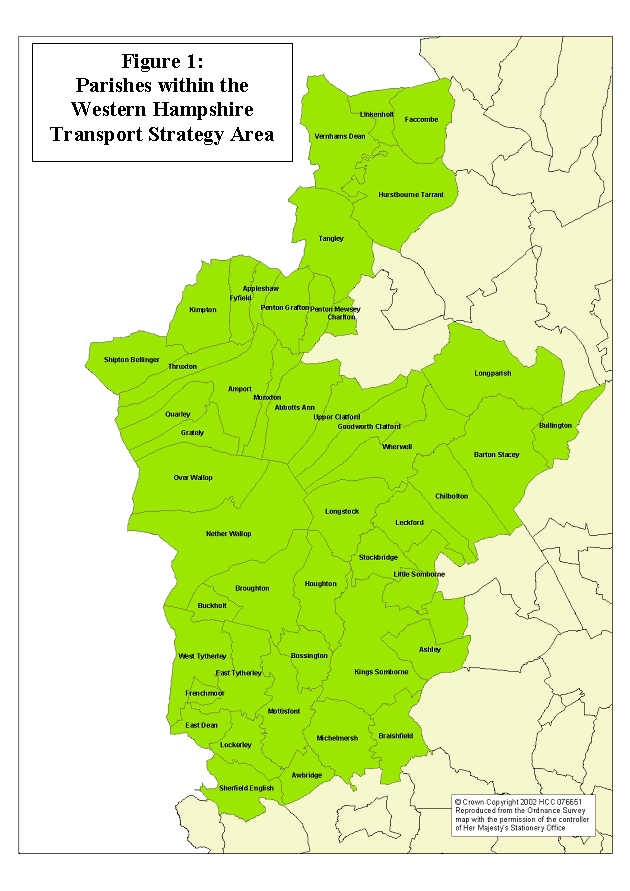
3.4 The WHTS area covers the rural parishes of Test Valley (as shown in Figure 1) excluding the urban areas of Andover and Romsey, the southern most parishes and West Wellow that are all included in other transport strategy areas.
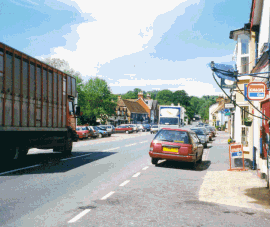 3.5 Western Hampshire is renowned for the beauty of its natural surroundings, ranging from the North Wessex Downs Area of Outstanding Natural Beauty (AONB) to the valleys and meadows of the River Test and its tributaries. In total, over 46,000 people live in the area, mainly in small villages and hamlets. The most significant community in terms of size is Stockbridge. Whilst Andover and Romsey are external to the Strategy area, they are fundamentally related to Western Hampshire and heavily relied upon by the rural population for services and goods.
4 THE NEED FOR A STRATEGY
4.1 The Government's transport policy has changed significantly in its emphasis over the last 10 years as issues of congestion and pollution have become more important. New road construction is no longer the first option. Instead, greater co-ordination and integration between land uses and transport planning is promoted, as is increasing people's awareness of transport issues to promote changes in travel behaviour.
4.2 Integration is one of the five core objectives of the Government's 1998 White Paper `A New Deal for Transport - Better for Everyone'. The five core objectives are
· Environment
· Accessibility
· Safety and Health
· Integration
· Economy
4.3 The concept of `integrated transport solutions' is at the heart of Government policy and there is an expectation for
· Integration within and between different types of transport
· Integration with environmental needs
· Integration with land use planning
· Integration with policies for education, health and wealth creation
4.4 This concept is therefore an important one as it shows the links between transport and the communities we live in, with our needs and desires to take part in different activities.
4.5 The Road Traffic Reduction Act 1997 also sets an important framework in which improvements to the transport network are to be made. The Act requires local authorities to undertake a review of existing and forecast levels of traffic growth on local roads and to set targets for reducing the level of traffic or the rate of growth. Targets set for WHTS are outlined in Section 12.
4.6 The Government's strategy `Transport 2010 - The Ten Year Plan' which develops the objectives of the White Paper into key actions identified £180 billion of funding from both the public and private sector to modernise the transport infrastructure by 2010. This has led to more funding being made available for rural areas, in particular for rural bus services and the modernisation and improvement of bus and rail services and infrastructure.
4.7 The Government's Rural White Paper - `A Fair Deal for Transport' also looks at ways of revitalising rural areas with particular emphasis on retaining their distinctive environment, economy and social fabric. Hampshire County Council and Test Valley Borough Council have successfully promoted partnerships with stakeholders and are creating strategies to help guide development and change in the countryside. This has led to a considerable awareness of rural issues and a structure of partnerships, particularly with parish councils.
Countywide Policies and the Local Transport Plan
4.8 The County Council's Corporate Strategy helps to ensure that policies in key areas compliment each other. The six key aims of the strategy are:
· Maximise life opportunities
· Stewardship of the environment
· Achieving economic prosperity
· Building strong and safe communities
· Improving services
· Developing councillors and staff
4.9 Travel and transport features prominently under the aim of Stewardship of the environment and the County Council is pursuing a policy of promoting transport and travel by means other than the private car. An important element of this is about changing people's perceptions and increasing their awareness and acceptance that changes need to be made. Headstart, the County Council's Community Involvement Initiative, has already shown that directly involving local people in transport policy can help support policies and initiatives that encourage more responsible use of the car.
4.10 The Local Transport Plan (LTP) 2001 - 06 sets out the proposed transport improvements across the County for five years, and is the principal mechanism for securing funding to allow schemes and projects to be progressed. The focus of the LTP is based upon the Government's core criteria of Accessibility, Environment, Economy, Safety and health and Integration. It provides a strategy that promotes realistic travel alternatives through developing targets and programmes in the context of local and national policy. WHTS is one of ten area strategies included in the LTP, developed to take account of the diverse nature of the County.
4.11 The Andover Transport Strategy (ATS) and the South West Hampshire Transport Strategy (SWHTS) border WHTS. These transport strategies have been agreed and work has started on achieving the aims and objectives set out in them. WHTS links in with these adjoining strategies, particularly in connection with the local urban centres of Romsey and Andover that significantly influence travel behaviour within WHTS.
4.12 This document sets out the Council's vision and strategy for transport in Western Hampshire. Through these policies and the development of complementary programmes, the local authorities aim to improve transport and build on existing partnerships with local people and organisations. In advance of the final strategy, a number of schemes have already been delivered in the area as detailed in the following sections, and further initiatives are being developed, based on the priorities established through this Strategy.
4.13 The County Council is developing a rural strategy that identifies a range of initiatives to support basic local services, combat social exclusion and help establish a thriving economy that includes rural transport packages. Test Valley Borough Council has also developed a rural strategy that addresses a number of key issues for the rural Test Valley, including transport. WHTS will be developed to remain consistent with these strategies.
Test Valley Borough Local Plan
4.14 A draft of the Test Valley Borough Local Plan Review was put on Deposit for consultation in January 2003. The Plan contains proposals to guide development in the Borough to 2011 and beyond. It sets out a range of transport policies and other policies to protect the environment as well as including proposals for the development of housing, leisure and community facilities. Hampshire County Council and Test Valley Borough Council work closely together to ensure that transport policies in the Local Plan are consistent with those already set out in the LTP.
5 KEY TRANSPORT ISSUES IN WESTERN HAMPSHIRE
5.1 The key transport issues in the Western Hampshire area are outlined over the following chapters under the headings of
· Accessibility
· The Rural Environment
· Safety and Health
· Economy
5.2 Key issues for action are highlighted at the end of each chapter.
6 ACCESSIBILITY
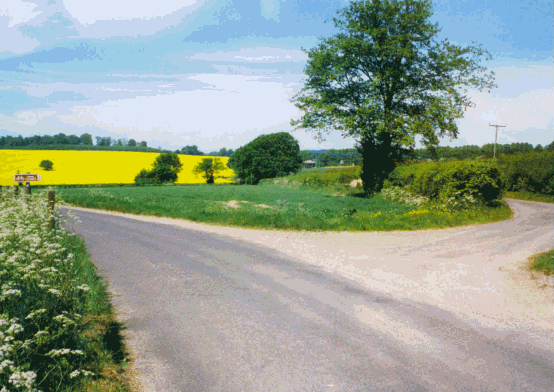
6.1 The current transport issues in Western Hampshire are broadly similar to most other rural areas. The lack of local facilities creates a need to travel, particularly to nearby urban centres, but there is a lack of public transport to cater for everyday journeys, placing a heavy reliance on car use. The local authorities are looking to reduce the need to travel through encouraging the provision of local facilities, such as one-stop shops, and increasing access to the internet. Nevertheless, when people need to travel a lack of choice places a heavy reliance on car use. The transport strategy is aimed at providing a wider choice of travel options to services such as health, retail, education and employment facilities.
6.2 The County Council's Accessible Transport Strategy (September 2000), sets out a series of policy objectives and steps which the Council and others can take to improve the transport system, and make it more accessible for older people and those with disabilities as well as those who simply have no access to a car. The promotion of social inclusion is a key Government objective that the County Council aims to take forward. The WHTS strategy has been designed and will be developed in line with this strategy to ensure that the needs of people with disabilities are taken into account.
Walking and Cycling
6.3 Because of the dispersed nature of services, walking, cycling, and horse riding in Western Hampshire are principally leisure activities although commuting to work or accessing shops and facilities will be encouraged where possible. The strategy will seek to encourage more cycling and provide facilities such as footways, cycle tracks and safety measures, which encourage the use of cycling and walking to access local amenities as an alternative to the car, particularly for short journeys. Hampshire County Council's Transpol survey on household travel behaviour, confirms this and the survey undertaken in the Test Valley area in 1997 showed that 80% of all journeys were by car (source: Transpol 1997). This strategy looks at how safer, more attractive environments for walking and cycling particularly in villages and settlements can be developed. In conjunction with the ATS and SWHTS, it also looks at how routes can be developed to link villages around Romsey and Andover to the two towns.
6.4 The Borough Council has prepared a draft cycle strategy that will provide the basis for the development of a prioritised network of cycle routes within the Test Valley. The strategy will also consider the provision of secure parking facilities at key locations such as railway stations, towns & village centres and interchanges.
6.5 Cycling is a good form of exercise and cycling as an alternative to the car can help reduce environmental damage caused by traffic. There is scope to encourage more cycling as a way of enjoying the area. The National Cycle Network Route proposals being implemented in Hampshire form part of the 4,000 miles of national links being promoted by Sustrans (the national cycling charity). The network is primarily a series of leisure routes, and the County and Borough Council will be working to develop other cycling facilities in the area including utility routes.
Initiatives to date
6.6 In the WHTS area, a section of Route 24 (Eastleigh to Bath) is at an early stage of investigation. The route runs from the boundary with Eastleigh to Romsey and then northwards towards Michelmersh and then via either Mottisfont or Dunbridge to Lockerley, West Dean and on to Salisbury.
6.7 It is the Council's intention to work with Sustrans to help identify the details of the route including the environmental and landscape implications and likely outline costs of this route. Any proposals for this section of the route will be developed in the context of the wider area based cycling strategies being developed for this area.
6.8 A series of `health walks' are being promoted across the county to encourage the use of local areas for leisure rather than encouraging car journeys, in particular to places like the New Forest. The self-guided walks are currently being introduced in the Waterside parishes, with investigations underway to find suitable locations in other parts of the county.
6.9 The main bus routes in this area operate between the urban areas of Andover, Romsey, Winchester and Salisbury at a minimum frequency of once an hour. However, evening and Sunday services are few in number, with smaller settlements away from the main roads less well served.
6.10 The rural nature of the area and the low population density makes it economically unviable for frequent conventional public transport routes and in recent years, operators have discontinued a number of services. Partnerships are needed with the public transport providers to optimise the public transport networks so that levels of accessibility can be maintained. These can also be supplemented with community transport services.
Initiatives to date
6.11 Hampshire County Council is working with adjacent local authorities on cross - border issues. For example, the County Council is working with Wiltshire County Council to develop a Bus Quality Partnership with the Wilts and Dorset Bus Company on the Salisbury to Andover corridor. This will link into the existing corridor from Andover to Basingstoke, operated by Stagecoach Hampshire Bus that is also being promoted through the ATS programme.
6.12 The Government's Rural Bus Grant fund has enabled the County Council to enhance infrequent services and provide new routes. The need to replace commercial routes withdrawn by operators is also becoming an important issue. Projects are being implemented following local consultation, and have been well received. Refinements are being introduced in the light of patterns of use and customer feedback. Some work has already been carried out to identify unmet needs in this area and will be used as a basis for further work in connection with Rural Transport Partnership Fund projects. Services 77 and 99 operating between Andover and Stockbridge are subsidised with funding from the Rural Bus Subsidy Grant. These services are also planned so as to maximise interchange opportunities in Stockbridge.
6.13 A number of low floor buses operate in this area. Wilts and Dorset introduced low floor vehicles on some services in to Andover from February 2003 which not only help those with mobility impairments, but also parents with young children in buggies. In addition the Cango buses are fully accessible and include facilities for wheelchairs.
Public Transport Information
6.14 The County Council publishes a series of Travel Guides covering all bus and rail services as a means of improving information regarding services. The guides are updated twice a year. The provision of real time information within the WHTS area will be considered along strategic routes. Providing up to date information on public transport services is an issue that will need further investigation and as part of the ATS, the implementation of real time information at the bus station is a priority.
Community Transport Initiatives
6.15 To increase the accessibility of shops and services to those with mobility impairments, a network of community transport facilities exist in WHTS, most of which are local in nature and rely on volunteers. The Broughton and Mottisfont Community Bus has been operating for nearly 20 years and provides scheduled local bus services. This service now has a wheelchair accessible minibus, the purchase of which was grant aided by both Hampshire County Council and Test Valley Borough Council. The Dial-a-Ride service, which provides a door-to-door service, together with community car share schemes, also operates in some of the villages.
Initiatives to date
6.16 Work has already started to develop liaison between the various schemes with the long-term aim of improving co-ordination and filling in gaps in provision; this will continue as part of the Rural Transport Partnership Fund project.
Cango
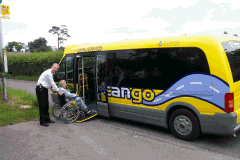 6.17 A new demand-responsive bus service, branded `Cango', was launched in Test Valley on 28 June 2002 as part of the County Council's new approach to providing public transport in rural areas of Hampshire.
6.18 Cango differs from conventional bus services which operate along a designated route, as the Cango services are more flexible, travelling where they are needed within a wide area to the north and east of Andover and serving many parishes, including Barton Stacey, Hatherden, Longparish Tangley, Upton, St Mary Bourne and Vernham Dean.
6.19 The approach taken in the Test Valley has involved converting two existing public transport routes, supported by the County Council, into seven more flexible demand-responsive bus services. This has been accompanied by minor changes to a number of other bus services in the area to ensure that the Cango services are integrated into the overall bus network. As a result of these changes, the majority of people in the area now have a greater opportunity to travel.
6.20 The Cango services, which operate from Monday to Saturday, have been designed to transport commuters from the surrounding villages into Andover and Whitchurch railway stations each morning to connect with the London trains. The two vehicles are then used to undertake two school transport contracts previously provided by taxis. They then provide services into Andover throughout the day to enable people to access shopping facilities and the hospital before providing the return journeys for the school contract and commuters.
6.21 Since the service was launched in summer 2002, passenger numbers have grown to 50% higher than the scheduled bus services they replaced. As part of the Western Hampshire Strategy, investigations into expanding the services to other areas and securing additional funding is being undertaken, with a further bid for Rural Challenge funding submitted in 2003.
Rail services
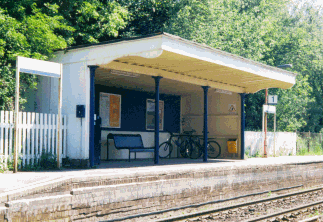
6.22 The WHTS area is served by an hourly service on the railway line between London Waterloo and the south west via Grateley station (on the Basingstoke to Salisbury line). The Southampton to South Wales line via Dean and Dunbridge station's, has a less frequent service with half of the trains passing straight through. There is also a need for people to access strategic railheads on the London to Bournemouth Line.
 Initiatives to date
6.23 Improvements have recently been made at Dean and Dunbridge stations to increase their accessibility by bicycle with the provision of more facilities for securing bicycles. More work will be done to improve access and information.
Road network
6.24 The principal road network in WHTS consists of strategic routes that are the A36, A303(T) and A34(T), as well as the A30, A3057 and A343 that carry longer distance as well as local traffic. The use of these routes for longer distance traffic travelling between the M27 and A303(T) and further north to Newbury impacts on otherwise quiet villages. A principal issue raised by local communities, is that of lorries travelling through villages leading to safety concerns for pedestrians and cyclists.
Annual Average Daily Traffic flow data (2001) in the WHTS area:
Location |
AADT 24hr. 2-way flow |
A30 (Broughton) |
4024 |
A34 (South of Bullington) |
43673 |
A36 (West Wellow) |
16358 |
A303 (East of Andover) |
47007 |
A343 (North of Andover) |
4804 |
A343 (South of Andover) |
7695 |
A3057 (Mottisfont) |
5719 |
 6.25 There are no public car parks in the WHTS area although within the villages such as Stockbridge there is on street provision serving local facilities. A study commissioned by the Borough Council and funded in part through the County Council's capital programme, has shown that there would be transport advantages to the implementation of decriminalised parking enforcement. This would bring the control of parking and enforcement of parking offences under the control of the Borough Council rather than the Police. The proposed timescale is that the Borough Council would have parking responsibilities by the end of 2003.
Actions - Accessibility The transport strategy will aim to: · Deter traffic, particularly heavy commercial vehicles, from using unsuitable rural roads. · Investigate the development of `quiet road' pilot schemes · Improve and promote the use of the bus and rail network · Promote the provision of public transport which is accessible to those with mobility impairments · Support Test Valley Borough Council in its application for decriminalised parking enforcement · Promote cycling as an alternative and healthy means of travel for leisure, journeys to work and to school as appropriate · Identify measures to make cycle journeys safer and more pleasant · Provide adequate and secure cycle parking at public transport interchanges · Monitor cycle use · Promote the implementation of safer pedestrian routes and improve road safety for pedestrians |
Issues - Accessibility How can the strategy · Improve public transport? · Improve co-ordination and integration, particularly with local innovations such as community transport initiatives? · Improve the environment for pedestrians, cyclists and horse riders? · Help minimise the impact of heavy commercial vehicles that have business in the area. |
7 THE RURAL ENVIRONMENT
7.1 One of the greatest concerns for an area such as Western Hampshire is that increasing levels of traffic and inappropriate traffic speeds in rural areas are making the environment more dangerous for pedestrians, cyclists and horse riders. However, any traffic management measures used to slow traffic can have an urban appearance that can be unsuitable for rural communities. Schemes involving lighting, especially in previously unlit areas also need to be carefully considered and designed.
7.2 The Local Plan outlines the principle that development and redevelopment will be encouraged within the villages, but strictly controlled outside of them. Such development will make the provision of public transport services more viable and will mean that housing, leisure and shopping facilities can be located more closely together to reduce the need to travel.
7.3 The County Council has a well established Parish Partnerships Programme that works directly with individual parish councils to identify the issues of importance to the local community, and find appropriate solutions to the problems. Match funding has been made available to assist in dealing with the issues, usually associated with improving safety for pedestrians. This has proved to be a successful way of providing local transport solutions that improve the local environment for all and make it a better place to live and work. Two examples are detailed below:
Broughton
7.4 In Broughton, gateway markings on entry to the village and road markings have been provided to slow traffic. Such low cost traffic management schemes have been successful in reducing traffic speeds through villages and providing better facilities for pedestrians.
7.5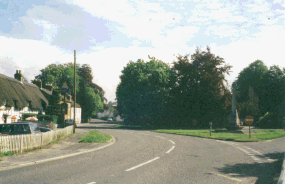 Traffic demand management measures are important where settlements are on main highway routes. This is especially true in King's Somborne on the A3057 just south of Andover, which has a high level of heavy commercial vehicles using the route. Relatively low cost improvements have been developed in partnership with the local community in King's Somborne that are designed to slow traffic along the A3057 through the village. Widening of the footway outside the primary school and replacement of pedestrian guard railing have also made the area safer for children and their parents.
7.6 The County and Borough Council are working towards reviewing the routeing strategy for heavy vehicles through the area. The Borough Council is developing a monitoring programme using a Geographical Information System (GIS) that plots lorry routes and depots. An initial HGV advisory route network has been established with strategic lorry routes in the area being the A303 and A34. Local lorry routes, which are designed to accommodate vehicles accessing local facilities, are A30, A343 and A305. A Freight Quality Partnership has also been established in Hampshire, which promotes a voluntary code of conduct for HGV drivers.
7.7 In developing the routeing strategy, the aim will be to keep lorry traffic and pedestrian and cycle routes separate which will help to achieve important safety objectives and make the environment more attractive for cycling, walking & horse riding.
Speed Restrictions Through Villages
7.8 With regard to the possibility of introducing lower speed limits through all villages, the County Council's policy is that in agreement with the Chief Constable, speed limits will be set at a level which is seen to be reasonable by the great majority of drivers. Factors such as the road environment, the number of speed related accidents and the actual current speed of traffic are taken into account. Speed limits need to be self-enforcing, and this is often achieved through traffic management measures such as gateway features, visual narrowing of the road or speed cushions. Any 20mph speed limits introduced would need to be self-enforcing in this way.
7.9 Quiet Lanes is a Countryside Agency initiative with the aim of conserving some quiet country lanes and managing them so that cyclists, walkers, horse riders and motorists can all share them safely. On a Quiet Lane, motorists are encouraged to travel at slower speeds; and there is tranquillity and respect for the environment. Hedges, verges and trees are managed to conserve and enhance the landscape. Local authorities have developed a series of demonstration projects across the country and the County Council will monitor their progress to evaluate their suitability for rural areas in Hampshire. In Mottisfont, a Parish Council project closing Hatt Lane to vehicular traffic has had some positive results.
Actions - Rural Environment The strategy will work towards improving the local environment by: · Encouraging new development which is accessible by public transport, walking and cycling · Ensuring that rural traffic calming measures are sympathetic to their surroundings · Deterring traffic, particularly heavy commercial vehicles from using unsuitable rural roads · Reallocating road space to reduce speed and to improve walking and cycling where appropriate |
8 SAFETY AND HEALTH
8.1 As previously identified, key safety concerns are related to increasing levels of traffic and inappropriate traffic speeds on rural roads. The Council is working on a number of initiatives as highlighted below.
Road Safety Programme
8.2 The County Council has a Road Safety Programme that identifies high-risk sites, routes and areas across the county. A large proportion of the programme has involved low cost - high yield accident remedial measures. In consultation with parish councils, the County Council will continue to investigate where safety improvements could be made. A review has recently been undertaken of the Council's road safety education, training and publicity services. The services are well supported and are contributing effectively to the Government's road casualty reduction targets.
Safer Routes to Schools
8.3 An increasing number of children are being driven to school, resulting in congestion outside schools at certain times of day, an unattractive environment for those who walk and cycle, and reduced levels of health and fitness.
8.4 Hampshire County Council has established a dedicated Safer Routes to Schools team working with schools to identify measures to improve safety and encourage travel by a range of modes of transport. The team also supports schools in the development of School Travel Plans, that demonstrates their commitment to reducing car borne journeys to and from school, and delivers infrastructure improvements in support of the plans.
8.5
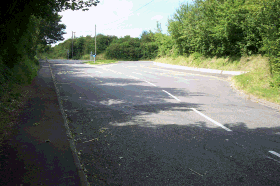 At Test Valley School Stockbridge, the bus lay by has been redesigned to formalise the existing arrangements for buses to drop off and pick up pupils. The scheme was designed and reviewed in consultation with the school and local residents before the final design was agreed. Its operation is being monitored. Further improvements to the highway environment are planned as part of an application by the school to build a sports hall. Low cost safety improvements are also being developed for King's Somborne, Shipton Bellinger and Goodworth Clatford.
8.6 Following the Crime and Disorder Act 1998, local authorities are required to undertake audits and publish strategies to tackle the issues that are raised. The Test Valley Community Safety Partnership has recently completed its latest audit. Achieving a reduction in vehicle crime is one of the key areas to be tackled. The strategies will help to establish better co-ordination between local authorities, the police and local communities to tackle these issues.
8.7 Personal security concerns can have an important impact on levels of public transport use, especially in unlit areas and on services with low patronage levels. The County Council has introduced CCTV at a number of locations countywide, but the suitability of this option for rural areas needs further investigation.
8.8 The Government's White Paper `Modernising the Health Service' and the accompanying Green Paper on public health `Our Healthier Nation - A Contract for Health' require local authorities to assist in improving the health of their communities. In transport terms, the main objectives are generally to improve the environment and quality of life with the specific objectives to:
· Reduce the number and severity of road casualties
· Help increase cycling and walking; and
· Improve access to health facilities
Actions - Safety and Health To assist in improving safety and health, the strategy will · Provide safe pedestrian and cycle routes where they offer a realistic and safe alternative to the car, for example routes to schools or new links to community facilities · Improve road safety for pedestrians and cyclists through local safety and traffic management schemes · Acknowledge the needs of those with mobility impairments · Work with schools to develop school travel plans and deliver infrastructure improvements to support these plans where appropriate |
9 ECONOMY
9.1 In its Rural Business Survey undertaken in 2000, Test Valley Borough Council identified that most businesses in the area are relatively small and tend to be independently owned. They are also well integrated with local communities, half of employees living within 5 miles of their respective work places. This is good news for the Council's efforts to promote travel to work by walking and cycling. However, there is still a high reliance on car use for commuting and journeys to schools where there are a lack of cycle routes and footways. The County Council is also working with businesses where there are opportunities to develop work place travel plans which encourage and provide facilities for employees to car share, travel by alternative means or work from home when appropriate.
Local Services
9.2 The report `Integrated Rural Services -Towards a Strategy for Hampshire' produced by Community Action Hampshire has identified the following key issues for rural areas across the county:
· Lack of access to vital services
· Loss of village shops and post offices
· Closure of pubs and banks
· Closure of rural police stations
· Poor public transport and gaps in community transport provision
9.3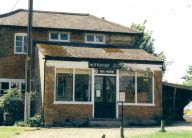 In WHTS a number of local facilities have closed, including the shops and post offices in Appleshaw and Thruxton. As well as the impact that each of these losses has had on the communities, there are also transport implications as people with cars travel greater distances, and those without are possibly left having to rely on others or make the best use of often inadequate public transport.
9.4 Where possible, the councils will work with developers to ensure that new facilities are located near to existing developments and by improving the quality of walking, cycling and public transport infrastructure. By locating new housing in existing settlements, local facilities can be sustained.
Tourism and Leisure
 9.5 Tourism and leisure activities are an important part of Western Hampshire's economy, based largely on the countryside heritage. One of the best ways to explore the area is by footpath or bridleway. The area boasts long distance routes for walkers (for example, the Test Valley and Clarendon Way), and several different cycling events are held throughout the year. Tourism activities will need to be mindful of the pressures that can be put on the local road networks in particular.
Actions - Economy The strategy will support the local economy by: · Improving pedestrian and cycle links to local shops, facilities and tourist attractions · Supporting land use policies that meet the needs of the local workforce |
Issues - Economy · How can the strategy help manage access to the countryside and Areas of Outstanding Natural Beauty (AONB) for leisure whilst ensuring the least possible damage to the environment? · How can the strategy support local facilities and reduce travel demand? · Are there more innovative ways of delivering services that should be explored? |
10 CURRENT INITIATIVES
10.1 As explained above, Hampshire County Council's approach to transport is to develop area transport strategies in partnership with local communities and organisations. This is being continued through the Local Strategic Partnership and Community Strategy. A number of initiatives are already underway in WHTS; details of some have already been highlighted in previous sections and others are covered below.
Working in Partnership
10.2 Hampshire County Council and Test Valley Borough Council are working in partnership with each other and with a number of key stakeholders to enhance the local environment and improve safety, including:
· Public transport providers and operators
· Schools
· The Countryside Agency
· Bordering local authorities
· Central and regional Government
· Environmental campaigners and user groups
10.3 A network of eleven district and county level Local Strategic Partnerships have been established, which provide a forum within which the County Council can exercise its community leadership role, including the development of Community Strategies. The focus is currently on the development of these community strategies where initiatives within the LTP are able to help address priorities, such as tackling the fear of crime in local communities; the promotion of healthier lifestyles; and the encouragement of greater community involvement.

10.4 It is important to work with local communities, not only to identify the issues that are important to them, but also to increase the awareness of wider transport issues and get them to play an active part in developing the solutions. Travel plans are being developed at a number of schools and businesses across the county as a result of these partnerships.
 10.5 Travel plans usually relate to the larger employers or groups of businesses within an area to reduce their impact on the local environment and also improve the safety, health and fitness of employees. In WHTS, the impact of travel plans may be limited as there are few large employers, and given the dispersed nature of activities and facilities in rural areas, the car is likely to remain a primary mode of transport. However, through the Work Place Travel Plan Co-ordinator, efforts will be made to identify where travel plans could be introduced. This will be especially important in considering planning consent for new developments. In addition, travel plans implemented in adjacent ATS and SWHTS areas are likely to have a bearing on travel.
Actions - Making it Happen The strategy will be delivered by: · Continuing to work with the local community to find appropriate solutions · Continuing to develop partnerships with schools to promote safer routes to schools · Forging partnerships with businesses to explore alternatives to car travel · Continuing dialogue with public transport operators to maintain the best level of service possible |
Issues - Making it Happen · Are these partnerships the best way to proceed with finding solutions to transport problems? · What resources are needed to deliver the partnerships identified above? |
11.1 Countywide transport policy plays a fundamental part in underpinning the development of the programme for WHTS. In order to achieve the aims and objectives, the programme of transport schemes developed will be updated annually within the context of national and local transport policy.
11.2 Funding to allow schemes to be built is secured through the LTP process with the programme being developed to reflect the priorities identified in this strategy. The capital programme is outlined for a 5-year period in the LTP. The Andover and Western Hampshire Transport Strategy Members Panel (comprising Hampshire County and Test Valley Borough Councillors), covers both the WHTS and ATS areas. It overseas the details of spending and makes recommendations to the Executive member for the Environment for spending on projects.
11.3 Increased funding has been made available in recent years for Rural Bus Grants and to promote walking and cycling, especially amongst school age children through the Safer Routes to Schools programme.
11.4 Sources of funding will include the Department for Transport, the County Council (as the local highway authority), Test Valley Borough Council and the private sector. Developers wishing to build in the area will be expected to make appropriate contributions towards the strategy.
12 TARGETS AND MONITORING
12.1 In order to meet the objectives of the strategy and in accordance with targets set out in the Road Traffic Reduction Act (1997), a number of targets for the WHTS area have been developed. These targets are shown below and are included in the LTP's 2002 Annual Progress Report.
 Targets
Encourage less reliance on the car and reduce the overall need to travel
· To reduce the rate of forecast traffic growth between 1998 and 2020 by 20%
· For all major new businesses to have a workplace travel plan with an approved monitoring strategy as part of any planning permission
· For 1 existing business to have a workplace travel plan in place by 2004
Promote new and improved passenger transport, cycling and walking facilities that are accessible to all and which provide a safe and convenient alternative to the car
· Increase use of public transport trips by one third (from 1997 base)
· Quadruple cycle use by 2010 (from 1997 base)
· Increase the number of walking trips by one third (from 1997 base)
· To achieve 95% of bus services running not more than 1 minute early or 5 minutes late
· Increase the satisfaction rating of public transport facilities
To improve road safety and personal security. By 2010, compared with the average 1994 - 98 to achieve:
· 40% reduction in the number of people killed or seriously injured in road accidents
· A 50% reduction in the number of children killed or seriously injured
· A 10% reduction in the slight casualty rate expressed as the number of people injured per 100 million vehicle kilometres
· To meet the street lighting target of responding to 98% of all reported faults within 5 calendar days
· Where appropriate, to increase the level of CCTV at public transport interchanges
Promote safer routes to school and the use of alternatives to the car for the school journey
· To increase the number of bus, cycle and walking trips to school to a minimum of 75% by 2010 (from 1997 base)
· For all schools to have the opportunity to participate in safer routes to school schemes by 2010 (2000 base)
· Increase the take up of cycle training in schools to 50% of available age range (from 1999 base)
Use new technology and information systems to make the most efficient use of the existing highway network and enhance the usage and operation of public transport systems · Provision of real time information on strategic bus routes |
Traffic and Travel Monitoring
12.2 In order to monitor progress against these targets, information is collected from a number of sources and surveys are undertaken on a regular basis. The whole monitoring process is under review, but currently, area strategy monitoring takes places in each of Hampshire's area strategies on a rolling programme every two years. The monitoring for WHTS was last conducted in July 2001, and it was therefore possible to tailor the monitoring programme in such a way as to provide data to support the development of the strategy.
12.3 Monitoring is carried out in order to evaluate and prioritise schemes within the strategy. A range of methods and mechanisms will be used in the monitoring and evaluation of the strategy to see how these targets are being met. These include:
· assessments of the use of a variety of modes of travel
· road casualty databases
· results from the County Council's Transpol household questionnaire surveys (see below)
· developing and consulting on a monitoring strategy
· Headstart community involvement programme
· before and after studies for specific schemes
12.4 Based on data from permanent traffic count sites and supplementary surveys, traffic levels in the area have risen by 2.7% per annum since 1994. Traffic levels on all roads in Western Hampshire are forecast to increase by between 28 - 56% between 1996 and 2020 - a rate which exceeds the high growth forecast. However, traffic on local roads is likely to be closer to the lower end of the range.
12.5 The Road Traffic Reduction Act (1997) targets for WHTS propose to reduce traffic growth on all roads by 20% by the year 2020 (from 1998 base).
12.6 Information about the way people travel in the area is gathered through Transpol, the County Council's household survey which has been undertaken in each district every 5 years. The last Transpol survey for the Test Valley area was undertaken in 1997 and collected data about the nature of households, travel patterns, and factors influencing travel choices, together with perceptions and attitudes concerning transport related issues. The results of the survey confirmed that the dominant mode of transport for all journey categories is the car. Over 80% of all journeys are made by car, compared with 11% by public transport and 3% by either foot or cycle.
12.7 The survey highlighted many of the problems perceived by people using public transport, including the provision of shelter facilities at bus stops and railway station car parking charges. Perceptions of cycling related to the lack of safety on roads and the provision of cycle lanes.
Actions - Targets and Monitoring · The Council will monitor traffic and travel behaviour across the area by conducting a range of programmed and ad hoc surveys · `Before and after' monitoring of traffic and travel behaviour will be conducted when new schemes are introduced to assess their effectiveness · Progress towards achieving the targets set out in the strategy will be reviewed each year as part of the Annual Progress Report |
Issues - Targets and Monitoring · Are the targets set for the WHTS area realistic? · What changes are needed to achieve these targets? · How can the Council achieve a good rate of response to the Transpol surveys? |
13 STRATEGY CONSULTATION
13.1 A draft version of this document was put out to consultation in November 2002. Consultees were invited to submit any comments on the strategy that they may have had. Feedback received as a result of this exercise has been considered and incorporated into the final strategy document where appropriate. If you have any questions or would like to know more about the WHTS schemes and initiatives included in this document, please contact:
Head of Transport Policy
Environment Department
Hampshire County Council
The Castle
Winchester
Hampshire
SO23 8UD
E-mail: [email protected]
13.2 A summary of this Strategy can also be viewed on line at www.hants.gov.uk/environment/whts.