Archived decisions
Hampshire County Council New Forest Transportation Strategy Members' Panel 18 March 2003 Lyndhurst High Street Traffic and Environmental Improvement Scheme Monitoring Report of the Director of Environment |
Item 10 |
Contact: Jonathan Crabb, ext 6047
1. Summary
1.1 This report outlines the results of the extensive data collection exercise which took place before and after implementation of the Lyndhurst High Street Traffic and Environmental Scheme. In order to assess the effectiveness of the scheme in meeting its objectives, and to gauge the efficiency of the implementation process, quantitative and qualitative data have been collected. The programme of surveys covered road traffic, pedestrian activity and air quality, as well as gaining the public's opinions and views on the scheme and the process of implementing it.
2. Background
2.1 During the past few years particular attention has been centred on developing measures to alleviate traffic and environmental problems in Lyndhurst, the principal administrative and visitor centre of the New Forest. Proposals already introduced include schemes to remove long distance traffic and heavy lorries from the town. Improvements to the eastern end of the High Street (Phase 1) were completed in 1998.
2.2 Following on from these measures the next phase of the Lyndhurst High Street Traffic and Environmental Improvement Scheme was developed in consultation with a local steering group. The provision of wider footways on both sides of the High Street, with improved crossing opportunities, was aimed at creating a safer, more attractive environment for residents, traders and visitors, whilst making more efficient use of the available road space. To facilitate this the width of the road was reduced and one of the two lanes removed. As part of this scheme improved pedestrian facilities outside the school and a new pedestrian phase on the Romsey Road arm of the existing signalised junction were also implemented.
2.3 The scheme aimed to:
(i) improve pedestrian safety and the perception of safety,
(ii) increase pedestrian activity;
(iii) increase trade;
(iv) influence driver behaviour and reduce off-peak traffic speeds;
(v) encourage visitors to spend more time (and therefore more money) in the High Street by creating a more pleasant environment;
(vi) possibly reduce very local car trips for shopping and school;
(vii) encourage other investment in the village; and
(viii) act as a catalyst for other initiatives.
2.4 The Lyndhurst High Street Traffic and Environmental Improvement Scheme was implemented in two stages. Stage 2a, outside Lyndhurst School, was completed in spring 2000. The final stage, along the High Street, was completed in spring 2001.
3. Monitoring Programme
3.1 In order to assess the effectiveness of the High Street improvement scheme, a comprehensive monitoring programme was designed to ensure that the County Council could learn from the development of this scheme and test whether its original objectives had been met. In order to make a comparison of traffic and pedestrian flows, surveys were undertaken before and after implementation of the scheme. Due to the outbreak of foot and mouth, which had a major impact on visitors to areas such as the New Forest, and to allow a `settling in' period for the scheme, the majority of the quantitative survey data was collected in summer 2002. Also, as part of the routine monitoring of the New Forest Transport Strategy (NFTS), some data was collected in March 2002, but these figures do not show the level of tourist activity. A plan showing the locations of the monitoring sites is attached as Figure 1.
3.2 Qualitative surveys were also conducted to obtain opinions and views on the scheme. As part of the `Best Value' monitoring a focus group was set up to find out the views of invited individuals to the consultation and scheme implementation process.
4. Data Collected
(i) Permanent Traffic Counts: A337 north and A35 west of Lyndhurst;
(ii) Manual Counts: A337 north and A35 west of Lyndhurst;
(iii) Turning Count: High Street/Romsey Road - 4 April 1999 and 12 September 2002;
(iv) Manual and Pedestrian Counts: Lyndhurst Infant School - 28 September 1999 and 12 September 2002;
(v) Journey Time Surveys - July and August 1999, September 2001 and August 2002;
(vi) Video Surveys - May 1999;
(vii) Pedestrian Counts (as part of the biennial NFTS surveys 1998, 2000 and 2002);
(viii) Speed Check - July 2000 and May 2002;
(ix) Air Quality Data;
(x) Personal Injury Accidents;
(xi) Pedestrian Interview Surveys - June 2002;
(xii) Review of Consultation Exercise - September 2001; and
(xiii) Meeting with Contractor - June 2001.
5. Survey Results
Quantitative Data
5.1 Permanent traffic counters located on the A337 to the north and the A35 to the west of Lyndhurst monitor the volume of traffic entering the High Street. Tables 1 and 2 give the five and seven day 24 hour averages for the months of August, September and October between 1999 and 2002. The data suggests that the volume of traffic entering Lyndhurst via the A337 and A35 has declined since 1999, although the volumes do fluctuate between months and years.
Table 1. Permanent Count Site A337 North of Lyndhurst - Traffic Flow Southbound into Lyndhurst
24 Hour |
5 Day Average |
7 Day Average | ||||||
1999 |
2000 |
2001 |
2002 |
1999 |
2000 |
2001 |
2002 | |
August |
6,952 |
7,113 |
6,524 |
6,183 |
6,805 |
6,926 |
6,270 |
6,052 |
September |
6,957 |
6,008 |
- |
6,683 |
6,779 |
5,964 |
- |
6,386 |
October |
6,894 |
6,339 |
6,276 |
5,290 |
6,644 |
6,148 |
5,992 |
4,983 |
Table 2. Permanent Count Site A35 West of Lyndhurst - Traffic Flow Eastbound into Lyndhurst
24 Hour |
5 Day Average |
7 Day Average | ||||||
|
1999 |
2000 |
2001 |
2002 |
1999 |
2000 |
2001 |
2002 |
August |
6,714 |
6,954 |
6,623 |
6,427 |
6,790 |
6,937 |
6,579 |
6,413 |
September |
6,990 |
5,339 |
5,798 |
5,801 |
7,106 |
5,446 |
5,784 |
5,872 |
October |
7,365 |
5,699 |
5,549 |
4,707 |
7,282 |
5,605 |
5,470 |
4,659 |
5.2 It should be noted that information in Tables 3 and 4 is based on a single 12 hour manual classified count for each year. Therefore the weather, incidents or events in the surrounding area can affect the survey results obtained. An accident on the M27 on the day of the August 2002 survey resulted in traffic rat-running through Emery Down and Lyndhurst High Street. Therefore, the count on A337 north of Lyndhurst will have been affected.
Table 3. Manual Classified Counts (12 hour one-way flows towards Lyndhurst)
March 2000 |
March 2002 |
August 2000 |
August 2002 | |
A337 N of Lyndhurst |
4,854 |
6,275 |
6,670 |
7,009 |
A35 W of Lyndhurst |
4,595 |
4,362 |
5,362 |
5,310 |
5.3 The manual counts indicate that the flow on the A337 has increased by 29% during the March 2000-2002 surveys and 5% during the August 2000-2002 surveys. The site for this survey is north of the junction of U139 with Emery Down. These surveys suggest that some vehicles may be diverting to other roads in the Forest and therefore not entering the High Street. The impact of recent traffic management works to reduce rat-running along Mill Lane, Emery Down will be monitored. The use of minor roads in the New Forest will also be included in a proposed demand-management study later this year. On the A35 there is a recorded decrease in both months on the days of the surveys, which is consistent with the data from the permanent count site.
Table 4. Turning Count: High Street/Romsey Road (12 hour)
High Street West |
Romsey Road (two-way) |
High Street East | |
April 1999 |
10,041 |
10,913 |
8,446 |
September 2002 |
13,571 |
14,137 |
12,878 |
5.4 Comparison of the turning surveys indicates a larger number of vehicles travelling down the High Street (52%) during the survey in 2002.
Table 5. Average Times Taken to Travel through the High Street from the Traffic Signals on Romsey Road to Gosport Land Junction (00:00 minutes:seconds)
Hours |
July 1999 |
August 1999 |
September 2001 |
August 2002 |
0800-0900 |
00:28 |
00:25 |
00:33 |
00:30 |
1000-1100 |
00:35 |
00:30 |
00:44 |
00:41 |
1700-1800 |
00:32 |
00:29 |
00:30 |
00:33 |
Table 6. Average Time Taken to Travel through A337 Junction (times indicate length of time vehicles queued at traffic signals - 00:00 minutes:seconds)
Hours |
July 1999 |
August 1999 |
September 2001 |
August 2002 |
0800-0900 |
00:34 |
00:48 |
03:16 |
01:08 |
1000-1100 |
01:04 |
01:36 |
00:37 |
03:59 |
1700-1800 |
00:56 |
01:11 |
00:54 |
05:38 |
Table 7. Average Time Taken to Travel through A35 Junction (times indicate length of time vehicles queued at traffic signals - 00:00 minutes:seconds)
Hours |
July 1999 |
August 1999 |
September 2001 |
August 2002 |
0800-0900 |
00:22 |
00:39 |
01:13 |
00:33 |
1000-1100 |
01:19 |
02:59 |
00:21 |
03:54 |
1700-1800 |
00:57 |
02:11 |
00:58 |
03:04 |
5.5 The objective of the journey time surveys was to ascertain if traffic travelling from the Cadnam roundabout via the A337, through the High Street, Gosport Lane, Shrubbs Hill or Chapel Lane is adversely affected, in terms of time travelled and vehicles queuing at junctions, by the introduction of the single lane. Surveys were undertaken during the following time periods: 0800-0900, 1000-1100 and 1700-1800 hours. These time periods represented the peak morning and evening commuter times, together with 1000-1100 which was considered off-peak but would also be a time when visitors would be entering the Forest.
5.6 The journey time surveys suggest that reducing the carriageway to a single lane has had little effect on the time taken to travel the length of the High Street (Table 5). A speed check indicates a slight reduction in the 85th percentile speed of vehicles from 24 mph during a survey before the implementation of the scheme to 21 mph during a survey following its implementation.
5.7 The surveys suggest an increase in waiting time at the traffic signals on the A337 and A35, especially during August 2002 (Tables 6 and 7). Traffic data does not show any increases of traffic volume at these times. However, a new pedestrian phase has been introduced at the A337 traffic signals and a recent pedestrian survey indicates that this crossing was used by 1,472 people between 0800-1800 hours. This may account for an increased delay to motorists at these signals. The timings of the signals can vary according to traffic demand, whether the pedestrian stage is demanded and how quickly vehicles clear the junction. Similarly, the introduction of the pedestrian crossing outside the school on the A35 may also account for an additional delay. A survey indicates that this crossing was used by 932 pedestrians during a ten hour period, which is a 7% increase on the number of pedestrians crossing at this point prior to installation of the crossing.
Table 8. Pedestrian Flows in the High Street (0900-1500 hours)
March 1998 |
March 2000 |
March 2002 |
August 1998 |
August 2000 |
August 2002 |
1,586 |
1,933 |
1,971 |
4,029 |
3,835 |
3,750 |
5.8 Pedestrian volumes in the High Street are recorded as part of the biennial surveys. The data suggests an increase during March but a decrease in August. A recent survey shows that 1,439 pedestrians used the crossing in the High Street during a ten hour period. Records show three personal injury accidents in the High Street in both 2000 and 2001.
5.9 Air quality monitoring outside the school indicates a further decrease in the annual average amounts for sulphur dioxide and nitrogen dioxide to 2000, with lead levels remaining the same. Nitrogen dioxide levels outside Lyndhurst bakery are at a similar level to 2000 following a decrease from since 1998. Since 2001 the District Council has used a slightly different method to average the data collected on nitrogen dioxide. Additionally, the tubes that are used come from GRADKO in Winchester and the analysis technique for the preparation of the tubes has shown over time an under-read of approximately 18%. Consequently this has been added to the averages, which gives corrected results for 2001 and 2002 of 26.53 Ugm3 and 22.28 Ugm3 respectively at the school and 51.15 Ugm3 and 54.30 Ugm3 respectively at the bakery. Accurate comparisons with historic data cannot, therefore, be made at this time, other than that there is a decrease in levels of nitrogen dioxide at the school and an increase at the bakery between 2001 and 2002.
6. Qualitative Information
Review of Consultation Exercise
6.1 Miller Associates, market research consultants, facilitated a series of workshops involving a cross-section of the local community to discuss the scheme consultation exercise. The consultation culminated in a public exhibition with an attendance of 813 people and the return of 521 questionnaires. The main findings of the consultants' research indicated that whilst the majority of residents was aware of the public exhibition, the extent they felt included in the exercise varied considerably. The exhibition was advertised using a flyer in the local free paper and all residents were kept informed of the results of the consultation and implementation of the scheme through a series of newsletters and press releases. Those actively involved were aware of the local steering group, received a lot of information themselves and believed that access to information for the general public was good, whilst some residents felt that they had received little direct communication. Many residents were not aware that the scheme had evolved as a result of listening to the views of local people and that there was a local steering group. Consequently, residents felt that information at an early stage so that they could actually input into the scheme before it advanced too far would be most useful. Details of the key issues raised are in Appendix 1.
7. Meeting with the Contractor
7.1 A meeting was also held with the company constructing the scheme following completion of the works to discuss public relations, contract issues and problems and solutions. The wash-up meeting proved very useful in providing feedback on the implementation of the scheme. Details are in Appendix 1.
8. Interview Surveys
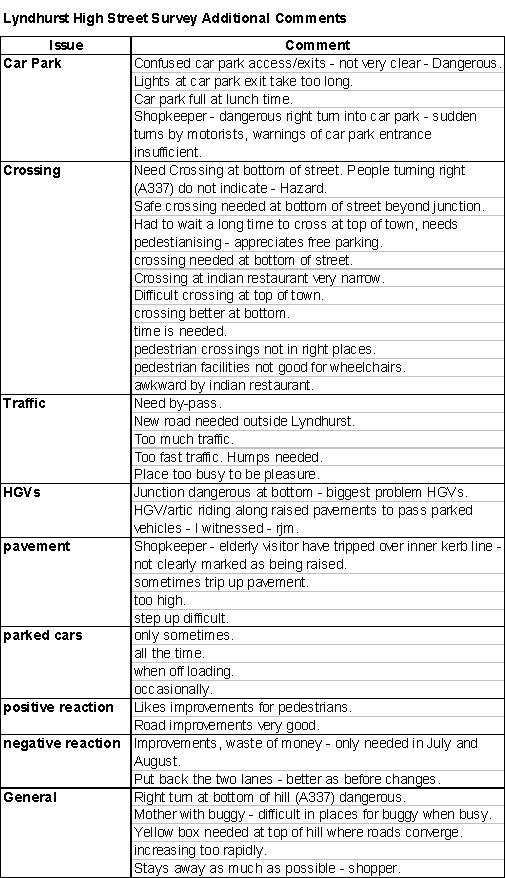
8.1 In June 2002, members of the public were stopped in Lyndhurst High Street and asked to answer a short questionnaire seeking their views on the scheme. The results of the survey are in Appendix 2. A total of 104 questionnaires was completed, with 60% of respondents living in Hampshire, of which 34% lived in Lyndhurst. The majority felt that the pavements were wide enough and that they felt safe from traffic. A total of 63% found it easy to cross the road but 45% still felt that there were not enough crossing facilities. The majority of respondents felt that destinations and parking were clearly signed and that parked vehicles, ie for unloading, in the High Street did not present any problems.
9. Conclusion
9.1 A substantial data collection exercise took place before and after implementation of the Lyndhurst High Street Scheme. In order to assess the effectiveness of the scheme in meeting its objectives, and to gauge the efficiency of the implementation process, quantitative and qualitative data were collected. This provided data, not only for air quality, personal injury accidents and traffic and pedestrian comparisons, but also on attitudes to the scheme and its implementation.
9.2 The results suggest that the volume of traffic entering Lyndhurst High Street has decreased in recent years and that some may be diverting onto minor roads through the Forest. A proposed study into demand management in the New Forest to be undertaken later this year will include minor roads. The reduction of the carriageway to a single lane has not affected the time taken to travel through the High Street and traffic speeds have reduced slightly, making it a safer place for pedestrians. The journey time surveys also indicate that vehicles are waiting longer to access the High Street on both the A337 and A35, especially during the summer and at peak times. This may be due to the introduction of crossing facilities at or near these junctions. However, 45% of respondents to a survey felt that there were not enough crossing facilities in Lyndhurst. Data suggest that the crossing facilities are well-used and pedestrians believed that the pavements were wide enough and they felt safe from traffic.
9.3 This extensive monitoring exercise was the first holistic post-scheme review, and market research consultants were employed to discuss the scheme consultation exercise. The main findings of the consultants' research indicated that, whilst the majority of residents were aware of the public exhibition, the extent they felt included in the exercise varied considerably. Residents felt that information at an early stage, so that they could input into the scheme before it advanced too far, would be most useful. Discussions with the contractor building the scheme also proved useful.
Recommendation
That the results of the surveys be noted.
Section 100 D - Local Government Act 1972 - background papers | |
The following documents disclose facts or matters on which this report, or an important part of it, is based and has been relied upon to a material extent in the preparation of this report. | |
NB the list excludes: | |
1. |
Published works. |
2. |
Documents which disclose exempt or confidential information as defined in the Act. |
TITLE |
LOCATION |
None. |
7799/JC
APPENDIX 1
Miller Associates report: "Transport Network Improvements - A Review of Consultation Exercises" October 2001: Main Findings
Awareness and Inclusivity
· A high level of awareness amongst all sectors of community - word of mouth played a large part.
· The majority of residents were aware of the consultation exercise but the extent they felt included in the exercise varied considerably.
· Those actively involved in the consultation felt that everybody was given the opportunity to participate if they wanted to.
· The consultation had been very effective in swaying opinion and gaining a lot of support for the scheme.
· The consultation was more likely to have embraced articulate and higher socio economic class residents.
· Failure to communicate different strands of the consultation to the whole community brought into question the honesty of it.
· Less articulate members of the community were reluctant to come forward to express their views, especially at public and parish council meetings.
· Regardless of how the consultation had been conducted, some of the less articulate members of the community would have been reluctant to put their views forward unless specifically invited to do so.
· This group also tended to have a greater belief in the ability of the `professionals' to make the right decisions.
· The less articulate members felt comfortable in the focus group, where a relatively small number of like-minded people were involved. They felt that such an exercise such as this would have brought them into the main consultation exercise.
The Steering Group
· Those who were very actively involved in the consultation felt that the steering group was effective, and valued the opportunity for local people to get involved in the details of the planning of the scheme.
· Not all members of the community felt able to approach members of the steering group.
· Whilst those who were on the steering group were aware of the involvement of local people from a very early stage, the majority of the residents were not aware of the existence of this group or of its role.
· Many ordinary members of the community saw the High Street scheme as being imposed upon them, rather than a solution that was jointly arrived at with members of the local community.
Communications
· There was considerable press coverage and residents were able to keep abreast of this if they wanted to.
· The scheme had a great deal of local interest and much of the communication was by word of mouth.
· Residents felt that they received very little direct communication from the County Council.
· Communication would have been most useful during the early stages, prior to concrete proposals being formulated.
· They wanted information at this early stage so that they could actually input into the scheme before plans were advanced too far.
· The majority of residents said they had not seen or received the newsletters sent out once the implementation of the scheme was underway.
· In their view information at this later stage was less valuable then it would have been prior to the development of the detailed plans for the scheme.
· Activists believed that they received a lot of information themselves and that access to information for the general public was good.
The Exhibition
· Responses to the exhibition by those who attended was generally very positive, especially amongst those who had an active role to play in the consultation.
· Residents felt that the computer simulation provided a good impression of how the High Street would look.
· Those actively involved in the consultation felt that the exhibition did a great deal to sway public opinion in favour of the scheme.
· Many of those opposed to the scheme felt that the exhibition was presented in such a way that it gave the impression that the details of the scheme were already decided.
· Many local residents felt that the demeanour of the staff led to the impression that all the major decisions had been made and that the exhibition was a formality designed to show residents the scheme that was to be imposed on them.
· Residents also resented officers who did not live in the area and who were unable to answer detailed questions about the area, making decisions that they felt would have a major impact on their lives.
· The timing and location of the exhibition came under criticism.
· Many people who visited the exhibition did so because they had strong views regarding the proposed scheme.
· The impression gained from other people attending the exhibition was that the majority of residents were opposed to the scheme and this led to an expectation, on their behalf, that the scheme would subsequently be dropped.
The Questionnaire and Other Feedback
· All those who attended the exhibition completed a questionnaire.
· Although those who were actively involved in the consultation said that the findings of the questionnaire were published, other members of the community questioned this.
· Having a questionnaire at an exhibition and particularly one that asked for an indication of the level of support for the scheme, did lead to an expectation that the decision about the scheme would be based on the responses to the questionnaire. There was a strong belief that the majority of people would not have given support to the scheme.
· By not publishing the findings of the survey widely, residents felt that the information had been suppressed.
· Residents said that the County Council had conducted an on-street questionnaire survey at the time of the pilot scheme.
· Whilst those actively involved in the consultation were aware that the scheme evolved as a result of listening to the views of local people, the vast majority of residents were not aware of this.
· Residents did not appear to have received any feedback regarding the different strands of the consultation.
· The failure to communicate the fact that local people's views had been taken into consideration added to the feeling that the scheme had been imposed on the community.
· A few members of the community felt they would like to give further feedback to the County Council regarding what they think of the scheme now it is in place.
Wash-up Meeting held with Mildren Construction June 2001
Public Relations
· The attendance at Parish, Chamber of Trade and Residents' Association meetings in the run up to starting construction works had provided benefit to the scheme.
· The level of information given to the public about the contract restrictions lead to some minor problems arising with the `more difficult' individuals on site.
· The use of a media handling strategy, written prior to any construction works starting on site, was felt to have been a major benefit in distributing clear and concise information at the right time.
· The issuing of a number of newsletters throughout the works was also supported, however distribution arrangements need to be improved in the future.
· Hand delivering newsletters to all properties avoids criticism of lack of information.
· The production and issuing of a simplified programme at the outset of the contract had assisted with positive public relations on the scheme. However, the programme could quickly turn to a negative tool, used by the media and public to highlight deficiencies.
· The contractors reported a significant level of ill-feeling from traders during their initial introductions at the start of the contract period. Consideration should be given to reviewing the level of support for schemes more fully from the outset and publicising details more fully to reinforce the reasons and local support for schemes.
Other issues discussed:
Problems and Solutions
Contract Issues
LYNDHURST HIGH STREET SURVEY JUNE 2002 APPENDIX 2
Overall Results | |||||||||||
SECTION 1 |
Car |
Bus |
Cycle |
Walk |
Other |
Total | |||||
Number |
% |
Number |
% |
Number |
% |
Number |
% |
Number |
% |
Number | |
How did you travel to Lyndhurst today? |
56 |
54 |
7 |
7 |
9 |
9 |
23 |
22 |
9 |
9 |
104 |
SECTION 2 |
Yes |
No |
Total |
||||||||
Number |
% |
Number |
% |
||||||||
Do you find it easy to cross the road? |
65 |
63 |
38 |
37 |
103 |
||||||
Are there enough pedestrian crossing facilities? |
57 |
55 |
47 |
45 |
104 |
||||||
Are the pavements wide enough? |
99 |
95 |
5 |
5 |
104 |
||||||
Do you feel safe from traffic? (ie not crime) |
73 |
70 |
31 |
30 |
104 |
||||||
SECTION 3 |
Yes |
No |
Total |
||||||||
Number |
% |
Number |
% |
||||||||
Are destinations and parking clearly signed? |
88 |
94 |
6 |
6 |
94 |
||||||
Do parked vehicles present any problems? |
23 |
22 |
81 |
78 |
104 |
||||||
SECTION 4 |
Lyndhurst |
New Forest |
Hampshire |
Outside Hampshire |
Total |
||||||
Number |
% |
Number |
% |
Number |
% |
Number |
% |
||||
Where do you live? |
35 |
34 |
19 |
18 |
8 |
8 |
41 |
40 |
103 |
||
SECTION 5 |
Work |
Resident |
Visitor |
Shopping |
Other |
Total | |||||
Number |
% |
Number |
% |
Number |
% |
Number |
% |
Number |
% |
||
What is the purpose of your visit? |
16 |
15 |
11 |
10 |
41 |
39 |
28 |
26 |
10 |
9 |
106 |