Archived decisions
DOCUMENT REF: Hythe Interchange Vision v3a.doc | ||||||
2 |
FINAL |
TB |
MC |
SS |
AKP |
Mar `03 |
1 |
DRAFT |
TB |
MC |
SS |
AKP |
Feb `03 |
Originated |
Checked |
Reviewed |
Authorised |
Date | ||
Revision |
Purpose Description |
| ||||

Contents
Section Page
Executive Summary iii
1. Introduction 4
2. Design Context: Policy guidance, stakeholder aspirations and user surveys 5
2.1 Overview 5
2.2 Project brief Error! Bookmark not defined.
2.3 Local Transport Plan 5
2.4 Supplementary Planning Guidance 6
2.5 HCAG feedback and aspirations 6
2.6 Feedback from additional consultees 7
2.7 Questionnaire survey results 7
2.8 Movement survey results 7
3. Design objectives 8
3.1 Overview 8
3.2 Essential objectives 8
3.3 Desirable objectives 9
3.4 Operational requirements 9
3.5 Building design issues 10
3.6 Other considerations 10
3.7 Conclusion 10
4. Design criteria and option assessment 11
4.1 Design criteria 11
4.2 Option assessment 12
4.3 Recommendations 13
Appendix A - Survey Results 14
List of Tables
Table 1 - Response to ranking aspects of the Interchange 14
Table 2 - Aspects rated poor or very poor and good or very good in the questionnaire results 15
Table 3 - Frequency of aspects considered most important 16
Table 4 - Aspects which would encourage bus use from ferry users 16
Table 5 - Assessment of survey results 17
List of Figures
4260252/101 |
Interchange Layout 1 |
|
4260252/151 |
Interchange Layout 1a |
|
4260252/201 |
Interchange Layout 2 |
|
4260252/301 |
Interchange Layout 2a |
Executive Summary
1. Introduction
Atkins have been commissioned by Hampshire County Council (HCC) to assist in developing a preferred preliminary design for a major transport and environmental improvement scheme for Hythe Interchange. This report presents the results of work done in the course of the project to review aspirations for the Hythe Interchange area and to develop concept options for consultation with local stakeholders.
2. Design context: Policy guidance, stakeholder aspirations and user surveys
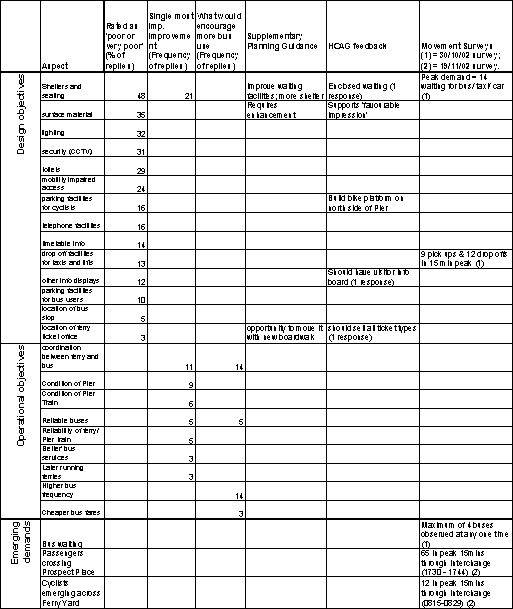
To understand the competing and complementary aims which potential concept designs would need to balance, a thorough review of relevant background information was carried out, covering both existing policy guidance and new information on stakeholder aspirations. Existing sources included HCC's brief for the project, the Local Transport Plan, Local Plan Supplementary Planning Guidance (SPG) for the site.
New sources of information included consultations with the local stakeholder group, site landowner and transport operators, complemented with local surveys of movement in Hythe and the interchange, and opinions on different aspects of the interchange from users. Two movement surveys and two questionnaire surveys have helped determine the demand for different transport modes at the Interchange and established ferry users aspirations for improvements to the facility.
3. Design objectives
Building on the identification of key design issues derived from the review of background information, those issues were then distilled into a composite set of design objectives which any proposed scheme for the interchange should aim to address. To highlight the key objectives an assessment of the main design and operational issues covered in the surveys and existing policy guidance was carried out. Objectives that were more widely reflected in the existing policy guidance or highly ranked by users were deemed essential to any design.
4. Design criteria and option assessment
In order to develop and assess concept options for Hythe interchange, the survey results, stakeholder views, SPG design objectives and other related objectives were the following priority list of design criteria have been identified to provide a core assessment framework.
Four options were assessed: Options 1, 1a, 2 and 2a. Option 2a offers the greatest benefits in terms of the key assessment criteria distilling the various aims and aspirations for the site and is recommended to be progressed further. Initial consultations with stakeholders revealed a further possible Option 1a which could offer additional benefits, subject to engineering feasibility assessment. Therefore this option is recommended to be progressed further in addition.
1. Introduction
Atkins have been commissioned by Hampshire County Council (HCC) to assist in developing a preferred preliminary design for a major transport and environmental improvement scheme for Hythe Interchange. This report presents the results of work done in the course of the project to review aspirations for the Hythe Interchange area and to develop concept options for consultation with local stakeholders.
In the course of the project the following key tasks have been undertaken:
· Review of current relevant documentation, site visit and initial briefings with relevant organisations including transport operators, the site land owner, HCC and New Forest District Council;
· Meeting in November 2001 with the local stakeholder group, the Hythe Centre Advisory Group (HCAG), to introduce the project;
· A further meeting in May 2002 with HCAG, to obtain feedback on local stakeholder issues and aspirations relating to the Interchange site;
· Passenger counts and opinion surveys to discover demand patterns and user aspirations for the site;
· Traffic/parking surveys and a traffic assessment of alternative road network options in Hythe to support the development of options for the site;
· Development of a detailed design brief for the site;
· Development of concept options for consultation with local stakeholders.
This document presents an assessment of the key data collected to identify a vision for Hythe Interchange. The assessment draws on the following sources:
· Local Transport Plan objectives;
· Supplementary Planning Guidance;
· Feedback from Hythe Centre Advisory Group (HCAG);
· Results of surveys of user movements and attitudes;
· The identification and assessment of potential options for rejuvenation of the current interchange area;
This vision sets out key objectives, particularly:
· To promote modal integration;
· To provide high quality passenger interchange;
· To provide a focal point for interchange and civic space;
· To aid the Local Transport Plan and South West Hampshire Transport Strategy.
Arising from the vision, design criteria are set out for developing a range of concept options identified for the site, and this report assesses those options against these criteria, recommending preferred options based on this assessment.
2. Design context: Policy guidance, stakeholder aspirations and user surveys
2.1 Overview
To understand the competing and complementary aims which potential concept designs would need to balance, a thorough review of relevant background information was carried out, covering both existing policy guidance and new information on stakeholder aspirations. Existing sources included HCC's brief for the project, the Local Transport Plan, Local Plan Supplementary Planning Guidance for the site.
New sources of information included consultations with the local stakeholder group, site land owner and transport operators, complemented with local surveys of movement in Hythe and the interchange, and opinions on different aspects of the interchange from users. Two movement surveys and two questionnaire surveys have helped determine the demand for different transport modes at the Interchange and established ferry users' aspirations for improvements to the facility.
2.2 Project brief
Relevant aspects from HCC's brief for the project include:
· Review of bus and waiting arrangements in Ferry Yard;
· Improved bus passenger waiting facilities;
· Improved travel information;
· Improved pedestrian access and review of public spaces;
· Improved cycle access and storage;
· New pedestrian link between pier head and promenade;
· Refurbished/rebuilt ticket office and pier head buildings;
· Improved waiting facilities for ferry passengers.
Underlining these local aspirations, the Local Transport Plan (LTP) (2001-2006) identifies the strategic role of the interchange, indicating broader aspirations including:
· Provision of an attractive alternative for car trips to and from Southampton;
· Investment in the interchange to reinforce maintenance of the ferry service;
· Provision for visitors, including access to and information about the New Forest.
2.4 Supplementary Planning Guidance
An important aspect which must be taken into consideration is the statutory document relating to Hythe Interchange. This is the New Forest Supplementary Planning Guidance (SPG) issued in 1997. The SPG supplements policies HD-1 to HD-9 of the New Forest District Local Plan (NFDLP). The NFDLP reflects the higher level aims and objectives of Hampshire County Council's Local Transport Plan.
The SPG reflects the need for design quality on the site as a central location in the heart of the village's conservation area, and as a potentially attractive civic space for people to gather in and pass through.
Within the SPG, policies relating directly to the interchange are:
· Hotspur House Area (NFDLP Policy HD-2);
· Ferry ticket office area (NFDLP Policies HD-2 to HD-4).
The key aspirations to emerge from these policies are:
· Improved waiting facilities with more shelter;
· Surface material requires enhancement;
· Minimising space occupied by vehicles;
· Increasing pedestrian space at the waterfront;
· Creating space for a larger and improved ticket office, possibly incorporating a waiting room, tourist information and outside seating;
· Provision of a link from the Promenade to the Interchange.
2.5 HCAG feedback and aspirations
The local stakeholder group, Hythe Centre Advisory Group (HCAG), has been consulted during the duration of the project and its members have given valuable local knowledge and advice. Each HCAG member was offered the chance to give their opinion on what they would like to see at the Interchange. The main points they raised concerning the Interchange were:
· The interchange should create a favourable first impression of Hythe;
· Buses should wait in Jones Lane or Jones Lane car park unless otherwise necessary;
· Unnecessary taxi waiting in Prospect Place should be reduced;
· An enclosed bus shelter should be built by the north wall of the ticket office;
· The ticket office should be multipurpose and sell tickets for all transport modes;
· A visitor information board should be installed in Prospect Place;
· A platform for parking bikes should be built on the north side of the pier;
· A lockable compound for bikes should be included at the interchange.
2.6 Feedback from additional consultees
Further consultation was conducted with the site owners, General Estates, and with Solent Blue Line. From these consultees, a number of detailed operational issues were identified for incorporation into the design options. These concerned the requirements of buses and other vehicles using the site.
2.6.1 General Estates
As the site owner, General Estates considered it important to recognise the needs of commercial land uses adjoining the site and to ensure the design discourages occasional indiscriminate parking on the site by private vehicles.
2.6.2 Solent Blue Line (SBL)
As the primary operator of buses at the interchange, SBL were cautious about any option which might involve all buses arriving at the interchange in one direction only. This would create unnecessary extra running time that would add to overall journey times for Southampton bound journeys. The operator considered that there is general cooperation between bus drivers and taxi drivers at the location. However, it was important to keep buses all in one area so that bus passengers do not have to cross the road. Although SBL see layover as an important requirement, they recognise that where space is limited, providing space for passengers may need to take precedence over layover space which could be provided elsewhere.
2.7 Questionnaire survey results
The questionnaire surveys revealed the following main issues for users concerning the design of the interchange:
· Covered waiting facilities are a high priority for users. This is supported by the fact that the current provision is considered poor or very poor by 48% of users;
· Aspects such as surface material, lighting and security all have over 30% of users rating them as poor or very poor, although these aspects do not feature significantly when users are asked what their top improvement would be;
· Users' other priorities for improvement concerned aspects for the operation of the interchange rather than its design.
2.8 Movement survey results
From the movement surveys, the main emerging issues to consider when designing improvements for the Interchange are:
· Up to four buses may be occupying the interchange at any one time;
· Up to 65 pedestrians and 12 cyclists may use the interchange at any one time.
Tables detailing the findings from these surveys are included in Appendix A.
3. Design objectives
3.1 Overview
Building on the identification of key design issues derived from the review of background information in the last chapter, this chapter provides a distillation of those issues into a composite set of design objectives which any proposed scheme for the interchange should aim to address. To highlight the key objectives an assessment of the main design and operational issues covered in the surveys and existing policy guidance was carried out. Objectives that were more widely reflected in the existing policy guidance or highly ranked by users were deemed essential to any design.
3.2.1 New Buildings/ Infrastructure
· Refurbished/ rebuilt ticket office;
· Improvements to the interchange area should include the following: new surfacing, landscaping and street furniture;
· Provide upgraded lighting;
· Replacing worn-out tarmac surfacing on the private forecourt in front of Hotspur House with paving of stronger character.
3.2.2 Passenger facilities
· Segregate pedestrians from vehicles;
· Improved pedestrian access;
· Improved waiting facilities for ferry/bus passengers including telephone and improved toilet facilities;
· Visitor/ passenger information;
· Use of high quality materials, lighting, furniture, planting, art etc;
· Access for mobility impaired;
· New bus shelters;
· A larger and improved ticket office
· Disabled driver parking spaces
· Drop off area for vehicle passengers
3.2.3 Pedestrian facilities
· New pedestrian link between Pier Head and promenade (this does not form part of the area of brief).
3.2.4 Cycling
· Improved cycle access and storage;
· Create a cycle link from the Pier Head to proposed routes via St Johns Street/The Marsh and via Pylewell Road/School Lane.
3.2.5 Taxis
· Provide spaces for taxi waiting area.
3.2.6 Buses
3.2.7 Passenger waiting and circulation facilities
· CCTV;
· Design interchange to give the opportunity to board buses from the pavement rather than the carriageway level where possible;
· Covered walk ways.
3.3.1 New Buildings/ infrastructure
· Strategically placed trees, shelters and seating needed to give focus to the interchange area;
3.3.2 Taxis
· Remote site for taxis with telematics to control access to the Pier;
· There could be a shared bus/ taxi waiting area away from Prospect Place.
· A `staging area' for buses elsewhere in the village may be more appropriate;
· Buses need more space once a year (e.g. Christmas and Carnival) to turn in the interchange, so turning space needs to be maintained;
· The cycle route (NCN Route 2) needs to be signed;
· A dedicated cycle route/ path would be desirable through Prospect Place;
· Secure cycle storage facilities should be maintained and enhanced;
· It will be important to maintain access to the Brinton Lane car park from Prospect Place (by the Drummond Arms) for the use of `park and ride' ferry users;
· Although a high roofed structure would allow boarding of double-decker buses under shelter, such a structure would radically alter the character of Prospect Place;
· A glass frontage and sides of any passenger waiting building would allow passengers to easily see approaching buses/ taxis.
· The ferry ticket office is owned by White Horse Ferries, the Hythe ferry operator.
· The highway running through Prospect Place is owned by HCC.
· The bus interchange area is leased to Solent Blue Line from General Estates.
· Use appropriate materials to reinforce segregated uses where safety and intimidation from buses and general traffic is an issue;
· Features to control speed may reduce the need for segregation and improve pedestrian accessibility;
· A combination of treatments could be extended across Prospect Place to create a more pedestrian friendly space;
· Enclosed areas will require daily supervision;
· Canopied areas do not require supervision, although noise and fumes from buses may be concentrated;
· Open seating areas have advantages in good weather conditions and may be preferable from a personal security standpoint;
· This site is the central location of the heart of the village's Conservation Area, and is therefore a driving force in terms of design quality. The site is more than just an interchange - it is potentially a civic focal point.;
· The design should not prejudice the future possibility of providing a light rail or tram that could travel along the pier and across the interchange area;
· Detailed points advised in the SPG for this area will also be taken into account.
3.7 Conclusion
This chapter provides a distillation of those issues into a composite set of design objectives which any proposed scheme for the interchange should aim to address. The next chapter prioritises this composite set into a shortlist of design criteria used in developing and assessing concept options for the interchange.
4. Design criteria and option assessment
In order to develop and assess concept options for Hythe interchange, the survey results, stakeholder views, SPG design objectives and other related objectives were the following priority list of design criteria have been identified to provide a core assessment framework. This assessment is shown at Table 5 in Appendix A and provides for the following design criteria:
· Covered waiting facilities;
· Provision of passenger drop off facilities;
· More effective utilisation of space occupied by vehicles;
· Provision of safe crossing facilities at Prospect Place;
· Creating space for a larger and improved ticket office, possibly incorporating a waiting room, tourist information and outside seating;
· Provision for bus access in both directions;
· Clear segregation of pedestrian and vehicular space, incorporating increased pedestrian space at the waterfront;
· Improving passenger waiting facilities and in particular the opportunity to provide high access kerbs to help board buses from the pavement rather than the carriageway level where possible;
· Provide space for taxi waiting area;
· For Hotspur House: vehicular access should focus on existing access to the side of Hotspur House;
· Space for public gathering and sitting, and as a setting for waterfront buildings including Hotspur House, the public lavatories and the interchange.
Three initial concept options have been identified as a basis for consultation with the site landowners, General Estates, and the primary bus operator, Solent Blue Line. These options are shown as drawing numbers: 4260252/101; 4260252/201, and; 4260252/301.
Each option has been assessed against the ten key criteria listed in section 5.1 judged to be of most importance when designing the layout of the Interchange. Adherence to each criterion is scored out of three.
· 3 = Meets or exceeds the criterion;
· 2 = Meets most of the criterion;
· 1 = Partially meets the criterion;
· 0 = Does not meet the criterion.
Key Criteria |
Layout Option 1 |
Layout Option 1a |
Layout Option 2 |
Layout Option 2a | |
1 |
Covered waiting facilities |
2 |
3 |
1 |
2 |
2 |
Provide passenger drop off facility |
3 |
3 |
3 |
3 |
3 |
Minimise space occupied by vehicles |
2 |
2 |
2 |
2 |
4 |
Provide safe crossing for those crossing Prospect Place |
2 |
3 |
3 |
3 |
5 |
Creating space for a larger and improved ticket office |
3 |
3 |
3 |
3 |
6 |
Maintain access for buses in both directions |
0 |
3 |
3 |
3 |
7 |
Clear segregation between pedestrian and vehicular space |
2 |
3 |
2 |
3 |
8 |
Provide high access kerb to assist the mobility impaired |
2 |
3 |
1 |
2 |
9 |
Cater for taxi demand |
3 |
3 |
3 |
3 |
10 |
Maintain vehicular access to the side of Hotspur House |
3 |
3 |
3 |
3 |
11 |
Provide space for public gathering and sitting, and as a setting for waterfront buildings |
To be assessed at detailed design stage | |||
Total |
22 |
29 |
24 |
27 | |
Option 2a offers some advantages over Option 2. It offers additional passenger shelters and a marginally clearer segregation between pedestrians and vehicles as there are less places where the two cross. The taxi bay/ bus bay swap does not register as a changed score as taxi demand is met even with Option 2a and the additional bus bay is not an essential requirement (1 bus bay in each direction is considered essential). Option 1 is less favoured as it does not provide access for buses in both directions.
As a variation of Option 1, a further option (1a) was identified from discussions with Solent Blue Line over the initial options, shown as drawing number 4260252/151. This option is subject to engineering feasibility and design but indicates scope to provide the advantage of two-way bus traffic over Option 1.
From the above discussion and assessment, Option 2a offers the greatest benefits in terms of the key assessment criteria distilling the various aims and aspirations for the site and is recommended to be progressed further. Initial consultations with stakeholders revealed a further possible Option 1a which could offer additional benefits, subject to engineering feasibility assessment. Therefore this option is recommended to be progressed further in addition.
One of the questions asked interviewees to rate various aspects of the Interchange on a scale from `very good' to `very poor'. Table 1 shows the results.
Table 1 - Response to ranking aspects of the Interchange
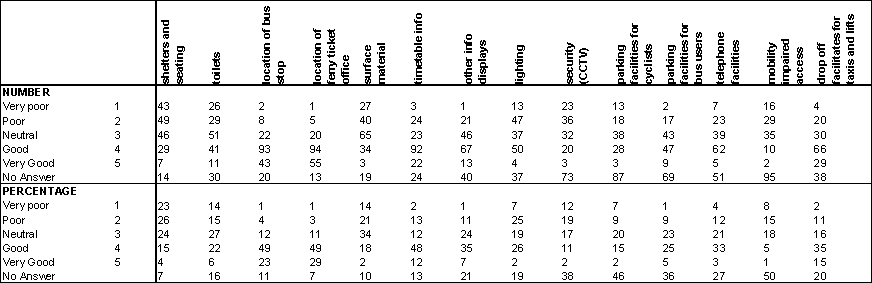
(N.B. The percentages contained in this table have been rounded for ease of use. Therefore, each column will not necessarily add up to 100%.)
Table 2 takes the data from Table 1, and summarises it by creating two lists, ranking the aspects by `poor' and `very poor' and `good' and `very good'.
Table 2 - Aspects rated poor or very poor and good or very good in the questionnaire results
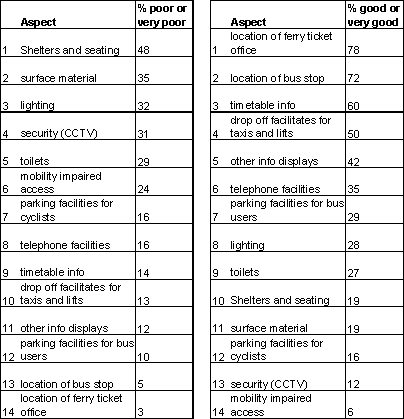
(N.B. The percentages in this table have been derived from the original data, rather than the rounded figures contained in Table 1. Therefore, the two tables will not necessarily correlate in all instances.)
An additional but important qualification of the data is that of the respective weighting given to results from Table 2. It must not be assumed that because someone rates an aspect poor, that they think it is a priority for improvement. For example, someone may rank toilet facilities as `very poor' but it may not bother them as they never use them.
Another question asked, `If there was one thing you could improve at the Interchange, what would it be?' The response is shown in Table 3.
Aspect (3 replies and over) |
Frequency of replies |
Covered waiting facilities/ cafe |
21 |
Coordination between ferry and buses |
11 |
Nothing |
10 |
Condition of Pier |
9 |
Condition of Pier train |
6 |
Reliable buses |
5 |
Reliability of ferry/ Pier train |
5 |
`Better' bus services |
3 |
Later running ferries |
3 |
A question on the ferry survey only asked, `what would encourage you to use the bus more?' Table 4 shows the responses received.
Table 4 - Aspects which would encourage bus use from ferry users
Aspect mentioned |
Frequency |
Higher bus frequency |
14 |
Coordination of bus and ferry |
14 |
Live close enough to walk |
9 |
Nothing |
6 |
Greater bus reliability |
5 |
Cheaper fares |
3 |
Bus should be free |
3 |