
Archived decisions
2003-2005
Ian Avery
Environment Department
Hampshire County Council
The Castle
Winchester
Hants SO23 8UD
Tel: 01962 846264
Email: [email protected] March 2003
Content
Page 3 What Is The Natural Resources Initiative Trying To Achieve?
A summary of the main features of the Natural Resources Initiative, its links to the community driven Natural Resources Trust, and to County Council Corporate Strategy and Sustainable Development Strategy.
Page 5 The Vision
· Short Term
· Medium Term
· Long Term
Page 6 In what context is NRI operating
· European
· National
· Regional
· Local
Page 10 Where Is the NRI Now?
An analysis of the gap between the vision, where we want to be, and where we are now
Page 14 What Opportunities Are Available ?
Key opportunities which are available for moving the NRI agenda forward towards the vision and identifying the key priorities for 2003/2005
Page 18 Identifying Priorities
This section translates the opportunities into key objectives and associated tasks for NRI over the period 2003/05
Page 22 Action Plan
The Action Plan setting out the performance measures, timescales, responsibilities and resource inputs for the key objectives and tasks has been developed directly from these priorities.
Page 24 Appendices
These provide some of the important background material to support the business plan
Contact
For further information please contact
Ian Avery on 01962 846264 Email [email protected]
1.0 What Is The Natural Resources Initiative Trying To Achieve?
1.1 The Natural Resources Initiative (NRI) is based on the principle that society's consumption of natural resources is unsustainable in the long term and that action at a local level-Agenda 21-can play an important role in achieving change. This type of approach is urged on local authorities by central government through a range of means including the provisions of the Local Government Act 2000 and guidance on the role of local government in sustainable procurement. The fundamental issue is about sustainability issues not being `nice to haves' but building them into a change process at the heart of local authorities, thus imbuing them into culture in dealing with the community and the provision of all services. Thus NRI is a non-statutory service that exerts the County Council's leadership and influence in the community and achieves `added value' through corporate working internally.
1.2 The focus of NRI in this business plan is on materials that end up as waste (household, commercial and industrial), but there needs to be clear links with the full NRI vision that includes energy, water, soil, etc in addition to waste as these elements are inter-linked and many initiatives will relate to more than just waste. The aim of the materials focus is to shift the emphasis over time from the current `throw away' approach to managing waste (waste management) to a `circular' model (resource management) that seeks to minimise resource use in the first instance and then returns unavoidable waste to the production cycle. This requires a proactive approach with an integrated programme of measures to influence production efficiency, lifestyle choices and consumption at one end of the chain and maximise recovery, reprocessing and recycling at the other.
1.3 The implication of not adopting a NRI approach to waste is an acceptance that waste management is about managing the linear progression of a problem with year on year increases in waste volumes, leading to increasing difficulty in implementing new infrastructure and increasing waste management costs with no spin-off benefits to the community.
1.4 Improving performance in the management of natural resources is a priority for the County Council in terms of both the Corporate Strategy (Aim 2) and the Public Service Agreement (PSA). The relevant requirements are set out in Appendix 1. NRI contributes to the achievement of the Corporate Strategy objective and leads the achievement of the PSA target.
1.5 NRI also links to other Corporate Strategy aims and to the Corporate Sustainable Development Strategy in terms of maximising associated environmental, social and economic benefits. For example:
· By helping provide life opportunities through work experience and skills training for the socially disadvantaged in conjunction with recycling and reprocessing activities;
· Contributing to economic prosperity by exploiting business opportunities associated with new demanufacturing industries and new markets for recyclables;
· Contributing to building strong communities by minimising crime and disorder impacts through a more holistic approach to abandoned vehicles;
· and Improving services by contributing to continuous service improvement, e.g. in waste management by reducing the impact of future increases in the waste management budget.
2.0 The Vision
2.1 NRI fits within the context of the natural resource community vision and goals (see Appendix 2) developed by a network of external and internal stakeholders (commencing with 30 people, increasing to 300 at the NRI launch in September 2002) during 2001/02.
The vision is:
`By 2012 the Hampshire community is acclaimed for its achievement through local action in conserving and using natural resources more efficiently'
2.2 A diagrammatic representation of how the NRI aims and visions link with other initiatives and groupings is set out in Appendix 3.
The NRI is operating to a 10 year timescale. For business planning purposes it is convenient to split this into three phases as follows;
2.3 Short Term (1-2 years)
· Continue capacity building and development of the NRI concept and network, including EC, national and regional links.
· Obtain essential data and commence development of a supporting strategy and land use plan framework
· Implement projects and initiatives that make a tangible difference, focusing on achieving the PSA and improving internal performance in moving from waste management to resource management.
2.4 Medium Term (3-6 years)
· Continue development and expansion of the NRI network
· Implement the strategy, including in respect of societal issues
· Develop the flow of projects with increasing emphasis on external projects
2.5 Long Term (7-10 years)
· To consolidate the above actions
· Achieve the community vision by 2012.
2.5 This business plan delivers the short term whilst allowing the building blocks of the medium / long term to be laid.
3.0 In What Context Is NRI Operating?
This section discusses the external factors that impact on NRI and influence the outcomes. The analysis highlights the European, national, regional and local contexts that support and under-pin the NRI approach.
3.1 European
3.1.1 During the past 25 years there has been a focus on reducing the environmental impacts of waste management, with the evolution of the waste hierarchy (prevention, reuse, recycling, recovery and disposal) as a framework for environmental protection and sustainability. This led to European Union (EU) wide Directives on Incineration and Landfill which when fully implemented, will halve the current environmental impacts from waste.
3.1.2 Much less progress has been made on waste prevention, which impacts on most stages of the product life cycle in addition to post-consumer waste. There is also increasing recognition that the environmental impacts of waste are just one element among the impacts arising from resource extraction, manufacturing, transport, trading and use of products. The European agenda is therefore moving to the bigger picture of making waste and resource policy more effective in achieving the broader objectives of environmental protection and sustainability. Part of this agenda is ensuring that better use is made of the resource that is waste, by increasing recycling and closing the material loop in terms of markets and demand for recycled products. Measures such as integrated product policy and producer responsibility are seen as important drivers for technological innovation at the production end of the cycle.
3.1.3 In summary, the new European Commission (EC) agenda is about ensuring that the consumption of resources does not exceed the carrying capacity of the environment and breaking the link between economic growth and resource use. This is reflected in the EC's Sixth Environment Action Programme that includes the following as two of the seven priority areas:
· Sustainable use and management of resources
· Waste Recycling
The implementation of the Sixth Environment Action Programme will result in significant new EC funding opportunities in the natural resources and recycling areas.
3.2 National
3.2.1 The UK has historically lagged behind most Northern European countries in terms of waste management practice and achievement. The most visible aspects of this are the UK's low household waste recycling levels and the very high reliance on landfill for waste disposal. However, this situation has to radically change over the next decade in order for the UK to comply with its obligations under the Landfill Directive.
3.2.2 The Strategy Unit in the Cabinet Office reported in November 2002 on what needs to happen for the UK to achieve its obligations and implement an effective waste strategy. Action on reducing waste growth (decoupling waste growth from economic growth) and increasing the level of recycling are seen a crucial to moving forward. In parallel with the publication of the Strategy Unit's report, the Chancellor announced the intention to use environmental taxation as a key driver for change, with the Landfill Tax for active waste set to increase from £13 per tonne to £35 per tonne in the medium term. This level of increase (more in line with European levels) will fundamentally change the economics of recycling versus landfill and create major new opportunities. Importantly, mitigating the impact of higher costs of waste management will be an increasingly important issue for business and the public sector. The key requirement will be to find innovative ways of `staying ahead of the field' in ensuring that recycling is the best option financially as well as in environmental terms.
3.2.3 The Government is also in the course of implementing EU `Producer Responsibility' Directives in respect of end of life vehicles and electrical and electronic goods. The new regulations will require producers to be responsible for recycling products they produce at the end of their lives and in so doing create new business opportunities. They also offer the potential synergies with local authority waste services, to the benefit of both public and private sectors.
3.2.4 The Government established the Waste and Resources Action Programme (WRAP) in 2001 with an initial budget of £40 million over three years to pump-prime new markets to support the expansion of recycling, the initial focus being on plastic, paper, glass and wood. WRAP have also taken on funding of initiatives to support aggregate recycling (funded from the Aggregates Sustainability Levy) and the Strategy Unit have proposed that they further extend their remit to include national waste awareness and recycling development (funded from Landfill Tax).
3.2.5 WRAP funding is generally subject to an open invitation and bidding process. There are also other funding sources to support innovation in the recycling and resource management areas:
· New Opportunities Fund-Transforming Waste (Community Recycling)
· Carbon Trust (technologies that reduce CO2 emissions)
· DTI Partners in Innovation Scheme (recycling construction waste)
3.2.6 Despite the above, there is still a strong impression that the Government are struggling to find an effective yet affordable way forward in addressing the waste management agenda and the preoccupation is about meeting the UK's medium term EU obligations rather than the longer term sustainability agenda.
3.3 Regional
3.3.1 The South East England Regional Assembly (SEERA) have recently published a draft regional waste management strategy that reflects resource management concepts. There have also been preliminary discussions prompted by us about the case for an over-arching regional resource management strategy.
3.3.2 The South East England Regional Development Agency are interested in the economic development opportunities associated with resource management and have established the first regional market development partnership with WRAP. A joint steering group on which we sit is developing the way forward. SEEDA recognise Hampshire and NRI as leading on the resource management agenda and there is the potential for financial support for strategic initiatives that meet regional economic development objectives.
3.4 Local
3.4.1 The County Council, together with the other Project Integra partners, responded for local reasons in the 1990s to the challenge of increasing recycling and minimising the use of landfill for household waste disposal. As a result, the arrangements to provide the core infrastructure necessary to meet the initial challenges of the Landfill Directive and recycling targets are already in place.
3.4.2 Hampshire and Project Integra are acknowledged nationally and internationally as leaders in integrated waste management, and, taken as a whole, achievement is on a par with the best in Europe. However, we are aiming at a moving target with a constant need to improve and the breathing space created by the investment or the past decade provides the opportunity to address underlying local concerns and issues about the historic approach to waste management. These can be summarised as follows:
· There is increasing public disaffection with existing waste management policies and processes, leading to opposition and delays to new facilities;
· Is it becoming increasingly difficult to identify/secure acceptable sites meeting planning policy guidance for major waste treatment/disposal facilities;
· Waste volumes are increasing each year and will have a major impact on infrastructure needs and waste management costs in the longer term;
· Despite extensive kerbside collections of recyclables, recycling banks and a network of 26 Household Waste Recycling Centres, only about a third of the currently targeted recyclables are being recovered;
· Other potentially recyclable materials, e.g. plastic film, wood, flat glass are not recycled because markets have not been identified; and
· The need to mitigate the trend of increasing costs of waste management.
3.4.3 Another very important issue is the current focus on household waste which, whilst a very important statutory responsibility, ignores synergies with commercial and industrial waste and the potential wider community benefits. For example, the objective in sustainability terms should be to maximise recycling regardless from where the waste arises; currently small and medium sized business often find it difficult to participate in recycling at all because economic services are not available to them.
3.4.4 In summary, the outcomes of local community engagement about Project Integra strategy in the mid 1990s and more recently about NRI, show a close convergence between NRI aims and the European, national and regional agendas. The underlying issue is concern about the unsustainability of the current approach and the feeling that there must be a better way. Given the UK's current dilemma as to how it improves waste management performance, there is an important opportunity for the County Council and NRI to map out a new `smarter' way of doing things and demonstrate this through projects and initiatives that make a real difference in terms of improving performance.
4.0 Where Is the NRI Now?
The NRI has been operating for 12 months in developing a new approach to address what is a massive agenda for change, to achieve the vision set out below, and in more detail in Appendix 2. This has required a significant amount of capacity building in the first instance and the achievements during the past twelve months are summarised in Appendix4. An analysis of the gap between the vision, where we want to be, and where we are now is set out below.
4.1 The Vision
4.1.1 By 2012 the Hampshire community is acclaimed for its achievement through working together in conserving and using natural resources more efficiently. The goals are to:
· Maximise the role of commerce and industry in driving forward the more efficient and cost effective use of natural resources
· Promote the concept of `consumer responsibility' by ensuring that people have the information to make informed lifestyle choices
· Reduce the impact of natural resource consumption on Hampshire's environment and climate change:
· Establish the public sector as examples of best practice in natural resource use
· Influence change at EC/UK government levels:
4.8 The above analysis clearly illustrates the major change management process involved in achieving the NRI vision. In moving forward, it is vital to balance progress on longer-term aims against the need to underpin the validity of NRI by achieving quick wins in terms of projects that demonstrate the benefits on the ground.
5.0 What Opportunities Are Available ?
This section discusses key opportunities which are available for moving the NRI agenda forward and then goes on to identify the key priorities for 2003/2005 in `closing the gaps' identified in the analysis set out in Section 4 above:
5.1 Policy and Strategy
5.1.1 NRI provides the opportunity to rethink and rationalise our policy and strategies for dealing with waste by maximising the resource potential, making best use of the existing infrastructure, meeting the need for additional facilities, addressing societal issues and opening up communication routes between household and commercial and industrial waste to the benefit of both public and private sectors. In order for that to happen, a number of pieces of jigsaw have to be in place and NRI is essentially about identifying and assembling those pieces at a local level.
5.1.2 A supportive land use planning framework is a vital piece of the puzzle and the proposed review of the Waste Local Plan provides an opportunity to develop a new approach along these lines. The key point is that the land use planning system has to make it very easy to recycle and recover and perhaps less easy to dispose. This is not the case at present - recycling and disposal are both difficult. Most recycling facilities are steered towards high value industrial land for which there is competition from other 'high value' uses. This type of land is generally expensive, something that can impact on the economics of recycling-if a site can be secured. By way of example, household waste recycling has been held back in Hampshire because it took about four years to identify and consent a new site for a materials recovery facility.
5.1.3 When one adopts a 'resource management' rather than a 'waste management' approach the boundaries between household and commercial and industrial waste streams blur, as the aim is to reuse or recycle waste whether it comes from a house, office, factory or construction site. The key thing is to ensure the optimum infrastructure to recycle construction waste can be provided. This puts the primary focus on recovery with disposal being secondary and whilst this may be largely presentational initially, it is important in setting the future direction. In order to plan along these lines, a number of questions need to be answered:
· What are the key resource streams in H, C&I waste-types and quantities?
· How are the key resource streams likely to change as a result of new legislation and technological innovation?
· What infrastructure (types, numbers and locations) is needed to recover and reprocess these streams? By way of example, construction waste is a low value material that often cannot be reused on the job that produced it and it is uneconomic to transport it long distances for storage. So local storage facilities may be needed-how many and where?
· What supporting industrial infrastructure is needed to get the materials back into the production cycle? There is a clear linkage here with district local plans or future local development framework.
· How are residues and residual waste to be dealt with?-back to the conventional process.
5.1.4 The other important aspect is getting community `buy-in' to the resource management approach and its implications. Our work on NRI to date has shown unanimous support for the concept (we are working closely with representatives from a range of sectors including Friends of the Earth) but when it gets to actual facilities it will not be so easy. There needs to be a community debate about whether we want to carry on as now or adopt a new approach on resource management lines, accepting that a new and different mix of facilities will be required and that these will give rise to objections in their own right.
5.2 Investment
5.2.1 Achieving the NRI vision in the long term will require fundamental changes in the way all sectors of the community operate, and major financial investment will be needed to achieve this change. Much of this will come about as a result of normal business processes, as has already happened with the investment of some £150 million in the new Project Integra household waste infrastructure.
5.2.2 A key aim of NRI is to maximise external funding and a strategy is needed to maximise such opportunities. There are a range of funding sources including the EC, SEEDA, New Opportunities Fund, Invest to Save, Partners in Innovation, WRAP and Landfill Tax. Some of these sources are not directly available to the County Council and it is therefore important that the funding potential of the Hampshire Natural Resources Trust is maximized and partnerships developed with industry, other public bodies (e.g. the health sector) and the community sector to maximise opportunities. An initial assessment indicates that an initial investment of £40,000 could unlock £3 million external funding.
5.2.3 A barrier to innovation is the impact of traditional financial practices that can make it difficult to produce conventional business cases for new processes that are in their infancy. The County Council can potentially play a key leadership role in breaking down barriers to mainstreaming sustainable resource initiatives, including by championing `invest to save' projects and routinely evaluating projects using whole life costs.
5.2.4 There are also business opportunities in the County Council assembling and making available land for NRI uses, including it taking an equity share reflecting the land values or by investment for a share of profits.
5.2.5 Since the above issues impact on conventional accounting practices, a nominated financial advisor from County Treasurer's Department is needed to work with NRI on developing new financial approaches.
5.3 Harnessing Entrepreneurship
5.3.1 The role of business and industry is fundamental to advancing the NRI agenda in terms of the overall lifecycle of products. Examples are innovative product design, new markets for recyclables and new technologies for the recycling and recovery of wastes. The need is to support entrepreneurs in progressing this agenda and ensure that success stories are widely publicised. It is also important that NRI can assist in pump-priming initiatives, including research and development, through making available modest top-up. Equal share or match funding. Partnership working with the Economic Development Unit, SEEDA, Hampshire Economic Partnership and Business Link on these issues is essential.
5.4 Demonstration Projects
5.4.1 Demonstration projects have a key role in raising awareness of new approaches and showing they work and are viable. Such projects can be initiated by the County Council directly, in partnership with others or by external agencies. NRI has an important role in stimulating and facilitating such projects, including in providing pump-priming finance where this can be achieved within the available resources.
5.5 Creative Solutions
5.5.1 NRI was conceived as a creative solution to a real and increasing problem. Further opportunities to employ creative thinking in moving NRI forward need to be identified.
5.5.2 The freedoms and flexibilities (see Appendix 1) agreed by the Government in respect of the NRI PSA target and the County Council's powers under the Local Government Act 2000 in respect of community leadership and influencing may provide opportunities. The County Council's `excellent' Comprehensive Performance Assessment (CPA) assessment result may also assist in relation to relaxation of restrictions on borrowing for investment.
5.6 Lifestyle Change
5.6.1 Lifestyle change, if it can be achieved, is important to the success of NRI. Historic approaches have focussed on individual service areas such as waste (reduction and increasing recycling) and travel (use of alternatives to the car) but is there is no compelling evidence that this has led to meaningful reductions in waste volumes or car travel. There is therefore a strong case for rethinking our approach. The series of Down to Earth conferences held in 2001/02 on the themes of travel, natural resources and society, came up with recommendations that should be followed up. It may thus be more effective to consider proposals for an integrated life style change programme where people are encouraged to take measures on waste, energy efficiency, water conservation and travel as part of an integrated package.
5.6.2 The European Association of Cities and Regions for Recycling (ACCR) has developed a major exhibition on sustainable resource use that is touring Europe in 2003. We have been invited to host the exhibition in Hampshire during August 2003 and this provides the opportunity to organise a series of events around the exhibition to help raise public awareness of NRI issues.
5.7 Synergies with Other Services
5.7.2 The fundamental principle behind NRI is that the waste problem cannot be solved in the long term by `end of pipe' solutions that deal with the symptoms of the problem. Acceptance of this principle opens up a range of new avenues that offer the potential not only to benefit waste management but other services areas. Examples are the economic and social benefits of NRI referred to previously. Other areas with potential synergies are:
· Use of waste wood as a an energy source
· The use of waste derived soil conditioner to address issues of deteriorating soil quality
· Links with education and citizenship
5.7.3 The Environment Department needs to ensure that NRI is included as part of sustainable development policies in all its service plans and where there are opportunities for `joining up' projects, these are coordinated and implemented. Thus indirect resources will be important, not as additional resource needs but by training and development of staff to ensure they have NRI in their toolkit in the same way as Equalities and Health and Safety.
5.7.4 NRI also has strong links with achieving community aspirations through the community planning process. In this respect, NRI can be seen as having the potential to contribute to the solution of a range of environmental, social and economic problems.
6.0 Identifying Priorities
This section translates the various issues and opportunities into nine objectives and associated tasks for the County Council's contribution to NRI over the period 2003/05. Five of the objectives, with a set of tasks under each one, relate directly to the community led vision which was developed for HNRI. The other four objectives are vital to allow the delivery of the five key objectives.
6.1 Maximise the role of commerce and industry in driving forward the more efficient and cost effective use of natural resources.
6.1.1 The aim is to assist Hampshire businesses in gaining a commercial edge through the adoption of best practice in integrated product design, efficient raw material use, best waste management practice and in harnessing new opportunities and technologies.
Key tasks are to:
· Seek SEEDA recognition of Hampshire as an economic hub for natural resource best practice
· Establish effective channels of communication with businesses via the Business Environment Forum, Hampshire Economic Partnership and other means;
· Work with Economic development unit and other business support agencies to develop an approach to supporting entrepreneurs in the NRI area; and
· Develop an approach to developing local markets for recyclables.
6.2 Promote the concept of consumer responsibility by ensuring that people have the opportunity to make informed lifestyle choices.
6.2.1 As noted above, it is proposed this objective be progressed as part of an integrated lifestyle change programme. The key task is to:
· Work with Performance and Innovation Branch to explore options for including NRI issues in an integrated lifestyle change programme.
6.3 Reduce the impact of natural resource consumption on Hampshire's environment
6.3.1 It is vital to demonstrate the effectiveness of NRI by implementing projects that make a real difference in the short term. Projects fall into two categories:
1) To achieve the PSA target for natural resources by diverting an additional 40,000 tonnes per annum from landfill. Given that this is over and above existing targets and we already have challenging household waste BVPIs, the additional tonnage will be secured through the commercial and industrial sector. Unlike most other PSA targets, this is a completely new target rather than an extension of an existing one. The task during 2002 has been to develop a plan to achieve the target, this involving five key initiatives, largely under the County Council's sphere of influence, that will deliver significant tonnages. The key PSA objectives for 2003/05 are to:
· Implement the plan to deliver the PSA tonnage;
· Implement an auditing system and confirm this meets PSA requirements; and
· Ensure delivery of 40,000 tonnes minimum in 2004/05.
2) To improve WDA performance in terms of recycling performance, cost savings and overall service provision by applying NRI principles. The following priority projects have been identified:
· Extend the range of materials recycled through the HWRC network e.g. wood, flat glass, fluorescent tubes;
· Develop and implement an holistic approach to abandoned vehicles that achieves cost savings, environmental and community safety benefits, and local economic development activity;
· Develop recycling and the services to businesses, especially SMEs, through the HWRC network; and
· Demonstrating the maximum level of recycling achievement and an integrated NRI approach through a demonstration project with Eastleigh Borough Council.
6.4 Establish the public sector as an example of best practice.
6.4.1 It is vital that the County council is able to demonstrate that it is `practising what it preaches' when seeking to influence the wider community, including the business sector, to adopt sustainable resource management. There is a trend of continuous improvement in the County Council's own environmental performance but the following are priority areas for further action:
· Contribute to an internal County Council waste management plan and waste data recording system;
· Contribute to the development of a sustainable construction framework;
· Influence the development of a corporate approach to green procurement; and
· Influence other public sector organisations to follow lead with best practice.
6.5 Influence change at EU and UK Government and regional levels.
6.5.1 The County Council has established itself at European and national levels as a leader in local action to advance the resource management approach. This provides us with a unique opportunity to influence and shape what is an emerging agenda at the macro level. Within the local government network nationally and regionally, it is important that we seek to shape mainstream thinking rather than being `out of step' with it. The priorities are to:
· Participate in EC, and regional debates on resource management issues;
· Organise NRI reception being held in Brussels by the Leader in Spring 2003;
· Seek Local Government Association endorsement of NRI concepts; and
· Support and develop the embryo regional County Council NRI network.
6.5.2 In addition to the five key objectives which stem directly from the vision, there are a number of supporting objectives which must also be completed to allow progress to be made on achieving the vision
6.6 To facilitate and enable external projects that meet NRI objectives.
6.6.1 The task here is to identify third party projects where the County Council plays a facilitation or supportive role, possibly with the provision of modest top-up funding. The aim for 2003/04 is to:
· Facilitate an enable an additional 10 projects that meet NRI objectives
6.6 Implement new infrastructure projects to facilitate reducing the impact of resource use.
6.6.1 A key part of the NRI jigsaw is the role the County council itself can play in assembling land and making it available to `kick start' new projects. The key priorities are to:
· Project manage the Bar End HWRC and Eco Centre development;
· Develop concept and project manage investigations into the feasibility of the Dummer site for NRI use;
· Investigate scope for private sector investment/joint venture partnerships, prepare development brief for Dummer and invite and evaluate private sector proposals; and
· Investigate and identify other opportunities for NRI use on County council land.
6.8 Develop and support the local HNRI network.
6.8.1 It was recognised from the start of NRI that the scale of the problem was bigger that any one organisation or sector and concerted action by the whole community is needed to bring about a solution. The NRI concept is based therefore on establishing a widely owned community vision for natural resources and then achieving action towards its achievement across the range of sectors. Establishing a wide NRI network is therefore an important priority and to date a local electronic network of 1200 organisations and individuals has been established. The key tasks are to:
· Support and expand the existing NRI network;
· Support and enhance the HNRI web site;
· Produce regular electronic HNRI newsletters;
· Establish a network of NRI community champions;
· Ensure the HNRI Advisory Group and HNRT are properly supported and advised;
· Develop plans for making the HNRI Trust independent of the County Council; and
· Engage County council members, chief officers and departmental management teams over NRI.
6.8 Develop and maintain a strategic overview and manage delivery of objectives
6.8.1 The need is to maintain the development of the NRI concept both externally and internally and to identify opportunities. The key tasks are to:
· Maintain an overview of EU, UK and regional policy in relation to natural resources;
· Develop an action plan for achieving the community NRI vision developed in 2002; (see appendix 2)
· Develop NRI as a means of contributing solutions to issues identified by local strategic partnerships;
· Develop and maximise internal synergies between NRI and other service areas;
· Ensure NRI concepts are reflected in minerals & waste local plan review;
· Develop and implement a strategy to maximise use of external funding;
· Review opportunities to advance NRI offered by PSA freedoms, Local Government Act 2000 and Comprehensive Performance Assessment, etc;
· To identify and where appropriate progress new opportunities and initiatives;
· Secure nominated financial advisor to work with NRI; and
· To monitor achievement of this Business Plan.
6.10 Research and development to maximise resource management potential
6.10.1 The need is to obtain information of potential resource streams, how they will change over time and the facilities needed to optimise recovery. The key tasks are to:
· Engage industry and prepare an assessment of future trends in key resource streams;
· Implement project to quantify key resource streams in household commercial and industrial waste and to achieve first iteration of infrastructure required to optimise performance (subject to external funding);
· Implement integrated research, development and demonstration programme to maximise use of secondary and recycled aggregates over a county geographic area (subject to external funding), and
· Support the HNRT in implementing R&D projects, including the Pilot Electrical and Electronic Gods Demanufacturing facility
7.0 Action Plan
The Action Plan setting out the performance measures, timescales, responsibilities and resource inputs for the key objectives and tasks are set out below, and has been developed directly from these priorities.
7.1 Staff Resources
7.1.1 The NRI concept is about a new way of working to achieve sustainability objectives and add value. Whilst a small core NRI Team is needed to lead and coordinate the overall concept and networks, much of the input will come from external and internal partners undertaking their day to day activities in a different way. Thus NRI is dependent upon operational managers being responsible for providing and directing professional input from within their teams but with overall accountability to the NRI team.
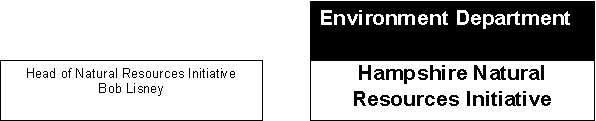
7.1.2 This Business plan is based on NRI Core Team of 6FTEs as proposed in the new Environment Department structure (see Appendix 5).
7.1.3 It is also based on a staff resource equivalent to 3 FTEs being allocated in the Waste Services Group being allocated to NRI tasks, primarily in relation to project management. A number of the tasks relate to activities already being undertaken by the Group. This staff allocation is subject to agreement with the Waste Services Group in the light of their business plan objectives.
7.1.4 Other indirect staff inputs, within the Environment Department, other County Council Departments and externally, are noted in the Action plan but not accounted for in staff resource terms. It is anticipated that such indirect inputs will be provided for in the relevant service business plans.
7.1.5 An administrative resource to support the work of the NRI Team is also not included as this will be provided on a Departmental basis. In addition to the need for a secretarial resource to the Head of Management Resources, a admin resource of 0.5 FTE has been identified to support the work of the Team and is the subject of a bid under the current Environment Department Administrative Services Review.
7.2 Management
7.2.1 The overall internal management structure for NRI is set out in Appendix 6. The arrangement for corporate leadership via the NRI Director Group is currently under review. However, it is important that any change maintains a strong corporate input into the overall direction of the initiative.
7.3 Finance
7.3.1 Set out below is the projected NRI budget in terms of expenditure and finance for the years 2003/04 and 2005/06. The analysis assumes the £150,000 budget bid for 2003/04 is successful and carried forward into 3004/05.
APPENDIX 1
Objective under Aim 2 of the Corporate Strategy in respect of natural resources, namely:
We will develop an action-orientated natural resources strategy and land use plan to:
· Minimise the use of virgin resources by promoting greater emphasis on the use of renewable and recyclable resources
· Minimise the creation of waste - reducing the amount of waste going to landfill; 33% household waste recycled by 2002/03, 40% by 2005/06
· Raise awareness in the community of the impact of lifestyles and business activity on the use of finite resources
· Ensure best practice in the County Council's own use of natural resources; and
The Public Service Agreement target for Natural Resources, namely:
· To divert an additional 40,000 tonnes per annum of household, commercial and industrial waste from landfill by 2004/05.
PSA Agreement - Freedoms and Flexibilities
· DEFRA will continue to explore with Hampshire County Council, how resources going to the Landfill Tax Credit Scheme, could be used to further the achievement of National Resource Management targets.
· DEFRA undertakes to explore with Hampshire County Council through further discussion ways in which the PFI rules can be relaxed to allow extra capital investment required in an integrated strategy to be eligible for PFI as part of an existing contract.
· DEFRA undertakes, in order to facilitate a streamlined integrated material resource, waste strategy, and land use plan for Hampshire County Council to discuss the relevant regulations, and options for a re definition of the legislation in the long term.
· As part of National Resource Management, Hampshire County Council will seek to purchase renewable energy / secondary materials, and to pump prime / stimulate sustainable industries locally. Some of this work is currently blocked by EU procurement regulations. DEFRA agrees to discuss with Hampshire County Council the scope for possible relaxations of this legislation in the long term. Hampshire County Council are aware that his may not be accomplished within the life of this LPSA.
DEFRA understand Hampshire's interest in seeking to introduce charging into their waste collection arrangements. Any decision will have to wait for the outcome of the Performance and Innovation Unit's study into the Waste Strategy 2000. Changes to existing legislation, such as the power for charging those bringing unworked waste to Civic Amenity sites, would require primary legislation. DEFRA and Hampshire County Council will continue to explore this issue through further discussions
APPENDIX 2
Hampshire Natural Resources Initiative Community Vision & Goals
The Vision
By 2012 the Hampshire community is acclaimed for its achievement through working together in conserving and using natural resources more efficiently. Our goals are to:
GOALS
Maximise the role of commerce and industry in driving forward the more efficient and cost effective use of natural resources by:
· Supporting Hampshire businesses in becoming leaders in technological innovation and harnessing new opportunities.
· Improve competitiveness by disseminating best practice and ensuring that the necessary support infrastructure is in place.
· Identifying and meeting research and development needs through stronger links with academic institutions and national programmes.
· Supporting social objectives, including the creation of new jobs in areas where they are needed.
· Support Hampshire business in understanding and acting upon the emerging environmental regulations and legislation.
Promote the concept of `consumer responsibility' by ensuring that people have the information to make informed lifestyle choices with the aim of:
· Minimising consumption of finite resources.
· Reducing rate of growth in waste and the more efficient use of water, energy, minerals and other parts of the natural resource system.
· Maximising participation to improve recycling levels.
· Encouraging `green' purchasing.
· Making `consumer responsibility' part of the education agenda and highlighting the impact of consumer decisions.
Reduce the impact of natural resource consumption on Hampshire's environment and climate change by:
· Increasing the contribution from renewable resources.
· Promote best practice in `sustainable' construction, agriculture, industrial, commercial and service operations.
· Adopting the use of `green' industrial processes and innovative waste management technologies and systems.
· Seeking to reduce the impact of transport.
· anticipating the impact of climate and other change on resource use.
Establish the public sector as examples of best practice in natural resource use by:
· Seeking to integrate sustainability into all activities and services by ensuring that natural resource efficiency considerations are central to all decisions taken and services delivered.
· Using local public policy to influence change.
· Championing `green' purchasing and sustainable construction.
· Demonstrating the viability and benefits of natural resource efficiencies.
· Maximising synergies with education programmes.
· Achieving the `triple bottom line' by linking natural resource initiatives to the achievement of social, environmental and financial objectives.
Influence change at EC/UK government levels by:
· Getting Hampshire recognised as a leader in natural resource issues.
· Actively participating through community, political and professional networks in debates at on policy development and new regulations.
· Developing an agenda for EC/UK government action that reflects the aspirations of the Hampshire community.
· Ensuring that politicians, the media and other opinion formers are briefed on the Hampshire agenda.
Appendix 4
NRI Achievements 2002
2002 was a capacity building year for NRI with the following achievements:
· HRNI network established and a NRI community vision and goals agreed by stakeholder participation
· HNRI launched at event attended by 300 people in September 2002
· HNRI website and newsletter implemented.
· NRI Trust established as a `not for profit' company with the County Council providing executive support. The Trust has secured £520,00 of landfill tax for a pilot electrical and electronic goods demanufacturing facility.
· Plan for achieving PSA target developed with a focus on five key projects (which the County Council can directly influence) to deliver target.
· Two funding bids (in partnership with Viridis) submitted under the DTI Partners in Innovation programme for an integrated R&D programme to maximise use of secondary and recycled aggregates. Bids successful at first round and full proposals to be submitted.
· Funding bid developed with a range of partners (including Southampton University, Open University) for a major study to quantify the key resource streams in commercial and industrial waste. Funding being progressed.
· Links with Business. Work in hand to refocus role of Hampshire Business Environment Forum with NRI and strengthening links with the Hampshire Economic partnership.
· Embryo regional county council NRI network established.
· Links established with SEEDA and involvement in regional market development group
· Profile of Hampshire NRI raised at EC, UK government and regional levels (presentations on NRI given to EC and LGA).
· Development and project management of the Bar End Eco Centre.
· Concept of resource park at the former Dummer Gypsy Site agreed by the County Council.
· Work with Winchester Prison and Winchester Mental health Alliance in providing support and advice to the development of a recycling centre at Winchester Prison and acting as broker in developing a project to collect cardboard from businesses in Winchester City Centre.
· Range of other external NRI projects under development or implementation. Pump-priming financial support given to a number of projects.
· Pilot demonstration project to optimise household waste recycling performance, provide recycling services to SME and undertake local market development agreed with Eastleigh Borough Council.
· Bid to the Carbon Trust initiated for financial support to developing a pilot Anaerobic Digestion Plant facility dealing with kitchen waste (25% funding offered is insufficient for project to proceed).
· Seminar held with stakeholders to discuss implications for Hampshire of implementation of End of Life Vehicle Directive. Also development of abandoned vehicle project in Gosport linked the Gosport Community Strategy.
 Appendix 5