
Archived decisions
Hampshire County Council | ||
Cabinet |
Item 4 | |
23 June 2003 | ||
Final Accounts 2002/03 | ||
Report of the County Treasurer | ||
Contact: Jon Pittam, ext 7400
1. Summary
1.1 There is a small overall saving in both service cash limited budgets and other budgets, totalling £0.2m (0.02%).
1.2 The following decisions are sought:
(i) That the variations in service cash limited spending, as set out in Table 1, be approved
(ii) That adjustments and variations on other budgets as set out in Table 4 be approved
(iii) That contributions to and from earmarked reserves be made as set out in Appendix 4 and that the draft protocol set out in Annex 2 to the appendix be approved
(iv) That the report on the County Council's treasury management activities as set out in Appendix 5 be approved
(v) That the final accounts of the Hampshire Pension Fund as set out in Appendix 6 be approved
(vi) That the final accounts of the County Council for 2002/03 be approved and submitted to the Council
(vii) That progress in implementing financial management policies as set out in Appendix 7 be noted
(viii) That £0.2m be added to the Leader's grants budget from balances
(ix) That the following recommendations on the financing of capital expenditure, as set out in Appendix 8, be approved:
a) That capital payments for the year be financed as set out in Table 2 of Appendix 8
b) That approval be given for the additional capital schemes contained in Table 2 of Annex 2 to Appendix 8 to be carried forward to 2003/04
c) That it be determined that:
(i) £9,816,592 of expenditure reimbursed by developers and outside agencies be capitalised
(ii) a transfer of £1,934,453 credit approval from Hampshire Fire and Rescue Authority be accepted in 2002/03 and returned in 2003/04
(iii) a transfer of credit approval from Portsmouth City Council be accepted in 2002/03 if the City Council establish they wish to do so and returned in 2003/04. The amount to be reported to Cabinet
(iv) £19,347,696 capital receipts be used to meet capital expenditure in 2002/03
(v) £14,964,124 (including £2,383,932 reimbursed by other authorities in respect of deemed debt) be set aside as provision for credit liabilities from the revenue account to avoid new loans authorised by credit approvals
(cdc) That services' capital programme cash limits for 2003/04 be increased by the sums shown in:
(i) column 6 of Table 1 of Annex 1 to Appendix 8 (to reflect the carry forward of capital schemes and of the balance of cash limits from 2002/03)
(ii) column 3 of Table 5 of annex 3 to Appendix 8 (to reflect services' share of capital receipts).
2. Reason
2.1 To enable the Cabinet to review the 2002/03 final accounts, prior to their submission to the County Council for approval.
3. Other options considered and rejected
3.1 Not applicable.
4. Conflicts of interest declared by the decision maker or a member or officer consulted
4.1 Not applicable.
5. Dispensation granted by the Standards Committee
5.1 Not applicable.
6. Reason for the matter being dealt with if urgent
6.1 Not applicable.
Approved by: Date:
Councillor T K Thornber
Hampshire County Council | ||
Cabinet |
Item 4 | |
23 June 2003 | ||
Final Accounts 2002/03 | ||
Report of the County Treasurer | ||
Contact: Jon Pittam, ext 7400
1. Introduction
1.1 Service cash-limited spending in 2002/03 is very close to the cash limit as predicted in the last monitoring report in April, with a net underspend of £181,000 (0.02%).
1.2 Despite the pressures during the year, Social Services spending has been contained within the cash limit, by just £72,000 (0.03%).
1.3 An overspend of £256,000 has been incurred on Environment mainly because costs of storage and disposal of fridges exceeded the additional grant received from the Government by £327,000 and savings from lower waste volumes and from other budgets were insufficient to compensate fully
1.4 As anticipated in the previous monitoring report spending on Policy and Resources was £331,000 below the cash limit (-1.0%), mainly because of lower spending on community planning grants, from the repair and maintenance of buildings winter contingency and on best value and public consultation budgets.
1.5 Net savings of £346,000 have been achieved on other budgets:
· from higher interest on balances and from savings on business rates as anticipated
· partly offset by higher spending on winter maintenance
· the Hampshire Fire and Rescue Authority's (HFRA) final levy is expected to be significantly lower than predicted
· a lower than anticipated requirement to provide corporate support for Milestones Museum and for Dibden Bay inquiry costs
· because of provision for a large public liability claim as anticipated, it has been necessary to increase the insurance provision by £1,390,000. The Chief Executive will be reporting further on insurance claims and overall risk management to a future meeting of Cabinet.
1.6 If Education, Policy and Resources, Recreation and Heritage and Social Services retain 50% of their underspendings, in accordance with the County Council's financial management policy, the effect will be to add £308,000 to balances at 31 March 2003. Final decisions on the carry forward of under and overspendings can be made by Cabinet when Executive members have considered their service final accounts reports.
1.7 Earmarked reserves at 31 March 2003 have fallen by £10.8m compared with those at 31 March 2002, mainly as a result of the planned use of capital reserves in 2002/03. School reserves are also slightly lower than at 31 March 2002.
1.8 Figures may still be subject to some further changes before the statement of accounts is approved, in particular if there are any significant changes in credit approvals. The accounts of the Pension Fund will be reported to the County Council in July and the full statement of accounts in September.
2. Service cash limit
2.1 There is a small net underspending of £181,000 (0.02%) in 2002/03 as anticipated in April's monitoring report. Variations in service spending against the cash limits reported in February, April and now are as follows:
Table 1 - 2002/03 estimated outturn
February 2003 |
April 2003 (monitoring report) |
June 2003 outturn | |
£'000 |
£'000 |
£'000 | |
Education |
-1,284 |
- |
-16 |
Environment |
390 |
-22 |
256 |
Policy and Resources |
- |
-240 |
-331 |
Recreation and Heritage |
480 |
59 |
-18 |
Social Services |
* |
* |
-72 |
-414 |
-203 |
-181 |
Note: In February 2003, it was agreed to carry forward Education's planned underspending into the 2003/04 and 2004/05 budgets and subject to the final outturn to set the projected overspendings on Environment and Recreation and Heritage services against the addition to balances in the 2002/03 budget.
· Social Services had identified spending pressures during the course of the year, and the Cabinet agreed in December to establish a reserve of £2m to assist in reducing delayed hospital discharges.
2.2 Variations compared with the 2001/02 outturn and from revised cash limits (as set out in Appendix 1) are as follows:
Table 2 - 2002/03 outturn - variations
2001/02 outturn variation |
2002/03 cash limit |
2002/03 outturn variation | ||
£'000 |
£'000 |
£'000 |
% | |
-60 |
Education |
582, 796 |
-16 |
0.00 |
-35 |
Environment |
77,886 |
256 |
0.33 |
40 |
Policy and Resources |
32,971 |
-331 |
-1.00 |
593 |
Recreation and Heritage |
26,164 |
-18 |
-0.07 |
-295 |
Social Services |
210,364 |
-72 |
-0.03 |
243 |
930,181 |
-181 |
-0.02 | |
2.3 Overall this is another extremely close result, following that in 2001/02. Comparative figures for previous years are:
Table 3 - Trends in service spending
£m |
% | |
1997/98 |
-1.6 |
-0.3 |
1998/99 |
-0.5 |
-0.1 |
1999/00 |
0.5 |
0.1 |
2000/01 |
1.4 |
0.2 |
2001/02 |
0.2 |
0.03 |
2002/03 |
-0.2 |
-0.02 |
Policy on carry forward of under and overspendings.
2.4 As the County Council has small balances, services are expected to carry forward overspendings to the following financial year. However when the 2002/03 budget was set, one of the specific uncertainties underlying the decision to budget for an increase in balances concerned the funding for the storage and disposal of refrigerators. New regulations had been introduced on 1 January 2002, but the Government made no decision about the allocation of additional resources to local authorities until the end of 2002. When the Cabinet considered the revised budget in February, it was anticipated that the additional grant of £843,000 allocated to the County Council for the disposal of refrigerators would be inadequate to cover the additional costs incurred in 2002/03 by about £400,000. However it was also assumed that the additional cost might be containable within the waste management contingency as a result of lower growth in waste volumes. The additional costs have amounted to £327,000, but these have only been partially offset by lower increases in other aspects of the waste management contract or from savings on other Environment budgets, resulting in an overall overspending of £256,000. In the circumstances, the Cabinet may wish to allow this overspending to be written off rather than carried forward within the Environment service.
2.5 The County Council's policy allows for the carry forward of 100% of planned underspendings identified specifically at the time of, or prior, to service budgets for the following year being prepared in January. Education has carried forward £1,284,000 for use in supporting the non-schools element of the Education budget in 2003/04 and 2004/05.
2.6 The policy on the remaining (unplanned) underspendings is to return 50% to the service and consider the use of the balance for corporate purposes. Retention of 50% of service underspendings (£218,000) would meet the majority of the cost of writing off the Environment overspending relating to the disposal of refrigerators. Social Services' underspending arises after the allocation of substantial additional funding of £2m for delayed hospital discharges during the course of the year.
2.7 However as most Executive members have yet to consider their service outturn reports and as the sums involved do not necessitate an urgent decision it would be possible to defer a decision on whether to depart from the policy of only allowing 50% carry forward of unplanned underspendings until after these reports have been considered.
Education (-£16,000)
2.8 A small underspending of £16,000 confirms the previous budget monitoring forecasts indicating that expenditure was likely to be very close to the cash limit.
Environment (£256,000)
2.9 The overspending of £327,000 on the disposal of refrigerators referred to in paragraph 2.4 and an overspending of £80,000 in highway maintenance were partly offset by a saving of £104,000 on highways management and support services together with other savings of £47,000.
Policy and Resources (-£331,000)
2.10 As anticipated, there are savings on community planning grants (£117,000) due to slower progress being made in developing district community strategies than had originally been envisaged. The full amount of the winter contingency within the repair and maintenance of buildings budget was also not taken up, resulting in an underspending of £79,000. These and other factors resulted in an underspending of £331,000 against Policy and Resources budget, marginally higher than the £240,000 forecast in the April monitoring report.
Recreation and Heritage (-18,000)
2.11 When the revised budget was approved allowance was made against the budgeted increase in balances to write-off the Milestones Museum deficit of £324,000 in 2001/02 and a projected deficit of £156,000 in 2002/03, subject to an anticipated 50% contribution from Basingstoke and Deane Borough Council. The outturn position is more favourable than forecast with the projected deficit in 2002/03 being limited to £135,000. Basingstoke and Deane Borough Council are expected to make an immediate contribution towards £50% of the cumulative deficit (£115,000) and thus the requirement for corporate support for Milestones Museum is £136,000 lower than allowed for in the revised budget. Savings of £18,000 have been achieved on other budgets.
Social Services (-£72,000)
2.12 Management action to deal with spending pressures have succeeded in achieving a Social Services outturn just within the cash limit. This is on the basis of an allocation of £1,050,000 from the delayed hospital discharges reserve to pay for specific care packages for clients vacating acute hospital beds. This leaves the balance of £950,000 to support continuing action in 2003/04. Its use is intended to maintain improved performance in avoiding delayed discharges before the introduction of fines payable to the NHS from 1 January 2004.
Cash limit adjustments
2.13 Appendix 1 shows the adjustments made to cash limits since the original budget for 2002/03 and Appendix 2 shows the variations from those approved cash limits for each service. The Education cash limit for 2002/03 has been increased by £304,000 as a result of a problem in apportioning supply teacher national insurance costs between different schools when the new SAP payroll was introduced. The problem was only completely resolved after the end of the year and will require some of the apportionments to be made to individual schools in 2003/04. A compensating cash limit adjustment will occur in 2003/04 providing all costs can be apportioned to specific schools.
3. Other budgets
3.1 The overall underspend on other budgets is just over £0.3m compared with the sum previously projected of £0.8m. A full analysis of the variations on other budgets is contained in Appendix 3.
Hampshire Fire and Rescue Authority (HFRA) levy (-£671,000)
3.2 The HFRA is yet to report on spending in 2002/03 but according to the HFRA Treasurer the outturn is expected to be £842,000 lower than the original budget, which would, in accordance with established practice, translate into a reduction of £671,000 in the levy on the County Council. £292,000 of the HFRA saving is the result of lower pension costs which are unpredictable due to the impact on lump sum payments of the decisions of individual officers on when to retire. For this reason pension payments have been ring-fenced within the HFRA levy. Savings are also anticipated in retained firefighters and non-uniformed pay costs and in other operational budgets, including additional income.
3.3 When the HFRA set its budget for 2003/04 it gave notice that 2003/04 levies might be increased to reflect any underspend achieved by the Authority in 2002/03. The Fire Authority's decision on by how much to increase the levy will not be taken until this is considered by the Finance and General Purposes Committee on 10 July. However, it can be expected, for example, that an increase will be needed to meet the eventual cost of implementing the firefighters' pay awards for November 2002 and 2003, so far as any costs above budgeted assumptions are not covered by transitional funding or savings realisable in 2003/04. The 16% phased pay offer made by the employer includes an increase of 7% from November 2003. This will add over £300,000 to the budgeted pay cost increase of 4% in 2003/04. This would therefore need to be a first priority in any revision of the Fire budget in 2003/04, together with any slippage in pensions costs budgeted for 2002/03.
Capital financing charges (-£78,000) and interest on revenue balances
(-£880,000)
3.4 Base rate fell to 3.75% in February and mainly as a result of this change the average rate of interest payable on loans for capital financing purposes fell from 5.32% in the revised budget to 5.29%, resulting in a small reduction in interest costs. Extra interest on balances as a result of favourable cash flow trends amounted to £880,000, so that the overall saving in capital financing costs and interest on revenue balances is in line with the £1m forecast in April.
Winter maintenance (+£308,000)
3.5 An overspending of around £220,000 had been predicted, but the final outcome was higher at £308,000.
Insurance (+£1,390,000)
3.6 The contribution to or from the insurance provision is based upon the value of claims paid in the year and the assessed value of outstanding liabilities for the year. As a result of higher levels of fire reinstatement and one large outstanding public liability claim, an increase of £1,390,000 is required.
3.7 The insurance reserve currently stands at £5.0m but as the cost of outstanding fire reinstatement currently exceeds £6m it is not recommended that the increase in insurance provision should be funded by a transfer from the insurance reserve.
Revenue contributions to capital
3.8 As explained in Appendix 8, 2002/03 capital spending and financing after allowing for borrowing, grants and contributions, revenue contributions to capital are required at the budgeted level of £27.0m together with further revenue contributions of £20.0m funded from the capital reserve.
Summary - other budgets
3.9 These variations can be summarised as follows:
Table 4 - Summary of variations on other budgets
£000 | |
Fire levy |
-671 |
Dibden Bay and Milestones Museum |
-176 |
Business rates |
-163 |
Capital financing charges |
-78 |
Interest on balances |
-880 |
Provision for doubtful debts |
-81 |
Winter maintenance |
308 |
Insurance provision |
1,390 |
Revenue contributions to capital |
- |
Other variations |
5 |
-346 |
3.10 Assuming that, although no final decision has been made, only 50% of service underspendings are carried forward, the overall position is as follows:
Table 5 - 2002/03 outturn
£000 |
£000 | ||
Service underspending (Table 1) |
-181 | ||
Other budgets (Table 4) |
-346 | ||
Earmarking of 50% of service underspends |
219 | ||
Potential increase in balances |
308 | ||
3.11 It is suggested that £200,000 of this increase be added to supplement the Leader's grants budget on a one-off basis during 2003/04, leaving an increase of £108,000 in balances at 31 March 2004.
4. Balances
4.1 The addition of £108,000 to general balances has the following impact:
Table 6 - Balances
£m | ||
Estimated balances at 31 March 2003 |
7.9 | |
Adjustment for unapportioned national insurance |
-0.3 | |
Addition to balances on closing 2002/03 accounts |
0.3 | |
Balances at 31 March 2003 |
7.9 | |
Reversal of unapportioned national insurance adjustment |
0.3 | |
Addition to Leader's grant budget |
-0.2 | |
Possible use during 2003/04 for firefighters' pay award and other pressures during the year, or for one-off budget support in 2004/05 |
-1.7 | |
Projected balances at 31 March 2004 |
6.3 |
5. Earmarked reserves
5.1 Earmarked reserves have reduced to £58.0m at 31 March 2003, which is £5.0m more than assumed when the budget was reviewed but £10.8m less than the reserves at the start of the year.
5.2 Variations in earmarked reserves are summarised below:
Table 7 - Earmarked reserves
2002 £m |
2003 £m | |
Schools |
31.0 |
28.3 |
Capital |
23.7 |
6.3 |
Service designated underspendings |
2.3 |
3.1 |
Invest to Save |
0.1 |
0.2 |
Insurance |
5.0 |
5.0 |
On-street parking |
4.6 |
4.2 |
Trading accounts |
1.6 |
2.3 |
Job evaluation transitional costs |
- |
2.0 |
Delayed hospital discharges |
- |
1.0 |
Grant equalisation |
- |
5.2 |
Other |
0.5 |
0.4 |
68.8 |
58.0 |
5.3 Details of movements in reserves during 2002/03 and of the protocol for each of the main classes of reserves are set out in Appendix 4.
6. Treasury management
6.1 The County Council's treasury management policy requires an annual report to the Cabinet on the exercise of the treasury management function. Details are set out in Appendix 5.
7. Pension Fund accounts
7.1 The separate accounts for the Hampshire Pension fund are also submitted for approval as Appendix 6.
8. Financial management policy
8.1 The County Council's financial management policy forms the basis of the County Council's medium-term financial strategy. Appendix 7 highlights the progress made in 2002/03 in implementing the policies.
9. Capital payments and financing
9.1 Appendix 8 sets out the details of capital financing for the year for approval.
10. Conclusions
10.1 This is a very close outcome (within 0.03% of total budget) for a difficult year. Prudent action was taken in setting the 2002/03 budget, and during the year, to deal with the risks inherent from additional pressures and liabilities. Executive members and budget holders, as well as all financial staff, deserve thanks for their efforts in balancing budgets and delivering excellent services during 2002/03.
10.2 The recommendations are contained on the summary decision sheet.
Section 100 D - Local Government Act 1972 - background papers
The following documents disclose facts or matters on which this report, or an important part of it, is based and has been relied upon to a material extent in the preparation of this report.
NB the list excludes:
Published works.
Documents which disclose exempt or confidential information as defined in the Act.
TITLE FILE
None
Hampshire County Council | ||
Cabinet |
Item 4 | |
23 June 2003 | ||
Final Accounts 2002/03 - supplementary report | ||
Report of the County Treasurer | ||
Contact: Jon Pittam, ext 7400
1. Summary
1.1 The Cabinet will recall that the final accounts are being reported a month earlier than normal as a first step towards earlier production of the statement of accounts and its approval by the County Council.
1.2 There are two material changes that need to be made to the published report. A new summary decision sheet is attached for approval.
1.3 There may be some minor final changes before the statement of accounts for 2002/03 is considered by the County Council in September, and any such changes will be fully reconciled and reported at that stage.
2. Changes required now
2.1 The Hampshire Fire and Rescue Authority (HFRA) is yet to consider its report on the 2002/03 accounts. It is understood that a decision by the HFRA to dismiss four firefighters has been overturned on appeal. The Authority will need to reinstate those firefighters and four year's back pay now becomes due in the 2002/03 accounts. The estimated cost is £187,000, reducing the County Council's share of the underspending on the Fire levy in 2002/03 by £149,000. This in turn reduces the County Council's overall underspend to £159,000.
2.2 Another technical adjustment is required between years for schools budgets. Final reconciliations show that teachers' pensions contributions were understated by £188,000 in April 2002 when the contribution rate increased from 7.4% to 8.35%. This will be accounted for in 2002/03 in the same way as the unapportioned national insurance (paragraph 2.13) as the charge must be reflected in individual school accounts. There will be the same neutral effect on balances at 31 March 2004.
2.3 These changes will have an impact on figures throughout the report and appendices. A copy of the amended pages will be made available with the minutes.
Summary of Appendices
Appendix Number |
Contents |
Colour |
1 |
Adjustment to service cash limits 2002/03 |
Green |
2 |
Major variations in service cash limited expenditure |
Pink |
3 |
Expenditure outside service cash limits |
White |
4 |
Earmarked reserves at 31 March 2003 |
Mauve |
5 |
Treasury management activities |
Salmon |
6 |
Hampshire Pension Fund 2002/03 Final accounts |
Yellow |
7 |
Financial management policies |
White |
8 |
2002/03 capital spending and financing |
Blue |
Appendix 1
Adjustments to service cash limits 2002/03
Appendix 2a
Education
Revenue Expenditure 2002/03
Major variations in cash limited expenditure - underspending of £16,000
Budget Heading |
Variation £'000 |
Adjusted Revised Budget £'000 |
Reason |
Strategic management of schools |
50 |
6,304 |
The most significant overspendings occurred on the LM contingency (£54,000), insurance (£23,000) and trade union and public duties (£34,000), offset by an underspending on premature retirements (-£60,000) |
Specific grants |
15 |
17,134 |
Additional costs re: Ethnic Minority Achievement |
Education otherwise than at school |
150 |
5492 |
The overspending resulted from additional costs of excluded pupils (£108,000) and extra staffing for the Portage Service (£40,000) |
Mainstream statements/out-county placements |
-50 |
10,695 |
Underspending on out-county placements |
Other access |
18 |
18,017 |
The main overspending arose on home to school transport (£42,000) offset by underspendings on pupil support (-£24,000) |
Non-local schools budget |
-51 |
827 |
Net underspending on inter-authority recoupment |
Nursery education |
-24 |
16,640 |
Claims from private and voluntary providers less than grant allocation |
Other continuing education |
-47 |
948 |
Increased share of profits from Careers Service partnership |
Services to schools and support |
-63 |
23,871 |
Mainly due to delays in replacing outdated ICT systems and inability to recruit staff. |
Appendix 2b
Environment
Revenue Expenditure 2002/03
Major variations in cash limited expenditure - overspending of £256,000
Budget Heading |
Variation |
Adjusted Revised Budget |
Reason |
£'000 |
£'000 |
||
Highways and Transportation |
|||
Highways maintenance - county roads and bridges |
80 |
17,167 |
Additional expenditure on emergency works following flooding (+£30,000), street lighting maintenance and column replacements (+£40,000), and other routine maintenance works (+£10,000). |
School crossing patrols |
2 |
945 |
Additional expenditure on infrastructure maintenance and site improvements. |
Public transport |
-4 |
5,095 |
Lower expenditure on public transport bus subsidies. |
Management and support services |
-104 |
14,799 |
Underspending on staff salaries |
Planning Services |
- |
4,540 |
Higher expenditure on environmental initiatives (+£126,000) and community development and other projects (+£4,000), offset by savings on planning policy (-£120,000), development control (-£5,000) and economic development |
Waste management |
|||
Contract related services |
315 |
31,421 |
Excess expenditure on storage and disposal of refrigeration equipment (+£327,000), partially offset by savings on other contract related services |
Other waste management services |
-22 |
2,226 |
Lower expenditure on disposal of abandoned vehicles (-£29,000), savings in administration |
Other services |
|||
Reservoirs Act 1975 |
-10 |
23 |
Lower expenditure in connection with the inspection of reservoirs. |
Appendix 2c
Policy and Resources |
Revenue Expenditure 2002/03 |
Major Variations in Cash Limited Expenditure - underspending of £331,000 |
Budget Heading |
Variation |
Adjusted |
Reason | |
Revised |
||||
Budget |
||||
£'000 |
£'000 |
|||
Performance Indicators |
-23 |
23 |
There is no longer a requirement to publish PI's in newspapers. It is intended to use the budget to improve the collection of PI information following the `reserved' opinion by the District Auditor on the BVPP. | |
Community Planning |
-117 |
270 |
Expenditure has been delayed pending agreement on the basis of allocation of this budget. | |
Emergency Planning |
-22 |
327 |
Improvements to Emergency Planning Centre were delayed due to work arising from the Gulf Conflict. | |
"Hampshire Now" and "Spotlight" |
-27 |
356 |
Mainly due to one-off income generated from adverts and inserts. | |
Best Value |
-40 |
227 |
Underspend due to delays on a number of consultancy projects due to range of factors, e.g. provision of detailed census information. | |
Support Services - Personnel and Training |
-33 |
2,204 |
The costs of resourcing the SAP HR phase II team were allowed for in the Personnel and Training revised budget, which was £27,000 over the services' cash limit. Savings of £33,000 were achieved due to a combination of vacancy management and achieving increased income targets, producing a saving of £6,000 against originally planned spending. | |
Support Services - County Treasurer |
-68 |
3,129 |
The underspend is due to management action reducing the anticipated £93,000 overspend regarding the Enterprise Project implementation, included in the revised budget, to £25,000. | |
Support Services - Office Accommodation |
+73 |
3,911 |
Office accommodation is overspent as a result of rent increases on leased properties, the impact of which is partially offset by savings elsewhere within the budget. | |
Support Services - Repair and Maintenance of buildings |
-79 |
3,503 |
This underspending arose as the winter contingency was not fully utilized. |
Appendix 2d
Recreation and Heritage
Revenue Expenditure 2002/03
Major variations in cash limited expenditure - underspending of £18,000
Budget Heading |
Variation |
Adjusted Revised Budget |
Reason |
£'000 |
£'000 |
||
Museums and Archives |
|||
Acquisitions |
-13 |
42 |
Reduced spending on acquisitions |
Libraries and Information Service |
|||
Supplies and services |
64 |
3,730 |
Higher than anticipated costs arising from the People's Network programme |
Fees and charges |
-70 |
-1,649 |
Higher income particularly from the extension of video/DVD lending service to more libraries |
Countryside |
|||
Premises related expenditure |
66 |
427 |
Additional spending particularly on site maintenance met from increased income |
Other hired and contracted services |
158 |
197 |
Extra spending across sites met from increased income |
Income |
-248 |
-904 |
Extra contributions from outside bodies particularly Countryside Agency and additional earned income across sites |
Arts, Sport and Community |
|||
Premises related expenditure |
9 |
111 |
Extra spending across centres met from increased income |
Income |
-16 |
-962 |
Extra income across centres |
Calshot |
|||
Supplies and services |
107 |
452 |
Extra spending on courses, equipment and materials |
Fees and charges |
-111 |
-1,465 |
Income from higher usage and extra courses |
Policy Development fund |
-14 |
486 |
Planned underspend to meet additional spending on Director and Business Development |
Director and Business Development |
17 |
237 |
Set up costs of new department |
Appendix 2e
Social Services
Revenue Expenditure 2002/03
Major variations in cash limited expenditure - underspending of £72,000
Budget Heading |
Variation |
Adjusted Revised Budget |
Reason |
£'000 |
£'000 |
||
Assessment & Care Management / Social Work |
-1,045 |
28,011 |
The main reason for underspend is the recruitment and retention difficulties, particularly in areas of the Children and Families Service |
Support Services & Management Costs |
-1,865 |
26,354 |
Support Services & Management costs were set an underspend target to offset known pressures in other sectors of the department. This was met by partial utilisation only of the budget for relocation costs (£300,000), holding vacancies in administrative posts and tighter management on non-pay expenses (£700,000), lower than planned spend on training (£380,000) and associated backfill arrangements (£70,000). |
Children & Families |
4,300 |
26,617 |
Main pressures relate to purchasing of external residential placements (£2.9m), of which £1.9m relates to Non County Placements and £1m to Independent Fostering Agencies (IFA). In-house fostering overspent by £1.1m due to an increase in the number of placements made of 65 during the year. |
Older People (Aged 65 or Over) including Older Mentally Ill |
651 |
71,406 |
The main area of overspend was on purchased services. The trend for more dependent, and therefore more expensive care continued in 2002/03, with an increase of over 9% of clients in nursing care (excluding Preserved Rights) |
Adults under 65 years with Physical or Sensory Disability |
-424 |
14,821 |
There were underspends on domiciliary and day care, where opportunities were maximised for obtaining transitional housing benefit and accessing the Independent Living Fund. |
Mental Health |
-311 |
526 |
Underspends have occurred primarily due to staff vacancies in day care. Maximum use of government grants was made. |
Other Adults |
-230 |
1188 |
Some spend has been diverted into other adult services (above). Budgets for 2003/04 have been amended in line with this. |
Supported Employment |
-138 |
935 | |
Asylum Seekers |
152 |
378 |
The main overspend was on children's services where the government grant was insufficient to cover the costs incurred. |
Unallocated Grants |
-1,047 |
1,047 |
At the revised budget stage there were significant grant balances unallocated pending further information. All such funding was allocated to client groups through the remainder of the year. |
Appendix 3
Expenditure outside service cash limits
3. Expenditure outside service cash limits
3.1 Table 1 below provides a detailed schedule of the variations on budgets outside service cash limits, which is summarised in Table 4 of the report.
Table 1
Revised budget |
Actual |
Variation | |
£'000 |
£'000 |
£'000 | |
Hampshire Fire and Rescue Authority (HFRA) levy |
38,940 |
38,269 |
-671 |
Contingency for Dibden Bay and Milestones Museum costs |
176 |
- |
-176 |
Capital financing charges |
28,241 |
28,163 |
-78 |
Interest on balances |
-3,099 |
-3,979 |
-880 |
Revenue contributions to capital |
27,004 |
27,004 |
- |
Insurance provision |
- |
1,390 |
1,390 |
Business rates |
163 |
- |
-163 |
Magistrates' Courts Committee |
9,502 |
9,519 |
17 |
Transfer from Magistrates' Courts reserve |
-19 |
-21 |
-2 |
Highways winter maintenance |
1,716 |
2,024 |
308 |
Flood protection levies |
5,429 |
5,429 |
- |
Mandatory awards to students |
2,457 |
2,464 |
7 |
Doubtful debt provision |
-300 |
-381 |
-81 |
Specific grants |
-126,507 |
-126,531 |
-24 |
Revenue Support Grant |
-237,616 |
-237,609 |
7 |
-253,913 |
-254,259 |
-346 |
Details of the variations are as follows:
HFRA Levy
3.2 The HFRA levy for 2002/03 is £38.940m and though a final levy for 2002/03 has yet to be reported it is expected to be £671,000 lower than budgeted which represents a savings of £842,000 against the overall budget for the HFRA. Savings have arisen as a result of lower pension costs of £292,000, which are ring fenced, but also as a result of lower spending on retained firefighters, non-uniformed pay and other operational costs. Income is also higher than estimated.
Contingency Provision (-£176,000)
3.3 A contingency provision of £2.069m was included in the revised budget for waste management contract costs which has been fully allocated to the Environment service but allocations agreed earlier in the year for the Dibden Bay inquiry and to support Milestones Museum have not been required in full, leaving a balance of £176,000 unallocated. Table 2 summarises the position:
Table 2
Revised budget |
Subsequent allocations |
Balance of contingency | |
£'000 |
£'000 |
£'000 | |
Waste management contract |
2,069 |
-2,069 |
- |
Milestones Museum |
- |
136 |
136 |
Dibden Bay inquiry |
- |
40 |
40 |
2,069 |
-1,893 |
176 |
Capital financing charges (-£78,000)
3.4 The savings of £78,000 against the revised budget are summarised in Table 3 below:
Table 3 |
Revised budget |
Actual |
Variation |
£'000 |
£'000 |
£'000 | |
Capital charges in service budgets |
162,975 |
162,079 |
-896 |
Asset management account and provision for dept repayment |
|||
Loan repayments |
|||
- principal |
12,547 |
12,551 |
4 |
- interest |
15,867 |
15,784 |
-83 |
Capital Charges |
|||
- to services |
-162,975 |
162,079 |
896 |
- to trading accounts |
-308 |
-376 |
-68 |
Earmarking of trading account capital charges to finance replacement of capital assets |
135 |
204 |
69 |
Capital financing charges |
28,241 |
28,163 |
-78 |
3.5 Base rate fell to 3.75% in February 2003, and mainly as a result, interest payable on loans for capital financing purposes was lower at 5.29% than the 5.32% assumed in the revised budget, resulting in lower interest costs of £83,000. This was the main reason for capital financing costs being lower than in the revised budget.
Interest on revenue balances (-£880,000)
3.6 Higher interest on balances is mainly a reflection of the extent to which internal resources were higher than anticipated. These internal resources are derived mainly from balances, earmarked reserves, provisions and deposit, together with the excess of creditors over debtors. These are difficult to forecast with precision, but a saving of around £1m had been anticipated in the April budget monitoring report and the final position was fairly close to this prediction.
Revenue contributions to capital (-)
3.7 The revised capital financing plan for 2002/03 required the use of revenue contributions to capital of £27.0m and a contribution of £17.5m from the capital reserve. Appendix 8 summarises the capital financing position in 2002/03 and identifies that all of the budgeted revenue contributions will be required to finance capital payments in 2002/03, together with a further £0.1m from the capital reserve.
Insurance provision (£1,390,000)
3.8 The assessed value of outstanding liability claims was £2.1m higher at 31 March 2003 than at the end of the previous year, but claims paid in the year were £0.7m lower than premiums, resulting in a £1.4m charge to the revenue account. The figures are summarised in Table 4 below:
Table 4
Buildings |
Liabilities |
Total | |
£'000 |
£'000 |
£'000 | |
Provision at 1 April 2002 |
- |
7,969 |
7,969 |
Premiums for 2002/03 |
1,905 |
3,724 |
5,679 |
Payments charged to provision |
-3,127 |
-1,887 |
-5,014 |
Outstanding provision at 31 March 2003 |
-1,222 |
9,856 |
8,634 |
Outstanding liabilities at 31 March 2003 |
- |
10,024 |
10,024 |
Variation in provision required |
1222 |
168 |
1,390 |
3.9 Though in accounting terms, there are no liabilities for which a provision is required in the accounts in respect of damage to the County Council's buildings, there are nonetheless substantial known commitments to be met in 2003/04 mainly arising from fires occurring in 2002/03, totalling over £6m. It is therefore recommended that the insurance reserve should be retained at its current level of £5.0m despite the increase in the insurance provision and the level of premiums for fire, flood and storm damage to buildings will need to be reviewed in advance of 2004/05's budget.
Business rates (-£163,000)
3.10 Business rate savings of £163,000 against the revised budget arose mainly as a result of successful appeals against school rating valuations.
Magistrates' Courts Committee (£17,000 but matched by increased Government Grant of £15,000 and an additional reserve transfer of £2,000)
3.11 The Magistrates' Courts Committee sets its revised budget for 2002/03 on the basis that it would carry forward a saving of £210,000 against its cash limit set by the Lord Chancellor's Department. The saving was in fact £19,000 lower at £191,000 an increase of £17,000 after allowing for the contributions from Southampton, Portsmouth and Isle of Wight unitary authorities. The impact upon the County Council's position in 2002/03 is neutral however after allowing for additional Government grant of £15,000 and an adjustment of £2,000 to the reserve transfer.
Highway winter maintenance (£308,000)
3.12 The County Council's policy is to budget for winter maintenance on the basis of average spending at current prices in the previous four years, with any under/overspending at the year end being outside service cash limits. Winter maintenance expenditure in 2002/03 totalled £2,024,000, £308,000 above the revised budget. During the winter two periods of snowfall occurred during January 2003 and salting operations were carried out on approximately 60 days, which was slightly above the average number allowed for in the budget.
Mandatory awards to students (£7,000)
3.13 The County Council is responsible for paying awards to disabled students towards their special needs, which they receive in addition to student loans. The awards are 100% grant-aided, but the County Council is responsible for the cost of any unrecovered grant overpayments.
Doubtful debt provision (-£81,000)
3.14 The County Council's policy is to make a provision against a proportion of debts which are more than one year old proving to be irrecoverable. Previously a specific provision had been made for doubtful Social Services debts, but as from 2002/03 these are allowed for in the general provision, adopting a consistent set of criteria. The overall provision at 31 March 2003 is £1,016,000 which is £381,000 less than the combined provision at 31 March 2002. A reduction of £300,000 had been anticipated in the revised budget, so that the saving against the revised budget amounts to £81,000.
Specific grants (-£24,000)
3.15 The additional grants comprise:
Table 5
Education - European Social Fund milk rebate |
-9,000 |
Magistrates' courts - higher grant due to reduced underspending (see paragraph 1.11 above) |
-15,000 |
-24,000 |
Revenue Support Grant (£7,000)
3.16 Revenue Support Grant is usually fixed for the year at the time of the Revenue Support Grant Settlement. However where errors have been made in the distribution of grant and brought to the government's attention but not corrected in the settlement, which have a significant effect on one or more local authorities, the Government has been prepared to amend the original grant settlement. This has occurred in 2001/02 as a result of errors in Haringey, Watford and Hertfordshire's SSA, which were understated in total by £265,000. All other local authorities incur a small reduction in Revenue Support Grant, amounting to £7,000 for the County Council.
Appendix 4
Earmarked reserves at 31 March 2003
Annex 1 - Appendix 4
Notes to summary of earmarked reserves at 31 March 2003
1. Schools reserve
In aggregate schools incurred expenditure of £2,622,000 more then their delegated budgets reducing the reserve to £28,332,000 at the end of the year. The table below summarises the position over categories of school.
Schools general reserve
Variation in the year |
Balance at 31 March | ||
£'000 |
£'000 |
% of budget | |
Nursery |
-1 |
82 |
10.7 |
Primary |
-1,474 |
16,495 |
6.8 |
Secondary |
-821 |
10,022 |
4.6 |
Special |
-326 |
1,733 |
7.2 |
-2,622 |
28,332 |
5.8 | |
The average level of school reserves has fallen as a proportion of budget from 6.9% to 5.8% during 2002/03.
2. Capital reserve - credit approval transfer
Commitments to transfer credit approvals to other local authorities in 2003/04 or subsequent years are as follows:
Portsmouth City Council |
HFRA |
Total | |
£'000 |
£'000 |
£'000 | |
Commitments outstanding at 1 April 2002 |
1,500 |
703 |
2,203 |
Transfers during 2002/03 |
-1,500 |
1,231 |
-269 |
Commitments outstanding at 31 March 2003 |
- |
1,934 |
1,934 |
3. Designated underspending
The table below summarises the movements in the reserve balance during 2002/03:
Balance 1.4.02 |
Variations arising from |
Balance 31.3.03 | ||||
2002/03 Budget |
2001/02 Final Accounts |
2002/03 Revised Budget |
2002/03 Final Accounts |
|||
£'000 |
£'000 |
£'000 |
£'000 |
£'000 |
£'000 | |
Education |
681 |
-651 |
-30 |
1,284 |
8 |
1,292 |
Environment |
660 |
-642 |
-18 |
- |
- |
- |
Policy and Resources |
- |
- |
- |
- |
166 |
166 |
Recreation and Heritage |
- |
- |
- |
- |
9 |
9 |
Social Services |
148 |
- |
-148 |
- |
36 |
36 |
Magistrates'Courts |
48 |
-24 |
-24 |
29 |
-2 |
27 |
Matched Standards Fund Contribution |
777 |
- |
-777 |
- |
1,335 |
1,335 |
Sickness/Maternity Leave buy-back |
- |
- |
- |
- |
54 |
54 |
School meals buy-back |
- |
- |
- |
- |
169 |
169 |
Total |
2,314 |
-1,317 |
-997 |
1,313 |
1,775 |
3,088 |
4. Invest to save
The table below summarises the movements in the reserve balance during 2002/03:
£'000 | |
Balance at 1 April 2002 |
101 |
Financing of additional staffing to support generation of capital receipts and business rate appeals |
-265 |
Repayments in respect of |
|
Funding of IT2000 infrastructure |
350 |
Capital receipt generation |
190 |
Business rates |
138 |
Financing of Enterprise project costs |
-350 |
Balance at 31 March 2003 |
164 |
5. Annex 2 - Appendix 4
5.1 Protocol for earmarked reserves
Reserve |
Purpose |
Use of reserve |
Management and control |
5.2 Review Process |
Schools |
Earmarking of the balance of unspent delegated budgets |
To supplement school's budget share, to finance capital contributions and to provide a contingency |
Responsibility of Head teacher and School governing body |
In addition to review by individual governing body, trends reviewed annually by Education Executive Member |
General capital |
To assist in matching the timing of the availability of capital financing resources with the timing of capital payments |
To finance locally - resourced capital expenditure |
By County Treasurer in conjunction with decisions on the financing of the capital programme |
Reviewed at least twice yearly on closure of the accounts and in approving a new capital programme |
Credit approval transfer |
To enable credit approvals to be repaid to transferring authorities on request |
To compensate for reduction in basic credit approval when transfer occurs |
By County Treasurer in arranging transfer of credit approval |
Self regulating |
Trading accounts |
To enable business units to carry forward planned surpluses |
To meet future deficits and/or restructuring costs, to fund capital investment or to return surpluses to customers by reducing prices |
By responsible Chief Officer subject to Executive Member approval, where appropriate |
Through production of an annual business plan linked to the budget process |
Designated underspendings |
To enable individual services to carry forward 100% of planned underspendings and at least 50% of unplanned underspendings |
To fund non-recurring expenditure in future years or to phase-in the requirement for additional funding or to achieve savings |
By service Chief Officer reporting to the Executive Member. Cabinet responsible for approval of cases where more than 50% of a saving is earmarked |
Reviewed annually during budget cycle |
On-street parking |
County Council's taxbase share on Local Government reorganisation of on-street parking reserve from charging for on-street parking in Southampton and Portsmouth |
Statutorily restricted mainly to the funding of off-street parking facilities |
Director of Environment. Use of the reserve substantially committed to the contribution of £2.3m to a Southampton multi-storey car park and to funding of park and ride schemes in the capital programme |
Reviewed in conjunction with preparation of Environment capital programme |
Insurance |
To cover fire, flood and storm damage reinstatement costs which are already committed and to reserve against adverse trends in liability claims |
To supplement annual `premiums' charged to services |
Chief Executive and County Treasurer subject to Cabinet approval |
At least annually on closure of the accounts |
Invest to save |
To provide funding for investment which will generate future cash savings which can be recycled back into the reserve |
For approved investment purposes subject to Cabinet or Policy and Resources Executive Member approval |
County Treasurer subject to Cabinet approval |
Reviewed annually in conjunction with proposals in the budget meeting invest to save criteria |
Job evaluation transitional costs |
To assist in meeting transitional costs likely to arise from implementation of the Pay and Benefit Review |
To supplement employee budgets in transitional period following implementation |
County Treasurer subject to Cabinet approval |
To be reviewed when impact of Pay and Benefit Review is known |
Delayed hospital discharge |
To support action required to reduce delayed hospital discharges in 2002/03 and 2003/04 |
To fund additional care packages |
Director of Social Services subject to Cabinet approval |
Future requirements for reserve to be reviewed for 2004/05 budget |
Grant equalisation |
To assist in managing the impact of further grant loss in 2004/05 and 2005/06 following the review of the Revenue Support Grant formulae |
To compensate for service and/or council tax impact of grant loss |
County Treasurer subject to Cabinet approval |
Reviewed as part of budget planning for 2004/05 and 2005/06 and as criteria for floors and ceilings are announced |
Segensworth unit factories |
To enable annual tenant contributions towards repairs to be earmarked for periodic major repair liabilities to infrastructure |
To fund maintenance of specific infrastructure which is the responsibility of the County Council as freeholder |
Director of Property, Business and Regulatory Services subject to terms of relevant agreement |
Reserve is ring-fenced |
Other minor reserves |
Sums set aside for specific future purposes |
To fund spending on specified purpose |
Various |
Reviewed at least annually on closure of the accounts |
Appendix 5
Treasury management activities 2002/03
1. Introduction
1.1 The new Treasury Management Policy Statement adopted by the County Council in February 2003 requires an annual report on the exercise of the treasury management function to be presented at the end of each year.
1.2 This report summarises the main aspects of the management of the Council's debt and lending in 2002/03 and in particular sets out:
· The Council's external borrowing requirement in 2002/03
· The economic background
· Types of borrowing used
· A comparison of the composition of Consolidated Loans Pool (CLP) debt outstanding at 31 March 2003 with that for the previous year.
2. External borrowing requirement in 2002/03
2.1 The Council's external net borrowing requirement depends on:
· The level of borrowing required
· Less the availability of internal balances.
2.2 The level of borrowing required for capital expenditure amounted to £39.3m in 2002/03 which was determined as follows:
£m | |
New capital expenditure financed by loan. Total capital payments in 2002/03 amounted to £156.0m, of which £104.1m was financed from Government grant, revenue contributions, reserves, usable capital receipts and external contributions, leaving £51.9m to be financed from loan. |
51.9 |
The sums set aside in the revenue budget for the normal repayment of debt. |
-12.6 |
39.3 |
2.3 As a result, bringing into account a decrease in internal funds of £15.8m, the level of external borrowing increased by £55.1m as the following table shows:
£m |
£m | |
Net increase in borrowing for capital purposes |
39.3 | |
Add |
||
Decreased internal resources temporarily available as at 31 March 2003 |
||
Earmarked reserves and provisions |
9.3 |
|
Revenue account balance |
0.5 |
|
Reduction in transferred debt |
-3.0 |
|
Variation in difference between amounts owing to and from the County Council |
9.0 |
15.8 |
Increase in external borrowing |
55.1 |
3. External borrowing
3.1 At its meeting in February 2002 the County Council set limits on total and temporary external debt of £360m and £240m respectively and borrowing levels remained within these limits during the year.
Long-term borrowing
3.2 The Policy and Resources Committee approved a treasury management strategy for 2002/03 in February 2002. Base rates then stood at 4%. At that time, market commentators were expecting rates to rise slowly over 2002/03 as economic recovery strengthened. Their expectations proved to be unfounded. Instead base rates were remarkable stable, staying at 4% until February 2003, when they were reduced by 0.25% to 3.75%.
3.3 The Committee agreed the following strategy:
· Long-term and short-term rates to be closely monitored.
· Long-term fixed-rate borrowing to be considered if long-term rates stand at 5% or below.
· Long-term fixed-rate borrowing to be considered at rates higher than this if clear signs of a rising trend occur.
3.4 Long-term rates had been relatively stable over the year to February 2002. At the time of that meeting 25-year rates stood at 4.875%. Forecasters were predicting marginal increases in long-term rates in 2002/03 but no dramatic changes. In the event, after rising initially in the early part of the year to a peak of 5.375%, for much of the remainder of the year long-term rates were on a downward trend, reaching a low in the middle of March 2003 of 4.45%.
3.5 In February 2002, the Committee agreed a guideline figure for long-term borrowing in 2002/03 of £19m to maintain the balance between fixed and variable-rate debt. In practice, loans were taken from the Public Works Loan Board (PWLB) totalling £22m during the year, in line with the agreed strategy, reflecting the fact that rates fell unexpectedly. £18m worth of those loans were for periods of 17 years or more. Two loans totalling £4m were taken which will mature in five years. The new loans taken are listed below:
£m | ||
19 July |
£2m for 25 years at 5% |
2 |
23 July |
£2m for 25 years at 5% |
2 |
8 August |
£2m for 17 years at 4.875% |
2 |
15 August |
£2m for 24 years at 4.75% |
2 |
28 August |
£2m for 22 years at 4.75% |
2 |
12 September |
£2m for 18 years at 4.625% |
2 |
13 December |
£2m for 23 years at 4.75% |
2 |
23 January |
£2m for 17 years at 4.625% |
2 |
30 January |
£2m for 5 years at 4.125% |
2 |
30 January |
£2m for 22 years at 4.5% |
2 |
7 March |
£2m for 5 years at 3.8% |
2 |
22 |
3.6 The average rate payable on the long-term fixed-rate portfolio fell during the year from 7.2% to 6.8%. The current PWLB rate for over 20 years is 4.5%.
Lender's option/borrower's option loans
3.7 The treasury management strategy report presented to Cabinet in February 2003 mentioned that the commercial money market had become increasingly competitive in the last year or so. In particular lender's option/borrower's option loans (LOBOs) were becoming more attractive, with rates matching or sometimes below PWLB rates.
3.8 A typical LOBO means taking a loan for a primary period at a relatively beneficial interest rate fixed for that period, followed by a higher rate for the remaining period which can be changed by the lender every six months. The Council, as borrower, would be able to opt to repay the loan at the end of the primary period and every six months thereafter, but only if the lender chooses to change the quoted rates.
3.9 As stated in February, the main advantages of LOBOs are as follows:
· Very cheap initial rates can be obtained (sometimes below 1%), which cannot be matched either by long or short-term loans available elsewhere.
· Quoted rates for the remaining periods to maturity are also relatively attractive, being similar to those available from the PWLB, although the lender can change the rate every six months - at which point the Council can repay.
3.10 There are also disadvantages, which are:
· There is a lack of certainty - the lender can change the rate every six months at the end of the primary period.
· If the rate isn't changed the Council cannot repay.
· The minimum principal sum for a LOBO is £4m, higher than the normal £2m tranches being taken from the PWLB.
3.11 LOBOs do not provide the guaranteed long-term interest rate stability provided by the PWLB's fixed-rate loans, but they are an attractive option when they offer very low interest rates for the primary period, and competitive rates thereafter. The Cabinet agreed in February that a ratio of 2:1 between new long-term fixed-rate borrowing and LOBOs would be appropriate. However, they would only be taken on two main conditions:
· That they would generate short-term savings over their primary periods compared with standard short and long-term interest rates.
· That their indicative rates for their remaining periods would be no higher than the trigger rate used for fixed-rate long-term borrowing.
3.12 Three LOBOs were taken in 2002/03 totalling £12m as follows:
Date |
Term |
Interest rates |
Amount | |
Primary |
Remaining |
£m | ||
7 June |
2 years/28 years |
4.5% |
5% |
4 |
2 August |
1 year/25 years |
1.9% |
4.99% |
4 |
29 January |
1 year/25 years |
0.99% |
4.62% |
4 |
Total |
12 | |||
Temporary borrowing
3.13 Temporary external debt includes borrowing from the Pension Fund and Hampshire Police Authority. Borrowing from these two sources reached peaks of £68.0m and £20.1m respectively. Temporary borrowing from other sources reached a peak of £32.0m at the beginning of August 2002. Interest to the Pension Fund and Police Authority was paid based on the monthly average seven-day notice rate, which over the year averaged 3.85%. The average rate paid on borrowing from other organisations was 3.84%.
4. External lending
4.1 Surplus cash balances were lent out during the year to borrowers on the Council's approved list. The list is kept under continuous review to avoid the possibility of any capital loss. In 2002/03 it included the major clearing banks, two top building societies, four highly rated European banks, and also two money market funds (MMFs), which were made available to local authorities from April 2002. MMFs are large pooled funds (most are over £1bn) that are able to invest in a whole range of money market instruments with maturities up to 13 months. Investors benefit when higher rates are available on longer-term deposits, but suffer no loss of liquidity. Funds can also be lent to other local authorities.
4.2 The weighted average rate achieved on funds lent out temporarily was 3.95%.
5. CLP debt outstanding
5.1 CLP debt outstanding represents the total indebtedness of the County Council on the acquisition and capitalised maintenance of assets not yet charged to the annual revenue accounts.
5.2 The following table sets out the balance of total indebtedness between long and short-term external borrowing and internal resources both at 1 April 2002 and 31 March 2003:
CLP debt outstanding | ||||
1.4.02 |
31.3.03 | |||
£m |
£m |
£m |
£m | |
External borrowing |
||||
Public Works Loan Board |
153.0 |
170.0 |
||
Market loans |
4.0 |
4.0 |
||
LOBOs |
- |
12.0 |
||
Temporary loans |
||||
-Pension Fund |
33.5 |
68.0 |
||
-Police Authority |
11.3 |
0.4 |
||
-Other |
3.7 |
6.2 |
||
205.5 |
260.6 | |||
Internal resources |
||||
Earmarked reserves and |
79.4 |
70.1 |
||
provisions |
||||
Revenue account balance |
8.4 |
7.9 |
||
All other internal resources |
70.9 |
158.7 |
61.9 |
139.9 |
Total |
364.2 |
400.5 | ||
Less |
||||
Advances for transferred |
60.4 |
57.4 | ||
services |
||||
303.8 |
343.1 | |||
Appendix 6
Hampshire Pension Fund - 2002/03 accounts
1. Introduction
1.1 This report presents the Pension Fund accounts for 2002/03.
2. 2002/03 accounts
2.1 A summary revenue account for 2002/03 is shown below with equivalent figures for the previous year.
2001/02 |
2002/03 | |
£m |
£m | |
Contributions and benefits |
||
Employees' contributions |
31.4 |
34.4 |
Employers' contributions |
63.6 |
71.4 |
Transfer values received |
17.4 |
14.6 |
112.4 |
120.4 | |
Benefits payable |
||
Pensions |
74.5 |
78.1 |
Lump sums and benefits |
11.3 |
12.2 |
Refund of contributions |
0.5 |
0.6 |
Transfer values paid |
9.7 |
10.3 |
Costs of administration |
1.4 |
1.5 |
97.4 |
102.7 | |
Surplus on dealings with members |
15.0 |
17.7 |
Returns on investments |
||
Investment income |
54.3 |
50.4 |
Change in market value of investments |
||
Realised |
-53.3 |
-83.9 |
Unrealised |
-47.5 |
-333.0 |
Gross return on investments |
-46.5 |
-366.5 |
Investment management expenses |
3.1 |
3.3 |
Net return on investments |
-49.6 |
-369.8 |
Total change in market value of Fund |
-34.6 |
-352.1 |
Opening net assets of the Fund |
1,935.3 |
1,900.7 |
Closing net assets of the Fund |
1,900.7 |
1,548.6 |
2.2 Employees' contributions rose by 9.6% compared with the previous year. Pay increased generally by 3% from 1 April 2002 and 1% from 1 October 2002, equivalent to 3.5% from 1 April 2002. Contributor numbers rose during 2002/03 by 5.8%, from 40,075 to 42,403, most being part-time workers.
2.3 Employers' contributions increased by 12.3%. After excluding early retirement charges of £3.5m in 2001/02 and £2.1m in 2002/03, employers' contributions rose by 15.3% from £60.1m in 2001/02 to £69.3m in 2002/03. These are assessed as a proportion of employees' contributions which rose by 9.6%. The remaining difference is explained by the fact that employers' contribution rates rose between 2001/02 and 2002/03 from 195% of employees' contributions to 205% (an increase of 5.1%) and 210% for voluntary bodies.
2.4 Transfer values received fell by 16.1% or £2.8m. £2m of this year's figure was accrued in last year's accounts and £0.8m of the previous year's figures was an AVC bulk surrender from Equitable Life.
2.5 Pensions paid increased by 4.8%. Pensions were increased by 1.7% on 8 April 2002. The number of pensions in payment rose in 2002/03 by 3.5% from 21,775 to 22,547.
2.6 There was a 8.0% increase in lump sums and benefits paid. These include deferred benefits going into payment, retirements and death grants. These are based on final year's pay which rose in 2002/03 by an average of 3.5%. There appears to have been a disproportionately high number of long-serving, high-earners retiring and death grants were 50% higher, each costing two years' pay.
2.7 Transfer values paid rose by 6.2% or 17% after ignoring a previous year's accrual of £0.9m. This reflects an increase in numbers of ex-staff transferring to other schemes.
2.8 Costs of administration rose by 7.1%. The main factor was an increase in administrative costs associated with a 6.1% increase in the number of scheme members from 78,583 to 83,375.
2.9 Investment income fell by 7.2%. Interest rates were low in 2002/03 compared with the previous year. This led to reduced income on the Fund's bond and cash holdings. Dividends on shares also dropped, particularly on UK and European shares.
3. Net assets statement
3.1 The net assets statement (or fund balance sheet) is summarised below:
2002 |
2003 | |
As at 31 March |
£m |
£m |
Investments at market value |
1,833.0 |
1,438.2 |
Debtors |
20.5 |
17.1 |
Creditors |
-1.4 |
-2.2 |
Cash |
48.6 |
95.5 |
1,900.7 |
1,548.6 | |
Represented by |
||
Fund balance at start of year |
1,935.3 |
1,900.7 |
Money that became available for investment in year |
66.2 |
64.8 |
Changes in investment market value |
||
-unrealised |
-47.5 |
-333.0 |
-realised |
-53.3 |
-83.9 |
1,900.7 |
1,548.6 |
3.2 The market value of investments fell during 2002/03 by 21.5%. The overall fund balance fell by 19.5%. This reflects a third year of poor performance by most equity markets. Index returns in 2002/03 in the UK, US, Japanese and European equity markets were -29.8%, -32.4%, -25.6% and -34.4% respectively. Returns on fixed-interest stocks were better. Index returns in the UK and overseas were 11.3% and 12.5% respectively. The poor performance of equity markets led to a £333m fall in the Fund's market value relative to its book cost.
3.3 Annex 1 provides a detailed analysis of fund holdings as at 31 March 2003. Annex 2 contains a series of graphs showing trends in pension activities since 1977.
Recommendation
That the accounts for 2002/03 be approved.
Annex 1 of Appendix 6
Pension Fund investments
Summary of holdings on 31 March 2003
Yield |
Split of Fund | ||||||
Book value |
Value at 31.3.03 |
Gross income |
Book value |
Current value |
As % of value |
Number of holdings | |
£'000 |
£'000 |
£'000 |
% |
% |
% |
||
United Kingdom investments |
|||||||
Fixed interest |
335,123 |
350,908 |
10,641 |
3.2 |
3.0 |
22.9 |
148 |
Shares |
651,177 |
597,391 |
23,769 |
3.7 |
4.0 |
39.0 |
211 |
Overseas shares |
|||||||
USA |
157,864 |
130,101 |
2,448 |
1.6 |
1.9 |
8.5 |
357 |
Japan |
107,763 |
81,752 |
795 |
0.7 |
1.0 |
5.3 |
109 |
Europe |
173,846 |
141,814 |
4,527 |
2.6 |
3.2 |
9.2 |
113 |
Other |
60,493 |
48,606 |
1,153 |
1.9 |
2.4 |
3.2 |
5 |
1,486,266 |
1,350,572 |
43,333 |
2.9 |
3.2 |
88.1 |
943 | |
Cash |
95,560 |
95,560 |
3,584 |
3.8 |
3.8 |
6.2 |
- |
Property |
70,500 |
87,600 |
6,405 |
9.1 |
7.3 |
5.7 |
15 |
Total |
1,652,326 |
1,533,732 |
53,322 |
3.2 |
3.5 |
100 |
958 |
Appendix 6 Annex 2
RECENT TRENDS IN PENSION FUND ACTIVITIES
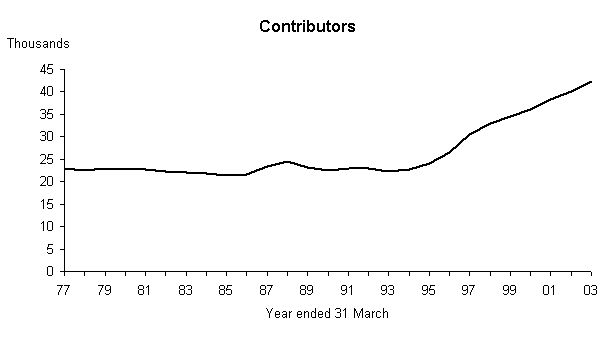
1. Number of Contributors
For the past eight years all part-time recruits have joined the LGPS automatically, whereas previously they only joined if they opted in.
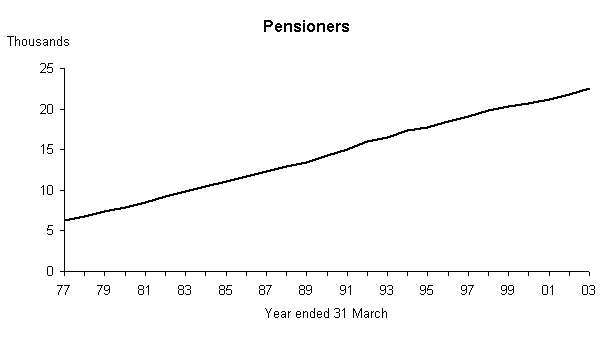
 2. Number of Pensioners
This graph continues to show a remarkably consistent increase in the number of pensioners in the fund.
3. Annual Income
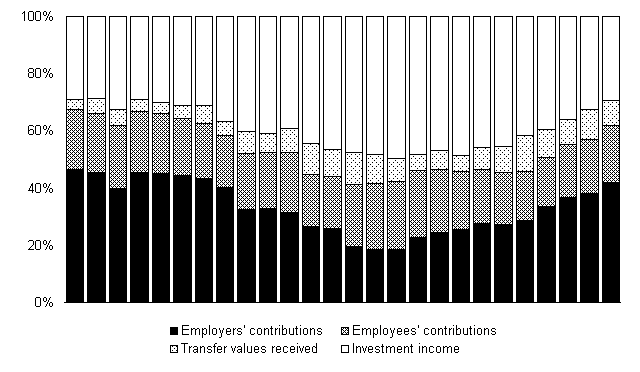
These diagrams illustrate the growth of the Fund's income since 1977, together with the split over the four main elements. Income has generally grown steeply in recent years, although it dropped slightly in 2000/01. However it has started to increase again since then as a result of increased employers' contribution rates. 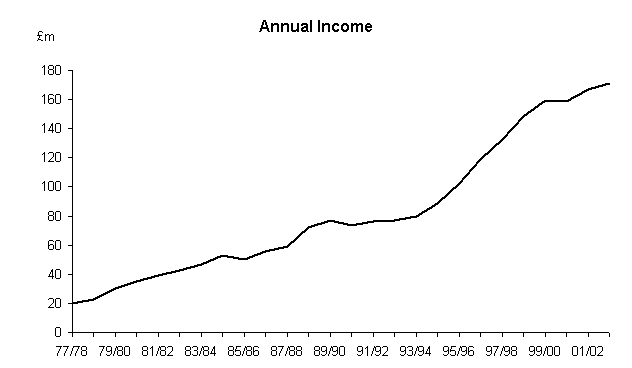
Realised and Unrealised Profits
This diagram shows the realised profit and, from 1986/87 when figures are available, unrealised changes in market value. The effect of the stock market falls in recent years are clearly shown. 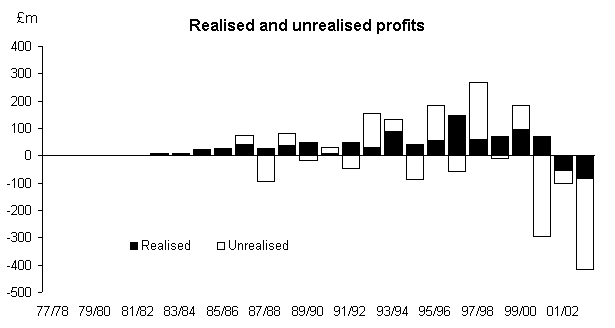
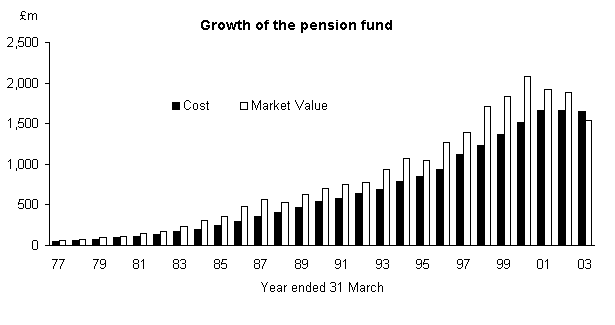
5. Growth of the Pension Fund
Markets have suffered a setback for the third consecutive year after a particularly strong performance over the previous five years, as the diagram below shows. This has resulted in market value being lower than book cost at March 2003.
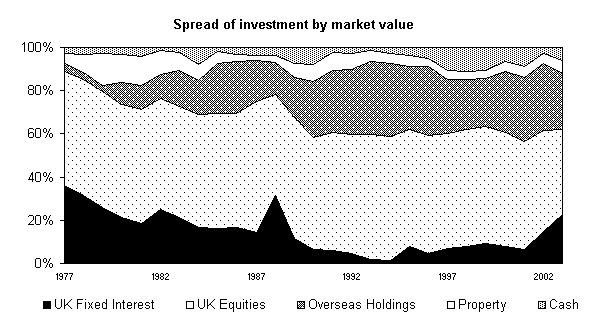
6. Spread of Investment by Market Value
The distribution of the Fund is illustrated in this diagram. The constantly changing picture is partly due to the relative values in different sectors of the market. Nevertheless, major changes are continually being made by positive portfolio management. In this connection it should be borne in mind that a switch of only 1% amounts to £15.0m
Appendix 7
Financial Management Policy |
Overall purpose : seek to ensure a high standard in the management of public finances in the best interests of the people of Hampshire.
Key policies designed to achieve this are to maintain and seek continuous improvement in:
1 |
Overall financial planning to integrate with other strategies |
Commentary |
||
1 |
Budget strategy related as appropriate to corporate strategy, Best Value Reviews, Public Service Agreements and Local Strategic Partnerships. |
The broad aim of bringing together performance issues with budgetary provision is being tackled through two main routes: first, the Chief Executive's work in aligning the corporate strategy with PSA and CPA targets and the key priorities of members: and second, the development of service improvement plans and workforce plans across the organisation, which will in turn be informed by the budget and the corporate strategy. A training and development event has been set up involving Chief Executive's, Personnel and Training and County Treasurer's staff in order to take forward the integration required. | ||
2 |
Ensure that the long-term level of revenue commitments does not exceed long-term funding likely to be available including reasonable expected levels of grant settlements and council tax |
A major criterion in appraising the 2003/04 budget proposals, hence establishment of grant equalisation reserve. | ||
3 |
Ensure integration of financial considerations into the Council's policy development processes |
Ensured on a day to day basis through head of profession network across all the Council's departments flowing into the political process. Specific examples include the financial framework established as the basis for developing local PSA agreement, close involvement in the strategy for building additional nursing care capacity, and assessing the financial aspects of the South Hampshire Rapid Transit scheme. | ||
4 |
Maintain three-year budget projections, whilst recognising the need to keep year-to-year flexibility in final resource allocation decisions |
Projections reported to Cabinet and County Council for 2004/05 and 2005/06 | ||
5 |
Seek to maintain the level of the locally-resourced capital programme |
Level maintained in real terms in roll forward of 2003/04 to 2006/07 programme approved in February 2003. Proposed to add spending of £10m to the programme as a result of higher projected capital receipts. | ||
6 |
Review the level of insurance reserve on an annual basis (in the context of the corporate risk management strategy) |
Reviewed in this report. Proposal is not to reduce the reserve in line with increased insurance provision, in view of level of outstanding fire reinstatement commitments | ||
7 |
minimise levels of non-earmarked reserves, with a target of 0.6% of net expenditure, in order to maximise use of available funds on service provision |
Non-earmarked reserves budgeted at 0.6% of expenditure by 31 March 2004 after allowing for possible use of £1.7m in 2003/04 to meet expected higher fire pay costs and other cost pressures | ||
8 |
maintain a statement of investment principles for the pension fund, incorporating the objectives of achieving a 100% funding level and maintaining a stable employers' contribution level, with a long-term target of around double the employees' contribution level |
Some mitigation against recent stock market falls was ensured by adopting a scheme-specific benchmark and increasing bond and property exposure relative to the average for pension funds. But recent sensitivity analysis suggests an increased shortfall which will have to be made good by employers' contributions rising to nearly three times employees, unless stock markets recover substantially by 31 March 2004 (the next valuation). Letters have been sent to all employees and pensioners reassuring them in the light of press comments on the `shortfall'. | ||
9 |
Deliver funding increases to schools, education and social services in line with government targets - while at the same time seeking to retain sufficient flexibility to enable distinctive local approaches to be taken in these and other service areas. |
Schools increase in 2003/04 in line with increase in formula spending share (FSS) and £2m in excess of DFES target. Social Services increase (including contingency items not yet added to cash limit) of £8m more than FSS | ||
2 |
Effective management of capital resources |
Commentary | ||
10 |
Maintain a capital expenditure strategy which feeds into a four-year capital programme updated annually |
Capital strategy prepared in July 2002 and assessed as good by the ODPM ( the highest category) | ||
11 |
Adopt a Public Private Partnership (PPP) approach, including the use of the Private Finance Initiative (PFI), where this provides best value for money for the Council |
Hybrid PFI framework adopted for SHRT and being evaluated in respect of other major projects for which PFI credits might be available | ||
12 |
Adopt an investment strategy for the Council's built estate which avoids increased long term costs resulting from delayed investment |
One of the six key objectives of the Strategy for the Built Estate approved in April 2003 | ||
13 |
Recycle assets as a means of maximising capital investment rather than repaying debt |
2003/04 to 2007/08 capital programme includes investment of £39m financed from capital receipts | ||
14 |
Allow services to retain at least 25% of the value of their capital receipts and, where necessary to finance investment in replacement assets, up to 100% |
This report recommends allocations to services in respect of 25% shares of 2002/03 capital receipts totalling £0.8m and a further £6.1m in respect of decisions to allow services to retain more than 25% and up to 100% of capital receipts | ||
15 |
Maximise use of borrowing approvals where linked to additional revenue support |
Maximum supported credit approvals were used in 2002/03 | ||
16 |
Seek to maximise capital resources by developing capital schemes in conjunction with external partners where appropriate |
External contributions of £9.8m were used in 2002/03 to enhance the value of the locally resourced programme | ||
3 |
Effective management of budgets |
Commentary | ||
18 |
Allocate provision for inflation to services at the start of each financial year and require any excess inflation to be absorbed |
Apart from contingency provision for pay increases in excess of 3% (which was allocated in October 2002 after the settlement of the Local Government pay award), the remainder of inflation allocations for 2003/04 were agreed in February at the time the budget approved. | ||
19 |
Devolution of financial management to service departments combined with appropriate financial training, provision of appropriate systems to generate management information and a framework of sound internal controls including Financial Regulations and procedures |
Process review and configuration of devolved financial management functions in SAP undertaken during 2002/03, prior to trial commencement in April 2003. | ||
20 |
Rigorous annual budgeting and budget monitoring processes |
2002/03 outturn very close to revised budget as anticipated from regular budget monitoring reports. | ||
21 |
Firm application of cash limits, with no supplementary estimates and the expectation that service committees will ordinarily repay any overspends and carry forward 100% of planned underspends and 50% of unplanned underspends |
Firm cash limits applied other than where the policy agreed at the time the budget was approved was to include a contingency provision or to allow for in budgeting for a contribution to balances, in view of scale of uncertainty. | ||
22 |
Maintain integrated accounting and budgeting systems and set a consistent overall financial framework across the authority, including for schools. |
Enterprise Project designed to extend the scope of existing integration. | ||
4 |
Ensuring good practice and probity |
Commentary | ||
23 |
Recognise the statutory and corporate finance roles of the County Treasurer in ensuring lawful and financially prudent decision-making through his membership of the Corporate Management Team |
No breaches of compliance. New corporate governance framework introduced. 2003/04 budget contains prudent risk management and establishment of grant equalisation reserve to help mitigate on a one-off basis future grant loss. | ||
24 |
Report internal audit's strategy to the Standards Committee |
Report on the 2003/04 strategy deliveries to the Standards Committee at its meeting on 28 January 2003, as part of its new role in Corporate Governance. | ||
25 |
Provide annual internal audit assessments for each department |
The practice of annual audit reports with an audit option on the internal control framework was introduced during 2002/03. In addition an assurance statement is also provided to accompany the final accounts to be considered by Executive Members and later publication with the County Council's Annual Accounts. | ||
26 |
Seek best value in spending, bearing in mind that considerations of quality, risk, sustainability, environmental impact, local economic development and equalities may all be relevant in addition to price |
Corporate Procurement Network and Corporate Procurement strategy set out a framework for achieving this, taking account of these factors. Procurement will shortly be the subject of a cross-cutting Best Value review. | ||
27 |
Assist Chief Officers to obtain maximum revenue resources for service departments (eg through grant applications/bids, partnership development, income maximisation) |
Both Economic Development and Recreation and Heritage employ officers specifically tasked with generating grant funding. We aid this by producing financial information (etc) for bids, and ensuring the systems are in place to check claims against grants are maximised. | ||
28 |
Require the continuing identification of efficiencies by expecting budgets to absorb the annual cost of increments |
Increments estimated at £2.7m absorbed in 2003/04 budget. | ||
29 |
Develop IT systems designed to enhance the provision of financial management information to users |
The continuing roll-out of SAP as the Council's integrated finance, human resources and purchasing system will lead to maximum integration of management information and the potential to link further developments to this system. It is complemented by other specialist systems, notably the current development of SWIFT to provide Social Services financial information in an operational context, the specialist pensions system CLASS and the national student support system which the Council is currently piloting on behalf of the Government. All these systems are intended to provide information which customers need, with an emphasis on self-service in such areas as payroll and pensions information and local budget management. | ||
30 |
Maintain Head of Profession arrangements whereby the head of each devolved finance unit has defined responsibilities for ensuring that both corporate and departmental needs are met |
Following the Best Value review of the finance function in 2001, devolved finance arrangements have continued to develop with a review being carried out of arrangements in each service department to check that the `boundaries' of the devolved finance unit are drawn in the best way. This has led to some rationalisation such that all teams of finance staff across the Council report to the relevant Head of Profession, and with the exception of PB&R (where there was less business logic for changing existing arrangements) all such staff are part of the County Treasurer's department. | ||
31 |
Maintain and work with Chief Officers to apply Financial Regulations and associated financial procedures in support of good practice in financial administration and corporate governance |
Part of the annual audit report and assurance statement refers specifically to the compliance with Financial Regulations and other procedures which comprise the controls framework. | ||
32 |
Maintain an effective and efficient internal audit function which works co-operatively with the Council's external auditor |
The District Auditor continues to maintain his reliance on the work of Internal Audit and has always commented positively on the quality and professional standards achieved in his annual management letter. | ||
33 |
Comply with the CIPFA Code of Practice for Treasury Management |
Updated Treasury Management Policy statement approved by the County Council in February 2003, in accordance with revised CIPFA Code of Practice. | ||
34 |
Comply with accounting and audit standards contained in the relevant Codes of Practice and CIPFA guidance. |
2001/02 Statement of Accounts prepared in accordance with revised Accounting Code of Practice and statement of internal control incorporated a year in advance of the statutory requirement. | ||
5 |
Efficient and accessible processing of transactions |
Commentary | ||
35 |
Best practice in relationships with local contractors and suppliers, including payment of bills in line with government prompt payment targets |
Consistently in top six County Councils for performance on BVPI 8 (prompt payment) over the past three years. | ||
36 |
An emphasis on continuous improvement driven by a customer focus as the best way to deliver good financial services |
The County Treasurer's Service Improvement Plan sets out the details of this approach, which focuses on the implementation of new systems and making use of customer feedback to enhance services. | ||
37 |
All services to be available electronically in line with government timescales, including moves towards employee self service |
Expected to be achieved as set out in the Departmental e-government plan. | ||
38 |
Obtain the Charter Mark for services dealing directly with the public, and seek to apply a similar approach to internal customers |
Pensions Services and Student Support currently hold the Charter Mark. Consideration is being given to applying for the Charter Mark for the Blue Badge service in 2004, and possibly for Social Services Income and Assessments and Benefit Advice at a later date. Charter Mark principles are adopted in the department's `charter of service' applicable to all sections. | ||
39 |
Keep transaction costs within the lowest 25% of costs among county councils. |
This was true the last time it was measured through benchmarking as part of the 2001 Best Value review. | ||
Appendix 8
2002/03 Capital Spending and Financing
1. Capital Expenditure
1.1 Table 1 below summarises the extent to which the 2002/03 capital programme has been started and the carry forward implications for 2003/04
Table 1 - 2002/03 Capital Programme
£'000 |
% | |
Approved value of capital programme starts |
133,068 |
100 |
Value of projects started in 2002/03 |
110, 630 |
83 |
Balance of cash limit at 31 March 2003 |
22,438 |
17 |
Value of projects approved for carry forward in May 2003 |
21,737 |
97 |
Further carry forward of projects requested by services |
630 |
3 |
Net balance of cash limit remaining to meet inflation costs |
71 |
- |
Cash limit carried forward to 2003/04 |
22,438 |
100 |
1.2 Annex 1 provides an analysis of the programme over services and contains details of requests to carry forward further schemes and an analysis of the net balance of the cash limit. Any services balance remaining at 31 March 2003 is available to offset the cost of inflation arising because of the delayed start to the schemes.
1.3 Total capital payments for the 2002/03 starts programme and from schemes in earlier years for £156.0m. This was £3.4m more than the adjusted revised budget. £2.7m of the higher spending was on schemes funded by outside agencies including £0.5m fees on the nursing homes' programme which have not yet been reimbursed by the Department of Health. £1m was on schemes which will be reimbursed by schools and £1.1m was on schemes supported by Government approvals. Payments on locally funded schemes were £1.4m less.
2. Capital Financing 2002/03
2.1 The proposed method of financing these payments is set out below:
Table 2
£'000 |
% | |
Loan |
51,850 |
33 |
Government Grants |
28,013 |
18 |
Contribution from developers and outside agencies |
9,817 |
6 |
Capital receipts |
19,348 |
13 |
Capital reserves |
||
BCA Transfer |
1,500 |
1 |
Other |
17,046 |
11 |
Revenue reserves - trading units, on street parking and invest to save |
1,462 |
1 |
Revenue contributions: |
||
General corporate provision |
24,989 |
16 |
Set aside by schools |
2,015 |
1 |
156,040 |
100 |
2.2 Capital receipts during the year amounted to £20m, or £19.3m after adjusting for the timing of deposits. This was £2.6m less than was estimated due to the timing of some receipts as between 2002/03 and 2003/04. Capital receipts in 2003/04 should therefore be correspondingly higher. All of the receipts can be used to finance new capital expenditure.
2.3 Government grants of £28.0m were principally for education (£23.7m) mostly for school conditions funding and devolved formula capital allocation. Government Grants for Magistrates Courts were (£2,9m). Contributions of £9.8m included developer contributions (£2.8m) contributions from other local authorities (£0.8m) and other contributions (£6.2m) including lottery funding.
3. Borrowing
3.1 Maximum borrowing is determined by the total credit approvals from the Government adjusted by transfers to and from other authorities. In 2002/03 credit approvals of £0.7m lent by the Hampshire Fire and Rescue Authority (HFRA) and £1.5m lent by Portsmouth City Council in 2001/02 were returned to those authorities. HFRA have lent £1.9m to the County Council in 2002/03 for return in 2003/04. These transfers amount to a net transfer from the Authority of £0.3m compared with £0.8m when the programme was last reviewed. Portsmouth City Council will shortly establish if they have unused credit approvals to lend to the County Council and if they do have credit approval to transfer revenue contributions will be reduced and an equivalent amount paid into capital reserves. In addition £120,000 credit approval was transferred to Havant Borough Council for social housing schemes included in the Social Services capital programme.
3.2 Government departments have until 30 September 2003 to issue some of their approvals for 2002/03 and so it is possible that the approvals still to be received will differ from the estimates in this report. Where there are differences, borrowings will be adjusted and offset by changes to revenue contributions.
3.3 After normal dept repayment of £12.6m the net increase in borrowings for the year was £39.3m. Other debt repayments reimbursed by other authorities for transferred services amounted to £3.0m. The County Council's debt outstanding on 31 March 2003 was £343.1m. This is equivalent to £277 per head of population. The increase in debt of £39.3m represents an increase of 12.9% over the year.
3.4 After allowing for borrowing, grants and contributions, capital receipts and the budgeted provision for revenue contributions the balance of the payments (£18.5m) is funded from capital reserves. This is £1.1m more than was estimated when the programme was last reviewed.
3.5 The trend in outstanding debt and projections for the next three years is set out in the following graph:
Table 3 - Trends in outstanding debt - at 31 March 2003

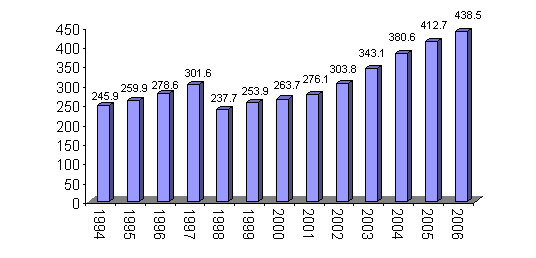 Capital receipts
3.6 Annex 3 contains an analysis of capital receipts obtained in 2002/03. Services can retain 25% of capital receipts from the sale of their assets with up to 100% for approved in/out schemes. Receipts from development account or county farm sales are retained for corporate use. In accordance with this policy, services' share of the 2002/03 capital receipts now due to be allocated amounts to £0.8m as set out in Table 5 of Annex 3.
4. Determinations by Cabinet
4.1 Part IV of the Local Government and Housing Act 1989 requires the County Council to make determinations for each year on certain capital issues. These are set out in recommendations:
a) That capital payments for the year be financed as set out in Table 2 of Appendix 8
b) That approval be given for the additional capital schemes contained in Table 2 of Annex 2 to Appendix 8
c) That it be determined that:
i) £9,816,592 of expenditure reimbursed by developers and outside agencies be capitalised
ii) a transfer of £1,934,453 credit approval from Hampshire Fire and Rescue Authority be accepted in 2002/03 and returned in 2003/04
iii) a transfer of credit approval from Portsmouth City Council be accepted in 2002/03 if the City Council establish they wish to do so and returned in 2003/04. The amount to be reported to Cabinet
iv) £19,347,696 capital receipts be used to meet capital expenditure in 2002/03
v) £14,964,124 (including £2,383,932 reimbursed by other authorities in respect of deemed debt) be set aside as provision for credit liabilities from the revenue account to avoid new loans authorised by credit approvals
d) That services' capital programme cash limits for 2003/04 be increased by the sums shown in:
i) column 3 of Table 5 in Annex 3 (to reflect services' share of capital receipts)
ii) column 6 of Table 1 of Annex 1 to Appendix 8 (to reflect the carry forward of capital schemes and of the balance of cash limits from 2002/03
Annex 1 - Appendix 8
Analysis of capital programmes 2002/03 and requests by services to carry forward further schemes to 2003/04
Table 1 - Analysis of Capital Programmes 2002/03
(1) |
(2) |
(3) |
(4) |
(5) |
(6) | |
Approved value of programme |
Value of projects started in 2002/03 |
Value of projects approved for carry forward in May 2003 |
Further carry forward requests by services |
Cash limit available for carry forward to meet 2003/04 inflation costs |
Cash limit carried forward to 2003/04 (cols 3+4+5) | |
£'000 |
£'000 |
£'000 |
£'000 |
£'000 |
£'000 | |
Locally resourced projects |
||||||
Education |
14,064 |
11,997 |
2,157 |
- |
-90 |
2,067 |
Environment |
13,583 |
13,583 |
- |
- |
- |
- |
Policy and Resources |
22,630 |
16,111 |
6,531 |
-116 |
104 |
6,519 |
Recreation and Heritage |
1,072 |
450 |
565 |
- |
57 |
622 |
Social Services |
5,732 |
2,183 |
2,857 |
692 |
- |
3,549 |
Total |
57,081 |
44,324 |
12,110 |
576 |
71 |
12,757 |
Supported by Government Approvals |
||||||
Education |
24,186 |
21,472 |
2,714 |
- |
- |
2,714 |
Environment |
33,670 |
31,295 |
2,375 |
- |
- |
2,375 |
Policy and Resources |
17,526 |
13,139 |
4,333 |
54 |
4,387 | |
Social Services |
605 |
400 |
205 |
- |
- |
205 |
Total |
75,987 |
66,306 |
9,627 |
54 |
- |
9,681 |
Total Programmes |
133,068 |
110,630 |
21,737 |
630 |
71 |
22,438 |
Table 2 - Requests to carry forward further schemes to 2003/04
£'000 | |
Policy and Resources |
|
New deals for schools condition funding |
54 |
Capital and major repairs - reduction to amount approved to be carried forward May 2003 |
-116 |
Social Services |
|
Social care information system |
381 |
Minor works in residential and day care premises |
104 |
Furniture and equipment in office bases |
44 |
IT equipment |
163 |
630 |
Annex 2
Summary of capital payments 2002/03
Table 3 - Analysis of payments over services
£'000 |
% | |
Education |
72,858 |
47 |
Environment |
53,673 |
34 |
Magistrates |
3,744 |
2 |
Policy and Resources |
13,116 |
8 |
Recreation and Heritage |
3,363 |
2 |
Social Services |
7,046 |
5 |
Creditors - reduction in the year |
2,240 |
2 |
156,040 |
100 |
Table 4 - Analysis of payments over type of expenditure
£'000 |
% | |
Land |
3,232 |
2 |
Construction work |
112,873 |
72 |
Fees and salaries |
28,104 |
18 |
Furniture, equipment and vehicles |
9,591 |
6 |
Creditors - reduction in the year |
2,240 |
2 |
156,040 |
100 |
5. Annex 3
5.1 Analysis of capital receipts 2002/03
5.2 Table 5
(1) |
(2) |
(3) | |
Net capital receipts |
Share from in/out and other schemes previously added to programme |
25% share of qualifying receipts now due to services | |
£'000 |
£'000 | ||
Education |
7,620 |
6,076 |
735 |
Environment |
112 |
- |
28 |
Policy and Resources |
|||
- Development account |
10,717 |
- |
- |
- Other |
773 |
- |
44 |
Recreation |
117 |
- |
29 |
Sale of vehicles |
9 |
- |
- |
19,348 |
6,076 |
836 |