
Archived decisions
Appendix 4
Hampshire County Council
Asset Management Plan
1 Summary
1.1 This corporate asset management plan (AMP) has been approved by the County Council and the Corporate Management Team. It accompanies the Council's Capital Strategy which brings together the key policies for managing the Council's capital assets, such as land, buildings, roads, bridges and equipment. The Capital Strategy and other documents mentioned in this corporate AMP are available through the Council's website or from the address at the foot of this document1.
1.2 The corporate AMP deals with the details of asset management and focuses on property assets. Schools, highways and transport infrastructure, vehicles, plant and equipment have been excluded, in accordance with guidance issued by the Government. The AMP shows that the Council has systems in place to identify and record information on its assets, including their condition and adequacy. It sets out the process for identifying the changes that are required in those assets to meet the needs of services, including how the relative priority of proposals are assessed. The key issues facing the Council on asset management are identified.
1.3 The Council has established a corporate property officer and department led by the Director of Property, Business and Regulatory Services. Arrangements have been in hand for some years, as is stated throughout the AMP, to:
· collect and collate data on property condition, safety and performance
· provide regular performance and management information to Members and stakeholders
· calculate local and national performance indicators
· assess property condition and maintenance liabilities on a five-yearly basis
· identify and manage strategic programmes to direct resources at the greatest risks and most significant liabilities
· develop corporate and cross-cutting service requirements, for example, in relation to the office accommodation portfolio
· maximise the value of investment through effective procurement strategies.
1.4 The major policies and objectives for the Council's property holdings are reviewed each year by the Executive Member for Policy and Resources within the context of the Corporate Strategy. This review sets the key property strategies and projects for the year ahead and makes sure that the Council's property management objectives are fully co-ordinated with the capital programme. Whilst the overall property strategies have remained consistent over the last ten years, the key objectives are reviewed and enhanced on an annual basis.
2 The County Council's asset management processes
Members of the County Council
2.1 Members play a key role in the management of the County Council's assets. This includes deciding:
· the Capital Strategy and corporate AMP
· the size of the four-year capital programme, within the context of the Council's overall financial strategy
· the detailed four-year capital programmes for individual services
· fine-tuning the capital programme, as a result of regular monitoring of the performance of the programme in terms of the progress of schemes and the financing of payments
· the policies for services, which affect the use and disposal of existing assets and the acquisition of new assets
· the direction of the programme of land and property reviews
· the acquisition of new assets and the disposal of surplus assets
· the Strategy for the Built Estate, including maintenance levels
· the content of the Education AMP1, the Local Transport Plan1 and other service plans affecting property
· the details of new capital schemes through the standardised project appraisal process
· property and other asset management issues as part of the Best Value reviews.
2.2 The Council will continue to retain a strong overview of the use of property assets through its `landlord and tenant' model. Service providers and asset users occupy and utilise property assets as `tenants', with the Council maintaining corporate ownership and taking strategic decisions as the `landlord'.
2.3 The Executive Member for Policy and Resources is responsible within the Cabinet for asset management. This includes the acquisition and disposal of all Council land, the review of land holdings and determining the policies and standards applied to the maintenance of all the Council's buildings. Key decisions, including the approval of the Capital Strategy, corporate AMP and capital programme are taken by the County Council itself on the recommendation of the Cabinet. The Executive Members responsible for each service regularly monitor the progress of schemes in their capital programmes. The Executive Member for Policy and Resources monitors the overall progress on the capital programme including the financing of payments. Asset management matters are also subject to scrutiny by the Council's policy review committees.
Asset Management Group
2.4 The Council's Asset Management Group of officers make sure that a corporate approach is taken on asset management at an officer level. The Group's terms of reference include:
· keeping under review the arrangements for the strategic management of the Council's assets
· preparing, reviewing and revising the Capital Strategy and the corporate AMP for approval by members.
2.5 The Group reports to the Corporate Management Team and includes:
Director of Property, Business and Regulatory Services
County Treasurer
County Surveyor
County Planning Officer
County Education Officer
Director of Social Services
Head of Policy Unit.
2.6 The Group is led jointly by the Director of Property, Business and Regulatory Services and the County Treasurer. The service chief officers provide input to the Group as representatives of all the Council's services. The Head of Policy Unit is represented by staff with particular responsibility for community planning to strengthen the links between the Community Strategy and the Capital Strategy and corporate AMP.
2.7 The Director of Property, Business and Regulatory Services is responsible at officer-level for the Council's property, architectural services, estates and valuation and office accommodation. This includes all aspects of property reviews including implementing agreed outcomes.
3 The County Council's Capital Strategy and other plans
3.1 The County Council's Capital Strategy1 has been updated by the Asset Management Group and approved by the Council in July 2002. The corporate AMP has been prepared within the context set by the Capital Strategy, which is underpinned by the six key aims in the Council's Corporate Strategy1:
· maximising life opportunities
· stewardship of the environment
· achieving economic prosperity
· building strong and safe communities
· improving services
· developing councillors and staff.
3.2 Each of these key aims has implications for the Council's assets and for future investment. All capital schemes contribute to meeting one or more of the key aims and all existing property holdings are reviewed within the context set by these aims.
3.3 In addition, the Capital Strategy is informed by the shorter term priorities identified by the Cabinet:
· crime, youth and deprivation
· education and skills development
· older people
· transportation (mobility and access) and economic housing.
3.4 Other important elements of the Capital Strategy include:
· maintaining and investing in capital assets - this has a high priority within the Council's overall financial strategy
· providing high quality and effective assets to support the delivery of services
· providing assets that are safe and fully accessible for all users and the public
· working closely with all partner organisations
· reviewing existing assets to release resources for reinvestment
· undertaking systematic land and property reviews
· promoting sustainable development through the capital programme
· using best value and Rethinking Construction principles in procurement.
3.5 The Hampshire County Structure Plan1 identifies areas of significant growth in new housing over the next ten years. Schools and other community facilities will be needed for these developments. The Council will reflect these requirements in future capital programmes. They are likely to need significant resources to finance them and the Council is preparing a strategy for securing contributions from new developments. Government support will also be needed to finance the required investment in services.
Community Strategy and the Vision for Hampshire
3.6 The County Council is working with the Hampshire district councils and other partners to establish district-based local strategic partnerships (LSP) and develop community strategies. The Council is also preparing with its partners a county-level Community Strategy1 which will take account of the Council's priorities and Corporate Strategy alongside the priorities and policies of other partners.
Performance Plan and Audit Reviews
3.7 The Capital Strategy and corporate AMP will also reflect changes to services and methods of service delivery as they happen over the next few years. In particular, outcomes from the Best Value reviews will have implications for asset management. The Council's Performance Plan1 sets out the programme of reviews to be undertaken. Issues affecting property and other assets will be considered as part of the each review where relevant. Guidance on consistency of application of policies for acquisition, disposal and development of assets is to be developed. The Capital Strategy and corporate AMP have taken account of the results of the Best Value reviews completed so far. An example is the rationalisation and improvement of Registration properties following the Best Value review of the Service.
3.8 The Council has entered into a Local Public Service Agreement1 (PSA) with the Government, covering the period from 2002/03 to 2004/05. Additional capital investment is required by the Local PSA, financed in part by unsupported borrowing approvals, and this has been included in the capital programme.
3.9 Full account has also been taken of reports arising from audit reviews, both by internal and the Council's external auditors, the District Audit service. Examples include action plans arising from recent value for money studies of asset management and environmental stewardship, including energy and water consumption. Asset management is also a regular review item in the internal Strategic Audit Plan.
Property Management Strategy and the Strategy for the Built Estate
3.10 The Council's Property Management Strategy is reviewed and agreed by the Executive Member for Policy and Resources on an annual basis. The key strategic policy objectives are:
· to ensure the effective and efficient use of assets through systematic land and property reviews
· to implement planned programmes of refurbishment, adaptation and maintenance to meet changing requirements and other statutory adjustments for effective service delivery
· to maximise the level of capital receipts whilst achieving high quality schemes in the provision of sustainable new buildings and development by third parties on Council land
· to acquire additional land for service delivery, development projects or investment purposes at the same time as considering environmental issues around development in Hampshire
· to create increased capacity to deliver the capital programme through partnerships with the private sector
· to review procurement opportunities to maximise the return on investment and the quality of outcomes from key projects.
3.11 The Executive Member also reviews and agrees the Strategy for the Built Estate which deals with the repair and maintenance of the Council's properties. The key objectives are:
· to direct resources to the highest and most significant maintenance liabilities in the permanent built estate
· to maximise the opportunities for planned maintenance regimes as opposed to `patch and mend'
· to ensure that the buildings are accessible and safe to occupy and that a robust corporate Health and Safety Strategy exists
· to maximise the value of particular levels of investment through effective procurement regimes
· to establish effective management partnership arrangements with schools and to maximise the opportunity for using Government funding
· to ensure that sustainability is at the heart of Property Management policies.
3.12 The approach incorporated within these strategies has been successful in working with building users to identify surplus properties, realise capital receipts, reduce temporary buildings and target capital investment at major new buildings and facilities to meet the needs of modern service delivery. It optimises the use of assets, in terms of maximising benefits and minimising costs. As an example, the Council has reduced its stock of temporary buildings from 1,100 to 220 over the last 10 years. This has been of considerable benefit to building users in the drive to improve service standards. Properties held in part for strategic purposes are included in these reviews to make sure that their continued ownership by the Council is justified in financial and management terms. Use is made of data on internal rates of return from properties where relevant.
Service plans
3.13 Service strategy and commissioning plans are considered and approved by Executive Members. They are linked to the Council's Corporate Strategy, the Capital Strategy and the Best Value review process. Detailed service AMPs have been prepared for education and local transport1. The corporate AMP builds on these plans, without repeating their details, to provide an overview of the Council's asset management.
3.14 The priorities for asset management arising from the social services plan include:
· modernising the Council's homes for older people, introducing intermediate and nursing care and reducing the number of delayed transfers from hospital from 166 in March 2002 to 125 at March 2003, and developing additional nursing home places with the National Health Service (NHS)
· making sure that all facilities comply with the requirements of the Care Standards Act 2000
· facilitating the developing agenda for supporting people. This includes using the Council's sites and borrowing approvals to assist the development of supported housing with district councils, in pursuit of the `Supporting People' objectives of independent living and social inclusion
· modernising services for people with learning disabilities in line with the objectives of the White Paper `Valuing People'
· implementing the National Service Framework for older people
· refurbishing and upgrading the premises used to provide residential care for children
· meeting the requirements of health and safety, disability discrimination, equality and other legislation
· providing equipment to help disabled people to remain in their own homes. Equipment services are run jointly by the Council with the health service
· developing community mental health teams and bases with Primary Care Trusts.
3.15 Although these plans are developed for individual services, the Council takes a cross-service approach wherever possible to service-based solutions. In addition, it has adopted over-arching strategies on sustainable development, corporate water action, equalities, e-government, procurement, office accommodation and land review.
Sustainability
3.16 The County Council attaches a high priority to promoting policies and actions to achieve sustainable development and has published a Corporate Sustainable Development Strategy1. The principles of Agenda 21 underpin the Council's management of its assets and capital investment. An Agenda 21 environmental policy statement for property has been prepared. This requires that buildings are developed with consideration for environmental issues at all stages of their life cycle, including energy efficiency and sustainability. A new early years centre at Warren Park Primary School, Havant is an example of a current project that is being built using robust, long lasting and low maintenance materials together with high levels of insulation and natural light.
3.17 The Council has agreed a Natural Resources Initiative to improve Hampshire's performance in the sustainable use of natural resources such as materials, energy, water and soil. It also adopted a Corporate Water Action Plan1 and follows the best practice in the effective and efficient use of energy and water in its own properties.
Equalities
3.18 The County Council is committed to securing genuine equality of opportunity, whether required by law or not, in all aspects of its activities as an employer and service provider. This is set out in the Corporate Equalities Plan and Race Equality Scheme1. It includes promoting equality of access to its services and facilities. Buildings are being adapted to meet the requirements of the Disability Discrimination Act 1995 and the Council has appointed a manager to implement and oversee its strategy. As an example, the accessibility of mainstream schools for pupils with sensory impairments or physical disabilities is being improved in conjunction with the Schools Access Initiative promoted by the Department for Education and Skills. Great Binfields primary school has been designed to cater for visually impaired pupils, with special attention given to wall and floor coverings and colour schemes.
Continuous improvement
3.19 These processes, followed by the Council for many years, have foreshadowed the development of asset management plans and, together with Best Value reviews, have placed the Council in a strong position to take forward its asset management. The focus remains the achievement of continuous service improvement and establishing further challenging targets for the future.
4 Planning and consultation
4.1 The County Council has had in place for some time extensive consultation and liaison arrangements on asset management with its key partners. Whilst the Council holds all property as a corporate resource, these consultation arrangements make sure all assets are used to optimise service delivery within available resources. In addition, consultation plays a key role in focusing investment and reinvestment strategies on necessary improvements. These are identified through the development and review of service plans by the operational departments and through corporate strategies agreed by the Council. The results of public consultation exercises are also important factors taken into account in deciding the Council's priorities for investment across the full range of its service responsibilities. A recent example is the importance placed by the public on footway and highway maintenance.
4.2 The Council's Capital Strategy and corporate AMP were discussed with representatives of the business community in July 2001. As a result, the key objectives in the business plans of the Chambers of Commerce will be matched with the Council's key aims in its Corporate Strategy. The priorities for business are skills, employment, transport, infrastructure, housing and the constraints of planning on enterprise. The Chambers confirmed their involvement in consultation on area transport plans and via the Hampshire Economic Partnership.
Partnerships with service users
4.3 The Council's partners in managing property assets include service managers, headteachers and other building occupants, school governors, dioceses, district councils, community groups and other voluntary organisations and Government departments. The Council works closely with the voluntary and private sectors. This includes the reuse or use of buildings for community purposes and co-locating facilities on the Council's sites.
4.4 Meetings are held with service users of buildings at least annually to discuss and agree property issues. The purpose is:
· to consult building users, as clients, about planned work
· to review a range of health and safety issues
· to consider future opportunities and projects
· to discuss any property or building issues of concern or interest to the building users
· to review the implementation of the planned maintenance programme
· to discuss and agree start and completion dates for projects
· to monitor progress on current projects.
Education partnerships
4.5 Full details of the Council's education partnerships with schools, governing bodies, dioceses, district councils, voluntary and community bodies, and many others, are published in the education AMP.
Social services partnerships
4.6 Partnerships with social services include the Hampshire and Isle of Wight Strategic Health Authority and the seven Primary Care Trusts, voluntary groups, relevant charities, independent service providers, service users and the Department of Health (DoH).
4.7 There are extensive consultation arrangements with the voluntary sector and interested organisations relating to the delivery of social services. These have been set down in the Hampshire Compact1, a framework for the working relationship between the County Council and the Community Sector. Recent joint working with the NHS includes:
· providing 500 new nursing care beds in new homes and extensions to existing care homes
· the opening of three Intermediate Care Units with others planned
· joint development of information systems to support joint mental health services across Hampshire using supplementary borrowing approvals from the DoH
· establishing local partnership boards to develop integrated services for people with learning disabilities through the pooling of budgets and other Health Act 1999 flexibilities
· applying, with the seven Primary Care Trusts covering Hampshire, to become a Care Trust for children and adolescents' mental health services.
Local transport partnerships
4.8 The Council's partnership arrangements for local transport are described in full in the Local Transport Plan (LTP)1. These partnerships encompass Hampshire district councils, businesses, transport operators, local communities, disabled people, central Government, health authorities, Hampshire Constabulary and adjacent local authorities. Area strategies with local partners cover ten areas across the County and involve full consultation processes with the community.
Other partnership arrangements
4.9 This list of partners on asset management matters is not exhaustive. The Council consults with all groups that may have an interest in issues affecting property and other assets. Consultations are undertaken at a variety of levels, from formulating overall cross-cutting and service strategies to Management Partnership meetings at individual service units.
4.10 The Council also works with partner organisations to provide input to the management of their assets where a positive impact on service delivery can be achieved. These include the development of shared leisure facilities jointly funded with district councils and sporting organisations. Partnerships have also been formed with registered social landlords to develop schemes on the Council's land to provide low cost housing for key workers employed in Hampshire.
4.11 The Council encourages partner organisations to reflect their involvement in the Council's capital schemes by contributing to the costs, where appropriate. The Council has enabled both Portsmouth City Council and the Hampshire Fire and Rescue Authority to make the maximum use of the borrowing approvals awarded to them by Government, through temporary transfers of unused approvals.
Consultation with service clients
4.12 The Director of Property, Business and Regulatory Services holds regular strategic meetings with service chief officers to discuss property issues. These are supported by well-established and innovative mechanisms for gathering customer feedback and undertaking consultation, including:
· meetings, at least annually, with individual local managers
· a customer call-centre for property management
· half-termly service review meetings with primary and secondary headteachers' representative
· comprehensive correspondence and complaints monitoring
· customer feedback, covering both in-house and external contractor performance, on completion of all projects
· surveys of client satisfaction - the results for 2001/02 and 2002/03 are outlined in section 10.
4.13 As part of ongoing liaison, discussions have been held during the preparation of this corporate AMP with property managers in each of the main service departments and their input is reflected in this plan.
4.14 The results from these consultation processes are used to improve property management services. Examples include a recent survey of schools' views, services' input to the land and property review process and the outcomes from Best Value reviews.
Public-private partnerships and the private finance initiative
4.15 The County Council considers all methods of procuring and financing its capital programme. It will adopt a public-private partnership (PPP) approach, including the private finance initiative (PFI), for projects where this is the best value for money. This is more likely to be the case for larger schemes. It is currently being considered as a means of financing the proposed South Hampshire Rapid Transit1 scheme, street lighting column investment and the development of new commercial and domestic recycling centres.
4.16 Hampshire's private sector waste contractor will also invest about £200m on waste disposal facilities under the Project Integra1 partnership with Hampshire district councils and Portsmouth and Southampton City Councils, which was awarded beacon status by the Government in 2000/01. Project Integra pre-dates the introduction of PFI funding arrangements and, although it shares the key features of PFI projects, it is not eligible for the Government support that PFI projects attract.
4.17 Innovative approaches to procurement are adopted in line with the Egan Report's recommendations. The replacement of the John Hanson Community School in Andover is a Demonstration Project with the Movement for Innovation (M4i). New engineering servicing contracts have been established with a value of £25m over five years. The M4i and Local Government Task Force have endorsed this approach as a model of best practice.
4.18 Since 2000, the Council has committed some £100m of capital projects that make extensive use of the principles outlined in Rethinking Construction and partnering with major contractors in the private sector. These projects form part of the Council's procurement strategy which promotes:
· the development of partnering frameworks
· team-working and whole-life costs to be considered alongside a value for money evaluation
· a focus on improvement and outcomes, as opposed to confrontational contracts
· longer-term and repeat contracts based on quality, price and performance
· safety management, cost and time predictability - with the client in mind.
5 Data management
5.1 The County Council has systems in place to keep a full record of its assets, providing operational details for property professionals, service managers, occupants and users. Details are held in the Asset Register, which has recently been upgraded as part of the Council's Enterprise Project1 to replace its financial and business related IT systems with a single integrated system. It holds records for over 7,000 separate assets with a total recorded value of just over £2bn. The Council will continue to maintain and update the Asset Register, with individual assets re-valued in a five-yearly rolling programme to meet the requirements of the Local Authority Accounting Code of Practice.
5.2 The Asset Register is supported by a number of complementary detailed databases covering specific operational functions. Each building is allocated a unique property reference number (UPRN). The majority of these systems have been developed over a period of years as individual applications to address specific issues. Many share links or fields of information. These systems will be maintained and will remain capable of supplying essential information for corporate asset management, both in terms of meeting the Council's objectives and monitoring performance and output. Checking procedures are included within each system to make sure that the data remains up-to-date and valid, including programmed site visits where appropriate.
5.3 The existing systems are robust and produce the data required for the property performance indicators, but there is scope for better integration. As an interim measure much of the information is now web-enabled allowing property professionals immediate access to up-to-date information. Training and awareness sessions for users have been delivered successfully. The first phase of the Enterprise Project1 included the new asset accounting module and future phases will include the replacement of core property databases. The timescale will be decided following appraisal of the options, which could include investment in an integrated Geographical Information System (GIS) based corporate records system.
6 The current asset portfolio
6.1 Detailed information is readily available from the County Council's systems on the numbers and value of the Council's assets for both corporate and operational use. A summary of the key statistics is included in Table 1. This shows the scale of the Council's property holdings and the resources used to manage them.
Table 1 The County Council's property assets |
||
At 31 March 2003 |
||
Land holdings |
6,600 |
hectares |
Buildings |
over 5,000 |
number |
Floor area |
1,600,000 |
square metres |
Schools |
547 |
number |
Other service units |
370 |
number |
People using buildings every day |
300,000 |
number |
Vacant properties: |
||
- sold or marketed over the last 2 years |
44 |
number |
- being marketed or prepared for continued use |
34 |
number |
- future use subject to further detailed review |
6 |
number |
Capital receipts generated in 20 years to 2002/03 |
£385m |
|
Asset values 31 March 2003 - from Asset Register |
£m |
|
Operational assets |
||
- land and buildings |
1,838 |
|
- vehicles, plant and equipment |
40 |
|
- infrastructure |
215 |
|
- community assets |
9 |
|
Non-operational assets |
64 |
|
Work in progress |
54 |
|
-------- |
||
Total - all assets |
2,220 |
|
-------- |
||
Revenue expenditure on property assets in 2003/04 |
£m |
|
- maintenance of buildings and grounds |
18 |
|
- energy, water, rents, rates, cleaning etc |
40 |
|
------ |
||
Total revenue expenditure |
58 |
|
------ |
||
As a percentage of the gross revenue budget |
4.6% |
|
£m |
||
Capital repairs of buildings 2003/04 |
14.3 |
|
New Deal for Schools allocation 2003/04 |
14.4 |
|
Condition of the County Council's buildings
6.2 The County Council operates a five-yearly rolling programme to update the condition and other data on its properties. The Director of Property, Business and Regulatory Services has surveyed the condition of the Education estate using a model suggested by the DfES for preparing asset management plans for schools. This model is being extended to the rest of the Council's built estate during the current five-year cycle, which will improve the consistency of the condition data. Revised data has recently been forwarded to the DfES.
6.3 The current programme for condition surveys is:
2003 |
Recreation and heritage assets including libraries and museums |
2004 |
Social services assets |
2005 |
Offices and the remainder of the estate |
6.4 Table 2 summarises the output from the existing condition assessments. It should be noted that the outstanding maintenance and condition work identified in the Table covers a ten-year period. This information has been reported to the Executive Member for Policy and Resources.
Table 2 Output from condition surveys - outstanding | ||
maintenance and condition work over a ten-year | ||
period | ||
Number of establishments |
Total £m | |
Primary schools |
||
Community |
306 |
89.4 |
Controlled |
70 |
15.0 |
Aided |
54 |
12.5 |
Foundation |
7 |
2.0 |
Secondary schools |
||
Community |
55 |
100.1 |
Controlled |
1 |
1.3 |
Aided |
2 |
1.9 |
Foundation |
13 |
18.1 |
Special schools and units |
30 |
9.3 |
Miscellaneous education |
9 |
0.4 |
--------- |
--------- | |
Education total |
547 |
250.0 |
Social services |
89 |
15.0 |
Office accommodation |
63 |
17.0 |
Libraries |
69 |
7.0 |
Museums |
26 |
4.2 |
Other services |
123 |
16.8 |
--------- |
--------- | |
Total |
917 |
310.0 |
--------- |
--------- | |
6.5 This information is available in a range of formats including the Government's standard grading for Education assets of A - D / 1 - 4.
6.6 Suitability assessments of the County Council's education buildings are complete and are informing the curriculum-linked improvement schemes in schools. Considerable emphasis is placed on the views of headteachers about the extent to which their buildings help or hinder curriculum delivery. The suitability of buildings used by other services has been considered in the ongoing land and property reviews described in section 8.
6.7 Under the Council's Strategy for the Built Estate, the Executive Member for Policy and Resources is responsible for approving the allocation of the Council's revenue and capital budgets for building maintenance. Progress against the issues identified for 2002/03 has been evaluated, as summarised in Table 3.
Table 3 Strategy for Built Estate - evaluation of outcomes in 2002/03 | ||
Issues for 2002/03 |
Outcomes | |
Generating capital receipts of £25m during 2002/03 and 2003/04 |
On target | |
Review of County Farms |
Concluded in October 2002 | |
Implement the largest external decoration programme with a value of £4.2m |
Successfully implemented, with excellent customer feedback | |
Implement recladding and reproofing programme for SCOLA buildings, costing £6.3m |
Implemented successfully | |
Install and test a new system of window replacement in conjunction with SAPA |
Pilot schemes implemented | |
Improve customer satisfaction ratings by 2% |
6% improvement achieved - new target established | |
New major programmes of fire safety and electrical repairs |
Implemented | |
Introduce new organisational arrangements to Property Management |
New Community Property Group and Primary Schools teams established | |
6.8 The Strategy for the Built Estate for 2003/04 continues these themes and adds the following new issues:
· further enhancing customer services
· implementation of schools-funded work
· consolidating the new teams in Property Management.
6.9 The Executive Member for Policy and Resources is responsible for the revenue budget of £12m for building maintenance in 2003/04. Almost 70% of this budget, £8.2m, is delegated to schools under the Government's Fair Funding policy. In addition, the Executive Member controls the provision in the Council's capital programme of £14.3m per annum for capital repairs, funded from the Council's own resources. This is used for the replacement of major building components such as roofs, cladding and heating systems. In addition, condition funding provided by the second and third years of the Government's current three-year New Deal for Schools programme totals £35m to 2003/04.
Other capital investment
6.10 In line with the Government's instructions, this corporate AMP deals only with property assets. However, whilst most of the County Council's capital programme involves investment in its own land and buildings or transport infrastructure, there are other types of capital scheme to be considered when determining priorities for the capital programme. These include major investments in IT systems, capital grants to other organisations, the transfer of borrowing approvals to partner local authorities to enable them to implement joint schemes and the provision of equipment and adaptations in clients' homes. The Council also has to meet the financing costs of waste disposal infrastructure to be provided by its waste contractor, which is expected to have a total capital cost of over £200m.
6.11 The Council's capital grants or contributions to schemes developed by other organisations play an important part in the Council's concept of partnership, as the maximum benefits for the community can often be gained from the Council's active participation in other organisations' developments. Examples include the Council's contributions to new or improved village halls, arts centres, theatres and other community facilities. The Council also supports the conservation of important heritage assets in Hampshire and the environmental improvement of coastal areas. Since 1994/95, the Council has secured housing opportunities for people with special needs by transferring part of its Government borrowing approvals to partner district councils in return for nomination rights to some of the houses in new developments.
6.12 The regeneration of older urban areas programme supports the Council's policies for long-term land use and travel. It aims to improve the quality of life of those living and working in older urban areas of the county. It achieves this by conserving and improving their historic fabric, celebrating a sense of place, improving community facilities and contributing to the local economy by improving trade and employment. In addition, the Council's Small Country Towns Initiative promotes and supports environmental improvements in town centres to increase their attractiveness and assist their prosperity by making them more pleasant places to live, work, do business and visit.
7 Programme development
7.1 Information about changes that need to be made to the Council's assets arising from the processes described in this corporate AMP, such as consultation with service users and partners, the land and property reviews, condition surveys, Best Value reviews and performance indicators, all feeds into the development of the Council's programmes for capital investment and asset disposal.
7.2 Decisions about the size of the capital programme are taken within the context of the Council's overall financial strategy. Provided the revenue consequences of schemes supported by the Government can be afforded within the overall financial strategy, the Council makes full use of the borrowing approvals and grants made available by the Government. The process for establishing and agreeing priorities for the schools capital programme is set out in detail in the local policy statement and statement of priorities in the Education AMP, in line with guidance from the DfES. Similarly, bids for other programmes take account of the criteria set by the sponsoring central Government department.
7.3 Having confirmed that it is feasible to take up in full the borrowing approvals and other allocations from Government for the education and local transport programmes, the Council determines the size of its `locally resourced' capital programme in the light of its overall financial strategy. In particular, the level of revenue contributions to the capital programme directly affects both the level of the council tax and the size of the capital programme. Local resources provide 31% of the funding for the Council's existing four-year programme.
7.4 Initially, the Cabinet allocates guideline limits for each service for the four years of the capital starts programme. The Executive Members decide the priorities for their service within these limits, taking account of the Corporate and Capital Strategies, the views of the public and partner organisations through the consultation processes described earlier in this AMP and recommendations by the Council's policy review committees. The Cabinet considers the programmes prepared by the Executive Members, fine-tuning where necessary to make sure that major new corporate and political priorities are met and that there is an appropriate balance between service areas. At both the corporate and service levels, the key driver is the appropriateness of existing assets for their future use, whether this involves alterations to schools to meet increasing or declining pupil numbers, or modernising homes for older people. Finally, the Cabinet recommends the programme to the County Council for approval.
7.5 The major priorities for the Council's locally resourced capital programme were reviewed in February 2002 as part of the preparation of the 2002/03 budget. This review took account of the analysis arising from the corporate AMP of the changes necessary to match the Council's existing assets to the needs of users and partners. For property assets, the priorities are:
· to provide for capital repairs for all buildings as part of the Council's Strategy for the Built Estate
· to meet specific priorities identified by the Capital Strategy process including the relocation and improvement of household waste recycling centres, the improvement of rights of way including byways open to all traffic, and the capital repairs of buildings other than schools
· to promote major one-off capital schemes which are not supported in full by Government approvals but which meet local priorities. Examples in recent years include:
- the reinvestment strategy to improve the Council's core stock of homes for older people (£7.5m)
- the reorganisation of primary school provision in south-west Basingstoke to take account of declining and rising pupil rolls in different parts of the area, to provide increased provision for early years and for children with special educational needs and to remove temporary classrooms (£7.4m)
- the proposed redevelopment of Alton library as a Discovery Centre (£1.4m).
· to maintain a small core provision in the capital programme for schemes other than the major investment areas of Education, local transport and capital repairs
· to meet the shortfall in borrowing approval made available by the Government for the Education programme as a result of the `receipts taken into account' deduction from Annual Capital Guidelines
· to provide for fees incurred in preparing surplus sites for disposal to secure the Council's flow of capital receipts for reinvestment in future capital programmes, and to contribute to the meeting future housing needs in the county.
Methods for determining priorities
7.6 All schemes in the Council's capital programme must meet one or more of the six key aims in the Corporate Strategy. This provides an initial coarse sieve for determining relative priorities. Schemes are also considered against a broad set of factors as part of the Council's project appraisal process. It is not a mechanistic `scorecard' approach and the final decision on schemes is based on a considered overview of their merits. This will reflect local political judgement and priorities, taking into account the views of users, partners and other stakeholders.
7.7 The Council's approach - of setting overall guidelines for each service's locally resourced capital programme and then fine-tuning the resultant capital programme to reflect the key priorities flowing from the Corporate Strategy - makes sure that capital investment is not excessively concentrated on the major high profile services. It recognises the merits of other schemes that have a high priority with the Hampshire community, as demonstrated by the Council's MORI opinion surveys and other consultation processes. In particular, it protects the relatively small, but important, provisions for:
· environmental improvements, in small country towns and other areas
· regeneration of Hampshire's older urban areas
· support for the conservation of important heritage assets and environmental improvements to coastal sites
· grants to village halls
· minor works and other improvements to libraries, museums, arts centres, countryside sites and community facilities
· minor works, furniture and equipment for social services residential and day care establishments
· transfer of borrowing approval to district councils to encourage the provision of special needs housing
· purchase of land to promote the Council's aim of stewardship of the environment.
7.8 Many of these provisions are `block' votes and each Executive Member will apply their own detailed criteria for assessing priorities for their services, including the corporate factors referred to in paragraph 7.6.
7.9 The priorities for allocating the capital repairs provision and New Deal for Schools condition funding are based on assessments of the condition of the building stock. The focus of the Strategy for the Built Estate is on a planned maintenance programme. There are also benefits in targeting particular issues at a corporate level, such as the replacement of Ballard warm air heaters, SCOLA and timber-framed buildings, and programmes of external repair. These include economies of scale in the procurement of work, the development of design and management skills on particular issues both in-house and amongst contractors, and consistency across the County in the improvements for building users, as well as minimising disruption. The corporate policy on these priorities is decided by the Executive Member for Policy and Resources.
7.10 The structured project appraisal process for capital schemes has been reviewed along with other control procedures in the light of the Council's new Cabinet and Leader constitution. The process makes sure that the need for each scheme and its role in furthering the Corporate Strategy and Best Value are fully considered by members of the Council before approval is given. Project appraisals establish what each scheme is expected to deliver in terms of targets for utilisation, energy use and, where appropriate, rates of return. These are measured during the post-completion evaluation of the scheme.
8 Under-use and disposals
8.1 The County Council's land and property review is a key element in the Property Management Strategy and provides a corporate overview of the use and effectiveness of property assets. It reinforces the corporate ownership of all land and buildings so that assets can be managed strategically in support of service requirements. Whilst the review is led from a corporate standpoint by the Director of Property, Business and Regulatory Services, the process includes full consultation and involvement with service managers covering the suitability of assets compared with service requirements and future needs. Issues considered include location, landholding, building form, condition, costs of occupancy, maintenance liabilities and the opportunities for reuse, sharing, refurbishment or disposal.
8.2 The Land and Property database holds detailed information on individual assets and is linked with other databases. It includes a summary of each property's current status and outstanding action points agreed following the land and property review. The opportunities for improving the database and its links to all other sources of asset information are being investigated as part of the Enterprise Project1.
8.3 Conclusions from the current round of reviews undertaken over the last six years have been reported to the Executive Member for Policy and Resources. Around 600 specific action points and further evaluations have been approved for property managers and service departments to progress. These range from minor site management issues to major rationalisation projects leading to capital investment to secure improvements to services.
8.4 In cases where property disposals result, the capital receipts are available for reinvestment, both in support of the corporate capital programme and, in some cases, on specific targeted improvements to service delivery.
8.5 The service plans prepared by operational departments, in conjunction with their key partners and other agencies, also lead to the review of future holdings of property assets. In this way, the suitability of existing property assets is compared with future service strategies and requirements. If changes or rationalisations are necessary, these can be planned at the earliest stage.
8.6 The Council is currently involved in several major schemes where the recycling of assets will result in the provision of new, remodelled or extensively improved modern facilities fit for current and anticipated future requirements. These include:
· a replacement for John Hanson Community School in Andover, costing in excess of £13m
· reorganisation of special education facilities in Winchester and Eastleigh (£8.5m)
· a £20m scheme to relocate John Hunt of Everest School in Basingstoke, assisting with the regeneration of an area of 1960s housing
· new primary schools and early years facilities in Farnborough (Cherrywood) and Basingstoke (Worting), funded by the anticipated capital receipt when parts of the existing sites are sold following completion
· a £7.5m investment scheme to upgrade homes for older people.
8.7 An up-to-date schedule of vacant property is maintained to make sure that properties do not remain unused without immediate reconsideration. This is reported annually to the Executive Member for Policy and Resources. This year's report showed that only 40 of the Council's 5,000 buildings are currently vacant and 34 of these are being prepared for disposal, marketed, refurbished or re-let. The remaining 6 properties are under review to decide their future.
Disposals
8.8 A Development and Projects Team of officers monitors the disposal programme and takes the necessary steps to progress it. The Team draws on all disciplines involved in the disposal of property. It looks for opportunities to improve the Council's asset base through the Local Plan review process in consultation and partnership with the district councils as local planning authorities. This process links with changes in operational service needs, particularly where major development areas generate a requirement to review current provision.
8.9 In accordance with the Council's corporate aims, particularly on the stewardship of the environment and economic prosperity, the development of land for planning and economic development purposes is carefully managed. This makes sure that the release of large areas for development reinforces the local planning process. The Council will continue to provide significant input to the preparation and release of such areas. This includes multi-disciplinary teams to liaise with both professionals and external project partners. Where appropriate, the Council invests in infrastructure in advance of the disposal of assets in cases where such investment will enhance the assets and the level of potential receipts. The Council also prepares detailed design briefs for sensitive disposals. These approaches enable the Council to influence the nature and quality of developments.
Shared use
8.10 The County Council is keen to share its assets with other agencies and partners wherever such arrangements provide Best Value by cutting across service and organisational boundaries. This includes taking space in other organisations' buildings, as well as hosting them in the Council's own properties. Social services and the National Health Service have shared capital assets for many years in order to provide seamless services. This began with the provision of accommodation for social workers in hospitals and now includes jointly-staffed community mental health teams, care managers placed in doctors' surgeries, jointly managed day care facilities and proposed joint developments through a Local Improvement Finance Trust. Other examples include co-locating highways offices with district councils under the Highway Network Management arrangements and providing accommodation for voluntary organisations in the Council's area and local offices.
8.11 Recruiting staff to provide high quality services is becoming increasingly difficult because of the high cost of housing in Hampshire. The Council is working in partnership with housing associations to develop under-used assets to provide low cost key worker accommodation. Several new affordable housing developments and schemes are being evaluated on a partnership basis with Registered Social Landlords and housing authorities. The future availability of key worker housing is assessed through the planning process and representations made where necessary.
8.12 The Council also encourages the appropriate use of its buildings by the community, in conjunction with its partners. An adult and community learning officer helps schools to promote community use of school buildings. The school hall at the new Great Binfields primary school in Basingstoke has been designed with this in mind, as the rest of the school can be secured to allow use of the hall. Community use of schools has also been enhanced by successful National Lottery projects under which the hours of community use have been agreed, for example the new sports facilities at Hamble School which have been part-funded by Sport England. A new arts and theatre facility has also recently been completed at Wildern School, Hedge End with contributions for community use from the local district and parish councils. The Council is also investigating the scope for developing Discovery Centres in libraries.
8.13 Shared use is investigated when the Council or other agencies need to acquire or provide a new facility. The possibility of sharing existing buildings is also considered but this does not always prove to be the best option. Whilst existing buildings may meet the needs of the host organisation, they are not always suitable for the access or location requirements of the partner's users.
9 Implementation programmes, and output and outcomes
Capital programme
9.1 The County Council's existing four-year capital programme covers the years from 2003/04 to 2006/07, and has been published in the Council's Budget Book for 2003/041. It has been prepared in accordance with the asset management principles in the Capital Strategy and this corporate AMP to meet the identified needs for capital investment. The programme is summarised in Table 4, together with the estimated capital payments on the new starts programme and on schemes already in progress.
9.2 The minor shortfall of resources in 2004/05 shown in Table 4 will be addressed when the programme is reviewed later in 2003. The Government's current spending plans SR2002 cover the period to 2005/06 and so the Council's programme for 2006/07 is currently at a minimum level. It is likely to increase when the Government's spending plans are confirmed.
9.3 The rolling four-year capital programme is reviewed each year as part of the process for determining the budget and council tax. This takes on board outcomes from the asset management planning process and the ongoing Best Value reviews. Once complete, individual schemes are evaluated with users against the outcomes expected. The results are fed back to influence the development of future schemes.
Table 4 Capital programme - value of schemes starting 2003/04 to 2006/07 | ||||
2003/04 |
2004/05 |
2005/06 |
2006/07 | |
£m |
£m |
£m |
£m | |
Schools |
63.0 |
36.8 |
31.2 |
4.1 |
Local transport * |
36.1 |
156.0 |
32.3 |
61.8 |
Libraries, museums, arts, countryside, sport etc |
2.1 |
1.3 |
0.8 |
0.8 |
Social services # |
1.2 |
1.2 |
1.2 |
0.7 |
Capital repairs of buildings funded from the |
||||
County Council's own resources |
14.3 |
13.6 |
13.6 |
13.6 |
Regeneration of older urban areas, household |
||||
waste recycling centres, magistrates' courts |
||||
and other schemes |
4.8 |
4.2 |
4.2 |
4.2 |
Not yet allocated |
- |
- |
2.0 |
2.0 |
---------- |
---------- |
---------- |
---------- | |
Total starts programme |
121.5 |
213.1 |
85.3 |
87.2 |
---------- |
---------- |
---------- |
---------- | |
* includes the South Hampshire Rapid Transit scheme which is expected to involve both conventional and Private Finance Initiative funding | ||||
# the scheme to provide additional nursing care beds will be added to the capital programme | ||||
Capital payments and financing |
2003/04 |
2004/05 |
2005/06 |
2006/07 |
£m |
£m |
£m |
£m | |
Payments on the starts programmes for 2003/04 |
||||
to 2006/07 and works in progress |
140.2 |
144.6 |
150.0 |
128.9 |
---------- |
---------- |
---------- |
---------- | |
Financed by: |
||||
Loans |
51.6 |
47.8 |
42.8 |
44.3 |
Capital receipts, including in/out disposals |
11.2 |
4.7 |
6.2 |
6.2 |
Grants and contributions |
41.9 |
59.7 |
74.4 |
52.2 |
Contributions from revenue and reserves |
35.5 |
32.2 |
26.6 |
26.2 |
Resources still to be identified |
- |
0.2 |
- |
- |
---------- |
---------- |
---------- |
---------- | |
Total financing |
140.2 |
144.6 |
150.0 |
128.9 |
---------- |
---------- |
---------- |
---------- | |
Capital receipts from the disposal of land and property
9.4 The County Council will continue to make full use of its own available resources to finance the capital programme. The Executive Member for Policy and Resources considers and agrees a rolling four-year programme of capital receipts, as shown in Table 4, which form an important component of the Council's corporate budget strategy. Throughout the 1980s and 1990s, the Council benefited from major long-term strategic disposals running over several years from sites within major development areas. As these developments are reaching completion, the Council is increasingly dependent on individual disposals of sites and buildings to support the capital programme. These are primarily the residue of previous strategic disposals, opportunities identified by the rolling land and property review, together with assets released as a result of other operational service reviews. It may prove difficult over the next few years to maintain the recent level of the disposal programme, which has raised £385m in the last 20 years. The figures for capital receipts in Table 4 include some major in/out disposals in 2003/04 but they also show how receipts are forecast to fall sharply in subsequent years.
Best Value reviews affecting asset management
9.5 The programme of Best Value reviews has begun to yield results and recommendations that affect the County Council's assets, in terms of rationalisation, improvement, shared use, acquisition and disposal. These results will be reflected in the capital programme and the disposal programme as they become available, subject to the corporate assessment of priorities. For example, the review of the Registration Service has resulted in proposals to rationalise the number of offices and to develop improvement programmes with the Service covering accessibility, signage and decorative appearance. The improvement plan is being implemented over the course of the next two years.
10 Performance monitoring and measurement
10.1 The County Council has embraced performance monitoring and measurement including:
· local and national property performance indicators (PIs)
· user satisfaction surveys
· output from condition surveys
· project reviews, including post-completion
· performance feedback
· take-up by schools of buy-back arrangements for property management services under local management (currently at 100% of schools)
· independent benchmarking exercises
· reviews of procurement methods.
10.2 The Council's results for the national property PIs have been calculated for 2002/03 in accordance with the guidance issued by the Government. The results are summarised in Annex 1. The scope for comparing the Council's performance with other councils will be explored now that all councils are required to compile these statistics. In future years, the PIs will be used to demonstrate improvements in the Council's asset management.
10.3 As part of the Council's Strategy for the Built Estate, a wide range of local property PIs have been developed and collected for the last three years. These are summarised in Annex 2. They complement the key property management objectives agreed by the Executive Member for Policy and Resources and are used to drive the service forward and improve responses to customers.
10.4 A review of local PIs is undertaken annually and reported to the Executive Member and chief officers. This report will also include the national PIs in future. An example of the outcome of this review process is the establishment of new targets relating to the reduction in energy and water consumption which directly support the Council's sustainable development strategy and the key aim in the Corporate Strategy of stewardship of the environment. This information is shared with building users through the regular partnership meetings where schools, for example, can compare their own data with national benchmarks. A recent joint initiative with local water companies will further enhance users' awareness of their own performance.
10.5 Whilst comparison with private sector providers (who are widely used by the Council to deliver property services) has been undertaken for many years, the absence of nationally agreed PIs until now has made comparison with other local authorities much more difficult to achieve on any meaningful basis. It has been possible to compare approaches to strategic asset management together with the scale and scope of authorities' property services and this has served to confirm the wide range of management models adopted by other authorities. The Council will use its membership of the South East Corporate AMP forum for county councils to develop the scope for benchmarking. Further work on benchmarking covering financial and other performance will also be undertaken as part of the forthcoming Best Value review of property services.
10.6 The well-established and innovative mechanisms for consultation with property users have been described in paragraph 4.12. The feedback from users is used as part of the process to seek continuous improvements of the service and has led to a 6% improvement in performance. Examples include the development of new services such as health and safety auditing for local managers, adopting new methods of procurement in order to deliver the increasing number of locally-funded projects and setting targets for improving the resolution of complaints. The results of feedback from users in 2002/03 are illustrated in Annex 3.
10.7 External recognition of the Council's work in 2002 includes the RIBA Award for the new Whiteley Primary School.
11 Key issues from the corporate asset management plan
11.1 This corporate AMP brings together the various strands of the County Council's asset management and demonstrates how the Council will continue to deliver high quality and effective asset management.
11.2 It is important that the Government creates as much financial flexibility as possible for local authorities' capital spending, so that the Council can meet its asset management liabilities which are forecast to grow over the next decade. Continued pressure from both the asset management review and Best Value processes to maintain downward pressure on property holdings is matched by upward pressure to increase their utilisation, thereby achieving Best Value for investment.
11.3 One of the key issues facing the Council on asset management, arising from this revision of the corporate AMP, is the investment required in the medium term to provide facilities for the substantial growth in households in Hampshire over the next ten years under the County Structure Plan. This will require additional funding from the Government.
11.4 In addition, the Council will need to continue to achieve a high level of capital receipts and revenue contributions so that it can maintain the level of its locally resourced capital programme, bearing in mind the Council's future maintenance liabilities amongst other demands. A reduction in the number of suitable sites for disposal and increasingly restrictive planning requirements will make it more difficult to maintain the flow of capital receipts over the next few years.
11.5 Other outcomes and benefits of the corporate AMP arrangements include:
· completing the five-year cycle of land and property reviews
· planning for the realisation in the longer term of around £30m of capital receipts in the North East of the County
· developing opportunities for the shared use of libraries and the development of Discovery Centres
· a review of all the Council's office accommodation buildings, valued at nearly £40m
· improving the consistency of condition data across the estate and start a new five-year cycle of condition reviews.
Footnote:
1 Links to the documents mentioned in the corporate AMP can be found on the County Council's Capital Strategy website at http://www.hants.gov.uk/TC/capitalstrategy/contents.html
For further information, please write to Ian Howell, County Treasurer's Department, Hampshire County Council, The Castle, Winchester, Hampshire SO23 8UB, or send an e-mail to [email protected]
Annex 1
National Performance Indicators
Property Performance Indicators 1A and 1B on Condition and Maintenance Backlog
These Performance Indicators:
· apply to properties other than schools
· measure the condition of assets in their current use
· show the severity and extent to which maintenance problems affect the property portfolio
· assist in the development of detailed information on the backlog
· in future years, will show year-on-year changes in maintenance backlog.
1A - Condition 2002/03 - excluding schools | |||||
Condition categories | |||||
Good |
Satisfactory |
Poor |
Bad |
Total | |
A |
B |
C |
D |
||
Gross internal floor space % |
% |
% |
% |
% |
% |
Operational assets |
7% |
92% |
1% |
- |
100.0% |
Non-operational assets |
|||||
General |
10% |
89% |
1% |
- |
100.0% |
Surplus property |
- |
100% |
- |
- |
100.0% |
All assets |
8% |
91% |
1% |
- |
100.0% |
1B - Maintenance Backlog 2002/03 - excluding schools | ||||||
Priority level | ||||||
Cost |
Urgent to prevent closure # |
Essential within 2 years |
Desirable within 3 to 5 years |
Long-term beyond 5 years |
Total | |
1 |
2 |
3 |
4 |
|||
£m |
% |
% |
% |
% |
% | |
Operational assets |
34.7 |
- |
31% |
60% |
9% |
100.0% |
Non-operational assets |
||||||
General |
24.3 |
- |
35% |
56% |
9% |
100.0% |
Surplus property |
0.6 |
- |
85% |
15% |
- |
100.0% |
--------- |
||||||
All assets |
59.6 |
- |
33% |
58% |
9% |
100.0% |
--------- |
||||||
# no properties have been assessed as requiring `urgent maintenance to prevent closure' as all the Council's buildings are subject to regular servicing and maintenance regimes. However, occasionally, buildings are closed due to unforeseen events such as flooding and require significant repairs. A recent example is St Bede Primary School, Winchester following the floods in winter 2000/01.
Property Performance Indicators 2A, 2B and 2B on Internal Rates of Return
These Performance Indicators demonstrate the financial justification for retaining a non-operational investment portfolio.
Overall Average Internal Rate of Return 2002/03 |
|||
PPI ref |
Average internal rate of return |
||
% |
|||
2A |
Industrial |
7.3% |
|
2B |
Retail |
n/a |
|
2C |
Agricultural investment property |
5.7% |
|
This information will be used to inform the Best Value review of property management in 2003 and to compare with other local authorities. Similar information is already used for individual properties during the Council's comprehensive land and property reviews that are carried out on a five-yearly cycle.
Property Performance Indicators 3A and 3B on Annual Management Costs
These Performance Indicators measure the cost and efficiency of property provision.
Total Annual Management Costs 2002/03 | |||
PPI ref |
Cost per sq m gross internal area |
||
3A |
Operational property |
£3.82 |
per sq m |
3B |
Non-operational property |
||
- industrial properties |
£0.56 |
per sq m | |
- agricultural properties |
£69.80 |
per hectare | |
Property Performance Indicators 4A, 4B, 4C and 4D on Maintenance, Energy and Water Costs
These Performance Indicators measure the efficient use of assets over time and year-on-year improvements in energy efficiency. Schools are excluded.
Maintenance, Energy and Water costs 2002/03 | |||
PPI ref |
Cost per sq m gross internal area |
||
4A |
Repair and maintenance |
£13.47 |
per sq m |
4B |
Energy costs |
£9.10 |
per sq m |
4C |
Water costs |
£0.70 |
per sq m |
4D |
Carbon dioxide emissions |
0.06 |
tonnes per sq m |
Property Performance Indicators 5A and 5B on the Delivery of New Capital Projects
These Performance Indicators:
· measure the delivery of new capital projects against time and budget targets
· apply to all new capital projects over £100,000, excluding schools, highways and IT.
PPI ref |
|||
5A |
Cost predictability |
||
Number of projects where the outturn cost falls within +/-5% of the estimated outturn, as a percentage of the total number of projects completed in 2002/03 |
75% |
see footnote 1 | |
5B |
Time predictability |
||
Number of projects falling within +5% of the estimated timescale, as a percentage of the total number of projects completed in 2002/03 |
70% |
see footnote 2 | |
Notes
1. |
At the Government's request, this PI excludes schools, highways and IT projects. As a result, the sample size is too small to draw any reliable conclusions. If education projects had been included, the result for indicator 5A would be 90%. |
2. |
The results for indicator 5B are not reliable because of: · the small sample size · the phasing of many projects · the budget provision for many projects is made available over several years, including funding from Government and partners · the impact of unforeseen events such as weather conditions. |
Annex 2
Property Services Performance Indicators
The following Performance Indicators measure the impact and scope of property management and customer satisfaction. They are reported to the Executive Member for Policy and Resources, the Corporate Management Team and stakeholders. The table shows the results for 2002/03 and the target for 2003/04.
Performance Indicator |
Current Performance (2002/03) |
Target Performance (2003/4) |
% of total work Planned Reactive |
77% 23% |
Position maintained |
Health and Safety - Performance against CRA (based on current performance in 2002/03) |
Red 2 Amber 15 Green 8 |
Red 1 Amber 11 Green 14 |
Customer Complaints |
184 |
Reduce by 10% |
Customer Compliments |
162 |
Increase by 10% |
Management Partnership meetings held |
563 |
585 |
Response times to letters and e-mails |
10 days |
Less than 10 days |
Creditor Payments made within 30 days |
85% |
90% |
Access for Disabled (BVPI) |
70% |
71% |
Departmental performance Customer Feedback |
Excellent 41% Good 44% |
2% improvement |
Annual Management cost per sq metre (Operational Property) |
£3.82m² |
Reduce by 5% (to be redirected to property management priorities) |
Performance Indicator |
Current Performance (2002/03) |
Target Performance (2003/4) |
Cost Predictability - percentage of projects Completed within +/- 5% of approved cost Time Predictability - percentage of projects Completed within +/- 5% of approved programme |
62.5% data not collected in 2001/02 |
70% 80% |
Contractor Performance - Customer Feedback |
Excellent 33% Good 46% |
2% improvement |
Number of (including a near miss) Safety Incidents on construction sites |
71 |
Reduce buy 5% |
Engineering Term Contract Performance |
data not colleted in 2001/02 |
> 90% of servicing completed to programme |
Maintenance Costs per M² |
£10.26m² |
|
Energy costs (BVPI) |
£8.59m² |
Reduce by 2.5% per year for next 3 years |
Water Costs (BVPI) |
£.54m² |
|
Carbon dioxide emissions (BVPI) |
0.08 tonnes per sq. m |
Annex 3
Client Feedback Received in 2002/03
At the completion of every project, the client is asked to complete a feedback summary giving their view on the performance of the Property Services Department and the contractor. The Department's service in 2002/03 has been rated as either good or excellent by 90% of customers for the 419 projects. This represents an improvement of 6% over the previous year.
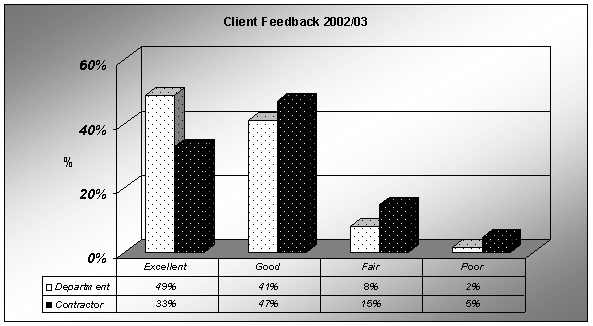
2002/03 chart is based on the results of 419 client feedback forms received.
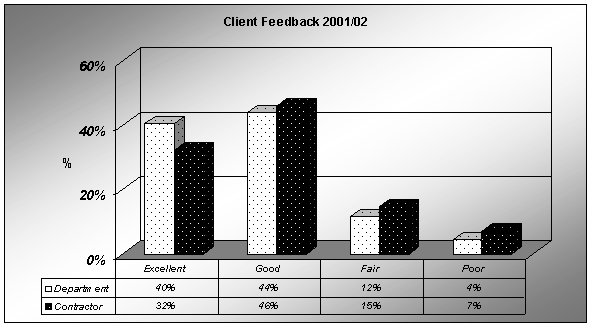
2001/02 chart is based on the results of 310 client feedback forms received