
Archived decisions
Hampshire County Council | |||
Cabinet |
Item 4 | ||
22 September 2003 |
|||
Local Government Balance of Funding Review | |||
Report of the County Treasurer | |||
Contact: Jon Pittam, ext 7400
1 Summary
1.1 The Cabinet is asked to approve a response to the Government's invitation to submit a paper to its review of the balance of local government funding between central grants and local taxation, and to agree that the response be copied to Hampshire MPs.
2 Reasons
2.1 The Council needs to influence the Government's review to maintain the local funding of services and to widen the local taxbase.
3 Other options considered and rejected
3.1 Not applicable.
4 Conflicts of interest declared by the decision maker or a member or officer consulted
4.1 Not applicable.
5 Dispensation granted by the Standards Committee
5.1 Not applicable.
6 Reason(s) for the matter being dealt with if urgent
6.1 Not applicable.
Approved by: Date:
Councillor T.K Thornber, C.B.E.
Hampshire County Council | |||
Cabinet |
Item 4 | ||
22 September 2003 |
|||
Local Government Balance of Funding Review | |||
Report of the County Treasurer | |||
Contact: Jon Pittam, ext 7400
1 Summary
1.1 The Government has invited interested parties to submit short papers to its recently established review of the balance of funding of local government between central grants and local taxation. The deadline is 30 September 2003.
1.2 This report explores the issues and principles underlying the arguments concerning the balance of funding and suggests a response to the Government's consultation, attached as Appendix 1.
2 Background
2.1 The Government promised in 2001 in its White Paper `Strong Local Leadership - Quality Public Services' to set up a high level working group to look at all aspects of the balance of funding. It eventually established the review in January 2003 with a steering group of 22 people including senior representatives of the Local Government Association, local authorities, the Chartered Institute of Public Finance and Accountancy (CIPFA), specialists in local government from academia, the business community, the trade unions and Government departments including the Treasury. It is chaired by the Minister for Local and Regional Government, Nick Raynsford.
2.2 The review's objectives are to:
· establish the nature and priority of the issue - by exploring and testing the criticisms levelled at the present balance of funding in England, establishing the key issues and determining the extent of their impact on different authorities
· identify and analyse options for change - by considering short and long term aims for changing the current balance of funding and the implications of each.
2.3 The steering group has met twice to discuss background papers and plans to meet regularly over the next year. It will then issue a final report discussing options for change. It will not make recommendations.
2.4 The Minister has invited those interested to submit papers of not more than four sides of A4 paper. The invitation includes a list of questions that consultees may wish to consider. This list covers nearly one side of A4 itself but consultees are not necessarily expected to respond to all the questions. Realistic suggestions and views on other related issues would also be welcomed by the Government.
2.5 The following paragraphs discuss the issues raised by the review in the context of the Government's questions. This analysis has then been condensed into a draft response in Appendix 1.
3 The Government's questions
Q1. Do you think that a change in the balance of funding would improve local government's accountability, efficiency, flexibility or other factors?
3.1 Until 1990, local government obtained over 50% of its revenue from locally raised taxes (the rates, both domestic and business). Grant from the Government financed from national taxation accounted for less than 50%. As the following chart shows, the position changed in 1990/91 when business rates were nationalised and then again in 1991/92 when Government grant was increased substantially following the decision to discontinue the community charge. This reduced the amount raised locally to around 25%, mainly from the council tax nowadays.
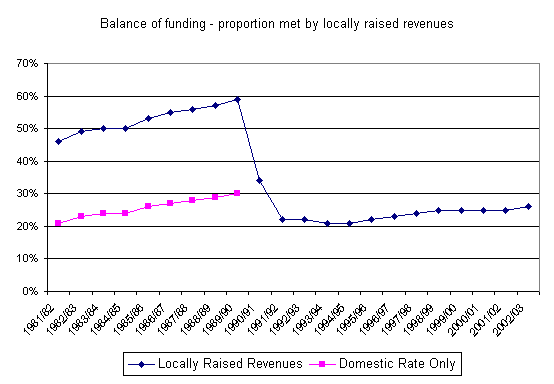
3.2 An increase in the proportion of local government's spending funded from income sources under the direct control of local government would be beneficial. Local government is not just an agent of central government, even for the services in which central government has a particular interest. Services are provided for local people who elect representatives as councillors and community leaders to see that they are provided to meet local needs and aspirations, many of which coincide with national priorities. The existing 75:25 split between central and local taxation does not allow local government to raise and control sufficient of its income to make meaningful that accountability to local people. It also hinders efficiency as too much effort is wasted on trying to maximise grant income from central government. Flexibility is compromised by the strings that are often attached to that central funding.
3.3 In its questions, the Government has not addressed the fundamental issue of the form of local government that the finance system will be supporting in future. Local authorities need to be strong and independent as elected representatives of local people, and in full control of service delivery and of their funding. This is likely to be undermined by the imposition of regional government, the passporting and ring-fencing of funding, and the hiving off major services into separate authorities or quangos with different funding streams (eg, post-16 education, police, fire, careers). This would be compounded by any solution to the balance of funding that removes schools from local authorities and funds them separately at a national or regional level. New proposals for children's services may also result in a further separation. The finance system appropriate to support a severely reduced local government would be much different from what is currently required. In particular, the Government should give a commitment that there will be no further reductions in local government's powers and duties.
3.4 The Government should also reconsider its double-funding of deprivation. Whilst it is accepted that some authorities have a higher need to spend because of deprivation in their local areas, the Government's Formula Spending Shares overstate the costs. For example, it is not credible that Birmingham should require £417.14 for every primary school pupil for deprivation costs whilst Hampshire receives £0. Or that Hackney should receive more as its top-up for deprivation for each older person (£528.12) than Hampshire receives in total per older person (£476.56). These distortions are compounded by the Government's targeted specific grants for deprivation, such as the Neighbourhood Renewal Fund.
Q2 Are there serious problems with the current local government taxation system, and if so, what are they? How can we best address them?
3.5 As with most taxes, there is a limit to how much can be raised from the council tax whilst still retaining public acceptance. The increasing disquiet at the scale of increases in recent years, particularly in 2003/04, suggests that the council tax may be approaching that limit, with the prospect that average increases in the remaining two years of the Government's current spending plans (2004/05 and 2005/06) will be at least twice inflation. The amount raised per dwelling is now almost as much in real terms as the community charge in 1990/91 just before it was abolished, as the diagram on the following page shows.
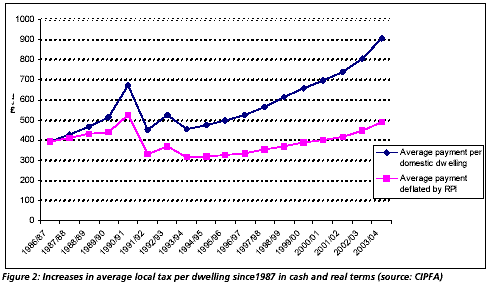
3.6 It is difficult to have a high yielding property tax without raising issues about ability to pay. The council tax is a property tax with a personal element (such as the 25% discount for single occupants). It is not as regressive as the community charge but it does impact heavily on those on low and relatively fixed incomes, particularly if they are above the thresholds for council tax benefits. Whilst in general terms the value of a person's dwelling is likely to be broadly correlated with their income, whether it is owned or rented, there will be exceptions particularly those people whose income has fallen through retirement, ill health or unemployment since they acquired their properties. But there will also be others who have chosen to maximise their investment in property and it is questionable whether they should expect more favourable tax or benefit treatment than those who invested instead in income producing assets.
3.7 A property tax focuses on a different aspect of individuals' wealth and ability to pay taxes than income tax. It is also possible to argue that some local services protect property or enhance its value, although perhaps not the major services of education and social services. On the other hand, the council tax does not meet the full cost of local services and the balance is currently provided from national taxation of income and spending.
3.8 If it is accepted that a property tax is an appropriate form of local taxation, the council tax has proven to be relatively successful. Collection rates have been high at 96%, similar to business rates at 98%. The council tax has also been predictable. Between 1997/98 and 2001/02 actual income from the council tax was never more than 2.3% different from expected income, compared with 5.4% for income tax, 4.4% for VAT and 6.8% for business rates.
3.9 Overall, the council tax is a robust and successful tax, which could be improved relatively easily by fine-tuning the valuation bands and benefit system to protect those on low or fixed incomes. As a form of taxation, it is also unique to local government and it would be a brave decision to give up such a major, reliable form of income.
3.10 However, the public may be approaching a limit in terms of how much they are prepared to pay as council tax (or at least in terms of the rate of increase in tax they are prepared to accept). Further large increases may compromise the credibility of the council tax. It would not be realistic to resolve the balance of funding by switching a significant part of central taxation to the council tax. If local government wishes to increase the proportion of its spending financed from local taxes, it will be necessary to use another form of taxation capable of yielding significant amounts to supplement the council tax.
3.11 This would be achieved by returning business rates to local control. It would improve the current split between central and local taxation from 75:25 to around 50:50. It would also encourage local businesses to engage more with their local councils ("new localism"). However, in return businesses might expect some form of representation or real influence in return for the risks to them of local control over business rates. This could perhaps be achieved by some form of representative election of business ratepayers onto councils for example. Even so, local control over the business rate is likely to be resisted by the business community and some form of restriction over the size of increases in the rate in the £ may be necessary. Currently, it is limited by statute to the annual retail price index each September. Linking the percentage increase in the business rate to the percentage increase in the council tax would be logical but would probably not provide much comfort to businesses. If the return to local control was part of a package that included introducing other forms of local taxation, it might be possible to reduce the rate in the £ at its inception. Businesses could then envisage the possibility of lower taxes as a result of local control.
3.12 The Government has resisted pressure to return business rates to local control. Instead, it has proposed allowing local authorities to retain any growth in business rates. Whilst this is helpful, it will not provide the significant increase in locally controlled taxation that local government requires. The Government's proposals for Business Improvement Districts will allow businesses to vote for higher business rates to be spent on specific projects in their areas. This is not a source of general taxation and is unlikely to raise significant amounts.
3.13 It could be argued that other forms of local taxation, in addition to the business rates and the council tax, would give local authorities more flexibility to develop taxation policies that suit their local circumstances. There have been many suggestions for new forms of local taxation over the years but most would not provide the significant yields necessary to affect the balance of funding to any material extent. The exceptions are a local sales tax and a local income tax, but both have significant drawbacks.
3.14 A local sales tax may not be practical in the relatively small jurisdictions of English local authorities because of the undermining effects of cross-boundary trading. Whilst a local income tax would be more closely linked to ability to pay than a property tax such as the council tax, it could gradually result in an increase in the level of direct taxation. On the other hand, it would be more buoyant than the council tax and the business rates. The council taxbase reflects only the increase in the number of dwellings each year and not rises in house prices. The planned revaluation in April 2007 will rebase the valuation bands from an April 1991 price base to April 2005 but this will not provide any additional income.
3.15 It has also been argued that it would be beneficial to reduce local government's dependence on the council tax as its sole source of local taxation. There would be disadvantages, however, in introducing a local income tax alongside the council tax. The public might find it difficult to understand why local government needed to raise a local income tax in addition to what it is already perceived to be a high level of council tax, with no obvious increase or improvement in service levels, even though there would be a one-off compensating reduction in national income tax.
3.16 Local government has traditionally been funded by a property tax in the UK, either the rates or the council tax (which is best described as a property tax with a personal element). There are merits in retaining that approach. The return of business rates to local control would be sufficient to change the balance of funding between central and local taxation to 50:50, which could be considered the optimum position. It would also have the advantage of not increasing the burden of local taxes on individuals.
Q3 What do you consider the most important principles and objectives of a local finance system and why? What are the implications of your chosen priorities?
3.17 Papers considered by the Review steering group have attempted to isolate the principles of a local finance system, including:
· accountability - of local authorities for their spending to their public via local taxes
· equity in the distribution of resources - so that those areas with either higher needs or lower resources, or both, receive more Government support
· fairness and legitimacy in the distribution of taxes raised - including the extent that taxes are progressive or regressive and whether the tax-take is proportionate
· buoyancy - including the need for a range of tax sources
· joining-up - does the system support and encourage partnerships and joint provision of services
· predictability and stability
· intelligibility and transparency
· cost effective to collect and hard to avoid.
3.18 It is clear that none of these principles can have primacy. There has to be some degree of trade-off and a theoretical analysis of the relative merits and ranking of these principles may be of academic interest but has limited practical benefit given the limited choice of local taxes.
3.19 The more important principles are covered by the following questions raised by the Government.
Q4 Does the present local government finance system distort accountability? If so, how? Is accountability the most important (or even the only) key principle for a workable system?
3.20 The 75:25 split between central and local funding damages the accountability of local authorities to their public, who find it difficult to understand why a 5% increase in council tax does not result in a 5% increase in spending and a 5% improvement in services. The preponderance of central funding means that changes by the Government in the distribution of revenue grant are often the most significant reason for changes in the council tax locally, as in 2003/04. The public quickly grasp that point and it undermines the credibility of both central and local government. A stable system is essential that is not undermined by arbitrary swings in Government grants.
3.21 Accountability involves more than just the balance of funding. It is essential that the `balance of control' between central and local government is reformed. For example, the Government's insistence that its planned increases in some services are passported into budgets, even though it has not provided the funding to support those increases, also undermines the accountability of councils. Central control of spending makes the current imbalance of funding even more critical. It would be eased, to an extent, if councils could spend central grants as they wished.
3.22 Accountability to all stakeholders is important but, as explained earlier, it is simplistic and unhelpful to try to isolate one principle as the most important in what is a complex and multi-faceted situation.
3.23 The role of councillors as elected representatives of the people has been repeatedly diminished by Government. It is important that this is reversed and increasing the proportion of local services funded from local taxes would be a major step forward, for example, by returning business rates to local control.
Q5 Are the balance of funding and local election turnout linked (directly or indirectly)? If so, how? Can the link be proved, and how? Does it have different effects in different areas or over time?
Q6 What else distorts the accountability of local authorities to their electorates? How and why? What can be done about it?
3.24 Some have pointed to the existing balance of funding as a reason for low and declining turnouts in local elections. The public, it is argued, see that so much of local authorities' finances are controlled by central government and believe that there is little point in voting in local elections.
3.25 This is probably true as the public's responses to budget consultation exercises and electioneering show. But it is only one of many reasons why turnouts are low in local elections, as they are in national and European elections, compared with other some other countries. The Government plans to commission research on the connection between the balance of funding, voter turnout and local authority spending decisions. It will be difficult to isolate the balance of funding as a cause from public complacency about democracy, general cynicism and dissatisfaction with politics, and disinterest if there is no personal or instant result. There is a danger that the Government will use the possibly ambiguous results from the proposed research as `real' evidence to dismiss `hearsay' arguments from local government about the balance of funding. The tone of some of the papers already prepared for the steering group suggest that the Government, or at least civil servants, are intent on undermining the balance of funding argument in order to maintain central control over the funding of local government.
3.26 The increased provision for local government in the Government's spending plans has been welcome, albeit part of the increase has been funded by the council tax and not by Government support. There are still significant shortfalls, however, between funding provision and service costs particularly on social services, schools and waste management. The lack of funding recognition for the County Council's waste management service contract, in contrast with other authorities' PFI contracts for waste, has been particularly damaging.
Q7 How important is equalisation? Would a change in the balance of funding provide an opportunity for less equalisation or more?
3.27 Local authorities have widely differing needs to spend on services because of factors such as deprivation, sparsity and area costs. These are reflected in the calculation of the Formula Spending Shares (FSS). They also have different levels of taxable resources because of varying house prices across the country. Both needs and resources are `equalised' by the Government in the current system using the revenue support grant. Local authorities with higher needs receive more grant as do those with lower council taxbases, so that the council tax in each area would be same if councils all spent at the level planned by the Government.
3.28 The existing levels of Government support through the revenue support grant and business rates are so high that each local authority receives much more grant than is necessary just to equalise their needs and resources. There could be a substantial reduction in Government support before the least needy and best resourced authority ceased to receive any grant. The Government has published a simplified calculation which shows that its formula grant (revenue support grant and business rates) for 2003/04 of £39.8bn could be reduced by £22.9bn before the best placed authority ceased to receive any grant. Business rates provided £15.6bn in 2003/04 so it would be possible for the Government to transfer control over business rates to local government and still be able to equalise needs and resources.
3.29 There would also be scope for the introduction of further local taxes raising up to £7.3bn, matched by a corresponding reduction in revenue support grant, before equalisation would require the best placed authorities to hand over some of their tax income to less well-off authorities. Such transfers would not be popular with `rich' authorities and their public.
3.30 Provided the assessment of relative needs through formulae such as the Formula Funding Shares (formerly the Standard Spending Assessments or SSAs) is fair and not double-counting other forms of Government funding, the equalisation of needs should be supported. That should not mean, however, that local authorities have no discretion over the level and nature of the services they provide. This goes to the heart of `local' government. Recent publicity about `postcode lottery' of services across the country, particularly in the health service, should be resisted or local government will be reduced to being agents of a central bureaucracy.
3.31 `Equalisation' in this context is different from the very damaging so-called `resource equalisation' imposed by the Government in its new revenue grant distribution system in 2003/04. This contributed to the £48m arbitrarily transferred from the County Council to authorities with high needs and low resources, largely in the North and the Midlands. The Government should reverse this transfer and should certainly not make further `resource equalisation' transfers in 2004/05 or future years.
3.32 The Government has, however, also raised a new concept of `dynamic equalisation' in one of the papers already considered by the balance of funding steering group. This seeks to achieve a similar transfer to areas of low resources and could be particularly disadvantageous for the County Council. The Government argues that so-called affluent areas are able to raise more from a £1 increase in the council tax than those with low taxbases. It suggests that it would be possible to equalise for incremental revenue raising. Tax rich authorities would have to pay over to tax-poor authorities part of the proceeds from any tax increase they wish to levy on their own taxpayers. Every authority in England would then be able to raise the same amount from a £1 increase in council tax, on the basis of `equal pain for equal gain'.
3.33 This proposal should be strongly opposed. After the losses of grant following the Government's review of revenue grant distribution in 2003/04, it would be unacceptable for Hampshire taxpayers to have to find yet higher tax increases so that part can be transferred to finance further spending in urban areas in the North and Midlands. Average council taxes are already highest in the South East where the higher costs of living lead to lower net disposable incomes.
Q8 How easily would equalisation work if there were no central grant and local government were funded entirely from local sources?
3.34 A scenario in which local government services could be fully funded from local sources seems unlikely, unless the Government has in mind taking away a substantial part of local authorities' responsibilities so that the rump could be funded in full from the council tax or other local taxes. One possibility might be to transfer responsibility for schools to a national agency. This would reduce FSSs nationally by at least the £22.1bn allocated for schools, possibly more if local education authorities' responsibilities were also transferred. This is similar in size to the Government's revenue support grant of £24.2bn in 2003/04. Remaining local government services could then be funded in full from local taxes via the council tax and business rates.
3.35 Whilst this might seem a simple way of resolving the balance of funding issue, the transfer of schools away from local education authorities would severely damage local government, particularly at the county level. It should be strongly opposed.
3.36 If local government were funded entirely from local sources, equalisation would involve transfers of local tax income from `affluent' authorities to those with higher needs and lower resources. This is likely to be a recipe for controversy and public disquiet at `their' taxes being used to support higher spending levels in other parts of the country. This supports the view that a 50:50 balance of funding is appropriate which would also:
· enable resources and needs to be equalised between authorities using Government grant
· recognise that authorities are expected to meet national standards for some services.
Q9 Is the restriction of local government's ability to raise taxes at will via `gearing' a useful discipline or an undemocratic burden? Does it promote efficiency? Is gearing itself the problem, or its uneven distribution?
3.37 The current dependence on Government grant means that for every 1% increase in spending, local authorities need to increase the council tax by 4%, on average. This is because the grant is fixed and all additional spending falls on the council tax. If the local tax base was widened, the gearing ratio would be reduced.
3.38 The Government argues that the gearing ratio acts as a necessary discipline on local authorities. It is a disincentive to increase spending and an incentive to search out savings and efficiencies because of the disproportionate impact of spending increases on the council tax. This may be true but it illustrates the Government's lack of trust in local authorities. In reality, there is always a significant disincentive attached to any increase in the council tax. That pressure does not need to be exacerbated by a high gearing ratio. It could also be argued that the gearing ratio actually weakens the disincentive as authorities can always blame council tax increases on something other than their own spending plans. There should be a clear transparent relationship between what local taxpayers pay and the level of service they receive.
3.39 The gearing ratio varies from authority to authority, ranging from less than 1.5:1 to 9:1 for those with high needs and low resources. The Government is concerned about the impact on such authorities and this has led to ideas such as `dynamic equalisation' discussed in paragraph 3.32. The impact of the gearing ratio would be lessened if the local tax base was widened by transferring business rates to local control, although there would still be a range of gearing ratios for different authorities.
Q10 How deeply should we be looking at other developed countries and why? What should we be looking for? Which countries should we look at and why? Do you know of any useful case studies?
3.40 Each country has developed different systems of national, regional and local government. What may or may not work in another country may not be relevant in the England because of differences in the underlying systems of government and politics. It is also necessary to take into account public perceptions in this country which have developed over time within the background of existing systems. As a result, it may be difficult to gain acceptance in England for a radically different system which may work perfectly satisfactorily in Europe or the US. For example, the public may find it difficult to accept a local income tax given the long tradition of using property-based taxes to fund local government services.
Q11 Should the Review commission research on different issues? Are the research proposals on the table realistic and suitable?
3.41 The Review has already developed research specifications on:
· the influence of tax and funding on local election turnout
· public knowledge and attitudes towards the current balance of funding and possible options
· international experience and lessons.
3.42 It might be helpful for the Government to commission research on the attitude of business towards local control over business rates, including what measures might be necessary to encourage business support for local control.
Q12 Do you think that the problems we (and you) have identified can be solved by a package of reforms to the existing system (e.g. changing the banding on council tax, encouraging local referendums on financial issues)? If not, please explain why you think major (and probably disruptive) change is needed.
3.43 A major change to the balance of funding is necessary. Transferring business rates to local control would be a significant change to the balance of funding but it would not be particularly disruptive.
3.44 Fine-tuning of the council tax is also necessary to make it less regressive, particularly for those on low or slowly rising incomes. Changes are also necessary to the bands, particularly at the top and bottom.
3.45 Turnout in local and general elections may be lower than desirable because the public have grown used nowadays to the instant results of interactive reality television shows. They find it more difficult to see a link between a decision to vote today in an election and the long-term events of a four or five year electoral term.
3.46 Referendums on one-off topics such as budget or council tax proposals might superficially meet the public's taste for instant voting, but they would cut across the primary role of councillors as representatives of the people, particularly if the results were binding. If voter fatigue is a real issue, introducing more and more referendums is unlikely to be successful in the longer term. The first referendum on budget proposals might be well supported but that is likely to pall if referendums are employed every year by each tier of local government (county, district, police, fire and parish in some shire areas). Formal referendum should be used as sparingly in local government as they are in national government. There are other more effective and less disruptive ways of consulting the public as the Government has shown in its guidance to local authorities on budget consultation.
3.47 The Government has highlighted in one of the background papers for the balance of funding steering group the reforms it has introduced over the last few years, including:
· the introduction of well-being powers
· reduced ring-fencing of revenue grants
· the single capital pot, reducing the ring-fencing of capital support
· the proposed prudential capital borrowing powers
· business improvement districts under which businesses can vote to pay higher business rates for investment in specific projects
· proposals for local authorities to retain part of the growth in business rate income
· access to potential additional income from congestion charges
· new freedoms to charge and trade
· retaining additional income from reducing the council tax discount on second homes
· retaining income from civil penalties for litter and dog fouling
· other freedoms for authorities rated as excellent.
3.48 Whilst most of these initiatives are welcome (although in many cases still to come into effect), it would be misleading of the Government to suggest that these changes will provide sufficient additional resources to make a meaningful change to the balance of funding.
Q13 What specific options for major change would you propose or support? What changes might you oppose? Why? What are the pros and cons of each of these options?
3.49 The Government should:
· transfer the business rates to local control, thereby improving the balance of funding to 50:50, subject to linking the increase in the business rates to the increase in the council tax and to providing the business community with effective representation on councils
· fine-tune the council tax, by revising the top and bottom valuation bands and by increasing the number of bands to make it less regressive
· improve the council tax benefit system to give better protection to those on low and slowly rising incomes
· reverse the `resource equalisation' introduced in the revenue grant distribution system in 2003/04 or, at least, do not make further resource equalisation adjustments in 2004/05 or subsequent years
· not introduce `dynamic equalisation'
· not make any further transfers of services away from local government, such as schools
· not introduce a local sales tax or a local income tax.
4 Response to the Government
4.1 The issues discussed above have been condensed into a four-page draft response in Appendix 1.
Recommendations
1 That the Cabinet authorises the County Treasurer to respond to the Government's invitation to submit views on its review of the balance of funding on the basis of the draft response attached as Appendix 1 subject to any comments Cabinet may have.
2 That the agreed response be copied to Hampshire MPs.
Section 100D Local Government Act 1972 background papers
The following documents disclose facts or matters on which this report, or an important part of it, is based and has been relied upon to a material extent in the preparation of this report.
N.B. the list excludes:
Published works.
Documents which disclose exempt or confidential information as defined in the Act.
TITLE FILE
None.
i:\ . . . . \ian\docs\Balance of Funding Review2.doc
Appendix 1
Balance of Funding Review - Draft Response
1 The following submission to the Government's review of the balance of funding between central and local government has been agreed by the County Council's Cabinet.
2 The County Council believes that a major change to the balance of funding is necessary to give local authorities the capacity to deliver the services that local people and the Government require. This change can be achieved by:
· transferring the business rates to local control, thereby improving the balance of funding to 50:50, subject to linking the increase in the business rates to the increase in the council tax and to providing the business community with effective representation on councils
· fine-tuning the council tax, by revising the top and bottom valuation bands and by increasing the number of bands to make it less regressive
· improving the council tax benefit system to give better protection to those on low and slowly rising incomes
· reversing the `resource equalisation' introduced in the revenue grant distribution system in 2003/04 or, at least, not making further resource equalisation adjustments in 2004/05 or subsequent years.
3 In addition, the Government should:
· not transfer any further services away from local government, such as schools
· not introduce a local sales tax or a local income tax
· not introduce `dynamic equalisation'.
4 The following sections outline the County Council's thoughts on these issues in more detail.
Balance of funding
5 An increase in the proportion of local government's spending funded from income sources under the direct control of local government would be beneficial. Local government is not just an agent of central government, even for the services in which central government has a particular interest. Services are provided for local people who elect representatives as councillors and community leaders to see that they are provided to meet local needs and aspirations, many of which coincide with national priorities. The existing 75:25 split between central and local taxation does not allow local government to raise and control sufficient of its income to make meaningful that accountability to local people. It also hinders efficiency as too much effort is wasted on trying to maximise grant income from central government. Flexibility is compromised by the strings that are often attached to that central funding.
6 The Government has not addressed the fundamental issue of the form of local government that the finance system will be supporting in future. Local authorities need to be strong and independent as elected representatives of local people, and in full control of service delivery and of their funding. This is likely to be undermined by the imposition of regional government, the passporting and ring-fencing of funding, and any further transfer away of major services, such as schools, to national agencies. The finance system appropriate to support a severely reduced local government would be much different from what is currently required. In particular, the Government should give a commitment that there will be no further reductions in local government's powers and duties.
Problems with the current local government taxation system
7 There is a limit to how much can be raised from the council tax whilst still retaining public acceptance. The increasing disquiet at the scale of increases in recent years, particularly in 2003/04, suggests that the council tax may be approaching that limit, with the prospect that average increases in the remaining two years of the Government's current spending plans (2004/05 and 2005/06) will be at least twice inflation. The amount raised per dwelling is now almost as much in real terms as the community charge in 1990/91 just before it was abolished.
8 It is difficult to have a high yielding property tax without raising issues about ability to pay. The council tax is not as regressive as the community charge but it does impact heavily on those on low and relatively fixed incomes, especially pensioners, particularly if they are above the thresholds for council tax benefits. A property tax focuses on a different aspect of individuals' wealth and ability to pay taxes than income tax. It has an impact on those people such as pensioners who may be "capital rich but income poor".
9 Overall, the council tax is a robust and successful tax, which could be improved relatively easily to make it less regressive, by fine-tuning the benefit system to protect those on low or fixed incomes and by varying the number of valuation bands and the ratios between them. As a form of taxation, it is also unique to local government and it would be sensible to retain such a major, reliable form of income.
10 It would not be realistic to resolve the balance of funding by switching a significant part of central taxation to the council tax. If local government wishes to increase the proportion of its spending financed from local taxes, it will be necessary to use another form of taxation capable of yielding significant amounts to supplement the council tax.
11 This would be achieved by returning business rates to local control. It would improve the current split between central and local taxation from 75:25 to around 50:50. It would also encourage local businesses to engage more with their local councils ("new localism") and their contribution could be recognised by allocating the business community representation on councils, possibly through an election amongst business ratepayers. If the return to local control was part of a package that included introducing other forms of local taxation, it might be possible to reduce the rate in the £ at its inception. Businesses could then envisage the possibility of lower taxes as a result of local control. Limits on local business rate rises could otherwise be considered.
12 It could be argued that other forms of local taxation, in addition to the business rates and the council tax, would give local authorities more flexibility to develop taxation policies that suit their local circumstances. Few taxes would provide the significant yields necessary to affect the balance of funding to any material extent. The exceptions are a local sales tax and a local income tax, but both have significant drawbacks.
13 A local sales tax may not be practical in the relatively small jurisdictions of English local authorities because of the undermining effects of cross-boundary trading. Whilst a local income tax would be more closely linked to ability to pay than a property tax such as the council tax, it could gradually result in an increase in the level of direct taxation. The public might also find it difficult to understand why local government needed to raise a local income tax in addition to what it is already perceived to be a high level of council tax, with no obvious increase or improvement in service levels.
14 Local government has traditionally been funded by a property tax in the UK, either the rates or the council tax (which is best described as a property tax with a personal element). There are merits in retaining that approach. The return of business rates to local control would be sufficient to change the balance of funding between central and local taxation to 50:50, which could be considered the optimum position. It would also have the advantage of not increasing the burden of local taxes on individuals.
Principles
15 There has to be some degree of trade-off between the principles identified for a local taxation system. A theoretical analysis of the relative merits and ranking of such principles may be of academic interest but has limited practical benefit given the limited choice of local taxes.
Accountability
16 The existing 75:25 split between central and local funding damages the accountability of local authorities to their public, who find it difficult to understand why a 5% increase in council tax does not result in a 5% increase in spending and a 5% improvement in services. The preponderance of central funding means that changes by the Government in the distribution of revenue grant are often the most significant reason for changes in the council tax locally, as in 2003/04. The public quickly grasp that point and it undermines the credibility of both central and local government. A stable system is essential that is not undermined by arbitrary swings in Government grants.
17 Accountability involves more than just the balance of funding. It is essential that the `balance of control' between central and local government is reformed. The Government's insistence that its planned increases in some services are passported into budgets, even though it has not provided the funding to support those increases, undermines the accountability of councils. Central control of spending makes the current imbalance of funding even more critical. It would be eased, to an extent, if councils could spend central grants as they wished.
18 The role of councillors as elected representatives of the people has been repeatedly diminished by Government. It is important that this is reversed and increasing the proportion of local services funded from local taxes would be a major step forward, for example, by returning business rates to local control.
Local election turnouts
19 Public concern about the extent to which local authorities' finances are controlled by central government is only one of many reasons why turnouts are low in local elections, as they are in national and European elections, compared with other some other countries. It is difficult to isolate the balance of funding as a cause from public complacency about democracy, general cynicism and dissatisfaction with politics, and disinterest if there is no personal or instant result.
Equalisation
20 Provided the assessment of relative needs through formulae such as the Formula Funding Shares is fair and not double-counting other forms of Government funding, the equalisation of needs is supported. That should not mean, however, that local authorities have no discretion over the level and nature of the services they provide. This goes to the heart of `local' government. Recent publicity about `postcode lottery' of services across the country, particularly in the health service, should be resisted or local government will be reduced to being agents of a central bureaucracy.
21 `Equalisation' in this context is different from the very damaging so-called `resource equalisation' imposed by the Government in its new revenue grant distribution system in 2003/04. This contributed to the £48m arbitrarily transferred from the County Council to authorities with high needs and low resources, largely in the North and the Midlands. The Government should reverse this transfer and should certainly not make further `resource equalisation' transfers in 2004/05 or future years.
22 The County Council strongly opposes the suggestions in one of the papers considered by the Balance of Funding Review for `dynamic equalisation'. It would be iniquitous for `tax rich' authorities would have to pay over to tax-poor authorities part of the proceeds from any tax increase they wish to levy on their own taxpayers. This would discredit the council tax and potentially make it unworkable, when there are already severe local concerns about people's ability to pay recent increases and about the cross-subsidisation by Hampshire residents of services elsewhere in the country.
23 It seems unlikely that local government services could be fully funded from local sources, unless the Government has in mind taking away a substantial part of local authorities' responsibilities so that the rump could be funded in full from the council tax or other local taxes. The County Council strongly opposes any further transfers of functions, such as schools, away from local government.
24 If local government were funded entirely from local sources, equalisation would involve transfers of local tax income from `affluent' authorities to those with higher needs and lower resources. This is likely to be a recipe for controversy and public disquiet at `their' taxes being used to support higher spending levels in other parts of the country. This supports the view that a 50:50 balance of funding is appropriate.
Gearing
25 It may be true that the gearing ratio is a disincentive to increase spending and an incentive to search out savings and efficiencies because of the disproportionate impact of spending increases on the council tax. In reality, there is always a significant disincentive attached to any increase in the council tax. That pressure does not need to be exacerbated by a high gearing ratio. The gearing ratio may also weaken the disincentive as authorities can always blame council tax increases on something other than their own spending plans. There should be a clear transparent relationship between what local taxpayers pay and the level of service they receive.
Research
26 It might be helpful for the Government to commission research on the attitude of business towards local control over business rates, including what measures might be necessary to encourage business support for local control.
Local referendums on financial issues
27 Referendums on one-off topics such as budget or council tax proposals might superficially meet the public's taste for instant voting gained from interactive reality television shows, but they would cut across the primary role of councillors as representatives of the people, particularly if the results were binding. If voter fatigue is a real issue, introducing more and more referendums is unlikely to be successful in the longer term. The first referendum on budget proposals might be well supported but that is likely to pall if referendums are employed every year by each tier of local government (county, district, police, fire and parish in some shire areas). Formal referendum should be used as sparingly in local government as they are in national government. There are other more effective and less disruptive ways of consulting the public as the Government has shown in its guidance to local authorities on budget consultation.