
Archived decisions
Hampshire County Council Executive Member - Social Care Item 3 22 September 2003 Care Attendants Report of the Director of Social Services |
Contact: Glyn Jones Ext: 7257
1 Summary
The following decisions are sought:
1.1 The Executive Member for Social Care approves Option 3 (see section 5.3).
2. Reason(s)
2.1 To enable domiciliary care services to be provided in the most effective way with regards to the current regulations and criteria. It will develop a number of specialist independent sector services. The proposed changes will not reduce service levels for individual users. It is anticipated that there will be an overall increase in contact hours purchased for disabled people in North Hampshire.
3 Other options considered and rejected
3.1 There were two other options considered:
Retention of the Care Attendant Service. This was not feasible due to the size of the service and costs of meeting regulatory requirements, together with the inability of users to use Independent Living Funding (ILF) to purchase additional care from the scheme.
Linking the Care Attendant Service with the Home Care Service. As above the same constraints regarding ILF apply. This sort of service is not a priority in the development of Home Care Services.
4 Conflicts of Interest declared by the decision-maker or a Member or Officer consulted
4.1 None
5 Dispensation granted by the Standards Committee
5.1 None.
5 Reason(s) for the matter being dealt with if urgent
5.1 Not applicable
Approved by: Date of decision:
Councillor Felicity Hindson
Hampshire County Council | |
Social Care Executive |
|
22 September 2003 | |
Care Attendants | |
Report of the Director of Social Services | |
Contact: Glyn Jones ext: 7257
1. Introduction
1.1 This report follows a review of future plans for the Care Attendant (CA) service where it is currently provided by Hampshire Social Services. The purpose of this report is to set out the context, content and recommendations of the review, seeking approval for the proposed course of action.
1.2 The review of the Care Attendant Service was identified in the action plan within the Commissioning Plan for Physical Disability and Sensory Services. There are three CA schemes covered by this report: Alton, Basingstoke and Winchester/Andover/Eastleigh.
1.3 A reference group was established to guide the process and a working group to complete relevant project work. The review had the following objectives:
· To identify commissioning requirements for domiciliary care for disabled people
· To consider the feasibility of the CA service being able to address these needs
· To identify options for future provision
2 Background
2.1 Care Attendant (CA) schemes were established as a joint-funded (Social Services and Health) scheme to enable disabled adults (under 65) to live in the community. This meant providing more intensive and complex domiciliary care and support than was generally available from other services at the time. There is no longer a distinction between the in house service and independent providers in terms of the level and complexity of care which can be provided. In Aldershot and South East areas of the County, the equivalent of a CA service is purchased through independent sector agencies.
2.2 The environment has also changed with options for living in the community now including Direct Payments, the Independent Living Fund, Supported Housing and Continuing Healthcare Funding. Through these funding streams, and with increased expectation of living in the community, an increasing number of people are being supported in their own homes, including individuals with greater and more complex support needs - for whom this would not have been an option in the past.
2.3 During the past three years the CA service has focussed on different priorities across the geographical area covered. In some areas the service has aimed to provide a long term service for clients with severe disabilities and complex problems. In other areas the focus has been to work with health colleagues and day services to provide a shorter term goal orientated reablement service.
2.4 In the three schemes, where the In House CA service has been provided there are many areas with low unemployment within a very rural geographical area. It is often difficult to find an adequate supply of domiciliary care at the time it is wanted at an affordable cost in the current marketplace. The CA service covers a smaller number of clients over a larger area than most providers.
2.5 The development of the National Care Standards Commission (NCSC) requires all domiciliary services to be registered by April 2003. More stringent standards will be required to be met to comply with regulations which include development of policies and procedures, and requirements to train care staff to NVQ 2 level and maintain a percentage of qualified staff.
3 The Existing Schemes
3.1 In March 2003 the current schemes employed 32 carers to help support 96 physically disabled adults to live in the community. 7 carers worked in the Alton Scheme, 9 in Basingstoke and 16 in the Winchester/Andover Scheme.
3.2 Of these 96 clients, 43 received a combination of support from the CA schemes plus the independent sector, and 53 solely from CA schemes. However in the same areas, independent domiciliary agencies supported a further 179 physically disabled adults to live in the community. The total number of clients supported by domiciliary care was 275.
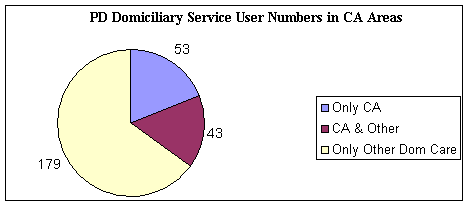
3.3 It is recognised that when it works consistently CA schemes can manage very complex care needs with experienced, trained workers. However there are a number of concerns expressed about the current situation.
a. The service no longer has a clear niche in the domiciliary care market.
b. ILF funding cannot be used to purchase in-house services.
c. It is difficult for the service to guarantee whole provision of packages (this is related particularly to being a small, dispersed service)
d. Difficulty in recruiting and retaining carers on the current terms and conditions has led to a reducing workforce. This has increased both travel and fixed costs per client contact hour.
e. Changing the current working culture and arrangements would not be possible within current terms and conditions. Zero base hours contracts have led to a practice of workers choosing when and with whom they work.
f. Unit costs are high.
3.4 The size of the service, given the geographical area covered, and lower density of service required, is well below the optimum to provide effective rostering, and cover for leave, training and sickness absence. For example the Winchester/Andover Home Care Service is organised into teams based on 7 patches. Each patch provides an average of 325 contact hours per week, a total of 2,275 hours per week for the 7 patches in the Winchester/Andover area. In contrast the CA service has attempted to provide 325 contact hours a week across the whole Winchester/Andover area, operating as 1 patch across the whole of the 7 areas covered by Home Care.
3.5 The small numbers of staff and clients per patch lead to increased risks of having difficulty covering sickness, leave, training etc, and therefore to be able to offer the consistency and reliability of service delivery expected by Care Managers. It also means an increased proportion of working time spent travelling. Unit costs also increase with the lack of economies of scale.
3.6 The NCSC requires a Registered Manager to work in each base which provides a CA Service. Given the distance in travel across the three large rural areas covered, Winchester/Andover, Basingstoke and Alton, it would not be feasible to reduce the number of work bases or to seek to centralise the service. The structure of the service therefore makes it the most expensive option given the cost of management overheads to retain the service within the three areas.
3.7 Registration with the NCSC has additional implications for development of policies, procedures and practice, training and recording. Whilst schemes were previously inspected and met the required standards, considerably more investment would be required to meet the current requirements.
4 Commissioning Requirements
4.1 Managers and staff from both purchasing and providing teams considered the commissioning needs, and service gaps for adults with physical disabilities. Two sets of needs were identified which required skilled and specialised intervention:
· high dependency, complex cases and terminal care
· or assessment, brokerage and reablement
4.2 Whilst the relevance and importance of the latter option to independent living and rehabilitation initiatives were recognised, the overwhelming area of need for sufficient and suitable service provision is in meeting the long term needs of high dependency and complex client provision. Intermediate care provision is already being developed by health and social services which provide for adult as well as older clients.
4.3 Consistency/flexibility, availability and quality were identified as the most important requirements in terms of service provision.
4.3.1 Consistency/ flexibility and availability
The need to cover from morning to night time seven days a week was a significant issue, as this is not available in all schemes. Services provided to highly dependent clients must be reliable and consistent to ensure that complex care needs can be met, and that clients are not put at risk by visits being missed or using staff with insufficient training. Care needs may also vary and provision needs to be made for visits to be lengthened or increased during periods of additional ill health.
The limited amount of care available, and difficulty in covering complex packages reliably from CA Services means funding is already used to purchase from independent providers to support service users with the consistent service they require.
4.3.2 Quality
The support needs, complexity of the personal care tasks, and moving and handling of many adult clients with physical disabilities, makes it more difficult to purchase suitable services for clients. In addition many of these clients require a greater number of hours provision than the average domiciliary care package and may present with more challenging behaviour as part of the symptoms of their condition.
Carers therefore require specialist training, not only in terms of their ability to understand particular conditions, care needs and issues, but the effects of these on individuals and families.
An important feature of the proposal includes the continuation of an individual service. It is essential that Hampshire County Council continues to place emphasis on both the quality of service and the accountability of future services. This will be achieved through its contracting mechanisms.
4.3.3 Costs
The need to maintain services within budget is a commissioning pressure. Any future venture needs to ensure that costs are justified in terms of the services provided. The current cost of care attendant via sample costing to provide an hour of carer time with a service-user (contact hour) is £19.17.
If the CA service was to provide a seven-day, morning to evening service, the unit cost with enhancements would conservatively rise by over 5%.
4 Option Appraisal
Three options were considered for future service provision and an options appraisal was carried out. A number of factors contributing to both service outcomes and the process of service development were considered. The table outlining the appraisal of options for provision of the CA service is included in Annexe A.
1. Retaining Care Attendant Service as a discrete service
2. Linking the Care Attendant Service with the Home Care service
3. Purchasing Care Attendant Services via the independent sector (In Aldershot CA services are already purchased through the independent sector and this has been
the source for comparison figures for this option.)
5.1 Option 1: Retaining Care Attendant Service as a discrete service
The size of the service and the geographical area covered has mitigated against the delivery of a cost effective service, despite the best efforts of managers and carers.
The table in section three identifies that less than 20% of clients receive a service only from CAs. This is due to the development of expertise in the independent sector and inability of the CA Service to provide sustained service delivery.
There has been increased use of the Independent Living Fund (ILF) by clients. This enables them to purchase their own services but legally Local Authorities cannot sell services so use of the CA service is prohibited.
The NCSC requirement for trained care staff at NVQ2 level is 50% by 2007. At present none of the Care Attendants have an NVQ qualification. To achieve a level of 55% of the workforce qualified would require 30 - 40% to be undergoing training for a one and a half to two year period, based on an average of 5 years in post for each carer. Ongoing NVQ training would be required for new recruits depending on the turnover of staff, which is high in the care industry.
5.2 Option 2: Linking the Care Attendant service with the Home Care service
In considering the potential for Home Care managing a CA service, their current situation must be considered, including recruitment issues and ability to supply a service which is distinct from their developing core business of short term, intermediate care initiatives.
The use of Home Care Services would also be prohibited for users of the ILF.
However the Home Care Service is currently better aligned to the requirements of the National Care Standards than is the CA Service and there has been a significant investment in achieving the required levels of NVQ training. Also, integration with the Home Care Service would offer the benefits of a centralised structure which includes personnel, finance and business management as specialist areas of expertise relating to direct service provision.
Transferring clients and staff to an In House Service would be managed internally and could present fewer personnel difficulties, provided that staff are able to work the rosters required by Home Care.
Previous attempts to integrate Home Care and CA Services have produced strong resistance from clients, who view the Home Care Service as a service for older people, and consider their needs to be very different to older people.
Any agreement to merge the two services would require a Service Level Agreement to ensure the service is provided against a service specification at an agreed price, so that the distinct purpose and priorities of the CA service could be maintained.
5.3 Option 3: Purchasing Care Attendant Services via the independent sector
This is how the majority of service is already purchased for adult clients with physical disabilities, with over 80% of clients receiving care from independent providers. The Aldershot CA Service is already provided through a purchased rather than in house service, initially by the Leonard Cheshire Foundation and now by Quality Care.
The advantages of this type of provision are :
· CA funding is directed to the most appropriate clients
· Increased flexibility is possible from a service which is a large scale provider
· Hourly rate is cost effective against costs of in house provision and there are reduced administrative costs and time
· All staff and care regulations are the responsibility of the agency.
· ILF can be used to purchase services.
· Contracts can be sought with local providers for each area on a PCT basis and therefore local health requirements can be considered as part of the service specification for each area.
Based on current market rates, it is suggested that 25-30% more service could be purchased by contracting with the independent sector.
However in the short term, the process of establishing contracts and managing the personnel issues would be more complex.
5.4 The options for future service provision have been considered and compared. in a fair and reasonable way, and the preferred option is option 3, to purchase the service via the independent sector.
5 Consultation with Users and Carers
6.1 All service users in receipt of care attendant only service have been seen by a member of staff to explain to them about proposed changes to service delivery. Service users in receipt of joint packages have been notified. Whilst there has inevitably been some concern, users have in the main been reassured by our approach and explanations that this is not about a reduction in service available to them.
6.2 Service user organisations locally have also been notified about the proposed model of service delivery.
5.3 There have been concerns raised about the proposal. It is a long standing service that has been valued; where relationships have been established this can be difficult, as we know from other changes in domiciliary care. In particular issues have been raised about the impact on quality and accountability. This report has attempted to answer these concerns and individual contact has been made.
5.4 As a consequence of staff changes, there have already been some negotiated changes with users. This is the intended pattern if the proposal is accepted.
6.5 A contingency plan is being developed for the maintenance of services throughout any transition, which would be anticipated to be complete by the end of November 2003.
6 Consultation with Primary Care Trusts (PCT)
7.1 Discussion has taken place with colleagues in all three PCT areas covered by the CA service and an extended period of time provided for feedback and comment. This is important as the services are joint funded. Concern was raised about maintaining collaborative planning and provision for clients with complex needs if independent providers were involved. However it was acknowledged that some very effective collaborative working has already taken place with independent providers.
7.2 It was also noted that whilst Care Attendants have not been involved in NVQ training, they have received a high level of training, often from health partners, that enables them to meet the care needs of clients with very complex disabilities. This training has included understanding the needs around specific disabilities, particularly neurological.
7.3 Questions have also been raised regarding the longer term joint commissioning requirements for adult clients with long term care conditions when the National Service Framework is published. However local contracting, on a PCT basis, is likely to provide a base for securing the immediate needs for service provision and flexibility for planning and meeting future priorities. There is a willingness to work with the agreed option, and PCTs have requested to be involved in the commissioning requirements of contracts and in the monitoring process.
8 Staffing
8.1 Discussions have begun with trade unions and staff members. There have been two sets of meetings with staff about the likely options open to then if the proposal is accepted.
8.2 It is recognised that the staff group have valuable skills which the council wishes to retain. Subject to the decision being made regarding the proposal it is intended that all staff will have redeployment status.
8.3 Many staff have applied successfully in advance of this for vacancies with the Home Care service. As a consequence the number of staff left in the service has nearly halved from that set out in paragraph 3.1.
8 Conclusion
9.1 There are clear issues with the continuation of the Care Attendant service as it currently stands, particularly due to the small, and non cost effective size of the service.
9.2 It is recognised that pursuing Option 3, purchasing the service via the independent sector, will cause an initial disruption to a small number of users who exclusively use the care attendant service. However, our experience of transferring the Care Attendant Service in Aldershot from the voluntary sector to the independent sector (on their termination) proved fairly successful. We would seek to replicate this approach.
9.3 The preferred option will mean that there will continue to be a choice for users. The contracting arrangements will ensure that the council retains accountability for services purchased. Care Managers will assist in the monitoring of quality via reviews and service users' feedback, alongside the new regulations and Inspection by the National Care Standards Commission.
9.4 The proposed changes will not affect the size of care packages for users; we have been stressing this in our contact with carers. There are opportunities for staff to move to similar jobs within the County Council to ensure their expertise is not lost.
9.5 It is also anticipated that we will be able to purchase additional contact hours as a consequence of this proposal for the same expenditure, yet minimising the number of agencies involved with individuals wherever possible.
9.6 Work will continue to be developed with PCT colleagues to re-establish joint commissioning arrangements for the future.
10 Recommendations
10.1 The Executive Member for Social Care is asked to approve Option 3 (see section 5.3).
ANNEXE A
OPTIONS APPRAISAL FOR PROVIDING CARE ATTENDANT SERVICE TO MEET REQUIREMENTS FOR :
High dependency clients/Terminal care clients/Complex client needs
OPTIONS |
|||||
CRITERIA |
In house CA |
In house HC |
Indep Sector | ||
O U |
Consistency/flexibility of service |
1 |
2 |
2 | |
T C O |
Availability of service including rural areas |
1 |
2 |
2 | |
C O M |
Specialist care and training provided |
2 |
2 |
2 | |
E S |
Cost effectiveness |
1 |
2 |
3 | |
R E Q |
Ability to work with individual PCTs re future developments/partnerships |
2 |
2 |
3 | |
U I R |
Ability to combine package with Direct Payments |
1 |
1 |
3 | |
E D |
Access to ILF funding |
1 |
1 |
3 | |
TOTALS |
9 |
12 |
18 | ||
P R |
Care Standards Requirements |
1 |
2 |
3 | |
O C |
Impact on staffing |
2 |
2 |
1 | |
E S S |
Perceived client perspective/impact |
2 |
1 |
2 | |
I S S |
Personnel/management implications: short term requirements long term requirements |
1 1 |
2 2 |
1 3 | |
U E S |
Possible Political implications of changing arrangements for CA Service |
3 |
2 |
1 | |
TOTALS |
10 |
11 |
11 | ||
SCORING -
OUTCOMES REQUIRED: 1 = low ability to provide, 3 = high ability to provide
PROCESS ISSUES : 1 = most complex issues, 3 = least complex issues
THEREFORE HIGHEST SCORES = MOST FAVOURABLE CHOICES