
Archived decisions
Hampshire County Council Andover and Western Hampshire Transportation Strategy Members' Panel 16 October 2003 Results of Transpol Travel Survey 2003 - Western Hampshire Report of the Director of Environment |
Item 10 |
Contact: Neil Thompson, ext 6298 email: [email protected]
1. Summary
1.1 This report outlines the key findings of the Test Valley travel attitude survey (Transpol), conducted in February 2003 for Western Hampshire, and the significance of the survey's findings for the local transport plan targets and objectives set out for the Western Hampshire Transport Strategy. The Executive Summary of the Transpol report is attached as an appendix.
2. TRANSPOL Travel Attitudinal Survey
2.1 Since 1992 Hampshire County Council has undertaken a rolling programme of travel attitude questionnaire surveys (Transpol). The surveys are conducted for each local authority district, and aid understanding of public attitudes towards transportation and can identify local transport issues. In February 2003, the latest survey was conducted for the whole of Test Valley. The data collected has been analysed on a district-wide basis, with key elements also reviewing the Western Hampshire part of the area as well.
3. Western Hampshire Transport Strategy - Targets and Objectives
3.1 The Western Hampshire Transport Strategy (WHTS) was produced following a public consultation exercise in November 2002 and approved by this Panel in March 2003.
3.2 The key objective of the strategy is to promote and encourage the use of non-car modes (public transport, cycling and walking) as an alternative to the car. The Transpol survey seeks to measure the satisfaction ratings of non-car modes, acting as an indicator of changing public perceptions towards car travel and the switch to alternative modes.
3.3 The surveys also help residents to consider their travel habits and how their action can contribute towards meeting the local Area Transport Strategy targets. The Transpol surveys demonstrate progress towards the key performance indicators, in particular to increase public support for more sustainable travel modes by 25% by 2010. Transpol is an integral part of the monitoring programme for Western Hampshire, which has been designed to identify actual progress on the ground, by meeting local targets, and contributing towards the provision of a safer and integrated transport network in Western Hampshire.
4. Summary of Transpol Findings
4.1 Postal questionnaires (including a travel diary) were distributed to 4,487 randomly selected households across Test Valley Borough in February 2003. Over 1,360 completed questionnaires were returned, representing a response rate of 31% (approximately 3% of all households in Test Valley). For the WHTS area 1,405 questionnaires were distributed, with 422 completed and returned. The data obtained was weighted to reliably represent the demographic structure of the area. A similar survey was conducted in November 1997, and comparisons have been made between the two surveys where possible. The methodology and approach have remained largely unchanged since the 1997 survey, although in comparing the results it should be noted that the questionnaire has been updated to closely reflect the changing travel patterns and socio-economic requirements over the intervening period.
4.2 One area of significant change is in relation to the use of the Internet, which can have a strong influence on travel choice. Over 75% of respondents in the Test Valley area have access to the Internet, with 63% accessing the Internet at home. The wider availability of public transport information on the web has widened travel scope for residents, allowing consideration of the bus over the car for short journeys to/from work, and enabling home working to reduce the demand for daily commuting.
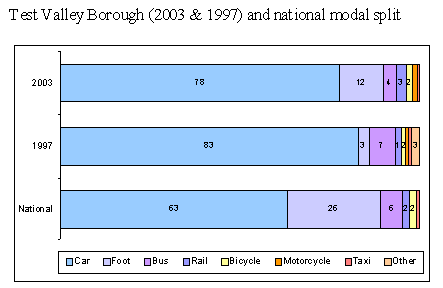
4.3 The modal split identified is shown in Table 1 below and is compared with figures from the National Travel Survey (NTS) for rural areas.
Table 1: WHTS - Modal Split Comparisons with Borough, County and National Travel Surveys
(All journeys over one mile)
Mode |
Borough - 1997 |
WHTS - 2003 |
Borough -2003 |
NTS -2003 |
Car |
83 |
84 |
78 |
63 |
Foot |
3 |
8 |
12 |
26 |
Bus |
7 |
3 |
4 |
6 |
Rail |
1 |
3 |
3 |
2 |
Cycle |
2 |
2 |
2 |
2 |
Taxi |
1 |
1 |
1 |
1 |
Other |
3 |
0 |
0 |
0 |
The higher proportion of car users, compared to the national mean, reflects the predominantly rural nature of the locality, with the lower incidence of public transport usage reflecting the few integrated rural bus/rail services. However, the proportion of people walking local distances within the WHTS area is higher then the district-wide figure.
4.4 Table 2 illustrates modal share for journeys to work.
Table 2: WHTS - Journey to Work Modal Split (Over One Mile)
Mode |
Borough - 1997 |
WHTS - 2003 |
Borough- 2003 |
NTS - 2003 |
Car |
74 |
86 |
74 |
70 |
Foot |
10 |
6 |
10 |
9 |
Bus |
2 |
1 |
2 |
3 |
Rail |
8 |
6 |
8 |
12 |
Cycle |
5 |
0 |
5 |
6 |
Taxi |
0 |
1 |
1 |
1 |
Other |
0 |
0 |
0 |
0 |
The proportion of commuters driving to work is substantially above the national mean in the WHTS area. Within Test Valley as a whole, the 1997 and 2003 figures indicate a decline in the proportion of people walking to work, cycling or using public transport.
4.5 Table 3 provides details of the modal split of journeys to school for all schoolchildren.
Mode |
Borough - 2003 |
WHTS - 2003 |
NTS - 2003 |
Car |
47 |
54 |
31 |
Foot |
29 |
13 |
33 |
Bus |
19 |
29 |
32 |
Rail |
1 |
0 |
0 |
Cycle |
4 |
4 |
4 |
Taxi |
0 |
0 |
0 |
Other |
0 |
0 |
0 |
The rural nature of the area suggests that the longer travel distances between residential areas and local schools contribute to the higher than the national mean figure for school trips by car. The survey also records that a higher number of pupils use school buses serving the more rural parts of the area where scheduled bus services are fewer in frequency.
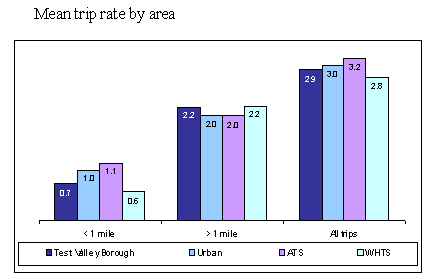
4.6 An analysis of trip rates has been undertaken, where a trip was defined as a single journey from origin to final destination. Respondents were asked to provide details of journeys they had made the previous day in the travel diary section of the questionnaire. In the WHTS area, an average of 2.9 trips were made, comprising 0.7 trips of a distance less than one mile, and 2.2 trips over one mile. Although the 1997 report does not disaggregate trip rate by district and area, the average trip rate for the Borough is 1.9 trips of over one mile. Younger age groups make on average more types of trips, though the aggregate total trip rate by males and females is the same for both genders at 2.9 trips for the Borough.
4.7 Respondents were asked how frequently they travelled by different modes of transport, and to indicate the reasons for their travel decisions. This showed that travel patterns are strongly influenced by car ownership. The majority travel mode in the Test Valley (78%) and the WHTS area (84%) is by car and, in particular, car journeys were favoured for their journey time advantage (54%). A total of 45% stated a reliance on the car with no other transport alternatives, whilst 42% of respondents perceived public transport as a poor quality alternative to the private car. Only 13% of all respondents travel by bus regularly and over 80% appear never to travel by bus. Similar findings to the 1997 survey indicate the lack of alternative public transport to the private car, and poor location of bus routes and stops to rural villages. These factors strongly influence the decision of respondents not to use public transport. However, rail use was more popular than bus, with over 25% of respondents in the WHTS area travelling by train according to the survey diaries. Respondents choose rail travel because of less stress than driving by car, and journey time advantages. Cycling is considered important, with nearly 14% of respondents cycling often or occasionally. Over 60% of respondents walk regularly - the most popular means of transport after the car. Respondents are motivated to walk by health and enjoyment (29%), with 10% citing good weather conditions and convenience over other modes.
4.8 Respondents were asked to give their impressions of local bus and rail services, along with cycling and walking, by rating a list of attributes for each mode to provide an indication of people's views. For bus travel the key perception in the WHTS area is that most respondents are satisfied with bus stop convenience (37%), with a further 36% stating relative ease in finding a seat on board. However, only 12% of respondents are satisfied with the overall quality of bus services. Rail services are considered punctual with quick journey times (33%), and stations served with a reasonable frequency (32%). Respondents were least positive about the links with cycle routes (3%) and bus services (5%). This reinforces the perception of poor integration of the transport network in the WHTS area. Responses on the perception of cycling and walking facilities were low, with few positive perceptions - only 11% of respondents on the whole thought cycle infrastructure was good, with low volumes of support for the safety and security of pedestrians. Only 8% of respondents were satisfied with the lighting of pavements and 12% with pedestrian crossing facilities.
4.9 Respondents were asked to allocate 100 points between twelve different transport options, in order to prioritise and identify their recommendations for transport improvements across the WHTS area. The highest overarching priority was to improve transport accessibility for all across the area (mean score of 13 points), followed by developing school and business travel plans and to improve the condition of roads and pavements. In 1997, the main priority was to reduce public transport fares, followed by traffic calming, more frequent bus services and additional town centre parking.
5. Conclusions
5.1 The Transpol survey findings will feed into the continued development of the Western Hampshire Transport Strategy and the capital programme for the area. In the development and implementation of WHTS, the information obtained from the Transpol surveys on modal choice, trip rate and journey purpose will enable monitoring and review of the strategy objectives and targets.
5.2 The key finding from the survey is that the Test Valley and WHTS areas have a far higher car dependency than nationally. There is a propensity for residents to use the car to commute to work and travel to school, due in part to a perception of poor local rural public transport services.
5.3 WHTS aims to tackle the above issues by developing softer measures, targeting residents' travel choices and car dependency, and encouraging the use of alternative and more sustainable forms of transport to the private car. The poor perception of public transport and lower participation in cycling and walking need to be tackled by highlighting the services already available, such as Cango, and through localised infrastructure improvements to rural bus services and improving connections and accessibility to walking and cycling routes.
Recommendation
That the results of the 2003 Transpol Household Travel Survey in Western Hampshire be noted.
Section 100 D - Local Government Act 1972 - background papers | |
The following documents disclose facts or matters on which this report, or an important part of it, is based and has been relied upon to a material extent in the preparation of this report. | |
NB the list excludes: | |
1. |
Published works. |
2. |
Documents which disclose exempt or confidential information as defined in the Act. |
TITLE |
LOCATION |
Atkins (July 2003) - Transpol County Travel Survey: Analysis for Test Valley Borough |
Transport Policy Section Environment Department |
8213/NT
Executive Summary
The Countywide Travel Survey (known as Transpol) was conducted in the Test Valley Borough in February 2003. Self-completion questionnaires and travel diaries were distributed to 4,487 randomly selected households across the district to investigate how people travel and their attitudes towards different modes of transport.
In total, 1,369 completed questionnaires were returned, yielding a response rate of 31%. This represents around 3% of all households within the district. Data has been weighted in order to better reflect the age and gender of the Borough's residents1.
The last Transpol Travel Survey was undertaken in the Test Valley Borough in November 19972.
Responses have been analysed both in aggregate, to represent the whole Borough, and where relevant, specific transport strategy areas have been analysed independently; Western Hampshire Transport Strategy Area (WHTS), Andover Transport Strategy Area (ATS) and Test Valley Urban (Romsey and Andover).
While this Executive Summary aims to provide an overview of the key findings, further data is available in the main body of this report and, where indicated, in the Appendices.
The County Council will be considering the general conclusions that can be drawn from this survey, and feeding these into the integrated development and delivery of both the Andover and Western Hampshire Transport Strategies.
 Test Valley Borough
The Test Valley Borough is of a predominantly rural nature, containing the market towns of Andover and Romsey. The key survey findings relevant to the Borough are detailed below.
General Travel Patterns
Respondents were asked to complete up to four travel diaries, one for each journey3 they made the day prior to survey completion. The results from all four diaries have been amalgamated in order to analyse how respondents travel.
The main mode of transport in the Borough is the car, which accounts for 78% of all trips made (as shown above). Though 15% higher than the national average of 63%4, car mode share in the Test Valley has decreased by 5% since the 1997 survey (83%).
At the same time, the Borough's walk mode share has increased from 3% to 12%, though it is still less than the national average (26%). Bus mode share has decreased from 7% in 1997 to 4% in 2003, while nationally, 6% of trips are made by bus. Rail, bicycle, motorcycle and taxi account for the Test Valley's remaining 6% of trips.
 Respondents also recorded the number of single trips of less than one mile and over one mile they made on the day prior to survey completion.
On average, respondents make 2.9 trips per day; 0.7 of a distance less than one mile, and 2.2 trips over one mile (as shown). In 1997, respondents made 1.9 trips of a distance greater than one mile.
Travel to Work
Within the travel diaries, respondents also stated the purpose of each journey they made. Those made for commuting have been analysed separately.
Test Valley respondents are slightly more car-dependent for commuting trips than the nation as a whole (74% of trips, compared to 70%5). While similar proportions (~10%) of commute trips are made on foot in both the Test Valley and in Great Britain, public transport has a smaller share in the Test Valley than the nation as a whole (10%, compared to 15%). The remaining 5% of commute trips in the Test Valley are made by bicycle and motorcycle.
However, while national trends show a slight year-on-year reduction in the proportion of commute trips made on foot and by bus, this has not been realised in the Test Valley, where travel to work patterns have not changed between 1997 and 2003.
Travel to School
For each child under the age of eighteen in full-time education within the household, respondents were asked to state their level of education, distance and means of travel to school/college.
Nearly half (47%) of the children in the Borough travel to school by car, while ~30% walk and ~20% travel by bus (10% on a scheduled service, 9% on a school bus). Four percent of children cycle to school, and 1% take the train6.
Age is an important factor in modal choice. Nearly 60% of primary school age children travel to school by car, while one-third walk and 6% take the bus. Car mode share amongst this age group has increased by 10% since the 1997 survey, while walk and bus mode shares have each fallen by ~4%.
The car is also the most popular mode of travel amongst secondary school children (37%), followed by the bus (31%). One-quarter of this group walk to school, and 5% cycle. There has been no significant change in the modes used by secondary school children between 1997 and 2003.
Car mode shares amongst both primary and secondary school children in the Test Valley are 20% higher and walk mode shares 20% lower than the national averages. Bus mode shares amongst both groups are comparatively in-line with national figures7.
Children in further education in the Borough are the most likely to travel to school by bus (60%), particularly on scheduled services (45%). Less than 20% of this group travel by car, while walk mode share is low at 11%, and 7% travel by rail. Car mode share has decreased by 10% between 1997 and 2003, while bus use has increased by 5% and walking by 3%.
The distance travelled to school also determines modal choice. Car and bus use tend to increase and walk mode share decrease with distance travelled.
Over 80% of Test Valley children living within half a mile of school make the journey on foot, and 14% by car. These travel patterns are similar to the national average for children living within one mile of school8.
Children in the Test Valley living between half and two miles of school travel by car (53%), foot (35%) or cycle (7%) to school. Car mode share is 10% higher and bus and walk mode shares ~7% lower than the national averages for those living one to two miles from school.
Within the Borough, nearly 60% of those travelling two to three miles to school travel by car, while ~25% take the bus and the remainder walk (14%) or cycle (4%). Car mode share is 7% higher and bus mode share 9% lower than national figures.
Within the Test Valley, car mode share (50%) is significantly higher and bus mode share (42%) lower amongst children travelling at least three miles to school than national averages.
Just under 30% of respondents feel that their children encounter some form of school travel problem. Bus mode share (particularly of scheduled services) is much higher, and car mode share much lower, amongst those who encounter travel difficulties.
Travel for Shopping and Leisure
Respondents were asked to say which transport modes they regularly use for shopping and leisure travel.
Within the Test Valley, 90% of respondents regularly use the car to make shopping trips. Eighteen percent frequently make shopping trips on foot, and 9% by bus. Similar modes are used for leisure travel; with 84% of respondents using the car, 27% travelling on foot and around 9% each travelling by rail, taxi and cycle. Those who use their car for shopping do so for convenience and to carry heavy/bulky goods.
Frequency of and Reasons for Use of Different Modes of Travel
Respondents were asked to say how frequently they travel by a range of modes of transport, and to indicate their main reasons from a list for choosing each mode.
Nearly all respondents from the Borough (97%) regularly9 travel by car10. Respondents consider the main reasons for choosing the car to be journey time advantages (mentioned by 57% of respondents), convenience (40%) and the poor quality of public transport alternatives (39%). In 1997, the main motivations for car use were seen to be journey time advantages, the lack of suitable alternatives, and poor quality public transport.
Though the majority of respondents (79%) rarely travel by bus, 14% regularly and 7% occasionally use the bus. Levels of bus use have not changed between 1997 and 2003.
Ten percent of respondents say they travel by bus because they have no alternative means of transport, while others choose the bus because of its convenience to both home (8%) and destination (6%). These were also the most common reasons identified in the 1997 survey.
While only 8% of respondents from the Test Valley regularly and 12% occasionally travel by rail, regular rail use has increased slightly since the 1997 survey from 5%.
Fifteen percent of respondents say they travel by rail because it is less stressful than driving a car, while others choose the train because of journey time advantages (13%) and to avoid traffic congestion (11%). Respondents in the 1997 survey also identified journey time advantages as their motivation for choosing rail. They also perceived rail travel to be relaxing nature and convenient.
More respondents cycle regularly (12%) than travel by train. A further 10% cycle occasionally, but the vast majority (78%) rarely cycle. Regular cycle use has increased by 2% since 1997.
Fifteen percent of respondents say they cycle because it is good for their health and enjoyable. Others cite good weather conditions (6%) and environmental concerns (3%) as their motivation. Respondents cited similar reasons in the 1997 survey.
Walking is the most popular means of travel after the car, with 64% of respondents in the Borough regularly and 12% occasionally making a trip on foot. The remaining 24% of respondents rarely walk to their destination11.
Respondents who choose to walk are motivated by the same reasons as those who choose to cycle; 36% state health and enjoyment, 14% good weather conditions and 13% convenience over other modes.
Impressions of Bus and Rail Services
Respondents were asked to give their impressions of local bus and rail services using a fixed scale to rate a list of aspects relevant to each mode12.
Of the aspects relating to bus services, respondents from the Test Valley Borough are most satisfied with the convenience of bus stops (which 42% consider to be good13), the ease of finding a seat (34%) and the ease of boarding and alighting (30%). Respondents in the 1997 survey were also most satisfied with these three aspects, though ratings of convenience and seat availability were around 5% higher and of boarding/alighting 3% lower in 1997.
In 2003, satisfaction with most aspects of local bus services is greater amongst occasional than regular users, particularly the convenience of stops (68% considered this to be good, compared to 51% of regular users), the ease of finding a seat and the friendliness of drivers.
All user groups are least satisfied with the cost of bus fares and provision of waiting facilities at bus stops.
Around 30% of regular and occasional bus users and 8% of irregular users consider the overall quality of bus services to be good.
Regarding rail services, respondents from the Borough are most positive about the length of journey times (33% consider this to be good) and frequency of rail services (31%). Impressions of rail services are generally more positive now than in 1997, particularly those relating to the convenience of station parking and the frequency of services.
Regular rail users in the 2003 survey are most satisfied with the frequency of services (70%), levels of personal security (55%) and the convenience of station parking (55%). Though regular users are more positive about most aspects than other groups, occasional rail travellers are most satisfied with journey times. Irregular users have the least positive impressions of all aspects of rail services.
Nearly 50% of regular rail users and only 18% of occasional and 9% of irregular users consider the overall quality of rail services to be good.
Impressions of Cycling Facilities and the Pedestrian Environment
Respondents were asked to give their impressions of local cycling facilities and the pedestrian environment using a fixed scale to rate a list of aspects relevant to each mode.
Respondents have poor perceptions of local cycling facilities. Respondents from the Borough are most positive about the provision of, and safety in, cycle lanes, which ~17% of respondents consider to be good. Respondents are least positive about the safety of cyclists on roads, which only 5% are satisfied with. However, impressions of all aspects of cycling facilities have improved since the 1997 survey (e.g. 18% of respondents are satisfied with the provision of cycle lanes in 2003, compared to 5% in the 1997 survey).
Generally, occasional cyclists are more positive about local cycling facilities than regular or irregular cyclists. For example, 33% of occasional cyclists consider the safety of cyclists in cycle lanes to be good, compared to 22% of regular cyclists.
Though the majority of respondents are indifferent to or dissatisfied with the quality of the local pedestrian environment, it is perceived more positively than cycling facilities. Respondents from the Borough are most satisfied with the cleanliness of pavements (35% consider this to be good).
Similarly, regular, occasional and irregular users of the pedestrian environment are most positive about the cleanliness of pavements (38%, 44% and 30%, respectively, consider this to be good) and slightly less satisfied with pedestrian crossing facilities and street lighting (~34%, 23% and 24%, respectively).
Assessment of Transport Options
Respondents were asked to allocate 100 points between twelve different transport options in order to identify their priorities for improvement.
Respondents' main priorities for investment are to:
(i) Develop school and business travel plans to reduce car use (mean 13.5 points);
(ii) Improve the condition of roads and pavements (12.0 points);
(iii) Improve bus transport (11.8 points); and
(iv) Improve rail transport (11.5 points).
Though the list of policy options used in the 1997 survey differed, some shift in priority is evident. In 1997, the main priority was to reduce public transport fares (16 points), followed by traffic calming, a more frequent bus service, and additional town centre parking.
In summary, the 2003 Transpol survey illustrates that the Test Valley Borough has higher car dependency than the rest of Great Britain, with 78% of all trips made by car (compared to 63% nationally). Similarly, Test Valley residents are dependent on their cars for commute trips (73%) and school travel (47% of the Borough's children travel to school by car). Test Valley residents make on average 2.9 trips per day, 2.2 of which are greater than a mile in distance.
Western Hampshire Transport Strategy (WHTS)
Of the 1,405 questionnaires distributed to WHTS residents, 422 were completed and returned. This equates to a 30% response rate.
General Travel Patterns
The main mode of transport in the WHTS area is the car, which accounts for 84% of all trips made. A further 8% of trips are made on foot. Use of public transport is low, with 3% of trips made by bus and 3% by rail. The remaining 2% of trips are made by taxi and cycle.
On average, respondents from the WHTS area make a total of 2.8 trips per day; 0.6 of a distance less than one mile and 2.2 trips over one mile.
Travel to Work
Eighty-six percent of WHTS commute trips are made by car. A further 6% of commute trips are made on foot, and 6% by rail.
Travel to School
WHTS children are more car-dependent than those living in other rural parts of Great Britain, Over half (54%) of the children in the WHTS travel to school by car, compared to 31% nationally14. Bus use within the WHTS (29%) is similar to the rural national average (32%). A further 4% of WHTS children cycle to school, compared to 1% nationally.
Travel for Shopping and Leisure
WHTS respondents are also heavily reliant on the car for shopping and leisure travel; 92% of respondents regularly use the car to make shopping trips, compared to only 8% who travel on foot, and 7% by bus.
Similarly, 83% of respondents regularly make leisure trips by car, while 20% walk, 11% cycle, 8% use taxis and 8% take the train.
Frequency of and Reasons for Use of Different Modes of Travel
Nearly all respondents from the WHTS (98%) regularly travel by car. Respondents consider the main reasons for choosing the car to be journey time advantages (mentioned by 54% of respondents). Forty-five percent state they have no alternative to the car, and 42% choose this mode because of poor quality public transport alternatives.
The majority of WHTS respondents (80%) rarely travel by bus. Just 13% regularly and 7% occasionally use the bus. The survey determined that those who travel by bus do so because they have no alternative mode (7%).
Rail use is slightly greater than bus use amongst WHTS respondents; 8% of whom regularly and 17% occasionally travel by train. Respondents choose rail travel because it is less stressful than driving a car (16%), offers journey time advantages over other modes (12%) and because of the difficulty and cost of parking a car (10%).
More WHTS respondents regularly cycle (14%) than travel by public transport. A further 10% cycle occasionally, though the majority (76%) rarely cycle. Respondents choose to cycle mainly because it is good for their health and they enjoy the activity (13%).
Walking is the most popular means of travel after the car, with 61% of respondents in the WHTS area regularly and 7% occasionally walking to their destination, though one-third of respondents rarely make a trip on foot.
Respondents who choose to walk are also motivated by health and enjoyment (29%), while around 10% of WHTS respondents cite good weather conditions and convenience over other modes.
Impressions of Bus and Rail Services
In investigating perceptions of local bus services, it is apparent that respondents from the WHTS are most satisfied with the convenience of bus stops (which 37% consider to be good), and the ease of finding a seat (36%).
Respondents are least satisfied with the cost of bus fares (only 5% consider this to be good) and the frequency of buses (6%). Only 12% of WHTS respondents are satisfied with the overall quality of local bus services.
Regarding rail services, WHTS respondents are most positive about the length of journey times (33%) and the frequency of services (32%). They are least positive about the provision of links with cycle routes (3%) and bus services (5%). Thirteen percent of WHTS respondents consider the overall quality of rail services to be good.
Impressions of Cycling Facilities and the Pedestrian Environment
Of the WHTS respondents who answered the relevant questions, few have positive perceptions of local cycling facilities. Respondents are most satisfied with the safety of cyclists in cycle lanes, which only 11% consider to be good. They are least satisfied with the safety of cyclists on roads (3%) and the security of cycle parking (4%).
Similarly, respondents from the WHTS area do not have positive impressions of the local pedestrian environment. Of those aspects lists, respondents are most satisfied with the cleanliness of pavements and personal safety, which 24% consider to be good. Only 8% of respondents are satisfied with the lighting of pavements and 12% with pedestrian crossing facilities.
Assessment of Transport Options
WHTS respondents' main priorities for investment are to:
(i) Improve transport accessibility for all (mean 13.0 points);
(ii) Develop school and business travel plans to reduce car use (12.2 points); and
(iii) Improve the condition of roads and pavements (12.2 points).