Archived decisions
Hampshire County Council Executive Member - Environment 11 November 2003 County-wide Review of Strategy Areas and Transportation Strategy Panels Report of the Director of Environment |
Item 7 |
Contact: Iain Reeve, ext 5189 email: [email protected]
1. Summary
1.1 The following decisions are sought:
That the Executive Member for Environment recommends to the County Council that:
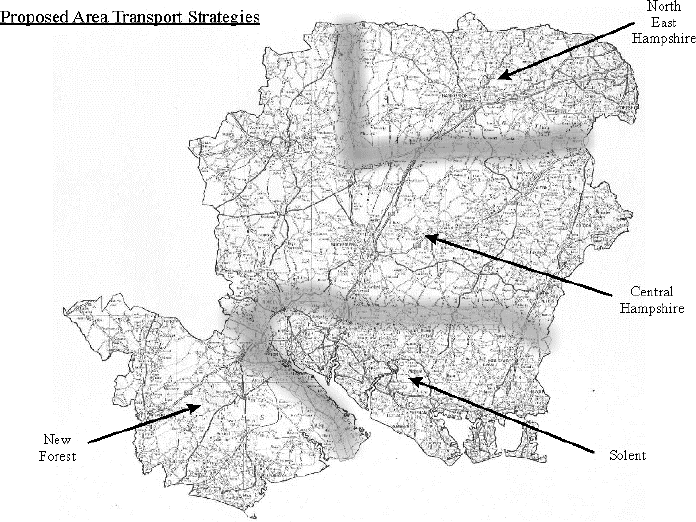
(i) the ten Area Transport Strategies be revised to four Area Transport Strategies, with the boundaries as proposed in Appendix 1;
(ii) the four new Area Transport Panels should have the terms of reference and constitution attached as Appendix 2;
(iii) the existing Highway Management Advisory Panels be renamed as Highway and Transport Advisory Panels and have the terms of reference proposed in paragraph 8.4; and additional representation from the Local Strategic Partnership set out in paragraph 8.5; and
(iv) the Chief Executive and the Director of Environment, in consultation with the Executive Member for Environment, be authorised to make any consequential arrangements required to effect these decisions.
2. Reason
2.1 The County Council's transport planning activity is currently divided into ten Area Transport Strategies. On 26 October 2003 Cabinet agreed the principle of a rationalisation into four areas for planning purposes, with increased emphasis on delivery and implementation at district council/ Local Strategic Partnership level. The paper proposing this rationalisation is attached as Appendix 3.
2.2 The Cabinet paper proposed four areas, namely North East Hampshire, Mid Hampshire, Solent Transport Area and South West Hampshire. After further discussion it is proposed that the titles of the Panels be as follows:
(i) New Forest;
(ii) Solent Transport;
(iii) Central Hampshire; and
(iv) North East Hampshire.
This paper gives more details of these proposed areas and a proposed Terms of Reference for each of the new Panels. It also proposed consequential amendments to the Terms of Reference for the Highway Management Advisory Panels to enable a transfer of some of the responsibilities currently assigned to the 10 Area Transport Panels.
3. Other Options Considered and Rejected
3.1 Taking no action.
4. Conflicts of Interest Declared by the Decision Maker or a Member or Officer consulted - None.
5. Dispensation granted by the Standards Committee - Not applicable.
6. Reason(s) for the Matter being dealt with if Urgent - Not applicable.
Approved by: Date:
Councillor K B Estlin
7. Proposed Boundary Details
7.1 The attached plan shows the proposed boundaries for the four new areas. Where possible, the areas have been defined by their transport characteristics instead of by authority boundaries. The four areas are:
(i) New Forest
This area comprises the whole of the New Forest District excluding the settlements of Totton and the Waterside. The northern boundary with the Central Hampshire area is defined as the A36. The area is largely rural, except for the Lymington/ New Milton area in the South West. Tourist travel is a significant feature of this area.
(ii) Solent Transport
The Solent Transport area covers the main south coast urban areas from the Waterside in the West to Havant in the East. It also includes the surrounding towns and villages where transport movements are predominantly towards the urban areas. The Northern boundary is to the north of Bishops Waltham, Droxford, Hambledon and Clanfield. This area is characterised by urban travel, especially travel to work.
(iii) Central Hampshire
The Central Hampshire area is the largest of the four strategic areas. It runs the entire width of the County from Andover in the North West to Bordon and Liphook in the East. It would include Petersfield, Alton, Winchester and Andover, as well as much of the Hampshire area of the proposed South Downs National Park. This area does not have as distinctive a character as the other areas. It would include travel to and from the market towns, some travel to work in London and some travel to the South Coast.
(iv) North East Hampshire
The North East Hampshire Area is defined by the A34 to the West and the North Downs ridge to the South. It contains the towns of Basingstoke, Aldershot, Farnborough, Farnham and Fleet. The area is characterised by cross-boundary travel, particularly journeys to London, the Thames Valley and the Blackwater Valley.
7.2 These proposed areas are very similar to the areas previously identified in the Structure Plan. However, whilst the Structure Plan areas were defined by district council boundaries, these areas are defined by physical boundaries or socio-economic factors. The proposed areas use some principal roads as boundaries and also seek to include settlements with similar travel characteristics. The boundaries are deliberately denoted by broad lines to encourage joint working by adjoining panels on cross-boundary issues.
8. Terms of Reference
8.1 Proposed terms of reference for each of these panels is attached as Appendix 2. A significant addition to the work of these Panels will be the ability to consider the links between transport and spatial strategy. The proposed level of representation for each Panel is based on the proportion of each district council that is within each area. The proposal is that district councils which are wholly or substantially included within an area are to be represented by four elected members. District councils that are partly within a transport strategy area are to be represented by two elected members.
8.2 The impact on the County Council's overall proportionality of reducing the number of Panels from eight to four with a County Council membership of five on each is as follows:
Total Seats Conservative Liberal Democrats Labour
249 155 65 29
In relation to the four Panels proposed, County Council membership of 3:2:0 in respect of the New Forest and Central Hampshire Panels is suggested and 3:1:1 in respect of the Solent Transport and North East Hampshire Panels; this then meets proportionality requirements.
8.3 There is also a need to revise the terms of reference for the Highway Management Advisory Panels. The existing terms of reference for these panels are:
(i) to receive reports on highway management topics and programmes, to offer advice and recommendations to the Highway Unit Manager and to monitor and review highway management activities; and
(ii) to receive reports on the implementation of traffic management schemes in the Area Transport Strategy programmes relating to that district, to monitor and review progress on those schemes and offer advice and recommendations as appropriate to the relevant project managers.
8.4 Under the new arrangements, these panels would have a greater responsibility for advising on the implementation of all transport schemes, instead of just traffic management schemes as at present. It is therefore proposed that they should be renamed Highway and Transport Advisory Panels, with the following terms of reference:
(i) to receive reports on highway management topics and programmes, to offer advice and recommendations to the Highway Unit Manager and to monitor and review highway management activities;
(ii) to receive reports on the implementation of transport schemes in the Area Transport Strategy programmes relating to that district, to monitor and review progress on those schemes and offer advice and recommendations as appropriate to the relevant project managers;
(iii) to consider Local Plan/Local Development Document transport issues where this is best dealt with at a District level; and
(iv) to advise on the detailed design of town transport action plans within an agreed framework.
8.5 The Highway and Transport Advisory Panels would retain their existing membership, constitution and working methods with the addition of up to three representatives from the District Local Strategic Partnership in order to integrate issues and priorities of the local community into the work of the Panel and a partnership approach to addressing them.
9. Consequential Arrangements
9.1 In order to bring these arrangements into force quickly, it is proposed that the Chief Executive and the Director of Environment, in conjunction with the Executive Member for Environment, be authorised to make any consequential arrangements. It is hoped that this would allow the Panels to be operational from March 2004.
Section 100 D - Local Government Act 1972 - background papers | |
The following documents disclose facts or matters on which this report, or an important part of it, is based and has been relied upon to a material extent in the preparation of this report. | |
NB the list excludes: | |
1. |
Published works. |
2. |
Documents which disclose exempt or confidential information as defined in the Act. |
TITLE |
LOCATION |
None |
8381/IR
APPENDIX 1
Hampshire County Council Cabinet 27 October 2003 County-wide Review of Strategy Areas and Transportation Strategy Panels Report of the Director of Environment |
Item 8 |
Contact: Iain Reeve, ext 5189 email: [email protected]
1. Summary
1.1 The following decisions are sought:
(i) That, subject to the consultation currently under way with the Transport Strategy Area Panels, the existing Transport Strategy Areas should be rationalised from ten to four areas, and better aligned with the range of sub-regional and other corporate policy developments. This would be complemented by greater emphasis on delivery and implementation at district council/ Local Strategic Partnership level.
(ii) That new Area Strategy Panels should consider a wider agenda to better integrate transport and spatial planning matters, and the administration of the Panels should be efficient and consider the new executive arrangements that have been introduced since Panels were first established.
(iii) That more work is needed to define the areas and their roles and responsibilities in relation to district councils, Local Strategic Partnerships and Highway Management Advisory Panels.
(iv) That Cabinet agrees to the principle behind this rationalisation into four areas and that further work should be undertaken to refine the details.
2. Reason
2.1 The development of the authority's next Local Transport Plan, the Regional Transport Strategy and the Regional Spatial Strategy suggests that the large number of strategies is not in line with emerging national and regional policies. The size of the existing strategies is also not consistent with the increasing emphasis on local decision making through Local Strategic Partnerships. Resources could be deployed more effectively from a rationalised structure with fewer Area Strategies.
3. Other Options Considered and Rejected
3.1 Retaining the existing arrangements for Area Transport Strategy Panels and dealing separately with Spatial Strategy matters. Increasing the number of strategies to align more closely with district council and Local Strategic Partnership boundaries.
4. Conflicts of Interest Declared by the Decision Maker or a Member or Officer consulted - None.
5. Dispensation granted by the Standards Committee - Not applicable.
6. Reason(s) for the Matter being dealt with if Urgent - Not applicable.
Approved by: ................................... Date: ....................................
Councillor T K Thornber
Hampshire County Council Cabinet 27 October 2003 County-wide Review of Strategy Areas and Transportation Strategy Panels Report of the Director of Environment |
Contact: Iain Reeve, ext 5189 email: [email protected]
1. Summary
1.1 Hampshire's overall transport strategy is set out in its Local Transport Plan (LTP). Given the size of the authority, the LTP is divided into ten Area Transport Strategies. These Area Transport Strategies are managed by a series of established Area Transport Strategy Panels which determine the priorities and programmes for each strategy area.
1.2 This report considers this arrangement. It recommends that the ten areas should be rationalised into four larger areas. These would cover North East Hampshire, Mid Hampshire, South West Hampshire and the Solent Transport area. This approach would be complemented by a strengthening of local involvement at district level through Local Strategic Partnerships and Highway Management Advisory Panels. The existing Area Transport Strategy Panels are being asked for their views.
2. Background
2.1 Area Transport Strategies have been the basis of transport planning in Hampshire since the mid-1990s. The ten areas, shown on the attached plan, were formed as urban and rural transport packages at a time when Government funding for integrated transport was largely focused on such package areas. Each of the strategy areas is administered by a Panel of District and County Council Members, which considers the strategy area objectives and proposed programmes which are then put forward to the Executive Member for Environment for decision. The Panels meet twice a year in the spring and autumn.
2.2 Some of the strategy areas are based on journey-to-work areas while others are based on the former highways maintenance island agencies. Some relate to district council boundaries and area strategies which pre-date local government reorganisation. They originally included the two cities of Portsmouth and Southampton.
2.3 As part of the LTP regime, each Area Transport Strategy has its own comprehensive set of objectives and targets. This has led to the LTP containing over 140 performance targets; more than nearly any other local transport authority. The need to monitor these targets has placed considerable resource demands on the authority.
2.4 The early Area Transportation Strategy Panels considered area strategies and priorities as well as discussing specific schemes. Specific schemes that have passed Project Appraisal stage are now dealt with at Highway Management Advisory Panel level.
3. Need for Change
3.1 The existing system of Area Transport Strategies has worked reasonably well. The thoroughness of the approach was instrumental in the authority's good LTP assessment of "well above average". The Panels have been generally successful in reviewing the strategies and capital programmes. Although progress varies, the authority is on course to meet several of the strategies' key objectives.
3.2 As the authority is now beginning the process of preparing its next full LTP, it is a sensible time to review the arrangements of Area Transport Strategies. There are a number of developments which suggest that the area transport strategy is a valuable approach, but that the number of strategies within it should be rationalised.
3.3 As noted above, it is relatively time-consuming and costly to maintain ten separate area strategies. The cost of administering and monitoring these strategies diverts resources that could be used on transport implementation projects. Hampshire appears to be dividing its area into smaller strategic units than almost any other local transport authority in England. The area strategies seem to be smaller than they need to be to meet the Government's official guidance on LTPs. The Government has asked local authorities to consider ways in which transport strategies can be considered at a more strategic level than before, including through the use of joint LTPs between neighbouring authorities.
3.4 Although there is no ideal, the size and boundaries of the existing areas also do not equate particularly well to existing travel patterns. Following the Solent Transport model, larger strategic areas would seem to be more effective in bringing together appropriate transport problems and solutions.
3.5 The Area Transport Strategies also do not align well with individual district councils and Local Strategic Partnerships. Because of this, it seems sensible to have a clear demarcation between Community Strategies at district council level and a smaller number of area transport strategies.
4. Regional Spatial and Transport Planning
4.1 Developments in regional spatial and transport planning also suggest that there is a strong case for rationalising the number of area transport strategies. The draft Regional Transport Strategy (RTS) has now been considered at Public Examination. A revised draft is expected before the end of the year. The draft RTS identifies a number of strategic areas that should be considered for transport planning purposes.
4.2 Although the precise boundaries are not established, the draft RTS identifies the Solent Transport Area and the Blackwater Valley as strategic areas. Northern parts of the county may also form a part of a strategic area under consideration for the Thames Valley, following a recommendation in the Thames Valley Multi Modal Study for a strategic implementation mechanism. The Bournemouth-Poole area has also been identified as a strategic area.
4.3 National Park designation will probably be introduced for the New Forest and possibly for the South Downs. The New Forest can and is recognised as requiring different treatment from the rest of rural Hampshire in transport and spatial strategy terms.
4.4 The Solent Transport initiative has been identified by the draft RTS as a possible model for strategic transport planning across the region. The Government has also shown considerable interest in the initiative, which may influence the next official guidance on LTPs. The Hampshire element of Solent Transport is essentially an amalgamation of the existing South West and South East strategy areas. The County Council has, in recent years, made good progress in bringing together all the interested transport stakeholders in the South Hampshire sub-region under the Solent Transport partnership. Signatories include the Unitary Authorities, Government and regional agencies, private operators and, largely through the Hampshire Economic Partnership (HEP), the business community. The HEP is also working to integrate land use strategies alongside those for transport. The importance of South Hampshire as an entity in transport, planning and economic terms is growing.
4.5 Work is proceeding on developing a Regional Spatial Strategy (RSS) which will complement the RTS. The Regional Assembly is consciously seeking to ensuring that the development of strategic areas within the RTS aligns well with the emerging sub-regions for the RSS.
4.6 Integrating spatial strategy with transport strategy has long been recognised by successive Governments and by the County Council as important to maximise the effectiveness of policies and the delivery of programmes. Having spatial strategy and transport strategy considered by the same County/District Council Panels would fit well with integration of these disciplines and also for integration arrangements between County and District Council government.
5. Greater Local Involvement
5.1 It is important that a rationalisation of area transport strategies should complement the development of Community Strategies and the increasing importance of Highway Management Advisory Panels. Community Strategies at district council level will play an increasing part in County Council service delivery planning.
5.2 The proposed rationalisation will mean that the revised area transport strategies will be able to concentrate more on strategic issues, with implementation and delivery being considered more at the district councils and LSP level. At the moment, the ten area transport strategies are complemented by specific action plans covering individual areas, including specific towns. It is envisaged that this approach would be continued and strengthened under these proposals.
5.3 The proposals would also allow for a strengthening of the Highway Management Advisory Panels. These Panels are based on district council areas. They meet on a six-monthly basis and look at present year's capital programme delivery as well as local maintenance and traffic management matters. These Panels advise the Executive Member and provide an opportunity for more district council Members to have direct contact with County Council staff and Members.
6. Administrative Arrangements for Joint Panels
6.1 Any new arrangements will need to recognise the Executive Member arrangements now in place and must be efficient, to make best use of both County and District Council staff resources. They will also need to be implemented in the context of Cabinet discussions related to the County Council's capacity to plan strategically and engage locally.
6.2 Existing Area Transportation Strategy Panels are led by the Executive Member for Environment and include representation by district council and County Council Members. The existing arrangements have the advantage of dealing with all debate at one level of meetings. They are an established mechanism that involves joint working but one that requires considerable officer and Member resource to work well.
6.3 Informal discussions with District Council representatives indicate that some districts would prefer to move to more regular joint meetings between respective Executive Members, rather than continuing existing Panel arrangements, leaving each Authority with the responsibility to obtain views and disseminate information within its own organisation.
6.4 The role of Area Transportation Strategy Panels and any subsequent arrangements should be to set medium-term strategies and share views on priorities within such strategies. This would influence the Capital Programme and the Panels should then monitor progress of delivery, and review priorities and achievements against a range of targets such as LTP, Comprehensive Performance Assessment and other performance indicators. The new Panels would also consider integration of transport with other policy areas, especially spatial planning. It may be possible to expand their role in the context of Agenda item 9 in relation to sub- regional planning Member arrangements.
6.5 The Panels are a fundamental part in the process of delivering the LTP and Hampshire's strategy approach has been recognised nationally. The new Panel arrangements will need to be developed in the context of:
(i) Community Strategies and local strategic partnerships;
(ii) current Cabinet considerations surrounding the need for the County Council to engage with stakeholders and the community at a more local level across a range of services and issues; and
(iii) Regional Spatial Strategy/Local Development Frameworks.
6.6 Consideration of any proposals for future working of any new arrangements following consultation would, therefore, need to be the subject of Cabinet consideration in the light of corporate issues mentioned above.
6.7 There are likely to be proportionality issues associated with the rationalisation and the Chief Executive will need to advise on these when the details are finalised.
7. Recommended Strategy Areas
7.1 Four broad areas are recommended:
(i) North East Hampshire;
(ii) Mid Hampshire;
(iii) Solent Transport Area; and
(iv) South West Hampshire.
7.2 Precise boundaries would be established if the principle of rationalisation is agreed. Regardless of the boundaries chosen, there will need to be considerable coordination and cross-boundary working between the different areas. Travel patterns do not respect administrative boundaries.
7.3 The County Council has an acknowledged track record of planning strategically and delivering high quality services locally - recognised in the CPA Award of `Excellent' status.
Recommendations
1. That, subject to the consultation currently under way with the Transport Strategy Area Panels, the existing Transport Strategy Areas should be rationalised from ten to four areas, and better aligned with other corporate policy developments. This would be complemented by greater emphasis on delivery and implementation at district council/Local Strategic Partnership level.
2. That new Area Strategy Panels should consider a wider agenda to better integrate transport and spatial planning matters, and the administration of the Panels should be efficient and consider the new executive arrangements that have been introduced since Panels were first established.
3. That more work is needed to define the areas and their roles and responsibilities in relation to district councils, Local Strategic Partnerships and Highway Management Advisory Panels.
4. That Cabinet agrees to the principle behind this rationalisation into four areas and that further work should be undertaken to refine the details.
Section 100 D - Local Government Act 1972 - background papers | |
The following documents disclose facts or matters on which this report, or an important part of it, is based and has been relied upon to a material extent in the preparation of this report. | |
NB the list excludes: | |
1. |
Published works. |
2. |
Documents which disclose exempt or confidential information as defined in the Act. |
TITLE |
LOCATION |
Local Transport Plan |
Environment Department Room 433 |
8381APPENDIX 1
APPENDIX 2
NEW FOREST TRANSPORT PANEL
Terms of Reference, Constitution and Administrative Arrangements
1. Title
The Panel shall be known as the New Forest Transport Panel and shall act in an advisory capacity only.
2. Terms of Reference
To advise the County Council's Executive Member for Environment on the development and implementation of transport strategies in the Panel area, as defined in the attached map. The Panel can advise on the implementation of individual schemes, although the primary responsibility for this advice will rest with the relevant Local Strategic Partnerships and Highway and Transport Advisory Panels, with whom the Panel will be expected to liaise. The Panel shall ensure consistency with overall policy objectives of the constituent Authorities. District representatives will be expected to facilitate liaison between their Councils and the County Council as Highway Authority, and to disseminate information within their Councils regarding deliberations of the Panel.
To consider the transport aspects of development plan proposals at regional, sub-regional and local level.
3. Constituent Authorities
The Panel is constituted by:
Hampshire County Council
New Forest District Council
Test Valley Borough Council
4. Membership
The Panel shall consist of five elected members from:
Hampshire County Council
And four elected members from:
New Forest District Council
And two elected members from:
Test Valley Borough Council
5. Chairman
The Chairman of the Panel shall be the Executive Member for Environment and his standing deputy shall be the Executive member for Spatial Strategy.
6. Protocol
All representatives shall use their best endeavours to resolve any outstanding differences, and agreement at the Panel will normally be by general consensus. Where this is not possible, the different views expressed will be reported to the Executive Member for Environment for final determination.
7. Officer Support
The Principal Adviser to the Panel on transport issues will be the Director of Environment. District officers shall be responsible for supplying advice and reports on development control/local planning issues in their areas.
8. Secretarial Support
Secretarial support will be provided by the Chief Executive, Hampshire County Council.
9. Conduct of Meetings
The conduct of meetings of the Panel shall be regulated by the Standing Orders of Hampshire County Council so far as the same are applicable to Committees.
10. Quorum
A quorum for meetings of the Panel shall be three of whom at least one shall be a member of the County Council as Highway Authority.
11. Powers to Commit Expenditure
The Panel shall have no powers to commit expenditure.
SOLENT TRANSPORT PANEL
Terms of Reference, Constitution and Administrative Arrangements
1. Title
The Panel shall be known as the Solent Transport Panel and shall act in an advisory capacity only.
2. Terms of Reference
To advise the County Council's Executive Member for Environment on the development and implementation of transport strategies and programmes in the Panel area, as defined in the attached map. Matters relating to the development of the rapid transit system in Hampshire shall be dealt with by the South Hampshire Rapid Transit Procurement Panel and the Light Rapid Transit Development Panel. The Panel can advise on the implementation of individual schemes, although the primary responsibility for this advice will rest with the relevant Local Strategic Partnerships and Highway and Transport Advisory Panels, with whom the Panel will be expected to liaise. The Panel shall ensure consistency with overall policy objectives of the constituent Authorities. District representatives will be expected to facilitate liaison between their Councils and the County Council as Highway Authority, and to disseminate information within their Councils regarding deliberations of the Panel.
To consider the transport aspects of development plan proposals at regional, sub-regional and local level.
3. Constituent Authorities
The Panel is constituted by:
Hampshire County Council
East Hampshire District Council
Eastleigh Borough Council
Fareham Borough Council
Gosport Borough Council
Havant Borough Council
New Forest District Council
Test Valley Borough Council
Winchester City Council
4. Membership
The Panel shall consist of five elected members from:
Hampshire County Council
And four elected members from each of:
Eastleigh Borough Council
Fareham Borough Council
Gosport Borough Council
Havant Borough Council
And two elected members from each of
East Hampshire District Council
New Forest District Council
Test Valley Borough Council
Winchester City Council
5. Chairman
The Chairman of the Panel shall be the Executive Member for Environment and his standing deputy shall be the Executive Member for Spatial Strategy.
6. Protocol
All representatives shall use their best endeavours to resolve any outstanding differences, and agreement at the Panel will normally be by general consensus. Where this is not possible, the different views expressed will be reported to the Executive Member for Environment for final determination.
7. Officer Support
The Principal Adviser to the Panel on transport issues will be the Director of Environment. District officers shall be jointly responsible for supplying advice and reports on development control/local planning issues in their areas.
8. Secretarial Support
Secretarial support will be provided by the Chief Executive, Hampshire County Council.
9. Conduct of Meetings
The conduct of meetings of the Panel shall be regulated by the Standing Orders of Hampshire County Council so far as the same are applicable to Committees.
10. Quorum
A quorum for meetings of the Panel shall be three of whom at least one shall be a member of the County Council as Highway Authority.
11. Powers to Commit Expenditure
The Panel shall have no powers to commit expenditure.
NORTH EAST HAMPSHIRE TRANSPORT PANEL
Terms of Reference, Constitution and Administrative Arrangements
1. Title
The Panel shall be known as the North East Hampshire Transport Panel and shall act in an advisory capacity only.
2. Terms of Reference
To advise the County Council's Executive Member for Environment on the development and implementation of transport strategies in the Panel area, as defined in the attached map. The Panel can advise on the implementation of individual schemes, although the primary responsibility for this advice will rest with the relevant Local Strategic Partnerships and Highway Management Advisory Panels, with whom the Panel will be expected to liaise. The Panel shall ensure consistency with overall policy objectives of the constituent Authorities. District representatives will be expected to facilitate liaison between their Councils and the County Council as Highway Authority, and to disseminate information within their Councils regarding deliberations of the Panel.
To consider the transport aspects of development plan proposals at regional, sub-regional and local level.
3. Constituent Authorities
The Panel is constituted by:
Hampshire County Council
Rushmoor District Council
Hart District Council
Basingstoke and Deane Borough Council
4. Membership
The Panel shall consist of five elected members from:
Hampshire County Council
And four elected members from each of:
Rushmoor District Council
Hart District Council
Basingstoke and Deane Borough Council
5. Chairman
The Chairman of the Panel shall be the Executive Member for Environment and his standing deputy shall be the Executive Member for Spatial Strategy.
6. Protocol
All representatives shall use their best endeavours to resolve any outstanding differences, and agreement at the Panel will normally be by general consensus. Where this is not possible, the different views expressed will be reported to the Executive Member for Environment for final determination.
7. Officer Support
The Principal Adviser to the Panel on transport issues will be the Director of Environment. District officers shall be responsible for supplying advice and reports on development control/local planning issues in their areas.
8. Secretarial Support
Secretarial support will be provided by the Chief Executive, Hampshire County Council.
9. Conduct of Meetings
The conduct of meetings of the Panel shall be regulated by the Standing Orders of Hampshire County Council so far as the same are applicable to Committees.
10. Quorum
A quorum for meetings of the Panel shall be three of whom at least one shall be a member of the County Council as Highway Authority.
11. Powers to Commit Expenditure
The Panel shall have no powers to commit expenditure.
CENTRAL HAMPSHIRE TRANSPORT PANEL
Terms of Reference, Constitution and Administrative Arrangements
1. Title
The Panel shall be known as the Central Hampshire Transport Panel and shall act in an advisory capacity only.
2. Terms of Reference
To advise the County Council's Executive Member for Environment on the development and implementation of transport strategies in the Panel area, as defined in the attached map. The Panel can advise on the implementation of individual schemes, although the primary responsibility for this advice will rest with the relevant Local Strategic Partnerships and Highway Management Advisory Panels, with whom the Panel will be expected to liaise. The Panel shall ensure consistency with overall policy objectives of the constituent Authorities. District representatives will be expected to facilitate liaison between their Councils and the County Council as Highway Authority, and to disseminate information within their Councils regarding deliberations of the Panel.
To consider the transport aspects of development plan proposals at regional, sub-regional and local level.
3. Constituent Authorities
The Panel is constituted by:
Hampshire County Council
Test Valley Borough Council
Winchester City Council
East Hampshire District Council
Basingstoke and Deane Borough Council.
4. Membership
The Panel shall consist of five elected members from:
Hampshire County Council
And four elected members from each of:
Test Valley Borough Council
Winchester City Council
East Hampshire District Council
And two elected members from:
Basingstoke and Deane Borough Council
5. Chairman
The Chairman of the Panel shall be the Executive Member for Environment and his standing deputy shall be the Executive Member for Spatial Strategy.
6. Protocol
All representatives shall use their best endeavours to resolve any outstanding differences, and agreement at the Panel will normally be by general consensus. Where this is not possible, the different views expressed will be reported to the Executive Member for Environment for final determination.
7. Officer Support
The Principal Adviser to the Panel on transportation issues will be the Director of Environment. District officers shall be responsible for supplying advice and reports on development control/local planning issues in their areas.
8. Secretarial Support
Secretarial support will be provided by the Chief Executive, Hampshire County Council.
9. Conduct of Meetings
The conduct of meetings of the Panel shall be regulated by the Standing Orders of Hampshire County Council so far as the same are applicable to Committees.
10. Quorum
A quorum for meetings of the Panel shall be three of whom at least one shall be a member of the County Council as Highway Authority.
11. Powers to Commit Expenditure
The Panel shall have no powers to commit expenditure.
8381APPENDIX2