
Archived decisions
The New Forest
Transport Strategy Document
Contents Page
Introduction 1
Vision 5
Policy Background 6
Public Awareness and Involvement 6-7
Aims and Objectives 7-8
Targets and Monitoring 9
Strategy Themes 10-26
Walking 10-11
Cycling 11-13
Passenger Transport 14-16
Personal Mobility 17
Demand Management 17-18
Larger Settlements 19
Remote Areas 20
Visitor Transport 21-22
Car Parking 23-24
Information and Education 24-25
Freight Movement 25-26
The Highway Network 28-30
Making It Happen 30
New Forest Transportation Strategy
Introduction
1 The first New Forest Transport Strategy was produced in July 1998, a partnership between Hampshire County Council, New Forest District Council and the New Forest Committee and covered the New Forest Heritage Area together with the adjoining Avon Valley and Downlands. The Strategy was the subject of consultation with numerous interested parties, including the Forestry Commission and Parish Councils. Through this Strategy a number of measures have been implemented, such as:
· improvements to Lyndhurst High Street and heavy commercial vehicle bans on some roads
· a revision to signing for the A35 to deter unnecessary through traffic
· the introduction of 40mph limits
· traffic management measures in Emery Down
2. This document sets out aims and objectives for the special character of the New Forest and individual parts of the strategy area. The measures range from encouraging alternative modes, improved integration between different modes of transport and improving town and village centres to the use of new technologies to aid the management of traffic.
They are based on the five key themes in the Local Transport Plan of :
- Improving ACCESSIBILITY to the area and its facilities where consistent with other objectives.
- Promoting the sustainability of the local ECONOMY
- Improving the local and wider ENVIRONMENT.
- Improving road SAFETY for all road users, including pedestrians, cyclists, horses and their riders.
- Improving INTEGRATION between different modes of transport.
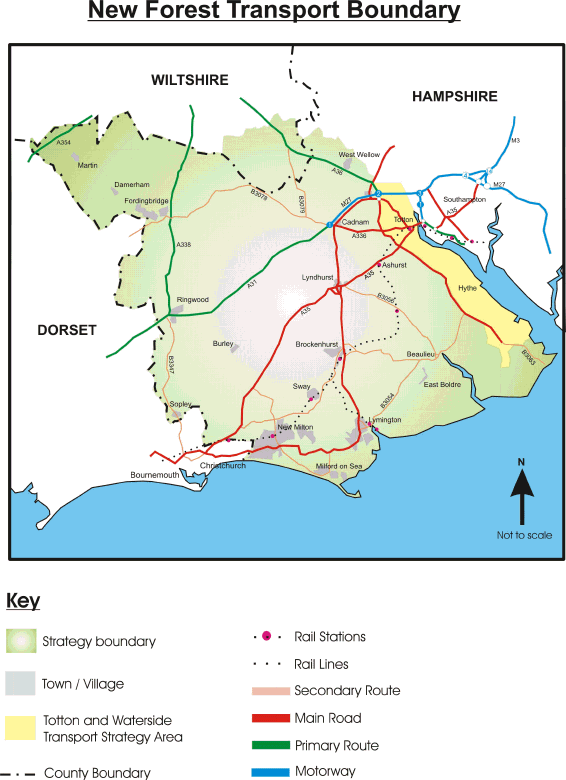
3. This strategy covers the same geographical area as the 1998 NFTS document and the former Coastal Towns strategy area. Expanding this area was considered but will be reviewed following the determination of the National Park boundary and the revision of Hampshire County Council's area strategy boundaries.
(See Figure 1 for the NFTS boundary).
4. The boundary proposed for the National Park in 2002 included not only the Heritage Area but also the Western Solent coast as far as Keyhaven and Hurst Castle. However, New Milton, Barton on Sea, Hordle, Everton and Milford on Sea are not included within the proposed National Park boundary. Covering nearly three-quarters of the New Forest District together with parts of neighbouring districts both in Hampshire and Wiltshire, the New Forest Heritage Area is recognised by the Government as having equivalent status to a national park for planning purposes. The Countryside Agency is taking forward the process of formal National Park designation, and has consulted widely on the proposed boundary and special administration arrangements. The National Park is currently proposed to include Ringwood, Lymington, open land on the western shore of Southampton Water and part of the Avon Valley, as well as the whole of the Heritage Area.
5. A National Park Authority will have the statutory purposes of conserving and enhancing the natural beauty and wildlife of the area, and promoting the public's understanding and enjoyment of the areas special qualities. It will also have a duty to foster the economic and social well-being of local communities. In addition, the majority of the Heritage Area/proposed National Park, including the open forest and much of the coastline and the Avon Valley are protected by national and international statutory nature conservation designations (Special Area of Conservation, Special Protection Area for Birds, Ramsar site and Site of Special Scientific Interest). These designations severely restrict the scope for even quite small-scale and localised upgrading of the existing transport infrastructure, and highlight the importance of making best use of that infrastructure as it stands.
6. In recent years, planning for the transport needs of communities - whether they are urban or rural, has significantly changed. Government guidance, particularly
· White Paper, 'A New Deal for Transport: Better for Everyone', 1997.
· Planning Policy Guidance (PPG) 13 Transport and Regional Planning Guidance (RPG9) for the South East.
These papers promote greater co-ordination between land use planning and transport planning.
7. This integrated transport strategy is based on policies in the Hampshire County Structure Plan Review, the New Forest District Local Plan and other neighbouring authority plans, Salisbury, Test Valley and Wiltshire. To achieve the aims and objectives of the New Forest Transport Strategy a programme of transport schemes and initiatives is updated each year. The schemes are included as part of the five year Local Transport Plan (LTP) submitted to the Department of Transport, Local Government and Regions (DTLR). The LTP sets out proposals for delivering integrated transport throughout Hampshire over a five year period. The plan covers all forms of transport, and is the main mechanism for co-ordinating and improving local transport.
8. Across all sections of the community it is recognised that road building alone cannot solve present or future transport problems. In the case of the New Forest, the building of new roads or capacity improvements on local roads could not cater for unrestricted car and lorry travel, either now or in the future. The impact of continuing to provide more road space on the Forest's environment and ecology would be unacceptable. At the same time other transport infrastructure including cycle tracks, hard footpaths and other facilities has its own environmental impacts.
9. Proposals which emerge from the New Forest Transport Strategy cannot be considered in isolation. The influence of the Strategy is not confined to the New Forest area alone, just as influences from external areas can affect the Forest. There are strong transport links with neighbouring areas. which will require close liaison with local authorities and organisations beyond the New Forest and Hampshire. Measures which form part of this Strategy may well extend beyond the borders of the New Forest.
Figure 1: Revised Strategy Boundary
Vision
10. A number of plans and strategies set out wide-ranging objectives for the New Forest which seek to safeguard the unique nature of the area for future generations to enjoy. Others address the needs of the wider community, both in the New Forest itself and in the remainder of the New Forest District. They include:
· New Forest Committee "A Strategy for the New Forest"
· New Forest District Council "New Forest District Local Plan"; Tourism and Visitor Management Strategy"
· Forestry Commission "Access and Recreation Plan 2001"
11. Local authorities alone cannot solve the traffic and environmental problems within the areas covered by the New Forest Transport Strategy. The support of residents, visitors, the business community, major land owners and interest groups is essential. While sensible car use remains the only option over much of the Forest most of the time, many expectations regarding private car use will have to change if we are going to make a difference. Through working partnerships, the New Forest Transport Strategy will help tackle the special issues which face the area.
The Vision of this Strategy is:
"To maintain and improve the area's distinctive character, whilst improving opportunities for sustainable travel for everybody through appropriate transport investment and greater integration. To enhance the environment and the local economy and reduce social exclusion. This will be achieved through the integration of land use and transport policies, through an innovative approach to travel and the management of existing resources in the New Forest".
Policy Background
12. The Hampshire County Structure Plan (Review) was adopted in January 2000 and sets out the strategic planning and transport policies for the period to 2011 for the whole of the County, including Southampton and Portsmouth. It proposes an overall strategy for development, for improving the environment and for managing the need to travel. Work on a further review of this plan commenced in 2001.
13. The New Forest District Local Plan was adopted in November 1999 and sets out detailed planning policies for most of the Forest and adjoining areas. A draft alteration to the Local Plan was placed on deposit in 2001.
14. Hampshire County Council published its Local Transport Plan (2001 - 2006) in accordance with the Transport Act 2000. The New Forest Transport Strategy both reflects and builds on these policies and those within relevant Local Plans. It reflects Government policies as expressed principally through Planning Policy Guidance Notes and Circulars and Regional Planning Guidance. Where necessary, it will complement the policies of adjoining development plans and transport strategies
Public Awareness and Involvement
15. Hampshire County Council aims to raise public awareness of the shared responsibility arising from uncontrolled car useage by encouraging everyone to think more carefully about their transport choices and even small changes in travel behaviour are important. Non-essential car use needs to be cut down to the benefit of our health, our working lives, the environment and society in general. Small changes in travel behaviour are likely to result in considerable benefits.
16. Traffic growth is a problem for everyone. It is important that we consider the issues and all play our part in the solution. Public involvement and consultation is a key part of the Strategy. The views of local communities are essential in the development of the Strategy and transport schemes and the Strategy partners attach great importance to the extensive consultation process that now takes place involving local communities and stakeholders prior to the implementation of any major transport scheme.
17. Most drivers accept that not all their mileage is essential. alternatives include:-travelling at other times when roads are less congested; car sharing with family and friends, walking or cycling more, using public transport or when possible, choosing to work or shop closer to home. But these options are often far less attractive, for example, walking alongside a busy road with no footpath. The Strategy seeks to enable and encourage individuals, employers and communities and public agencies to make such changes.
18. Every private car user can reduce the number of trips they make, whether by increased car sharing, use of public transport, walking and or cycling. 4 billion journeys in the UK are under 1 mile which is less than a 20 minute walk or a 5 minute bicycle ride. 50% of journeys are under 3 miles and 70% of the remainder are under 5 miles which is still only a 30 minute bicycle ride.
19. Data from the 1991 census indicates that 16% of households in the New Forest District do not own a car. This figure is lower than the national average, but still represents a sizeable number of households and indeed the figure is significantly higher in parts of Lymington, New Milton and Ringwood.
20. Reducing the impacts of traffic will most likely mean reducing levels of traffic in particular places at certain times. This in turn means restricting and or imposing extra monetary costs on mobility, particularly in sensitive and or congested locations. It is imperative that such restrictions (which are quite justified in themselves) do not compound the difficulties faced by people living in the New Forest area and already disadvantaged by age, disability, income or other factors.
21. This strategy is being developed in association with Hampshire County Council's 'Headstart' Transport Awareness Campaign. 'Headstart' is a community involvement initiative which aims to raise everyone's awareness of the problems caused by ever-increasing use of the private car, an acceptance that everyone has a part to play in solving the problem.
Aims and Objectives
The aims of the New Forest Transport Strategy are:
1. to help deliver the aims and objectives of the New Forest Committee's "Strategy for the New Forest".
2. to support and maintain the vibrancy and economic vitality of local communities.
3. to provide effective local transport solutions tailored to the needs of particular areas which reduce impacts on the Forest environment.
4. to reduce the adverse impacts of traffic on the environment and local communities especially in the designated National Park
5. to integrate land use and transport planning.
6. to increase the opportunities for sustainable travel and accessibility for all, having regard for the particular sensitivity of remote areas.
The objectives of the New Forest Transport Strategy are:
1. to promote new and improved passenger transport, cycling and walking facilities that are accessible to all and which provide a safe, reliable, affordable and attractive alternative to the car.
2. to provide imaginative local solutions that maintain the character of the Forest and its towns and villages, contribute towards the development of a safe, attractive and cherished environment, reduce visual impact, noise and air pollution, and at the same time enhance in a sustainable way access to services, goods and markets for local people and businesses.
3. to ensure that any new major development which is likely to generate significant additional traffic is located and planned to provide as far as possible alternative means of travel to the private car preferably making use of existing services and interchanges
4. to investigate measures such as road closures and road pricing to manage the use of the Forest's highway network and reduce the undesirable effects of traffic on wildlife, outdoor recreation, the unique Forest environment and the understanding and enjoyment of its special qualities.
5. to raise public awareness of transport issues and maintain support for the Strategy, with a view to bringing about changes in travel behaviour
6. to identify a range of targets and indicators which can be monitored in order to assess the effectiveness of the Strategy's measures.
7. to improve road safety and reduce the number of injuries to both people and animals.
8. to ensure adequate accessibility for people with disabilities.
9. to reduce the level and impact of through traffic on the New Forest.
Targets and Monitoring
Local targets for NFTS (By 2020 if not stated otherwise):
· To reduce traffic growth by 30% (In 2001 traffic growth in Hampshire was 2.9%, compared with 1.2% nationally)
· To reduce by 5% the proportion of trips by car in the New Forest in favour of public transport, walking and cycling.
· To achieve a 10% reduction in visitors arriving by car.
· To reduce by 30% on 1996 levels through and non-essential traffic in Lyndhurst High Street, and traffic travelling through the Forest using other inappropriate roads.
· By 2010 (compared with the average 1994-98) to reduce the number of people killed or seriously injured in road accidents by 40% (children by 50%) and to reduce the slight casualty rate by 10%.
· To promote the introduction of Company and School Transport Plans.
· To increase public support for more sustainable travel choices by 25% by 2010 (as monitored by Transpol surveys).
· To achieve the objectives of the National Air Quality strategy by using biological indicators to measure success.
· To contribute to the UK's climate change targets.
· To reduce the proportion of single occupancy car trips by 20% through increasing awareness and the implementation of company travel plans.
· To increase the use of public transport by one-third through improving and increasing services.
· To contribute to the National Cycling Strategy targets of quadrupling the number of trips made by cycle by 2012 and from a 1996 base through the implementation of cycle schemes and improved links within the Forest.
· To increase the level of walking by one third.
· To increase use of dial-a-ride services and other complimentary transport services by 2006, addressing areas of need.
· To increase the proportion of parking spaces for families and people with mobility impairments.
· To reduce by 30 per cent on 1996 levels, animal deaths and injuries on Forest roads.
· To increase size of identified remote / tranquil areas.
· To improve accessibility to local services - Particularly in areas with high levels of social exclusion.
22. To evaluate and prioritise the schemes and measures intended to achieve the aims and objectives of the New Forest Transport Strategy the following monitoring programme will be carried out both during and outside the main visitor periods.
· Traffic counts
· Pedestrian and cyclist counts
· Transpol (attitude surveys)
· Public transport surveys
· Before and after monitoring of specific schemes (or linked groups of schemes)
· Air quality and biological monitoring
· Accident data relating to people and animals
· Surveys for access to services
The Strategy
23. To enable the practical development of the Transport Strategy the issues have been sub-divided. This will allow a focus on differing needs within the New Forest area, as well as planning of the best use of existing and proposed transport infrastructure.
24. When developing Strategy measures and initiatives the Strategy partners will ensure sympathetic design and the use of materials in keeping with the Forest as a National Park or its equivalent. To achieve this, it may be necessary to seek approval for variations to normal transport standards.
25. A key mechanism in implementing the Strategy will be the New Forest Visitor Transport Initiative. The County Council has endorsed an action plan for the Initiative which includes preparation of a visitor routing plan, a car-free visitor guide and the revival of the New Forest Pony Express visitor bus service operated experimentally in 1999.
26. Safe walking, cycling and horse riding through routes need to be created into the forest from nearby towns, villages, railway stations and from the coast to the central perambulation.
Strategy Themes
· Walking
· Cycling
· Passenger transport
· Personal Mobility
· Demand management
· Larger settlements
· Remote areas
· Visitor attractions
· Car parking
· Information and education
· Freight movement
· The Highway network
Walking
27. Most of us are pedestrians for at least part of every journey, often less emphasis has been given to the needs of pedestrians. Pedestrian safety, pleasure and comfort are all jeopardised by vehicles. The Strategy will switch the emphasis from providing for the motor car towards raising the priority attached to pedestrians, allowing safe and easy access on foot to local facilities.
Actions - Walking
To achieve this objective the Strategy will:
· Encourage a shift toward pedestrian priority in the larger settlements.
· Promote the implementation of safer pedestrian routes at all locations within the Forest where pedestrian activity is high or where the provision of such facilities may promote walking as an alternative means of transport.
· Develop a footpath maintenance strategy which prioritises pedestrian's needs.
· Improve road safety for pedestrians throughout the area.
· Promote Safer Routes to Schools.
|
Cycling
28. There is considerable scope for encouraging cycling in the New Forest area as it is not only an environmentally friendly mode of transport but it is also a way of enjoying the Forest and coastal areas.
29. Government policies now place greater emphasis on getting people to their destinations on foot, by bicycle and by public transport. As part of the Hampshire County Structure Plan (Review), consideration has been given to the need for further emphasis on policies to encourage cycling and walking. Many motorists own a bicycle and they would be more likely to use it, as an alternative to driving, if conditions were improved. Visitors could be encouraged to cycle from their homes to their destination rather than driving into/through the forest with bikes and then cycling.
30. There is a need to continue to work with passenger transport operators in order to provide more cycle carrying capacity on trains and specially adapted buses. 34. A comprehensive and integrated cycle network will need to integrate with networks of adjacent counties and districts as well as neighbouring transport strategy areas within the county of Hampshire.
31. The Strategy's remit is to establish an area-wide network of on-road and shared-use cycle routes and facilities for utility and recreational cycling. Off-road cycling throughout the Crown Lands of the Forest is managed by the Forestry Commission and requires a sustained effort of maintenance and control in order to avoid environmental damage. Cycling is becoming increasingly popular in the Forest, as shown by the growth in commercial cycle hire, and it is therefore important to consider provision for safe road-based cycle routes to access a carefully managed network of cross-Forest tracks. Both the County Council and Forestry Commission are committed to working together to achieve this. Though some problems have arisen in developing on-road cycle routes in the New Forest due to environmental and safety issues.
32. Route 204 (Southampton to Exeter) of the National Cycle Network proposes to cross the New Forest with a branch from Brockenhurst running down to Lymington. A network of interlinked routes for the New Forest is being developed and preliminary consultation plans have also been drawn up for Lyndhurst, Lymington and New Milton. Some routes have already been implemented and others are under investigation and can then be prioritised.
Actions - Cycling
The New Forest Transport Strategy will:
· Promote cycling as an alternative and healthy means of transport.
· Progress in consultation with local and national cycling organisations a comprehensive and integrated cycle network linking communities, allowing visitors cycle access to attractions, and creating links to routes in neighbouring Transport Strategy areas.
· Identify measures to make cycle journeys safer and more pleasant, including the reallocation of road space where appropriate
· Encourage the establishment of further cycle hire facilities in appropriate locations. · Provide adequate and secure cycle parking at public transport interchanges, in towns and villages and at strategic locations across the Forest. · encourage rail and bus operators to increase and improve provision for carrying bicycles and publish information about such services
· Encourage local employers to promote cycle use via work place travel plans
· Monitor cycle use and public attitudes towards cycling in the Forest. · Continue to consult with local and national cycling organisations on cycling strategies · Promote and provide cycle facilities as part of Safer Routes to Schools via the implementation of school travel plans.
|
Passenger Transport
33. Whilst it is accepted that sensible car use is and will remain an important element of rural transport we must strive to ensure that wherever possible adequate choice and accessibility is available and use of the private car ceases to be the only real option.
34. As the network of bus services is limited to a number of frequent inter-urban services and less frequent village buses, rural communities tend to rely more on their cars. There are bus services linking:
· Lymington, New Milton Christchurch and Bournemouth.
· Lymington, Lyndhurst and Southampton
· Ringwood and Avon Valley to Salisbury.
35. Where services are provided commercially, generally by the Wilts and Dorset Bus Company, the County Council assists the operation through publicity, infrastructure and bus priority measures.A New Forest Area fold out map showing bus, rail and ferry information with indicative bus frequencies is published, which is supplemented by individual bus timetables produced by Wilts & Dorset.
36. A new `Cango' Demand Responsive bus service began operating in November 2002 in the areas around Lymington, New Milton and Sway. They follow a semi fixed route and can divert off to pick up passengers at any time. Work has included new bus stops with high quality information delivered door to door in the operating area.
37. Lymington is a major tourist destination but there is no provision for tourist coach parking. The integration between bus and rail movements in the town is impaired through the distance between the rail and bus stations. The provision of dedicated facilities will have to be considered to avoid coaches being parked in unsuitable locations and to encourage the use of bus and coach travel as an alternative to the car. Traffic management and bus priority measures could improve access to Lymington bus station.
38. Some of the Forest is well served by rail, with the express London-Weymouth service calling at Brockenhurst, and stopping services on the same line calling at Ashurst, Beaulieu Road, Brockenhurst (connections to Lymington Town and Lymington Pier stations), New Milton, Sway and Hinton Admiral. Cross-country trains also serve Brockenhurst and provide a valuable link for the New Forest for journeys, avoiding London, from the Midlands, the North and Scotland. There are direct services to Havant, Chichester, Southampton, Bournemouth and on to Gatwick Airport and London Victoria.
39. The opportunities for local authorities to influence levels of provision and to encourage new developments will be pursued in liaison with operators. Use of the rail line by visitors is minimal but the newly completed interchange between buses and trains at Brockenhurst station offers a viable alternative to access the Forest, especially with the promotion of the station as a rail head for car free tourism. New Milton station and the Lymington Town and Lymington Pier stations have potential to be better interchanges if made more readily accessible by foot, bicycle and bus. There is scope for increasing the number of rail journeys into Southampton and Bournemouth, particularly by commuters, transferring trips from car to train, a County wide policy relating to parking at stations is currently being developed. As indicated several major New Forest settlements are served by rail, and improvements to service provision and station facilities will be encouraged. Christchurch will also increasingly become a major gateway point for the New Forest and strong use of rail and bus routes from there could ease car pressures. The County Council is investigating the potential for funding to extend the `Cango' Demand Responsive Service to provide services to take commuters to Brockenhurst rail station in the mornings and collect them in the evenings. This would serve the residential areas around Brockenhurst. Funding may be available from South West Train's Integration fund.
40. Despite the suspension of Rail Passenger Partnership schemes by the Strategic Rail Authority in January 2003 the County Council with South West Trains are looking at alternative means of funding small scale improvements at stations by other methods. In the past, the Rail Passenger Partnership programme has provided funding to assist enhanced rail services and facilities that contribute to the governments wider objectives for increased passenger and freight useage. Improved station facilities, cycle parking, extended car parking and passenger information systems among other schemes were funded by these means.
41. Wightlink ferries from Lymington to Yarmouth are one of three ferry connections between the mainland and the Isle of Wight for vehicles (cars/coaches/lorries) as well as foot passengers. They run from a terminal adjacent to Lymington Pier station and correspond with the train times forming a "gateway" to the Isle of Wight. The Hythe-Southampton ferry, while outside the Strategy area, provides an important link for foot passengers and cyclists and underpins the role of Hythe as a "gateway" to the Forest.
42. Beyond conventional bus and rail services, the County and District Councils have increasingly become involved in providing and supporting community transport services as well as focusing on services to help disabled passenger, services are also targeted at reducing social exclusion.
43. In rural areas, deficiencies may develop and cannot be filled through traditional bus services, there may be opportunities for the voluntary sector to provide services in partnership with local authorities. The dial-a-ride and voluntary car schemes in the New Forest are good examples. But there is scope for better provision through improved conditions. Funds from the Rural Bus Grant have been used to enhance and improve some bus services for both the local community and visitors to the New Forest.
44. There is considerable scope to provide and promote greater use of, and achieve a shift towards public transport, within the Coastal Towns area, (population approximately 48,000). There is also a fundamental need to provide high quality alternatives for both those who do and those who don't have access to a private car.
Actions - Passenger Transport
The Transport Strategy will strive to:
· Improve and promote use of the rail network accessing and egressing the New Forest area through publicity and joint working/ticketing arrangements.
· Improve public transport interchanges at all rail stations, from Christchurch to Totton to allow onward connections to visitor attractions, With these two stations being increasingly used as New Forest gateways.
· Encourage public transport operators to increase and improve provision for carrying bicycles and publish information on facilities provided. · Establish a quality partnership to help achieve these action points · Provide adequate and secure provision for cycle parking at all New Forest stations, as a means of encouraging cycling for commuting journeys to rail stations.
· Implement transport information systems linked to providing real-time information about public transport services.
· Provide for greater public transport access into the Forest through partnership with local businesses and events.
· Investigate the potential for recreational park and ride facilities, using both the rail network and buses operating from sites adjacent to the Strategic Road Network outside the Designated National Park Area, then promote and provide.
· Where appropriate, develop demonstration projects on specific corridors, routes or settlements. The projects would work towards clearly identified objectives and would aim to increase the use of public transport.
· Raise public awareness and gain acceptability of the need to change travel behaviour.
|
Personal Mobility
45. Research by the Office of National Statistics shows that over 14 per cent of adults in Britain have some form of physical, sensory or mental disability. After adding those who are temporarily disabled due to injury, illness, frailty and loss of mobility through normal ageing or by looking after young children, it is estimated that about 10 million people in this country are mobility impaired in some way. This clearly shows that full account must be taken of the needs of such people in preparing a transport strategy.
46. The Transport Strategy will do so. Implementing this policy commitment will involve ongoing consultation with relevant mobility impaired groups to ensure that practical requirements are incorporated into the initial design of schemes. The Strategic Rail Authority also make funding available to ensure train operators are resourced where necessary to implement the requirements of the Disability Discrimination Act (DDA) on access to stations.
Actions - Personal Mobility
As part of this Strategy it is proposed to:
· Promote the provision of passenger transport (trains, buses and taxis) which is accessible to and accommodates the needs of the mobility impaired, paying particular attention to wheelchair users. · Investigate the opportunities for Shop-mobility schemes, i.e. wheelchair hire facilities in towns. · Review the provision and location of parking spaces allocated to the mobility impaired at all workplaces, amenities, including local shopping centres, visitor attractions and other places of interest. · Continue to consult with relevant groups
|
Demand Management
47. Demand management is a method of lessening the impact of motor vehicles on an area by reducing the number of trips and managing the number of vehicles going into that area. Demand management is a powerful tool; it is likely to provide the key to achieving many of the aims and objectives of the Strategy.
48. Government advice states that both urban and rural transport strategies must seek to manage the demand for access by car. Viable alternatives to using the car are to be promoted and provided but should be linked to appropriate measures to persuade the committed motorist to use alternative transport, make more efficient use of the car by car sharing and otherwise reduce the number and length of car journeys.
49. The Strategy promotes policies which meet this criterion but there is increasing pressure on the New Forest area, particularly from cross forest traffic, visitors and local residents using their car, many of them travelling short distances. There will need to be a radical and innovative approach in managing this demand in the future, but the challenge will be developing proposals that are acceptable to local communities.
Actions - Demand Management
The Strategy will consider and if appropriate bring forward certain demand management measures:
· Managing traffic to restrict vehicle numbers.
· Re-allocating road space in favour of, cycling, walking, buses and coaches. e.g. "quiet lanes", priority routes, pedestrian zones and home zones.
· Road closures and where appropriate, the creation of cul-de-sacs.
· Car parking management (including charges in appropriate locations).
· Limiting access to parts of the Forest by means of charging.
|
50. In future, some form of road pricing scheme, linked to alternatives such as public transport, may be considered as this could provide a viable and effective way of managing travel demand. Hampshire County Council has no plans for road pricing currently, however, all measures will be investigated in order to promote more sustainable modes of transport and reduce reliance on the private car.
51. The potential for the introduction of car parking charges within the New Forest and Coastal Towns as a demand management policy, would need to be given careful consideration as this may intensify the on-street parking and encourage illegal parking elsewhere. New Forest District Council is taking steps towards the introduction of charges in its own town centre car parks and the decriminalisation of on-street parking control as part of a wider scheme for the management of traffic in the District.
52. The "Quiet lanes" initiatives have been developed elsewhere and could benefit the New Forest. A positive policy for introducing these quiet lanes is through the Transport 2000 Act which will help achieve our aims and objectives.
Larger Settlements
53. The larger settlements within the Strategy area i.e. Ringwood, Fordingbridge, Lymington, New Milton, Lyndhurst and Brockenhurst perform important functions as centres of local economic activity. They also attract visitors and act as centres for recreational walking / cycling. It is important that the role of these towns and villages is maintained and enhanced. This can be achieved by bringing forward proposals that reduce the impact and dominance of the motor vehicle while maintaining accessibility (in line with the objectives established in "A Strategy for the New Forest") by more environmentally acceptable modes of transport.
Actions - Larger Settlements
Proposals will be developed for the larger settlements to meet the following aims:
· Improve the visual attractiveness, economic viability, vitality and environment of towns and villages by reducing the adverse impact of motor vehicles.
· Ensure local businesses and shopping centres thrive by introducing appropriate traffic management and improving parking facilities where appropriate.
· Improve access by passenger transport.
· Encourage the provision of local services.
· Improve facilities for cyclists and pedestrians
· Improve accessibility for people with mobility impairments.
· Minimise through traffic. · Develop them as centres for recreational walking / cycling with facilities and links that widen the forest network of paths / cycle routes. · Introduce Home Zones
|
Remote Areas
54. Remote areas are those parts of the Forest which still retain a sense of `wilderness' and where wildlife habitats are most sensitive to disturbance. The concept of remote and tranquil areas is put forward both in the Hampshire County Structure Plan (Review) and "A Strategy for the New Forest" where they are described as areas being managed to protect "the often intangible qualities of tranquillity and remoteness".
Their identification and maintenance will seek to achieve three key objectives:
· To provide people with an informed choice between visiting easily accessible, popular areas and visiting relatively inaccessible parts of the Forest in pursuit of a sense of remoteness.
· To protect vulnerable wildlife and habitats from disturbance.
· To safeguard remote areas and increase the proportion of the Forest which meets remote areas criteria.
This can be achieved by:
a) specific visitor management, and traffic management in order to reduce noise, disturbance levels and visual intrusion.
b) policies to limit visual intrusion from built structures, noise pollution and light pollution especially in open or treeless areas.
c) Education awareness
Actions - Remote Areas
To support these objectives, the Transport Strategy will aim to:
· Reduce access by road to remoter parts of the New Forest through the introduction of appropriate traffic management measures, e.g. road closures, restraints, charges for access. · Ensure that there is limited, but not necessarily signed , parking within a maximum of 5km by safe walking routes to the centre of each remote area, to encourage access on foot for enjoyment of these areas.
· Reduce the provision of parking at or near to the remotest parts of the Forest.
· Reduce the visual and noise impact of road traffic.
|
Visitor Transport
55. The importance of visitors and tourists to the Forest is essential for the local economy to prosper. However, whilst there are considerable benefits, visitors and tourists generate significant levels of car traffic, which pose a threat to the unique environment of the area. There is, however, an opportunity to manage the influence of such car traffic, which will not only protect the environment, but also improve accessibility in and around the Forest, which will encourage more visitors and tourists to the Forest.
56. There is clearly an opportunity within this strategy to influence the mode of visitor transport into the forest which will seek to:
· Promote alternative means of transport from towns into the forest.
· Encourage people into towns and villages which will promote a vibrant economy.
57. Major visitor attractions in the forest attract a significant volume of traffic, in some cases through quite sensitive parts of the forest. It is estimated that approximately half of car borne journeys in the plan area may be generated by attractions. However they also serve a useful purpose in providing a focus for visitors and as such can help achieve the objectives outlined in the "Tourism and Visitor Management Strategy for the New Forest". Increasing their role could go some way to reducing pressures on other more environmentally sensitive areas of the open Forest. This should be carried out through linkages to and enhancement of public transport services (as part of the New Forest Visitor Transport Initiative) to provide alternatives to the private car. The New Forest Visitor Transport Initiative sets out to provide the visitor routing plan and car free visitor guide to improve traffic management and visitor information in the forest.
Actions - Visitor Transport
This strategy puts forward policies and proposals that support the "Tourism and Visitor Management Strategy" and "visitor transport initiative" and, with particular regard to major visitor attractions, its proposals are:
· To work with the NFTA and tour operators to improve the management of local coach and car routing and parking arrangements and establish an integrated visitor routing system for the whole district.
· To provide public transport information and associated ticketing services through the New Forest District Council's Visitor Information Services.
· Ensure as far as possible that all publicity leaflets and brochures provide information on alternative travel facilities to private cars.
· To provide improved transport information at a strategic and local level (so that visitors can make a more informed choice, preferably at the start of their trip) by appropriately using the latest technology such as Intelligent Transport Systems, e.g. TRIP in tours (multi-media interactive display units). · Improve bicycle storage facilities at all public transport interchanges
|
Car Parking
58. The management of car parking is one clear opportunity to link land use planning and transport planning. One useful and effective tool in demand management is more effective control of car parks, In central areas which or can be easily provided with ready access to alternative modes of travel, there may be a case for reduced provision or the introduction of car parking charges (or both) linked to improved on-street parking enforcement and appropriate enhancement of alternative modes.
59. The Forestry Commission maintain 130 car parks which can accommodate in excess of 4,200 cars. New Forest District Council maintain a number of car parks within the area such as, Lyndhurst, Lymington, New Milton, Milford-on-Sea, Ringwood, Fordingbridge, Burley and Brockenhurst only to mention a few. Hampshire County Council maintain one car park at Lepe Country Park whilst South West Trains maintain car parks at several of the railway stations. Charges are currently levied at District Council "amenity" car parks and some station car parks but the District Council is to undertake consultation in 2003 on a scheme to extend charging to its town centre car parks as well.
60. The pressure of people and cars on certain areas of the Forest and settlements can be to some extent managed by adjusting car park capacity as part of an integrated strategy. The opportunity for Park and Ride services, will be investigated to ascertain its opportunity to contribute towards the aims and objectives of this strategy. Additionally, car parking charges have a role to play in demand management. All controlling authorities will need to consider carefully and take a coordinated approach towards, the management of car parks and charges in order to protect the Forest, towns and villages in the most efficient way A pricing mechanism may also generate funding for additional initiatives, such as park and ride or shuttle buses and for measures to control parking in inappropriate areas. The overall approach will need to have regard both to the effectiveness of parking controls in restraining traffic levels and to the impact of overspill parking on sensitive environments. The transport and planning authorities are taking a coordinated approach to the provision of parking on new developments.
Actions - Car Parking
The Transport Strategy will:
· Develop and implement a car parking management strategy that will assist in meeting the aims and objectives of the Transport Strategy, the Strategy for the New Forest, the Tourism and Visitor Management Strategy and the Forestry Commission's Access and Recreation Plan. Where necessary the management of car parks, by appropriate and agreed means, will be used to manage demand for access to the Forest and to town centres by car.
· Investigate the potential to establish alternative car parks, linked to park and ride services, at appropriate locations close to the Strategic Road Network. Encourage visitors to the Forest to transfer to rail at stations with appropriate parking facilities (e.g. Southampton Airport Parkway/Brockenhurst/New Milton). · Investigate the opportunity for park and ride services.
|
Information and Education
61. Information is now recognised as a very powerful tool in managing the number and distribution of trips made. In the past, the supply of transport infrastructure with an over-abundance of capacity especially in road space, has led people to assume that they can travel where and when they wish. Little consideration has been given to the erosion of the public transport infrastructure, as the range of facilities for the car have dominated public spending programmes. The harsh reality is that the increase in the private car use has outstripped available road space. This, coupled with the growing public awareness of the damage to the environment and economy of increasing car use, has driven the need to look at alternative strategies. The challenge is to reduce the impact of the car on the forest and this requires alternatives that are reliable, regular and affordable.
62. Against this background, a range of technological solutions are now available to planners to influence people's movements and travel choices. The ability to influence people's decision-making by providing information has always been recognised, but has only recently been used to its full extent in transport planning. The simplest form of information for many has been the road sign, which has been used and continues to be used to good effect in many places to guide travellers from A to B by the most appropriate route. While the road sign can be used to influence travel route, it is not such an effective tool in influencing the choice of travel mode. It is now proposed to use information systems to help meet the wider aims and objectives of the Strategy for the New Forest, the Tourism and Visitor Management Strategy and the more specific aims of this Transport Strategy. Such information systems could promote alternative forms of transport to the private car for people visiting the New Forest and coastal areas, and provide information on alternatives available in neighbouring areas, e.g. Bournemouth, Southampton, Portsmouth, Winchester or even London.
63. Signing is recognised as being a valuable tool in influencing drivers' choice of routes and their behaviour once on them. It can portray important visitor information to all modes, for example, vehicle drivers and cyclists to take particular care when passing horses. Although signs are governed by regulation and there is little flexibility, careful consideration can help to minimise the proliferation of signs. Special exemptions in the design or siting of signs may need to be considered.
Actions - Information and Education To support these objectives, the strategy will aim to:
· Encourage the use of information systems, where appropriate to help meet the wider aims and objectives of the strategy
· Promote alternative modes of transport to the private car for people visiting the forest and coastal towns areas.
· Promote information on the alternative transport available in neighbouring areas.
· Consider special exemptions in the design and or siting of signs.
|
Freight Movement
64. Hampshire County Council Lorry Policies seek to reconcile the needs for moving freight with those of minimising the impact of freight on communities. Applying these aims to the unique environment of the New Forest area requires a sensitive balance between the need for lorries to service communities within and around the New Forest area and the need to minimise the impact of lorry movements which pass through communities and through the fragile environment of the Forest itself. The proportion of heavy commercial vehicles remained fairly constant between 1996 and 1998, with around 2.8 per cent in March and 1.8 percent in August. The use of rail to service industry on the eastern edge of the Forest may offer an opportunity to reduce the potential impact of road freight on the area. But the impact of rail freight itself must also be controlled. Hampshire County Council are at present in the process of establishing a freight strategy and route plans are being revisited.
65. Industry within the Strategy area is predominantly in Lymington, New Milton, and Ringwood although major freight generating areas are located on the edge in the Totton, Marchwood and Fawley corridor and in the Bournemouth area. The main source of freight movement in the New Forest is to commercial premises, residential areas and on its south-western and eastern edges. However, there is also a significant volume of lorry traffic associated with waste disposal and recycling, which affects disproportionately particular parts of the forest.
66. In order to protect the town and village centres and unsuitable roads from heavy traffic a review is being undertaken of lorry routes in partnership with the Parishes, neighbouring authorities and the Freight Transport Association (FTA). Advisory signing schemes or other methods for the industrial areas and other parts of the Strategy area may be part of such a routing strategy.
67. Through traffic should be encouraged onto the major fenced highways and vehicles moving within the forest should be managed to a level and manner consistent with its character, recreational use and the requirements of everyday forest life.
Actions - Freight Movement The Transport Strategy will work closely with the Highways Agency, influence policies in line with the NFTS objectives, as well as continue to actively pursue Freight Quality Partnerships which will all have an effect on the New Forest:
· Develop proposals to discourage lorry traffic from unsuitable areas or in areas that are not readily served by a lorry route network, and encourage lorry traffic onto more appropriate routes - account will need to be taken of local lorry movements serving the Forest area. · Re-visit, distribute and promote freight strategy and route plans to operators and others accessing the forest.
· Review present controls of lorry traffic in the New Forest in consultation with neighbouring local authorities and introduce new controls where appropriate.
· Resist major developments where by would increase freight movements in the New Forest. · Establish and promote a New Forest Freight Quality Partnership
· Explore ways in which local businesses can be helped to minimise the impact of freight movements. · Identify opportunities for the provision of appropriate lorry parking so as to minimise the impact on unsuitable areas.
|
The Road Network
Strategic Road Network - the County Council's Strategic Road Network (SRN) forms the basis of the highway network for inter-urban and regional road movements and comprises all motorways, trunk roads and county roads forming the National Primary Route Network, together with other important 'A' roads. Although the SRN comprises only 5.5 per cent of the total county road network, it forms the key road links and plays a major role in supporting the national economy and shaping the local economy.
The Hampshire County Structure Plan (Review) divides the SRN into two categories (see plan) :
The national primary routes and average annual daily flows (24 hour period) unless otherwise specified are:
M27 (A31 at eastern Forest boundary to Cadnam). |
Between Junction 1 and 2 68,817 vehicles |
A31 (T) (M27 Junction 1 to county boundary with Dorset). |
A31 Ringwood 60,421 vehicles |
A36 (T)* (M27 Junction 2 to Plaitford |
West Wellow 16,358 vehicles |
A338 (Ringwood northbound to Downton |
Breamore 12,640 vehicles |
A354 across the north-western edge of the New Forest District. |
Manual Classified Count (12 hour period only) 5265 vehicles |
*the trunk road status of the A36 is under review.
68. In line with Structure Plan policies, these routes should cater for long-distance through traffic of all classes. In the Forest area as much long-distance traffic as possible should be encouraged to use the SRN, particularly heavy goods vehicles. It is also important to encourage locally generated traffic onto these roads whenever possible in preference to other non-strategic routes. The coastal towns are quite remote from the Strategic Road Network. Any improvements to the SRN would have to be judged both in the light of the development plan and the planning status of the New Forest.
Distributor Road Network - forms important links within and between main settlements, and links them to the SRN. They are roads which provide access to major industrial, commercial, visitor or retail areas of larger towns, These should be improved only to relieve serious congestion, safety and environmental problems or to promote the objectives of this Strategy taking into consideration environmental factors.
Within the New Forest District, the Distributor road network and average annual daily flows (24 hour period) unless otherwise stated include:
A337 (Cadnam to Lymington). South of Lyndhurst |
13,160 vehicles |
A35 (Bransgore, through Lyndhurst to Ashurst). West of Lyndhurst |
10,435 vehicles |
B3055 (Hinton - Beaulieu). Sway |
5,167 vehicles |
B3058 (Ossemsley - Everton). Lymington Road, Milford |
6,234 vehicles |
69. Lyndhurst in particular, situated at the intersection of the A337 and A35, suffers from severance and traffic in its main shopping area. The measures undertaken through the Transport Strategy have contributed positively to an improved environment in the High Street, particularly for pedestrians. The main further measure still to be implemented is improvement of the A326/A35 Colbury Junction to allow southbound traffic to turn west towards Lyndhurst.
Following completion of this work, and further traffic flow monitoring, the Councils will assess the impacts of the Colbury right turn and the need for additional measures to relieve local congestion in Lyndhurst being included in the next LTP (2006-11).
If shown to be needed this could include consideration of a range of options, such as reviewing priorities at junctions and the routing, signing and management of traffic to and through the village (the possibility of road construction will be reviewed, however the benefits would need to be very significant in view of the environmental designations in and surrounding the village).
These options would have to be assessed as to their contribution towards the strategy objectives and their potential environmental benefits and disbenefits.
Local Road Network - comprises all other publicly maintained roads. These minor roads provide access to the wider and deeper Forest. They meet local access needs, but also distribute visitors around the Forest area through commuting traffic, visitors who live within the forest as well as tourists from outside of the forest. Influencing the distribution of visitors may help Forest residents to travel more easily and meet their needs.
Road Hierarchy - The Forest road network has the potential to help sub-divide the stock management zones, the importance of which became clear during the Foot and Mouth crisis in Spring / Summer 2001.
Actions - Strategic Road Network
For strategic routes, the Transport Strategy will:
· Encourage by appropriate means, and in consultation with the Highways Agency, all through traffic, particularly heavy lorries, to use the SRN.
· Develop opportunities to conserve and or improve the quality of the environment along major road routes and keep under review the need for crossing points for both people and animals.
· By implementing a New Forest Signing Strategy and using appropriate traffic management measures, encourage locally generated traffic leaving the Forest area to access the SRN as soon as possible. Conversely traffic entering the Forest area for signed destinations will be encouraged to remain on the SRN for as long as possible.
|
Actions - Distributor Road Network
For the Distributor Road Network, the Transport Strategy will: · Define the network
· Ensure these roads are subordinate to the character of the Forest
· Use appropriate traffic management measures to reduce the propensity of motorists to use these secondary roads where they provide an attractive alternative route to the SRN.
· Ensure that local traffic is signed to these roads in preference to minor Forest roads.
· Continue the implementation of road safety measures to further reduce the number of accidents involving animals and people.
|
Actions - Minor Road Network
For minor forest roads, the Transport Strategy will:
· Ensure these roads are subordinate to the character of the Forest.
· Implement traffic management and speed control measures to ensure minor roads that remain open to all traffic are not attractive to non-essential users.
· Following investigation and consultation, limit the use of some minor roads to provide for park and ride, mini buses and "access to property only" basis where they penetrate the remote areas of the Forest (exemptions to include cycling and horse riding).
· Following investigation and consultation, consider closure of some routes to motorised traffic where they are lightly used, where suitable alternative routes exists and or where there would be significant benefit to the environment or to non-motorised road users (e.g. roads that penetrate the remote areas of the Forest).
|
Actions - Road Hierarchy
For road hierarchy in the forest, the Transport Strategy will:
· Ensure that the road network can act as an effective aid in stock management if necessary, by installing cattle grids at key identified locations (as recommended by the New Forest Foot and Mouth Liaison Group.
|
Making it Happen
70. The Transport Strategy has been developed to set out realistic objectives and targets which, when implemented, will make a significant contribution to achieving the aims and objectives
71. A programme of measures to implement the Transport Strategy has been developed and included in the Local Transport Plan (LTP) that covers the period from 2001 to 2006. Further programmes will appear in subsequent local transport plans. Where appropriate, Strategy proposals will be incorporated into the relevant local plan.
72. The cost of implementing the strategy will be considerable. The implementation of transport schemes will be phased to make the most of the available money and to provide best value. The timetable will depend on funding which will be sought through Department for Transport, (including LTP funds, Bus Challenge, Rural Transport Partnerships etc), the County Council, New Forest District Council, Parish Councils and private sector in the form of developers' contributions associated with new development.
73. The strategy will need to respond to policy changes at national, county-wide and local levels. It is intended to implement the Strategy through partnerships with local authorities, local transport operators, the local community, businesses, schools and other service providers. The investment programme on its own will not solve all the problems - publicity and the partnership will ensure that as many people as possible are involved in this way through effective management and increased choice of alternatives the delivery of the strategy can be taken forward