
Archived decisions



Section 100 D - Local Government Act 1972 - background papers | |
The following documents disclose facts or matters on which this report, or an important part of it, is based and has been relied upon to a material extent in the preparation of this report. | |
NB the list excludes: | |
1. |
Published works. |
2. |
Documents which disclose exempt or confidential information as defined in the Act. |
TITLE |
LOCATION |
South Hampshire Study |
Members' Rooms and the Environment Department Library, Hampshire County Council, The Castle, Winchester, Hampshire SO23 8UD during normal office hours. |
8397/SR
APPENDIX
SOUTH HAMPSHIRE STUDY
EXECUTIVE SUMMARY
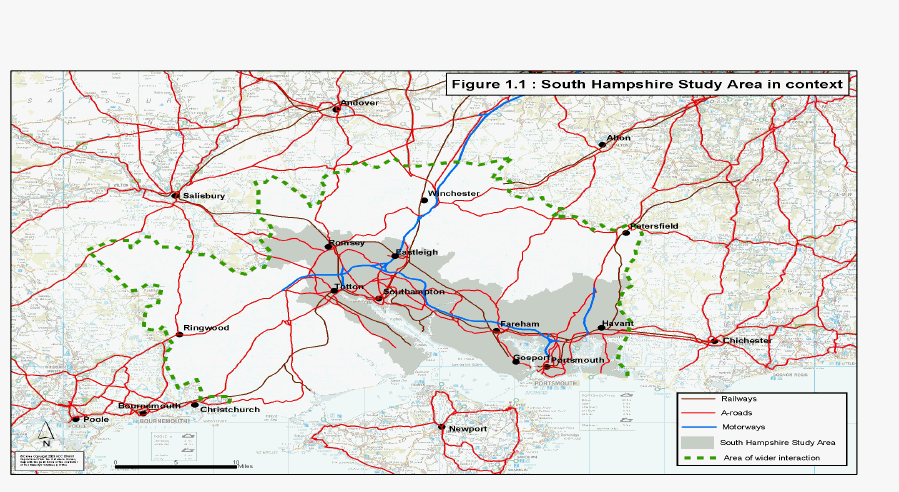
1. The purpose of the South Hampshire Study is to provide the foundation for the preparation of a land use and transportation strategy for South Hampshire for the next 20 years. The Study relates to the built-up area of South Hampshire together with the separate settlements and undeveloped areas immediately adjoining. A wider area of interaction has also been defined. The Study is essentially a factual analysis of information and forecasts, from which key conclusions are drawn.
Regional and European Linkages
2. South Hampshire has many important economic linkages with European and global markets. Development of these linkages could help to expand the local economy and reinforce South Hampshire's role as a 'gateway' from the UK to mainland Europe and the world.
3. There are some 30,000 flights annually from Southampton Airport, and 59,000 and 25,000 shipping movements from the ports of Southampton and Portsmouth respectively.
4. South Hampshire is generally well connected to the rest of the South East and other regions, and there are many economic and social linkages between them. The planning of South Hampshire must be considered as part of the wider South East region and Europe.
5. Connections include transport links, cross-commuting, trips for shopping, tourism and recreation and business links.
Economy
6. With an economy worth around £15 billion, South Hampshire generates least two thirds of Hampshire's total Gross Domestic Product and 13 per cent of the South East economy.
7. The urban centres continue to provide the highest concentration of jobs. However, there is a broad dispersal of employment throughout the sub-region.
8. One of the key reasons for the designation of South Hampshire as a Priority Area for Economic Regeneration in South East England, is the need to address high levels of deprivation.
9. South Hampshire has pockets of high unemployment and severe deprivation, especially in inner city wards and outlying housing estates.
10. Regional Planning Guidance suggests that tailored regeneration strategies and positive planning policies are needed to tackle deprivation. Schemes under the Single Regeneration Budget also have a role to play.
11. A major decline in manufacturing has been offset by an increase in service sector employment. Public services, retail, hotels and restaurants, and business services are now the biggest employers in South Hampshire.
12. In 2001 manufacturing accounted for 13% of total employment in the Study Area. The largest employment sectors are shops, hotels and restaurants (26%), public services (24%) and finance and business services (21%).
13. There is substantial commuting within the Study Area and to/from Winchester and West Sussex. Some South Hampshire residents commute to London, Surrey and Basingstoke; there is also commuting into South Hampshire from Dorset and Wiltshire.
14. Tourism and shopping are important elements of the South Hampshire Economy.
15. The commercial ports of Southampton and Portsmouth continue to make substantial contribution to the South Hampshire economy.
16. The Port of Southampton is one of the largest and most diverse ports in Europe and generates some 11,300 jobs associated with the Port and its related activities. The commercial and ferry port operations in Portsmouth are much smaller but still significant.
17. Rationalisation of MoD operations is likely to result in growth in defence related activity in and around Portsmouth.
18. Portsmouth Naval Base employs some 14,000 people, in addition to 6,500 ship-based service personnel.
19. The continued growth in use of Southampton International Airport is important to the South Hampshire economy. It has seen considerable growth in passenger numbers in recent years whilst there is demand for possible further commercial expansion.
20. Passenger numbers at the airport grew from 200,000 per annum in the early 1990s to 1 million in 2003 and are expected to grow further.
21. Focusing on the development and expansion of business clusters is one option for capitalising on South Hampshire's economic strengths.
22. Existing or emerging clusters include the marine sector; pharmaceuticals; aviation; electronics, telecommunications and computing; media/creative arts; and scientific research and development hubs.
23. Development of employment floor space averaged 103,000 square metres per year over the last 15 years and 88,000 square metres per year over the last seven years. Development for industrial use continued despite employment decline in manufacturing.
24. Substantial amounts of employment floor space have been lost primarily to housing. In the two cities, the creation of new floor space has not kept up with the loss of existing space.
25. Between 1998 and 2002, around 270,000 square metres of employment floor space was developed or given planning permission for other uses. Around two thirds of the loss was concentrated in the two cities. Apart from in the two cities, this loss was more than offset by the creation of new floor space.
26. Supply of employment land is not meeting demand, especially for move-on accommodation for local businesses.
27. The local authorities have identified some 1.3 million square metres of employment floor space which is planned for, has planning permission or is currently available for occupation. However, these figures do not reflect constraints that some sites have in meeting local needs, while some sites are not available in the short term.
28. The forecast increase in employment in the service sector will outweigh the projected decline in manufacturing jobs, resulting in an overall growth in demand for labour between 1996 and 2026.
Transport
29. South Hampshire has good road and rail networks, though substantial sections are congested at peak periods and this is forecast to worsen. Road traffic growth and car ownership are above the national average. Yet, nearly one in five South Hampshire residents live with walking distance of a rail station and the rail network has the capacity to carry more passengers.
30. If current trends continue unchecked then the ability of the transport network to cater for the additional travel demands associated with any future spatial strategy will be severely jeopardised.
31. Responsibility for transport infrastructure and operations is largely in private hands; each tends to be undertaken in isolation. The `Solent Transport' partnership was formed in 2002 to plan and co-ordinate South Hampshire's transport.
32. The objectives of the sub-regional spatial strategy for South Hampshire and those of the Solent Transport partnership will need to be fully integrated with one another.
33. Transport investment alone cannot solve the problem. Lifestyle and behavioural change are equally important.
34. New and more innovative solutions need to be investigated including better land use and transport integration, provision of infrastructure and services, and better co-ordination of investment across all modes. A complementary programme of non-transport or `soft policy' behavioural change initiatives will also be needed.
35. Possible measures include high density development around transport hubs, more stringent parking controls, congestion charging/road pricing, individualised transport planning, reallocation of road space to modes other than the car, and development of a South Hampshire Rapid Transit network.
Housing
36. A failure to recognise and plan for housing need will cause social problems and adversely affect economic performance.
37. South Hampshire could need to plan for 50,000 - 82,000 new dwellings between 2001 and 2021.
38. There may be a be a need for up to 33,000 extra dwellings, in addition to those currently expected to come forward between 2001 and 2021. Most of the extra dwellings would need to be built on greenfield land.
39. The Regional Spatial Strategy will set the actual provision to be made.
40. The supply of new affordable houses is falling well short of needs, and is a major issue which must be addressed by the sub-regional strategy.
41. The cost of re-developing brownfield sites for residential uses and improving social mix reduces the opportunities for securing affordable housing provision in the urban areas.
42. In the six local authorities wholly within the Study Area, there is a need for nearly 5,000 affordable houses each year whereas only 840 per annum are being built or acquired.
43. The provision of key worker housing in South Hampshire needs to be addressed if the economic regeneration objectives of RPG9 are to be met.
44. House prices have risen beyond the reach of many people and employers are experiencing problems in recruiting and retaining key staff. This can adversely affect public services and the local economy or result in larger journeys to work from areas where properties are cheaper.
45. In the older urban areas the age and condition of a significant part of the housing stock will become an increasingly important issue to address, especially within the private sector. Redevelopment schemes will need to enhance local environments and offer a mix of house types and tenure. Overall densities may fall thereby increasing the pressure to identify land for housing in adjoining areas.
46. Just under 20,000 dwellings (5.6% of stock) are estimated to be unfit in the local authorities wholly within the Study Area. Approximately 90,000 dwellings in South Hampshire were built before 1919, half of which are unfit or in substantial disrepair. Some 2.3% of total stock was vacant in 2002, which is consistent with normal vacancy rates necessary for the housing market to function.
Environment
47. Local and global factors affect the approach to environmental issues and will be important influences on a long term strategy for South Hampshire.
48. These factors include the growing awareness of the importance of environmental and natural resources; the value placed by local communities on nearby undeveloped land, and the human impact on resource consumption and the global environment.
49. The opportunities provided by, and constraints on development arising from, the designation of two new National Parks will have implications for any sub-regional strategy.
50. The new National Parks proposed for the New Forest and South Downs will replace the existing Heritage Area and Area of Outstanding Natural Beauty (AONB). Chichester Harbour is also designated as an AONB. Most of the Itchen, Hamble, Test and Meon valleys remain largely undeveloped open countryside and retain their recreational, wildlife, landscape and tourism value, although they are affected by development pressures.
51. The requirements of European Habitat Regulations necessitate a stringent environmental assessment of any development proposals.
52. The enhancement of biodiversity should be an integral part of any sub- regional strategy.
53. Parts of the New Forest, river valleys, Solent coast and estuaries are protected by European and, in some cases, by international habitat legislation. Other areas are protected under national legislation. Policies and proposals must also take account of their impact on particular species and on biodiversity generally.
54. Landscape characterisation treats designated and non-designated landscapes equally. There is an opportunity to apply this approach to the preparation of a strategy for South Hampshire.
55. Landscape character assessment identifies the features of different rural landscapes without judging their worth. It also links landscape, biodiversity, history and cultural identity.
56. Strategic gaps maintain areas of open countryside separating built-up areas across much of South Hampshire. Their continued relevance and boundaries will need to be reviewed in developing a spatial strategy based on the principles of sustainable development.
57. Long term future development within the sub-region will no longer be able to take water supply for granted. New water infrastructure and resource development should be provided in a sustainable way consistent with the required enhancements to water quality and the need to maintain habitat sensitivity.
58. The implications of the effects of climate change on a spatial strategy for South Hampshire will be significant.
59. Climate change will create many challenges for South Hampshire, requiring adaptations to sea defences; flooding warnings; farming methods; recreation and tourism patterns, and domestic lifestyles.
60. The concentration of economic, recreational and habitat values on the South Hampshire coast provides a unique dimension to the sub-region.
61. South Hampshire still contains significant areas of open coastal areas of environmental importance. The coast is also important for its major commercial ports of Southampton and Portsmouth and for its marine-related industries.
62. The spatial strategy for the sub-region should be based on objectives which attach an importance to the quality of urban environments equal to that of the environment outside urban areas.
63. The quality of the urban environment is also crucial to secure urban renaissance, encourage people to live in urban areas and maximise the development potential of brownfield sites.
64. Sustainable development of the urban fringe is needed to provide multi-purpose countryside for the benefit of local communities and businesses and adjacent urban areas. New development on the urban edge should bring positive quality of life improvements to rural and urban residents.
65. The countryside around the urban areas of South Hampshire is a complex area of rapid change and competing pressures for land. Many areas of urban fringe are highly valued locally and there are opportunities to capitalise on this.