Date: 19 November 2003 Item 6 Report by: The Hampshire Director of Environment, Portsmouth City Planning Officer and Southampton Executive Director of Development Written by: Antony Payne, telephone 01962 846766 Purpose and Summary: House building performance is currently a major concern to the Government, Regional Assembly and local authorities. Regular monitoring of the position is necessary to ensure that policy objectives are being met. This report sets out house completions in Hampshire for the year ending March 2003 and considers how the numbers relate to Structure Plan and regional planning provisions and that forecast in last year's Policy H4 Monitoring Report. A total of 5,600 dwellings were built during this period which, although still below the target set out in Regional Planning Guidance, represents a significant improvement on recent years. Completions were within 3% of the figure forecast in last year's Policy H4 Housing Monitoring Report, which is also an improvement on the previous year. As with previous years, completion rates have varied across Hampshire and it remains the case that if all councils had met, as a minimum, their share of the Structure Plan annualised baseline requirement, the RPG figure would have been exceeded. Some districts are still some way below their annualised share of the Structure Plan baseline housing figure and the councils affected have set out how they see their performance over the past year, and the steps they are taking to improve the position. RECOMMENDATION: That the Panel (i) considers the position in those districts that are significantly below their annualised Structure Plan figure for completions; (ii) calls on all local planning authorities to increase their efforts to meet or exceed their annualised Structure Plan figure for completions; and (iii) confirms that all districts are required to deliver their Structure Plan baseline figure and cannot draw on completions in other districts to reduce this requirement.
1 Introduction 1.1 The number of houses built in the South East of England, including Hampshire, has fallen below regional planning targets and is consequently of concern to the Government, Regional Assembly and local authorities. In May 2003 the then Minister of State for Housing, Planning and Regeneration, Jeff Rooker, wrote to the Chairman of the Strategic Planning Joint Advisory Panel stating that he expected to see significant improvement in the performance of Hampshire in the next year in line with the estimates set out in the Policy H4 Monitoring Report 2003. The Government Office for the South East (GOSE) has subsequently intimated that "housing completions in the South East is on the Prime Minister's top ten list of issues", and Keith Hill, the new Minister of State for Housing and Planning, can be expected to maintain the interest in Hampshire shown by Lord Rooker. 1.2 This report provides the first insight into how the Hampshire Structure Plan area is performing since Lord Rooker's letter. 2 Completions 2002-2003 2.1 Completions by district for 2002-03 are set out in Appendix 1, Table 1. Key points to note are: (i) 5,600 dwellings built - a 16% increase on the previous year; (ii) completions were 7% short (430 dwellings) of Regional Planning Guidance (RPG) annual target; (iii) completions were within 3% (165 dwellings) of that forecast in last year's Policy H4 Monitoring Report; (iv) Southampton, Rushmoor and Test Valley all saw significant increases on the previous year; (v) New Forest, Fareham, Basingstoke, Eastleigh and Havant all saw lower numbers built than the previous year; and (vi) if all parts of Hampshire had delivered, as a minimum, their Structure Plan annualised baseline figure the total number of completions would have exceeded the RPG figure.
2.2 Completions for the year ending March 2003 by Structure Plan sub-area are set out in Appendix 1, Table 2. Completions in all sub-areas were up on the previous year, most notably in the northern area which saw a 27% increase. However, completions since 1996 in the northern sub-area remain well below that required by the Structure Plan, unlike the other two areas which have delivered or exceeded their requirement. 3 Performance 1996-2003 3.1 Graph 1 (overleaf) shows completions between April 1996 and March 2003. The increase in completions seen last year continues a trend started in 2001. It also shows the forecast of completions to 2011 based on last year's Policy H4 Monitoring Report. 3.2 The number of planning consents issued has also shown a steady growth in recent years (see Graph 2, also overleaf). Almost 7,000 dwellings were approved in the year ending March 2003 - a 32% net increase in consents on the previous year. The total number of consents are 8% up on the position in March 2002. Although some of these will be in outline only, there is the prospect that many will be translated into full consents and implemented within the next few years, and in the process help Hampshire to exceed its RPG target. 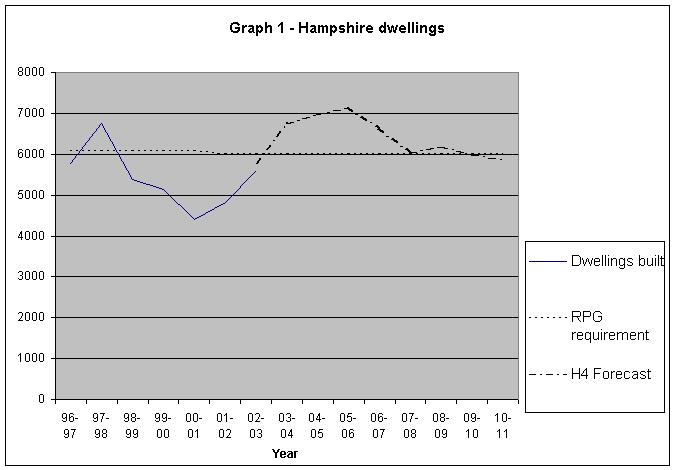 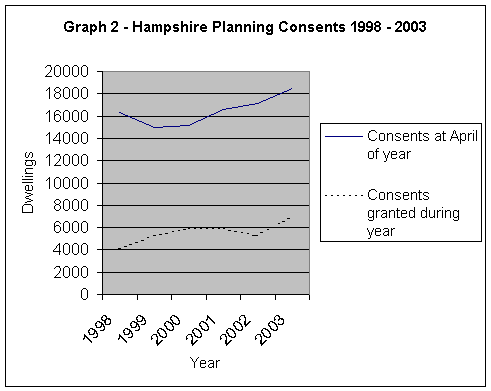
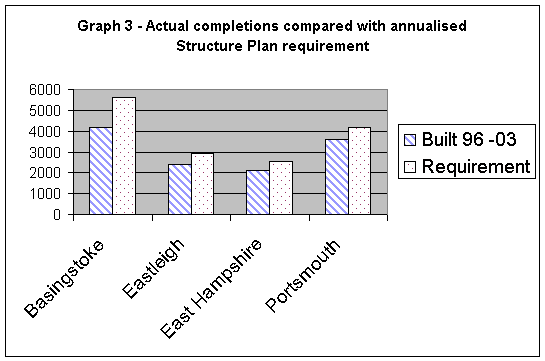
3.3 Appendix 1, Table 1 provides an overview of completions between 1996 and 2003 across Hampshire by district. This shows that seven authorities have to date exceeded their Structure Plan baseline annualised figure by between 9% and 30%. The remaining six are below their baseline figure by between 4% and 26%. Assessment against the Structure Plan baseline requirement is considered to be a more appropriate measure than the baseline plus reserve approach used last year by GOSE. The latter is considered flawed as it penalises those districts with a reserve housing requirement as the reserve has yet to be released. 3.4 The four authorities most adrift from their baseline annualised rate (see Graph 3) were invited to comment on their performance over the past year and the steps they are taking to catch up. The authorities are: (i) Basingstoke and Deane (26% below Structure Plan baseline); (ii) Eastleigh (18% below); (iii) East Hampshire (17% below); and (iv) Portsmouth (14% below).
 3.5 The responses are set out in Appendix 2. 3.6 The authorities have outlined the steps they are taking to increase overall supply. These include: (i) regular monitoring of supply, starts and completions; (ii) reviewing procedures to speed up the processing of major development applications and Section 106 agreements; (iii) identifying sites in urban capacity studies to stimulate demand; and (iv) preparing development briefs.
3.7 Based on recent levels of consents and building starts, they generally report optimism that their outturn figures for completions for the year ending March 2004 will show substantial improvements. 3.8 Eastleigh also draws attention to the fact that, as completions in South West Hampshire are in excess of the Structure Plan baseline, the shortfall in the borough has been made up by the level of completions elsewhere. This analysis is flawed insofar as completions in those districts that are exceeding their baseline are helping to bridge the gap between the Structure Plan baseline figure as a whole and the RPG target. They cannot be used to offset the shortfall in provision in those districts that have yet to meet their baseline. All planning authorities should accordingly aim to meet their individual Structure Plan baseline housing supply figure. 4 Conclusion 4.1 The number of dwellings built in 2002-03 was very close to that forecast. The reasons for the difference will be examined to help further refine the forecasting used in the next Policy H4 Monitoring Report. This will be published for consultation before the end of the year with a report back to this Panel in the spring. Although it is too early to assess overall levels of supply, there are other positive indicators, such as the increase in planning consents, that suggest that the growth in house building seen last year represents the start of a more sustained recovery. 4.2 However, now is not the time for complacency - planning consents need to be translated into dwellings and progress must be maintained on local plan production to ensure further land is brought forward in future years. The shortfall in meeting RPG targets 2001 to 2003 (over 1,600 dwellings) has also to be made good in future years. Planning authorities need to build on the momentum that has been made over the past 12 months to ensure that the RPG target is met in full. 4.3 The increase in house building is also good news for the provision of much needed affordable housing that is brought forward via the planning system. This has suffered as a consequence of the low overall rates of house building seen in recent years. 4.4 The next Policy H4 Monitoring Report, due to be published by the end of the year, will provide more detailed assessments of future housebuilding supply and forecasts of completions. |