Archived decisions
|
|
|
STRATEGIC PLANNING JOINT ADVISORY PANEL | ||
Date: 19 November 2003 Item 5 Report by: The Hampshire Director of Environment, Portsmouth City Planning Officer and Southampton Executive Director of Development and Sustainability DRAFT ADDENDUM TO STRUCTURE PLAN SUPPLEMENTARY PLANNING GUIDANCE `IMPLEMENTING POLICY H4' Written by: Stuart Roberts, tel 01962 846782 Purpose and Summary: The Structure Plan Supplementary Planning Guidance, called `Implementing Policy H4', outlines the processes to be followed in deciding if, and then where, to release the Structure Plan's reserve housing provision. A draft Addendum to the document has been prepared to amplify the process and the factors for deciding where to trigger a release, in the event that a release is necessary. The Panel is recommended to approve and publish the draft Addendum for public consultation. RECOMMENDATION: That the draft Addendum to the Supplementary Planning Guidance, `Implementing Policy H4', be published for public consultation. 1 The Hampshire County Structure Plan 1996-2011 Supplementary Planning Guidance (SPG) `Implementing Policy H4' was adopted by the Hampshire strategic planning authorities in February/March 2001. It explains how, in the light of monitoring information, the strategic and local planning authorities will decide if, when and where any of the Structure Plan's reserve housing provision will be released for development. The SPG can be seen at: www.hants.gov.uk/structureplan/spgpolicyH4.html. 2 The SPG gives a comprehensive explanation of the process for deciding if it is necessary to consider triggering the release of some of the reserve housing provision. That process has been followed during the last two years with the publication of, and consultation on, the annual `Policy H4 Monitoring Report'. 3 The SPG is more sketchy, though, on the process for determining where to make the release, in the event that a release is necessary. This has not been a handicap so far, because the monitoring during the last two years showed that it was not necessary to contemplate triggering a release, and so the question of where to make the release did not arise. However, it is possible that this year's Policy H4 Monitoring Report (to be published next month) or a future year's report could conclude that a release is necessary, thus requiring a decision to be made on where to trigger the release. 4 In view of that, it is far preferable to conduct a considered debate now on the process to be followed, instead of leaving the matter until there is a need to implement the process. The latter would cause confusion and delay, and inevitably lead to individuals' views on the process being coloured by their views on the outcomes. 5 Hence a draft Addendum to the SPG has been prepared for consideration by this Panel - see attached appendix. It builds on the process outlined in the SPG but adds further detail about factors to be used by this Panel in identifying where to make a release in the event that one is necessary (paragraphs 3.1 to 4.3 of the appendix) and the arrangements for public consultation thereon. It reiterates the statements, previously agreed by this Panel, that the failure of any district council to identify its reserve housing provision will not influence decisions on where to trigger the release of reserve housing provision (paragraphs 6.1 to 6.3 of the appendix). 6 The draft Addendum has been discussed with officers of the Hampshire District Councils. Some welcomed and endorsed the document overall; others questioned whether it was appropriate to produce it in view of the impending disappearance of the County and City Councils' statutory role in strategic planning (upon the Planning Bill gaining Royal Assent next year) and the expected replacement of the Structure Plan by Regional Planning Guidance during 2006. Supporters of the draft Addendum countered that decisions on whether to release the reserve housing provision would need to be made by somebody during 2004 to 2006 (presumably the South East England Regional Assembly) and it would be preferable for the Hampshire authorities to determine the process to be used (by adopting the draft Addendum) rather than leaving the Assembly to reach decisions on whatever process/criteria it deemed appropriate. Representatives of the Government Office for the South East have stated that it will be helpful to have an agreed process to identify the location of any release of reserve provision. 7 Consequently, the draft Addendum is presented to this Panel meeting, with a recommendation that it be approved for public consultation. The comments received will be considered by the portfolio holders/Executive Members in each of the three strategic planning authorities prior to adopting the Addendum. | ||



Section 100 D - Local Government Act 1972 - background papers | |
The following documents disclose facts or matters on which this report, or an important part of it, is based and has been relied upon to a material extent in the preparation of this report. | |
NB the list excludes: | |
1. |
Published works. |
2. |
Documents which disclose exempt or confidential information as defined in the Act. |
TITLE |
LOCATION |
None. |
8398/SR
APPENDIX
DRAFT ADDENDUM TO SUPPLEMENTARY PLANNING GUIDANCE
`IMPLEMENTING POLICY H4'
1 Introduction
1.1 The Hampshire County Structure Plan 1996-2011 Supplementary Planning Guidance (SPG) `Implementing Policy H4' was adopted by the Hampshire strategic planning authorities in February/March 2001. It explains how, in the light of monitoring information, the strategic and local planning authorities will decide if, when and where any of the Structure Plan's reserve housing provision will be released for development.
1.2 This draft Addendum adds further clarification of the process of deciding where the release will be made, in the event that a release is needed. It is being prepared now, so that it is in place prior to the need to make decisions on where to release the reserve housing provision.
1.3 This draft version of the Addendum has been published by strategic planning authorities for public comment. Sections 3 and 4 contain the new guidance and your views are invited on them. Please send your comments by (date) to Sue Clark, Environment Department, Hampshire County Council, The Castle, Winchester, Hampshire, SO23 8UD or by e-mail to [email protected].
1.4 In particular, your views are sought on whether:
(i) the process set out in sections 3 and 4 is clear and reasonable?
(ii) the factors set out in paragraphs 3.1 and 4.2 are the right ones to inform decisions on where to make any necessary release of reserve housing provision?
(iii) a weighting (high, medium, low for example) should be given to those factors?
(iv) the decision-making sequence proposed in paragraph 5.2 could and should be speeded up?
2 Determining if a release is necessary
2.1 The Structure Plan provides for a `baseline' housing provision (Policy H2) and a `reserve' housing provision (Policy H4). The reserve provision includes extensions to several baseline Major Development Areas (MDA), a wholly new MDA and quantums of housing outside the MDAs. Policy H4 states that greenfield reserve allocations will only be released for development if there is a compelling justification to do so.
2.2 The Regional Planning Guidance (RPG) for the South East published by the Government in March 2001 - a year after the Structure Plan was adopted - requires a housebuilding rate in the Hampshire Structure Plan area of 6,030 dwellings per year. This is a rate of building which is above the Structure Plan's baseline provision. This does not automatically mean a release of some of the reserve housing provision; the extra housing required by the RPG could instead come from additional `urban capacity' within Hampshire's cities and towns. The latter would be in line with Planning Policy Guidance (PPG) Note 3 `Housing' which requires previously developed sites to normally be developed before greenfield sites; it would also accord with the Policy H4 stipulation that there must be a compelling justification for the release of greenfield reserve sites.
2.3 The Supplementary Planning Guidance `Implementing Policy H4' sets out the process for monitoring these matters and reaching a decision each year on whether there is a compelling justification to release any of the reserve housing provision. Central to the process of deciding whether to release any of the reserve, is the publication of an annual housing technical report which compares housing supply each year up to 2011, with the RPG requirement.
2.4 If this report reveals a shortfall in future housing supply the strategic planning authorities will consider the extent to which it could be filled without recourse to the reserve provision. If the shortfall cannot be met by other means the strategic planning authorities would consider triggering the release of some of the reserve housing provision. This shortfall may be in only one, or several years, and could be in any year up to 2011. Recognising the lead-in times for site development, it will be necessary to trigger the release several or more years ahead of the identified shortfall.
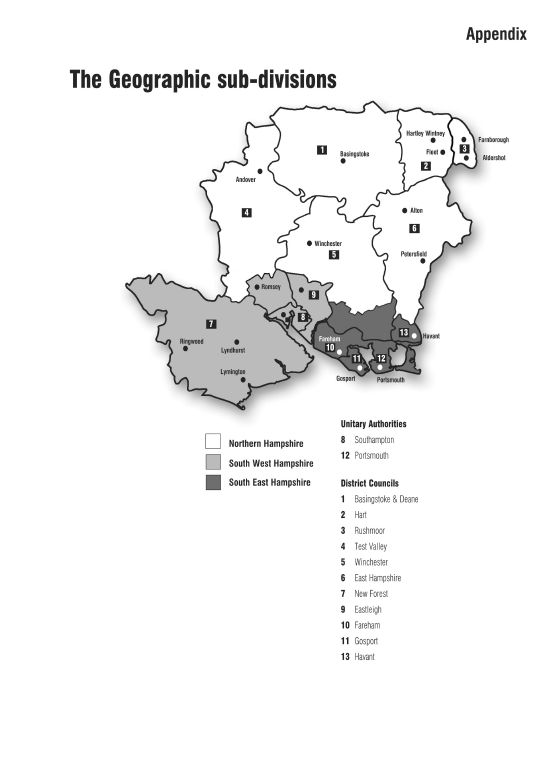
2.5 The Supplementary Planning Guidance explains that if a release is made the strategic planning authorities would decide in which of the three geographic sub-divisions of Hampshire1, the release should be made. The next step would then be for the strategic and local planning authorities to decide in which Districts that release should be made, and whether it should involve some of the reserve MDA provision. Release would not necessarily be in the same District(s) as the identified shortfall in housing supply.
2.6 The remainder of this Addendum clarifies how these decisions will be made.
3 Determining in which sub-division(s) to make the release
3.1 In deciding in which sub-division(s) to make the release, the strategic planning authorities will consider the following factors:
(i) Whether any of the sub-divisions are under performing in relation to the baseline housing requirement and whether this under performance is forecast to continue. Any such under performance would be a factor favouring the release of some reserve provision in that same sub-division.
(ii) The buoyancy of the housing market/housing demand in each sub-division, as indicated by house price inflation2 and vacancy rates3. High house price inflation relative to the other two sub-divisions and low vacancy rates would be factors favouring the release of some reserve provision in that sub-division.
(iii) The affordability of housing in each sub-division as indicated by the house price/income ratio4. A high ratio relative to the other two sub-divisions would be a factor favouring the release of some reserve provision in that sub-division.
(iv) A comparison of forecast labour demand5 and forecast labour supply6 in each sub-division. A shortfall in forecast labour supply compared to forecast labour demand would be a factor favouring the release of some of the reserve provision.
(v) The size of the release. A small release would most sensibly be confined to only one sub division. A larger release might be confined to only one sub-division, or could be spread across two or all three.
3.2 It is possible that these factors may conflict and point towards releases in different sub-divisions. In that event the strategic planning authorities would need to reach a considered judgement on the weight to be given to each factor. The outcome could be that the release is made wholly in one sub-division, or in two sub-divisions, or is spread across all three.
4 Determining in which District(s)/MDA(s) to make the release
4.1 Following the decision on the sub-division(s) in which to make the release, the strategic and local planning authorities would decide in which District(s) and/or reserve MDA to make the release(s). (This step would not be necessary if all the reserve in a particular sub-division were released.)
4.2 In coming to this decision, the following factors will be considered:
(i) the same information, at District level, as set out in (i) - (iii) in paragraph 3.1 above.
(ii) The size of the release. A small release might sensibly be confined to just one District. It would also be sensible not to trigger the release of the reserve Major Development Area at Winchester City North unless the whole of it is to be released.
(iii) The year(s) in which the completed dwellings are required (as identified through the analysis described in paragraph 2.3 above). For example, a reserve site with development constraints which cannot be overcome until, say, 2008, would be ineffectual in bridging a shortfall occurring in the year 2006. (See paragraph 6.3 in relation to Districts where reserve sites have not yet been identified.)
(iv) The ability of the housing market in each District to absorb the additional housing, such that the additional dwellings would be occupied immediately on completion.
(v) The need for affordable housing. Favourable consideration would be given to a release in a District which has an above average requirement for affordable housing.
4.3 It is possible that these factors may conflict and point towards releases in different Districts/reserve MDAs. In that event, the strategic and local planning authorities will need to reach a considered judgement on the weight to be given to each factor. The outcome could be that the release is made wholly in one District, or in one reserve MDA/MDA extension, or in more than one.
5 Consultation and Implementation
5.1 The Supplementary Planning Guidance embodies a period of consultation on the monitoring information before decisions are taken by the strategic planning on whether to release any of the reserve provision. It is appropriate that consultation should also take place on where the release is to be made in the event that a release is necessary. This consultation would help confirm (or otherwise) whether there is a `compelling justification' to release greenfield reserve sites; the test set by Policy H4.
5.2 The sequence of events would be as follows:
(i) the housing technical report setting out the analysis of whether there is a need to release reserve provision would be published each November for public comments (as now);
(ii) the report and public comments thereon would be considered by the Strategic Planning Joint Advisory Panel (JAP) in the following March (as now);
(iii) if that year's report concluded that a release was necessary, a second separate report would be presented to the same JAP meeting setting out the analysis of the factors in paragraph 3.1 and 4.2 of this Addendum, and recommending where the reserve provision should be released;
(iv) that second report would then be published for public comment;
(v) the comments received on it would be considered by the portfolio holders/Executive Member in each of the three strategic planning authorities, who would confirm or otherwise the decision on where the reserve provision should be released.
5.3 This sequence is explained graphically in the flow diagram overleaf (to be added in published consultation version).
5.4 The above process will trigger the release of some of the reserve MDA provision and/or a quantum of the non-MDA reserve provision in a District(s). If the latter is triggered, the local planning authority will then need to decide which reserve sites to release, ensuring that the total capacity of the sites meets the quantum of release triggered.
5.5 The local planning authority(ies) will be expected to act promptly to make the actual release(es). This will need to be sufficiently in advance to ensure delivery of completed dwellings in the year(s) when the shortfall is predicted to occur.
5.6 The County Council in responding to subsequent consultations on planning applications and evolving Local Plans will take account of the Joint Advisory Panel's conclusions.
6 Non-identification of reserve provision
6.1 At the time this Addendum is published, not all the reserve provision required by Policy H4 has yet been identified in Local Plans. This will not in any way influence decisions on where to release the reserve in the event that some reserve provision needs to be released.
6.2 In District(s) where a release is triggered and the local planning authority has identified the reserve provision, that authority will, as a consequence, be in control of the release process, as described in paragraph 5.4.
6.3 In District(s) where a release is triggered but the local planning authority has not identified the reserve provision, the precise location of the released sites will emerge from housebuilders and landowners promoting sites through the development control process.