
Archived decisions

The Annual Report of the Complaints and Customer Care Service
(incorporating the Annual Report of the Operation of the Complaints Procedure)
2002-2003
Social Services Department
Irene Unwin
Complaints and Customer Care Manager
Performance Management Unit
Contents
1. Introduction
2. The Procedure in Outline
3. Independent Persons
4. Social Services Staff
5. Other Procedures
6. Statistics
7. Outcomes and Learning
8. Other Aspects of the Service
9. Discussion and Conclusion
1 Introduction
1.1 The National Health Service and Community Care Act (1990) and the Children Act (1989) require social services departments to produce an annual report of the operation of the complaints procedure The Department of Health guidelines for this report state that the report should include a summary of statistical information and a review of the effectiveness of the procedure, to be presented to the relevant Members Committee of the County Council.
1.2 The Best Value Review of the Complaints Procedure in 2001 highlighted the need to further the work undertaken by the complaints office; to use a customer care approach to resolving complaints whenever possible and to use the learning from complaints and other departmental processes to improve the way in which social services are delivered to the people of Hampshire.
1.1 Annual reports have to date dealt only with the operation of the complaints procedure. However in response to both developments since the Best Value Review and the interest shown by members in the work of the service when previous reports have been presented, this year's report will be more comprehensive and consider the impact of the service and some of the outcomes which have been achieved.
1.3 This report will look at the scope of the activities of the Complaints and Customer Care Service and in addition to giving details of the statistical information collected will describe the impact of the service in respect of outcomes for individual service users and upon how services are delivered.
1.4 The customers of the operational part of the service are service users. However, the service also supports staff, not only in dealing with complaints but by managing both the department's response to violence and abuse to staff and `Speak Out' the process by which staff can report bad practice. Finally the service has a responsibility for co-ordinating the investigation of untoward incidents across the department and ensuring that investigations are completed in a timely and appropriate way and that recommendations are followed through.
1.5 This range of activities means that the Complaints and Customer Care Service is uniquely placed to collect a wide range of information about when services may not have met the expectations of service users or the standards required by the department and to use this information to continuously
_ A dissatisfied customer is one whose expectations have not been met.
_ A satisfied customer is one whose expectations have been met.
_ A delighted customer is one whose expectations have been exceeded.
1.6 improve the quality of services.
1.7 The above is often used when thinking about how to manage customer care. Many complaints and expressions of concern suggest that people did not receive the service they expected, either because it was not of a good standard or possibly because the expectations themselves were unreasonable or unrealistic. The service is also sent many compliments about the work of the department, often from people who are delighted by the service received and whose expectations have been exceeded. The report will make reference to compliments received to offer a more complete picture.
1.8 Throughout this report examples of complaints are given to illustrate the text. In order to respect confidentiality the examples are anonymous and the details have been changed where the situation could make an individual or situation identifiable. All examples are based on complaints for the period covered by this report with one exception (Mrs O) as no suitable complaint arose to illustrate the text. This use of examples is similar to that used by the Local Government Ombudsman in his annual reports.
2 The Complaints and Customer Care Process
2.1 All service users and people caring for those using our services should know how to voice a compliment, complaint or concern. A leaflet called `So What do you Think?' should be given to all people who have had contact with departmental services and is widely available in local offices, residential and day care services and Information Centres. In addition the information is available on the HantsWeb and people can contact the service by using an On-line Form. The information available does not give full information about the formal procedure, but does advise people to contact the complaints officer if not satisfied with the initial response.
2.2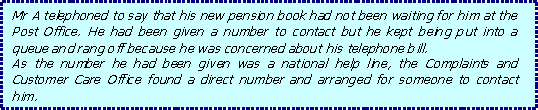 The wide availability of information about how to contact the Complaints and Customer Care Service means that people use the telephone number given not only to make complaints but to seek help or advice. The service also deals with correspondence to headquarters, including to named people such as the Director, where the main issues appear to be about how services are being provided. A small proportion of these contacts can be dealt with immediately by, for example, providing the information which is being sought or advising if the matter concerns another agency who can deal with it. In some circumstances the office will contact another agency on the caller's behalf, particularly if the caller has clearly been having difficulty finding the right person to talk to.
2.3 If the matter is more complex and will require the Complaints and Customer Care Service to seek further information, the contact is logged and a file opened. The file will remain open until the matter is resolved. What happens next will be guided to a large extent by what outcome the person making the contact is looking for. If it is a relatively straightforward matter it can be dealt with straightaway. Matters which are more complex and will require further investigation to resolve are acknowledged and will be forwarded to the appropriate manager to prepare a response, or in some situations agreement will be reached that the Complaints and Customer Care Service will deal with the matter. Sometimes both immediate action and a detailed response are 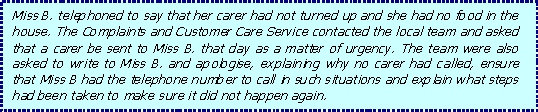 needed.
2.4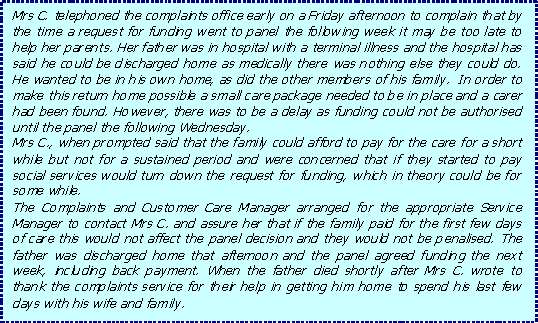 Some of the matters brought to the attention of the Complaints and Customer Care Service are most appropriately dealt with using creative problem solving techniques, either at headquarters or locally. `Complaints' can be `problems' in a different guise and can be resolved by resolving the problem.
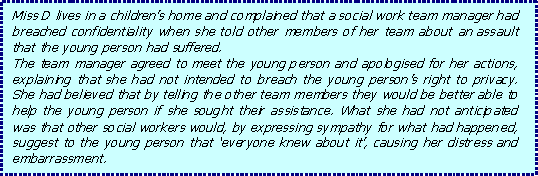 2.5 There are complaints where mistakes have clearly been made and staff are encouraged to acknowledge these and do what they can to put it right.
2.5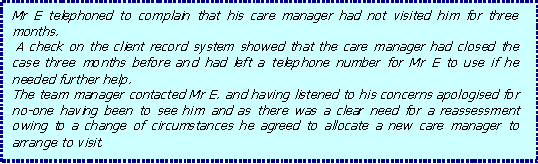 Complaints also arise through miscommunication or because of false expectations and no-one is `at fault'. People using our services often do so at a particularly stressful time in their lives and we should therefore anticipate that things which have been said may be misheard or forgotten. When such situations occur staff are encouraged to acknowledge that there has been a misunderstanding and apologise for the upset caused, at the same time as clarifying the situation in writing.
2.6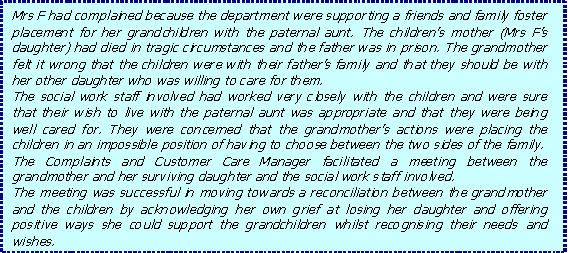 There are situations where face to face contact is the best way of resolving a complaint. Conciliation is particularly effective when a complainant becomes entrenched in a particular view point and staff hold an opposing view. If necessary, either an Independent Person or one of the Complaints and Customer Care staff can facilitate such a meeting.
2.7 In exceptional circumstances an `internal investigation' may be requested if a complaint is either of a serious nature or about events which happened some time ago. The matter will be drawn to the attention of the appropriate County Manager and Assistant Director with the request that they formally commission an investigation, both to establish the facts and make recommendations for any remedial action. The investigation may be carried out by a senior staff member or one of the complaints officers.
2.8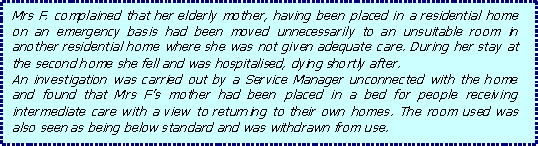 If a complaint cannot be resolved informally complainants have the right to take their complaint further. If they are `qualifying persons' under the relevant legislation (e.g. a service user or a parent/carer) they can request that the matter be investigated by an Independent Person under Stage 2 of the complaints procedure. The Independent Person will see the complainant, relevant staff and files as necessary before preparing a report. The initial meeting between the complainant and the Independent Person is important in that it is the complainant's opportunity to state clearly the complaints which are to be investigated and, as importantly, to state what outcomes they are looking for. This gives the Independent Person not only a framework for the investigation itself but a basis upon which to make recommendations which will help to resolve the complaint. There is an element of negotiation in this process and it may be necessary for the Independent Person to visit the complainant more than once.
2.9 The complaints officers will receive a draft copy of the report and carry out an initial `checking' to ensure that the conclusions are reasonable and based on a demonstrable evaluation of the evidence, and that any recommendations are realistic. All the parties concerned then have an opportunity to comment on the draft report before the Independent Person submits a final report which will state whether or not the complaints have been upheld and if appropriate, make recommendations. Any recommendations would be considered seriously by the Department but are not binding. They are responded to by the appropriate County Manager who will identify what actions will be taken following the investigation.
2.10 If the complainant is not satisfied with the outcome of the investigation they have the right to be heard by a Review Panel. The panel comprises three people, one of whom may be an elected Member. The panel must be chaired by an Independent Person. The complainant attends the panel meeting and explains to the panel the causes of concern. The panel will then interview the staff involved and the Independent Person who completed the investigation before preparing a report of their findings and making appropriate recommendations. The report and recommendations will be responded to by the Director.
2.11 If not satisfied with the outcome of the panel, the complainant may take the matter to the Local Government Ombudsman, who will decide on the basis of information from the Department and the County Council whether or not to further investigate the complaint.
2.12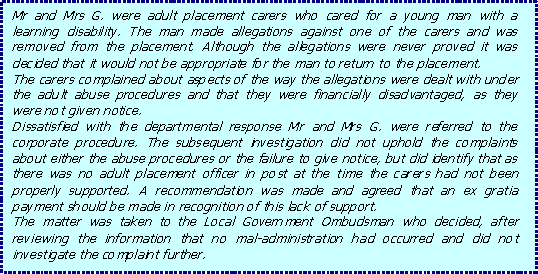 There are some people who wish to pursue a complaint who do not qualify for the social services procedure, for example, providers of services. In this instance the matter may be referred to the corporate complaints procedure. After the matter has been investigated through the corporate procedure the complainant may proceed to the Local Government Ombudsman. The role of the Local Government Ombudsman is to decide whether mal-administration has occurred, not to re-investigate the complaints.
3 Independent Persons
3.1 The Complaints and Customer Care Service maintains a panel of Independent Persons who can be called upon to carry out the formal investigation of complaints and to sit on or chair review panels.
3.2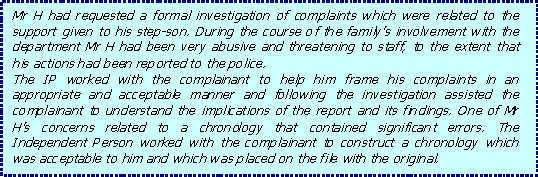 In recent years the annual report has described a further role for Independent Persons, that of conciliators or mediators. This role has continued and Independent Persons have successfully acted as conciliators with regard to both the informal and formal complaints procedure.
3.3 The work undertaken by Independent Persons has continued to be diverse, including carrying out investigations not related to the formal complaints procedure, and investigating personnel related matters.
3.4 Many of the Independent Persons who carry out work for Hampshire SSD's Complaints and Customer Care Service also carry out the same work for Southampton and Portsmouth. There is regular liaison and information sharing between the three departments with regard to Independent Persons and an informal agreement that we adopt the same remuneration conditions.
3.5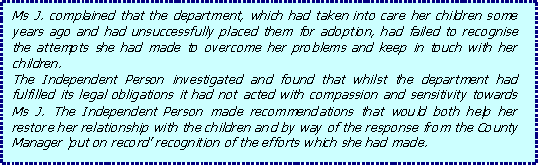 A consequence of the significant effort put in to resolve complaints informally is that the complaints which are investigated are likely to be complex and emotionally charged. That the majority of complaints are resolved at this stage of the process is largely due to the skills of the Independent Persons.
4 Social Services Staff
4.1 The Complaints and Customer Care Service works with departmental staff in a number of different ways with regard to complaints:
¬ To request and monitor responses to complaints and recommendations from investigations and review panels.
¬ To train and advise staff in complaints handling and resolution
¬ To support staff who have been the subject of complaints.
4.2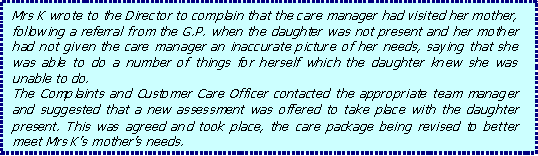 There has been an increase in the amount of contact that the Complaints and Customer Care Service has with a range of operational staff in the Department. This has arisen owing to the continued change in culture and the recognition that the quicker complaints are resolved the better for staff and complainants alike. The Complaints and Customer Care Service may be able to suggest immediate remedial action to resolve a complaint quickly and avoid the need for the matter to be `investigated'
4.3 The Complaints and Customer Care Officers may make direct contact with front line staff if they are in the best position to give the information needed to answer a query or there is a concern which needs addressing quickly. Aware that a telephone call from `the complaints office' can lead to anxiety in staff, efforts have been made, through by example speaking to staff groups, to reassure staff that such a telephone call does not mean that they are `in trouble', but that either the service is seeking information or wishes to pass on information. The service will never commit a staff member to an action before getting their agreement first.
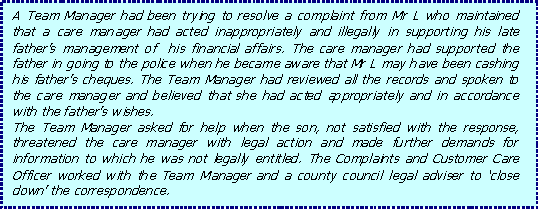
4.4 There is now a greater willingness on the part of operational staff to seek the advice and support of the Complaints and Customer Care office to resolve complaints. This can range from asking advice about how to manage a specific complaint to `handing over' a complex or difficult complaint where dealing with the complaint or series of complaints is impeding the ability of staff to get on with their caring tasks.
4.5 For the Complaints and Customer Care Service to be effective in resolving complaints it is important that other staff are aware of their role and also have training and support available to aid effective local complaints handling.
4.6 Information about the complaints procedure is in all staff induction programmes. For staff who regularly deal with complaints as part of their work there is a half day course on `Complaints Awareness'. The objectives of this course are to make staff aware of the complaints procedure in more detail and to identify and practice ways of dealing with complaints which increase the likelihood of the complaint being resolved promptly and effectively. Last year four half day courses were given, facilitated by the Complaints and Customer Care Officers.
4.7 Two whole day courses were also given on `Effective Complaints Handling'. This course looks in greater detail at how to manage complaints, particularly through the use of conciliation. The course is aimed at people who may be required to resolve complaints as part of their practice and is fully participative. `Real' examples are given for people to consider and work through to resolution, allowing participants to practice conciliation skills.
4.8 No two courses are exactly the same as the courses use examples relevant to the work of the participants. An important message given on both courses is that many of the skills necessary to resolve complaints successfully are those which people use every day in social care practice, such as listening, problem solving and negotiation skills. Over the year both types of course received very positive feedback through the course evaluation forms.
4.9 Staff involved in the formal complaints procedure need to be supported through the process, especially at Stage 3, which can be very stressful and may feel intimidating. As the number of Review Panels is very low it is also likely that staff requested to attend will never have been to a panel before.
4.10 In order to support staff in the process one of the Complaints and Customer Care Officers will brief staff beforehand by explaining how the process works and giving practical advice.
4.11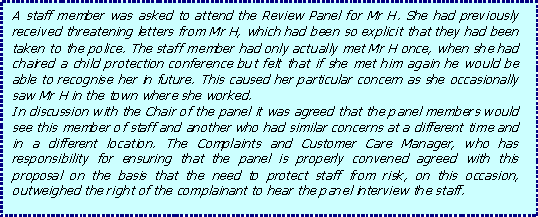 Staff safety is always a consideration and for one panel this year it was necessary to manage the panel in such a way as to ensure that staff were not exposed to verbal or possibly physical abuse.
4.12 It is important to note that the majority of complaints are dealt with effectively by the staff involved and their managers. A course participant remarked that he had observed a movement away from a `blame culture' which leads to defensiveness, to a culture where it is accepted that mistakes can occur and that it is better for everyone if mistakes are admitted and steps taken to ensure that they do not reoccur. Genuine apologies go a long way in resolving complaints and what the majority of complainants are seeking is an acknowledgement that something has gone wrong and someone to say `sorry' and mean it.
5 Other Procedures
5.1 It has already been mentioned that not all complainants qualify to use the formal stages of the social services' complaints procedure. People who are providing a service to the department and whose complaint can not be resolved informally will be referred to the corporate complaints procedure. There are also complaints which cannot be addressed through the procedure and which have to be addressed through another procedure.
5.2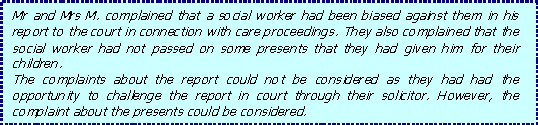 One area of complaint which can not be addressed through either the formal or informal procedure is when the matter is before the court. If the complaint is about legal action being taken by the department the complaints can not be considered. The defining question in deciding whether or not to consider such complaints is `Will the complainant have or have had the opportunity to make a challenge in court?' If the answer is `yes' then the complaint can not be considered. If the answer is `no' and the court proceedings have been completed the complaint can be considered. If the court proceedings have not been completed the complaint can be `put on hold' until proceedings have been finished.
5.3 Complaints which relate to the proceedings of child protection conferences also can not be considered and have to be dealt with through the Area Child Protection Committee Complaints Procedure.
5.4 There is a separate procedure for complaints and allegations against foster carers. However, if the matter is a `complaint' the two processes are identical and interchangeable. If however the `complaint' is treated as an allegation against the foster carer this will be dealt with through the foster care procedure.
5.5 It can be very difficult to determine whether or not complaints about financial matters can be addressed through the formal complaints procedure. If the matter cannot be resolved informally it is usual practice to consult with the county council's legal department. The defining question which is applied is whether or not it is reasonable to ask an Independent Person to make a judgement based on interpretation of the law.
5.6 Although not strictly an alternative procedure, the Local Government Ombudsman will contact either the Chief Executive's office or the complaints office direct to seek information about a received complaint. This would not necessarily be a complaint which had come to the attention of the Complaints and Customer Care Service. It has now become the usual practice of the LGO to discuss whether or not it is appropriate before referring anyone back to the formal complaints procedure. This has been welcomed, as in the past matters have been referred back which are not appropriate, leading to false expectations on the part of the complainant.
5.7 Finally, it is not considered appropriate to use the complaints procedure if the complainant is clearly stating that he or she is seeking significant compensation as their desired outcome. Such complaints are rare but if they occur the complainant is advised to seek legal advice or the matter is referred to the Chief Executive's office.
5.8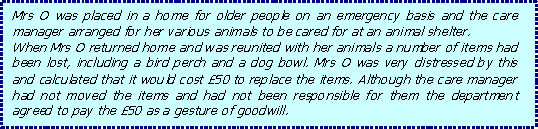 If, however, the complainant is seeking recompense for a small amount and has clearly suffered a loss, a payment would normally be agreed. The amount would be based on the principle used by the Local Government Ombudsman in deciding compensation, namely a calculation of how much it would cost to put the complainant back in the same position as before the loss was incurred.
6 Statistics
6.1 Owing to the changes in the area structure, as reported last year, it has become increasingly difficult to collect reliable statistics from areas. As areas no longer have a distinct identity, and with service managers working across areas, comparative statistics no longer have any significant meaning. This year's statistics are therefore based on the complaints which have been dealt with at some point by the Complaints and Customer Care service.
6.2 Over at least the last three years the trend was for an increase in the number of complaints. This year there has been a reversal of that trend with a decrease of 4.4% in the number of referrals to the Complaints and Customer Care Office recorded on the headquarters database. (See Table 1.) These were either referrals which came into the office direct or were sent to other headquarters staff and forwarded.
Table 1. Entries on Complaints Database | |||||
99 - 00 |
00-01 |
01-02 |
02-03 |
%diff | |
Number of referrals |
357 |
462 |
496 |
474 |
-4.4% |
6.3 However, it is now possible to consider and compare the composition of the entries into categories. Table 2 shows this breakdown. This indicates an increase in the number of complaints, as expressions of dissatisfaction with the service, of 10%.
Table 2. Breakdown of Entries Over Last Two Years | |||
2001-02 |
2002-03 |
%diff | |
Complaints |
390 |
428 |
10% |
Advice |
26 |
18 |
-30% |
Help |
20 |
17 |
-1.5% |
Referral |
60 |
11 |
-81% |
Total |
496 |
474 |
-4.4% |
6.4 Table 3 (see over) gives the number of new referrals to the service by client group. This shows that there has been an increase of 9% in the number of new referrals from the children and families' sector, with decreases in the remaining client groups. However, 33 of the complaints in the children and families client group were from children and young people themselves compared to 23 the previous year. This increase reflect the effort that has been made to ensure that children and young people express their concerns appropriately about the care they are receiving.
Table 3. New Referrals by Client Group Over Three Years | ||||
2000-01 |
2001-02 |
2002-03 |
%diff | |
Children and Families |
158 |
167 |
183 |
9% |
Older People |
166 |
177 |
140 |
-21% |
Learning Disability |
47 |
51 |
44 |
-14% |
Mental Health |
23 |
21 |
22 |
- |
Physical Disability |
63 |
74 |
53 |
-28% |
Home Care |
1 |
25 |
- | |
Other |
5 |
6 |
7 |
- |
6.5 Table 4 shows the relationship between the person making the complaint and the service user. The increase in number of complaints from service users themselves is replicated in all client groups, although there is only a significant increase in respect of children and families. Numerically there has been a decrease in `self' referrals from the physical disability group, however as a proportion of the complaints made, there has been a rise from 35% to 40%. Although there has been a slight increase in self referrals from people with learning disabilities this still represents a small proportion (6%) of the complaints made.
Table 4 Relationship between the Person making the Complaint and the Service User | |||
2001- 2 |
2002-3 |
% | |
Self |
85 |
104 |
(14%)17% |
Parent |
119 |
101 |
|
Spouse/Partner |
31 |
33 |
|
Son/Daughter |
109 |
83 |
|
Other Relative |
38 |
50 |
|
Foster Parent/Carer |
20 |
19 |
(49%) 45% |
MP/Councillor |
102 |
158 |
(16%) 26% |
Other Professional |
23 |
15 |
(3%) 2% |
Solicitor |
1 |
8 |
(0.16%) 1.3% |
Advocate |
26 |
16 |
(4.3%) 2.6% |
Other |
47 |
21 |
(8%) 3.5% |
Total |
601 |
608 |
(2001-02) 2002-03 |
6.6 The most significant increase in referrals, both numerically and proportionally, is from councillors and M.P.s. Over a quarter of all referrals came from this group, with this year 13 from councillors and 145 from M.Ps compared to 6 from councillors and 98 from M.Ps the previous year. The increase in number from councillors could reflect an increase in requests from the Executive Member for support in resolving complaints and concerns.
6.7 A small, but significant increase in complaints from M.Ps was noted in last year's report, with no obvious reason being clear. The more significant increase this year is most likely attributable to the full year effect of restructuring. Previously most Area Directors had some form of regular contact with their local M.Ps, either through meetings or telephone conversations. Some Lead Service Managers, but not all, have started to make formal links with their local M.Ps. It would appear however that the majority of M.Ps are addressing their concerns straight to the Director rather than to the area.
6.8 Over the last three years the number of complaints which could not be resolved informally has decreased and it was suggested last year that the trend was unlikely to continue. However, last year there was a further, albeit small, decrease in Stage 2 Investigations, from 8 to 7. As a proportion of complaints received at Headquarters this equates to 98.3% being resolved informally in 2001-2002 and 98.5% in 2002-2003. A summary of the Stage 2 Investigations is given over.

Table 5 Independent Person's Investigation 2002-2003 | |||
Client group |
Brief Description |
Outcome* | |
1 |
LD |
Parents complained about the actions taken by staff in a Day Service in response to an accident sustained by their adult daughter |
3 |
2 |
OP |
A family complained about the actions of a care manager assessing the needs of a carer looking after her terminally ill husband. |
3 |
3 |
LD |
Parents complained about the decision of the department to place their adult son in supported housing rather than residential care. |
4 |
4 |
P.D |
A man complained about the contents of a report prepared by an Occupational Therapist. |
4 |
5 |
O.P. |
A man complained about the department's failure to pay the full costs of his parents' residential care. |
4 |
6 |
O.P. |
A man complained that the department had not fulfilled its responsibilities with regard to finding residential care for his father and that he had not been given adequate information. |
4 |
7 |
C&F |
A mother complained about how she not been supported in maintaining appropriate contact with her children who had been placed for adoption but for whom no placement could be found. |
1 |
* 1 = complaint fully upheld 5 = No element of the complaints upheld. | |||
6.9 In addition to these investigations two complaints were referred to and investigated through the Corporate Complaints Procedure. The first related to Adult Placement Carers who felt the department had failed to support them when two service users were removed from their care following allegations against them. The second complaint was from the owner of a mobile home park who felt that a district council and social services had breached planning regulations in installing a ramp and had not consulted with him properly.
6.10 Two Review Panels were held during the course of the year, compared to one the previous year. The first concerned investigation number 2 and the second concerned a complaint which had been made and investigated the previous year. Both panel findings are discussed in a later section, although in both the findings of the Independent Person were upheld.
6.11 A further panel was convened but did not take place. The events which led to this are also described in detail in a later section.
Costs
6.12 There are two budgets to cover the costs of the operation of the complaints procedure. The first is used primarily for paying the costs of Independent Persons and holding Review Panels and the second is a compensation budget.
6.13 The average cost of an investigation was £721 over the year, an increase from the average of £525 the previous year. The costs ranged from £309 to £1651. Table 6 shows the range of costs over the last three years. The increased costs reflect both the increasing complexity of the complaints which are investigated and the time taken by Independent Persons in preparing reports which are required to be of a high standard. A significant proportion of the time taken to complete the most expensive investigation was spent clarifying the complaints.
Table 6. Range of Payments to Independent Persons. | ||||
Up to £500 |
£500 - £1,000 |
£1,000 - £1,500 |
Over £1,500 | |
2000-01 |
6 |
7 |
1 |
0 |
2001-02 |
3 |
3 |
2 |
0 |
2002-03 |
1 |
3 |
2 |
1 |
6.14 The Review Panels cost £1143 and £1380 each. This is a significant increase in the costs of previous panels and has arisen through a combination of the additional time taken by Panel Members in preparing for the panel and the costs of hiring appropriate venues.
6.15 There were two payments made from the Compensation Budget. The first was recommended by the panel held with regard to the complaint carried over from the previous year and was for £250, in recognition of the time and trouble the complainant had spent in pursuing his complaint. The second was for £500, as recompense was recommended by the Independent Person investigating number 7 in recognition of the costs expended by the mother in trying to maintain contact with her children.
6.16 The Independent Person or panel members recommending compensation will not recommend a specific amount in their reports. The amount is agreed between those making the recommendation, the senior manager responding to the recommendations and the designated complaints officer, using the guidance from the Local Government Ombudsman about returning the person to `the state they were in before'.
6.17 It was predicted last year that there may be an increased number of calls upon the compensation budget as there were no budgets which could be called upon in the areas for local resolution. This has not in fact occurred and there have been no requests outside of the formal procedure.
Response Times
6.18 There have only been a very small number of occasions when referrals to the Complaints and Customer Care Service have not been acknowledged within the correspondence standard and the reason is usually because there is insufficient information to write an acknowledgement, possibly because the complaint is anonymous or no address has been given.
6.19 The percentage of complaints fully responded to within 28 days has risen from 68% to 75% this year. Whilst every effort is made to ensure that responses are within the 28 day period this may not be possible for a number of reasons, such as the time it may take to collect all the information particularly where the complaint is complex and spans services, or the absence through illness or holidays of key personnel. When it is not possible to respond fully within the time period the complainant will be informed of the delay and the reasons for it.
Compliments
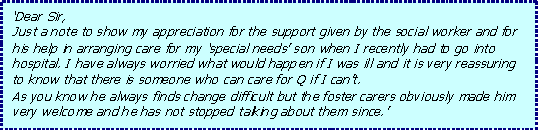
6.20 There has been an increase in the number of compliments received by the service in the last year, 113 compared to 87 the previous year. These are only the compliments which are received at headquarters and many more are sent to the staff concerned. The majority of compliments relate to directly provided services, such as home care and the provision of aids and adaptations, although there are also compliments about the work carried out by care managers and social workers who have arranged care packages.
6.21 It was noted earlier in the introduction that `a delighted customer is one whose expectations have been exceeded'. This is reflected in some of the compliments received.
7 Outcomes and Learning
7.1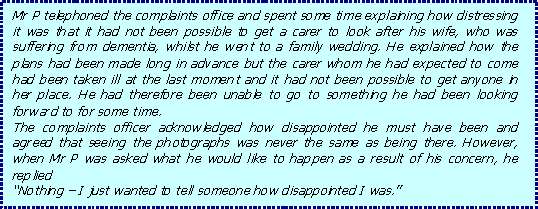 An important question which should be asked of a complainant when they have explained the problem is about what outcomes they are seeking. Not all complainants will be clear what outcome they are looking for but it is difficult to know what will be a satisfactory resolution for the complainant without this information. Sometimes the making of the complaint is sufficient in itself and the complainant will be happy that someone has listened to what they have to say.
7.2 The outcomes sought by complainants usually involve one or more of the following:
¬ An apology
¬ An acknowledgement that something went wrong
¬ The matter put right
¬ An explanation of what has happened
¬ The same thing not to happen to anyone else.
7.3 It is only a small minority of complaints that relate to the work of specific individuals and are seeking some form of sanctions against that person. The message is given very clearly in staff complaints training that if an individual has made a mistake they should acknowledge this and learn from the experience so that it does not reoccur. Very occasionally the complaints officers will become aware that a specific worker has had a number of similar complaints made against them. In this situation the member of staff's manager will be contacted informally and the matter drawn to their attention, with the expectation that remedial action will be taken.


7.4 It is not always possible to provide the outcome a person is looking for. This may be because, although a need has been identified, it is not possible to provide a service to meet those needs because a resource is not available. In such circumstances it is only possible to apologise and explain the problem.
7.5 The desired outcome may also not be possible because it is contrary to the department's policies and procedures or the action required is not justifiable. The desired outcome expressed by the complainants (Investigation No 2) was that the care manager should be dismissed. Although it was openly acknowledged by the department that the staff member involved did have some training and support needs, but there were insufficient grounds to warrant disciplinary action.
7.6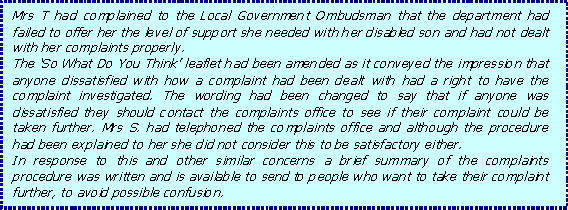 `Failure of communication' has been a long standing cause of dissatisfaction expressed in complaints. Analysis of complaints can help identify where communication needs to improve. This can be on the level of emphasising the importance of agreements or decisions being confirmed in writing to avoid misunderstandings, to identifying where there are gaps in the information available to service users which need filling.
7.7 It was noted in the introduction that a dissatisfied customer is one whose expectations have not been met and there have been a number of examples where this has been the case. This is particularly evident in Children and Families where it is possible to group the expectations of complainants, for example:
¬ That Social Services can accommodate children and young people who parents consider to be `out of control'.
¬ That Social Services will intervene in disputes between parents and enforce contact arrangements.
¬ That Social Services will provide respite care `on demand' rather than in response to an assessed need.
7.8 Such complaints highlight the need to continue to try and effectively communicate the role of social services to both the general public and other agencies. It is not unusual for other agencies to suggest to people that they contact social services for help inappropriately, for example, a G.P. suggesting someone contact social services for help with housework.
7.9 There have been a number of learning points for the department which have arisen, either from the informal resolution of complaints or as direct learning from investigations and review panels.
7.10 It has been acknowledged for some time that the quicker a response is made to a complaint, the greater the chances of a speedier resolution. The `proof' of this has been evidence over the last three years of the reduction in complaints going to the formal stages of the procedure. This year has also provided evidence that a failure to act quickly can lead to a complaint escalating and becoming very difficult to resolve. In Investigation No 2 it was found that it took seven weeks to respond to the original complaint. It was acknowledged by the Service Manager involved that a speedier and more personal response (he chose to write rather than make direct contact) may have stopped the complaint escalating.
7.11 The second review panel highlighted a further learning point for the complaints process. The complainant had been very abusive to staff to the degree that the police had had to be involved when serious threats had been made against a staff member. However, the investigation and later Review Panel both identified that there was justification for the complaints, even if the manner in which the complaints were made was not acceptable. This posed a challenge for the process and the Independent Person must be commended for helping the complainant make his complaint in an acceptable manner.
7.12 The recommendations from Investigations and Review Panels can highlight learning for the department. If complaints are upheld there are likely to be recommendations which relate specifically to the situation, such as a recommendation that an apology is given and steps taken to put the matter right. There may also be instances, even if the complaints are not upheld, where recommendations are made which will improve practice in services across the department. For example, following investigation No 1, the Day Service concerned obtained a new wheel chair for emergency use in the centre. Guidance was also issued to staff in all day services about the proper recording of accidents. Following investigation No 2 a commitment was given to ensure that care managers, undertaking a carer's assessment, should identify, record and refer any other person living in the household who required a care management assessment. Following investigation No 6 the Independent Person recommended that the wording of a departmental publication was changed to clarify the role of the department in funding residential care.
7.13 It is not unusual for findings from Investigations and Review Panels to reflect concerns which have been raised in other areas of the department's work. For example, Mr R's concerns related to a chronology of events regarding a young person in care. One of the issues for the complainant who requested the second review panel was about the chronology which had been prepared for a child protection conference. The need to produce chronologies has been a recommendation of more than one Internal Management Review over the last few years. The complaints highlighted that it was not enough just to produce the chronology, but they should also be accurate and appropriate.
7.14 It has been noted in recent reports that complaints have become more complex. This year has seen an increase in complaints where the complainant, or advocates working on their behalf, have challenged the department's interpretation of legislation or central government guidance. This has been evident in a small number of difficult to resolve complaints about funding for residential care, in particular the need for families to pay `top up ` funding and/or the setting of the `Hampshire rate'. The department in this context is facing challenges which are being made to other authorities across the country.
7.15 The management of these complaints has highlighted a need for managers to be confident that when seeking residential provision reasonable steps have been taken to locate and offer care which meets assessed needs. It is not sufficient for the department to state that affordable care was available when needed, it has to be able to demonstrate that this was the case.
7.16 Feedback from complaints is given in a number of different ways. From individual formal complaints the County Manager for the client group will be aware of the complaints and by responding to the recommendations of an investigation will have greater knowledge. The recommendation themselves may highlight learning and ways to improve practice. County Managers will also be alerted if an issue of concern arises, either on a number of unrelated occasions or if a matter of a serious nature occurs.
7.17 One of the complaints officers regularly attends the Lead Service Managers meeting and will draw to the attention of service managers matters of concern. This may be specifically related to the operation of the complaints procedure but may also relate to `themes' which have emerged or the sharing of good practice where positive intervention has resolved a complaint and the learning may be useful to others in a similar situation.
8 Other Aspects of the Service
Vexatious or Abusive Complainants
8.1 As identified in previous reports dealing with complainants who challenge the service takes up a significant proportion of the work load of the service. However, this year it is possible to report that progress has been made in the effective management of a number of vexatious or abusive complaints.
8.2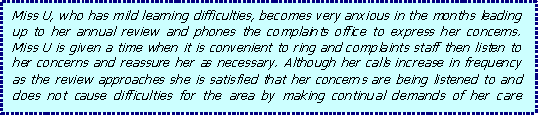 This progress has come about because of a number of factors: It has been recognised that some complainants will continue to complain and strategies have been adopted to minimise disruption.
8.3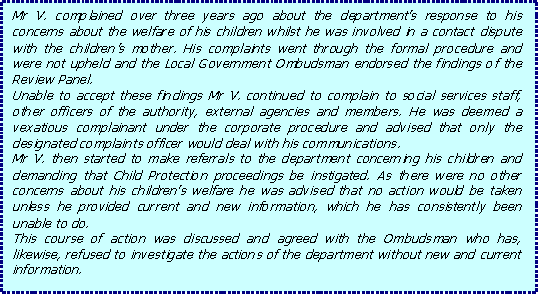 Over the last year there has been greater communication with the Local Government Ombudsman. This has been a useful two way increase in communication with the LGO which has included it being possible to contact the Local Government Ombudsman's office direct and seek advice about managing difficult complainants. It is not unusual for vexatious complainants to approach the Ombudsman direct, particularly if they are not getting the response they are seeking from the department. It is useful to know that the Ombudsman will support an agreed strategy for dealing with a complainant and will not unwittingly undermine the approach taken by the department.
8.4 Persistent and vexatious complainants will also contact Members and the service has been active in being available to Members to explain situations and support them in their dealings with vexatious complainants.
8.5 In the previous report reference was made to the use some complainants were making of the Internet and Emails and the impact the directness of this approach had on staff. One particular complainant continued to use Emails to pursue his complaints in a manner which was totally inappropriate and abusive to staff. This complainant continued to be active throughout last year, even after his Emails were all automatically forwarded to the complaints service, which did at least offer staff protection from continued intimidation.
8.6 A further approach taken to `manage' vexatious complainants is to adhere strictly to the complaints procedure. One complainant refused to accept the report of the Independent Person but then requested a Review Panel, whilst at the same time imposing a list of unreasonable demands on the process (e.g. that it should be held out of county, that the press should be invited etc.) In order to try and move the process to a conclusion a Review Panel was convened according to usual practice and on a date he had said he would be available. He chose, however, not to attend.
8.7 The Internet was also used by Mr V. (see above) to publish `his story' which included abusive language to named members of staff. The Local Authority was powerless to take any action, but fortunately other parties identifiable on the site could and it was removed.
8.8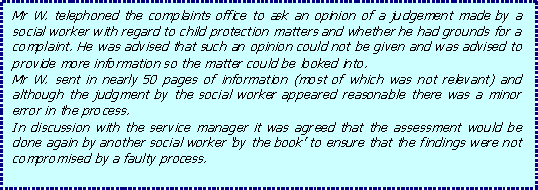 It is possible from accumulated knowledge of persistent or abusive complainants to `detect' potential problems at a very early stage and take steps to ensure that the situation is contained and dealt with swiftly and appropriately.
8.9 Using a different practitioner to carry out a reassessment is one way of dealing with such complaints, another is to move quickly to the formal stages of the process to stop the complaints escalating.
Looked After Children
8.10 The Complaints and Customer Care Service has worked closely with the CAT (Care Action Team) over the last year and has regularly attended meetings and supported events. This has proved to be mutually beneficial with the service being able to offer practical support to the work of the team and also given the service the opportunity to `pick up' on issues affecting looked after children generally and support some individual children.
8.11 The service helped organise The Event II, an activities day held at Calshott Activities Centre in September. This was the sequel to `The Event' held in 2001, which was specifically aimed at consulting with children and young people. The Event II was held in conjunction with colleagues from Recreation and Leisure and the aim was to give children and young people an opportunity to experience activities which they may like to take up as a hobby or interest.
Prevention and Management of Violence
8.12 The Complaints and Customer Care Service has responsibility for the department's strategy for protecting staff from violence and abuse. In order to promote the department's overall commitment to reducing violence and abuse to staff a formal debate was held, which was open to all staff and chaired by the Director, with the motion being ` This house believes that the department should adopt a Zero Tolerance Policy towards violence and aggression.
8.13 It was a lively and emotive debate, and whilst the motion was lost, it did allow a frank exchange of views in a forum not usually available to staff and presented a model of `consultation' which could be used to discuss other issues.
Internal Management Reviews
8.14 Mention has been made previously of the range of investigations that can arise from issues raised by complaints. The service also has a responsibility to co-ordinate and manage internal management reviews, including those which may be required by the Area Child Protection Committee.
8.15 Although each of these investigations have their own reporting systems, the Complaints and Customer Care Service gains additional knowledge about the quality of service offered to users and as suggested earlier with regard to chronologies allows connections to be made with regard to a range of issues and helps feed into the learning of the department.
9 Discussion and Conclusions
9.1 This report has highlighted both the operation of the complaints procedure within the Social Services Department and the diverse information which is available to the Complaints and Customer Care Service.
9.2 Although the focus of the work of the service has continued to move towards an emphasis on customer care rather than just complaints management, there are objectives for the service which it has not been possible to achieve over the last year.
9.3 The Complaints Procedure has not been updated since 1997 and whilst the formal procedure still applies the emphasis has changed and the procedure is not placed in the wider context of the service. In the year 2000 the Department of Health published a discussion document called `Listening to People', which discussed various aspects of the operation of the social services complaints procedure. New guidance is due to be published, to come into effect in April next year, on the operation of the procedure and therefore it would not be reasonable to update the current departmental procedure until the new guidance is available.
9.4 The service is still using the same database to monitor complaints and there is no indication that there is any further progress towards a corporate complaints database.
9.5 Progress has, however, been made towards extending the work of the service with looked after children and the funding has been secured for a Children's Participation Officer, who will work as a member of the team and amongst other responsibilities, including supporting the Care Action Team, will manage a Children's Rights Officer. These two posts will focus on helping children and young people participate in decisions about how services are organised and run and ensure that each child or young person can access the support they need to participate in decisions about their own lives. This will include making sure that each child has access to an advocate when needed, including when accessing the complaints procedure.
9.6 With the increase in partnership working, particularly with health colleagues there is a need to ensure that complaints are dealt with appropriately and that coordinated and consistent responses are made to complaints, even though the processes may be different. A protocol has been agreed for dealing with complaints relating to mental health services.
9.7 It is now several years since there has been any external training regarding conciliation and mediation. It is therefore proposed to hold a training event for Independent Persons and staff who are likely to be involved in conciliation, including the complaints officers using an external trainer.
9.8 This report has identified some of the ways in which the Complaints and Customer Care Service has continued to develop and improve. However, what it has not been able to do fully is reflect the accumulated knowledge of the service in a way which is useful to others. It is therefore recognised that in addition to formalise the feedback to staff about improvements which can be made in terms of practice it is also necessary to find ways to identify and share the knowledge which has been gained about managing complaints within a culture of customer care, or `bottling the wisdom' and sharing with others.