
Archived decisions
Hampshire County CouncilHealth Review Committee Item 8 16 December 2003 Proposals to Develop or Vary NHS Services Report of the Chief Executive |
Contact: Denise Holden ex 7338
e-mail: [email protected]
1. Summary and Purpose
1.1. The purpose of this report is to alert Members to proposals from the NHS to vary or develop health services in the area of the Committee.
1.2. Proposals that are considered to be substantial in nature will be subject to formal consultation and the response of the Committee will take account of the criteria adopted by the Committee on 29 July 2003 with particular emphasis on the duties placed on the NHS by Section 11 of the Health and Social Care Act 2001.
1.3. The report and recommendations support the delivery of Aim 5 (Improving Services) of the Corporate Strategy.
2. Consultation by Eastleigh and Test Valley South and Mid-Hants PCTs: reprovision of in-patient services for older people with mental health problems in Eastleigh and Winchester
2.1. Further to the action agreed at the last meeting the working group has response to the PCTs conducting the consultation. This response reflected the approach agreed by the Committee and was informed by to visits to the facilities at Winchester and Moorgreen. The report of the second visit is attached at Appendix One.
2.2. The response sent by the working group is attached at Appendix Two
3. Eastleigh and Test Valley South Primary Care Trust Consultation Pending: The Mount Hospital
3.1. Following a recent press report that the Mount Hospital would close, the Chairman of the Working Group, in consultation with the Chief Executive and Chairman of the Health Review Committee, wrote to the Chief Executive of Eastleigh and Test Valley South PCT. This letterset out the expectations of the Committee in relation to the duty of all NHS bodies to consult and involve prior to service changes being agreed.
3.2. In response the Chief Executive
_ Apologised for the report in the press
_ Reaffirmed that no decision can be taken by the PCT or Eastleigh and Winchester Healthcare Trust to close the Mount until Section 11 responsibilities have been fully discharged and formal consultation completed
_ Noted that provision of services at the Mount were under pressure as a result of staffing difficulties
3.3. The PCT is currently drawing up plans to involve local people and key stakeholders in exploring the options for service provision in the area.
4. `HealthFit' Implementation
4.1. The Committee has confirmed that it expects to be consulted on the nature of the consultation process prior to the launch of any formal consultation process.
4.2. No further information has been provided by the Strategic Health Authority
5. Mental Health Services in North East Hampshire
5.1. The Committee was initially advised that this proposal was pending and that this did not involve any change to services provided to the residents of north east Hampshire.
5.2. The recommendations of the lead PCT are attached at Appendix Three.
5.3. It is not yet clear whether the revised proposal will have an impact on Hampshire residents. If the revised proposal does have implications for the services to Hampshire residents then a further consultation may be required.
5.4. If a second consultation does take place there will need to be arrangements for a joint committee with Surry Overview and Scrutiny Committee.
5.5. No response to the points raised by the Committee has yet been received.
6. Blackwater Valley and Hart Primary Care Trust: Changes to Service Provision at Fleet Hospital
6.1. The Committee has received notification of this consultation, which is now under way.
6.2. Further information about the proposal are attached at Appendix Four
6.3. Members views on the proposal are invited.
6.4. The Trust has been alerted to the emphasis placed by the Committee on `Strengthening Accountability' and the involvement of patients, the public and key stakeholders in planning services. Details of the breadth and scope of the consultation process will be reported to the Committee.
7. Maternity Services in South East Hampshire
7.1. The Committee has now been formally notified of the pending consultation on the future provision of maternity services in South East Hampshire. This will affect services provided to people living in Hampshire, Portsmouth City and the Isle of Wight.
7.2. Arrangements for establishing a joint committee are in place. Representation from Hampshire will include those members with a particular interest in maternity and children's services.
7.3. The joint committee will be established to respond to the proposals from the lead PCT. The joint committee will look at the service from the perspective of the entire population affected and provide a regular up-date to the Health Review Committee.
7.4. The criteria for assessing proposals from the NHS agreed by the Committee will be drawn to the attention of the joint committee.
8. New Forest Primary Care Trust: PFI proposal for Lymington Hospital
8.1. New Forest PCT has launched the consultation for the proposed PFI development at Lymington Hospital
8.2. The new community hospital will include the inpatient provision of:
_ Birthing centre -8 beds
_ Acute Medical -36 beds
_ Medical Day Recliners -6 beds
_ Trolleys - 12 beds
_ Emergency assessment unit - 14 beds
_ Surgical - 14 beds
_ Rehabilitation -16 beds
8.3. Details of the proposal are attached at Appendix Five
8.4. This initiative is strongly supported by the local community
Recommendations
1. Consultation by Eastleigh and Test Valley South and Mid-Hants PCTs: reprovision of in-patient services for older people with mental health problems in Eastleigh and Winchester
_ That the Committee endorse the response from the working group
_ The response to the points raised by the Working Group is reported back to the next meeting of the Committee
2. Eastleigh and Test Valley South PCT: Consultation on the future of The Mount Hospital
_ That the Committee receives the plans for involving local people, patients and key stakeholders in determining the options for the future of services currently provided at the Mount Hospital
3. `HealthFit' Implementation
_ That the Committee continues to press the Health Authority for clarification of the HealthFit proposals
4. Mental Health Services in North East Hampshire
_ The Committee is advised of the response of the lead PCT
_ Any revision of the original proposal is assessed to determine the implications for services to people in the north east Hampshire area
5. Blackwater Valley and Hart PCT: Changes to Fleet Hospital
_ Members wishing to comment on the proposal send the Chairman their views by 15 January
_ Feedback from the PCT on the response to consultation is reported to the Committee
6. Maternity Services in South East Hampshire.
_ Members endorse the establishment of a joint committee to consider proposal for developing maternity services in South East Hampshire
_ Cllrs Mrs MacNair Scott and Mrs P Dickens are invited to join the Committee
_ The criteria for responding to consultation previously agreed by the Committee are drawn to the attention of the joint committee.
7. New Forest PCT: PFI proposal for Lymington Hospital
_ Any Member wishing to comment on the proposal send the Chairman their views by 31 January 2004
_ That the Committee receives a copy of the outcome of the consultation process from the PCT
Section 100 D - Local Government Act 1972 - background papers
The following documents disclose facts or matters on which this report, or an important part of it, is based and has been relied upon to a material extent in the preparation of this report.
NB the list excludes:
1. Published works
2. Documents which disclose exempt or confidential information as defined in the Act.
File Location
Appendix One
Hampshire County Council
Health Review Committee
Services for Older People in Eastleigh and Winchester Working Group
Notes of Visit to Moorgreen Hospital
Present: Cllrs Mrs Holden-Brown, Mrs Banks, Davies Dear
In attendance: Denise Holden, Penny Velander, Kevin Page Ann Martin, Mike Smith, Julie Sharp, Patricia Julian (follow-up meeting)
Background
The purpose of the visit was to familiarise members of the working group with the in-patient facilities for older people with functional or organic mental illness at Moorgreen Hospital. The visit was requested to enable members to fully respond to consultation from East and Test Valley South PCT and Mid-Hants PCT regarding proposals to change the pattern of in-patient care in the area. The second site affected by the proposal was visited by the group on 2 September.
The Moorgreen Hospital site is extensive and accommodates a range of services including those for adults with a mental illness, people with a learning disability, older peoples rehabilitation and a day unit. The Countess Mountbatten Hospice is also based on the site.
The main hospital building is a traditional build dating from the turn of the last century. The scope for remodelling the environment in which care is given is constrained as a result. There are however newer buildings on the site, notably the Tom Rudd Unit, where services are provided in a more contemporary environment.
There are five ward areas in this Unit, three of which are currently providing clinical care to older people requiring rehabilitation.
Willow Ward
This ward provides care for older people with dementia and other organic mental illness. The ward provides predominantly crisis care for people and can often be the first admission experienced by individuals who have been cared for at home. The ward is currently arranged as two nightingale style wards areas of 8 and 11 beds respectively, separated for men and women. There is a separate dining room and access to an outside secure garden area. Within the ward area space is limited, especially for those with a tendency to wander or with challenging behaviour. Little privacy is possible although there are separate toilet areas for patients.
The Trust has previously applied for and received central funding to improve the ward areas. This represents approximately 25% of the resource required to fully up-grade the area. Due to the limits on modernisation imposed by the current building the Trust is looking to move Willow ward to the newer Tom Rudd Unit. One of the closed wards ( currently housing the occupational health department) would provide for a modern environment for caring for this vulnerable group of patients.
The ward currently provides care for people living in the southern parishes of Eastleigh and Southampton east.
Linden Ward
This ward is opposite Willow ward in the main hospital building. As such it has the same limitations in terms of the environment, particularly in terms of space. The proposals currently being consulted on would see this area up-graded.
The ward currently has an 8 bedded bay, a two bedded bay and a three bedded bay, each of which is very limited in terms of space and privacy. The 8 bedded unit has storeroom access adjacent to a bed and the wash basin facilities cannot be curtained off for privacy.
There is a good sized dining/day area with access to a garden, a quiet room and smoking room. Space for staff is very limited. There is an assisted bath facility and separate toilets for men and women. Three rooms on the ward are set aside for ECT, although these are not in frequent use and it is proposed that these be incorporated into the refurbished ward area. The south facing aspect of the ward was bright and sunny.
The ward currently provides care for people living in the southern parishes of Eastleigh and Southampton east.
Privacy for visitors or carers to the ward is limited.
Upstairs from the ward was an occupational therapy kitchen which could be used by patients requiring assessment prior to returning home. This area was well equipped bright and sunny.
Allbrook Ward (Tom Rudd Unit)
Allbrook Ward is one of five wards located in the purpose built unit. Three wards are currently used to provide clinical care. Allbrook ward is currently closed and used as the headquarters for the Occupational Health Department. This area is intended to be reopened to accommodate Willow ward.
This is a clinical area of a high standard. It is bright modern and airy, with ample space for a range of facilities including and outside garden area and dining room. Toilet and bathing facilities are modern and the bays are able to be used flexibly to afford greater privacy for those who require it without patients feeling isolated.
This facility offers a standard of accommodation that is comparable to that at Melbury Lodge.
Voluntary Sector Support
Members were particularly keen to ascertain the level of support that the voluntary sector were able to provide, particularly in terms of transport for carers wishing to visit Moorgreen hospital. Although the manager of the service was not present at the initial visit of the working group the lead manger did subsequently meet with the Chairman of the Working Group.
This was a very helpful meeting which confirmed
· Transport can be booked between 9.00am and 5.00 pm Monday to Friday. Transport is available at weekends but needs to be pre-booked via a diary system
· There are currently 8 designated drivers but more are currently being recruited All have police and health checks (including eyesight) and insurance and driving licenses are checked annually
· A new mini bus will be available in the near future and the possibility of a weekly bus service from the Eastleigh area is currently being explored
· Back-up is provided through community groups
· The cost of the transport is 35 pence per mile. Although no charge is made the cost of the journey is estimated and the option of a donation is available.
· If a person is not able to get to the hospital by any other means the service will guarantee a visit at least once a week. Collection can be anywhere within reason across the area.
· Urgent cases can be accommodated (e.g. some-one requiring an x-ray) as long as there is a nurse escort
· In addition to the transport service the volunteers also provide help with a range of services, including memory assessment. A very successful bereavement service has been introduced for families and other local people. An extension of this service is currently being piloted with the Alzheimer's Society.
General Comments/ observations
· Staff were welcoming and keen to show the level of care provided. The subsequent discussions with key staff demonstrated a flexible and caring attitude to meeting the travel needs of carers and this approach was reflected in all contact with staff.
· The current environment of both Willow and Linden is not suitable for providing inpatient services. Both wards require considerable modernisation to provide an appropriate setting within which care can be provided for these vulnerable groups of patients
· There are also questions about the suitability of both areas for staff to work effectively and safely
· Given the late stage of the consultation process it was of some considerable concern that West Hampshire Trust was still awaiting the decision of Southampton City PCT regarding the move of Willow ward to the current Allbrook ward. Whilst it is essential that staff working have a base for co-ordinating and administering a service it must be questioned whether an area built to provide patient care is a suitable or appropriate setting. This point is particularly pertinent when the current environment of patients on Willow ward is considered.
· There are limits on the extent to which Linden ward can be up-graded given the limits on resources. The plans for this area are less advanced than those for Willow ward. At present it is not clear if the toilet facilities will be modernised as part of the current reprovision proposal, this needs to be addressed, particularly as the intention is that more patients will be referred to Moorgreen as a result of the closure of Shawford ward in Winchester.
· Given the limitations to up-grade the environment of Linden Ward, and the fact that the Tom Rudd Unit is not currently fully utilised as a clinical area urgent consideration should be given to the option of relocating Linden Ward to the Tom Rudd Unit
· The extent to which patients carers and other key stakeholders had contributed to the planning process was not clear. In particular engagement needed to include local voluntary sector services such as Eastleigh MIND.
· There is scope for greater integrated working across the locality. The value for this has been seen in the model used for adult mental health services. Services for older people with mental illness currently includes close working at service delivery and the potential for enhancing this through pooled budgets or other integrated arrangements needs to be fully explored.
· There is an active voluntary service in the area that is well organised and able to provide a range of back-up services to people attending Moorgreen Hospital. Transport services and the bereavement service seem to be particularly highly valued. There needs to be full involvement of this service, and others that exist across the area, in planning and developing integrated care for older people.
· It would be helpful to have further information about the way in which patients requiring acute intervention are dealt with
· Provision of services to meet the needs of black or other ethnic minority groups needs to be established
· The intention to close the Mount Hospital was announced on the day of the Working Group visit to Moorgreen. This is being pursued separately with the Trust concerned, however it is not clear whether this change will impact of the services provided at Moorgreen and Melbury Lodge
Hampshire County Council Appendix Two
Health Review Committee
Consultation on the reprovision of in-patient services to older people with a mental health problem in Winchester and Eastleigh
Working Group Response
Further to consultation with the Chief Executive I am writing in response to the above consultation document on behalf of Hampshire County Council Health Review Committee.
The Working Group has tried, to the fullest extent possible, to take account of the national context within which services for older people with a mental health problem should be developed. Our understanding has been informed by the relevant National Health Services Frameworks and particularly reports such as `Forget Me Not'. The responses from Southampton and South West Hampshire Community Health Council and Winchester and Central Hampshire Community Health Council have also been helpful in providing a local context to the proposals as has the additional information made available by both Trusts.
There are a number of general comments that we would wish to make to both PCTs as well as some more specific points that will require a response.
As part of our commentary it is also important to acknowledge the new arrangements for consultation and the scrutiny role that has now been passed to Local Authorities. This is a new way of working for us and we are aware of the challenges posed for NHS staff having to work across an old and a new system. We would wish to commend the efforts made by each of the Trusts to engage with us and other stakeholders as the consultation process has rolled forward. We particularly appreciated the invitation to visit the facilities where these services are provided and would wish to extend our thanks to all the staff who made us so welcome. The reports from each of our visits are attached to this response.
It has been encouraging to see that the feedback generated by the consultation process has informed the way the PCTs intend to provide services for older people. As this is a process that will be on-going we hope the Health Review Committee will be invited to contribute to the development of the shape of these services in the future.
The services that are the subject of the proposal are provided to people who are often physically, mentally and socially vulnerable . Although there seems to be agreement that acute beds do not provide optimum care for individuals there is no doubt that there is a need for an acute facility that is able to provide for short-term emergency assessment or respite as well as a need for in-patient or residential services for people who can no longer be supported in the community.
The emphasis on the provision of greater community support to enable people to stay at home for as long as possible, and avoid in-patient admission is one that the Working Group would support. This aspiration can, however, only be achieved by real investment in the provision of integrated support within the community. Primary care, social services, housing, carers, the voluntary and independent sector all have a part to play in enabling the right community support to be provided in a timely and appropriate way, based on the needs to the individual concerned. The emphasis placed in the consultation document on the proposal as simply a `reprovision of ward space' did not reflect this complexity and it has been helpful to see that subsequent correspondence from both PCTs recognises this point and includes a commitment to the provision of community services to meet national requirements and local needs.
Consideration of the proposal by the Working Group has focused on two main themes; inpatient provision and community services. We remain of the view that the implications of changing inpatient provision and expanding community services must take into account the interdependencies that exist between the different parts of the care system supporting older people with a functional or organic mental illness. The immediate financial pressures facing the Trusts underline the need for there to be clarity regarding the consequences of the disinvestment proposed on other parts of the system, particularly carers. We have developed this point further in the points discussed below.
1. The Case for Change
Sections 2 and 3 of the consultation document sets out reasons for change. There is a strong emphasis on the delivery of national policy relating to services for older people in accordance with local needs, using the resources and facilities available as effectively as possible.
The case for the financial savings suggested from the implementation of the proposal is however less clear to the Working Group for the following reasons:
· there is a detailed breakdown of the current usage of inpatient beds. This is based on an average and it is encouraging to be able to note that further work is currently underway to determine that actual use of the beds. There is however far less information about the services currently provided across the three communities affected in terms of primary care support, day care, intermediate care, levels of respite and support to carers. It has therefore not been possible for the Working Group to determine whether the proposed investment in community services is appropriate and therefore that the savings accrued are genuine
· The increase in staffing proposed is not set against any indications of current provision and activity making it difficult to determine what improvement would actually be secured
· We are not clear whether other options for investing the funding available in the community have been considered and in this respect we are keen to hear the views of other key stakeholders consulted, particularly people using the services, the voluntary sector and social services
· The provision of respite care was a specific concern for the Working Group. There is reference to the minimal respite being re-provided on page 11 but no clarification of what that might be. National documentation (Forget Me Not in particular) refers to the need for the provision of respite in a range of settings, including at home and access to emergency provision. It is essential that this resource is available if more emphasis is to be placed on care in a domiciliary or community setting and carers are to be fully supported. Correspondence from the PCTs does include reference to the intention to address the issue of respite as part of the development of the overall strategy for these services, however this is a future intention that will take place after this proposal has been implemented.
2. Strategic Direction
Although the proposals are focused on a specific operational area of services for older people with a mental health problem the Working Group considered that any change needed to contribute to the delivery of a clear strategy for local people. Confirmation from both PCTs of the development of an overall strategy for services for older people with a mental health problem, including the `one-stop-shop' model were encouraging and it would be helpful to have an indication of the anticipated time frame for developing this.
The Working Group was unclear about the role of the Local Implementation Team in taking this work forward and whether the Local Strategic Plan would be the vehicle through which progress with services for older people with a mental health problem could be demonstrated.
There is clearly a high level of integrated working developing between the NHS and social services. Noting the work recently commissioned to examine the scope for further integration of health and social services the Working Group would request that the Health Review Committee receives a copy of the findings of this work when it is published in the Spring.
The Working Group does welcome the commitment of MHPCT to the development of a strategy for carers and the early action that has been taken to explore how this work might be taken forward.
3. Developing the Workforce
The wish to make financial savings by from the reprovision of inpatient services for older people and additional investment in the community is made clear in the consultation document and the Working Group acknowledges the pressures that the NHS is under to achieve stringent savings targets.
The level of saving to be secured through the implementation of this proposal is significant in terms of the actual budget for services for older people with a mental health problem. Linking back with national proposals for workforce development the Working Group has been keen to ascertain if the redirection of funding set out will contribute to the development of the workforce in the community setting. Good practice guidance, for example points to the need for there to be tangible investment in training primary care staff in the early detection and diagnosis of mental health problems experienced by older people and the need from specialist staff to be an accessible source of advice and support.
The Working Group is concerned that the intention to redirect a substantial level of funding away from these services could cut across the need to develop the work force in the community. MHPCT for example highlights the support for the provision of a dementia nurse to provide practical support and relief to carers in the community, yet this funding is not available.
4. The Environment within which care is provided
Section Three of the proposal is helpful in setting out what the proposed changes will mean for people using the services. The first of these `providing high quality inpatient services' draws out the inpatient accommodation suggested for both Winchester and Eastleigh patients.
As our visit report highlights, with a few relatively minor issues of concern (such as arrangements for managing patient who wander at night) the Working Group was reassured that the environment provide at Melbury Lodge was appropriate for supporting patients with a functional or organic mental illness. Clear plans have been developed and there had been significant input from key frontline staff.
The situation at Moorgreen is less clear cut. The Working Group was very concerned to note that, although preparatory work that had been underway for some considerable time there was still no clarity about the availability of the new ward area, despite recognition that Willow Ward was not a satisfactory environment in which to care for people with an organic mental health problem.
The fact that the Ward was needing to cope with high levels of emergency admissions, with some individuals being hospitalised for the first time reinforced the need for there to be a supportive environment for patients, carers and staff. The availability of a high quality alternative in an adjacent purpose built unit had been identified but there seemed to be uncertainty as to whether the NHS organisation owning the proposed new area would make it available. Given that the proposal for changing services had reached the stage of formal consultation the Working Group considered that this continued uncertainty was unacceptable. This matter needs to be addressed as a matter of urgency by the PCTs concerned. The facilities implicated are part of the NHS estate and should to be employed to the benefit of patients to the fullest extent possible.
Similarly the Working Group was concerned about the environment of Linden Ward and the scope for this to be improved within the constraints of the current building. As there is a further ward within the Tom Rudd unit which is currently closed we would ask that consideration is given to relocating Linden Ward to this area. This option may in turn bring additional benefits by using skilled staff more effectively.
If this is not possible then we would ask that the plans for redeveloping this area are revisited to ensure that patients have privacy, dignity and the benefit of modern facilities, including toilets, washing and recreational areas. Our understanding is that, at present, the toilet facilities are not included in the redevelopment plans.
In the interim the Working Group was concerned that the environment offered to older people with a mental health problem at Moorgreen is not of a standard currently available at Melbury Lodge and Shawford Ward and would ask what options were open for deferring the transfer of patients until the required refurbishment has been completed.
5. Summary
In summary the Working Group would support the intention to re-provide inpatient care from Shawford Ward to Barnes Ward at Melbury Lodge. There are, however, a number of operational points that need to be addressed, as set out in the response to consultation from Winchester and Central Hampshire CHC and we would find it helpful to have sight of the PCTs reply to this correspondence. With regard to the transfer of patients to Moorgreen there remain a number of outstanding issues that require clarification.
For ease of reference the specific points raised in this letter requiring a response are:
Case for Change
· How has the level of investment in community services been determined and what improvements are anticipated
· Have other stakeholders been able to inform options for investment in the community setting
· What feedback has been received from other service providers, the voluntary sector, carers patients and the public in response to this consultation.
· What evidence is there that the current levels of respite care are appropriate. Is this supported by carers.
Strategic Direction
· What is the timeframe for developing the strategy for older people with a mental health problem
· What is the role of the Local Implementation Team and does this link with the Local Strategic Partnership
· The Committee should receive a copy of the work commissioned to examine the scope for further integration of health and social services
Developing the Workforce
· What plans are in place for developing the workforce and are these supported by additional resources
The Environment in which care is provided
· When will the relocation of Willow Ward to Allbrook Ward be confirmed
· What is the scope for relocating Linden Ward to the Tom Rudd Unit
· If the relocation of Linden Ward is not possible can the redevelopment plans for the area be revisited
· What are the options for deferring the transfer of patients from Melbury Lodge to Moorgreen until the refurbishment has been completed.
· The Committee should receive a copy of the PCTs response to the issues raised by Winchester and Central Hampshire CHC
The Guidance supporting the scrutiny process suggests that responses from the NHS to issues raised by overview and scrutiny committees should be provided within 28 days. As this will fall between Christmas and the New Year we would suggest that the responses, whether combined or individual, should be with us by 6 January 2004.
Copies to:
Cllr R Ellis
Cllr P Banks
Cllr G Davies-Dear
Cllr E Randall
Cllr R Knasel
Cllr F Hindson
Carole Bennett
Claire Foreman
Chris Reed, Eastleigh Borough Council
Simon Eden, Winchester City Council
Winchester and Central Hampshire CHC
Southampton and South West Hampshire CHC
Gareth Cruddace, Hampshire and Isle of Wight Strategic Health Authority
John Richards, Eastleigh and Test Valley South PCT
Chris Evernett, Mid-Hants PCT
Hampshire County Council Appendix Three
Health Review Committee: 16 December
Mental health Services in Surrey and North East Hampshire: Excerpts from response to consultation
Background
Guildford and Waverley Primary Care Trust (PCT), as the lead organisation for the Consultation, invited comments from people who use services, carers, public, staff and partner organisations, on behalf of Blackwater Valley and Hart PCT, East Surrey PCT, East Elmbridge and Mid Surrey PCT, North Surrey PCT, Woking Area PCT, North West Surrey Mental Health Partnership Trust, Surrey Hampshire Borders NHS Trust, Surrey Oaklands NHS Trust, Surrey Sussex and Hampshire and the Isle of Wight Strategic Health Authorities working in partnership with Surrey County Council and Hampshire County Council.
During the Consultation process a total of 84 written responses were received and many comments from the 13 public meetings.
Source of Response |
Number |
People who use Services |
6 |
Carers |
9 |
Staff including Clinicians |
15 |
Staff Side i.e. Trade Unions |
2 |
Members of the Public |
1 |
Voluntary Groups |
17 |
District/Borough/Parish Councils |
4 |
NHS Primary Care Trusts |
8 |
NHS Provider Trusts |
5 |
Strategic Health Authority |
1 |
Community Health Councils |
3 |
County Council |
2 |
Overview and Scrutiny Panels |
2 |
Members of Parliament |
3 |
Other including Anonymous |
6 |
Total |
84 |
Main Messages - Positive Feedback
a) Respondents welcomed the opportunity to give their views about the strategic direction for the future of services
b) There was support for a merger of the trusts in the west, however some respondents e.g. Surrey County Council, National Institute for Mental Health in England (NIMHE), PCTs, provider trusts, recommended that a move to create a surrey-wide trust at this point, or in the future, would mitigate against the negative effects of further re-organisation within a short timeframe
c) The service model was viewed positively, in particular the emphasis on caring for patients in a primary care setting and the scope to provide services when and where they are needed
d) The service model provides a consistent framework across Surrey and north east Hampshire for implementation of the National Service Framework (NSF); but also allows for local variation to meet the needs of people in specific communities
Main Messages - Concerns Expressed
e) The document was, in some instances, not felt to be sufficiently detailed or user friendly in choice of language
f) Lack of detail on the service model, in particular a supporting description of the `patient's journey'
g) Concerns were expressed that the document did not include detail on other services such as, for example, learning disability, older people's services
h) The need to modernise access and provision of mental health services particularly in tiers 1 and 2 - mild to moderate needs
i) For the service model to be responsive to people's needs there must be a range of appropriate services, such as crisis response and rehabilitation
j) Concerns were expressed that some changes to services in the East have already taken place before the outcome of the Consultation is known
k) Concern that with a Surrey model, services need to stay locally focussed
Specific Issues Raised During Consultation
a) What is the plan/process to take forward the work from this Consultation on a partnership basis
b) How will the resources be allocated flexibly to meet needs at all levels as described in the model
c) Do GPs and other primary care staff have adequate training and resources to support people with mental health problems in their local communities
d) How will the information from this Consultation be used to shape the mental health services in Surrey and north east Hampshire
e) Impact on the carer in this model needs to be carefully planned for
f) There needs to be closer working and partnership building, in particular, with the voluntary sector
g) Repeated organisational change needs to be avoided so that service development can be prioritised
Members of the Steering Board had access to the full range of responses (anonymised where this had been requested).
Recommendations
The Surrey and North East Hampshire Mental Health Strategy Steering Board makes the following recommendations to the Board of Guildford and Waverley PCT:
a) To endorse the proposed service model
b) To endorse the strategic direction of travel
c) To recommend that a Surrey and north east Hampshire Mental Health and Learning Disability Trust be established and that due process is carried out to ensure full engagement of the local communities in the further development of this outcome
d) To endorse the proposals for changes in the east of the County
e) To ensure that where there are cross boundary issues, and where other organisations need to know and understand the decisions made by the core stakeholders within Surrey, these are effectively communicated
Hampshire County Council Appendix Four
Health Review Committee
Alert to Consultation: Fleet Hospital
Provision of rehabilitation services
for older people at Fleet Hospital
Public consultation document
Introduction
Fleet Hospital is a community hospital providing in-patient rehabilitation
services with beds in Calthorpe Ward, beds for GP use and provision of
occupational therapy, physiotherapy and speech and language therapy. It
also provides a busy outpatient department, a physiotherapy outpatient
department, x-ray and ultrasound. The Primary Care Trust is committed
to continuing to provide these services at Fleet Hospital.
Cox Ward has recently been vacated and the patients relocated to
Farnham Hospital. This provides the PCT with an opportunity to look at
the whole range of services we want to develop at Fleet to improve the
range of care and services we offer to older people.
This consultation document focuses on how Fleet Hospital could be used
to improve the provision of rehabilitation and related services,
predominantly for older people, in the Fleet area. There are a number of
reasons for addressing this, including:
· The National Service Framework for older people which sets
standards for a uniform service with local flexibility
· The population is getting older but want to lead independent lives
· Current services are fragmented and uncoordinated which leads to an
inefficient use of resources
· The need for a local responsive service.
We would like your help to ensure we develop a coordinated approach
centred on patient and public need. We are asking and involving different
groups and organisations within the Fleet community. This document is
one of the initial ways of consulting.
Vision
As we get older, living independent lives often depends on health and
social care services working together to support us. To be successful
different organisations working together as partners requires all the
participants to share the same vision.
The local model of care is to ensure that:
"Any older person in ill health will have their needs met through
local services that prevent wherever possible the need for
admission to hospital."
Older people will receive appropriate hospital care when it is needed. The
service goal will be to return them to their own home (the place from
which they were admitted) as soon as possible with the necessary
support.
We have started to fulfil these goals in a small way with integrated care
services for people with Chronic Obstructive Pulmonary Disease (COPD)
where health, voluntary and social services are all working together.
Rehabilitation at Fleet Hospital
Our vision for the local community is that Fleet Hospital should become
the centre of excellence for all the local services (health, social, and
voluntary care).
The hospital will become a gateway where:
· One visit or call will be the key to unlocking the services for your needs
· Services are tailored into individual care packages.
This vision for Fleet Hospital would be in addition to the other essential
services already provided.
We want to develop rapid assessment, particularly for older people, by
making better use of the diagnostic facilities in the hospital to enable
people to receive the appropriate treatments in the best place as soon as
possible. Essentially, the hospital will bring access to all the services
(primary care, social services, community and voluntary care, housing,
occupational therapy and physiotherapy and specialist COPD care) under
one roof and add extra services for rehabilitation, social and health
education and general care advice and management for chronic diseases.
Capacity
Fleet Hospital cannot work in isolation. All the changes must build on what
has already been started, work in conjunction with Farnham Hospital, and
include the new central directives for both health and social services.
One of the major concerns expressed to us is the fear that change will
mean a decrease in services and reduction in beds. We understand this
and know that getting the right balance of treatment and prevention is
critical.
The original six beds which were to transfer to Fleet Hospital from
Farnham Hospital have been provided in the private sector.
New facilities at Aldershot Centre for Health will be completed in summer
2005. This new facility will provide increasing opportunities for the
delivery of rehabilitation support services.
More rehabilitation facilities and beds have been provided in the
community at Place Court and Thurlston House by Hampshire Social
Services.
The PCT has commissioned 12 specialist rehabilitation beds at Farnham
Local Care Centre (FLCC).
Having covered the provision of beds we want to provide a more
comprehensive care service in new and flexible ways centred on Fleet
Hospital.
Proposals
To enable us to provide a joined up approach across the community for
services for older people we will need to undertake some refurbishment at
Fleet Hospital. We would like to turn Calthorpe Ward into the Calthorpe
Rehabilitation Centre for Older People. This would provide:
· A single point of access for the public with a wide range of health and
social care options available to older people requiring care, support
and or advice. One telephone number, contact with a person who can
assess your basic need and refer you to the right specialist or give the
advice you need.
· A base for the Blackwater Valley and Hart Primary Care Trust
intermediate care team (nurses, carers therapists and social workers)
to provide the new services where and when you need them.
· A base for the voluntary sector so everybody is under one roof.
· Ward kitchen facilities in Calthorpe Ward, which need to be
refurbished so that patients can be assessed carrying out normal daily
activities.
· An upgraded environment to meet new standards on dignity and privacy.
These proposed investments will form the infrastructure changes
necessary at Fleet to enable the hospital to become the gateway to the
new services. There are two options open to us to achieve the above.
Options
Option 1
Implement the original plan to transfer six beds to Fleet Hospital from
Farnham Hospital with the option to either refurbish the existing Cox
Ward or leave it as it is.
Option 2
Do not transfer six beds from Farnham Hospital, use the extra beds as
shown under the section on capacity. Then use the vacated Cox Ward as
the base for the Intermediate Care Team. Refurbish Calthorpe Ward to
upgrade facilities and provide assessment, etc to establish the Calthorpe
Rehabilitation Centre for Older People.
Conclusion
Each of the options has been examined for the implications and benefits
for patients, the public, the Trust and NHS and the local care community.
The following criteria were used:
· Assuring standards of care
· Extending access of services
· Ensuring equity of services and funding
· Developing services which promote independence
· Helping older people to stay healthy
· Developing more effective links between health and other services.
We chose not to go with Option 1 because it restricted us to
providing services based on beds, and we could not conform to
the imperatives in the National Service Framework to provide
new services according to the above criteria.
Therefore we chose Option 2 which provides considerable
benefits to patients and the public and allows us to develop
new services in a modern flexible way.
The proposed changes at Fleet will be the key to enabling the hospital to
take its rightful place at the gateway of local care.
If the upgrading work is not undertaken then there is a risk that Fleet
Hospital will have a limited reactive role in the crisis management of acute
illness or as a substitute for long term care, both of which would be a
disservice to the health needs of older members of the community.
Your comments
We would welcome your comments. Please contact:
Barbara Knight
Fleet Hospital
Church Road
Fleet GU51 4LZ
Please mark the envelope `Fleet consultation process'
Email: [email protected]
Fax: 01483 782799
Produced by Blackwater Valley and Hart Primary Care Trust, Winchfield
Lodge, Old Potbridge Road, Potbridge RG27 8BT
Tel: 01252 849000
Fax: 01252 849001
November 2003
Hampshire County Council Appendix Five
Health Review Committee
Lymington Hospital PFI
Lymington New Forest Hospital
Overview
Following the initial PFI scheme first developed in 1998 a new scheme has been formulated and designed to meet the ever changing requirement of the New Forest Community. The functional content, scope and scale of the scheme is essentially similar to the original project previously developed, though the building design has been updated to enable support services to meet the NHS Plan and complement modern clinical practices.
Proposed Development
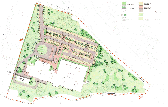
Ampress site housed a former industrial works with office and recreational facilities. It comprises approximately 38 acres in total. It is located at the north east extremity of Lymington adjoining the railway and accommodates industrial and office buildings, a petrol station and a mini-supermarket, the remainder of the site is being redeveloped predominantly for industrial use.
The Trust owns 9.7 acres of the Ampress land, the hospital being located on the southern portion of the site the north eastern edge of Lymington.
How many beds will there be?
The Trust have identified the following functional requirements for the new Hospital.
New Hospital
Inpatient Beds 94
Maternity 6
What services will be provided?
There will be a:
_ Ward building, housing rehabilitation and therapy services, medical and surgical patients in designated areas,
_ Diagnostic and Treatment Centre incorporating outpatient facilities and an endoscopy suite, and day surgery facilities,
_ Minor Injuries Unit (MIU),
_ Imaging Suite (X-Ray and CT Scanner),
_ Maternity department,
_ Support Services including Pharmacy and Catering
All services have sufficient space and flexibility to expand and adapt to the inevitable changes of the NHS.
Lymington will act as a community hospital serving local needs and also continue to provide an MIU service. This will enable better local treatment and is expected to reduce the number of patients from Lymington and the local area travelling to hospitals in Southampton, Bournemouth and Salisbury.
Demand for Car Parking
The planning application proposes to include 205 parking spaces. This is a reflection of the level of parking currently available at the existing hospital, with the additional requirement in predicted activity of a further 850 patients per month using Outpatients, Day Surgery and other services contained within the Diagnostic and Treatment Centre.
In considering the level of parking required for the site, account has been taken of the County Council's standards which set out the requirements which the County would wish to achieve for new hospital developments.
In addition, the Council's guidelines state that for general development approximately one cycle space should be available for every 20 car spaces. The hospital will provide in excess of 10 cycle spaces.
There is also provision for one motorcycle space for every 25 cars. The hospital will therefore provide 8 motorcycle spaces.
Any Questions?
This leaflet answers some questions you may have.
NFPCT is committed to involving the community in helping to progress the services for the new Lymington Hospital.
Should you require any further information or wish to be considered to be part of a working group, please fill in the Patient and Public Involvement questionnaire or contact;
By 'Phone:
01590 646406 (General Enquiries)
By Post:
Sue Howson
PFI Project Director
Paul Johnson
PFI Project Manager Based at:
Lymington Hospital, Southampton Road, Lymington, Hampshire SO41 9ZH
By E-Mail: