
Archived decisions
Hampshire County Council | ||
Cabinet |
Item 6 | |
15 December 2003 | ||
2004/05 Provisional Local Government Finance Settlement and Budget Guidelines | ||
Report of the County Treasurer | ||
Contact: Jon Pittam, ext 7400
With the concurrence of the Chairman under Section 100 (B) (4) (b) of the Local Government Act 1972 this matter is included on the agenda to enable provisional budget guidelines to be set.
1. Introduction
1.1 The provisional local government finance settlement was presented to Cabinet on 24 November 2003.
1.2 It is now necessary to set budget guidelines in the light of the provisional settlement and to respond to the consultation on the settlement to the Office of the Deputy Prime Minister (ODPM) by 2 January 2004.
1.3 Ministers have decided not to meet individual authorities this year. As there have been no changes to the formula Ministers will meet the major groups representing local authorities and will receive written representations in the usual way.
1.4 The next steps during January 2004 are for:
· service budgets to be prepared in consultation with executive members for consideration by policy review committees
· executive members to approve budgets within guidelines for submission to the Leader and Cabinet.
1.5 The Leader will propose a budget for agreement with the Cabinet at its meeting on 12 February 2004 for submission and approval by the County Council on 25 February 2004.
1.6 The report sets out
· the budget strategy
· development of the budget strategy and budget consultation during the year
· key points of the provisional local government finance settlement
· proposed response to the settlement
· budget guidelines
· options for further budget consultation
· guidelines for preparation of the capital programme
2. Budget strategy
2.1 The Cabinet has confirmed its budget strategy that
· Schools budget increase will be fully passported, matched by Government grant, as constrained by the Secretary of State's reserve power to require this outcome.
· Social Services will have a cash increase in line with the rise in Social Services Formula Spending Share (FSS)
· Schools and Social Services will be required to meet all cost pressures, demands, contingency, new pressures and priorities within these cash limited increases
· extra contingency to match the commitments on waste management from new infrastructure costs, increases in volumes and effect of landfill tax on the private sector contract
· all other services have a base budget increase only and have to meet all cost and other pressures within this limit, including the redeployment of existing resources to higher priorities as necessary
2.2 In arriving at the base budget it is assumed that
· income will be maximised in line with inflation
· efficiency savings will be achieved to absorb costs not budgeted for (increments etc)
3. Development of budget strategy and budget consultation
3.1 The Leader has met each executive member during October and November to review the impact of the budget strategy. These discussions
· reviewed the improvement in performance and outcomes from the additional resources provided in the 2003/04 budget, particularly: £3.5m for improved domiciliary care of the elderly in Hampshire to improve performance against the local public service agreement target; £3.5m to reduce delayed discharges from hospital due to lack of alternative Social care facilities; and £3.5m to improve the condition and maintenance of local roads and pavements. Business plans for the use of these additional resources, and progress against them in improving performance, have been reported to earlier Cabinet meetings
· looked at pressures on budgets which could not be constrained within base budgets or within the projected FSS cash increases in Schools and Social Services and as necessary also looked at any savings and redeployment of resources that would be required to offset these increases
· reviewed pressures and savings over a three year period. This allowed for the integration of the locally resourced capital programme with the revenue budget, following the introduction of the Prudential Code on Capital Finance (the Code), because of the possible use of unsupported borrowing from 1 April 2004. The Cabinet on 24 November considered the Code and agreed the policies for its use
- to integrate capital and revenue decision making
- to facilitate invest to save initiatives
- to allow unsupported borrowing to be financed by virement from the revenue budget (subject to conditions)
- to provide for temporary `bridging' finance using unsupported borrowing in advance of releasing capital receipts
- but to be cautious about the use of unsupported borrowing as a means of supplementing the capital programme
· helped to determine provisional budget priorities within the corporate strategy and linked
- to the achievement of local public service agreement targets
- to the four short-term Cabinet priorities (young people, education, older people and transportation), but in broadly cost-neutral terms
- to possible savings of 1.1% to help reduce the projected council tax rise to around 5%, and any further savings to meet plans in excess of the budget strategy, should these be required later in the decision making process
3.2 The result of the discussions was a better view of the budget guidelines to set for each service and to ensure priorities were reviewed within the corporate strategy and the resources likely to be available.
3.3 These projections forecast a council tax rise of 6.7% to maintain current services and meet anticipated pressures on local services and waste management, but no more.
3.4 Budget consultation against the base position of a 6.7% council tax rise, the potential effect of reductions in service to achieve a 5% council tax increase, or possible growth financed within a 9% rise were carried out during July and from September to November. The results have previously been reported, with a preference for a 6-7% rise to maintain current levels of service. The consultation process started with the MORI community workshop and also included meetings with: residents associations; business interests; local strategic partnerships (district and other local councils, health and Government agencies); the voluntary and community sector; and the Schools Forum.
4. Provisional local government finance settlement
4.1 Following the presentation to the last meeting, the usual detailed Appendix of the settlement has been deleted this year, and will not need to be repeated in the final budget setting report. However this section of the report reiterates the key points in the settlement against which representations can be made, and to set the context for changes in the budget projections and recommended budget guidelines. No further presentation on the settlement will be made.
4.2 £300m has been added to the settlement as follows:
· £100m for environmental, protective and cultural services (EPCS) but after this has been apportioned between county and district level authorities it has resulted in a FSS increase of just 3.1%, below the base budget requirement for the County Council
· two new specific formula grants of £100m each have been introduced for safeguarding children and for access and systems (for elderly services, including delayed discharges from hospital). These are not ring-fenced and can be used to meet local priorities
4.3 A 3.5% floor (as projected) and 5.8% ceiling for authorities with Education and Social Services responsibilities.
4.4 There are no formula changes, and the County Council appears to have made some gain from data changes, mainly from the area cost adjustment (but remembering that gains in one year are usually followed by losses the next year).
4.5 The ring fence has been removed from five grants for Social Services and three for EPCS worth £750m. However this is of no consequence to the County Council because as an excellent authority under the comprehensive performance assessment it had qualified for this `freedom' in 2003/04. There are no significant EPCS grants at the County Council level.
Formula Spending Share (FSS)
4.6 The overall percentage increases in the national settlement compared with the FSS increases for the County Council are:
Table 1: County Council FSS increases 2004/05
National |
Hampshire | |||||
TAS |
FSS |
FSS | ||||
% |
% |
% | ||||
Education |
6.9 |
5.5 |
4.5 | |||
Personal Social Services |
8.4 |
6.3 |
7.4 | |||
Highway Maintenance |
2.5 |
2.5 |
4.2 | |||
Environmental, Protective and Cultural Services |
3.3 |
2.8 |
3.1 | |||
Capital Financing |
7.3 |
5.1 |
7.6 | |||
Total ( County Council Services) |
6.6 |
5.0 |
5.2 | |||
Fire |
3.9 |
3.9 |
4.0 | |||
Police |
3.0 |
4.9 |
5.5 | |||
· TAS is total assumed spending which is the Government's view of the level of local authority revenue expenditure it is prepared to support through grants
· FSS is formula spending share which is the amount the Government assumes is the need to spend for revenue support grant (RSG) distribution purposes, and is the total arrived at after the deduction of specific grants from TAS
4.7 Table 1 shows the priority given to Education and Social Services in the Government's spending plans compared with other services.
4.8 The increase in Education FSS is 4.5% in cash terms for the County Council. This is matched by grant and has two components
· 4.7% for the Schools block which is equivalent to a 5% per pupil increase in Schools FSS. This is the amount required to deliver the minimum guaranteed 4% per pupil increase for each individual school. This amount has to be fully passported to schools unless there are very exceptional circumstances. The Secretary of State for Education now has reserve powers to compel the passporting and the County Council has to notify the Secretary of State that it will passport the amount by 31 December 2003.
· a separate 3% floor for the Local Education Authority (LEA) block
4.9 The overall increase in Social Services FSS is 7.4%, more than the 5.8% increase originally projected, but not fully matched by a grant increase (based on the Government's presentation of the Schools FSS increase being the first call on the grant income). The increase has the following components
Increase | ||
% | ||
Children's |
5.7 | |
Elderly |
11.2 | |
Other adults |
3.6 | |
Social Services Total |
7.4 |
4.10 The emphasis on elderly matches the County Councils short-term Cabinet priority for older people.
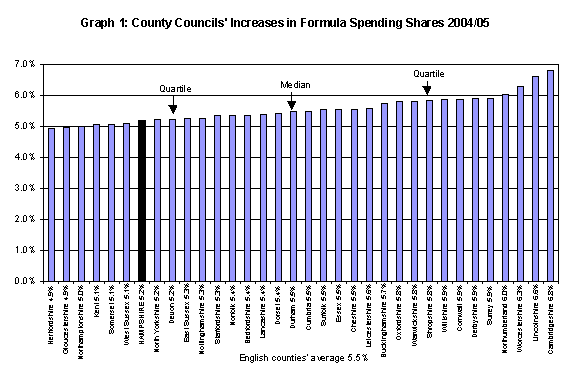
4.11 The County Council's FSS increase of 5.2% is below the average for County Councils of 5.5% as shown in Graph 1.
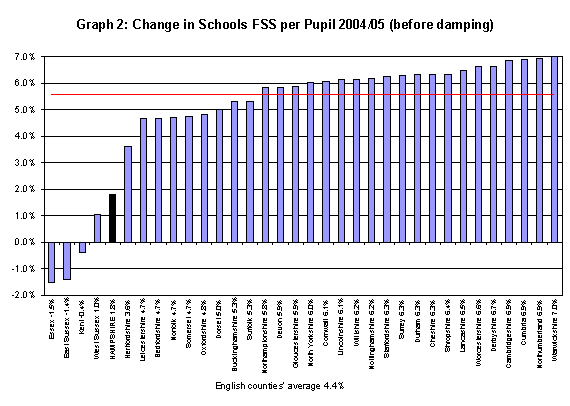
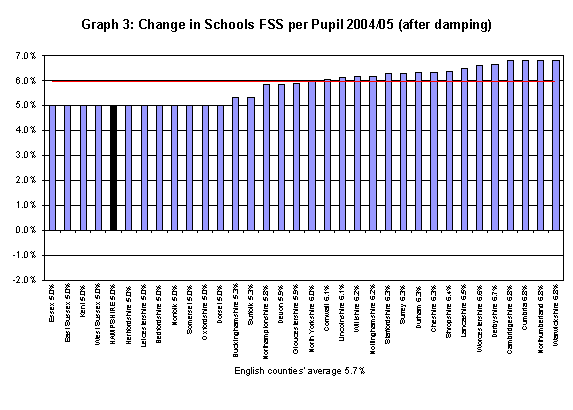
4.12 The County Council is still affected by damping of its losses from the formula changes for schools introduced in 2003/04. The Government has reduced the impact of this by continued damping. The changes in schools FSS before and after damping can clearly be seen in Graphs 2 and 3. The continuing impact of formula changes for schools and for area cost adjustment boundaries in 2003/04 appear to be the main reasons for the below average FSS increase, despite the above average FSS gain on Social Services (7.4% compared with national 6.3%).
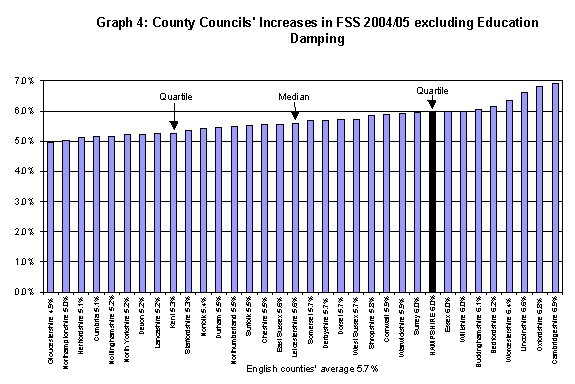
4.13 If the effects of overall Education damping are removed, the County Council's FSS increase would be at the upper quartile (Graph 4). This shows the debilitating effects of the schools formula changes which need to be reversed or at least suspended, rather than merely deferred until 2006/07 and following years.
4.14 Indeed the Government itself recognises the instability these changes are causing by having to set overall floors and ceilings around the Schools funding guarantee amount. A 3.5% floor and a 5.8% ceiling have been set for grant increases together with a separate condition that no authority receives a grant increase less than its increase in Schools FSS.
Revenue Support Grant (RSG)
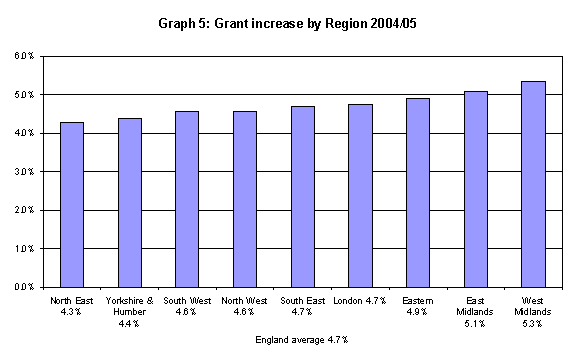
4.15 As there are no formula changes and no further resource equalisation adjustment to FSS in 2004/05, unlike 2003/04, there is not an extra shift in resources from the South East to the urban areas in the North and Midlands. Indeed the North East as a region has the lowest increase in 2004/05 (Graph 5).
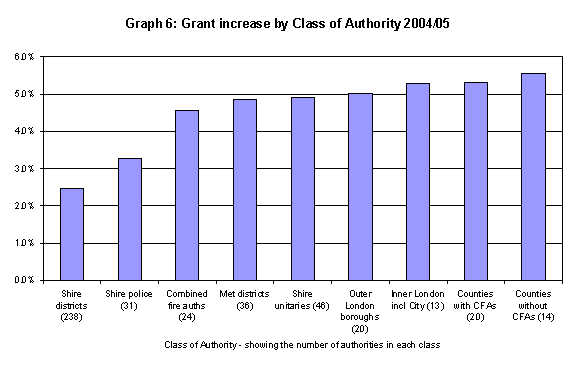
4.16 Shire counties as a class (Graph 6) receive the largest increase because of their Education and Social Services responsibilities. Their grant increase is more than double that for shire district councils.
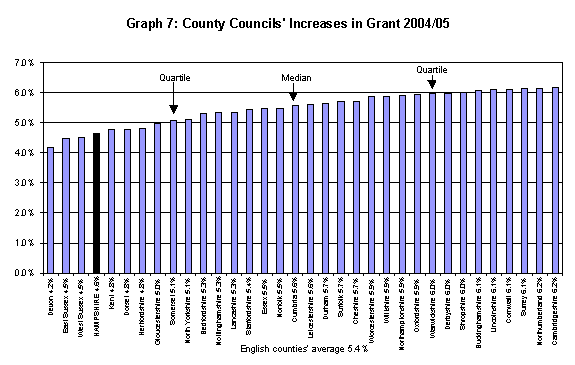
4.17 This County Council's grant increase is 4.6% in cash terms, slightly more than anticipated, but below the English counties average of 5.4%. It is the fourth lowest of all counties as shown in Graph 7.
4.18 The County Council has now lost all of the grant due to formula changes for all services except Education and is therefore now above the grant floor (3.5%) for all services other than Education.
4.19 About £19m of Education transitional (damping) grant remains to be lost, mainly from 2006/07 onwards.
4.20 The Government has recognised the detrimental effect of its grant changes upon schools and has therefore effectively postponed the worst consequences of the changes until 2006/07 by a higher grant floor for Schools in 2004/05 (4% per pupil guarantee for each individual school). The overall 4.7% cash increase for the schools block is much higher than the anticipated 2.5% inflation led floor anticipated in early summer - that is before the Government accepted that LEAs were not to blame for the funding crisis in schools.
4.21 It is estimated that a further £8m of grant loss has occurred in 2004/05 compared with the £14m loss originally projected for that year.
4.22 The 4.6% total cash grant increase is £28.3m
· of which £24.5m is to `match' the increase in Schools FSS
(£26.4m for the increase in Education FSS)
· which `leaves' £1.9m for increased spending on all other services
4.23 The £1.9m increase for all other services is clearly inadequate for the base budget pressures of £15.4m, on all other services, together with the need under the Council's budget strategy to increase Social Services by a further £10m to match the FSS increase for that service. However that remains a local decision and there is no requirement to passport this increase as there is with the Schools budget.
4.24 Although the Government has been forced to increase grant by at least the increase in Schools FSS for 2004/05 (after failing to do so for all authorities in 2003/04), RSG is not a ring-fenced grant and it is not appropriate to earmark the grant increase just for Education. It still remains the case that the Schools FSS increase has to be met by 61% grant and 39% council tax in proportion to the Council's overall funding position.
Specific grants
4.25 The Government has announced that the proportion of specific grants which are ring-fenced has been reduced from 13.3% to 11.1% in 2004/05 (for the reasons set out in paragraph 4.5). It has transferred the Social Services quality protects specific grant into RSG in a neutral manner (unlike the transfer of standards fund grant in 2003/04 which exacerbated the problem for schools and had to be replaced by an additional council tax rise). It has introduced two new specific grants on Social Services which benefit the County Council (paragraph 4.2).
4.26 Despite these changes specific grants nationally have increased by 11.7%, about 2.5 times the increase in government grant support for FSS.
4.27 For Education there are significant increases of 19.7% nationally in the specific grant for excellence in cities, 12.8% for teachers pay reform; and 117% for childcare. The County Council's share of the first increase is disproportionately small, just £0.2m, as most grant is channelled to deprived areas. Details of the other two grants are still awaited, but teachers pay reform grant is needed to cover the cost of previous teachers' performance pay settlements.
4.28 There is a significant increase for Social Services however, of around £7m for the County Council or about 2.6% on the budget in the following areas:
£m
· safeguarding children 1.3
· access and systems capacity (elderly) 2.8
offset by withdrawal of deferred payments
and performance fund grants
· delayed discharges 0.7
(to meet the full year costs
from the introduction of fines)
· other changes 2.2
7.0
4.29 These grants are not ring-fenced and will be of substantial advantage to Social Services in meeting budget pressures on its key problem areas of children's and elderly services. A further grant has yet to be notified associated with the phasing out of residential allowances by the Government but this is expected to be matched by additional funding commitments.
4.30 There has again been a substantial increase of 12.5% in specific grant for neighbourhood renewal funds targeted at deprived areas in addition to the extra deprivation weightings introduced into RSG in 2003/04.
Adjustments made in the settlement
4.31 There are three significant changes in the settlement which the Government has made adjustments for to compare funding changes between 2003/04 and 2004/05. These are:
· separation of combined fire authorities for precepting purposes from 1 April 2004
· transfer of most of the levies for flood protection to direct grant from the Environment Agency, leaving a residual amount
· transfer into FSS and RSG of Quality Protects specific grant
4.32 The effects of these changes in the starting point for the County Council's FSS are shown below:
Table 2: Adjustments to settlement in 2003/04
2003/04 Settlement £m |
2003/04 Adjusted Settlement £m | |
Government grant |
295.4 |
290.0 |
Non domestic rates |
332.6 |
320.0 |
Revenue Support Grant |
628.0 |
610.0 |
Council tax payer |
366.6 |
347.9 |
Formula Spending Share |
994.6 |
957.9 |
4.33 This means that FSS and RSG are adjusted in the 2004/05 settlement for the net effect of these changes. However the Government cannot change the actual council tax levied by the County Council in 2003/04. The effect of the separation of the Fire Authority for precepting purposes is different to previous changes ( for example post 16 and sixth form funding). In those cases the Government transferred sufficient grant to offset the council tax raised for these services to the Learning and Skills Council. For Fire however the council tax simply transfers from the County Council to the Fire Authority. The bill still remains the same for the council tax payer in 2004/05 for any given level of spending - they will pay the same amount but to two different authorities instead of the one payment to the County Council in 2003/04.
4.34 This means that the actual rise in council tax for the County Council in 2004/05 will be much lower than the real underlying council tax increase when the effect of the transfer of the precept for the Fire Authority is taken into account. It is the underlying change from the adjusted 2003/04 settlement which will be the key figure for the Government ( in setting capping criteria or making comparisons) and for the Hampshire council tax payer. But it will remain the case that the County Council's tax rise will appear to be below inflation because of this change in precepting powers for the Fire Authority.
4.35 The outcome is illustrated in Table 3, which shows the changes in grant and council tax payer support on an adjusted and unadjusted basis, assuming that the County Council spent at FSS.
Table 3: Change in grant and council tax support implied by Government in the 2004/05 provisional settlement
2004/05 consultation |
Change from 2003/04 |
Change from adjusted 2003/04 | |
£m |
% |
% | |
Government grant |
324.6 |
9.9 |
11.9 |
Non domestic rates |
313.8 |
-5.7 |
-2.0 |
Revenue Support Grant |
638.4 |
1.7 |
4.6 |
Council tax payer |
369.1 |
0.7 |
6.1 |
Formula Spending Share |
1007.5 |
1.3 |
5.2 |
4.36 Table 3 shows that Government grant has increased by 4.6% on the adjusted base and that Government expects the council tax payer to contribute a further 6.1% if the County Council spent in line with FSS. However the County Council budgeted to spend (3.8%) more than FSS in 2003/04 and this amount, and the increase for 2004/05 on it is not matched by Government grant. The equivalent grant increase and council tax burden go up by 1.7% and only 0.7% respectively if no adjustment is made for the effect of the Fire transfer.
4.37 The effect on the council tax when the Fire Authority becomes a precepting body on 1 April 2004 is set out in Tables 4 and 5. Calculations involve grant and net taxbase and are not precisely the same for the combined fire authority (HFRA) as for the County Council, because of the different ratios of net to grant taxbase between the contributing authorities. In addition the Government has used assumed national council tax to calculate the income at FSS. This is based on the assumed tax used for existing metropolitan fire authorities, matched by equivalent reduction in the assumed tax attributable to the County Council and unitary cities.
Table 4: Adjustments for Fire to 2003/04 base
County Council |
HFRA | ||
£m |
£m | ||
Fire FSS |
39.4 |
49.5 | |
Capital financing FSS |
0.3 |
0.3 | |
Fire FSS total |
39.7 |
49.8 | |
Government grant |
20.9 |
26.2 | |
Council tax income |
18.8 |
23.6 | |
Adjustment for spending at FSS |
39.7 |
49.8 |
4.38 The figures above show the adjustments made for FSS and grant purposes. The totals now allocated in the adjusted base for HFRA were of course previously distributed between the three contributing authorities. The effects on budgeted spending are shown in the next table.
Table 5: Effect on budgeted spending in 2003/04
County Council |
HFRA | ||
£m |
£m | ||
Fire levy |
40.9 |
51.3 | |
Less government grant |
20.9 |
26.2 | |
Met by council tax |
20.0 |
25.1 | |
Net taxbase |
475,062 |
595,345 | |
2003/04 Band D council tax for Fire on adjusted basis |
£42 |
£42 |
Capping
4.39 In announcing the provisional settlement the Minister made the following statements
· `clear that the current trend in council tax rises is not sustainable'
· `Government will be looking at next year's council tax rises closely....looking for efficiency savings....will take account not only of one year's increases but also of the trend of increases over more than one year'
· `every local authority - including fire and police authorities - must be in no doubt that we are prepared to use our targeted capping powers in 2004/05 if necessary'
· `recognise that in areas where there is a combined fire authority, next year's budgets will not be comparable with this year'
· will consult `about the level of earlier years' budgets which we will use for comparison purposes when we come to consider the use of capping powers'
4.40 A 10% council tax increase has been suggested as a possible trigger for capping. However as the above statements make clear increases in budget and council tax over a number of years will be considered, as well the effect of Fire precepting. (In future, comparisons between County Councils will need to be split into two, those 14 authorities unaffected by local government reorganisation which retain Fire as a service, and those 20 counties where combined fire authorities were set up in 1997).
4.41 The increase in the County Council's budget compared with other counties from 2001/02 to 2004/05 is in the upper quartile and perhaps getting nearer to capping territory. But this is an artificial basis for comparison and if adjustments are made for the transfer of sixth-form colleges to the Learning and Skills Council (LSC) in 2001/02 a different picture emerges with Hampshire's increase in the lower quartile (because of its relatively low number of school sixth forms). The County Council should not be a target for capping because of its budget increase.
4.42 The cumulative increase in Hampshire's council tax over the same period is slightly above average. This indicates that despite significant grant loss and relatively low grant increases by comparison over recent years, that the council tax rises are not likely to be any way near capping territory. However the position will need to be reviewed as other authorities make their plans for 2004/05 and the Government responds. There are no pre-announced capping limits, either selectively or generally.
4.43 Graph 8 compares cumulative council tax and rebased budget increases for the same three year period. It shows that:
· there is little correlation between authorities' council tax increases and budget increases over the years
· the Minister's comments blaming profligate local authorities for recent large council tax rises are misplaced
 Graph 8:
Help for individual council tax payers
4.44 The Minister indicated that Government wished to work with local authorities to examine options for promoting council tax benefit and encouraging the take-up of council tax benefit by potential beneficiaries. This will closely align with the County Council's wishes to assist those on low and fixed incomes, whether individuals, families or pensioners. Representations have been made separately in the County Council's response to the Balance of Funding Review.
4.45 The Minister also indicated that 1.9 million pensioners could potentially gain from the introduction of pension credit. Billing authorities (the district councils) have a new power to grant further discounts to individuals, or classes of council tax payers such as pensioners. As previously reported this meant that the County Council could not provide discounts directly within the new Regulations introduced with the Local Government Act 2003. It was also reported that Counsel's opinion was necessary in advance of any scheme for the County Council to provide direct rebates to any pensioner requesting them - for example to offset half the cost of the 2004/05 council tax rise. As expected the Counsel's opinion did not support the introduction of such a tax benefit without the potential costly challenge of other classes of council tax payer in similar or more constrained financial positions. The Leader has therefore fully pursued every option to see if any of the strain on pensioners from council tax rises could be offset. As a result there is now no requirement to find additional savings to offset the cost of a local rebate scheme for pensioners, and it is anticipated that the County Council would wish to support the Government's aim of working together to improve council tax and other pension benefit take up.
4.46 The Minister concluded his announcement by stating that it is "now vital that councils meet the expectation of their tax payers and budget prudently to improve services at a reasonable cost".
4.47 This conclusion fits closely with the County Council's own budget strategy and can be supported.
Summary of settlement
4.48 The settlement can be summarised as follows:
· £8m of grant lost compared with £14m projected
· £19m of grant still to be lost over future years
· 4.6% grant cash increase, lower than average of 5.4% for counties, slightly better than projected, but still insufficient to match the budget increase of 5.4%
· £26.4m of the total grant increase of £28.3m is required to support the increase in Education FSS, leaving just under £2m for other services.
4.49 Appendix 1 sets out the history of financial statistics for the County Council with information on SSA/FSS, grant, budgets and council tax changes, and spending on services relative to SSA/FSS.
5. Response to settlement
5.1 It is suggested that a written response be made to the settlement to meet the deadline of 2 January 2004, and that the County Treasurer agree the response with the Leader based on the comments below and any further views expressed at Cabinet. It is also suggested that copies of the response be sent to the Local Government Association and the County Councils Network for consideration in their meetings with the Minister, and to Hampshire Members of Parliament.
5.2 The key issues to raise include:
· recognising that the Government has damped down the potentially harmful effects of the formula changes for schools, but point out that these changes need to be suspended or reversed completely otherwise the damage will still be done for 2006/07 onwards
· reiterate out that the County Council has always fully supported its schools and has budgeted over FSS historically
· therefore deplores the introduction of passporting by reserve power to schools and the attempt to ring-fence revenue support grant against a passporting target, especially for a council rated as excellent within the Comprehensive Performance Assessment
· point out that the County Council had to over-passport by £2m in 2003/04 to meet its schools needs because of the formula changes and cessation of Standards Fund grant in that year, which led to an unsustainable council tax rise of 15%
· appreciates that the Government has recognised this in its targeted transitional grant for individual schools with the greatest difficulty, but argue that too much has been allocated in this way with possibly perverse incentives for schools which manage their budgets well. It would have been better to allocate this additional resource through the damping arrangements to recognise the impact of the formula change on all schools and to compensate the Authority and its council tax payers for the over passporting in 2003/04
· 4.6% grant increase falls short of the FSS increase of 5.2%
· welcome the additional specific grants for Social Services which will help to relieve some of the pressures, especially in services for the elderly and children
· say yet again that the rapidly increasing costs of waste management are not properly recognised and because the County Council's private sector contract pre-dated the private finance initiative (PFI) it therefore has no support from PFI credits.
· to draw attention to the lack of accountability for the supplementary flood defence levies which can continue to be levied on the County Council at three times the level of recognition in FSS.
6. Budget guidelines
6.1 Budget and council tax projections have been made since the budget consultation exercise began in July 2003. The announcement on schools funding in October 2003 provided the basis for the last projection which anticipated a grant increase of 3.9% and a budget rise of 5.1% leading to a council tax increase of 6.7%, still within the range of a 6 to 7% council tax rise used for the "standstill" budget during the budget consultation meetings.
Base budget assumptions
6.2 The original base budget assumptions were:
· full passporting of Schools Budget increase
· equivalent FSS increase in cash terms for Social Services to meet budget pressures in excess of its base budget increase
· base budget increase for all other services plus an additional £3m contingency for waste management to meet the anticipated contract costs from volume increases, landfill tax and new infrastructure
· 3.5% for pay and 2.5% for price increases
· grant equalisation reserve used proportionally to grant loss in each year
Education
6.3 The October and subsequent announcements have confirmed that:
· the Standards Fund reduction in 2004/05 has been reinstated and met by additional resources - this is worth £7m to the County Council and removes a significant budget pressure that would otherwise have had to be assimilated within the overall grant increase
· 2.5% teachers pay award for 2004/05
· 4% per pupil minimum guarantee for every individual school which meets the estimated cost pressure of 3.4% for the average school in updating its budget from 2003/04 to 2004/05
· a targeted transitional grant totalling £6.9m to be allocated to individual schools with particular difficulties against criteria agreed with the Secretary of State
· 5% per pupil increase in Schools FSS (4.7% in cash terms), with grant to match and a requirement to passport fully which must be confirmed with the Secretary of State by 31 December 2003
· 3% cash floor for the LEA block
6.4 The full passported amount for the schools budget is £24.5m, of which £13.1m is `growth' above the base budget estimate. Within the overall sum about £16m will be required to meet the 4% per pupil guarantee which leaves some headroom within the individual schools budget (amount to be delegated to schools). Figures are still being worked on and the gap between the guarantee and the full passported amount also has to meet increased costs and numbers of pre-school children, LEA contributions to the Standards Fund and costs of special education needs (SEN) and excluded pupils (EOTAS) within the constraints on the central schools budget. Discussions with the Secretary of State are therefore necessary to help absorb the SEN and EOTAS costs within the passported amount in 2004/05 taking into account both the limits on `central' spending and `over passporting' that was necessary in 2003/04.
6.5 Given these parameters it is recommended that the budget strategy be confirmed : to passport fully the Schools budget increase, to provide for a base budget increase for the remainder of Education in line with other services and negotiate with the Secretary of State and the Schools Forum to use the headroom flexibility within the Schools budget and any over-passporting in 2003/04 to meet any additional costs of special educational needs and excluded pupils. Any overspending against the schools block in 2003/04 would also need to be recovered against the passported increase in 2004/05.
Social Services
6.6 The original projections assumed an increase of 5.8% in the Social Services FSS. The actual increase is now 7.4%, but is not matched fully by the grant increase of 4.6%, leaving £5.5m to be met in full by the council tax increase.
6.7 The cash increase for Social Services over and above the base budget increase would be:
· at 5.8% £6.1m
· at 7.4% £9.8m
6.8 In addition Social Services will have a further £7m of extra non-ring-fenced special formula grant which it can use to meet additional pressures and demands, or £5.4m after allowing for the impact of inflation on existing spending financed by specific grant.
6.9 The potential additional resources for Social Services are therefore about £15.2m or 5.7% more than its base budget increase.
6.10 It would be possible to consult on either level of increase, and unless the Cabinet required a lower council tax rise, the 7.4% FSS increase could be met within the original projected council tax rise of 6.7% without requiring cuts in other services.
6.11 However if this increase is confirmed it would be necessary for the Social Care executive member to take a three-year view for 2003/04 to 2005/06 to ensure that any over commitment in 2003/04 is repaid in full in 2004/05 and to make sure the full year effects of new commitments made in 2004/05 are contained within that cash limit and do not become a new pressure in 2005/06.
6.12 The budget and specific grant increases for Social Services have been at historically high levels and have helped to lead to the recent Social Services Inspection assessment that the Council is serving most of its clients well with excellent prospects for improvement.
Table 6: Increases in Social Services budget
Budget increase |
Specific grant increase |
Total | ||||
£m |
% |
£m |
% |
£m |
% | |
2001/02 |
10.5 |
7.0 |
3.1 |
26.3 |
13.6 |
8.4 |
2002/03 |
11.6 |
7.3 |
9.5 |
32.0 |
21.1 |
11.2 |
2003/04 |
20.5 |
11.6 |
11.4 |
60.6 |
31.9 |
15.4 |
2004/05 (provisional) |
15.2 |
7.5 |
7.0 |
11.1 |
22.2 |
8.3 |
Cumulative 2001/02 to 2004/05 |
37.7 |
197.5 |
50.6 | |||
6.13 The cumulative budget increase has been 37.7% over a period when the County Council's total budget has gone up by 29%, while additional specific grants have taken the overall cumulative spending increase to more than 50%.
6.14 In 1996/97 spending was 6.7% below SSA but had risen to 5.6% above SSA before the introduction of FSS and resource equalisation in 2003/04.
Waste Management
6.15 The previous forecast of the contingency which is held centrally to meet the possible, but not certain, costs of increased volumes, landfill tax and infrastructure for 2004/05, was about £3m, on top of £0.9m for inflation. Latest estimates of inflation and the other factors are now lower and the increase required has been reduced to £2.3m. The Government has also announced the deferral of the landfill allowance trading scheme until 2005/06 avoiding a new pressure on the 2004/05 budget.
Pay and prices
6.16 The original assumption was 3.5% for pay and 2.5% for prices. The teachers pay award has been settled at 2.5% and the Department for Education and Skills has assumed a similar settlement for non-teaching staff in fixing the minimum guarantee for schools. It is therefore appropriate for the County Council to align its assumptions with this in terms of passporting for schools and preparing budgets for the LEA block, the cash increase in Social Services, and base budget rises elsewhere.
6.17 It is too early to be certain if this assumption is safe for other pay awards and a final decision can be made in February. 3.5% now seems a bit high, and 3 to 3.25% may be the more likely outcome. It might be possible later to revise upwards the provision for price inflation if there is some scope to do so from a small reduction in the pay assumptions. This will make no difference to the cash increases for Schools and Social Services. For the time being the difference of 1% in pay has been retained in the inflation contingency and not allocated to service cash limits in setting budget guidelines. The net `saving' on non-passported budgets from a 2.5% pay assumption is £1.2m. It will provide some flexibility when taking final decisions on the budget in February either on pay and prices; or used in final decisions on the level of council tax.
Grant equalisation reserve
6.18 The budget strategy assumes that this will be used proportionally to grant loss. Final decisions on the use of this reserve over what will now be at least a three year period from 2004/05 to 2006/07 can be made in February and provides some final flexibility on options and consultation over service levels and council tax rises.
Service cash limits
6.19 Using these assumptions, within the budget strategy, allows budget guidelines to be set for service cash limits. Budgets within these guidelines can be prepared by executive members and reviewed by policy review committees in January, to report back to the Leader and Cabinet to make final decisions.
6.20 There are three parts to the construction of the cash limits
· adjustments for changes in function and specific grants
· base budgets
· additional amounts for Schools and Social Services
6.21 Details of the definitions for the base budget and changes are set out in Appendix 2.
6.22 Table 7 summarises the adjustments made together with inflation and allowable growth within the base budget definitions.
Note: Other changes include additional specific grant financed expenditure of £18.6m
6.23 Table 8 then adds in the additional passported amounts for Schools and Social Services showing the potential `growth' of:
· £13.1m for Schools, as adjusted for any overspending carried forward from 2003/04
· £9.8m for Social Services, which together with additional specific grant of £5.4m should meet the priority pressures for elderly and children's services
Table 8: Budget guidelines - total service cash increases 2004/05
Base budget 2004/05 |
Passported amounts |
Total cash limit |
Increases on adjusted base | |
£m |
£m |
£m |
% | |
Schools |
590.0 |
13.1 |
603.1 |
4.6 |
LEA |
61.1 |
61.1 |
2.9 | |
Total Education |
651.1 |
13.1 |
664.2 |
4.4 |
Waste management |
33.3 |
33.3 |
6.6 | |
Environment |
52.8 |
52.8 |
3.9 | |
Total Environment |
86.1 |
86.1 |
5.0 | |
Policy and Resources |
38.8 |
1.0 |
39.8 |
2.9 |
Recreation and Heritage |
28.1 |
28.1 |
3.8 | |
Social Services |
279.0 |
9.8 |
288.8 |
7.5 |
Service cash limits |
1083.1 |
23.9 |
1,107.0 |
5.2 |
Other budgets
6.24 The main changes here are the removal of the budgets for fire and most of flood protection, the increased cost of capital financing and the additional £1.2m on pay allocated to contingency for the time being. A further sum of £2m has also been added to the inflation contingency for the time being to provide some flexibility to meet new priorities and/or to reduce the proposed council tax rise after final budget consultation when firm recommendations are made to the Council.
Table 9: Other budgets | |||
2003/04 Budget |
2004/05 Budget |
Variation on adjusted budget | |
£m |
£m |
% | |
Fire levy |
40.9 |
- |
- |
Capital financing |
29.7 |
33.2 |
11.5 |
Revenue contribution to capital |
29.9 |
30.2 |
2.5 |
Flood protection |
5.4 |
0.7 |
- |
Inflation contingency retained |
9.1 |
9.5 |
- |
Other including specific grants |
-121.1 |
-132.6 |
- |
Total other budgets |
-6.1 |
-59.0 |
8.9 |
6.25 The overall budget for 2004/05 compared with 2003/04 can be summarised as follows:
Table 10: Total 2004/05 budget within budget guidelines | ||||
2003/04 original budget |
2003/04 adjusted budget |
2004/05 budget |
Variation on adjusted budget | |
£'m |
£'m |
£'m |
% | |
Education |
628.5 |
628.8 |
664.2 |
4.4 |
Environment |
81.6 |
81.6 |
86.1 |
5.0 |
Policy and Resources |
37.7 |
37.7 |
39.8 |
2.9 |
Recreation and Heritage |
27.3 |
27.3 |
28.1 |
3.8 |
Social Services |
263.1 |
263..1 |
288.8 |
7.5 |
Total services |
1,038.2 |
1,038.5 |
1,107.0 |
5.2 |
Other budgets |
-6.1 |
-44.6 |
-59.0 |
8.9 |
Total budget |
1,032.1 |
993.9 |
1,048.0 |
5.4 |
Previous forecasts
6.26 The previous forecasts have to be amended for
· effect of the function and specific grant changes in the provisional settlement
· new FSS and grant figures, and to adjust the central Schools and Social Services FSS increases on revised passporting percentages.
Council tax forecast
6.27 The projected council tax rise remains at 6.7% to meet an overall spending increase of 5.4% against a grant increase of 4.6%. The differences from the 2003/04 budget and the previous forecast because of the two amendments set out in paragraph 6.26 are summarised in the next table.
Table 11: Effect of changes on 2004/05 budget forecast
2003/04 Budget |
Previous forecast |
Adjusted Previous forecast |
Current forecast | ||||
£m |
£m |
% |
£m |
% |
£m |
% | |
FSS |
994.6 |
1,039.3 |
4.5 |
1,001.3 |
4.5 |
1,007.5 |
5.2 |
Budget |
1,032.1 |
1,085.0 |
5.1 |
1,045.0 |
5.1 |
1,048.0 |
5.4 |
Grant |
628.0 |
652.6 |
3.9 |
634.6 |
4.0 |
638.4 |
4.6 |
Collection fund surplus |
2.9 |
2.0 |
2.0 |
2.0 |
|||
Council tax requirement |
401.2 |
430.4 |
408.4 |
407.6 |
|||
6.28 Table 11 shows that the budget increase of 5.4% is just above the overall FSS increase at 5.2%.
Council tax
6.29 The Government has adjusted FSS and grant for the separation of the Fire Authority as a precepting body but is unable to reduce the council tax levied by the County Council in 2003/04. The budget and the council tax bill for Fire simply moves from the County Council to the Hampshire Fire and Rescue Authority (HFRA) for 2004/05.
6.30 In making comparisons it is therefore also necessary to adjust the 2003/04 budget base for the transfer of Fire (as at Table 11) and also the council tax base. The Government has recognised that in 2004/05 where combined fire authorities exist that the council tax increases shown on the council tax bills will not be comparable. As previously reported the Government has issued a new regulation under the Local Government Act 2003 to add this `health warning' to the council tax bills. The Government will also use adjusted budget and council tax figures for capping purposes as previously explained.
6.31 The result is that:
· the County Council's budget rise, adjusting for the Fire transfer is 5.4%
· and the council tax rise, also adjusted for Fire basis is 6.7%
· but the council tax rise shown on the bill for the County Council will only appear to be 1.3%, (because the County Council's 2004/05 council tax excluding funding for the Fire Service will be compared with its 2003/04 tax which included funding for the fire service).
6.32 The next table shows the
· council tax rise of 6.7%
· apparent council tax rise of 1.3%
Table 12: Projected 2004/05 council tax rise
2003/04 Budget |
Previous Forecast for 2004/05 |
Adjusted previous forecast |
Current forecast | |
£m |
£m |
£m |
£m | |
Council tax requirement |
401.2 |
430.4 |
408.4 |
407.6 |
Band D council tax |
£844.56 |
£901.55 |
£855.35 |
£855.90 |
Less Fire |
£42.17 |
|||
Adjusted council tax |
£802.39 |
£855.35 |
£855.90 | |
Increase on bill |
(6.7%) |
(1.3%) |
(1.3%) | |
Council tax increase |
N/A |
6.6% |
6.7% |
6.33 Table 12 shows that:
· the council tax rise of 6.7% is broadly consistent with the Government's assumed increase of 6.1% in council tax income at Band D for spending at FSS
· the effect of Fire separation results in a council tax rise of 6.7% (for comparison and capping purposes) for the Council's remaining services, but the actual council tax rise shown on the bill will appear to be just 1.3% (from £845 to £856).
Total budget over FSS
6.34 The projected budget of £1048.0m is £40.5m (4.0%) over FSS, compared with 3.8% in 2003/04.
Budget against FSS blocks
6.35 After apportioning support service and other costs on a very approximate basis, a provisional comparison of budget against FSS blocks shows the following position.
Table 13: 2004/05 Budget compared with FSS
2004/05 FSS |
2004/05 Budget |
Variation | |
£m |
£m |
% | |
Education |
606.8 |
614.8 |
1.3 |
Social Services |
227.0 |
227.5 |
0.2 |
Highways Maintenance |
46.6 |
52.7 |
12.9 |
EPCS |
82.4 |
118.0 |
43.2 |
Capital financing |
44.7 |
35.0 |
-21.7 |
Total |
1007.5 |
1048.0 |
4.0 |
Provisional figures
6.36 All figures are provisional and may be subject to further changes during the budget process, at final settlement and following final notification of taxbase. The guidelines figures will also change because of any final amendments in February and it is intended to make the appropriate reductions for SAP benefit realisation after agreement by the executive member for Policy and Resources in January 2004.
Efficiency improvements and maximisation of income
6.37 As usual it is anticipated that executive members will consider and report back on:
· efficiency improvements achieved in absorbing pressures and costs within the budget guidelines
· the annual review of charges and the maximisation of income
· the redeployment of any resources required to offset any new spending priorities, or inescapable budget pressures, or legislative requirements which otherwise cannot be met within their budget guidelines
Service considerations
6.38 It is anticipated that Education and Social Services will be able to prepare budgets within the enhanced budget guidelines resulting from the higher increases in FSS for those services. It is also assumed that the £3.5m contingency reducing delayed discharges from hospitals will be incorporated in the base budget for Social Services because of the continuing commitment into 2004/05 as reported to Cabinet in October.
6.39 All other services, with the exception of the contingency provision for waste management, will have base budget increases only and will have to meet any new priorities or pressures by redeployment of existing resources.
6.40 Environment plan to do this but have further pressures on bus contract price increases, projected at around £0.5m in 2004/05. The base budget continues the £3.5m sum set aside in the 2003/04 budget for one year only, subject to review, to improve the condition and maintenance of local roads and pavements. It is suggested that £0.5m is be allocated to meet the increased costs of bus subsidies, leaving £3m for a further year of improvement in the maintenance of local roads and pavements, subject to a further review of improved performance which results before setting the 2005/06 budget.
6.41 Policy and Resources has some flexibility from its share of the passported increases for Schools and Social Services, provided its budget is allocated in support of those services. There are also a mixture of new one off and continuing corporate pressures which will need to be resolved when details are clearer before the final budget is set in February. These include: costs of restructuring Personnel and Training; initial set up costs of a recruitment centre and delivering the human resources SAP payback; further work on the pay and benefits project; expansion of occupational health to secure reduction in long-term sickness; additional capacity for modern records to deal with electronic records and the Freedom of Information Act; and necessary one-off investment in E-government to ensure targets are met for 2005.
6.42 Recreation and Heritage will also endeavour to continue its redeployment of resources to meet new and changing priorities. Application of unsupported borrowing approval will create flexibility to enhance its capital programme, and to enhance facilities, particularly at Calshot Activity Centre, on an invest to save basis to enhance future income generation and improved services. It is suggested that virement and invest to save proposals for unsupported borrowing be brought forward within the policy framework agreed at the last Cabinet meeting within the Prudential Code on Capital Finance.
6.43 The Cabinet may also require a degree of flexibility in making final budget decisions on the four short-term Cabinet priorities. The Leader has made it clear that these developments should be broadly cost neutral, but some redeployment of resources, or additional pump-priming may be required to make some further progress in these areas.
6.44 There are a number of other priorities which may need additional resources or further savings or redeployment to initiate. These might include concessionary fares for young people (budget requirement though is not required until 2005/06), the introduction of area scrutiny panels, accredited community support officers or affordable housing initiatives. These may all be items for further budget consultation (see paragraph 7) but the latter two might be offset against any additional income which might be forthcoming from the reduction in the council tax discount on second homes.
Council tax discount on second homes
6.45 Regulations will become effective from 18 December 2003 (Local Government Act 2003) to enable billing authorities to reduce the discount on council tax for second homes from 50% to 10%.
6.46 The development of a protocol and initial views were considered by Hampshire and Isle of Wight Local Authorities Association (HIOWLA) on 28 November 2003. The district councils wished to consider affordable housing for key workers by possibly creating shared equity purchase schemes rather than housing to let, in partnership with housing associations. The legal power to share equity will need examination.
6.47 Some smaller authorities may not wish to participate but the Leader is convening a further meeting with the district councils who would benefit most from the changes to explore their willingness to pilot and develop the protocol further with the County Council.
6.48 The key priority will be to determine an agreement to reduce discounts from 1 April 2004 so that it can be built in to the taxbase for 2004/05, which has to be declared by billing authorities by 31 January 2004. This would leave time for use of the additional income to be considered. Details of the potential income, protocol and possible use were considered by Cabinet in October.
7. Budget consultation
7.1 Previously options around 5%, 7% and 9% council tax rises have been used in budget consultation with:
· business
· local strategic partnerships
· voluntary sector
· residents
· Schools Forum
7.2 The Cabinet may wish to conclude consultation with these groups during January based on the 6.7% rise still projected, or possibly options of 6%, 7% and 8% to give flexibility in making final budget decisions.
7.3 The community workshop could also be reconvened to report back on progress and seek final views. It had been planned to build on the qualitative aspects of the community workshop with a quantitative telephone survey run by MORI in January. It is suggested that this should still go ahead to secure best practice budget consultation and continue the County Council's commitment to consult fully before making its final decisions. This consultation would be around the original options or refined down to specific
proposals based on a narrower range of 6%, 7% or 8% council tax rises - in effect this would generate either savings or growth options of £4m either side of the 7% (6.7%) rise to implement budget guidelines.
7.4 The Leader could sound out Cabinet on possible proposals, based on previous discussions, and then work them out with the Treasurer to provide specific options for the MORI telephone survey in January 2004.
7.5 By January the provisional decision of the HFRA will be known which will enable the Cabinet to see clearly the overall impact on the council tax payer in Hampshire following the separation of Fire for precepting purposes.
8. Capital guidelines
8.1 The programme for each year is to be prepared in two parts:
· schemes supported by Government approvals, whether in the form of capital grants or Government supported borrowing
· schemes within the guidelines set by the Cabinet for locally-resourced schemes. These can be supplemented as appropriate by services' own resources including virements from revenue and contributions from developers, schools or other external bodies. From 1 April 2004 approved unsupported borrowing, in accordance with the policies approved at the last meeting of the Cabinet, either on a temporary or permanent basis, and service funded, can also be considered.
8.2 Details of capital grants and Government supported borrowing from 2004/05 and subsequent years have yet to be announced but are expected in mid-December. The Cabinet agreed in November to continue the current policy of making maximum use of Government supported capital approvals. Service guidelines will be determined once the relevant Government announcements have been made. At this stage the opportunities for possible development of PFI projects can also be reviewed in the light of the Government's decisions on the availability of PFI credits and any new policy directions identified.
8.3 The provisional cash limits at 2004/05 outturn prices for locally-resourced schemes over the four years from 2004/05 to 2007/08 are shown in Table 14.
Table 14: Capital cash limits - locally resourced schemes
2004/05 |
2005/06 |
2006/07 |
2007/08 | |
£'000 |
£'000 |
£'000 |
£'000 | |
Policy and Resources |
||||
Schools block chargeable capital repairs |
9,295 |
9,295 |
9,295 |
9,295 |
Other |
8,904 |
13,904 |
9,004 |
7,204 |
18,199 |
23,199 |
18,299 |
16,499 | |
Education |
- |
- |
- |
- |
Environment |
12,905 |
12,905 |
12,905 |
12,905 |
Recreation and Heritage |
||||
Main programme |
1,123 |
611 |
611 |
611 |
Winchester Cultural Centre/Gosport Discovery Centre * |
1,000 |
1,000 |
1,000 |
- |
2,123 |
1,611 |
1,611 |
611 | |
Social Services |
741 |
741 |
741 |
741 |
33,968 |
38,456 |
33,556 |
30,756 | |
* commitments are subject to the project appraisals for the cultural/discovery centres | ||||
8.4 The guidelines are based on the cash limits for the current programme, adjusted for virements to and from revenue, plus 2.5% for inflation in line with the non-pay inflation assumption in the revenue budget.
8.5 Executive members may propose supplementing their capital guidelines from their services' own resources, including virement from their revenue budgets or by using their share of capital receipts obtained in 2002/03 as allocated by the Cabinet in July 2003 (if not already used for the 2003/04 programme).
8.6 Executive members may also anticipate their share of capital receipts obtained in 2003/04 provided the receipt has actually been received and the share agreed.
8.7 Proposals for Executive members to retain more than the standard 25% share of capital receipts for `in and out' schemes should be put forward to the Executive member for Policy and Resources for consideration, in line with the current policy.
8.8 Within the guidelines, some flexibility between starts years is possible, provided the total four-year guideline for each service is not exceeded. Bunching of payments in any one year or front-loading must also be avoided.
9. Local Government Act 2003
9.1 In addition to the power to reduce the council tax discount on second homes other provisions commenced automatically by order on 18 November 2003. These included:
· provisions to enable the new capital finance system to operate for 2004/05
· regulations in force from 1 January 2004 to ensure that authorities set their affordable borrowing limits for 2004/05 in accordance with the Prudential Code
· minimum reserve requirement, but not applied until 2005/06 budget round
· requirement for the Chief Financial Officer (CFO) to report to the authority when it is making the statutory calculations required to determine the council tax or precept. The authority must take the report into account when making the calculations. The report must deal with the robustness of the estimates included in the budget and the adequacy of the reserves for which the budget provides. What is required is the professional advice of the CFO on these two questions connected with matters of risk and uncertainty. These discussions are the conclusion to the budget process involving consideration by the Leader, Cabinet, executive members, policy review committees and officers, and appropriate information will have been given at the earlier stages. It is therefore reasonably certain that a positive opinion can be given to the County Council at its budget meeting in meeting this new requirement.
Section 100 D - Local Government Act 1972 - background papers
The following documents disclose facts or matters on which this report, or an important part of it, is based and has been relied upon to a material extent in the preparation of this report.
NB the list excludes:
Published works.
Documents which disclose exempt or confidential information as defined in the Act.
TITLE FILE
None
Appendix 1 |
The County Council's FSS, Budget and Council Tax - Past Trends |
1994/95 |
1995/96 |
1996/97 |
1997/98 |
1998/99 |
1999/00 |
2000/01 |
2001/02 |
2002/03 |
2003/04 | |
** £m |
£m |
£m |
£m |
£m |
£m |
£m |
£m |
£m |
£m | |
FSS (SSA before 2003/04) |
934.0 |
875.5 |
917.9 |
676.7 |
713.0 |
746.7 |
784.8 |
829.6 |
863.2 |
994.6 |
RSG |
380.0 |
342.3 |
332.7 |
226.4 |
230.7 |
226.9 |
212.8 |
246.7 |
237.6 |
295.4 |
Business rates |
299.4 |
289.7 |
329.9 |
236.0 |
248.8 |
272.1 |
309.4 |
304.4 |
332.7 |
332.6 |
RSG & business rates |
679.4 |
632.0 |
662.6 |
462.4 |
479.5 |
499.0 |
522.2 |
551.1 |
570.3 |
628.0 |
Council tax at standard spending |
254.6 |
243.5 |
255.3 |
214.3 |
233.5 |
247.8 |
262.6 |
278.5 |
292.9 |
366.6 |
Budget |
913.1 |
875.5 |
920.8 |
692.4 |
737.3 |
781.6 |
822.6 |
871.3 |
920.5 |
1,032.1 |
Variation from FSS/SSA |
-20.9 |
0.0 |
2.9 |
15.8 |
24.3 |
34.9 |
37.8 |
41.8 |
57.3 |
37.5 |
% variation from FSS/SSA |
-2.2% |
0.0% |
0.3% |
2.3% |
3.4% |
4.7% |
4.8% |
5.0% |
6.6% |
3.8% |
Council tax (£m) * |
233.8 |
243.5 |
258.2 |
230.1 |
257.8 |
282.6 |
300.4 |
320.2 |
350.2 |
404.1 |
Council tax (£ per band D) |
£420.84 |
£433.71 |
£454.86 |
£503.91 |
£557.37 |
£609.66 |
£644.85 |
£680.58 |
£734.67 |
£844.56 |
Year-on-year changes (%) |
1995/96 |
1996/97 |
1997/98 |
1998/99 |
1999/00 |
2000/01 |
2001/02 |
2002/03 |
2003/04 | |
(adjusted for function changes etc) |
% |
% |
% |
% |
% |
% |
% |
% |
% | |
FSS (SSA before 2003/04) |
0.2% |
2.7% |
2.1% |
2.7% |
3.9% |
5.2% |
5.8% |
5.4% |
5.7% | |
RSG |
-0.6% |
-7.8% |
6.4% |
-5.5% |
-4.0% |
-6.1% |
15.8% |
-1.0% |
8.4% | |
Business rates |
-3.3% |
13.9% |
-4.6% |
5.4% |
9.3% |
13.7% |
-1.4% |
10.0% |
0.0% | |
RSG and business rates |
-1.8% |
1.9% |
0.5% |
-0.1% |
2.8% |
4.7% |
5.6% |
5.1% |
3.8% | |
Council tax at standard spending |
5.8% |
4.8% |
5.9% |
9.0% |
6.1% |
6.0% |
6.3% |
5.9% |
9.0% | |
Budget |
2.3% |
3.0% |
2.1% |
3.9% |
5.2% |
5.3% |
5.9% |
6.9% |
8.2% | |
Council tax * |
14.8% |
6.0% |
5.4% |
12.2% |
9.6% |
6.3% |
6.3% |
10.0% |
16.0% | |
Council tax per band D |
13.7% |
4.9% |
10.8% |
10.6% |
9.4% |
5.8% |
5.5% |
7.9% |
15.0% | |
* Excluding effect of collection fund surpluses and Council Tax Benefit Limitation Scheme | ||||||||||
** Figures for 1994/95 include police function | ||||||||||
The County Council's Variation of Spending from FSS (SSA before 2003/04) |
1993/94 |
1994/95 |
1995/96 |
1996/97 |
1996/97 adjusted for LGR |
|||
% |
% |
% |
% |
% |
|||
Education |
4.4 |
4.4 |
5.9 |
4.4 |
6.7 |
||
Social services |
-16.8 |
-12.3 |
-6.8 |
-4.1 |
-6.7 |
||
Police |
-4.7 |
-4.4 |
|||||
Fire |
-12.3 |
-14.7 |
-8.3 |
1.0 |
1.2 |
||
Highway maintenance |
-12.0 |
-8.1 |
-11.1 |
-13.2 |
-10.5 |
||
EPCS |
-1.7 |
3.2 |
20.1 |
30.6 |
49.3 |
||
Capital financing |
-42.7 |
-31.2 |
-41.1 |
-28.3 |
-29.6 |
||
Total |
-4.0 |
-2.2 |
0.0 |
0.3 |
2.4 |
||
1997/98 |
1998/99 |
1999/00 |
2000/01 |
2001/02 |
|||
% |
% |
% |
% |
% |
|||
Education |
4.8 |
1.2 |
1.2 |
1.0 |
0.9 |
||
Social services |
-5.0 |
-2.6 |
3.6 |
3.7 |
4.0 |
||
Fire |
3.4 |
8.7 |
8.1 |
6.5 |
9.6 |
||
Highway maintenance |
-11.2 |
-11.9 |
-9.3 |
-7.0 |
-7.0 |
||
EPCS |
46.1 |
54.2 |
61.7 |
65.2 |
69.7 |
||
Capital financing |
-23.1 |
-8.3 |
-17.6 |
-15.7 |
-19.5 |
||
Total |
2.3 |
3.4 |
4.7 |
4.8 |
5.0 |
||
2002/03 |
2003/04 compared with FSS less uplift |
2003/04 compared with FSS |
|||||
% |
% |
% |
|||||
Education |
0.9 |
0.6 |
0.6 |
||||
Social services |
5.6 |
9.0 |
-0.1 |
||||
Fire |
15.0 |
16.6 |
3.8 |
||||
Highway maintenance |
-2.9 |
9.5 |
11.8 |
||||
EPCS |
72.3 |
84.5 |
33.1 |
||||
Capital financing |
-23.7 |
-26.3 |
-25.3 |
||||
Total |
6.6 |
8.5 |
3.8 |
||||
Appendix 2
Base Budget 2004/05
1. Definitions
1.1 The first stage in the construction of the budget for 2004/05 is the preparation of a base budget. The rules used this year are similar to those applied in 2003/04, which are summarised below.
1.2 The 2004/05 base budget is defined as the current year's budget adjusted for:
· allocations made for inflation in 2003/04, including the full year effect of the cost of pay awards in 2003/04
· exclusion of expenditure included in the 2003/04 budget which was financed by the carry forward of planned underspendings from 2002/03, the one-off use of reserves or balances, or which was approved on a non-recurring basis
· the revenue effect of past capital programmes, subject to its inclusion in the approved capital programme
· the full year effect of council-approved policies included in the current year's original budget, which have been introduced part-way through the year
· changes in income volumes which are not the result of policy decisions by the County Council
· correction of arithmetical errors in the current year's budget
· the following specific items:
Education |
Variations arising directly from changes in the number of pupils in schools, pupils eligible for free meals and numbers of days in the school year |
Environment |
Routine highway and street lighting maintenance arising from variations in road length Variations in waste disposal volumes |
Social Services |
Increased cost of joint finance schemes with health due to operation of the taper |
2. Provisional base budget for services
2.1 The table overleaf analyses the provisional base budget for 2004/05 for services' cash-limited expenditure. Significant movements are detailed below. Service base budgets include a provision for future inflation based on the following assumptions:
· pay and price increases at 2.5%, offset by increased income to match cost increases
· an increase in the employers' contribution to the local government pension scheme from 12.9% to 13.5%, from 1 April 2004
· an increase of 2.9% in the provision made for increased grants to voluntary organisations and for internal support service charges, equivalent to the average level of inflation provision for pay and prices
Original budget 2003/04 |
Variation in inflation to Nov 2003 prices |
Other variations |
Allocation for future inflation |
Provisional Base Budget 2004/05 | |
£m |
£m |
£m |
£m |
£m | |
Education |
628.5 |
0.4 |
8.0 |
14.2 |
651.1 |
Environment |
81.6 |
1.2 |
1.9 |
1.4 |
86.1 |
Policy and Resources |
37.7 |
0.1 |
- |
1.0 |
38.8 |
Recreation and Heritage |
27.3 |
- |
0.1 |
0.7 |
28.1 |
Social Services |
263.1 |
0.9 |
9.6 |
5.4 |
279.0 |
1,038.2 |
2.6 |
19.6 |
22.7 |
1,083.1 |
2.2 The variation between the actual cost of inflation to November 2003 and the provision for inflation included in the 2003/04 budget is as follows:
£m | |
Inflation on waste management contract and business rates allocated from central contingency |
0.7 |
Full year effect of pay awards implemented during 2002/03 |
0.2 |
Actual cost of non-pay inflation between November 2002 and 2003, higher than provided for in 2003/04 budget |
1.7 |
2.6 |
2.3 `Other variations' are made up as follows:
£m | ||
Increased spending financed by Government specific grants on Education (£11.2m) Social Services (£7.0m), and Environment (£0.4m) |
18.6 | |
School budget support grant allocated after the 2003/04 budget had been approved and assimilated into FSS in 2004/05 |
0.3 | |
Allocation of contingency for action to reduce delay hospital discharges |
3.5 | |
Provision for higher waste management contract costs, mainly relating to the disposal of refrigerators, for which contingency provision made in 2003/04 |
1.3 | |
Adjustments for virement between capital and revenue spending |
0.3 | |
Expenditure in 2003/04 financed on a non-recurring basis from underspendings in 2002/03 |
-0.5 | |
Absorption of excess cost of inflation in 2003/04 |
-1.7 | |
Other allowable variations in the base budget: |
||
Pupil numbers |
-2.2 | |
Changes in the number of school days in the financial year |
-0.5 | |
Revenue effect of the capital programme |
0.4 | |
Increased share of cost arising from tapering arrangements with health authorities |
0.1 | |
19.6 | ||
3. Summary of overall provisional base budget
3.1 The following table summarises the other elements of the base budget in addition to service cash limited budgets:
£m | |
Service cash-limited budgets |
1,083.1 |
Magistrates' Courts |
10.8 |
Flood protection levies |
0.7 |
Revenue contributions to capital |
30.2 |
Capital financing costs |
33.2 |
Mandatory awards to students |
1.8 |
Balance of contingency provision not reflected in service cash limits |
7.5 |
Contributions to reserves |
9.4 |
Specific grants |
-154.6 |
1,022.1 |