
Archived decisions
Annexe B1
Health Review Committee
Health of Children Looked After by Hampshire County Council
Issues Report

November 2003
Contents:
Page | |
Responses form looked after children and young people |
2 |
Responses from foster carers |
6 |
Responses from registered managers of children's homes |
10 |
Responses from primary care teams |
14 |
Responses from directors of public health (primary care trusts) |
18 |
Responses from designated teachers for looked after children |
20 |
How can we use this information to bring about positive change? |
25 |
1a - Responses from looked after children and young people
Issues raised by responses to the questionnaire devised and circulated by the CAT Team:
Question 1, 2 and 3 |
On the whole, they do not have problems in accessing primary health care. |
Question 4 |
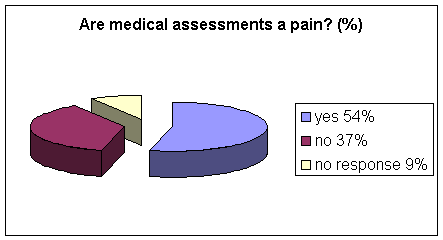
The big issue for those responding to the questionnaire - to many, the annual health assessment, or `medical', is, in their words, a pain. They'd like it undertaken more quickly, with less waiting and with simple, straight-forward questions. |
Question 5, 6 and 7 |
The responses to these questions are encouragingly positive, indicating that young persons feel those caring for them take health issues seriously, provide the opportunity for healthy eating and that, for most of them, there is someone they can approach and talk to about health issues that may be worrying them. |
1b - Responses from looked-after children and young persons
Age: only 21 provided this information, and are aged between 11 - 16.
1. Are you able to see a doctor or dentist when you feel you need to? |
(35)YES / (3)NO |
2. Do you have any choice in which doctor you see? |
(19)YES / (17)NO / (2)N/A |
3. Do you sometimes think that you'd rather see a nurse rather than a doctor for certain things? |
(18)YES / (20)NO |
4. Do you find the annual medical assessments a pain? |
(21)YES / (14)NO / (3)N/A |
Could you briefly tell us how you think they could be changed?
Don't have them, make them quicker, shorter waiting time, less questions, only see the doctor when I'm ill, use local/usual GP, only one a year, less detail, less forms, less often, they are ok all you have is a check up.
5. Do you feel that your carers are concerned enough about your health? |
(28)YES / (10)NO |
Do they take your worries and concerns seriously? |
(30)YES / (4)NO / (2)N/A |
6. When you need advice on things to do with your health, are you able to speak to someone that you feel comfortable with? |
(30)YES / (8)NO |
7. Are you given the opportunity to have a balanced diet? |
(29)YES / (6)NO / (2)N/A |
Do you have any problems with food and drinks where you live? |
(7)YES / (29)NO / (2)N/A |
1c - Comments from children and young persons
Medical assessments
- Better now because they've let my GP do my medical
- Don't have them so often
- Only go to the doctor when you are unwell, like my friends
- Sometimes you could be waiting ages
- Don't have so many questions
- I think they are ok: all you have is a check-up
- Haven't had one - refused
- Be quicker, `cos they take for ever
- Ask straight, simple questions because when I have my medical I'm always asking `what do you mean?'
- Could be moved to local GP
- There's too many forms to fill in
Being in care
- It's better than being at home, 100%
- I feel certain people outside of Social Services treat me differently, as though there is a stigma attached to being in care
- Sometimes you feel like you are different from others
- It's not what you expect: it is really hard being away from your family
- It's crap
- It's rubbish
- I wish I still lived with my parents or with a friend
- Bed time is 8.45, could it be 9.00!
- I love my foster carers and I will never move
- It's not fair that we are not allowed a normal childhood
2a - Responses from foster carers
Issues raised by responses to the questionnaire
Question 4 |
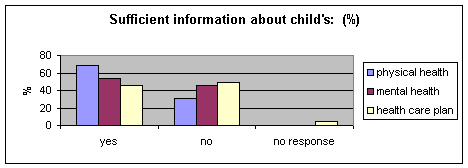
- About a third of those responding consider that they do not receive enough information about a child's physical health when the child is placed with them. - Almost a half say they do not receive enough information about the child's mental and emotional health. - About half say the child placed with them does not have a health care plan. |
Question 5 |
By and large, those responding say they do not have problems accessing primary health care. They do mention problems in finding a NHS dentist. |
Question 6 and 7 |
Almost all foster carers say that they register the children placed with them with their own, local GP. Only short-term respite placements would therefore, in emergency, ask their GP to see a looked-after child as a visitor or temporary resident (when complete medical records would not therefore be available). |
2b - Responses from foster carers
1. Name and address |
||||
2. Do you provide |
||||
long-term care? |
21 |
for pre-school children |
11 | |
short-term/respite care? |
25 |
aged 5 - 11 |
19 | |
aged 12 - 15 |
17 | |||
aged 16 + |
12 | |||
3. Do you foster more than one child? |
(23)YES / (11)NO / (1)N/A |
4. When children have been placed with you, have you been given sufficient information about their |
|
· physical health? · mental health? · does the child have a health care plan? |
(24)YES / (11)NO (19)YES / (16)NO (16)YES / (17)NO / (2)N/A |
5. Have you been able to get medical, dental or other healthcare for children you have fostered? |
|
· from the GP · from the dentist · from the optician · other (please specify) |
(33)YES / (1)NO / (1)N/A (27)YES / (7)NO / (1)N/A (29)YES / (4)NO / (2)N/A hearing tests, eye unit, behaviour therapy, GU, maternity, paediatrician neurologist, orthodontist, grommets, adenoids, child guidance, hospital |
6. Have the children you foster been registered with your GP? |
(30)YES / (3)NO / (2)N/A |
7. Have they remained on the register of the GP where they previously lived? |
(7)YES / (25)NO / (3)N/A |
2c - Comments from foster carers
Biggest problem is obtaining NHS dentist.
More funding so there's sufficient counselling and mental health care.
Difficult to get the right services to help under 16s with sexual behaviour issues.
A lot of children I have fostered have been allergic to cola and food colorants: how can I seek confirmation that this contributes to behaviour problems?
Those who need counselling often have to wait some time: there's not always good liaison between counsellor and foster parent, who often needs guidance to help the child.
History of violent outbursts at school and at home not fully explained prior to placement.
Lack of counselling to help with emotional problems.
Delays of months (even a year) in undertaking medicals, so lack of information for foster carers about a new placement.
Trouble in getting mental health appointments.
Waiting times too long for referrals of children with behavioural problems and for child and family therapy.
Head lice! Difficult to get rid of them.
I had a pregnant 14 year old girl placed with me and it was hard to try and keep her healthy and get her to visit the ante-natal clinic regularly. She always needed guidance during pregnancy.
I had to take a 15 year old girl to the GUM clinic: they helped her a lot.
Give foster carers as much health information about the child as possible, and especially about HIV.
3a - Responses from registered managers of children's homes
Issues raised by responses to the questionnaire
Question 2 |
- Like foster carers, tend to the view that information at placement could be more complete, especially on emotional/metal health problems. |
Question 4 |
- Responses confirm that health examinations concentrate on physical health and do not identify emotional/metal health issues. |
Question 7 |
- No problems in accessing main primary care services of GP, dentist and optician but do indicate problems in accessing (and securing early attention from ) other services. |
Question 9 |
- Approximately a quarter of homes lack arrangements for children and young people to access health advice without approaching staff |
3b - Responses from registered managers of children's homes
0. Name, post and address 1. When children are placed with you, do you receive sufficient information about their | |||
· physical health? · mental health? |
(8)YES / (2)NO / (1)N/A (5)YES / (6)NO | ||
2. Do children routinely have a health care plan? |
(7)YES / (3)NO / (1)N/A | ||
3. Does the health examination following a placement sufficiently identify | |||
· physical health problems? · mental health problems? |
(9)YES / (0)NO / (2)N/A (1)YES / (8)NO / (2)N/A | ||
4. How soon after placement does health examination take place? |
1 day (1 home) 3 days (1 home) 7 days (2 homes) 14 days (3 homes) (3)N/A | ||
Would it help you if it took place more quickly? Aim to undertake within |
5 days (1 home) 7 days (3 homes) 14 days ok (1 home) (4)N/A | ||
5. Is there sufficient access to specialist support services? |
(4)YES / (6)NO / (1)N/A | ||
6. Have you been able easily to get medical, dental or other health care for children resident with you? |
|||
· from the GP · from the dentist · from the optician · other (please specify) ______ |
(10)YES / (0)NO / (1)N/A (7)YES / (2)NO / (2)N/A (9)YES / (0)NO / (2)N/A CAMHS (1 home) Various specialists (1 home) No other (9 homes) | ||
7. Does a psychologist visit the home to help you both in recognising that a child is having problems and in tackling those problems? |
(2)YES / (7)NO / (2)N/A | ||
8. Are there arrangements so a child can discreetly and confidentially seek help and general advice on personal and social health care without approaching staff? |
(7)YES / (3)NO / (1)N/A | ||
3c - Comments from registered managers of children's homes
We have a high record of young people refusing to attend health appointments - very problematic.
Easier access to medical records and information/exchange of information between all involved.
Unified Adolescence Team (Health based CAMHS related team) support us through local budget arrangements: very handy for `care and cluster' units to receive mental health support direct.
Registered managers suggest the following issues should be considered
o Positive health care (exercise, washing, brushing teeth)
o Diet
o Access to exercise facilities, especially 10 -14 year olds
o Preventing smoking and drug and alcohol abuse
o Sex education
4a - Responses from primary care teams
Issues raised by responses to the questionnaire
The responses made, and comments made on the forms, suggest that GPs are conscious of health care of looked-after children being an issue and area where they might make improvements. Several indicate that the very fact of being asked questions about whether they have a `lead' and what information is included in practice records has prompted them to think about what might be done.
Question 2 |
Only a few practices have designated a `lead' person for looked-after children - and it is in all cases a GP rather than a practice administrator or nurse. |
Question 3 |
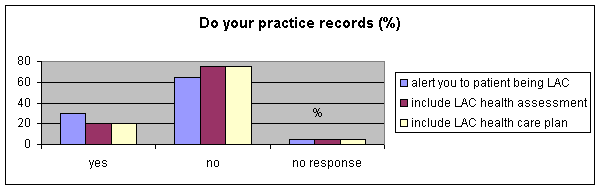
About a third already have in place arrangements that would alert a GP that a patient is a looked-after child or young person. Few practices include the child's or young person's health assessment and health care plan with medical records. |
Question 4 |
Few practices record who should be asked to give consent for treatment of a looked-after child. This can be a less than straightforward issue when consent is needed for treatment of looked-after children. |
Question 6 |
GPs are of the general view that they are consulted no less or more frequently by looked-after children than by children in general. |
Question 7 |
Half those responding have `occasional' problems in securing past medical records for looked-after children. 20% say they `never' have that problem. |
Question 8 |
The responses indicate that most GPs answering this question are satisfied that the NHS services to which they would wish to refer patients who are looked-after children are available. A slightly smaller proportion were satisfied that, having made the referral, the patient is seen sufficiently quickly and the necessary treatment provided. |
Question 10 |
It is clear from the responses that GPs see Social Services as the focus for information about looked-after children - and their additional comments (see below) make suggestions for improvements. |
1. Name, post and address 2. Has your practice designated a `lead' for health care of looked-after children? (1)N/A |
None GP Practice Administrator Practice Nurse |
16 |
||||
5 |
||||||
1 |
||||||
9. Do your practice records |
||||||
· alert you to a patient being a looked-after child? · include a looked-after child's health needs assessment? · include a looked-after child's health care plan? |
(8)YES / (14)NO / (1)N/A (5)YES / (17)NO / (1)N/A (4)YES / (18)NO / (1)N/A | |||||
10. Do your records show who should be asked to give consent for treatment of a looked-after child? |
(4)YES / (19)NO / (2)N/A | ||||||
11. Please give an indication/estimate of the number of looked-after children registered with your practice. |
(9) average answer 14.9 (9)unknown (4)N/A |
||||||
14. In your experience/opinion, are you consulted as frequently by looked-after children as by children in general? (4)N/A |
less frequently as frequently more frequently |
3 |
|||||
13 |
|||||||
3 |
|||||||
15. Have you had problems in securing past medical records for looked-after children? (4)N/A |
frequently occasionally never |
3 |
|||||
12 |
|||||||
4 |
|||||||
21. When you have referred looked-after children to specialist support services within the NHS, do they get the service they need? |
|||||||
· Availability of service · Timeliness of service |
(14)YES / (3)NO / (6)N/A (12)YES / (4)NO / (7)N/A | ||||||
continued
22. Are there other specialist support services outside the NHS to which you would refer looked-after children if they were available? Please specify: (7) no, (14)N/A, (1) already use Home Start, (1) counselling | |
23. We know there are problems in the sharing of information about looked-after children between agencies: · do you routinely share information about looked-after children with Social Services? |
(10)YES / (10)NO /(3)N/A |
· do you need information/more information about looked-after children from other agencies?
Agency/agencies:
(6)Social Services / (1)other medical services / (3)yes but agency not named / (6)no / (8)N/A
Information (from Social Services): inform us that the child is a looked-after child, share information, social situation, at or before placement, the first we know is when the foster parent tells us, background, previous medical history.
4c - Comments from primary care teams
Social services should discuss the possibility of fostering with the potential foster parents' GP before placement. I have had some experiences which would not have happened if prior consultation had taken place.
Social Services not good at returning phone calls.
Information not always received in good time for new placements, first we know is when foster parent tells us.
Health visitors would be aware (informed by Social Services) of placements of under 5s. This is not so with older children nor children in private fostering arrangements, who could perhaps be a vulnerable group.
GPs have no knowledge of who is looked-after except when carers inform them. Health Visitors are not informed of looked-after children in the area/at local schools and it would be useful if they were.
Generally works fine through good foster parents.
We have no way of knowing a child is looked-after unless someone chooses to tell us. When they register, the form gives no indication of this.
5a - Responses from directors of public health
(primary care trusts)
Issues raised by responses to the questionnaire
Question 2 |
There are Department of Health general guidelines on how primary care should deal with situations where patient records are not available or incomplete. PCTs do not therefore generally have `local' guidance. One PCT's response records that its Child Health Unit follows up when a child's patient records are missing and attempts to trace them by contacting previous GPs/PCTs, carers and Social Services. |
Question 3 |
Only some PCTs have in place a record of the number of looked-after children in the PCT's area. A number have replied that the information could be obtained by additional interrogation of existing data bases. One is currently compiling the information - and it would seem that compiling a data base of looked-after children can be time-consuming, with a designated nurse spending time chasing records. |
Question 4 |
All PCTs recognise looked-after children as a specifically identified patient group. |
Question 5 |
Questionnaire responses are cautious in answering this question: in essence, no, data is not available, and what data there is relates to too small a sample to be statistically reliable. But some response go on to comment that anecdotal evidence, research studies and general impressions are that looked-after children have greater mental and emotional health needs than children in general - which is coincident with views expressed by other groups of respondents. |
Question 6 |
A difficult question to answer because data not available. Most think looked-after children seek access to services less readily than children in general. There is an interesting comment of anecdotal reports that foster careers are better at seeking advice and accessing health services than children's homes... |
5b - Responses from directors of public health
1. Name, post and address |
||||||||||
2. Because of changes in placement and the circumstances in which some children come into care, there can be difficulty in tracing and transferring medical records. A particular issue can be absence of immunisation/vaccination records. Does the PCT have a policy or issue `best practice guidance' to GPs when medical records are missing/incomplete? |
(1)YES / (5)NO | |||||||||
Does it include guidance on re-immunisation/vaccination? |
(3)YES / (2)NO / (1)N/A | |||||||||
3. Does the PCT have records of the number of looked-after children · within its area? · registered with individual GP practices? |
(4)YES / (2)NO (1)YES / (5)NO | |||||||||
4. Does the PCT recognise looked-after children as a specifically identified patient group? |
(6)YES / (0)NO | |||||||||
5. Does data on consultations and treatments indicate that their medical needs are greater than children in general? Please respond separately, if data available, on · general physical health · mental health |
(2)YES / (3)NO / (1)N/A (2)YES / (3)NO / (1)N/A | |||||||||
6. Do looked-after children seek help and access to services from which they would benefit as readily as children in general? |
more readily the same less readily N/A |
|||||||||
3 |
||||||||||
3 |
||||||||||
6a - Responses from designated teachers for looked after children
Issues raised by responses to the questionnaire
Question 2 and 3 |
Responses to questions 2 and 3 show most `recognise' in the school's records that a child is a looked-after child, and that the designated teacher is alerted at time of admission. |
Question 4 and 5 |
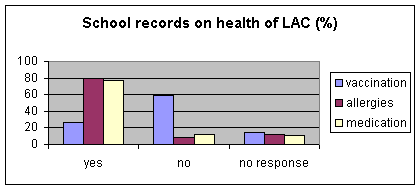
Responses to these questions suggest that schools will often know which GP a looked-after child is registered with, and may have limited medical information (about allergies and current medication). |
Question 6 |
An encouragingly high proportion of the schools responding routinely share information about looked-after children with other agencies. It is apparent that they see Social Services as the focal point and facilitator for such exchange of information. |
Question 7 |
A high response rate to this question shows schools are alert to the health issues of looked-after children and know how to progress issues related to individual children. |
Question 8 |
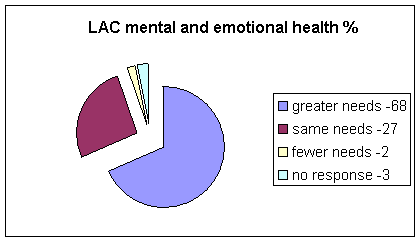
A pattern emerges from these responses - that designated teachers perceived the general physical health of looked-after children to be much the same as children in general but a significant majority think they have greater mental and emotional health needs than children in general. |
1 Name, post and address 2 When a child is admitted on roll, is it recorded if the pupil is a looked-after child? |
(62)YES / (3)NO /(3)N/A |
3 Is the designated teacher automatically informed when a new starter is a looked-after child? |
(58)YES / (8)NO / (2)N/A |
4 Normally, pupil records show who is the child's G.P.: with looked-after children that information may not be provided at registration. If not provided, does the school follow this up to obtain that information? |
(51)YES / (13)NO / (4)N/A |
5 Does the school keep a record of other health information about looked-after children? | |
· vaccination/immunisation · allergies · medication · other (please specify) |
(19)YES / (40)NO / (9)N/A (55)YES / (5)NO / (8)N/A (53)YES / (8)NO / (7)N/A various medical conditions |
6 We know there are problems in the sharing of information about looked-after children, do you routinely share information with: |
· social services? · educational psychology service? · education welfare service? · school nurse? |
(62)YES / (1)NO / (5)N/A (53)YES / (10)NO / (5)N/A (55)YES / (9)NO / (4)N/A (54)YES / (8)NO / (6)N/A |
· do you need information/more information from other agencies?
Agency |
Information |
(11)Social Services (1)Health Service (2)Foster Parents (1)Councils (1)Court Welfare (52)N/A |
More background information, more up to date, more timely (e.g. in advance of placements), who the children are, shared procedures Correspondence and reports from health professionals. General updates. Who is on the register? Circumstances of coming into care. |
continued
7 If you consider a looked-after child has unrecognised/unaddressed medical or social health needs |
|||||||||
- from whom would you seek advice? - to whom would you refer the child? - how would you make that referral? |
school nurse/carer/social services as above/relevant professional e.g. EP or EWO telephone/letter/referral form | ||||||||
8 In your experience, do looked-after children have more health problems than children in general? |
greater needs |
same needs |
fewer needs | ||||||
general physical health (2)N/A |
6 |
58 |
2 |
||||||
mental and emotional health (2)N/A |
47 |
18 |
1 |
||||||
6c - Comments from designated teachers
We are not always informed when children no longer `looked after'.
Emotional and mental health issues often the last to be addressed and need higher priority.
Although we share information with Social Services, it tends to be when there are concerns rather than as a matter of course.
Most of our looked-after children require a `positive thinking' programme to help them build self esteem.
Information not always provided by Social Services: not informed a child was on child protection register until invited to a review meeting.
Need more background information to know what experiences the child has had leading to them being a looked-after child so we can be more sensitive to their needs and fears.
We understand the need for confidentially but at times information we are given is vague.
Pupils with foster parents are usually well cared for and health-related issues dealt with by them. In our experience, looked-after children do not experience significant health problems.
Staff try to treat all students the same.
Who should tell the school that a new admission is a looked-after child?
Social Services should tell us when a child is a looked-after child.
Social Services should pass on information and not expect schools to find out information about the child.
Brief school on a looked-after child's background.
Social Services should forewarn and give notice of meetings requiring school's representation.
Want quicker feedback when have raised concerns: we are often left not knowing what has happened and how to proceed.
Often Social Services cancel meetings.
Designated teachers have suggested the following as issues which should be considered
o Eating disorders
o Self harming
o Sex and drugs education
7 Response sheet
7a Please add any further comments you would like to make on any aspect of the questionnaire
7b How can we use this information to bring about positive change?
We would like your further thoughts on how we can use the information in the questionnaires to influence future changes. There are three questions below which can be used as prompts.
Question 1.
How can we engage with children and young people to help them have a better understanding about health promotion?
Question 2.
What are the obstacles that would stop 1 happening and how could these be overcome?
Question 3.
What are the three key issues that we need to tackle?
Please return this section by Friday 5 December to:
Lucy Marr, Policy Unit, Hampshire County Council, The Castle, Winchester SO23 8UG. [email protected]