Archived decisions
Hampshire County Council Education Policy Review Committee 2 March 2004 Review of primary and special school provision in the east New Forest area - overview Report of the County Education Officer |
Item 5 |
Contact:
Ann Begley, Assistant County Education Officer, 01962 846518; [email protected]
Chris Holt; Education Officer (Primary); 01962 845673; [email protected]
Bob Eardley; Strategic Planning Manager; 01962 846275; [email protected]
1 Summary
1.1. This is the second part of a report on the outcome of consultations following the review of primary and special school provision in the east New Forest area. It was originally intended that the whole review would be the subject of a report to the 2 March 2004 meeting of this committee. However, in an attempt to lessen the period of uncertainty for schools, and in recognition of the complexity of the review, it was decided that the outcome of the consultations would be reported in three stages. The first stage of the review, on the Calmore schools, was the subject of a report to this committee on 20 January 2004.
1.2. This report sets out the background and common issues affecting three of the areas engaged in the review, which comprise the following schools:
· Area 1 - Dibden: Langdown Infant, Langdown Junior, Wildground Infant and Wildground Junior schools
· Area 2 - South Waterside A: Blackfield Infant, Blackfield Junior and Fawley Infant schools
· Area 3 - South Waterside B: Holbury Infant, Holbury Junior and Manor Infant schools
1.3. It has been decided to undertake a separate review of the Special Schools during the summer term. It was considered that the inclusion of the Special Schools at this stage would make the review overly complicated. A report on these schools will be made to the Education Policy Review Committee at its meeting on 12 October 2004.
1.4. The three reports which follow this item consider options for future primary school provision for each of the areas set out in paragraph 1.2. Each report suggests a way forward (as did the first stage report on the Calmore schools), the combination of which represents an overall strategy designed to achieve high quality, cost effective educational provision within local communities (see Appendix A of this report). The following appendices are included in each report:
· Appendix 1: notes of meetings held with parents, staff and governors of the schools;
· Appendix 2: the LEA commentary on school performance for each of the schools;
· Appendix 3: a list of all correspondence and documentation received;
· Appendix 4: a map of the area under consideration.
1.5. Members have visited all of the schools, as detailed in section 7.
1.6. In addition to the consultation with governors, staff and parents, the views of parish councils have been sought and discussions have taken place with the New Forest Local Strategic Partnership (sections 5 and 6 refer).
1.7. Members are asked to advise the Executive Member for Education of their conclusions on the options set out in the reports in order that decisions may be made about the future organisation of primary education in these areas of the east New Forest.
1.8. The proposals support the County Council's corporate aims of maximising life opportunities, building strong and safe communities, and improving services.
2 Strategic implications
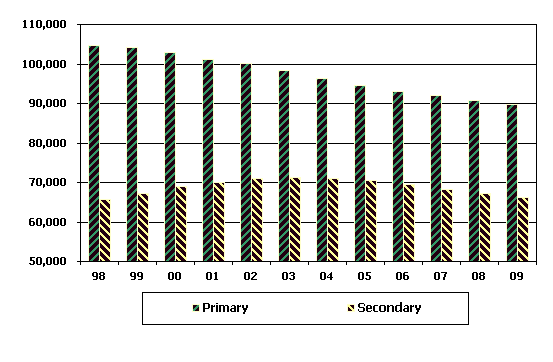
2.1 The County Council has a statutory duty to plan the provision of school places and to secure an appropriate balance locally between supply and demand. Needs change in response to population movements and fertility trends. In many areas of the county, child populations are falling as populations stabilise. Although additional dwellings are being built, many of these are to house an increased number of households, many of which do not include children. Where child populations do rise additional accommodation may be needed, but this becomes difficult if resources are locked up in areas of declining population. The graph at Appendix B shows the changes in the primary school population in Hampshire.
2.2 The population changes mean that schools may go through periods when there is pressure on places and others where there is a surplus. Where numbers are falling sharply, and the trend is more than short-term, the extent of surplus raises questions of the use of resources. Premises have to be maintained whether they are full or not. Where schools become small, they have to be subsidised at the expense of the rest of the service in order to sustain the curriculum. In isolated communities, this may be unavoidable. Large numbers of small schools would, however, reduce significantly the resources available to other schools. Examples of the costs of educating pupils in schools of different sizes, based on the agreed funding formula for schools in Hampshire are given in Table 1. As a school's budget depends on the number of pupils, significant drops in pupil numbers affect staff numbers and stability and can only be "cushioned" to a limited extent. It is important to plan for the future. A school which is functioning well with current numbers of pupils and staff may find it difficult to sustain the quality and range of provision as numbers and resources fall. Numbers on roll may also be indicators of parental confidence in a school.
Table 1 Per pupil costs in Hampshire primary schools
No. of pupils on roll |
Cost per pupil £ p.a. 2003/04 |
50 |
3,710 |
100 |
2,769 |
150 |
2,441 |
200 |
2,286 |
250 |
2,210 |
300 |
2,162 |
350 |
2,129 |
400 |
2,105 |
450 |
2,084 |
500 |
2,070 |
2.3 The 2003/04 - 2007/08 School Organisation Plan, approved by the School Organisation Committee on 16 December 2003 draws attention to the rising number of primary surplus places in Hampshire and the need to ensure that the increase is effectively managed. The overall level of surplus, which was 8% in January 2003, is forecast to rise to 13% by 2008, significantly above the 10% level considered a reasonable upper level by the Audit Commission. The forecast surplus is equivalent to 69 one form entry primary schools.
2.4 The effective management of surplus places creates valuable opportunities to improve the learning environment through the provision of specialist teaching spaces and also to enhance community provision, particularly through the development of early years facilities. It is important to maximise the opportunities by releasing the resources which would otherwise be locked up in surplus places.
3 Background and consultation options
3.1. On 27 March 2003 the Executive Member for Education authorised local consultations with the Dibden and South Waterside schools' communities following an analysis of primary school provision in the respective areas. The analysis showed that in the Dibden area, the low number of pupils at Langdown Junior School was a cause for concern. In the South Waterside area there was significant surplus provision (Table 2 refers).
3.2. The analysis also showed that none of the mainstream primary schools in the east New Forest area have resourced provision for pupils with special educational needs, resulting in primary age children having to be transported long distances to access specialist provision for language impairment and emotional and behavioural difficulties. The position will, however, be improved as a result of the decision of the Executive Member for Education on 22 January 2004 to publish statutory notices establishing resourced provision for language impairment at Calmore Infant and Calmore Junior schools. This decision is subject the outcome of responses to the notices and consideration by the School Organisation Committee.
3.3. Based on the January 2003 pupil census, Table 2, which follows, formed part of the consultation document.
Table 2
School |
Net capacity |
Partici-pation rate (%) Jan 2003 |
No. on roll Jan 2003 |
Fore-cast no. on roll Jan 2008 |
Surplus Jan 2003 |
Surplus 07/08 | |||
Places |
% |
Places |
% | ||||||
Area 1 Dibden |
Langdown Infant |
120 |
63 |
112 |
103 |
8 |
6.7 |
17 |
14.2 |
Langdown Junior |
150 |
82 |
121 |
113 |
29 |
19.3 |
37 |
24.7 | |
Area 2 South Waterside A |
Blackfield Infant |
270 (60) |
88 |
196 |
159 |
74 |
27.4 |
111 |
41.1 |
Blackfield Junior * |
480 |
107 |
420 |
331 |
60 |
12.5 |
149 |
31.0 | |
Fawley Infant |
90 |
104 |
68 |
51 |
22 |
24.4 |
39 |
43.3 | |
Area 3 South Waterside B |
Holbury Infant |
180 |
87 |
144 |
138 |
36 |
20.0 |
42 |
23.3 |
Holbury Junior |
360 |
86 |
339 |
244 |
21 |
5.8 |
116 |
32.2 | |
Manor Infant |
90 |
104 |
90 |
93 |
0 |
0.0 |
(3) |
(3.3) | |
* Foundation School
( ) Capacity in brackets indicates temporary classrooms included in the overall total
3.4. Following the September 2003 pupil count Table 2 has been amended. Table 3 now shows the updated figures, which also make it possible to project to 2008/09. In response to questions, figures to show the total capacity have been added. (See note (d)).
Table 3
* Foundation school
( ) Capacity in brackets indicates temporary classrooms included in the overall total
Notes:
a) Infant school participation rates reflect the number of children attending the school compared with the number of children living within the school's catchment area.
b) Junior school participation rates reflect the percentage of children transferring from the linked infant schools.
c) Wildground Junior School has been added to the table in response to questions which led to further consultation.
d) MOE (More Open Enrolment Capacity) figures for September 2000 have been added to Table 3. These show the capacities of the schools before the initial phase of the review of primary provision in this area. As part of the LEA's continuing dialogue with schools in managing the provision of places, this phase focused on identifying surplus places in schools which could be redesignated to specialist teaching facilities. These redesignations have provided accommodation which is needed to support the current curriculum and sought to match available space more closely to the number of pupils. As a result of this work, up to September 2003, surplus places in the schools listed in Table 3 have been reduced and the totals are shown in Table 4 as follows:
Table 4
Reduction in surplus places Sep 00 - Sep 03 |
Surplus places Sep 08 if no further action taken | |
Langdown Infant |
30 |
35 |
Langdown Junior |
90 |
80 |
Wildground Junior |
120 |
15 |
Blackfield Infant |
49 |
112 |
Blackfield Junior |
0 |
159 |
Fawley Infant |
30 |
22 |
Holbury Infant |
90 |
52 |
Holbury Junior |
176 |
119 |
Manor Infant |
30 |
4 |
Total |
615 |
598 |
3.5 The extent of the surplus places still remaining at schools in the east New Forest area led to consultation taking place on specific options in each of the three areas:
Dibden
The possible amalgamation of Langdown Infant School and Langdown Junior School to form a one or one and a half form entry primary school on the junior school site, incorporating early education and childcare facilities, with the infant school site being used for other purposes, or sold for residential development.
South Waterside A
The following possible amalgamations of Blackfield Infant School, Blackfield Junior School and Fawley Infant School:
(i) Blackfield Infant, Blackfield Junior and Fawley Infant schools to be amalgamated on the Blackfield Junior School site to form a three form entry primary school, with the Blackfield Infant School and Fawley Infant School sites being used for other purposes, or sold for residential development;
(ii) Blackfield Infant School and Blackfield Junior School to be amalgamated on the Blackfield Junior School site to form a two and a half form entry primary school, with the Blackfield Infant School site being used for other purposes, or sold for residential development, and no action being taken at Fawley Infant School;
(iii) Blackfield Infant School and Fawley Infant School to be amalgamated on the Blackfield Infant School site to form a three form entry infant school, with Fawley Infant School being used for other purposes, or sold for residential development, and no action being taken at Blackfield Junior School.
South Waterside B
The following possible amalgamations of Holbury Infant School, Holbury Junior School and Manor Infant School:
(i) Holbury Infant, Holbury Junior and Manor Infant Schools to be amalgamated on the Holbury Junior School site to form a two and a half form entry primary school with the Holbury Infant School and Manor Infant School sites being used for other purposes, or sold for residential development;
(ii) Holbury Infant School and Holbury Junior School to be amalgamated on the Holbury Junior School site to form a two form entry primary school, with the Holbury Infant School site being used for other purposes, or sold for residential development, and no action being taken at Manor Infant School;
(iii) Holbury Infant School and Manor Infant School to be amalgamated on the Holbury Infant School site to form a two and a half form entry infant school, with the Manor Infant School site being used for other purposes, or sold for residential development, and no action being taken at Holbury Junior School;
4 Early Years Provision
4.1. In agreeing that consultation should take place on the various options for each area, the Executive Member for Education was keen to explore opportunities which may arise as a result of potential changes to the current pattern of primary school provision, to consolidate and enhance early years provision as appropriate.
4.2. Table 5 sets out the number of pre-school age children and the provision known to be available to them in the Furzedown and Hardley ward, the Fawley, Blackfield and Langley ward and the Holbury and North Blackfield ward.
Table 5
Ward (Schools) |
No. of early years places |
No. of 3 and 4 year olds | ||
2003 |
2004 |
2005 | ||
Furzedown and Hardley (Langdown schools) |
85 |
101 |
107 |
101 |
Fawley, Blackfield and Langley (Blackfield and Fawley schools) |
140 |
106 |
117 |
102 |
Holbury and North Blackfield (Holbury and Manor schools) |
90 |
171 |
155 |
171 |
4.3. An analysis of the data available from the County Council's Early Education and Childcare Unit has shown that there is a shortfall of early years provision in Furzedown and Hardley ward and a significant shortfall in Holbury and North Blackfield ward. Fawley, Blackfield and Langley ward has a surplus of early education places, but not enough to compensate for the shortfall in Holbury and North Blackfield and not easily or readily accessible by residents in other wards. Bearing in mind that the County Council has a duty to secure good quality early education places from the age of three years for those parents who request them, there is a strong case to strengthen and extend this provision on either or both the Holbury and Manor school sites, depending on the outcome of the review.
5 Parish Councils
5.1. Parish councils in each of the three review areas were consulted. Their responses are set out in the separate reports.
6 New Forest Local Strategic Partnership: response to consultation
6.1. The New Forest Local Strategic Partnership discussed the issues at a meeting on 18 December 2003 and the outcomes are summarised as follows:
a) The Partnership recognises the difficult task the County Council has in attempting to balance cost effectiveness of service provision and best use of assets with the needs of the community;
b) The Partnership is concerned at the potential impact school closures and mergers may have on local communities and that an assessment of this should be part of the review process;
c) The future use of any surplus school buildings should be considered as part of the review process;
d) The review process should include early involvement of Local Strategic Partnerships and the use of the Community Strategies for the District and the County;
e) In undertaking reviews of this nature the County Council should place significant weight on the longer term effects of school closure on the well being of children in the area.
7 Members' visits
7.1. Members visited the schools on the following dates:
· Langdown schools on 11 December 2003
· Wildground schools on 10 February 2004
· Blackfield schools and Fawley Infant on 12 February 2004
· Holbury schools and Manor Infant on 28 January 2004
Issues raised are addressed in the separate reports.
8 Views of the local County Councillors
8.1. Local County Councillors will be expressing their views at the Education Policy Review Committee meeting on 2 March 2004.
9 General Issues raised during consultation
9.1. The following general comments are given on the main issues arising from the consultations:
Forecast pupil numbers
9.2. Much discussion and correspondence centred upon future numbers of children in the area and schools they might attend. Forecast pupil numbers take into account all planned new housing, including type and tenure, and are based upon small area population forecasts which detail the number of 0 - 4 year-olds in an area. There is no significant new housing proposed in the New Forest District Council's local plan in the three areas covered by this report, which covers the period up to 2011.
Mixed age classes/ size of classes
9.3. Mixed age classes and their perceived impact on standards was the subject of discussion with parents at schools in all three areas. Mixed age classes would be the normal model of organisation in a primary school taking entry numbers differing from whole numbers of forms of entry or where age groups varied in size; such schools operate successfully in Hampshire.
9.4. On 5 December 2002 the Secretary State for Education and Skills was asked by a Member of Parliament what research the Department for Education and Skills had done on the effects of mixed age teaching in primary schools. Mr Miliband - Minister for Standards in Schools, responded on behalf of the Secretary of State as follows:
`The department is not currently undertaking research on this subject. Previous research has shown that there are a number of positive benefits for primary school pupils in mixed age classes. These include the opportunity to form wider friendships and for younger pupils to learn from their contemporaries, more individualised teaching, and the opportunity for pupils with differing abilities to provide intellectual stimulation for each other. The research does not find positive effect for attainment. However, there appears to be no negative impact for pupil attainment of what is known as "vertical grouping". Teachers tend to be more negative about mixed age classes, believing them to create more work and complicate class management'.
9.5. There is no evidence to support the premise of some parents that a primary school will result in larger classes. Class sizes in infant, junior and primary schools throughout Hampshire are broadly similar. In the context of legislation governing infant class size, a maximum of 30 (other than in temporary, exceptional circumstances) class size will be determined through the internal organisation and management of the school. Crucial to the success of an amalgamated primary school would be the appointment of a headteacher who would lead the school through organisational change whilst continuing to focus on the main standards agenda.
Primary brief / buildings
9.6. The concern of parents, staff and governors regarding what would be provided in an amalgamated primary or enlarged school is acknowledged. Any building work would reflect the County Council's model brief for primary schools. The County Council is committed to consultation with school governors on all details to do with the development of their buildings.
9.7. The County Council has an excellent track record in managing significant building works on a range of education sites throughout the county. The same high standards, in particular to do with health and safety, would be adhered to if works were undertaken.
Size of schools
9.8. The issue of small schools was raised in all three areas. Officers' attention was drawn to the point that in Hampshire there are other, smaller schools than these infant and junior schools which manage to operate effectively.
9.9. Hampshire County Council's School Organisation Plan, sets out the county's policy with regard to optimum school size as follows:
· Infant schools should, wherever possible, fall within the range two forms of entry (180 children) to five forms of entry (450).
· Junior schools should, wherever possible, fall within the range two forms of entry (240) to five forms of entry (600).
· Primary schools should, wherever possible, fall within the range one form of entry (210) to three forms of entry (630).
9.10. Whilst recognising that there will inevitably be schools outside the optimum ranges quoted in the School Organisation Plan for a variety of reasons, for example geography and fluctuating rolls, the factors generating the County's policy of optimum school size, such as achieving a pupil population of a size which facilitates cost effective education, remain. It is acknowledged that schools outside these ranges can achieve excellent results. It is also recognised that schools which fall below the minimum optimum size are more vulnerable in their ability to sustain high quality education.
9.11. Whilst parents' anxieties about school size and the perception of the individual child within it are understood, experience in Hampshire shows that children do well in the size of schools which would result through amalgamation. There would be benefits from the economies of scale arising from larger budgets and from the career opportunities which these larger schools could offer to teaching staff in an era of difficult staff recruitment. Schools of these sizes would be successful provided that there is effective senior and middle management allied with appropriate pastoral care procedures for the pupil community.
SEN resourced provision
9.12. As stated in paragraph 3.2 there is an identified need in the New Forest area for mainstream, school-based SEN resourced provision for primary age children with language impairment and for children with emotional and behavioural difficulties. During the consultations it was queried whether such provision might be imposed on a school as a result of surplus places which might exist there. The County Council does not have the power to impose such provision. The establishment of SEN resourced provision requires the publication of statutory notices setting out the County Council's proposals. Subject to any objections to the proposal, the School Organisation Committee would be the determining body. Quite apart from the legal process to be followed, the single most important factor in the success of any mainstream based SEN resourced provision is the willingness of the host school to include and embrace such provision.
Infant and Junior to Primary
9.13. The County Council supports infant and junior as well as primary schools. Providing for the age groups in a single school or in separate infant and junior schools works, and there are many examples of successful schools of all types. Infants can flourish in infant and primary schools. That includes large primary schools where size is addressed by good leadership and organisation, and the evidence is that the older children take a particularly responsible attitude towards the youngest. Class sizes are not determined by the age range and funding per pupil is based on the same formula, whatever the type of school
9.14. If a primary school is formed from existing infant and junior schools, the process is managed carefully, in the light of the particular circumstances. It could entail the closure of both the existing infant and junior schools and the opening of a new primary school. A governing body for the new primary school would be constituted on a temporary basis prior to its opening and would appoint the headteacher who would then work with the governing body to appoint staff. Potentially displaced staff from the closing infant and junior schools would, with the agreement of the temporary governing body, be given first opportunity to apply for positions in the new primary school. Another way would entail the closure of one school and the change of character and enlargement of either the junior or the infant to a primary school. The governing body and staff of the non-closing school would become the governing body and staff of the primary school. Again, potentially displaced staff from the closing school would, with the agreement of the governing body, be given first opportunity to apply for vacant posts in the new primary school.
9.15. If building works are required to support reorganisation (or any other reason), the County Council uses its expertise and experience to ensure high standards of product and process. Disruption is kept to a minimum and the schools are fully involved in the development of the improvements.
10 The way forward
10.1 The County Council needs to take strategic decisions which are in the best long term interests of children, including those aged 3 - 11 in the communities subject to this review. Proposals for each area are set out in the three separate reports.
10 Capital strategy and revenue implications
11.1 Capital works arising from school amalgamations are primarily funded from the sale of land, with additional funding when required provided from resources in the Education capital programme and from schools' devolved capital. The scope and cost of proposed works take account of the redesignation of surplus general teaching accommodation to provide specialist facilities which has already taken place, referred to in Table 4 of this report.
11.2 When school reorganisations are carried out, the opportunity is taken to add accommodation and carry out alterations to bring buildings up to the standard of the current primary school building brief, through the addition of specialist teaching accommodation, as well as providing any further general teaching spaces required. Where facilities for early years or the community are required, these are provided, where possible within the overall funding available and making use of suitable existing accommodation.
11.3 In many cases refurbishment work is required in a school being extended and/or adapted as a result of reorganisation. This ensures that the whole building is developed to a good standard. The extent of refurbishment needed will vary from building to building; this work could be phased over a period of time. During the feasibility study exercise, the Director of Property, Business and Regulatory Services has investigated the scope and cost of internal refurbishment to the existing buildings based upon:
· desktop study of the existing buildings, including available Asset Management Plan data;
· previous experience of similar building types;
· a tour of the buildings alongside Members' visits.
The likely scope of works would include new decorations, finishes, fixtures and fittings which are in poor condition. During future design development, further work would be done to ascertain the detailed scope of works and costs, together with the potential opportunity to bring forward other expenditure from the capital programme and landlord resources.
11 Process and timescales
11.1 The details are provided for each area in the three separate supporting papers.
12 Recommendations
12.1 That the report be noted.
Section D - Local Government Act 1972 - Background Documents
The following documents disclose facts or matters on which this report, or an important part of it, is based and has been relied upon to a material extend in the preparation of this report.
None.
NB The list excludes:
1 Published works
2 Documents which disclose exempt or confidential information as defined the Act.
Appendix A
Summary of outcomes of the recommended ways forward
1 Surplus place removal
1.1. Table 1 below sets out the reduction in surplus places at the schools engaged in the review of primary school provision in the east New Forest area:
School |
Reduction in surplus places: Sep 2000 - Sep 2003 |
Reduction in surplus places: proposed |
Total |
Calmore Infant |
150 |
90 |
240 |
Calmore Junior |
30 |
120 |
150 |
|
30 |
60 |
180 |
Langdown Junior |
90 | ||
Wildground Infant |
60 |
- |
60 |
Wildground Junior |
120 |
- |
120 |
|
90 |
120 |
270 |
Holbury Junior |
60 | ||
Manor Infant |
30 |
- |
30 |
|
49 |
210 |
259 |
Blackfield Junior |
- | ||
Fawley Infant |
30 |
- |
30 |
Total |
739 |
600 |
1339 |
2 Early Years
2.1. Expansion of early years provision at Calmore Infant School for up to 68 children to meet the identified shortfall in the area.
2.2. Purpose-built early years provision at Holbury for up to 80 children to meet the identified shortfall in the area.
2.3. Opportunity to house a local pre-school at Manor Infant School to meet local request.
3 Special Educational Needs
3.1. Resourced provision for primary age children with language impairment in a more local setting at Calmore Infant and Calmore Junior schools.
Appendix A
4 School Library Service
4.1. Re-location of the School Library Service, (which is required to vacate its present base in Lymington) to a more convenient location at Calmore Junior School, Totton.
5 Local schools for local communities
5.1. The retention of educational provision for primary age children within their present local communities.
6 Capital investment
6.1. The recommended ways forward represent a County Council capital investment of some £4.425 million. This will be met through anticipated land receipts in the region of £3 million, together with capital funding to support surplus place removal and early years provision within the education capital programme.
Appendix B
Hampshire pupil numbers 1998 - 2009