Archived decisions
|
|
|
STRATEGIC PLANNING JOINT ADVISORY PANEL | ||
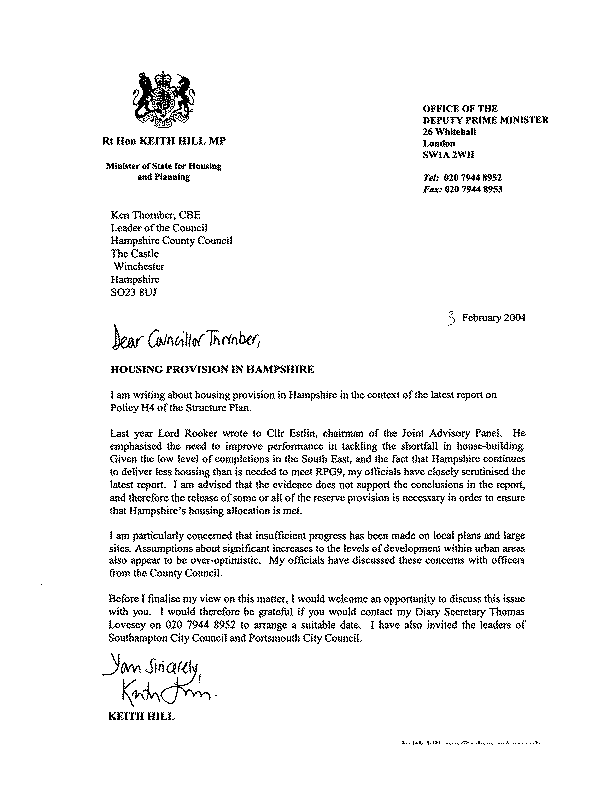
Date: 10 March 2004 Item 6 Report by: The Hampshire Director of Environment, Portsmouth City Planning Policy H4 Monitoring Paper 2004 Consultation response from Government Office for the South East Written by: Antony Payne, tel 01962 846766 email: [email protected] Purpose and Summary: To consider the views of the Government Office for the South East on the Policy H4 Monitoring Paper 2004 and whether, in the light of all the responses received, the reserve housing supply should be released. RECOMMENDATION: That the Strategic Planning Authorities be recommended to: (i) welcome the comments by the Government Office which have helped test and refine the assumptions that underpin the monitoring process; (ii) note the call to release the reserve, but consider that, on balance, the `compelling justification' to release it, as required by the Structure Plan, has yet to be satisfied; (iii) conclude that there is no need to act in haste. The reserve could be released in 2005 or 2006 to address a future shortfall, in the event of the Monitoring Paper 2004 proving to be too optimistic; (iv) urge local planning authorities to maintain progress towards the adoption of local plans without further delay; (v) urge local planning authorities to raise and maintain the level of full and outline planning permissions from a three year to a five year supply; (vi) urge local planning authorities to give consideration to expediting the local plan to deliver the baseline housing supply without significantly prejudicing local plan processes; (vii) urge local planning authorities to implement any action plans that have been agreed with the Government Office; (viii) request that local planning authorities report back to the next Panel meeting on (iv) (v), (vi) and (vii); (ix) urge the Government Office to support (iv), (v) and (vi) through representations to the Planning Inspectorate (to conduct Inquiries expeditiously and issue reports promptly), by sympathetic application of the Greenfield Directive and through representations to the Highways Agency, Environment Agency and English Nature regarding their approach and attitude towards development proposals; (x) agree to assess urban capacity studies for consistency with the Good Practice Guide published by the Regional Assembly; (xi) agree to undertake critical path analysis on large housing sites to create greater certainty as to when such sites can be expected to deliver house completions; and (xii) recognise that, if enhanced certainty on housing delivery cannot be demonstrated next year, there may be no alternative but to release some of the reserve housing provision. 1. Introduction 1.1 The Policy H4 Monitoring Paper was published for consultation in December 2003. A summary of the comments received is set out in a separate agenda item. One of the respondents was the Government Office for the South East (GOSE) and in its response a call is made for JAP to consider releasing some, if not all of the reserve housing (see Appendix 1). Keith Hill MP, the Minister for Housing and Planning, has also recently written to the Leaders of the three Strategic Planning Authorities to express his concern about future housing provision in Hampshire and has requested a meeting with them to discuss this issue (see Appendix 2). At the time of writing a date for this meeting had not been set. A verbal update on the outcome of the meeting (if it has been held) will be reported to the Panel. 1.2 This report considers and responds to the issues raised by GOSE. 2. Aims and Visions of Corporate and Community Strategies 2.1 This report supports the aims and visions of the three strategic planning authorities' corporate and community strategies by helping ensure that sufficient new homes are made available whilst securing the regeneration of existing urban areas and avoiding the unnecessary development of greenfield land. 3. Response by GOSE 3.1 The Policy H4 Monitoring Paper 2004 forecasts that Hampshire will meet its RPG dwellings requirement to deliver 30,150 dwellings between 2001 and 2006. GOSE accept that the short term housing supply `appears sound'. 3.2 However, GOSE believes that weaknesses in the evidence base has led it to conclude that there is a high risk that Hampshire will not deliver the RPG target between 2006 and 2011. GOSE argue that the county as a whole has failed to deliver sufficient houses for a number of years, despite previous monitoring reports indicating that conditions are about to improve. 4. Strategic Planning Authorities' Officers' Comments 4.1 The actual performance of Hampshire in recent years has been close to the average for the South East as a whole, which itself has generally underperformed against the RPG requirement (Graph 1) (see end of this report). One reason for Hampshire's poor performance is due to delays in approving the Structure Plan and the resulting `knock-on' effect for local plan preparation. However, since the turn of the century the county has seen a greater improvement in its performance than the rest of the South East. The improvement across Hampshire is expected to continue over the next few years. The quality of monitoring in Hampshire has also been raised in recent years, not least because this is a prerequisite necessary to inform Policy H4 of the Structure Plan. 4.2 GOSE's main concerns with the supply forecasts 2006 - 2011 are: (i) `The assumed rates of completions appear to be extremely optimistic' Comment: The Policy H4 Monitoring Paper 2004 contains two estimates of supply - one is a `best case' scenario which indicates that the RPG requirement would be comfortably exceeded. This estimate is based on a survey carried out by County and District Council officers on the progress of development on large housing sites and represents the optimum that could be achieved. The Paper also includes an `adjusted' scenario which takes into account the uncertainties surrounding different types of supply (see Appendix 6 of the Monitoring Paper). After applying the adjustments the RPG requirement is still met. The difference between the two scenarios amounts to some 6,800 dwellings - more than the RPG requirement for a year. This provides a reasonable cushion should the optimum rate of delivery not be achieved. (ii) `Allocated sites in local plans may not deliver the required number of dwellings by 2011' Comment: This is already acknowledged within the Strategic Planning Authorities methodology for forecasting future house building. The County Council Housing Land Supply Monitoring document 2004 identifies over 2,600 dwellings, predominately on sites allocated in local plans, that may not be developed before 2011. The Policy H4 2004 Monitoring Paper has excluded these from its calculations. In addition, the adjusted supply scenario of the Monitoring Paper (Appendix 6) further reduced the number of dwellings that might be built by 2011 by over 4,000 in recognition that some sites that are currently expected to be developed by 2011 may not be built. One of the main risks associated with supply from allocated sites is uncertainty concerning the adoption dates of local plans. This is considered further in 5.1 (i) below. (iii) `Supply from urban capacity sites and windfalls can have little weight until studies and assumptions have been tested through the local plan process' Comment: The urban capacity figures used in the Monitoring Paper are based on studies undertaken by planning authorities and have already been `discounted' for non-completion in accordance with guidance set out in Government advice "Tapping the Potential". The Monitoring Paper recognises that local plan inquires will test the assumptions concerning contributions from urban capacity sources. If they are found wanting, the Inquiry Inspector will almost certainly recommend that substitute sites are allocated to make up any deficit in baseline supply. In February 2004 the Regional Assembly published a Good Practice Guide for assessing urban housing potential and as, as stated in the Monitoring Paper (para 6.14) the Strategic Planning Authorities intend to review the current round of studies for consistency with the approach advocated by the Guide. The number of completions from large brownfield windfalls 1996 - 2003 averaged 1,514 dwellings p.a. The equivalent contribution anticipated in the Policy H4 Monitoring Paper for the period 2003 - 2011 is 1,760 p.a. (for the adjusted supply) and just over 2,000 p.a. (for the total supply). Completions 1996 - 2003 largely reflect that which was achieved prior to the introduction of PPG3 and the preparation of urban capacity studies. It seems both reasonable and realistic to expect future completions to be at a higher level. Last year some 3,200 dwellings were added to the identified large site supply from unallocated brownfield sources. This is significantly higher than that required to deliver the Policy H4 build rates. (iv) `The estimated completions for large sites (e.g. major development areas) is considered to be too optimistic' Comment: There is little consensus amongst the respondents to the Monitoring Paper on the anticipated contribution from the major development areas. In contrast to GOSE, the relevant district councils and developers with interests in their development generally hold the view that the rates set out in the Monitoring Paper are, if anything, on the pessimistic side. There are recent examples of large greenfield developments being built in Hampshire within short timescales (eg extension to Chandlers Ford, over 1,300 dwellings built 1996/97 to 2000/01). Planning applications are expected over the next few months for West of Waterlooville MDA, Aldershot Sustainable Urban extension (Project Connaught) and some very large sites in north Basingstoke. In the case of the two sites comprising Andover MDA, applications are expected to be submitted before the outcome of the local plan inquiry, with a view to the granting of approval upon favourable receipt from the Inspector. Progress is being made to secure the development of these large sites and it still seems reasonable and realistic to assume that they will deliver significant numbers of houses by 2011. The risks associated with the development of the Major Development Areas (MDAs) is considered further in 5.1 (ii), (iii) and (iv) below. In recognition of the uncertainty surrounding the MDAs, the Monitoring Paper adjusted supply assumed that only 80% of the likely supply (some 2,800 dwellings) would be built by 2011. This is considered to be a reasonable assumption based on the development of three large sites spread over a four or five year period. As a new action, the Strategic Planning Authorities intend to undertake a critical path analysis for the delivery of very large sites and identify the key stages prior to the commencement of development. The phasing profiles set out in the next Housing Land Supply schedule will reflect the findings. (v) `The wide variation in forecasts of future supply between the three annual monitoring reports is troubling' Comment: The difference in supply between the 2002 and 2003 Monitoring Papers is largely due to changes in the assumptions concerning contributions expected from small sites and MDAs (see paragraph 8.5 of the 2003 Paper for details). The 2003 Paper took a much more conservative and realistic stance on supply from these sources. The increase in supply between the 2003 and 2004 Papers is due to a substantial amount of additional land being identified than was the case 12 months earlier. Table 1 (end of report) shows one aspect of this trend. Although almost 15,000 dwellings were built in the three years to April 2003 the estimates of future supply on identified large sites has actually increased by some 6,700 over the same period. Part of the new supply has come from new greenfield sites identified in local plans and the rest from new urban capacity and windfall sources. Although there is strong evidence to show that urban capacity sites are obtaining planning permission (see, for instance paras 6.3 - 6.4 of the Monitoring Report), the overall anticipated number of dwellings that remain available from this source in the past year has barely diminished - largely as a result of new sites emerging within Southampton and Portsmouth (for example, a scheme of over 500 dwellings was granted approval last month on a site at Gunwharf Quay, Portsmouth that the City Council had not previously thought likely to come forward for residential use). Hampshire authorities have acted to increase the supply of housing sites, and therefore it should not be surprising that the figures have increased. 5. Risk Assessment and Risk Management 5.1 In addition to its formal response to the Policy H4 Monitoring Paper, GOSE has also requested that the main risks associated with the assumptions underpinning the estimated supply 2006 - 2011 be examined and management measures identified that would minimise the risks or mitigate their effects. The Strategic Planning Authorities have undertaken this work in association with the district councils and the conclusions are: (i) Local Plans slippage - if all current local plan timetables were to slip by a year, the effect on the supply would be a loss of between 3,200 and almost 4,000 dwellings in the period up to 2011. There are 10 local plans still to be adopted and the likelihood of all of them slipping by this amount is considered to be low. However, the assessment does demonstrate that local planning authorities need to be vigilant and adhere to current timetables if the available supply prior to 2011 is to be maximised. GOSE itself may also have a role to play here by encouraging the Planning Inspectorate to complete the inquiry stages of Hampshire local plans as quickly as possible. (ii) MDAs not supported by Inquiry Inspectors - if this happened there is the prospect that alternative sites would not come forward fast enough to deliver many dwellings by 2011. The adopted Structure Plan supports the development of MDAs in the locations proposed in local plans and this should carry weight in the deliberations of the Inspector. Indeed, the Inspector for the Havant Local Plan has recently reported on that part of the West of Waterlooville MDA within the Borough and has accepted the principle of the proposal. The likelihood of a current MDA not being supported by the other Inspectors is considered to be low. (iii) Sites suitable for residential development not coming forward - in most cases the management of this risk is beyond the control of the Local Planning Authority (LPA) as it requires landowners and developers taking the initiative and preparing a viable development proposal. Planning authorities are, however, working with GOSE and taking a more robust approach to housing delivery. In many cases a schedule of actions have been agreed between them to help facilitate development. (iv) Sites developed slower than expected - although LPAs have a key role in processing applications as quickly as possible, build rates ultimately rest with developers. There is some evidence to suggest that developers are limiting the pace of development on some large sites to a lower rate than might have been expected in the past. The phasing set out in the Hampshire Housing Land Supply schedules is based on site assessments by officers within the three Strategic Planning Authorities, together with district council colleagues, taking into account the views of developers where known. The Policy H4 Monitoring Paper's adjusted supply reflects concern that some sites may be built at a slower rate than expected by discounting the available supply by between 5 and 20%. (v) Planning obligations - have been widely recognised as introducing delays in the granting of planning consent. LPAs are now addressing this issue and delays should be reduced, providing the development industry also speeds up its handling of such agreements. The Government has also proposed changes to the current system that are intended to speed up the process. Overall there is a good prospect that concluding planning agreements will, in future, not unduly delay the issuing of planning consent. 5.2 The following can also impact on the forecasts set out in the Monitoring Paper but generally lie outside of the responsibility of planning authorities: (i) Grants to registered social landlords (RSLs) - in the past RSLs utilising grant have been very successful in developing brownfield sites within urban areas. Uncertainty over future funding means that this development activity is vulnerable at present. In addition, the Housing Corporation has indicated that it expects future s106 affordable provision will be implemented without grant assistance. This may delay schemes or render marginal schemes not viable. The priorities and funding levels set out in the next Regional Housing Strategy (due Spring 2005) is also likely to impact on the number of schemes that are supported in Hampshire (note, however, that this does not necessarily mean that fewer schemes will be supported, it could be more). (ii) Macro economic factors - a downturn in the economy and/or high interest rates would probably lead to lower demand for new housing and consequently a slower rate of house building than that forecast in the Policy H4 Monitoring Paper. However, the Treasury is currently upbeat about UK economic growth prospects and, despite concerns about recent levels of house price inflation, few economists support the view that a major recession is on the horizon. (iii) Attitude of Government agencies - such as the Highways Agency, English Nature and Environment Agency. These are key consultees for planning applications and the stance they take can create delays in the development process. The current approach taken by the Highways Agency (resisting large housing developments within a few miles of the motorway network) is a case in point which, if taken to its logical conclusion, could significantly undermine the Structure Plan. GOSE could help overcome these problems by making representations to the agencies concerned to promote a greater sense of urgency, coupled with a more positive `can do' attitude. 5.3 The key conclusions arising from the risk assessment are firstly, that further slippage in local plan adoption dates will undermine the supply forecast and secondly, that there is a need to create greater certainty over future supply by taking steps to raise the number of dwellings with planning consent over the next two years from the current county-wide three year supply to five years. A five year supply would significantly enhance the prospect of meeting the RPG requirement by 2011. 6. Timing the Release of the Reserve 6.1 The purpose of the Policy H4 housing reserve is to augment supply from other sources to ensure that the RPG requirement can be met. In order for the reserve to be effective, it must be released in time to deliver sufficient dwellings within the time period required. GOSE has asked the Strategic Planning Authorities to look at the rate at which reserve sites could delivery dwellings in the event that they are released. The Strategic Planning Authorities have undertaken an assessment of the reserve to determine how much could be built by 2011, if it was all released - and their conclusions are set out in Table 2 at the end of the report. 6.2 The figures show that a release made this year could produce over 9,000 dwellings by 2011. There would be a reduction of some 1,200 dwellings if the release was delayed to 2005, whilst a release in July 2006, can still be expected to produce over 6,000 additional dwellings. After 2006 there is a rapid tailing off of supply - such that a release in July 2009 is not expected to produce any dwellings by March 2011. 6.3 The figures given in Table 2 assume that the release mechanisms proceed smoothly. However, a release in 2004 or 2005 will inevitably mean some reserve sites being released in advance of local plan inquiry reports being published and local plans adopted. It could also result in reserve sites coming forward for development ahead of baseline sites that are allocated in local plans. Developers with interests in allocated sites could rightly feel aggrieved if a reserve site was seen to `leapfrog' a baseline site. A more logical progression would be to release the baseline supply (ahead of local plan adoption, if necessary), before the reserve is considered for release. 6.4 For these reasons the release of some reserve sites could be delayed by LPAs refusing applications, or as a result of legal challenges from other parties (environmental groups or developers with interests in baseline sites or alternative sites being promoted through the local plan). A release in July 2006 does not give rise to these concerns as all local plans are scheduled to be in the final stages of adoption, or will already be adopted. 6.5 GOSE has not quantified how much of a shortfall it believes Hampshire is facing in its baseline supply, or the amount of reserve that should be released this year to meet its concerns. A total release in July 2004 could produce the equivalent of almost one-third of the RPG requirement 2006 - 2011. Delaying a release until 2005 could produce the equivalent of 25% of the total RPG requirement. Even a release in July 2006 can be expected to contribute about 20% of the total dwellings needed to be built between 2006 and 2011, or about one years RPG requirement. The Policy H4 Monitoring Paper has concluded that there is more than sufficient land expected to come forward to deliver the RPG requirement. Given the amount of reserve that could come forward in 2005 or 2006 to augment this supply, there seems to be no strong case for releasing any of the reserve this year. 7. Options for the Joint Advisory Panel 7.1 The Monitoring Paper is a forecast of future supply based on a set of assumptions. The aim is to ensure delivery the RPG requirement averaged over the period to 2011 and to only release the reserve housing supply when there is a compelling justification to do so. The main difference between your officers' views and that of GOSE relate to the degree of confidence in the forecasts and the allowance of contingency in the event of build rates falling short of that forecast. Your officers believe that there are good grounds for assuming that the RPG requirement can, on the basis of current monitoring, be met without recourse to the reserve. GOSE believe that the Monitoring Paper figures are overly optimistic and moves should be made now to release some, if not all of the reserve. Your officers believe that, if the Monitoring Paper is over-optimistic and the reserve is required, a decision to release taken in 2005 or 2006 should still enable a significant number of additional dwellings to come forward to ensure delivery of the RPG requirement. A release made now could result in Hampshire exceeding the RPG requirement and lead to the unnecessary development of greenfield sites or, alternatively, to greenfield reserve sites being built at the expense of harder to develop brownfield sites. The net effect could be that there is no significant increase in completions, but a different profile in the type of sites developed. In the process Hampshire may even fail to meet the Government target of building at least 60% of completions on previously developed land (which has been achieved each year since 1999 - 2000). 7.2 The recommendations in this report set out a number of actions for local planning authorities, GOSE and the Strategic Planning Authorities to do to further test the assumptions set out in the Monitoring Paper and increase the degree of confidence that sites will come forward when expected and deliver the number of houses required. 7.3 If this Panel decides not to release the reserve this year, GOSE could advise the Minister that: (i) it is satisfied that additional work has been undertaken and measures put in place such that there is no requirement to pursue a release of the reserve this year, or (ii) a call to release of all or part of the reserve is necessary this year to ensure that future supply achieves the RPG requirement. 7.4 If the Minister agrees with the latter course of action, he is likely to issue a Ministerial Statement to the effect that he believes a release of the reserve is necessary now to deliver the RPG requirement. A partial release of the release could be effected by the Minister making reference to the release being in one or more of the Structure Plan sub-areas. The Statement would give a `green light' to developers to submit applications on reserve sites (or other sites where the reserve has not been identified in full). If local planning authorities refuse these applications it can be expected that Inspectors at any subsequent appeals will give due weight to the Statement. One undesirable side effect of encouraging speculative applications and an `appeals led' approach to housing land releases is that they may result in local planning authorities diverting resources away from pro-active planning, such as plan preparation, thereby increasing the prospect that local plans could be delayed further. There could also be legal challenges if the reserve is not released in accordance with the adopted supplementary planning guidance. 8. Conclusion 8.1 The Policy H4 Monitoring Paper 2004 concludes that there is sufficient land currently available to meet the RPG requirement without recourse to the release of greenfield reserve sites. An adjustment has been applied to the available supply and takes into account many of the issues raised by GOSE. The adjusted supply is still sufficient to meet the RPG requirement. 8.2 An analysis of the risks associated with the future baseline supply has also been undertaken. One of the major risks identified is the impact that further delays in local plan processes will have on completion rates. Delays in plan adoption would also affect the amount of reserve provision that could be built by 2011. Local planning authorities must keep to current local plan adoption dates to ensure that the Policy H4 supply forecast can be delivered. 8.3 A second risk, concerning uncertainties about the rate at which allocated sites will come forward for development, could be significantly reduced if local planning authorities gave urgent consideration to expediting the local plan to deliver the baseline housing supply without significantly prejudicing local plan processes. Steps could include preparatory work on the development of sites, encouragement to developers to work up schemes and granting planning approval for non-contentious allocations in advance of local plan inquiry reports. The aim should be to raise the supply of dwellings with full and outline planning permission from the current level of three years to five years supply. Development could then commence at a quicker rate that would be the case if everything was held back until after the local plan was adopted. GOSE may have an important role to play here as sites released early will inevitably fall within the ambit of the Greenfield Directive. 8.4 An analysis of the housing reserve indicates that a decision to release in 2004, 2005 or 2006 would enable a significant amount of additional housing to come forward by 2011, should it be required. However, a release of the reserve ahead of the adoption of local plans is likely to be problematic and should only be contemplated after steps have been taken to release allocated sites that form part of the baseline requirement. 8.5 Structure Plan policy H4 states that greenfield reserve allocations should be released where monitoring indicates that there is a compelling justification to do so. This year's Monitoring Paper concludes that there is no compelling need to release the reserve at the present time. A risk assessment of the supply has identified a number of measures that planning authorities and others can take in order to create greater certainty in the supply forecast. Analysis has also shown that there is no necessity for an immediate release of reserve sites in order for them to make an effective contribution by 2011. There is therefore no need to act in haste - the reserve could still be released either next year or the year after to address a future shortfall, if further analysis shows that the Monitoring Paper is proving to be too optimistic. | ||



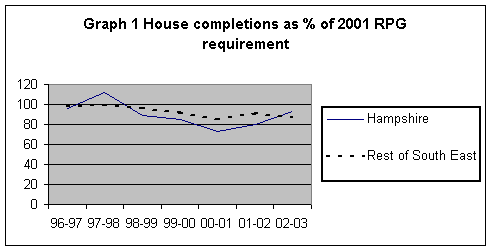
Table 1: Estimates of identified housing supply (dwellings)
April 2000 |
April 2001 |
April 2002 |
April 2003 | |
Identified large sites ..... |
27,146 |
31,367 |
30,925 |
33,156 |
..... built in subsequent 12 months |
3,458 |
3,655 |
4,396 |
5,174 (est) |
Identified small sites ...... |
2,628 |
2,954 |
3,190 |
3,394 |
...... built in subsequent 12 months |
950 |
1,160 |
1,204 |
1,134 (est.) |
Source: County Council Housing Land Supply Monitoring Information
Table 2: Number of dwellings that could be built if the whole greenfield reserve was released
Release date |
Total dwellings built by March 2011 |
July 2004 |
9,417 |
July 2005 |
8,272 |
July 2006 |
6,090 |
July 2007 |
3,296 |
July 2008 |
505 |
July 2009 |
0 |
Section 100 D - Local Government Act 1972 - background papers | |
The following documents disclose facts or matters on which this report, or an important part of it, is based and has been relied upon to a material extent in the preparation of this report. | |
NB the list excludes: | |
1. |
Published works. |
2. |
Documents which disclose exempt or confidential information as defined in the Act. |
TITLE |
LOCATION |
Hampshire County Council Housing Land Supply Monitoring Information 2004 |
Contact: Mick Tanner, Research & Communications Group, Environment Department |
8644/AP
APPENDIX 1
Letter from Government Office for the South East
Hampshire & Isle of Wight Area Team |
|||
Stuart Roberts |
Planning |
||
Head of Spatial Strategy, |
|
Bridge House |
|
Hampshire County Council, Environment Dept, The Castle, WINCHESTER, Hants, SO23 8UE. |
1 Walnut Tree Close Guildford GU1 4GA Switchboard: 01483 882255 Tel: 01483 882 517 |
||
FAX: 01483 882 309 |
|||
GTN: 3011 2517 |
|||
e-mail: drichards[email protected] |
|||
www.go-se.gov.uk |
|||
Our Ref: GOSE/102/001/HAMP/011 |
|||
Dear Stuart,
POLICY H4 MONITORING PAPER 2004
Thank you for consulting the Secretary of State on the 2004 monitoring paper. We have looked closely at the report. Whilst the short term position appears sound, we are concerned over the accuracy of the long term forecasts. Weaknesses in the evidence base lead us to conclude that there is a high risk that Hampshire will not deliver the RPG target by 2011.
The County as a whole has failed to deliver sufficient houses for a number of years, despite previous monitoring reports indicating that conditions are about to improve. There is also nothing in the report to suggest that local authorities are committed to the actions needed to achieve the increase in completions in the long term. In our meetings with districts it is apparent that many are prepared to do no more than meet the baseline. They also fail to provide evidence of housing supply beyond the next three or four years. Finally, delays to the plan preparation process are preventing housing sites come forward.
As a result of this lack of confidence in the forecasting, the JAP is asked to consider the release of at least some of the reserve in order to provide certainty that housing numbers will be met.
Once the Joint Advisory Panel has made a decision on 10th March, the Secretary of State will consider what further action, if any, is necessary.
Detailed comments are set out in the attached schedule
Yours sincerely,
Paragraph no. |
Comment |
4.2 |
The 02/03 figure was actually 9% below the adjusted requirement of 6165 |
4.3 and Table 1 |
The accuracy of short term projections is not important, and is relatively simple when it is based on planning permissions. Release of the `reserve' is intended to replace a shortfall several years into the future, therefore the key test is the credibility of the long term forecasts. There is no further evidence presented by the report to provide confidence in the robustness of the long-term forecasts. |
5.4 and Tables 2 and 3 |
These tables are misleading, as they do not compare performance with the RPG requirement. In fact, the Structure Plan area only delivered 84% of the RPG requirement over the period 1996-2003. |
6.8 and Tables 6 and 7 |
Only those sites with planning permission can realistically be considered as identified supply. They are the only sites that offer sufficient certainty of delivery before 2011. Allocated sites in adopted local plans offer medium certainty, but allocations that have not been through the inquiry process can have much less weight attached to them. It should not be assumed that all the current allocations will deliver completions by 2011. Throughout the South East there are many examples of allocated sites being subject to delay. The Barker review (chapter 9) provides a useful analysis of the timescales for house building. Many local plans are not due to be adopted until 2005 or even 2006; it is not clear how sites allocated in these plans will deliver the planned rates by 2011. There is no evidence that LPAs are prepared to release sites in advance of local plan inquiries. There appears to be an inconsistency concerning the large site figures for Basingstoke and Fareham. Table 7 show figures of 8626 and 1946 respectively. However, the large sites schedule shows estimates of 7322 and 1402 dwellings completed by 2011. The `other supply' column cannot be included as there is no firm commitment to release these sites. This sums to a shortfall of 1,848 dwellings. |
6.10 and Table 8 |
Supply from urban capacity sites and windfalls can have little weight until studies and assumptions have been tested through the local plan process. There is a danger of double-counting supply from UCS and windfalls. If the UCS has identified potential sites they should be identified in the local plan; if they are not identified then they should be considered as windfalls. Windfall rates should be informed by the UCS and not just previous rates of supply. |
6.16 |
Given the long lead-in times required to deliver large sites, and the risk from other factors which can delay delivery, many of the assumptions are considered unrealistic. For example, there is some doubt that West of Waterlooville will deliver 1600 dwellings by 2011, given the lack of planning permission and the very high rate of assumed completions. |
Table 10 |
It is troubling that the forecasts for the period 06-11 differ so widely between each of the three reports: in 2002 an average of 7106 was estimated, in 2003 this was revised downwards to 6148, and this year has been revised upwards again to 7564. The report does not clarify the source of these additional 1400 dwellings per year, or how circumstances have changed over the year so that the estimates have had to be significantly revised. The assumed rates of completions appear to be extremely optimistic, taking account of past rates. Over the last 3 years Southampton averaged 724 per year, yet it is now suggested that they will average 825 per year. This is a phenomenal rate of completions that in recent years has only been bettered by Milton Keynes and Ashford; areas of growth on Greenfield sites. Whilst such a rate would be welcome, it is regarded as extremely unrealistic. Neither the Southampton Local Plan, nor evidence submitted to the local plan inquiry support this high and sustained rate of housing. The position in Portsmouth appears even more optimistic: an average of 856 per year, compared with the average over the last 3 years of 572. It is doubtful whether such rates, even if attained, could be maintained to 2011, some 8 years. Finally, the estimate for Project Connaught in Rushmoor appears optimistic. There is no planning permission and the development is large and complex. |
Para. 7.7 |
Comparisons with the 1980's are not helpful. The planning policy environment is now completely different. Firstly, significantly more dwellings are expected to be built on brownfield sites, which are more complex and can take longer to build out than a Greenfield site. Secondly, the expectations for development are much greater: higher densities, good quality designs and layouts, affordable housing and other public benefits, access to all modes of transport etc. |
Para. 7.10 |
The adjustments are welcome. However, they do not overcome the significant weaknesses in the forecasts, set out above. |
APPENDIX 2