Archived decisions
Hampshire County Council Winchester Highway and Transport Advisory Panel 23 March 2004 Revised Roles of Panels Report of the Chief Executive and Director of Environment |
Item 5 |
Contact: Jonathan Crabb, ext 6047 e-mail: [email protected]
Debbie Vaughan, ext 7330 e-mail: [email protected]
1. Summary
1.1 This report sets out the revised terms of reference and scope for the new Highway and Transport Advisory Panels (HTAPs) and their relationship with the Area Transport Strategy Panels.
1.2 This approach is also complemented by a strengthening of local involvement at district level through the Local Strategic Partnerships (LSPs) and the Highway and Transport Advisory Panels.
2. Greater Local Involvement
2.1 It is important that a rationalisation of area transport strategies should complement the development of Community Strategies and the increasing importance of HTAPs. Community Strategies at district council level will play an increasing part in County Council service delivery planning.
2.2 The rationalisation of the Area Transport Strategy Panels means that they will be able to concentrate more on strategic issues, with implementation and delivery being considered more at the district councils and LSP level. The area transport strategies are complemented by specific action plans covering individual areas, including specific towns.
2.3 The proposals would also allow for a strengthening of the HTAPs. These Panels are based on district council areas and look at the present year's capital programme delivery as well as local maintenance and traffic management matters. They advise the Executive Members for Environment and Spatial Strategy and provide an opportunity for district council Members to have direct contact with County Council staff and Members.
2.4 There have been informal Executive Member to Executive Member in some district to discuss matters in detail. They have expressed an interest in continuing with these meetings to complement the work of these Panels.
3. Terms of Reference of the Highway and Transport Advisory Panels
3.1 In support of the new arrangements detailed above, at its meeting on 27 November 2003 the County Council approved revised Terms of Reference for the new HTAPs, which are set out in Appendix 1.
3.2 The HTAPs have a greater responsibility for advising the Executive Members for Environment and Spatial Strategy on the implementation of all transport schemes, rather than just traffic management schemes as previously within the former Highway Management Advisory Panels.
3.3 The revisions to the terms of reference are as follows:
(i) to consider Local Plan/Local Development document transport issues where this is best dealt with at a district level;
(ii) to advise on the detailed design of town transport action plans within an agreed framework; and
(iii) that there will be the addition of up to three representatives from the District Local Strategic Partnership on the panel for the purposes of integrating issues and priorities of the local community into the work of the Panels and adopting a partnership approach to addressing them.
4. Revised Arrangements for Area Transport Strategy Panels
4.1 The new arrangements will need to recognise the Executive Member arrangements now in place and must be efficient, to make best use of both County and District Council staff resources.
4.2 The role of Area Transport Strategy Panels should be to set medium-term strategies and share views on priorities within such strategies. They would influence the Capital Programme, monitor progress of delivery, and review priorities and achievements against a range of targets such as Local Transport Plan (LTP), Comprehensive Performance Assessment and other performance indicators. The new Panels would also consider integration of transport with other policy areas, especially spatial planning.
4.3 The Panels are a fundamental part in the process of delivering the LTP, which is considered under Agenda item 12. The new Panel arrangements will need to be developed in the context of:
(i) Community Strategies, Local Strategic Partnerships and Local Development Frameworks; and
(ii) Regional Spatial Strategy/and Regional Transport Strategy.
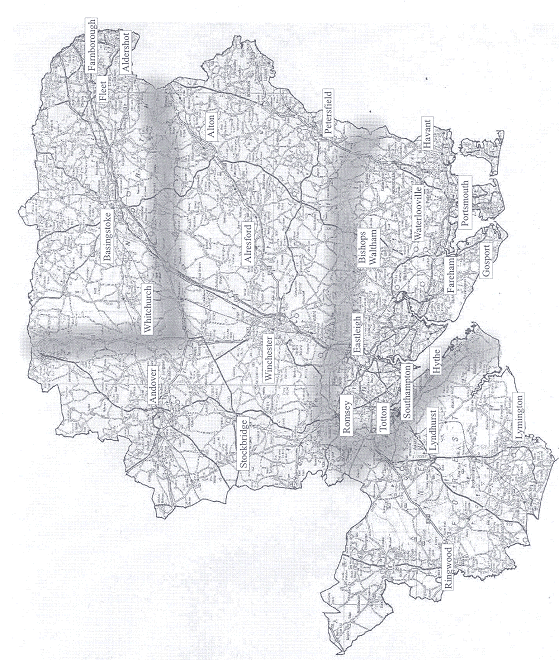
4.4 It is important that the new Area Transport Strategy Panels liaise effectively with other panels which also have a responsibility for developing and implementing policies and schemes within their areas. The boundaries of the area strategies are deliberately denoted by broad lines to encourage joint working by adjoining panels on cross-border issues. Where there are cross-boundary issues, for example a route strategy, then it may be appropriate that both panels consider the issue. A degree of flexibility will be required to deal with issues on an individual basis depending upon their circumstances. A plan of the boundaries is attached as Appendix 2.
Recommendation
That this report be noted.
Section 100 D - Local Government Act 1972 - background papers | |
The following documents disclose facts or matters on which this report, or an important part of it, is based and has been relied upon to a material extent in the preparation of this report. | |
NB the list excludes: | |
1. |
Published works. |
2. |
Documents which disclose exempt or confidential information as defined in the Act. |
TITLE |
LOCATION |
County Council Report - 27 November 2003 |
Environment Department Room 418 |
8547/JC/DV
APPENDIX 1
HIGHWAY AND TRANSPORT ADVISORY PANEL
Terms of Reference
1. To receive reports on highway management topics and programmes, to offer advice and recommendations to the Highway Unit Manager and to monitor and review highway management activities.
2. To receive reports on the implementation of transport schemes in the Area Transport Strategy programmes relating to that district, to monitor and review progress on those schemes and offer advice and recommendations as appropriate to the relevant project managers.
3. To consider Local Plan/Local Development Document transport issues where this is best dealt with at a district level.
4. To advise on the detailed design of town transport action plans within an agreed framework.
5. That there will be the addition of up to three representatives from the District Local Strategic Partnership on the Panel for the purposes of integrating issues and priorities of the local community into the work of the Panels and adopting a partnership approach to addressing them.
APPENDIX 2