
Archived decisions
Hampshire County Council
Buildings Land and Procurement Panel Item 11
24 March 2004
Capital and Major Repairs 2003/04 and 2004/05 and beyond Report by the Director of Property, Business and Regulatory Services |
Contact: Karen Murray Ext: 7876 email: [email protected]
How the conclusion in this report fits with the Corporate Strategy Because the activities covered by this report affect the majority of the County Council's services, they contribute to the achievement of all the corporate aims, in particular: Aim 1 - maximising life opportunities - by providing a good quality, safe and well maintained estate for the community to enjoy. Aim 3 - Stewardship of the Environment - by ensuring the built estate is well maintained and provides an environment in which people want to live. Aim 5 - improving services - by providing good quality buildings that enable improved service delivery. |
2.5 |
The above priorities have impacted on the rate of progress on traditional capital repairs, where a programme of work has been approved in line with available funding. Another factor has been the extent to which it has proven possible to provide adequate resourcing without committing the County Council to potentially unsustainable levels of longer-term expenditure. |
2.6 |
When the initial budget allocations for 2003/04 were approved, a contingency of £1.5m was set aside which was subsequently allocated to an 18 month programme in line with high priority areas informed by the Corporate Risk Assessment. The major programme areas were: · fire precautions · asbestos management · electrical services · structural collapse By mid February, 35% of the capital budgets set aside for these purposes had been allocated, with the remainder to be committed by the middle of 2004/05. |
2.7 |
For the reasons outlined above, it is likely that it will be necessary to carry forward in the region of £4m of capital and major repairs resources to enable the approved programmes to be implemented in a sustainable manner and to address the issues in the following section of the report. |
3. |
2004/05 and beyond |
3.1 |
The resources available in the 2004-05 capital programme are: |
£000 Capital Repairs 6,354 Major Repairs 8,310 NDS Condition Fund 17,190 31,854 | |
The capital repairs provision includes £736,000 which so far has only been made available in 2004/05, and the longer term NDS position is uncertain. It is therefore appropriate to continue to take a longer-term view of the resources available as the picture could be - if NDS were not available beyond 2005/06 - that funding would reduce over the years as follows: |
2004/05 |
2005/06 |
2006/07 |
2007/08 |
|||
£000 |
£000 |
£000 |
£000 | |||
Capital Repairs |
6354 |
5618 |
5618 |
5618 | ||
Major Repairs |
8310 |
8310 |
8310 |
8310 | ||
|
17190 |
11341 |
- |
- | ||
31854 |
25269 |
13928 |
13928 | |||
3.2 |
It is possible, therefore, that within two years resources could be less than half their current level. 2004/5 is also the first year in which the Government will specify specific minimum allocations for spending at primary schools due to changes planned from 2005/6 in the way capital funding for secondary schools is to be allocated and the start of the Building Schools for the Future initiative which will only target secondary schools. | |||||
3.3 |
There are other major issues which need to be addressed and which support a longer-term approach to resource management. The planned review of the capital programme due to be completed in May will consider: · the possibility that funding will be required to contribute towards the costs of redeveloping Ashburton Court. Whatever the future of Ashburton Court, significant capital repairs funding will be required and there could be merit in earmarking over the next three years a specific allocation to facilitate planning of work to Ashburton Court. | |||||
| · A significant liability relates to the remedial work required for the corporate IT suite at headquarters involving potentially the replacement of fire detection, alarm and suppression systems, replacement of air-handling equipment and the impact of providing secondary generating capacity to the IT suite. While not all costs will fall on Policy and Resources the investment will be significant in any single period and it therefore makes sense to plan this over a three-year period. · Subject to the final brief and scope of work at Winchester Discovery Centre, it is planned to include a programme of work for repairs and replacement of major components in the Jewry Street Library to coincide with major development works. · The need to fund the urgent replacement of key property and related financial management IT systems which are currently mainframe systems; the mainframe will be withdrawn from April 2005. (In developing these systems, business practice improvements will be sought, although it is unlikely that these will deliver direct cash savings). Appendix 3 contains further information relating to the proposed replacement of main frame computer systems. | ||||||
3.4 |
The capital programme provision for major repairs in 2004/05 is at the 2003/04 level, uplifted by 2.5% for inflation. It is recommended that the 2003/04 detailed allocation remain largely unaltered. This is because it is proposed to increase the allocation in support of County Farms and the Gypsy and Traveller Service, which will enable high priority and unavoidable commitments to be met, and enable Government Grant income to be maximised. The proposed allocations are shown in Appendix 2. | |||||
3.5 |
It is recommended in this report, for reasons mentioned in 1.2 and section 2, that the carry forward of £4m should be endorsed. Due to the exceptional and unusual liabilities, it may be some weeks before any definite recommendations will be made. | |||||
3.6 |
The proposed allocation of traditional capital repairs in 2004/05 is as follows: | |||||

 NDS Condition Fund
Allocation |
Proposed Allocation | |
2003/04 |
2004/05 | |
£000 |
£000 | |
Replacement systems and components |
2050 |
2100 |
Electrical Safety |
1030 |
950 |
Joint funded schemes and landlord's - |
||
minor works and infrastructure contributions |
1080 |
1100 |
Access initiatives |
170 |
180 |
Land Management |
125 |
130 |
Contingency |
1744 |
1894 |
6199 |
6354 |
Recommendation(s) | |
That the Panel advises the Executive Member for Policy and Resources that: approval be given to: | |
1 |
The level of budgetary commitment. |
2 |
The management of the programme over the longer-term. |
3 |
The proposed allocations of the 2004/05 capital and major repairs budgets. |
4 |
The proposed additions to the programme. |
5 |
Any under commitment against the capital budgets being carried forward to 2005/06. |
6 |
Following the further research and detailed design work, which is currently being completed with regard to replacing the CAC system, a further report be presented to BL&PP in May. |
Section 100 D - Local Government Act 1972 - background papers
The following documents disclose facts or matters on which this report, or an important part of it, is based and has been relied upon to a material extent in the preparation of this report.
NB the list excludes:
1 Published works
2 Documents which disclose exempt or confidential information as defined in the Act
........................
........................
BLPP0304C
Appendix 1
P&R Major Repairs 2003/04
Commitment as at 14 February 2004
Work Type |
Budget |
Commitment |
Percentage |
(£'000) |
(£'000) |
||
Asbestos Removal |
650 |
209 |
32.2% |
Planned Maintenance |
2,660 |
1,548 |
58.2% |
Redecorations and major repairs associated with capital projects |
1,365 |
1,050 |
76.9% |
Planned Electrical Repairs |
320 |
39 |
12.2% |
Planned Mechanical Repairs |
470 |
478 |
101.7% |
Strategic Maintenance |
1,310 |
533 |
40.7% |
Fire Precautions |
725 |
29 |
4.0% |
External Works & Landscaping |
390 |
200 |
51.3% |
Demolition |
165 |
56 |
33.9% |
Vandalism Prevention |
155 |
103 |
66.5% |
Landlord's Contributions |
655 |
176 |
26.9% |
County Farms |
456 |
415 |
91.0% |
Non Functional Buildings |
160 |
0 |
0.0% |
Contingency |
96 |
0 |
0.0% |
Total |
9,577 |
4,836 |
50.5% |
Appendix 2
Proposed Budget Distribution - Major Repairs
Allocation |
Proposed Allocation | |
2003/04 |
2004/05 | |
£000 |
£000 | |
1. Major Repairs |
||
Asbestos Removal |
250 |
250 |
Planned Maintenance |
2,610 |
2,610 |
Redecorations and major repairs |
||
associated with capital projects |
1,365 |
1,365 |
Sub total |
4,225 |
4,225 |
Major Engineering Repairs |
||
Planned Electrical Repairs |
320 |
320 |
Planned Mechanical Repairs |
470 |
470 |
Sub total |
790 |
790 |
2. Landlord's Programmes |
||
Strategic Maintenance |
1,060 |
1,060 |
Fire Precautions |
370 |
370 |
External Works and Landscaping |
390 |
390 |
Demolition |
165 |
165 |
Vandalism Prevention Measures |
155 |
155 |
Landlord's contributions |
405 |
405 |
Sub total |
2,545 |
2,545 |
3. Other Allocations |
||
County Farms |
225 |
370 |
Non functional buildings |
160 |
170 |
Contingency |
162 |
210 |
Sub total |
547 |
750 |
TOTAL |
8,107 |
8,310 |
Appendix 3
1. Purpose of Report
This report explains the background and the anticipated benefits of replacing
the County Architect Commitment (CAC) legacy system wit
2. Background
2.1 CAC is a core financial legacy system used by approximately 180 staff for construction type procurement. It is an ordering and invoicing system which includes functionality such as order variations, printing, order approval, invoice processing, accrual information and reporting. CAC, being a version of the County Council's former Financial Management System (FMS), is integral to the corporate ledger system and is needed to manage annual budgets of over £40m.
2.2 Variation orders (specific to the construction industry) are also raised which contain specific instructions for external contractors and form part of the legal audit trail between the County Council and the contractors.
2.3 CAC is an Oracle mainframe system and, as indicated above, was originally designed as an integrated extension to FMS. As all mainframe legacy systems must be replaced before closure of the mainframe computer on 31 March 2005, it has been necessary to find another system that can replace the CAC functionality. Failure to implement a workable solution will jeopardise the department's ability to effectively manage and report upon large amounts of expenditure.
3. CAC Replacement Proposal
3.1 Reviews were carried out in 2001 and 2003 to establish whether SAP would meet the department's needs for replacing CAC. However, at that time SAP was unable to provide a workable solution for some essential functionality.
3.2 IT Services was commissioned in October 2003 to undertake a feasibility study to see if CAC could be converted in its existing form for continued use within IT2000. This was seen as an interim measure to overcome the mainframe closure and buy time until SAP was able to fully meet the department's needs.
3.3 However, the feasibility study concluded that the conversion of CAC would not be cost effective at an estimated £400,000. The high cost was due to the need to re-write over 300 executable programmes and replicate a significant part of the FMS system needed for CAC to operate. Further, this was seen as a high risk solution as similar conversions had not been carried out before and the success of the project could not be guaranteed.
3.4 The alternative solutions then considered were:
· To assess the possibility of extending the life of the mainframe computer - this was subsequently ruled out due to the high cost (estimated to be£2m).
· To revert to manual/paper systems - this was not practical given the volume of transactions (15,000 orders/variations and 16,000 payments per annum) and the need to maintain control of expenditure in excess of £50m. This would be a backward step for the department's processes and aims for developing e-Government initiatives.
· To develop the solution in SAP and find other ways to meet the product's shortcomings. SAP was now seen to be the only practical way forward.
4. The main benefits of using SAP for replacing CAC
4.1 In addition to the mainframe closure, the other key business drivers and benefits for choosing SAP include:
· SAP will enable the replacement of a number of existing paper processes used in the procurement of major capital work. This use of e-commerce will modernise and integrate a number of procurement activities extending the user base to approximately 300 people.
· The benefits of integration to the existing use of SAP within the County Council for the financial management of its budgets and payment processes. The replacement of CAC with SAP was always in the scope of the Enterprise Project.
· The corporate requirement to provide information about procurement that takes place throughout the council in order to identify procurement trends and potential savings that can be made. Using SAP will allow this information to be available to those who need it and supports the Corporate Procurement Policy.
· It is anticipated that SAP will enable a better service to be provided to our customers with regard to payments.
4.2 Further, the initial shortcomings that were identified in regard to a SAP solution have been addressed by the next SAP upgrade which the County Council plans to implement in August 2004. This mainly concerns the capacity of the system to handle variation orders which are specific and integral to procurement within the construction industry.
5. Project Management and Costs
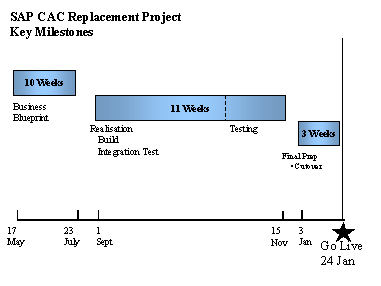
5.1 A project steering group has been established and a project definition report produced. The following diagram shows the key milestones for the project:
5.2 The current estimate of total costs represents the worst case scenario. These are shown in the table below and have been rounded to the nearest thousand. The total cost is estimated at £600,000 (comprising £390,000 internal costs, and £210,000 external costs).
Internal Costs £'000 |
External Costs £'000 | |
Consultancy partner |
110 | |
Enterprise Team Resources |
150 |
|
Business project support (IT Services) |
66 |
|
Business project support (Property Services) |
40 |
|
Training (Property Services) |
54 |
|
Usability |
100 | |
Contingency |
80 |
|
Overall Total |
390 |
210 |
Appendix 4
Hatch Warren Junior School
For several years the performance of the roof structure at Hatch Warren Junior School has been closely monitored. Over the years there has been extensive water penetration, in different places throughout the building, suggesting a significant deterioration in the roof components. While this is not in itself unusual, the approach, traditionally to such issues, is to patch and mend for a period, to maximise the original investment in the structure. Hatch Warren Junior School is relatively new. If a patch and mend strategy is not appropriate then due consideration would be given to complete re-roofing, usually of the external covering. In this particular case it looks as if the roof components, principally glazing, tiles and zinc, are all deteriorating and a complete new roof, including the structure, would be required. Again, this is not unique and such an occasion happened at Bishops Waltham Primary School several years ago.
The recent technical reports suggest that there is wholesale failure in the ridge light glazing, the tiled roof cladding and the zinc roof sheeting to the lower roof. In the case of the latter there is evidence of significant corrosion. Within the roof itself the vapour barrier seems to be incomplete and the insulation saturated. The situation has not been helped by extensive vandalism to the roof and a series of remedial repairs have been carried out. In turn, these repairs have restricted the overall environmental performance of the building with significant overheating in summer and under-heating in winter. Improving the environmental conditions in the school will be a significant by product of replacing the roof structure.
Having considered the structural stability of the roof, and the issue of safety, it would appear that the high level glazing is not toughened or specified safety glass and would now no longer be allowed in such a situation. While the work could be done in phases, say a couple of classrooms at a time, there is no doubt that the contractor would need to get access to the roof both from above and below causing significant disruption to the school. Even if you took two classes out at a time to work in because of the close proximity of other children and classrooms, you would in effect be taking out of use significantly greater space than the contractor was working in.
The ingress of water and moisture and the saturated insulation can only be prevented now by re-roofing the building. The benefits of avoiding future disruption to the school, improved safety, more effective environmental conditions, and getting the work done in one contract phase, suggests that the unusual step of bringing together in one contract work that could be carried out over several years is the most effective way forward.
Further work needs to be done to determine whether temporary roof covering would be required while the work was being done and how this could be specified. It would also be appropriate to decant the children. There are several options for this.
While this would cause significant disruption, it could coincide with the significant extensions being planned for the school later this year, and the opportunity could arise to bring together the re-roofing contract and the major extension work into one contract with one contractor taking overall control and supervision of the work. This would have the benefits of a larger critical mass of work and overall better value. Having considered the options the recommendation would be to fund from this year and next the remedial works to the roof spreading the cost of the project across two financial years.