
Archived decisions
Hampshire County Council
Buildings, Land and Procurement Panel Item 9
24 March 2004
Strategy for the Built Estate
Report by the Director of Property, Business and Regulatory Services |
Contact: Karen Murray Ext: 7876 email: [email protected]
How the conclusion in this report fits with the Corporate Strategy This report impacts on the delivery of all the Corporate Aims in particular: Aim 1 - maximising life opportunities - by providing a good quality and well maintained built estate for the community to enjoy . Aim 2 - stewardship of the environment - by ensuring the built estate is well maintained and provides an environment in which people want to live. Aim 5 - improving services - by providing good quality buildings that enable improved service delivery. |
2004/05 |
2005/06 |
2006/07 |
2007/08 | |
Capital Repairs |
6,354 |
5,618 |
5,618 |
5,618 |
Major Repairs |
8,310 |
8,310 |
8,310 |
8,310 |
Revenue Maintenance 1. |
12,565 |
12,565 |
12,565 |
12,565 |
NDS Condition 2. |
17,190 |
11,341 |
- |
- |
|
16,034 |
14,321 |
15,000 |
15,000 |
|
60,453 |
52,155 |
41,493 |
41,493 |
|
 Devolved Capital 3.
 (Schools)
1. At current rates and does not include passporting or inflation uplift.
2. The DfES has not given any indication of the level of resources to be made available in 2006/7 and beyond.
3. These sums are delegated directly to schools although the majority of the funding is used to undertake building work. It has been assumed that the current level of devolved capital will continue in 2006/7 and 2007/8.
4.2 |
Revenue Expenditure |
|
With over 60% committed to planned engineering servicing and maintenance and 12% against planned asbestos testing and internal decorations only 27% is spent on reactive maintenance such as vandalism, roof leaks and asbestos removal. The completion of the Ballard heater replacement programme and the SCOLA re-cladding programme is helping to maintain and improve the balance between planned and unplanned expenditure. This balance will produce the greatest long-term benefits in terms of reducing maintenance liabilities. | ||
4.3 |
Capital Expenditure | |
Virtually all capital expenditure by its nature is planned, which would significantly increase the figure of 60% quoted above. With the engineering term contracts fully established and the focus on servicing it is difficult to see how much more this balance between planned (including servicing) and reactive work could be improved. | ||
4.4 |
Distribution and implementation of NDS Condition (some £50 million so far) is aimed, exclusively, at permanent school buildings with the largest liabilities. Given the remaining maintenance liability at schools (around over £200 million over the next 5 years) the spending priorities previously established remain relevant and once again have been used as the base for allocating NDS and landlord's funding in 2004/05. The table below summarises the impact planned NDS programmes have had over the last four years: | |
NDS Investment | ||
Priority Area |
£000 |
Number of Schools |
SCOLA Re-cladding |
11,620 |
50 |
Flat Roofing/window replacement |
9,430 |
115 |
Boilers Mechanical System replacements |
7,000 |
140 |
Fire Precautions/Electrical Safety |
5,780 |
107 |
External Works & Drainage |
1,090 |
53 |
External redecoration |
5,710 |
153 |
General building, engineering and structural repairs |
3,660 |
21 |
Other work including temporary classroom replacement and contingencies |
11,810 |
n/a |
* |
46,100 |
639 |
* excludes fee provision
4.5 |
The allocation in 2004/5 is £17.2m and will be targeted at continuing to reduce maintenance liabilities particularly in areas such as SCOLA re-cladding and external decoration and to address the priorities identified in the Corporate Risk Assessment. |
5 |
Policy Management and Improvement |
5.1 |
Procurement Initiatives |
A key component of the initiatives during 2003/4 has been the introduction of the Framework Agreement for major schemes and programmes in order to help create the capacity to deliver a capital programme of around £125m (roughly double last year's programmes). With the major frameworks established the next stage will be to plan for the introduction of frameworks for small and medium size contractors and to create supply chains for specialist areas such as engineering, roofing and cladding. A detailed report covering procurement initiatives appears later on the agenda. | |
5.2 |
Sustainability |
It is proposed that the future thrust in this area will be to focus on initiatives to reduce carbon emissions. This is in line with the Government's agenda on climate change. Projects at Social Services Homes and offices, that will build on earlier initiatives that have already proved successful in reducing total energy and water consumption, are proposed later on the agenda. The Council's approach, over many years, to energy conservation means that many of the simple measures now being promoted by the Government have already been taken and that future projects are likely to have longer (greater than five years) payback periods. | |
5.3 |
Corporate Risk Assessment for the Built Estate |
The Panel will receive a detailed report on progress against the implementation of the Corporate Risk Assessment and an update on current performance using the previously agreed `traffic light' system in May. This review of performance and progress is key to establishing the relative priority for future action and resource allocation. It is necessary therefore, at this stage, to maintain the approach agreed last year in order not to anticipate the outcome of the review and to retain a contingency within capital repairs. Proposals relating to the distribution of the contingency will be brought forward to the May Panel meeting. Early indications suggest that following a review of fire management policy much of the next 18 months activity will focus on improving performance through training and development and revised strategies and guidance. The introduction of further Regulations relating to the management of asbestos has prompted a review of the existing management plan in order to ensure compliance with the legal frameworks. Meeting the new Regulations is likely to have significant resource implications. | |
5.4 |
DDA and Access |
The Best Value Performance Indicator measures the percentage of buildings open to the public in which all public areas are suitable for and accessible to disabled people. The County Council is ranked top authority for this year with a BVPI of 70%. The target for the next two years has been kept at 70% which reflects the Government's earlier proposal to amend the criteria and increasing public expectations. It is now understood that this BVPI will be subsumed with a wider one incorporating equalities. This year 24 public buildings have been improved with a range of initiatives including improved signage, sensory access e.g. induction loops, vehicle circulation (platform lifts) ramps, increase in accessible parking areas, redecoration of internal spaces to incorporate colour contrast and upgrades. In tandem with the improvements the access audits have progressed with over 95% of the first phase now completed. In the coming 12 months further improvement work will be progressed and the next phase of access audits at 150 buildings, that are partly open to the public, will be planned. A full progress report is later on the agenda. | |
6. |
Performance Review |
6.1 |
Customer Services |
While the department has been collecting customer views and publishing performance data for many years it has never conducted independent research among schools although some feedback is available from the Audit Commission's survey of schools views, mentioned later. It is therefore proposed to engage Lynn Miller Associates to undertake face-to-face and telephone research initially amongst the Primary phase during the early part of the summer-term. The research will be informed by a series of face-to-face discussions with Headteachers and is likely to cover satisfaction with the current service and service improvements and developments. The outcomes will be reported to a future Panel meeting. | |
The Audit Commissions survey contains feedback from 40% of schools in all phases, about the quality of Building Maintenance Services and the quality of programming and management of building projects. The survey enables responses to be tracked since 2000 and it is very pleasing to note that the responses in both areas show a significant increase in satisfaction. When the results are looked at nationally they show satisfaction ratings to be in the top ten of all Local Education Authorities. | |
6.2 |
A review of performance in all areas is planned to be reported to the Panel once a full twelve months analysis becomes available. |
Recommendation(s) | |
That the Panel advises the Executive Member for Policy and Resources that: | |
1 |
the strategy and objectives for 2004/5 be adopted; |
2 |
the resources for 2004/5 are allocated in 2004/5 based on the strategic objectives and the programme, identified in Appendix 1. |
Section 100 D - Local Government Act 1972 - background papers
The following documents disclose facts or matters on which this report, or an important part of it, is based and has been relied upon to a material extent in the preparation of this report.
NB the list excludes:
1 Published works
2 Documents which disclose exempt or confidential information as defined in the Act
........................
........................
BLPP0304K
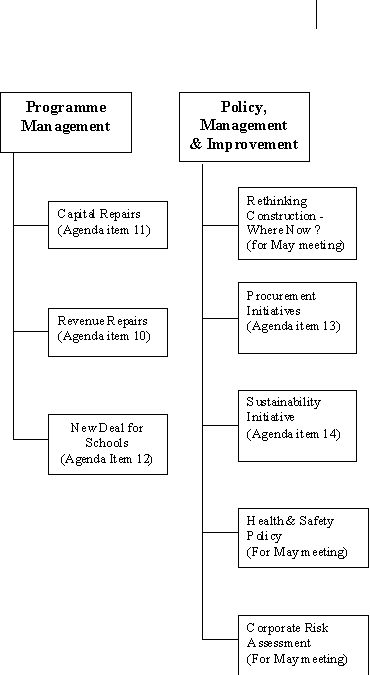
The strategy remains the principal means by which the key objectives are established, key projects and budgets identified and the means by which the critical dependencies are identified and managed.
STRATEGY FOR THE BUILT ESTATE

Key Objectives (Agenda item 9)






Performance
Review
DDA Initiatives
(Agenda item 15)

Staffing and
Consultant
Partnerships
Fire Management
Programme
(for May meeting)




Capital Projects
& Project Appraisals

The importance of the annual allocation of resources should not be underestimated because of the significance of ensuring that progress can be made on a number of related issues at any one time.