
Archived decisions
Hampshire County Council Environment Policy Review Committee 5 May 2004 Natural Resources Update Report of the Director of Environment |
Item 11 |
Contact: Bob Lisney, ext 6647 email: [email protected]
1. Summary
1.1 The Natural Resources Initiative (NRI) is a service that supports the County Council's leadership and influencing role in a long-term change management programme. Initially, it aims to achieve a more efficient use of material resources. This accords with the community vision that was agreed in 2002 and subsequently endorsed in the two year business plan agreed at Member, Corporate and Departmental level in April 2003.
1.2 The formation of the Natural Resources Branch in January 2004 within the Environment Department provides the opportunity to ensure that all natural resource areas, renewable energy, water, soil, etc are equally considered in the future. It also provides a better opportunity to promote the department's work in these areas in accordance with the original NRI objective. Most of the work in 2003 has been focused on materials, especially in respect of a range of construction-related demonstration projects which puts the County Council on track to achieve the Public Service Agreement (PSA) target. Also, the Material Resources Strategy (MRS) has emerged as the principal vehicle for translating NRI concepts into practical strategies and plans, and integrating them into related services.
1.3 In 2004/05 the opportunity will be taken to raise the profile of sustainability and natural resources issues, both within the County Council's own service areas as well as leading on the issue generally, especially via the Community Strategy Framework. The integration of work on the NRI with a range of other programmes dealing with renewable energy, water, soil, etc will also take place. The County Council has a major role in `practising what it preaches' in relation to its own business activities. Whilst much has been achieved, proposals for moving further forward on this agenda will be developed over the next six months.
2. Corporate Strategy
2.1 This report supports Aim 2 of the Corporate Strategy (Stewardship of the Environment) by developing an action-orientated natural resources strategy and land use plan. The NRI is also a key Environment Department priority.
3. Introduction
3.1 The NRI is a service that exerts the County Council's leadership and influence through multi-sector networks to make a real difference, both within the County Council and externally, in the use of natural resources in Hampshire. The approach focuses on both local action and influencing change at EU, national and regional levels to achieve the community vision agreed in September 2002.
3.2 NRI is a long-term change management programme. The concept has received widespread support from community partners and stakeholders. The challenge now is to move forward in progressive steps focused on practical actions and deliverables. The application of NRI concepts can directly improve a range of services within the Environment Department, including minerals and waste planning; waste services; work on renewable energy, soil and water strategies; and to a range of services in the wider County Council generally, including sustainable procurement and economic development.
3.3 NRI objectives for materials were set out in the Cabinet agreed Business Plan 2003-05 in spring 2003. Since then there have been a number of important developments and this update supplements the original document for the coming year.
3.4 The MRS, a joint initiative between the County Council (Minerals and Waste Planning, Waste Services and NRI), Portsmouth and Southampton City Councils and Project Integra, has emerged as the principal vehicle for translating NRI concepts into practical strategies and plans for materials, and integrating them into related services. The process can be shown diagrammatically as follows:
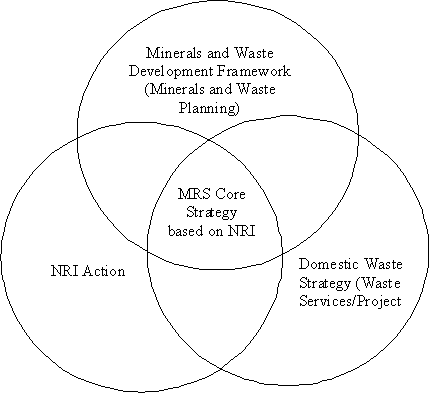 Minerals and Waste Development Framework (Minerals and Waste Planning)
MRS Core Strategy based on NRI
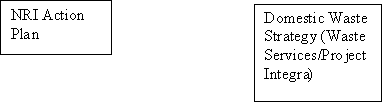
3.5 The Assistant Director (Natural Resources) is the overall Project Director for the MRS. Staff are involved in developing the MRS philosophy and managing the process leading to an integrated core strategy, land use framework and a long-term domestic waste strategy, as well as leading the work to develop an Action Plan to achieve the vision.
4. Scope
4.1 The initial priority of the NRI was to focus on materials that end up as waste. This was because of the huge amounts going to landfill and the substantial impact of EU and UK legislation on all sectors that will require infrastructure changes in the next few years. However, the full vision includes energy, water, soil and climate change actions in addition to waste. As these elements are all inter-linked the opportunity will be taken to maximise work on joint implementation plans.
5. Operational Methodology
5.1 The basic assumption behind NRI is that the way society currently uses natural resources must change on sustainability grounds. The County Council can play a key community leadership role in bringing that change about, particularly via influencing the community strategy process and involving the 11 local strategic partnerships. The working philosophy is that a small direct NRI Team and financial resource can mobilise a much larger internal and external `virtual team' to achieve real change. This work is to be supported by maximising the use of external funding to support demonstration initiatives and projects.
5.2 The NRI Team has the ability to develop and implement innovative and creative approaches, and engage and influence others to achieve real change. The challenge in undertaking the above activities is to focus from a very broad and immature agenda on a set of defined, prioritised and integrated activities that will have the greatest impact in improving the environment and quality of life in Hampshire. The Action Plan for materials will be developed through the MRS process. This is the key priority in moving NRI forward in 2004 whilst other areas are developed.
5.3 The action plan will be developed with a view on the much wider UK and European agenda, where new and future legislation will have a major impact upon the work that can be achieved in Hampshire. One role of the action plan will be to identify areas where influence can be brought on specific topics which are of interest to Hampshire.
6. Aims and Objectives
6.1 The following NRI Vision and Objectives were agreed by stakeholders in September 2002:
`By 2012 the Hampshire community is acclaimed for its achievement through working together in conserving and using natural resources more efficiently. The goals are to:
(i) maximise the role of commerce and industry in driving forward the more efficient and cost effective use of natural resources;
(ii) promote the concept of `consumer responsibility' by ensuring that people have the information to make informed lifestyle choices;
(iii) reduce the impact of natural resource consumption on Hampshire's environment and climate change;
(iv) establish the public sector as examples of best practice in natural resource use; and
(v) influence change at EC/UK government levels.'
6.2 The Business Plan 2003-05 sets out the framework for progressing these objectives. Over the past nine months working experience has clarified how practical delivery may be achieved, including:
(i) the discussion paper `Waste to Resource Management', drafted by the NRI Team, developed the NRI philosophy in the context of the linkages with minerals and waste planning, waste services and the Project Integra partnership. This document not only informs all the activity in Hampshire but also has had a national impact with its adoption as the Local Government Association policy for England and Wales, as well as being adopted by some five counties and one London borough as their policy guide; and
(ii) the adoption of the MRS concept within the Environment Department to integrate the preparation of a new Minerals and Waste Development Framework, Waste Strategy and the NRI Action Plan.
6.3 In order to maximise the economic and social opportunities associated with the sustainable use of natural resources, a range of projects has been pursued to include opportunities for economic development and new jobs, and the provision of training and work experience for the socially disadvantaged.
7. Action Plans
7.1 2003/04 has been a developmental year for NRI, with the establishment of a core team and a linked `indirect' team (three full-time equivalents) in Waste Services managing practical NRI projects, including the PSA target and investigations into resource parks.
7.2 The core Team became fully staffed on a permanent basis in October 2003. The Head of NRI was given wider responsibility in January 2004, to include Corporate Sustainable Development and Environment Strategy, so that the closely related areas could be led by one set of key staff. A full list of key achievements for 2003/04 is set out in Appendix 1.
7.3 Some new actions are now being carried out via the work on developing the MRS:
(i) engaging industry in assessing future trends in resource streams;
(ii) establishing a network of community champions (NRI Advisory Group currently acting in this role);
(iii) working to support entrepreneurs in the NRI area; and
(iv) exploring options for including NRI in an integrated lifestyle change programme.
7.4 The Action Plan for 2004/05 at Appendix 2 is based on the agreed Business Plan, refined and focused to take account of developments over the past nine months.
8. Resources
8.1 It is intended to deliver the 2004/05 Delivery Plan within the existing direct revenue-funded staff and financial resources, whilst taking advantage of opportunities to secure additional external finance.
8.2 The core team consists of five staff and three `indirect' FTEs in the Waste Services Group working on NRI projects. It may be necessary to review the allocation of activities between the available staff to ensure that the key priorities are achieved. The NRI Team is also managing a temporary post providing administrative support to the MRS and funded from the MRS budget.
8.3 NRI is funded as follows:
(i) the core budget for NRI when it was set up; and
(ii) balance of PSA pump-priming funds in the sum of £157,675 (being spent over three years - 2004/05 is the last year).
9. The Future
9.1 A new Natural Resources Branch was created in the Environment Department in January 2004. This brings together:
(i) strategic environmental and sustainability policies, strategies and programmes of work, including renewable energy and climate change, water, soil initiatives amongst others;
(ii) developing policies for minerals and waste, including the statutory minerals and waste development framework that is being integrated into the MRS; and
(iii) the original NRI Team.
9.2 The Natural Resources Branch provides the opportunity to raise the profile of issues that are of key importance to the environment and quality of life in Hampshire, as well as improving effectiveness and achievements by better integration of a range of distinct but closely-related areas. Key issues include implementation of the Hampshire Water Strategy and development of a new Soil Strategy. There needs to be a clear focus on achieving real change, and in this respect it is important that the County Council `practises what it preaches' in how it goes about its own business activities.
9.3 Over the next six months a revised plan will be developed but given the potential impact across all service sectors, it is suggested that all Members be given the opportunity to discuss the issues and the way forward at a training event to be held on 19 November 2004.
Recommendations
1. That activities planned in 2004/05 be supported.
2. That, in view of the dynamic nature of the function's corporate impact and the opportunities to provide a higher profile for existing strategies, a training event for all Members be held on 19 November 2004.
Section 100 D - Local Government Act 1972 - background papers | |
The following documents disclose facts or matters on which this report, or an important part of it, is based and has been relied upon to a material extent in the preparation of this report. | |
NB the list excludes: | |
1. |
Published works. |
2. |
Documents which disclose exempt or confidential information as defined in the Act. |
TITLE |
LOCATION |
None |
8748/RPL
APPENDIX 1
KEY HNRI ACHIEVEMENTS 2003/04
1. Implementation of a range of construction-related demonstration projects, in partnership with Highways Management, the Engineering Consultancy, Raynesway Construction Southern Limited, Foster Yeoman and others, that are on track to achieve the PSA target of 40,000 tonnes of material diverted from landfill by 2005.
2. Implementation of a pilot project in partnership with Gosport Borough Council to deal with abandoned vehicles more effectively, with the aim of a county-wide application.
3. Improvement of the County Council's performance on natural resource use via development of a Sustainable Construction Framework, schools recycling project and other departmental projects (in addition to PSA projects).
4. Improved links and support to business via a revamped Hampshire Business Environment Forum, the Hampshire Business Environment Awards. and the Hampshire Economic Partnership (the coordinator of the Business Environment Forum is now jointly funded by NRI and Economic Development).
5. Successful hosting of the exhibition `The Earth, A User's Guide' at Intech in Winchester, which attracted over 5,000 visitors during August 2003.
6. Project management of resource park proposals, including the Bar End household waste recycling centre and Eco-centre (planning consent secured and advance earthworks carried out) and feasibility studies into the use of Peak Copse, Dummer.
7. Secured £80,000 from the South East England Development Agency (SEEDA) to fund a temporary project manager (to be recruited) to market test and implement resource park concept.
8. Launched the discussion paper `Waste to Resource Management'. The paper has been instrumental in influencing change at national and regional level as well as being the guiding document for the future policies for Hampshire.
9. Developed the MRS philosophy and support to its implementation. The MRS approach has been widely supported by stakeholders.
10. Expanded the NRI networks, including inaugural meetings of a new NRI European network and a core UK County Council NRI network to share best practice and expertise.
11. Administration of the Hampshire Natural Resources Trust, including the project manager in the execution of the Waste Electrical and Electronic Equipment Research Project.
12. £1 million plus of external funding secured via the external funding strategy in partnership with Viridis. Funding for an initial project to identify what needs to happen to maximise construction waste recycling in Hampshire was secured under the Department of Trade and Industry `Partners in Innovation' programme.
13. Improved arrangements for monitoring and disseminating EU and UK policy and regulatory proposals and responding to consultations. Direct input to the EC policy discussion on the `Thematic strategy for the use of natural resources'.
14. Enhanced the NRI website and produced an electronic monthly newsletter.
APPENDIX 2
HNRI ACTION PLAN FOR 2004/05
1. Achieve PSA1, involving a major initiative to maximise construction waste recycling within the Environment Department, and to develop wider construction-related changes in the corporate programme.
2. Manage and contribute to the delivery of MRS core strategy, and land-use development framework.
3. Develop and implement the NRI Action Plan to support the outcomes of the MRS process.
4. Within the MRS develop a long-term vision and strategy for the cost effective management of domestic waste in conjunction with Project Integra.
5. Lead and support the County Council's corporate sustainable development initiatives.
6. Investigate and, if appropriate, progress PSA2.
7. Deliver market development programme including:
(i) implement SEEDA-funded resource park programme; and
(ii) project manage Bar End, Peak Copse and other potential sites.
8. Secure third party funding via External Funding Strategy.
9. Support and maintain key existing networks and HNRI Trust (pending externalisation).
10. Support and develop NRI partnerships, including support and advice to West Sussex County Council.
11. Maintain overview and respond to external policy developments.
12. Develop and monitor internal sustainable development initiatives.
13. Maximise synergies and efficiencies in new Natural Resources Branch.
14. Influence corporate organisational development, and develop Members and staff in accordance with Corporate Strategy Aim 6.