Archived decisions
Contact: Andrew Smith, Ext 6003
1 Summary
1.1 The following decisions are sought:
i) that the Executive Member for Recreation and Heritage welcomes the progress made to date on the production of Countryside Access Plans for the Forest of Bere and Forest of Eversley; and
ii) supports the conclusions reached upon the processes followed and how it is proposed to use the lessons learnt as these Plans are developed for the remainder of the county
2 Reason
2.1 So that the development and delivery of these plans for the remainder of the county can continue, having benefited from the information gleaned from these two pilot areas and the advice received upon the process and different techniques employed.
2.2 Taking the broader Countryside Access Plan approach to this new duty accords with the Council's Corporate aims. In particular, this broad, inclusive approach seeks to contribute towards maximising life opportunities (aim 1) whilst recognising the importance of the protecting and enhancing the countryside for people and wildlife (aim 2). Improving the opportunities for people to enjoy the countryside will also have benefits for the rural economy and thereby contribute to the third corporate aim and the focus for ensuring that the access provided is safe and easy to get to will help towards achieving aims 4 and 5.
3 Other Options Considered and Rejected - Not applicable
4 Conflicts of Interest declared by the decision maker or other Executive Member consulted -
None
5 Dispensation granted by the Standards Committee
Not applicable
6 Reasons for the matter being dealt with if urgent
Not applicable
Approved by: Date:
................................. .........................
Councillor J. Waddington
Contact: Andrew Smith, Ext 6003 email: [email protected]
COUNTRYSIDE AND RIGHTS OF WAY ACT 2000 S60. - Rights of Way Improvement Plans Every local highway authority other than an inner London authority shall, within five years after the commencement of this section, prepare and publish a plan, to be known as a rights of way improvement. |
1. Summary
1.1 In November 2002 Hampshire County Council was chosen by the Countryside Agency to be one of six demonstration projects nationally to produce `Exemplar' pilot Rights of Way Improvement Plans. This report seeks endorsement from the Policy Review Committee for the approach taken in the two areas of the county chosen, and to note and support the conclusions upon the differing techniques employed towards the production of these Plans.
2. Purpose of the Report
2.1 The purpose of this report is to inform members of the work that has been undertaken over the past 18 months. In particular, Members are asked to note the differing techniques used to find out the issues which people consider to have bearing on their ability to access or enjoy the countryside. The County Council has taken a broad approach to the content and scope of these plans by considering `access to the countryside' in a wide sense and the initial research has also included the view of farmers and landowners. Whilst this approach is wider than implied by the Statutory Guidance accompanying this new duty, this report seeks Member support to continue with this broad, more inclusive approach, as work on these plans for the remainder of the county proceeds.
3. Background
3.1 Local highway authorities are required under sections 60 and 61 of the Countryside and Rights of Way Act to review the adequacy of their rights of way network, and prepare and publish plans. These plans should contain; the authority's assessment of whether local rights of way meet the present and likely future needs of the public; the opportunities provided for exercise and open air recreation and the enjoyment of the areas; and access to local rights of way by blind, partially sighted persons and others with mobility problems.
3.2 The Regulations subsequently came into force in 2002 requiring the County Council to produce plans before November 2007 and to review these plans within ten years. New funding has been made available through the Standard Spending Assessment to enable the County Council to work towards fulfilling its new duties under this act.
4. The Countryside Access Plan Approach
4.1 Hampshire County Council welcomed this opportunity to review the network, but felt that a wider approach was needed. Therefore, the Countryside Service response to this new duty was to propose the production of `Countryside Access Plans'. Both the Recreation and Heritage Policy Review Committee (report agreed by the Policy Review Committee on 27th June 2002) and Hampshire Countryside Access Forum supported this approach.
4.2 The title `Countryside Access Plan' reflects this wider approach, reviewing not just the 3,000 miles of rights of way in the county but also other resources used by the public for countryside recreation. These include the Service's 82 sites, sites managed by other organisations such as the Forestry Commission and Woodland Trust, and other permissive access areas or routes. This approach was favoured as it more truly reflects the use that the public make of the countryside and therefore will enable a more accurate assessment of issues and needs.
5. Piloting the Process
5.1 In September 2002 the Countryside Agency invited local authorities to bid for funding to pilot these new plans; the pilots would then provide best practice guidance on this new duty for all authorities to follow. The Countryside Service bid successfully to pilot the Countryside Access Plan approach for two areas in Hampshire.
5.2 The Forest of Bere and Forest of Eversley were chosen for the first plans as:
· both are rural areas surrounded by extensive urban areas and are therefore likely to experience high demand for access.
· both are the subject of an existing partnership project looking at land management and land use on the urban fringe; this project had conducted useful research and established community involvement.
· the Integrated Access Demonstration Programme had developed projects in the Forest of Bere area, such as working with farmers in one of the urban fringe estates under most pressure, and establishing and addressing equestrian access issues; again, this had provided information and local involvement which the pilots could utilise.
5.3 A grant from the Countryside Agency was used to fully fund two research studies:
· A full use and demand survey for the Forest of Eversley
· An equestrian use and Demand Survey, concentrating on the Forest of Bere and then testing the issues Hampshire-wide
5.4 This research has been complemented by work undertaken within the Countryside Service. Together these studies have contributed to the production of Countryside Access Plans for the Forest of Bere and the Forest of Eversley.
5.5 In the Forest of Eversley, research was conducted by consultants (Sheffield Hallam University) and then the plan produced by Countryside Service staff. For the Forest of Bere area, Countryside Service officers undertook the bulk of the research and produced the plan. The tables in the Appendix 1 give details of the tasks for each stage of this process.
6. Local Access Forum Involvement
6.1 Strategic involvement in the preparation and implementation of Rights of Way Improvement Plans is a central role of Hampshire Countryside Access Forum (Hampshire's statutory Local Access Forum). Local highway authorities are expected to involve local access forums in the preparation of their Rights of Way Improvement Plans from the outset. They are also expected to prepare progress reports for forums as the plans are prepared, published, implemented and reviewed.
6.2 An item on these plans has been taken to every meeting of Hampshire Countryside Access Forum since their inception in October 2002. We have asked for advice on the Countryside Access Approach, the process for the pilots and how the Forum would wish to be involved in the process
7. The Research
_ Issues identified in the Forest of Bere area
7.1 The research results indicate that there is generally an under supply of recreation routes in the Forest of Bere area, particularly for cycling, horse riding and carriage driving and yet there is a high demand for this provision. The increase in traffic on minor roads has resulted in concerns over safety and prompted the need for more off road cycling and walking routes between communities. Land owners and managers identified a high level of misuse and crime of the countryside within the Forest of Bere and some actions that could be attributed to a lack of understanding rather than malicious behavior.
_ Issues identified in the Forest of Eversley area
7.2 The countryside recreational resource adequately meets local needs with much of the resource provided by Ministry of Defence, Forestry Commission and Hampshire County Council. A number of issues are linked to the large number of permissive paths in the area and include a lack of signage and information about the access resource and demand for promoted circular walks. A fear of personal attack was shown to be a significant barrier to people's use and enjoyment of the of the countryside and may be due to the amount of woodland, high density of routes and limited information leading to a feeling of isolation and lack of confidence.
7.3 A list of the issues which have arisen from the research is appended at Appendix 2
8. Conclusions Upon The Process
8.1 There were significant differences in the issues found in the two pilot areas. A single plan for the county may have masked the variance in local needs and so may have been of less benefit when implemented. For example, the equestrian research concluded that, county-wide, Hampshire residents are fairly satisfied with the amount of access available to them. In the Forest of Bere, this was markedly different - there was a strong demand for more routes. This finding supports the idea of producing several area based plans for the county. The Access Forum agreed with this approach at their April 2004 meeting but also supported the idea that there will be issues and actions arising that need to be addressed at a county-wide level.
_ What factors should guide choice of area?
8.2 The Forest of Bere area is of fairly uniform landscape character and soil type and this, above other considerations, seems to have been reflected in the survey responses, which consistently raised the same issues throughout the area. The best approach would therefore seem to be identifying areas which are fairly uniform in landscape and soil type, but bearing in mind their human catchment area.
8.3 One of the conclusions in the Eversley report is that the public do not limit the areas they use for recreation by political boundaries, and so cross-boundary working may be appropriate. It seems particularly appropriate to look at cross-border working with the unitary authorities, since Hampshire is often the nearest countryside for these urban populations.
_ Should the County Council employ consultants to do this work ?
8.4 Thorough research was conducted to identify the issues for both pilots and there was little difference in resources required, whether the research was conducted by the Countryside Service or through consultants. For Eversley, Countryside Agency funding was used to employ consultants and in addition some officer time was needed to manage the contract. For the Forest of Bere work, a six month full-time member of staff was needed and a smaller amount of funding for the equestrian study. The process followed is set-out in Appendix1.
8.5 However, when officers used the research to write the issues and those issues were presented at workshops for the Local Access Forum and staff, the implications of these different approaches became apparent.
8.6 Countryside Service officers have a thorough local knowledge of the areas they manage which proved to be invaluable for understanding the area and the issues in the Forest of Bere research work. This in turn enabled the issues to be clearly conveyed in the draft plan and to staff and Forum in workshops, and will allow the effects of suggested actions to be determined clearly.
8.7 The research for the Forest of Eversley was carried out in a highly competent manner and was rigorous and well documented. The report has provided some valuable recommendations for carrying out future plans. However, it has proved more difficult for officers to glean the issues from this research and it has produced a less focussed issues paper. This is because the understanding of the research findings and the character of the area is inevitably not as in-depth or rounded as it would have been had the research been carried out in-house.
8.8 Local knowledge and staff involvement in research was therefore found to be highly beneficial and the proposed process for the remaining plans therefore reflects this.
_ Just a review of rights of way or access to the wider countryside ?
8.9 Surveys for both pilots showed the importance of the routes and areas which are not Rights of Way - in Eversley, for example, 41% of walkers and 68% of cyclists stated that they use the other resources more than rights of way.
8.10 In Eversley, there are relatively few rights of way but large areas of heath and woodland managed by public bodies for access, as well as MOD land which is being used for de facto access. If only the rights of way network had been considered it would show apparently large gaps in the network and it may have been concluded that there was a need for more rights of way. In fact, the household survey showed overwhelming satisfaction with the amount and location of access, due to the large amount of alternative access available.
8.11 The research report for the Eversley plan therefore fully endorses the `Countryside Access Plan' approach, incorporating the whole access network both when conducting research and when implementing improvements.
8.12 In both areas, user group representatives and public landowners were interviewed, and the findings tested quantitatively using questionnaires.
8.13 In Eversley, a large-scale household survey was conducted. This served to provide statistics which supported the findings from both national research and the local interviews, but did not add significantly to the understanding of those issues.
8.14 In Bere, a much smaller survey was made of user group members and community groups which again supported the findings from the interviews but did not provide further understanding of issues or highlight any missed issues.
8.15 Major user group organisations represent only a tiny minority of total participants in a given activity - for example, the Eversley report concluded that the Ramblers Association are estimated to represent 0.4% of all walkers nationally, the CTC 1% of cyclists and the BHS 12% of riders. Therefore, whilst interviews with user group representatives are extremely useful, the findings must be tested against a wider audience. At the end of the research, it could be seen in both areas that the interviews had identified the issues correctly and gave a rounded and thorough understanding of each issue.
8.16 Both plans will undergo a limited, targeted consultation followed by a wide public consultation. In light of the above it was felt that although it is necessary to include a quantitative element in the initial research to confirm the validity of issues identified, this had not added significantly to understanding and so the majority of time and cost should be devoted to the interviews.
8.17 The statutory guidance for preparing Rights of Way Improvement Plans clearly states that the Council should assess latent demand and provide for the needs of these potential users. Whilst the research has endeavoured to do this, there are difficulties:
8.18 Firstly, it is difficult to assess the demand as representatives are not readily identified and surveys consistently attract more responses from those interested in the subject, i.e. existing users. This was true for both pilot areas, even though the postal survey for Eversley was extensive (sent to 6,000 households).
8.19 Secondly, national research shows that non-participation in countryside recreation is largely driven by factors that local authorities cannot necessarily influence - in the Countryside Agency's research of 1,540 household, 64% of non-users cited `no time', `health reasons', `old age', `not interested' or `keep fit in other ways'.
_ Should we seek landowners' views?
8.20 In both pilots, our approach went further than the government guidance on Rights of Way Improvement Plans by incorporating the views of the `supply side' - i.e. those providing access. Their views were often necessary to fully understand the issue and ensured that requests were seen in perspective and actions remain realistic and appropriate. In some cases, information from landowners clarified why apparently obvious problems reported by users remain, and enabled us to represent the issue in a more rounded and realistic way.
8.21 There are some activities which are particularly characteristic of certain areas, for example carriage-driving in the Forest of Bere and New Forest, and it seems sensible to adjust the research process to reflect these local characteristics.
8.22 Both pilot areas were the subject of an existing project and so background research was available. The same will be true of the New Forest, where there are many strategies or plans which pay particular attention to countryside recreation, and so the process in this area may be streamlined.
_ How can Local Access Forums continue to contribute?
8.23 Hampshire Countryside Access Forum (HCAF) provided advice on strategic matters relating to the Countryside Access Plan approach and suggested process, as well as contributing towards the pilot plans. In practice, the former worked well and was valuable in identifying process and principles. However, it has proved difficult for a county-wide forum to have meaningful input into area plans if the area has not been familiar to them. In the Forest of Bere, an equestrian forum comprised of local riders and drivers has been able to provide direct input to the detail of the plan in this area.
8.24 It is suggested therefore that for the remaining area plans the strategic advice is sought from HCAF as a county-wide forum and that members of the forum are asked to help form a locally-based focus group of users and landowners to guide and have input towards that area plan.
9. The Way Forward
_ Areas
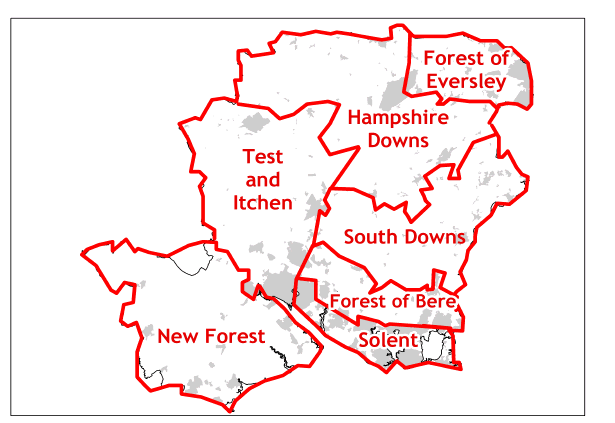
9.1 The areas proposed for rolling-out the process across the remainder of the county are shown in the Map at Appendix 3. These areas have been identified through looking at landscape character and soil type, which should give reasonable consistency of issues within each area. All the plans should overlap and the boundaries shown on the plans are intended to be indicative only.
9.2 Through the pilots a process has been identified to produce the remaining Plans. The benefits of undertaking the research within the Service are clear, and so it is proposed that the process, from research to plan production and consultation, will now be undertaken by Countryside Service officers.
9.3 This process will be led by the Access Development Team, which has been created under the Countryside Service review to provide a focus for new, innovative approaches to access to the countryside, in its broadest sense. This team will work closely with officers across the Service as the Plans are developed to ensure that the Service as a whole contributes to the process and is therefore well placed to help ensure that they are delivered.
9.4 For each plan, a focus group comprised of local countryside users and land managers will be asked to guide the process and provide local information and contacts. These groups already exist in the New Forest and South Downs as sub-groups of HCAF.
9.5 Some of the research from the pilots will benefit other plans - for example, the equestrian survey produced Hampshire-wide information, the Eversley report confirmed that national figures are generally representative of Hampshire, and survey questions and formats can be re-used for other areas. The availability of this information, and the results from the other pilot projects nationally, will be reflected in the proposed process for the remaining plans.
Recommendations
It is recommended that the Recreation and Heritage Policy and Review Committee:
(i) welcomes the progress made to date on the production of Countryside Access Plans for the Forest of Bere and Forest of Eversley; and
(ii) supports the conclusions reached upon the processes followed and how it is proposed to use the lessons learnt as these Plans are developed for remainder of the county.
(iii) that (i) and (ii) above be commended to the Executive Member for Recreation and Heritage
Section 100 D - Local Government Act 1972 - background papers
The following documents disclose facts or matters on which this report, or an important part of it, is based and have been relied upon to a material extent in the preparation of this report.
N.B the list excludes:
1. Published works
2. Documents that disclose exempt or confidential information as defined in the Act
3. Title : None
Appendix 1
Process and detailed tasks used to produce the pilot plans
Appendix 2
Forest of Eversley Countryside Access Plan - Issues Arising from the Research
Issue 1 - The fear of crime is affecting people's participation and enjoyment of the countryside
Issue 2 - Publicly owned countryside sites and Ministry of Defence land provide a significant proportion of the access network
Issue 3 - The information provided about the access resource is inadequate
Issue 4 - There is an under supply of access resource for legitimate off road motorised vehicle users however they are not welcomed in the countryside
Issue 5 - In some areas there is a lack of access resource for cyclists and horse riders
Issue 6 - There is a demand for more connectivity of walking routes to and from countryside sites and communities
Issue 7 - Many farmers and landowners find that providing more public access entails a workload and financial burden
Issue 8 - Some members of the public lack and understanding of their rights and responsibilities
Forest of Bere Countryside Access Plan - Issues Arising from the Research
Issue 1 - There are difficulties in getting to the Forest of Bere to enjoy the countryside.
Issue 2 - There are insufficient off-road routes that link centres of population to each other and to countryside sites
Issue 3 - Major countryside sites provide limited resources for off-road cycling
Issue 4 - There is an undersupply of access resource for horse riding and carriage driving
Issue 5 - Countryside users are forced to use, or cross, busy roads to link up off-road access
Issue 6 - There is a lack of awareness of users requirements when creating new, or managing existing, access and access facilities
Issue 7 - There is a lack of consideration for other users on multi use routes
Issue 8 - Many farmers and landowners find that providing public access entails a work load and financial burden
Issue 9 - Multi use routes in the Forest of Bere are in a worse condition than the rest of the county
Issue 10 - Uncontrolled dogs and fouling are a deterrent to countryside users and makes managing land for access both costly and hazardous
Issue 11 - Crime and misuse of the countryside is costly for those managing land with access and affects people's enjoyment
Issue 12 - Public access to the countryside can have a negative impact on land management for conservation and the sustainability of vulnerable species and habitats
Issue 13 - The information provided about the access resource for all users is inadequate
Issue 14 - Poor communication between users and access providers leads to misunderstandings
Issue 15 - New legislation is imposing a cut off date for historical rights of way
Appendix 3
Proposed Areas for the Production of Countyside Access Plans in Hampshire
(Proposed areas are marked in red; Hampshire boundary and urban areas also shown)