
Archived decisions
Hampshire County Council Health Review Committee Item 8 25 May 2004 Proposals to Develop or Vary NHS Services Report of the Chief Executive |
Contact: Denise Holden ex 7338
e-mail: [email protected]
1. Summary and Purpose
1.1 The purpose of this report is to alert Members to proposals from the NHS to vary or develop health services provided to people living in the area of the Committee.
1.2 Proposals that are considered to be substantial in nature will be subject to formal consultation. The nature and scope of this consultation should be discussed with the Committee at the earliest opportunity.
1.3 The response of the Committee will take account of the criteria adopted by the Committee on 29 July 2003 with particular emphasis on the duties placed on the NHS by Section 11 of the Health and Social Care Act 2001.
1.4 The report and recommendations support the delivery of Aim 5 (Improving Services) of the Corporate Strategy.
2. Eastleigh and Test Valley South Primary Care Trust Consultation: The Mount Hospital
2.1 The final phase of the consultation period was launched by ETVSPCT on 15 April and ran to 13 May. This shared the model for the future provision of health services developed by the PCT following feedback from patients, carers, the public and other key stakeholders over the last 5 months.
2.2 In addition to comments secured during the public meetings over 200 responses were received to the initial document circulated by the PCT in February. These comments, which included the views of the Working Group of the Committee supported to need for services to promote rehabilitation and independence through the provision of
· Home care and community services, including night support/sitting services
· Integrated day hospital facilities with input from therapists, primary care, social services and the voluntary sector
· Locally based 24 hour inpatient provision
· ease of transfer to and from acute care
· improved access across the area
· The Working Group visited the Mount Hospital on 17 March. The report of this visit was tabled at the meeting on the 30 March and supported by members. This is attached at Appendix One.
2.3 The response of the working group to the model for service development now proposed by the PCT is attached at Appendix Two. This takes account of the points raised in previous correspondence and reports to the Committee.
2.4 The PCT has confirmed that it will share the next stages of this reconfiguration with the Committee and given an absolute assurance that no services will close until alternative provision is available. In addition the PCT intends to invite patient and carer representation on the steering group to oversee this work.
3. `HealthFit' Implementation
3.1 The formal response from the Committee to the Health Authority was sent on 10 March. This set out:
· The concerns of the Committee about the level and consistency of community, public and patient engagement the took place at stages 3 and 4 of the HealthFit development process
· The need for each of the localities to be engaging with local people in developing proposals
· The need for the Committee to be apprised of any service change that may be substantial at the earliest opportunity.
3.2 The response received from the Strategic Health Authority on 7 May is attached at Appendix Three
4. Mental Health Services in North East Hampshire
4.1 The response from the NHS to the Hampshire /Surrey Joint Committee is attached at Appendix Four. This confirmed that all the findings of the joint committee were accepted but did not contain satisfactory detail on the action being taken to address the weaknesses identified.
4.2 The Chairman of the Committee will meet with Surrey Health Overview and Scrutiny Committee on 9 June to discuss the further action required by the NHS.
5. Blackwater Valley and Hart Primary Care Trust: Changes to Service Provision at Fleet Hospital
5.1 The Committee has previously received information about these proposals.
5.2 The PCT has been keen to respond to the emphasis placed by the Committee on `Strengthening Accountability' and the involvement of patients, the public and key stakeholders in planning services.
5.3 The consultation process has provided the PCT with a clear idea of the elements of its proposals that are supported by local stakeholders and those that remain a cause of concern to local people.
5.4 Further work will now be undertaken with key stakeholders to develop affordable options for developing services. These will be subject to further consultation.
6. New Forest PCT- The Future of Community Hospitals
6.1 The New Forest PCT has published a comprehensive setting out the options for developing community hospitals and services in the New Forest area.
6.2 The document considers the potential and options the community hospitals in the medium term and seeks the views of patients, the public and local stakeholders in developing a final strategy.
6.3 Three issues are discussed
· Is the patient pathway and experience enhanced by having a community hospital
· Do community hospitals relieve the pressure on acute services
· Are they a cost effective use of finite resources
6.4 The full document is attached at Appendix Five. Comments are invited by the 27 July.
7. Hampshire Partnership: reprovision of Locally Based Hospital Units for people with learning disabilities in South West Hampshire
7.1 The Hampshire Partnership, working with Hampshire County Council Social Service s, has produced published arrangements for re-housing and providing domiciliary support to this services for people with learning disabilities in South West Hampshire.
7.2 The proposal includes detail of the work undertaken to involve stakeholders and the public and feedback on existing services from residents and relatives.
7.3 Details of the proposal are attached at Appendix Six. Comments are invited by the end of May.
8. Maternity Services in South East Hampshire
8.1 The Committee is still waiting for confirmation of the timing of the formal consultation process.
8.2 Arrangements for establishing a joint committee are in place. Representation from Hampshire will includes Cllr Ellis, Cllr Bayford, Cllr McNair Scott and Cllr Dickens.
8.3 The joint committee will consider any proposal from the perspective of the entire population affected and provide a regular up-date to the Health Review Committee.
9. Foundation Hospitals: Southampton University Hospitals Trust; Winchester and Eastleigh Health Care; North Hampshire Hospital
9.1 The formal consultation on the constitution of the proposed Foundation Trusts closed on the 2 May.
9.2 The Chairman, in consultation with the Chief Executive, responded to the five local hospitals providing services to people living in Hampshire that are seeking Foundation Trust Status with effect from 1 October 2004.
9.3 The consultation documents did not include any proposals to substantially develop or change services therefore joint committee arrangements to respond to the consultation process were not be necessary.
9.4 The response highlighted a number of wider issues that were of concern to the Committee and asked for a number of points of clarification from the Independent Regulator. Particular emphasis was placed on the containing requirements of section 11 of the Health and Social Care Act and early involvement in considering proposals to substantially vary or develop NHS services
9.5 A full copy of the issues raised with the regulator and other responsible bodies, as well as the individual responses to the NHS Trusts is attached at Appendix Seven. This has been circulated to all county councillors for information.
10. Reforming the NHS Complaints Procedure: National Consultation
10.1 The final form of the response to this national consultation exercise is attached at Appendix Eight.
11. `Choosing Health': National Consultation on Public Health
11.1 The Department of Health launched a major consultation exercise on 3 March. This with run to 28 May.
11.2 The draft response from the Committee is attached at Appendix Nine.
Recommendations
1. Eastleigh and Test Valley South PCT: Consultation on the future of The Mount Hospital
· That the Committee endorses the response of the working group.
· The PCT is invited to up-date the Committee on progress at the next meeting
· The Committee reaffirms its expectation that services will not close until suitable alternative local provision has been made
2. `HealthFit' Implementation
· That the Committee is up-dated by the Health Authority on the next steps of the HealthFit process.
· The Committee continues to press for information on the engagement of local people across localities as HealthFit rolls forward.
3. Mental Health Services in North East Hampshire
· The Committee is advised of the response of the lead PCT and any subsequent action taken by the joint Surrey/Hampshire Committee
4. Blackwater Valley and Hart PCT: Changes to Fleet Hospital
· Members indicate their support for the revised arrangements for developing services at Fleet Hospital proposed by the PCT
· The Committee is advised of the next phase of consultation.
·
5. New Forest PCT: The Future of Community Hospitals
· Members invite to PCT to confirm the response received from local people to the discussion document
· Members wishing to comment on the discussion document do so via the lead officer by 27 July
·
6. Hampshire Partnership: reprovision of LBUs for people with learning disabilities
· Members note the action taken by the Hampshire Partnership
· Comments are passed to the lead officer by the end of May
7. Maternity Services in South East Hampshire.
· Members are informed of any action taken by the joint committee
· The criteria for responding to consultation previously agreed by the Committee are drawn to the attention of the joint committee.
8. Foundation Hospitals
· The Committee endorses the action taken by the Chairman in relation to Foundation Hospitals
·
9. Reforming the NHS Complaints Procedure
· The Committee endorses the response to the Department of Health
10. `Choosing Health': National Consultation
The Committee endorses the draft response to the Department of Health
Section 100 D - Local Government Act 1972 - background papers
The following documents disclose facts or matters on which this report, or an important part of it, is based and has been relied upon to a material extent in the preparation of this report.
NB the list excludes:
Published works
Documents which disclose exempt or confidential information as defined in the Act.
File Location
Hampshire County Council Appendix One
Health Review Committee
`Mount Hospital' Working Group Report: Visit to Mount Hospital
17 March 2004
Present
Cllr Pam Holden-Brown (Chairman)
Cllr Patricia Banks
Cllr Glynn Davies-Dear
Cllr Edith Randall
In attendance
Helen Hooper - Divisional Senior Nurse, WEHT
Manda Copage- Project Manager, ETVSPCT
Denise Holden- Health Review Manager, HCC
Introduction
The purpose of the visit was to see the facilities currently provided at the Mount Hospital based in Bishopstoke including the Day Hospital, in-patient service and physiotherapy clinic. This visit would inform the response of the Working Group to the proposals from Eastleigh and Test Valley South Primary Care Trust (ETVSPCT) and Mid-Hants PCT, to reprovide the current service in a more modern setting.
The interest of the Health Review Committee in responding to this consultation exists at two levels:
1. Has there been adequate involvement of local people in shaping the document and responding to consultation
2. Is the proposed way forward in the interests of the local health service.
Comments from local people at the recent public meetings included a number of concerns about the use of the Mount site should the land be sold. Although the
Working Group recognises that this is an issue that will be of interest to local people, this aspect of the proposal does not fall within the remit of the Health Review Committee.
ETVSPCT has been working with patients, carers and other key stakeholders to identify the way in which the current service can best be provided to the different communities served. Comments received, including feedback from the public meetings held in early March indicated that
· Staff are highly valued and provide high quality care to patients and carers
· The environment in which this care is provided does not meet the needs of modern health services
· Staffing pressures have reached the point where 12 beds have been closed. This situation could deteriorate if staff are not retained and may lead to the closure of further services on the grounds of safety.
· Access to the Mount was convenient for people from the Bishopstoke area. For others access can be difficult with some of the day ambulances taking up to 2 hours to get people home. Public transport to the site is a problem from some areas.
· A number of outpatient clinics have already been relocated to other areas such as Eastleigh Health Centre.
Day Hospital
Based on the ground floor of the old main building the Day Hospital currently provides up to 14 places for people requiring rehabilitation and assessment.
There are a number of referral routes to the Day Hospital, including self-referral. Care provided includes dietetics, physiotherapy, occupational therapy and clinical psychology, in addition to medical and nursing care. There are separate treatment areas and dining facilities within the area although the layout of these is constrained by the original design of the building. There is some access (although not disabled) to the upper floors. These are used for administration purposes.
The Day Hospital has a dedicated ambulance which arrives at 10.00 am and collects patients at approximately 2.00 pm. An `outreach team' operates from the site in the afternoons providing support in peoples homes.
The Eastleigh Learning Disability team is also based on in this facility.
Inpatient Wards
The two wards based on the Mount site have capacity to provide 38 beds, although due to recruitment problems 12 beds have been closed for some time. The wards provide 24-hour care for people requiring more intensive rehabilitation before going home or into other care. The emphasis is on building independence and improving the quality of life of patients. Lengths of stay can be over three months.
Access to the ward area is through an external walkway, with some cover but open to the elements. This has a significant slope and is uneven.
The wards were busy and staff were working closely with patients. A mix of other support services is provided including speech therapy, social care, dietetics and occupational therapy.
The layout of the buildings limited the scope for the environment to be modernised and this fact placed a number of constraints on access to facilities such as toilets and washing areas. Although some had been refurbished others were in a more variable in terms of access and privacy. The open style of the bed areas further restricted privacy and the space available to provide active rehabilitation. In a number of areas the floors were sloping, uneven or both.
In order to get a patient to the physiotherapy department staff need to negotiate patients down the walkway, across an uncovered access road and down further corridors.
Physiotherapy Department
The physiotherapy department is located at some distance from the ward areas and day hospital. The accommodation provides for a clinic for outpatients that is able to treat local people for a range of musculoskeletal problems in addition to an inpatient gym area. Originally intended to be temporary the accommodation needs up dating.
Findings from the Visit
The Working Group found it helpful to see the environment in which rehabilitation services were being provided and build an understanding of the options for providing these key services in the future. A number of comments and questions came out of this visit: these are set out below:
· Members were struck by the commitment of staff to providing a high quality of care to patients although the environment was less than ideal. It was helpful to have confirmation that staff would be offered alternative employment should the services at the Mount be relocated.
· Access to the ward areas via the exposed walkway was a source of concern.
· Issues relating to privacy and dignity are addressed as far as possible in the environment but do not meet modern expectations. Additionally active rehabilitation can be adversely affected by access to individual bed areas.
· Transport to and from the site is a particular issue for people from the Bishop's Waltham and Chandlers Ford area. Accessibility to the rehabilitation service needs to be a key criterion in considering alternative locations.
· The potential for an intermediate care facility, providing for `step down' from acute care or `step up' from community care is significant. There does however need to be further clarity regarding how this arrangement would work practically, particularly in terms of providing support to carers in the community. In this respect some provision for respite needs to be clearly addressed in any future proposals.
· The work on modelling this as a service for local people by the University of Southampton is a useful tool for helping to develop a service that is `fit for the future'. The Working Group would be interested in seeing this report when it is available.
· The current facilities based on the site urgently need to be modernised and different arrangements for service provision may bring additional benefits for patients. As such all options must be explored by the PCTs. Nevertheless there are some services, such as outpatient physiotherapy that are well used by local people. Options for service provision therefore need to look realistically at what can be provided on the site, including to possibility of capital investment being met by the private sector.
· It would be helpful to know what scope there may be for GPs with a special interest to have an active role in supporting the rehabilitation service.
· The role of the `Preventing Dependency Team' will be key in ensuring that people, both patients and carers' are properly supported in the community. It would be helpful to have further information on the way in which the PCTs intend to develop this service.
· ETVSPCT has worked closely with local people to develop a model for providing these services. One of the issues that emerged through at the public meetings was a concern that alternative sites for care may not be more convenient or accessible. This is particularly key for inpatient provision. It would be helpful therefore to have an indication of where any future services would be located if they were to move from the Mount.
Hampshire County Council Appendix Two
Health Review Committee
The Mount Hospital: Response to Consultation
Response to the Consultation on the reprovision of rehabilitation services
This letter sets out the response of the Health Review Committee to the formal consultation on the future provision of the rehabilitation services currently provided at the Mount Hospital. It builds on the response that the Working Group provided in March to the `Listening Document' published by Eastleigh and Test Valley South Primary Care Trust (PCT) and the report of the visit of the Working Group to the Mount site.
The interest of the Committee in responding to this proposal exists at two levels:
3. Has there been adequate involvement of local people in shaping the document and responding to consultation
4. Is the proposed way forward in the interests of the local health service
As such our comments focus on the provision of rehabilitation services currently provided by the PCTs and not the issues raised in relation to the disposal of the site.
The Committee is aware of the commitment of both Eastleigh and Test Valley South PCT and Mid Hants PCT to fully discharging their duty to involve and engage with local people in the planning and delivery of health services. The process of engagement and involvement that the PCTs have developed in shaping this proposal is to be commended. This process has moved consultation away from the traditional format of public meetings on a predetermined proposal to a model that allows local communities and service users to inform and shape the services to be provided. The Committee is strongly supportive of this approach and considers that there has been appropriate involvement of local people in developing the proposals. We would also wish to welcome and endorse the intention to continue to involve patients, carers and other key stakeholders as the planning process develops.
The Committee supports the service changes outlined in the consultation document and the clear commitment to providing services to people in their own homes or as locally as possible. The following comments reflect this support and raise some additional points that merit further consideration.
Home care and community services: if the purpose of rehabilitation is to help people maintain independence for as long as possible then there must be adequate support to those living in their own homes. The care model proposed would seem to be flexible enough to provide for both an on-going need for support or a period of more intensive intervention. As planning for these services develops it would be helpful to have confirmation that account will be taken of:
· The range of agencies and professionals that provide care in the different communities served. Co-ordination across these agencies will need to be managed to ensure that the resources available are used as effectively as possible and support the delivery of the single assessment process. The scope for integrated working across the agencies concerned needs to be maximised and co-ordinated.
· The provision of care according to need: this should include services on a 24-hour basis where this is necessary. The reprovision of these services provides an important opportunity to establish care pathways and protocols for people requiring different levels of rehabilitation and support to enable them to retain their independence for as long as possible.
· Carers must be supported and have input into the care planning process. This includes access to respite where this is required. In this respect it must be remembered that the needs of people living with dementia are very different from those with other chronic problems and should be provided for appropriately. The reference to the provision of support at night and respite services is strongly supported by the Committee. It would be useful to have further information on the timetable for developing the carers strategy as well as any criteria that may be developed in relation to access to respite care and night support.
· It was helpful to have the additional detail on the range of specialist care that can be provided in people's homes and the increase in work force that will be needed to provide this care. Action to improve staff recruitment and retention has been specified. The success of the model proposed does however depend on the right staff being available and clarity regarding responsibility for providing this care. How confident are the PCTs that there is sufficient human resource capacity in the communities to provide the required levels of service in people's homes. What scope is there for GPs with a special interest to have an active role in supporting the rehabilitation service?
Day Hospital provision: Noting the comments of patients about the value of the day hospital provision it was disappointing to note that the services was operating at 58% capacity. The commitment to reprovide this service and increase the rehabilitation services available for patients with special needs (e.g. dementia) is strongly supported. It would be helpful to have your comments on the scope for the day hospital to be managed in such a way that it brings together health and social care and the voluntary sector service providers. This would provide a flexible resource not only for people requiring rehabilitation but also respite, assessment and other support. This could include for example foot care, pharmacy services, audiology and some diagnostic services as well as a range of outpatient clinics.
24 hour in-patient care: It was helpful to have the additional information on the number of beds that would be available and the way in which these would support patients in terms of `step up' or `step down' care. Confirmation that the main unit would be within a particular radius and that car parking would be included in the tender for this facility is very helpful. The scope for there to be some provision for GP beds, emergency respite and some terminal care should be explored as this work develops.
Transport arrangements will need to be carefully considered when identifying potential sites for day care and 24 hour care. This must include an evaluation of parking and public transport access as well as agreement with the voluntary sector regarding the provision of non-emergency transport.
Outpatient facilities: It remains clear that some of the outpatient services, particularly physiotherapy services are well used by people living in the Bishopstoke area. We would there request confirmation that these services will continue to be provided locally with all options for service provision considered. This should include scope for any future use of the Mount site to include NHS facilities as part of any redevelopment package negotiated.
The final point that we would wish to make relates to the level of savings that the PCTs are seeking to make from the reprovision of these services. The Committee is aware of the financial challenges facing the NHS in Hampshire and the Isle of Wight. We would therefore ask for an explicit commitment that the delivery of this service model to these vulnerable people will not be compromised by the need for further savings to be made
Please do not hesitate to contact us should you require clarification on any of the points outlined above. We look forward to receiving further information about the final proposals at our meeting on the 27 July.
Cllr Dr Raymond J Ellis C.Chem FRSC Cllr Mrs P Holden-Brown
Chairman, Health Review Committee Chairman, Working Group
Hampshire County Council Appendix Three
Health Review Committee: 25 May 2004
HealthFit: Health Authority Response
To: Councillor Dr. R J Ellis
Chairman,
Health Review Committee
Hampshire County Council
The Castle,
Winchester,
Hampshire,
SO23 8UJ Date: 5 May 2004
Dear Councillor Ellis
Thank you for your letter of 17 March 2004, in which you raise some concerns regarding the HealthFit Strategic Framework which we launched in January. May I begin for apologising for the delay in responding. Some of your questions were challenging and required input from a range of sources. In my response I will closely follow the format of your original letter and answer each point in turn.
Paragraph 5: It is not clear how this engagement will be taken forward across the localities affected....
It is the responsibility of the localities to engage with local people and local organisations within their geographical area. The Strategic Health Authority (SHA) will assist and support them in this, but the centre cannot drive local engagement on behalf of the localities. There are monthly meetings with locality directors and community engagement and communications features regularly as a regular item. Its importance has also been highlighted at a series of recent locality reviews with Chief Executives.
Paragraph 6: That the local plans are very variable in form and content, particularly with respect to the way in which patients and the public have been engaged...
We have noted your comments and passed these to locality directors.
Paragraph 7: The document notes the challenges of taking this forward but does not include any assessment of the risks. It would be helpful to understand where responsibility for achieving these (costs) targets rests within the localities.
Throughout the Strategic Framework the SHA has used the word challenges instead of risks. All NHS organisations are required to carry out risk assessments of specific proposals and business cases. We will analyse the process of the project for risks, referencing national guidelines, clinical advice and known best practices. Each Trust and PCT has responsibility for identifying the risks associated with achieving delivery targets and these are clearly set out within their local delivery plans in a Risk Management Plan. The SHA performance manages the organisations against these targets. The SHA continually emphasises that any service change or business case must contribute towards recurrent financial balance and sustained NHS Plan targets.
Paragraph 8: It would also be helpful to have confirmation that the PCTs consider the balance between acute provision and community/primary care is correct...
The local health economies are working to shift the balance between acute and primary care provision. The Strategic Framework does focus on the acute provider, but a high proportion of objectives contained within it relate directly to national targets driven to improve local access/availability of care in an effort to reduce health inequalities, reduce inappropriate demands on secondary care and thereby improve the life and experience of the patient. The key to achieving our shared vision across the entire health and social care economy lies in changing the relationship between primary and secondary providers and in establishing effective communication links between health professionals. We wish to establish services that recognise that primary care is the life long provider of health care to the population whilst secondary care provides expert advice to primary care clinicians and clinical secondary care and specialist intervention to patients.
Paragraph 9: It would be useful to know if consideration has been given to the scope for integrated working across health and social service providers.
All PCTs have working relations with their local social care providers and meet regularly to discuss patient/client services at various meetings. Similarly, Social Services have clinics or offices within general hospitals to aid communication with health professionals and to offer easy access to their clients.
Paragraph 10:
(a) Have the planning assumptions underpinning the discussion document taken account of the anticipated demographic changes?
NHS plans, developed by the PCTs and Trusts, are built upon the marriage of national targets and local agendas which take into account current and future demographics for health and community care. Each PCT Public Health Directorate has responsibility for providing useable and accurate information to support capacity and service planning. This includes data on population trends, mapping health occurrences to specific areas and developing strategies with areas of deprivation to even out the health inequalities imbalance.
(b) What are the links with the changes in primary care and the new contract arrangements for GPs, including Out-of-Hours (OoH) care?
In March 2000, The Department of Health commissioned an independent review of GP Out-of-Hours (OoH) services. The report of the Review "Raising standards for patients, new partnerships in out-of-hours care" was published in October 2002 and, in accepting all of its 22 recommendations, the government endorsed its view that a new, integrated OoH service could be in place by 2004. This new model will ensure that, for the first time, the same high quality OoH service will be available to all NHS patients in England, regardless of where they live, or the GP practice with which they are registered.
PCTs have been tasked with developing better integrated emergency care networks. The Department of Health has been working with PCTs and SHAs to ensure that GPs, A&E, NHS Walk-In centres, pharmacists and the ambulance services work together and with NHS Direct to deliver better and assured access for patients.
This work provides the platform for the new General Medical Service (GMS) contract which will make PCTs responsible for planning and providing OoH care.
Whilst the new GMS contract was implemented on 1 April 2004, nationally a phased approach has been adopted. PCTs have started to work on detailed plans to take forward their new commissioning responsibilities for OoH services. Robust plans and arrangements are required to be in place by December 2004.
As plans are developed locally, community nursing and mental health teams, ambulance services, minor injuries units, walk-in centres and acute A&E services will become part of a network to provide appropriate and integrated care during OoH.
A range of developments is taking place locally. This includes the STEP Project (See and Treat Emergency Practitioner) project being adopted at North Hampshire Hospitals NHS Trust, where joint training is taking place for nurse practitioners and paramedics, with an aim of seeing and treating patients who may otherwise require attendance at hospital.
(c) What impact will Foundation Hospitals have on the locality proposals?
All applications for Foundation Hospital status must include a robust vision for the delivery of clinical care ad any plans for service development must fit strategically with the plans of the wider health and social care economy. The SHA checks all Foundation Hospital applications thoroughly and is unlikely to support any that cannot demonstrate strategic fit.
(d) Is there scope for applying the notion of a single system approach to some of the management support services across Trusts within a locality?
The NHS is always considering new ways of working that reduce financial pressures and aid a shared approach to support services. There are several examples of shared support services across localities.
(e) Are the levels of investment in acute care currently planned affordable and sustainable given the current financial deficit in the health economy?
Each PCT is responsible for delivering an affordable and sustainable Local Delivery Plan, which directs service provision and development for the next three years.
(f) How will the work be taken forward where services cross more than one locality area?
The principles underpinning HealthFit include the requirement for all health and social care organisations in the localities to work together towards common aims to improve efficiency, reduce unnecessary admissions and ensure the right patients are seen at the right time in the right environment. This will be achieved through effective collaboration. Overall, HealthFit provides an opportunity for sharing approaches and resources effectively.
Specific Points Related to the Document:
Paragraph 1.4 - Cancer Services:
The Central South Coast Cancer Network will be following the recently produced guidelines from the National Cancer Action Team Patient and Public Involvement (PPI) published on 3rd March 2004. This document clearly sets out NHS responsibilities taking into account Section 11 requirements. The network already has a strong history of public and patient involvement.
Paragraph 1.6 - PPI Engagement:
Please refer to the SHA response to your question in paragraph 5 above.
Paragraph 2.1 - Community Engagement:
We can confirm that you will be fully involved in all approaches to formal consultation and that the SHA will work with you to determine whether any proposal is substantial or not.
Page 20.E - Neonatal Services:
The purpose of the central south coast neonatal intensive care strategy is to provide a system of health care delivery that meets the needs of the newborn in the area served by the Central South Coast in line with the national standards set out in the Department of Health document for the provision of neonatal services. The aim is to provide local services, enabling local units to remain open and meet working time directives by concentrating the smallest and most complex intensive care in the two tertiary centres at Portsmouth and Southampton (level 3 units). The remaining 5 neonatal units in Hampshire and Isle of Wight will provide an agreed range of services which may include short term intensive care, high dependency and special care.
In order to maintain maternity services it is necessary as a minimum requirement for all neonatal units to retain a 24 hour ability to provide stabilisation and start initial treatment of newborn infants prior to any transfer to a tertiary centre. Following care from a tertiary centre all units will have the capability of accepting return transfers in order to facilitate the care of newborn babies as close to home as possible.
Such a system of care should be delivered within the framework of a managed clinical network. Neonatal units are working collaboratively to ensure that newborn infants and their families receive appropriate care, in a setting able to meet their needs, as close to home as possible. With only a limited number of exceptions mothers and babies receive their care within the network and mothers know in advance where and how care will be provided should a problem arise with their baby.
In order to do this it is necessary to build upon the existing limited neonatal intensive care capacity at the designated level 3 centre at Southampton University Hospital Trust. This unit is already operating over capacity for its neonatal intensive care cots. In line with the strategy it will be expecting an increase in the number of transfers into its unit of the sickest babies requiring the highest level of neonatal intensive care.
In addition, as stated in the HealthFit Strategic Framework, this system of care delivery is also dependent upon a planned and responsive transport service providing for the retrieval and return of babies between hospital sites. This is essential particularly for the hospitals in the north of the county to ensure continued quality and timeliness of care.
Page 22 - Sustaining Maternity Services:
The SHA is encouraging all localities to review the viability/affordability/sustainability of midwifery led units. This piece of work will feature in the SHA's delivery agreement with each locality (where appropriate). The HIOW Midwifery Group will also be actively involved in the reviews.
Page 26/27 J, K,L,M & N - Partnership Working:
The SHA acknowledges the need for strong partnership working in the areas quoted. With implementation of the forthcoming National Service Framework (NSF) for Children's Services, there will be more emphasis given to inter-agency working. There is already a very good multi-agency approach in many clinical areas.
Page 26 K - Childrens and Young People:
The new Child Health Clinical Network, when established, will lead on co-ordinating the work to deliver HealthFit and on the developments of models and pathways to address sub-speciality issues and priorities. PCTs also have a lead role on securing views of children and young people about the services available to them.
Page 29 - Mid and South West Hampshire:
The locality expects to develop children's services in line with the emerging standards. They will continue to separate paediatric services from adult services, including in 2004, the creation of a separate paediatric orthopaedic outpatient service and improvements to the paediatric radiology department to ensure that children's care is provided in child friendly facilities. Specialist paediatric services will continue to be concentrated at Southampon General Hospital and work with partners will continue in order to develop integrated community services and improved services for adolescents in all parts of HIOW.
Page 29 - Vitual Hospital:
In the context of Southampton and Winchester, a `virtual' children's hospital is a concept that would ensure much closer working between clinicians in Southampton and Winchester and ensure that within the hospitals there are dedicated child-friendly facilities e.g. children's outpatient clinics that are separate from clinics for adults.
Page 29 - North East Hampshire:
Plans are being developed in the locality to address the Children's NSF Standards. The work on developing Working Time Directive compliant plans will also be key to the provision of sustainable and affordable maternity and paediatric services.
Page 33 - Inter-organisational Collaboration:
During 2004, the SHA may establish a pan-HIOW emergency care services planning group to look at the variety of issues concerning emergency care provision. If the group is established, a work programme will be prepared. The group is likely to comprise medical, nursing, management and ambulance services and representatives from other key professional groups.
Page 34 - Single Point of Access and Triage:
The Portsmouth and South East Hampshire Locality is improving access to emergency care using several initiatives. Residents from North East Hampshire requiring emergency access are dealt with by Surrey emergency care providers and are therefore outside our remit. PCTs are responsible for commissioning OoH services.
Page 34 - Hospitals at Night:
There is a wealth of national evidence available from the Department of Health on the Hospitals at Night initiative. NHS Trusts in Hampshire and Isle of Wight have already begun to implement this initiative.
Page 34 - Out-Of-Hours:
The SHA will take a strong lead in assessing the effectiveness of OoH arrangements through a variety of means; regular meetings with OoH leads; membership of the Pan Hampshire OoH group; rigorous vetting arrangements of PCT plans for service developments from 1 April 2004 and robust and regular performance management arrangements.
Page 34 - Alternatives to Admission:
The role of the voluntary sector in supporting alternatives to admission is already being addressed by some localities and is likely to be an item for discussion by the new emergency planning group, if and when established.
Page 34 - Emergency Transport:
Regarding emergency transport, all patients and their representatives have a responsibility to consider alternative transport provision in the event of non-life-threatening emergency situations. Various options are available and the spirit of HealthFit encourages everyone to consider all appropriate options before first considering emergency services unnecessarily. Apropriete options could include; contact their GP; seeking advice from NHS Direct; seeking advice and treatment through a community pharmacy; visiting a walk-in centre; seeking treatment from a minor injuries unit and finally seeking advice from A&E.
Page 35 - Changes to provision at SUHT and WEHT:
The ideas for changes are at a very early stage. The Trusts are aware of their duties under Section 11.
Page 35 - Interpretation of terms:
The SHA agrees entirely with your point and will ensure that the new emergency services planning group takes this forward in any work it undertakes
Page 36 - Portsmouth and South East Hampshire:
The provision of services in Portsmouth and South East Hampshire is and has been under consideration for some time. In Fareham and Gosport at the moment a discussion period is underway with over 10 planned public meetings starting in April and concluding in June 2004. Immediately following this period it is envisaged that a single preferred option will be taken forward into formal consultation from July 2004.
Page 36 - Queen Alexandra Hospital (QAH) Redevelopment:
The risks associated with the QAH redevelopment plans are constantly under review and the understanding is that plans are on target to be completed in 2007/8.
Page 40 - Investment for older people:
Your point is duly noted and is already very well understood within the health community.
Hampshire County Council Appendix Four
Health Review Committee
Hampshire/Surrey Joint Committee: Response to Joint Committee recommendations
St. John's Court
51 St. John's Road
Redhill
Surrey
RH1 6DS
26th March 2004
Cllr Mrs Diana Bowes
Chairman
c/o Member Services
Joint Health Select Committee
Surrey County Council
County Hall
Kingston upon Thames
Surrey KT1 2DN
Dear Cllr Bowes
Re: Joint Health Overview and Scrutiny Committee - Proposals to Create a Single Trust
I am writing in response to the very full summary of findings, conclusions and recommendations following the Joint Committee's consideration of the proposal to create a single trust serving the populations of Surrey, North East Hampshire and Croydon. As I stated at your meeting I was to attend the Croydon Overview & Scrutiny Committee on the 2nd March. This I did along with the Chief Executive of Surrey Oaklands Trust, the Chief Executive of Croydon PCT and the Director of Social Services for Croydon. I received a copy of the draft minute of their meeting recently.
I should like to record appreciation for the thoroughness of the Joint Committee's review and accept the criticisms outlined. As I explained at respective Scrutiny meetings the outcome of the original consultation in respect of management arrangements was not as expected and we clearly acknowledge and accept that people concerned with learning disability services were not consulted specifically. We have apologized for this and are now putting in place a programme whereby users and carers of learning disability services can be fully involved in the development of the new organization.
Your report was discussed in detail at the Trust Reconfiguration Project Board earlier this month and the draft minute from the Croydon meeting will be similarly discussed at the next meeting in April. We appreciated the Joint Committee's acceptance of the case for a single mental health and learning disability trust subject to the recommendations set out which we accept in full.
I should like to make specific comment on the recommendations as follows:
Consultation
The implementation of the new 2001 Act is a learning exercise for us all and early advice to the Overview & Scrutiny Committees will be made. The adoption of Patient & Public Involvement Strategies in NHS organizations coupled with the creation of Patient Forums and establishment of Patient Advocacy & Liaison Services (PALS) will greatly assist full and proper involvement and engagement in an appropriate and timely manner.
User & carer involvement
Consultation and advice is being sought from service users and carers as to the most effective ways of achieving an inclusive process. A database of links to all group and individual service user and carer stakeholders is currently being prepared. This will ensure maximum communication of forthcoming processes. In the first instance this will involve a clear explanation of the consultation and reconfiguration process to date and will offer an open invitation to take part in the future process including planned stakeholder event(s) beginning in April 2004 and during the period leading up to April 2005. Securing the immediate and ongoing involvement, engagement and understanding of service user and carer stakeholder groups at this stage is a vital component so the use of jargon free language will be important as will communicating through a variety of different methods.
Engagement will need to be with each of the different stakeholder groups (i.e. adult mental health, learning disabilities, older people, specialist health services, children & young people) each currently have their own individual arrangements for service user / carer representation. Formal routes for these groups into the overall Trust Reconfiguration Project Board, the various work streams and sub-groups is currently being planned and will be established as quickly as possible. Events planned from April through to July plus an ongoing development programme for the new Trust will be essential to ensure full and proper engagement.
Establishing models for future service user and carer involvement will be developed with the full stakeholder involvement. Individual service users and carers will be invited to become involved and / or comment as the plans evolve. Support for service users and trainers who wish to become more involved in the reconfiguration process will be secured on an individual basis if required. The model for co-operative partnership working with people who use services and their carers will follow a process that builds on existing models of good practice. An example of this is "Training for service users by service users", developed by West Surrey Service User Training Group, and is a process of professional and service user co-operative working aiming to equip service users to become involved in the planning and development of services.
There will be an expectation that all local service user and carer groups will represent all other local views via communication and consultation as appropriate. Future plans for representation on the new Trust Board will be clarified in the formal Trust Application document.
Transport
The issue of transport is part of the work streams for the new Trust and progress will be monitored through the project plan.
Service delivery outcomes
The National Service Frameworks for mental health, older people, children and Valuing People set out the requirements for service quality and outcomes and these will be monitored in line with performance management arrangements. The Project Board is considering how an evaluation might best be achieved.
Learning disability services
It is recognized and accepted that needs of people with a learning disability and those with a mental health problem are different. Equally, there is a need to provide good quality mental health services for a person with learning disability when required. Focussed work on defining and developing specialist services is commencing. The involvement of service users and their carers will be part of the engagement process described above. With specific reference to Croydon, confirmation that the agreed Social Care Change Programme will continue was given to the Overview & Scrutiny Committee and Croydon PCT with Croydon Social Services will conduct an option appraisal for the future organization of services for Croydon residents on a timeframe to be agreed.
Frontline clinical and social care staff
Work continues with primary care clinicians on the development and implementation of the service model in mental health. Piloting of community-based services is already underway in specific localities. This is an aspect which will develop alongside the formation of the new organization and beyond.
The issue of a staff survey is a matter that will be pursued by the Human Resources work stream.
Strategic outline case
The Trust Application document, currently being developed, will address the key components of the arrangements to support the delivery of services, their location and associated resources. It must be understood however, that the shaping, style, development of services and the staff who provide them will continue beyond the submission of the Application document and the physical establishment of the new organization.
Financial resources and commissioning plans
The Committee will be aware that we are about to begin year 2 of the Local Delivery Plan for each Local Health Economy and therefore the commissioning plans for mental health and learning disability services are within these plans. In support of the creation of the new Trust detailed work is also underway on financial investment; this is part of the overall Project Plan. Information on the anticipated level of resourcing can be made available to the Committee once the current work is complete. Meanwhile, there is to be specific work undertaken on future commissioning arrangements and processes as another work stream.
I hope the above has given the Committee the assurance it seeks at this stage. I am conscious that much of the specific detail requested on staff and staffing and financial investment needs to come from work in progress. We would be pleased to share the outcome with the Committee at key stages. I shall forward a copy of the finalised Project Plan now that the Committee has indicated its support for the creation of the new Trust as set out in your response. May I suggest that we discuss and agree key reporting dates?
Please note that the Steering Group referred to in your correspondence has now been superceded with the formation of the Trust Reconfiguration Project Board chaired by the Chief Executive of the Strategic Health Authority.
Elaine C Best (Miss)
Chief Executive
c.c. Members of the Trust Reconfiguration Board
Hampshire County Council Appendix Five
Health Review Committee: 25 May 2004
New Forest PCT: The Future of Community Hospitals
CONTENTS
Page No.
1. |
FOREWORD |
4 |
2. |
EXECUTIVE SUMMARY |
6 |
3. |
INTRODUCTION |
9 |
3.1 |
Background |
9 |
3.2 |
Aim of Framework |
13 |
3.3 |
Local Context - Developing Services in line with the Needs of our Population |
13 |
4. |
THE VALUE & BENEFITS OF COMMUNITY HOSPITALS |
15 |
4.1 |
Introduction |
15 |
4.2 |
Current Provision |
15 |
4.3 |
Local Ownership and Value |
19 |
4.4 |
Financial Value |
20 |
4.5 |
Effectiveness and Efficiency |
22 |
4.6 |
Clinical Governance |
24 |
5. |
DRIVERS FOR CHANGE |
26 |
5.1 |
Local Delivery Plan (LDP) |
26 |
5.2 |
Nursing Care Investment Strategy (NCIS) |
26 |
5.3 |
The Lymington New Forest Hospital - Private Finance Initiative (PFI) |
27 |
5.4 |
HealthFit |
27 |
5.4.1 |
Maternity Review linked to Healthfit Implementation |
28 |
5.4.2 |
Emergency Services |
28 |
5.4.3 |
Older People |
29 |
5.4.4 |
Diagnostic & Treatment Centre |
29 |
5.5 |
New General Medical Services (GMS) Contract |
30 |
5.6 |
Change Agent Team |
30 |
5.7 |
Intermediate Care |
30 |
5.8 |
Continuing Care |
31 |
5.9 |
Length of Stay |
31 |
6. |
NATIONAL STRATEGIC CONTEXT |
32 |
6.1 |
Patient and Public Initiative (PPI) |
32 |
6.2 |
Keeping the NHS Local |
32 |
6.3 |
Choice |
32 |
6.4 |
Payment by Results |
32 |
6.5 |
Reimbursement of Delayed Transfers of Care |
33 |
7. |
COMMUNITY HOSPITALS IN THE NEW FOREST - THE FUTURE OPTIONS FOR CHANGE |
34 |
7.1 |
Introduction |
34 |
7.2 |
Specialist Rehabilitation |
34 |
7.3 |
Urgent Care Centres - Services `Out of Hours' |
34 |
7.4 |
Continuing Care including Respite |
35 |
7.5 |
Public Health Function |
36 |
7.6 |
Expanding Intermediate Care |
36 |
8. |
THE MODERNISATION AGENDA |
37 |
8.1 |
Introduction |
37 |
9. |
DIRECTION OF TRAVEL FOR OUR COMMUNITY HOSPITALS - 2004-06 |
40 |
9.1 |
Options for the Future |
40 |
9.2 |
To Close or Not to Close? |
40 |
9.3 |
Fenwick Hospital |
40 |
9.4 |
Hythe Hospital |
41 |
9.5 |
Milford-on-Sea Hospital |
41 |
9.6 |
Fordingbridge Hospital |
42 |
9.7 |
Lymington New Forest Hospital |
42 |
9.8 |
Ashurst Hospital |
42 |
9.9 |
Considering Options |
42 |
10. |
INVOLVING OUR COMMUNITY AND STAKEHOLDERS |
44 |
10.1 |
Introduction |
44 |
10.2 |
Future Potential of the Community Hospitals |
44 |
11. |
SUMMARY |
45 |
APPENDICES:
1. |
SUMMARY OF BED NUMBERS |
46 |
1. FOREWORD
The New Forest Primary Care Trust (PCT), now in its third operational year, has made significant progress towards developing the full potential of its 4 community hospitals.
This document outlines developments in NFPCT's community hospitals, setting them against the local and national contexts and discusses possibilities for improvements as we move towards developing the new Lymington New Forest Hospital. Its aim is to provide a definitive strategy setting out the future of our community hospitals. We recognise that such a strategy cannot be developed without involving the local community. We intend to launch a public involvement programme to help us gain a comprehensive understanding of the views of New Forest residents so we can modernise our community hospitals in line with local needs.
As the organisation responsible for developing health services in the New Forest, we are constantly striving to make the most of our community hospitals. Our initial ideas for developing this valuable resource were set out in our first community hospitals strategy, `The New Forest Network' (published July 2002). This document was built on work undertaken in previous studies relating to community hospitals in the New Forest and the work carried out in preparation for the establishment of the PCT. A central element was the priority given by the PCT and the population of the New Forest to the redevelopment of the Lymington Hospital through a Private Finance Initiative (PFI) scheme. This project remains pivotal to our updated vision for the future of local health care.
Since `The New Forest Network' was published the PCT has achieved many significant service developments demonstrating tangible progress in our drive to make the best use of our community hospitals. This is particularly evident when looking at our joint working with Hampshire County Council Social Services. Both organisations have a shared population, a number of common government targets and a strong desire to improve services. We have made particular strides forward by working togehr to develop services for older people and are working jointly within the PCT's Older Persons Modernisation Team on developing integrated services. Our aim is to ensure a jointly planned approach to increase quality and efficiency and provide better services for older people in the New Forest.
Although community hospitals play an important role in the provision of services for older people, they also deliver a wide range of other beneficial health services/functions. These currently include two Birthing Centres, Diagnostic & Imaging facilities, outpatients services, community dentistry, podiatry and the provision of accommodation for outreach community staff and voluntary sector services.
One of the most significant achievements of the PCT has been the innovative reprovision of 30 rehabilitation beds at Lymington Infirmary. This involved reproviding the care formerly delivered to inpatients by converting to a community-based model of care. This project was completed in March 2003 following a period of public consultation. It has proved successful in improving both patient care and access to services and has allowed us to maximise our use of beds in other hospitals throughout the Forest.
2003/04 has been an important year for the development of our community hospitals and services, but we can and will achieve more.
A summary of achievements relating to our community hospitals is as follows:
· Reproviding and reprofiling the capacity of community hospital beds (in excess of 45) and releasing £850,000 back into the PCT's revenue base line, recurrently, with full effect from 04/05.
· Reducing the length of stay (LOS) in both community and acute hospitals resulting in improved care and support for patients and increasing our overall bed capacity. (NB: Our work has helped reduce the LOS for New Forest patients over 80 years treated at Southampton University Hospitals Trust by 5 days).
· Increasing the bed occupancy rate in our community hospitals from an average of 65% to 85%.
· Reducing delayed transfers of care from a high of 35 to average of 15 per week.
· Redesigning our workforce including medical and nursing staff, as well as allied health professionals.
· Developing multi-professional teams which work across health and social care (locality teams), rapid response teams and home treatment teams.
· Creating the first specialist post acute stroke rehabilitation unit in the New Forest area.
· Improving the physical environment where patients receive care.
· Developing a shared care model between Consultants and GPs for all beds within the community hospitals. This was based on the premise that all patients in hospital are entitled to see a specialist and the empirical expectation that this approach reduces length of stay and bed occupancy. (NB: This is also important in the context of implementation of the new GMS contract).
NFPCT has only been able to achieve the above because it has staff who are willing to embrace change and rise to the challenges that this presents. The PCT has the resources in the community hospital infrastructure and associated services to enable it to implement change proactively.
For the period April 2004 to March 2006, NFPCT will continue to require a significant amount of its' existing capacity in relation to its' community hospital beds. It must be recognised that in less than 12 months, (since March 2003), 45 beds have been effectively reprovided in community services and hospitals within the NFPCT. To determine the precise model of future capacity will now require time to consult with our community and partners.
It is essential that the outcome of the discussion initiated by this document and our public involvement work, along with the final version of our community hospitals strategy will underpins the viability of the new Lymington/New Forest Hospital. This will ensure that the PCT provides effective local services which meet patient need and ensure value for money.
2. EXECUTIVE SUMMARY
The NHS Plan sets out an ambitious programme to improve health services and health outcomes. The major challenges are focussed on reducing waiting times for treatment. The main improvements patients will see include:
· A maximum wait of 3 months for an outpatient appointment by 2005.
· A maximum wait of 6 months for a hospital operation by 2005, falling to 3 months by 2008.
· A maximum wait of 4 hours in A&E by 2004.
· A maximum wait of 48 hours to see a GP by 2004, by another Primary Care Professional within 24 hours.
As a PCT, it is of paramount importance that we consider all of our resources and services against the delivery of the above improvements. NFPCT was established in 2001 and was privileged to inherit a comprehensive range of services and resources. We are unique in having four community hospitals (based in Hythe, Lyndhurst, Fordingbridge and Milford on Sea) and an acute hospital based in Lymington.
It is our view that a community hospitals play a specialist role in offering a comprehensive range of primary care led health services. If optimised appropriately this resource will significantly contribute to NHS Plan targets and most importantly add value to the patient experience. It is against this backdrop that this document is presented.
NFPCT has already taken the opportunity to review the role, function and potential of its network of community hospitals, taking into account its commissioning role and the need to consider the most appropriate clinical pathway for patients. The strong providing role relating to primary and community care gives the PCT the opportunity to ensure that services are delivered in the most appropriate place to meet the needs of the local population. Additionally, partnerships with HCC Social Services and other independent providers are significantly contributing to developing service shifts from secondary to community/primary care.
This document considers the potential and options for our hospitals in the medium term, the PCT will take account of the views of our public, patients and local stakeholders in developing a final strategy. We recognise that it is not a buildings-led exercise and that the hospitals must be seen in the context of the care provided in primary and community hospital settings.
This document sets out to discuss 3 issues:
· Is the patient pathway and experience enhanced by having a community hospital?
· Do community hospitals relieve the pressure on acute services?
· Are they a cost effective use of finite resources?
The aims are to:
· Maximise the community hospitals resource for the greater benefit of the PCT's population and that of the wider health economy by ensuring that they are complementary to the aspirations of `Healthfit'.
· Improve and enhance clinical services by embracing new and modern technologies and ways of working to provide services as close as possible to patients homes.
· Reduce waiting times and improve access by ensuring a rapid transfer of appropriate patients to intermediate care beds and to consider the role of intermediate care in preventing admission to secondary care services. This will continue to significantly reduce delayed transfers of care.
· Modernise and redesign hospitals facilities to optimise their potential as `resource centres' for unscheduled care, other specialist care and as a focus for important local health services, eg. audiology, podiatry, etc.
· Demonstrate affordability for the new Lymington New Forest Hospital PFI development by providing evidence of overall cost reduction by using community hospitals as opposed to expensive acute care resources.
The framework considers the potential and options for the hospitals in the medium term, the PCT will take account of the views of our public, patients and local stakeholders in developing a final strategy.
The PCT recognises that it is not a buildings-led exercise and that the hospitals must be seen in the context and be complementary to the total spectrum of care provided in primary and community hospital settings.
To Close or Not to Close?
Any considered document relating to services delivered from buildings must sensibly consider closure as an option. In doing this, it must be recognised that:
· The PCT's community hospitals have a role in reducing the pressure on the acute services. If the beds were not there, the patients who occupy beds would not disappear and this in turn would increase the pressure on the acute sector, national access targets and delayed transfers of care.
· The PCT has an obligation to discuss and consult with patients and the public along with stakeholders regarding any changes.
· These hospitals enjoy considerable local ownership and investment.
· Innovative developments and the reconfiguration of services within and outside of our hospitals will deliver significant and cost effective health gain for the local population and will effectively support the new hospital.
This document will demonstrate that community hospitals will change from their traditional model to provide modernised facilities and services able to respond to the needs of patients.
NFPCT community hospitals in future will:
· Provide intermediate care/step down beds for a range of specialties, thereby allowing length of stay in acute care to be radically reduced.
· Provide accommodation and service as a community resource base for multi-disciplinary teams, eg. Older Persons.
· Provide outpatient/one stop shop/diagnostic centres.
· Service as a single point of access for `unscheduled' care including Minor Injuries Units.
All the above will be developed further in full consultation with our public, patients and staff.
3. INTRODUCTION
3.1 Background
Since its establishment in 2001, the New Forest Primary Care Trust (NFPCT) has been continuously reviewing the role function and potential of its community hospitals and the services it provides in line with local and national priorities.
The New Forest PCT inherited 5 community hospitals. These, plus the Lymington/New Forest Hospital totalled 6 sites. In March 2003, 30 inpatient beds at Lymington Infirmary closed, following public consultation. The PCT now has 4 community hospitals, which have all undergone a variety of important developments in line with our vision of providing intermediate care and rehabilitation services locally. Reprovision of 15 beds has also occurred from the Western Hospital, Southampton.
This document updates and takes forward the previous strategy for our community hospitals published in 2002 entitled `The New Forest Network'. The key messages in that document were:
i) The community hospitals are a resource for the local population of the New Forest and their role in the overall system of health care (ranging from health care in the patients' home along to specialist care in hospitals) allowed the following to happen:
· Provide care as close to home as possible that is clinically appropriate and safe.
· Foster community partnership and engender local ownership, ensuring integration with the public, voluntary, independent and statutory organisations.
· Meet the needs of the local residents of the New Forest, and extend the service to nearby populations as appropriate.
· Provide a service that represents value for money.
· Proactively manage the community hospital resource to optimise their utilisation within the overall spectrum of care.
· Ensure that the PCT's health care resources are managed as part of the clinical network of services, including the interfaces between them.
ii) Pathways and their Value
A series of care pathways are being developed to show how patients will access services in the New Forest, and how the relationship between the providers within the whole health and care system will be formally developed to ensure appropriate use of services and facilities. These pathways identify how the flow of patients to the Acute sector may be managed, and the stages in the assessment, diagnosis, treatment and follow-up of particular conditions may be reduced if the Community Hospital services and facilities are improved.
The pathways have been developed for patients with Strokes, Pneumonia, Rectal Bleeding and Older People with Injuries. These show the impact of the proposed new way of working in the PCT with the development of the role of Lymington Hospital as a centre to the network of community hospitals.
The Stroke Care and Pneumonia Care pathways show the proposed shift of patient flows away from the acute general hospital, with the management of appropriate care closer to home with patients benefiting from a single assessment at Lymington Hospital as part of the process of designing a structured plan of care. An example of this is capture below:
Stroke - Current Service
New Strokes may be admitted to the District General Hospital (DGH), Lymington Hospital or a local community hospital. A number may be supported at home on a "wait and see" basis. The requirement for a CT scan for each new stroke may not be complied with. Alternatively, the patient may be transported from an outlying hospital to Southampton for the scan.
Rehabilitation offered in the DGH is limited. The rehabilitation programmes offered within the network of community hospitals is considered to provide an appropriate model of care for patients with strokes.
Stroke - Proposed Service
In the future, almost all patients will be admitted to Lymington Hospital. A CT scanner will be provided, so that the patient may benefit from the required diagnostic tests and single assessment process. The assessment would be undertaken by the New Forest Care Team, including the Consultant Physician for Older people. Integrated rehabilitation services would be offered at the earliest appropriate stage following admission, either at Lymington Hospital or in their local community hospitals or at home through the community rehabilitation team.
Patients will be offered continuing rehabilitation and support either on a structured basis, tailored to their needs and preferences, and monitored through the Community Team. The service would be linked into the national Sentinel Stroke Audit, and would be developed in line with national requirements and best practice.
Pneumonia - Current service
Patients who are diagnosed by their GPs as having pneumonia may be admitted to a DGH, Lymington Hospital, or a local community hospital. A number may also be monitored at home. The average lengths of stay are shown in the chart.
Pneumonia - Proposed Service
Patients who are diagnosed by their GPs as having pneumonia would be admitted to the Medical Assessment Unit at the new Lymington Hospital for a full assessment. This will include a full diagnostic work up, and would typically involve a stay of 24 hours. The Unit will enable all patients to have the benefit of a specialist assessment and diagnosis by the Consultant Physician in the Elderly who would be part of the multi-disciplinary team. This New Forest Care Team based in the Assessment Unit would design a Care Plan for the patient, and recommend the most appropriate place for care. This may include an inpatient stay in the community hospital close to them, home care, home care with day support or a DGH stay if required. Home care may be undertaken by a Community Respiratory Team for example. The team would monitor the progress of the patient.
The lengths of stay for patients who are hospitalised should reduce, as patients benefit from a structured plan of care.
The PCT is proposing to invest in modern services at Lymington Hospital in order to develop the role and function of the hospital to co-ordinate the network of community hospitals. The new configuration for the whole system of community hospital and community services contributes to the broader national policy direction and the priority being given to Intermediate Care. In this context, the development of care pathways will contribute to the intermediate care agenda by helping to avoid inappropriate admissions to acute general hospitals, and by developing community and primary care services within and around the network of community hospitals.
iii) Service Elements in Community Hospitals
The previous document identified a number of services that may be considered as desirable in each geographical location with respect to equity and access. These include:
Core Services
The following services describe what would be available within each of the localities within the New Forest, respecting the rights of local people to have access to these services wherever they may be living.
Community Beds
Currently community beds are used flexibly, according to the needs of local people, the capacity of the hospital, the competency of the clinical staff and other factors. Each of the pockets of population offers beds - Fordingbridge, Lyndurst, Hythe, Milford and Lymington. It was proposed that the use of the beds was more structured in the future, to ensure that the services being offered can be supported by appropriate equipment, facilities and staff.
An example of this is the conversion of 6 beds at Hythe Hospital to accommodate step down intermediate care, specifically orthopaedic rehabilitation. The PCT does not want to reduce the number of intermediate care/GP beds for the population of the New Forest overall, but wants to demonstrate optimum utilisation of the in-patient facility.
Functions for in-patient beds include acute medical care, specialist rehabilitation, structured convalescence, palliative care, respite care and social care. Beds may be managed by GPs, Consultant & GPs as shared care, nursing staff, therapists or others. Some, but not all of the beds fit into the national definition of intermediate care.
Day Care
All of the community hospitals in the New Forest offer day care for older people. In Hythe, the service is provided within a social services facility, with support from the health community rehabilitation team. The day care services for older people are likely to develop as integrated health and social care centres, with input from specialist clinical and therapy staff. Clinics and therapeutic sessions will be incorporated into the new model of day care.
Specialist Out-Patient Services
There is scope to increase the range and frequency of out-patient clinics in most of the community hospitals in the New Forest. As each hospital develops its primary role and function, the out-patient clinics to support this role will become clear. For instance, hospitals providing step-down orthopaedics will benefit from orthopaedic clinics. Hospitals offering GP community beds or intermediate care beds for older people will need Geriatric clinics, general medical clinics and surgical clinics. An emphasis will be placed on ensuring that there is ready access to the necessary specialist expertise to support the function of the hospital. Clinics may be run by Consultants, specialist GPs, nurses, therapists etc.
iv) Possibilities for Community Hospitals
Considering the value of community hospitals not just because of the beds they contain but their potential as resource centres for many groups of people with a variety of problems and needs (for example specialist outpatient services in mobility - including rheumatology and orthopaedics).
3.2 Local Context - Developing Services in line with the Needs of our Population
The Local Population
The New Forest PCT's Health Strategy, 'Improving Life in the New Forest 2003 - 2006', (published in July 2003), describes in detail the need for, development and implementation of a Health Strategy for the New Forest PCT. The health needs of the local population are identified and specific action plans are included in relation to Cancer, CHD, Children and Young People, Health Inequalities, Older People, Sexual Health, Substance Misuse and Transport and associated access issues.
Overall the New Forest enjoys better health than the country as a whole, with life expectancy from birth that exceeds the national average by a significant margin.
Conversely, the 2001 health census indicated that 17.8% of New Forest residents reported a limiting long term illness compared with 17.9% across England and 15.5% in the South East, suggesting that the community experiences a similar level of disability and illness to the national average, but higher than our neighbours in the South East.
Overall the forest population is ageing steadily, with a growing proportion of people over 75. The age structure of the population is considerably older than the national average with 22% of residents aged over 65 compared to 16% nationally, while the over 75 years is 11.1% compared to 7.5% nationally. Nearly a third (32.4%) of all households is made up solely of pensioners; this compares with only 23.8% nationally, and there are approximately 12,500 pensioners living alone in the New Forest. Demand for health and social care is consequently greater than in areas with a younger population.
Work on fuel poverty suggests that we have an excess winter mortality of approximately 150 deaths per year, the highest in SW Hampshire, and the rates of hip fracture in the community are higher than we would expect from comparable populations.
These demographic and health data point to the fact that the New Forest now has one of the more aged populations in Hampshire, with significantly increased demand for health and social care. The trend looks likely to continue. The health and social care needs of this population are compounded by the rural nature of the locality and the difficulties with access to basic services such as GP surgeries, post offices, and local shops, and patchy transport infrastructure.
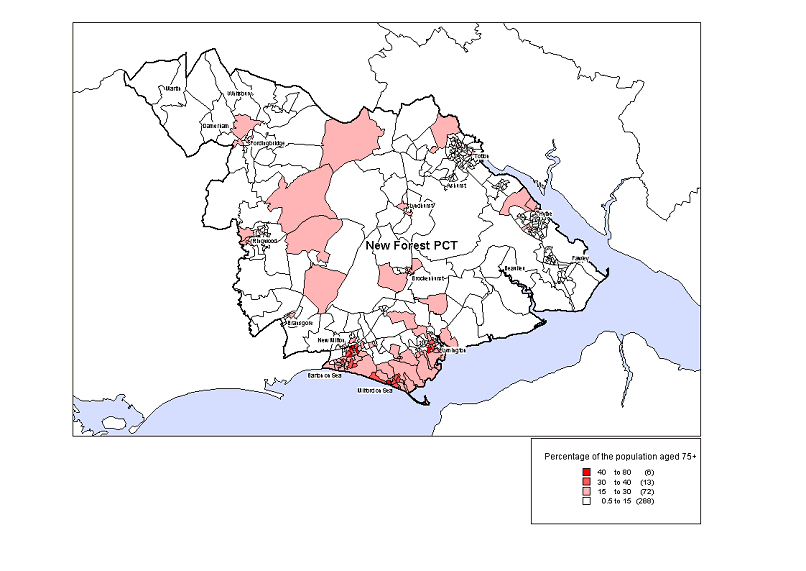
4. THE VALUE & BENEFITS OF COMMUNITY HOSPITALS
4.1 Introduction
This chapter considers the value of the considerable resource currently available as community hospitals. Community hospitals need to be seen not just as place where there are in patient beds, but a valuable resource centres for many groups of people - for example locality based community staff for all care groups, specialist resource centres for varied patient groups and centres of specialist access for the local population (for example a mobility centre associated with specialist clinics in orthopaedics and Rheumotology).
All aspects of care and the efficiency and the effectiveness of the community hospitals are being constantly reviewed and maximised. The success of this is ensuring that patients receive the most appropriate care in the most appropriate environment and that the whole health economy can maximise the bed stock to achieve access targets thereby giving benefits to all. As "Keeping the NHS local" indicated there are sustainable solutions for smaller hospitals to secure their valued role at the heart of communities. Service redesign offers the potential for high quality of care to be offered in smaller hospitals more than has previously been thought possible.
4.2 Current Provision
Community Hospitals in the New Forest
The PCT owns and currently provides services from 4 community hospitals at Hythe, Milford-on-Sea, Fordingbridge and Lyndhurst (The Fenwick Hospital). Some support services and community services continue to be provided from the Graham Rehabilitation Unit on part of the previous Lymington Infirmary site. The Ashurst site is also owned by the PCT but leased by Southampton City PCT who are responsible for service delivery. The PCT also owns and provides acute medical services, elective surgical services, outpatients and diagnostics from Lymington Hospital.
Current Roles and Indication of Distances between Hospital Network
Milford-on-Sea War Memorial Hospital
Milford currently has 9 GP Beds and 10 consultant led Post Acute Stroke rehabilitation beds (from 1 April 03), and an outpatient department which has just been refurbished by League of Friends donations. It has an active day care unit to support the Stroke Unit. The benefits of a dedicated specialist stroke rehabilitation unit for stroke are well established and a requirement of the NSF for older people. The creation of a dedicated Stroke Unit was a significant achievement for the PCT in 2003.
The plan is to repatriate the activity which currently takes place at Christchurch for stroke rehabilitation either when capacity allows in the next few months and at the latest when the Lymington New Forest Hospital is commissioned.
Hythe Community Hospital
Hythe Hospital has 10 GP beds 6 Orthopaedic step down beds and 8 Maternity beds (Southampton University Hospitals Trust).
Hythe has an outpatient facility, X-Ray, Minor Injuries (MIU) facility and houses the main MPTT service for ETVS PCT and NFPCT.
It also provides a base for the provision of many community services (eg. dental, continence, community rehabilitation, childrens services, audiology) from a diverse number of providers including social services as well as providing accommodation for a GP. It also offers a range of out patient clinics for a wide variety of services with visiting consultants for SUHT.
Fenwick Community Hospital
This hospital has 20 beds. The care of the patients is looked after by the GPs supported by a visiting Geriatrician and staff grade doctor. The inpatients fall into two main categories, intermediate care and rehabilitation. A pilot was introduced at this hospital with local GPs to admit patients who are registered with GPs in other parts of the Forest, and lessons learnt from this pilot will be implemented as the new GP contract is introduced.
Following a risk assessment the delivery of surgery from this hospital has been reviewed. Specifically as a result of clinical governance issues the provision of this service has reallocated to Lymington hospital and seven beds have been re-designated as 6 intermediate care beds.
The theatre facility is being converted to a rehabilitation facility for inpatients and outpatients. The Bellwood ward has recently been refurbished including a new bathroom and toilets along with the extension of the day room. (League of Friends donation).
Fordingbridge Community Hospital
This hospital has 31 beds (15 consultant led Salisbury NHS Trust and 16 GP beds). This hospital was previously part of Salisbury NHS Trust prior to the inception of the PCT in 2001. This hospital provides a service to those patients living in the west of the New Forest and also links with hospitals and local authorities in Dorset and Wiltshire. Transport links are very difficult to this part of the New Forest. Some beds are commissioned by South Wiltshire PCT.
There is a small out outpatient facility, X-ray supported by Salisbury NHS Trust and the MPTT is developing its services in this area, particularly for orthopaedics. This hospital mainly provides rehabilitation and intermediate care along with an active day centre. There is also respite care provided to the local population of two beds at any one time. Specialist provision in the form of holiday renal dialysis (3 beds) is provided in partnership with "triple C" (which is a charitable organisation) during six months of the year.
Lymington Hospital (note this is not classed as a Community hospital in the traditional sense)
This hospital has a total of 75 beds. It is currently subject to a PFI scheme because the hospital has outlived its capacity and infrastructure and is unable to provide the environment for modernised 21st Century care. The PFI business case fully describes in detail the new services.
Lymington is a consultant led hospital and has 30 medical beds, a medical admissions ward of 13 beds, 12 surgical beds, 12 day case beds and 8 maternity beds commissioned from SUHT.
It has a Minor Injuries Unit (MIU) open daily from 8am to 9pm which sees 16,000 attendees per annum.
There is a maternity unit of 8 beds, and this service is commissioned from Southampton University Hospitals Trust.
There is one operating theatre, an endoscopy suite, a wide range of outpatient clinics.
It also offers local x-ray facilities (with 35,000 attendees anticipated in 03/04), pharmacy and pathology services. Other diagnostics include cardio respiratory services.
The outpatients department sees on average 25,000 attendees per annum in a variety of specialities staffed by over 35 consultants from SUHT. NFPCT as a provider is on line to meet all its targets for 03/04.
Service and Capital Developments in 2002 and 2003 include:
· Elimination of mixed sexed accommodation and improvement of privacy and dignity of patients. This had to be achieved, despite the fact that the building would be replaced within 2 years.
· New centralised appointment centre designed to allow patients to select a date for their appointment at hospitals throughout the New Forest.
· Improved bronchoscopy facilities and equipment at the day unit (equipped and donated by League of Friends).
· Improved accommodation and valuable new equipment for the cardio-respiratory services.
· Improved bronchoscopy facilities and equipment at the day unit (equipped and donated by League of Friends).
· Improved accommodation and valuable new equipment for the cardio-respiratory services.
· Major new x-ray and ultra sound equipment.
· This hospital, like others has benefited from a significant capital contribution from the League of Friends in excess of £400,000 in 03/04.
Ashurst
This is currently leased to Southampton City PCT who provided hosted clinical services from the site for children and families and in patient physical disability services.
4.3 Local Ownership and Value
Unlike many DGH's which hold little affection from their local communities- community hospitals are very much owned by the local population. Their use and support features regularly on the agendas of local parish council meetings and they all have active leagues of friends. This reinforces their role as part of the local community and the NHS needs to harness this support and ensure that the community hospitals are used to maximise the value they can offer.
They generate considerable finance for the NHS through voluntary subscription. The following table demonstrates the financial contribution attracted by local subscription form each of the hospitals over the last year.
Hospital |
Contribution from League of Friends in 2003/4 |
Fenwick |
£59000 |
Hythe |
£79000 |
Milford |
£123000 |
Fordingbridge |
£5000 |
TOTAL |
£257000 |
4.4 Financial Value
The actual cost of an occupied bed varies between hospitals -not surprisingly given the special nature of the rehabilitation at Milford (i.e. the stroke unit), the costs are higher there.
However the mean cost across all community hospitals is approximately £200 per day compared with £389 per day in an acute hospital. Although it would be inappropriate to transfer many patients from acute care to community hospitals as part of an episode of care. There are several groups of patients, eg. those requiring active rehabilitation who we perceive would experience improved clinical outcomes in a more appropriate facility and closer to home.
More importantly however is the financial value of the Community hospitals for the whole health economy- this is best illustrated with reference to the delayed discharges in the New Forest PCT.
Investing in a senior nurse to develop the bed management team has enabled NFPCT to increase bed occupancy within the community hospitals (see Section D) as well as reducing delayed transfers of care within our three main acute providers and Lymington Hospital. This has had a positive impact on the work and delivery of health and social care within the New Forest. The improvements which have been achieved and maintained at SUHT are outlined in the table overleaf.
The chart above shows that over a 12 month period a local PCT has on average 55.5 DTC's compared with NFPCT with an average of 21.3 DTC's over the same period. Even without taking into account the fact that the average age in the Forest is 10 years older the local PCT this shows that at a cost of a bed at SUHT being £389/day :
11/02-12/03 |
Average monthly DTC's |
Cost per annum |
Total DTC's |
DTC's per 100,000 population |
Local PCT |
55.5 |
£ 7,880,000 |
782 |
22.9 |
NFPCT |
21.3 |
£ 3,024,000 |
299 |
11.7 |
Given that it costs between £1.5-£2 million to run a community hospital for a year and that closing one would tend to lead to larger numbers of delayed transfers of care.
Consideration relating to the cost effectiveness of maintaining the service currently must be given a high priority.
4.5 Effectiveness and Efficiency
What does the evidence say about the value of community hospitals?
The modern community hospital has evolved and adapted within the contemporary NHS and represents an established form of intermediate care widely available across the U.K. However, there has been little robust evaluation of the clinical or economic outcomes of community hospital care. The weakness of the community hospital evidence base is disappointing as its multi-disciplinary structure, its flexibility to respond to a range of conditions and circumstances, its special relationships with local services and its potential to reduce district general hospital bed pressures can make a real difference to the recovery and rehabilitation of older people. In the light of these findings, the Kings Fund in collaboration with Bradford Hospitals is undertaking research to look at four basic questions:
1) Do older people transferred to a community hospital obtain and maintain a greater degree of functional independence?
2) Is carer burden and strain reduced?
3) Is the patient and carer experience more favourable?
4) Is the "whole system" cost (Health and Social Service combined) comparable or less with the community hospital model of care?
The research report has not been published but emerging findings are that community hospitals provide better outcomes for patients admitted for intermediate care in terms of the daily activities which contribute to their quality of life. Importantly they do this without increased cost to the health social care economy (overall LOS ie including both eh DGH and the CH LOS are no longer than usual care - staying in the DGH) and without increasing carer burden and strain which had been a significant finding with some hospital at home schemes which provided home based rehabilitation.
Efficiency
In order to play their full part in the local health economy, the community hospital need to run at maximum efficiency.
Considerable progress has been made in this respect over the last 2 -3 years - the table below demonstrates bed occupancy and LOS for each of the hospitals.
Fenwick Hospital | ||
2002/03 |
2003/04 Apr-Dec | |
Average Length of Stay (ALOS) |
23.36 |
25.97 |
Bed Occupancy Rate (BOR) |
62% |
85% |
Cost per occupied bed (COB) |
£203 |
£198 |
Total revenue allocation (Full Year) |
£1,171,000 |
£1,447,000 |
League of Friend capital contribution |
£59,000 | |
Hythe Hospital | ||
2002/03 |
2003/04 Apr-Dec | |
Average Length of Stay (ALOS) |
27.1 |
22.77 |
Bed Occupancy Rate (BOR) |
56% |
78% |
Cost per occupied bed (COB) |
£264 |
£239 |
Total revenue allocation (Full Year) |
£1,944,000 |
£2,163,000 |
League of Friend capital contribution (Note: ALOS increased as case mix changed - Stroke Unit) |
£79,000 | |
Milford-on-Sea Hospital | ||
2002/03 |
2003/04 Apr-Dec | |
Average Length of Stay (ALOS) |
20.0 |
25.22 |
Bed Occupancy Rate (BOR) |
79% |
73% |
Cost per occupied bed (COB) |
£154 |
£241 |
Total revenue allocation |
£1,223,000 |
£1,628,000 |
League of Friend capital contribution |
£123,000 | |
Fordingbridge Hospital | ||
2002/03 |
2003/04 Apr-Dec | |
Average Length of Stay (ALOS) |
34.76 |
34.69 |
Bed Occupancy Rate (BOR) |
||
Cost per occupied bed (COB) |
£143 |
£153 |
Total revenue allocation/Full Year Effect |
£2,241,000 |
£2,387,000 |
League of Friend capital contribution |
£5000 | |
There is still considerable work to do to improve the bed occupancy and shorten LOS further whilst still maintaining appropriate quality of care. Unfortunately there are not many comparators for Community Hospital performance indicators. As a guide however it is noteworthy that the above LOS are well within the National intermediate care guidance which is of a maximum LOS of 6 weeks (42 days)
4.6 Clinical Governance
The value of the NF community hospitals need to be considered in the light of evidence about the quality of care delivered. This is outlined below:
Clinical Audit
Three major audits have been undertaken in 03/04 at all NFPCT hospital sites (Lymington, Hythe, Milford-on-Sea, Fordingbridge and The Fenwick). These were as follows:
· An Audit of End of Life Care within the hospitals of the NFPCT - This audit was commissioned following the publication of the Commission for Health Improvement (CHI) report on the findings of their investigation into Gosport War Memorial Hospital. (CHI was asked to investigate Gosport War Memorial Hospital as a result of concerns expressed concerning the care and treatment of frail older people who were patients in hospital between 1998 and 2001)
· Senior Monitor Audit of the Community Hospitals in the New Forest
The purpose was to:
o Reflect on and benchmark nursing practice in Hythe, Milford, Fenwick and Fordingbridge Hospitals.
o Ensure the standard of record keeping adhered to the Nursing and Midwifery Council (NMC) guidelines and would reflect the care given in cases where notes were called in evidence before a court of law, in order to investigate a complaint or other appropriate purposes.
o Monitor the issues raised by `Essence of Care'. (A national benchmark of nursing care).
o Recognise particular needs at ward level.
A full action plan has been developed and implementation is being monitored by the Clinical Governance Committee.
· Audit of Patient Care in Lymington Hospital
The purpose was to:
o Monitor the issues raised by Essence of Care.
o Reflect on and benchmark nursing practice in the surgical and medical wards at Lymington Hospital (In-patient Care).
o Show whether the Minor Injury Unit (MIU) provides a defined service supporting Primary Care and the District Hospital Accident and Emergency Department and ensure that clear guidelines of management were in place.
o Ensure the standard of record keeping adhered to the Nursing and Midwifery Council (NMC) guidelines and would reflect the care given in cases where notes were called in evidence or to investigate a complaint or other appropriate purposes.
A full action plan has been developed and implementation is being monitored by the Clinical Governance Committee.
Full copies of the above audits are available on request.
The NFPCT is currently undertaking a fourth full audit in relation to `falls' within the community hospitals.
5. DRIVERS FOR CHANGE
5.1 The Local Delivery Plan (LDP)
This is a 3 year plan which specifies the investment of the New Forest PCT over the period 2003 - 2006. It reflects the Government's priorities and planning framework for 2003 to 2006 'Improvement, Expansion and Reform' in accordance with the NHS Plan. The plan is explicit as to the key investment priorities to be funded from the growth allocation the PCT receives. In summary, the LDP states that during the period to 2006 the NFPCT will:
· Continuously engage with the public and patients in clarifying priorities and requirements for health and social care.
· Reduce waiting times and improve access to high quality care
· Reduced inequalities in our local communities
· Improve and enhance clinical services, in both primary, secondary and social care, and in specialist services
· Support, develop and redesign our workforce to respond to changing patterns of services
· Modernise and redesign services
· Use the Health Act Flexibilities and partnership working vehicles for change, in order to benefit service users.
This LDP is currently being updated to take account of the specific service developments needed to improve services and meet targets during 2004/05. Specifically targeted investments in a variety of services are detailed in the LDP and link to the way in which we propose to develop our community hospitals. (The LDP is available as a separate document).
5.2 Nursing Care Investment Strategy
The PCT has entered into a formal partnership agreement with Hampshire County Council to create additional nursing care capacity across Hampshire. The business case to support this development is underpinned by three key factors:-
· Replacing lost capacity where analysis suggests that between 800-1000 additional places would be required in Hampshire if the present trends in home closures continued
· The number of people waiting in hospital beds for nursing home places
· Growth in the need for nursing care alongside the growth in the population aged over 85.
The Nursing Care Investment Strategy means, subject to planning permission, that 100 new nursing home beds will be created within the New Forest at Ringwood and Totton and they will complement and support to overall level and quality of care for older people in the New Forest.
5.3 The Lymington New Forest Hospital - Private Finance Initiative (PFI)
The Lymington New Forest Hospital PFI scheme is an integral part of the service strategy for NFPCT. The scheme aims to provide services that have a more acute focus, bridging the gap between services provided by our acute partners and the intermediate and community care provided by the current community hospitals and services.
The realisation of this project, in conjunction with the enhanced services planned for the community hospitals, will be an enabler to developing more robust clinical pathways that put the patient experience at the centre of all service planning.
The key to developing the functional content of the new hospital was to view the services delivered from the new site as an integral part of the overall service strategy for NFPCT and not in isolation. Hence as the service strategy within the community hospitals has developed i.e. the re-provision of services from Lymington Infirmary, we have taken the opportunity to review the functional content of the new hospital. In addition, we have been cognisant of the need to ensure strategic fit with Healthfit and in particular with regard to the review of Midwifery services that could result in the development of a stand alone birthing unit serving the whole of the New Forest.
5.4 HealthFit
HealthFit is a strategic framework for future health services in Hampshire and the Isle of Wight. It is consistent with the NHS Plan as the main national strategy for the NHS, and lays out the SHA's development plan for health services within our area.
HealthFit describes the key strategic issues facing the local NHS and those that work within it, and offers a vision for the improvement of specific services. During January, the SHA launched the framework following approximately 18 months of discussion and debate between primary care, acute and specialist Trusts in the area. Integral to the plan has been the input of doctors, nurses and other clinical experts and representatives of the general public. The key drivers for change relate to:
· the changing profile of the population and society's increasing expectation of health service provision
· the importance of securing an appropriately skilled workforce
· opportunities presented by improved information management & technology
· the crucial significance of financial stability
· the need to develop patient choice
· work to tackle health inequalities
· the value of working in partnership with other organisations.
HealthFit examines five crucial clinical services. These are:
· Children's services
· Maternity services
· Emergency services
· Older people's service
· Cancer services
Additionally, it emphasises the requirement for increased capacity within this health economy to achieve the NHS Plan targets, specifically in the area of acute services, both in-patients and out-patients.
The new Lymington Hospital will be an integral component of the HealthFit strategic framework, as it will be providing capacity in the areas of medical beds, diagnostic and treatment facilities and day surgery. Although the majority of DTC services being proposed for Lymington are considered `core services' for our resident population, it will be important to ensure that services of a more specialist nature or where small volumes are indicated, that these are planned on a whole systems basis with the other emerging DTCs in Hampshire. The two developing DTCs for our patch are in Southampton and Winchester.
The Community Hospitals will provide significant benefits for HealthFit in the following areas:
5.4.1 Maternity Review linked to Healthfit Implementation
NFPCT is conducting a review of the two birthing centres within the Forest with the aim to explore the potential for rationalisation.
This work to date has been undertaken in partnership with SUHT and in collaboration with local women, midwives and other stakeholders in the service.
The review of maternity is a key component of the Health fit strategy which links the reconstruction of childcare services and neonatal intensive care.
The emerging midwifery strategy is considering the possibilities for rationalising our midwife-led units across the patch, by additionally providing `centres of excellence' in communities for midwifery. NFPCT's original intention was to re-provide maternity services from the existing Lymington Hospital into the new hospital. However, the other Community Hospitals and other sites need to be considered as potential resources to provide midwifery-led units, identified as necessary by HealthFit to serve women in the New Forest and West of Southampton. Thus there is the potential of redeploying the existing planned midwifery beds in Lymington Hospital as a small private unit - with the consignment financial benefits.
5.4.2 Emergency Services
The Community Hospital will continue and develop further to play a full part in the locality's delivery of HealthFit - Emergency Care. They will do this by:
(a) Acting as locality-based services which will underpin the chronic disease management programmes which are known to reduce unplanned admissions.
(b) Acting as intermediate care resources to provide alternatives to acute admissions.
(c) Facilitating discharge thus increasing acute hospital capacity.
(d) Acting as urgent care centres to deliver the PCT Out of Hours strategy. Since the PCT has decided to deliver an in-house service, the urgent care centres will be able to maximise the value of the Community Hospitals as part of the emergency strategy.
(e) Being part of the New Forest Emergency Network which is all of the above plus the new model of emergency assessment for Lymington Hospital.
5.4.3 Older People
The HealthFit strategy for older people proposes:
· High quality person-centred care delivered as near as possible to
· patients homes.
· Avoiding admission to acute hospital where domiciliary appropriate.
· Facilitating rapid hospital discharge and optimising use of domiciliary and bed based intermediate care, to achieve maximum independence for older people.
As will be seen, there is considerable overlap between this and the emergency care strategy. Likewise, Community Hospitals need to be used to serve both purposes - especially given the older population of the New Forest. In addition, HealthFit also supports the National Service Framework for Older People, aside from the issues outlined above, the medical care shared between G.P and hospital specialist (so called shared care model) will ensure access of all patients in Community Hospitals to specialist assessment and services (for example - stroke and falls).
5.4.4 Diagnostic & Treatment Centre
The new Lymington Hospital will be an integral component of the HealthFit strategic framework and complement the two emerging DTC's in the Mid and South West patch. It will be providing capacity in the areas of medical beds, diagnostic and treatment facilities and day surgery. Although the majority of DTC services being proposed for Lymington are considered `core services' for our resident population, it will be important to ensure that services of a more specialist nature or where small volumes are indicated, that these are planned on a whole systems basis with the other DTCs in Hampshire.
In summary, the new Lymington Hospital should be seen as a key component of the HealthFit strategic framework for Hampshire and the Isle of Wight. This new and modern facility will respond to the needs of the local population as envisaged by HealthFit and play an important role in the whole spectrum of health services across the patch. NFPCT recognises that ongoing discussions will be required with other PCTs and Trusts to ensure that low volume services are not duplicated and delivered within the most effective and efficient way.
5.5 New General Medical Services (GMS) Contract
Since most of the community hospitals have their medical care delivered on a shared care basis (between GP's and consultants), the changes in contractual arrangements with the new GMS contract will effect the model of medical care. Nationally, at the present time, there remains a lack of clarity about the exact position of GPs admission rights to a GP hospital after the implementation of the new contract. It seems certain that the current "bed fund" will have to change so as to allow better financial reward for high quality medical care and more flexible use of the community hospital beds. The PCT is currently developing its proposed approach building on local developments to date. The new GMS contract offers significant opportunities to influence the shift in services from secondary to primary care, as primary care clinicians develop skills of a more specialist nature, eg. GPSi's, specialist nurses, etc. New facilities in our community hospitals will be enhanced to undertake more surgery consultation, etc.
5.6 Change Agent Team
In 2003, the Change Agent Team, which is part of the NHS Modernisation Agency, carried out an analysis of intermediate care for older people. As part of the feedback nationally they advised that we should focus less on bed based options as the solution for intermediate care & develop more home based care services to ensure that community hospitals are available for sub acute care, chronic disease management & rehabilitation.
5.7 Intermediate Care
Over the next three years a Workforce Development Confederation funded project, which is looking at developing an Intermediate Care workforce, will progress. It will enable us to consider alternative models for Intermediate Care. It may reduce the demand for inpatient Intermediate Care. During the course of further work in the next 12 months, in finalising this strategy, the effect of any recommendations will be modelled to take account of the options for final service and bed configurations for each site. (Available as a separate document).
5.8 Continuing Care
Some older people and those with mental health problems may also fall into Category 1 of the Continuing Care eligibility criteria. These patients, by definition are the most unwell, being unstable and needing constant review by health care professionals. Sometimes such patients are managed in nursing homes or at home by relatives and friends who have developed skills because of their caring role. Patients cared for at home will often requires respite care in an environment similar to home. Thus they are regarded as 'Category 1' respite patients and it is an option that some of our community hospital beds could meet these particular needs. It is estimated that the NFPCT population needs 6-10 beds at any one time for its 'Category 1' needs including respite care.
5.9 Length of Stay
The investment in locality teams and bed management has had a positive effect on the LOS of NFPCT elderly patients (over 80 years) within the acute sector reducing from 23.21 days at SUHT in 02/03 to 17.75 days in 03/04. This has had a positive impact on the quality of care experience by the patient and has freed up bed capacity within the acute sector. Work has also taken place to develop and improve the Home Treatment Team for elective and non-elective orthopaedic cases. Not only does this team reduce the LOS for this care group, but NFPCT received a very good rating for low readmissions to hospital within 28 days following treatment for a fractured hip, and according to CHI reported the second best performance against this indicator in the country for the year 2002-03.
6. NATIONAL STRATEGIC CONTEXT
6.1 Patient and Public Involvement (PPI)
The PPI agenda and the requirement to consult and engage with the public on any proposed service redesign or change. This is overseen by the local authority Overview and Scrutiny review of local health services, and the establishment of the independent reconfiguration panel in relation to hospital and associated service developments and redesign.
6.2 Keeping the NHS Local
The DOH publication, Keeping the NHS Local "A New direction of Travel" considered new roles for community and other local hospitals and outlined the expectations for local patient and public involvement in service changes and set out the following principals in relation to the development of services.
· Developing options for change with people not for them. The PCT will approach the next phase of this strategy starting from the patient experience and our commitment to improve choice, working in more depth and detail with our communities, patients and staff to develop new ways of delivering services.
· Focussing on redesign of services within the context of an appropriate location. The PCT believes that redesign can offer a high quality alternative to relocating services, extending the range of options for developing new configuration that meets local needs and expectations. Given the number of sites in the New Forest and in the light of service developments thus far, this option will be thoroughly tested.
· Taking a whole systems view of the NHS, this means the New Forest PCT, in partnership with others and linked to the Hampshire wide proposals for service development (HealthFit) will ensure that it maximises the contributions of different hospitals, primary care facilities, intermediate and social care providers within a whole system, with the objective of achieving more integrated planning and integration of services.
6.3 Choice
The National Choice programme currently focuses on offering individual patients a degree of choice about where and when their planned surgery takes place. That degree of choice may be offered at different points in the patient pathway (for example, after a six month wait or at the point of referral).
6.4 Payment By Results
In October 2002, the DoH released a document that set out plans for fundamental changes to the way funds flow through the NHS. The aim of these changes is to remove prices from local negotiation and so allow discussions to focus on increasing volumes of activity, improving efficiency, reducing waiting times, developing the patient choice agenda and improving quality.
6.5 Reimbursement of Delayed Transfers of Care
Legislation became operational on 1st January 04 and requires local social services departments to reimburse acute hospitals for delays in arranging discharge from hospital. This applies to medical beds at Lymington Hospital.
These more recent policy initiatives which underpin the NHS Plan and NSF implementation also link to local health need and policy initiatives. These are described in the following sections.
7. LOOKING TO THE FUTURE OF OUR COMMUNITY HOSPITALS - IMPORTANT FACTORS TO CONSIDER
7.1 Introduction
The modern community hospital has evolved and adapted within the contemporary NHS and represents an established form of intermediate care widely available across the U.K. However, there has been little robust evaluation of the clinical or economic outcomes of community hospital care. The weakness of the community hospital evidence base is disappointing as its multi-disciplinary structure, its flexibility to respond to a range of conditions and circumstances, its special relationships with local services and its potential to reduce district general hospital bed pressures can make a real difference to the recovery and rehabilitation of older people. In the light of these findings, the Kings Fund in collaboration with Bradford Hospitals is undertaking research to look at four basic questions:
1) Do older people transferred to a community hospital obtain and maintain a greater degree of functional independence?
2) Is carer burden and strain reduced?
3) Is the patient and carer experience more favourable?
4) Is the "whole system" cost (Health and Social Service combined) comparable or less with the community hospital model of care?
The NFPCT has been continually considering the above questions. Along with information, local knowledge and evidence based practice it is proposing the following opportunities for usage at the hospitals in future:
7.2 Specialist Rehabilitation
The benefits of a dedicated specialist rehabilitation unit for stroke patients is well established and a requirement of the NSF for older persons. Demographic information suggests that a unit of 15 beds would accommodate the needs for the NFPCT. Currently 60% (10 beds) are provided in Milford hospital and there are plans to move these beds to the new hospital in 2006. Some specialist stroke rehabilitation is also commissioned from Christchurch hospital. The plan is to "repatriate" activity when extra space in the new hospital is available. Other consultant led specialist rehabilitation need is difficult to estimate, since it is currently provided within the existing community hospital complement. There will always be a need for consultant input into complex rehabilitation, the shared care model of rehabilitation, ensuring consultant input into the hospitals is likely to be the best model for the patients.
7.3 Urgent Care Centres - Services 'Out of Hours'
The new GMS contract allows GPs to pass the responsibility for their patients treatment `out of hours' to the PCT. The PCT is developing an in-house Out of Hours (OOH) service. This will include visits and Urgent Care Centres (UCC).
UCCs are being established in three areas of the New Forest PCT area. The units in Hythe and Lymington will be integrated with the Minor Injuries Units to provide comprehensive Urgent Care Centres. The third unit will not be integrated and will be based on a model of a Primary Care Centre, this will be located in Fordingbridge initially, but may move to Ringwood later.
The Urgent Care Centres will be Practitioner (from Nurse and Paramedic backgrounds) led and will deal with patients from Primary Care OOH on an appointment basis and with Minor Injuries on a walk in basis. Doctors will be available for referral of Primary Care patients during the Out of Hours periods as part of the Out of Hours service.
Since Community Hospitals are recognised already by the local population as health resources, the setting up of urgent care centres in one or two community hospitals makes economic sense and maximises the use of existing resources. The additional benefits of integrated MIU and Primary Care Treatment centres are not only financial as the integrated workload will provide greater flexibility and maintain competences of the practitioners working within them.
7.4 Continuing Care including Respite
The community hospitals provide specialist nursing care together with ready access to geriatricians and allied health professionals. They are thus ideally suited to manage the needs of older people with and without mental health problems, who are in category 1 of the NHS continuing care eligibility criteria. These patients by definition are the most unwell, being unstable and needing constant review by health care professionals.
It is probable that the needs of such patients could be met with the development of a continuing care unit or a dedicated facility within a community hospital (which would be subject to the same National Care Standards as other, private providers). This issue is of paramount importance as investment in the private sector is escalating beyond affordability.
Sometimes such patients are managed at home by relatives and friends who have developed skills because of their caring role. Such patients will often need respite care in an environment similar to that they would have experienced had they not been at home. Thus they are regarded as category 1 respite patients and such a community hospital unit could suit their needs also.
It is likely that the NFPCT population needs 6-10 beds at any one time for its category one needs including respite care.
Category 2 patients will continue as now to have their respite provided in a variety of ways - the shared care unit at Solent Mead (a local authority extra care rest home in Lymington) continues to provide an innovative model of care and was developed as part of the Lymington Infirmary reprovision.
7.5 Public Health Function
The community hospitals are not just about beds and buildings. They are strategically placed to focus on a range of community activities relating to screening and prevention, eg. fallers prevention groups.
7.6 Expanding Intermediate Care
Intermediate care provided from our facilities should ensure both early discharge from a District General hospital (referred to as post acute care) and where possible prevent admission in the first place.
Planning for the exact number of intermediate care beds is not a precise science. The New Forest has within the last 12 months dramatically remodelled its bed numbers and indications to date confirm that those changes are robust and sustainable. Clearly, any approach or further change must link to anticipated need, service configuration and number of beds in the proposed new Lymington/New Forest Hospital.
The need for intermediate care beds is determined by a range of factors such as:-
· The current waiting list for a post acute care bed which generally is ten patients at any one time across the New Forest.
· The positive impact the orthopaedic stepdown beds and home treatment community services has had on length of stay and patient experience including reduction of readmission notes.
· The British Geriatric Society (BGS) figures for Intermediate care need based on a limited amount of published research, indicates the number of beds 12.3 per 100k population. This would suggest that the NFPCT requires 221 beds to meet its populations needs. This is far more than the 85 beds which are currently provided (January 2004) in the New Forest community hospitals and also includes those currently commissioned from other providers e.g. stroke facilities at Royal Bournemouth & Christchurch Hospital.
· The BGS figures should be considered to be an over estimate as the non-residential multi-agency alternative models have not been factored into the 'equation', as yet. Our experience from the Lymington Infirmary reprovision is that one quarter of intermediate care bed requirements can be provided by adequately resourced community based services.
8. THE MODERNISATION AGENDA
8.1 Introduction
Locally, the PCT has developed a model of working with Hampshire County Council Social Services, whereby some of the beds in our community hospitals will be used for what is termed "interim care," This will benefit patients as they will be ale to spend the rehabilitative element of their care closer to home. It will also benefit the local health community as it will release valuable acute bed capacity in our three local acute providers and improve the throughput of patients in acute beds at Lymington. Careful monitoring will ensure delays do not increase disproportionately within the community hospitals. Scope for financial reimbursement between social services and the PCT for the use of these beds as "interim care", is currently under discussion.
In the modern NHS community hospitals continue to demonstrate a high level of satisfaction from local users of the service. Within NFPCT there is a low level of complaints about our community hospitals many compliments relating to care received Facilities at all our community hospitals have contributed to an overall lowering of the NFPCT and other providers access times for a range of services, including outpatients, diagnostics, and rehabilitation services, amongst others.
8.2 This framework has discussed the many possibilities for optimising the usage and the new funding that our community hospitals and services can undertake. Achieving these aspirations will require new ways of working, different approaches by staff and skills development. This can be best described by the following Case Study which discusses the present, the short-term future and the long-term potential:
8.2.1 Case Study Example
Mrs Y is a 95-year-old lady who is generally completely independent and self-caring with weekly home-help for domestic chores only. For the last few days she has felt unwell and shivery and has taken to her bed for a couple of days with self-administered Paracetamol for a "chill". She wakes at night, feeling unwell and falls on her way to the bathroom. She calls her Lifeline, who call her daughter, who, in turn, calls an ambulance.
What happens next can be described in three possible scenarios:
i) The Current Situation:
The ambulance driver visits and notes that besides a fall, her temperature is elevated and she is rather unwell. The ambulance crew feel she is too unwell to leave overnight, so they suggest taking her to hospital. Lymington Minor Injuries Unit is closed, so she is taken to the Accident & Emergency Department at SUHT, which is very busy. She is assessed by an emergency care SHO who thinks she has pneumonia. He arranges blood tests, an ECG and a chest x-ray. Two hours elapse to get these results. He then calls the on-call medical team for admission.
The on-call SHO in medicine reviews her an hour later, by which time it is 04.30. He is not sure that she really needs admission, but thinks it likely; therefore, he advises and starts antibiotics and lets the bed manager know. The patient sits in Casualty until a bed is eventually found at 10.00 a.m. and the patient arrives on her new ward at 10.45 a.m. By that time, she has missed the Consultant post-take ward round and, unfortunately, is missed off the list. Nonetheless, the treatment started is perfectly appropriate and is continued. The patient is much less feverish, but is not eating and drinking well. The next day she is moved to another ward because of bed pressures and the new medical team note her to be dehydrated. They continue the previous treatment started in Casualty and also give her some intravenous fluids. The patient has now been bed-bound and immobile for thirty-six hours. The patient is a little tearful and rather muddled about what has been happening. The Consultant ward round later that day identifies the need for rehab, as the patient is really rather poorly mobile; however, the Consultant who lives and works in Southampton is not sure where the rehab should be. The Community Discharge Liaison team assess the patient the next day and put her on the waiting list for a Community Hospital in the New Forest, assessing her as "not ready" as she is still having intravenous fluids. A week later, the patient has now been immobile for over ten days. She has no intravenous fluids up, she is eating and drinking better and is able to move to her Community Hospital. She now makes extremely slow progress because of a tremendous loss of confidence, but, eventually, is discharged home with an augmented home care package, some three weeks later. Her overall length of stay in hospital has been about four and a half weeks, and she is having a high cost package on discharge.
ii) An interim scenario which could occur over the next three years:
Ambulance on arrival to the patient's home notices that the patient is unwell and decides that she needs admitting to hospital. However, new protocols have now been developed so that the ambulance driver can call Lymington Hospital medical team directly and ask for her to be assessed there. She is assessed on the ward by the medical SHO, straight into a hospital bed and investigations etc., are done. She is seen by a Consultant within twelve to eighteen hours. Although intravenous antibiotics were started initially, a care pathway has pre-determined when she will switch to oral antibiotics. The patient is able to eat and drink from the start, although subcutaneous fluids are given for two days to augment this. It is determined on the post-take ward round that she will need a Community Hospital and local knowledge allows her to be put on the waiting list straightaway. She is moved within twenty-four hours, as the nurses in the Community Hospitals are able to monitor her chest and administer fluids appropriately. The patient's own G.P. and the visiting consultant continue to care for her. The Locality Team of Therapists and Social Workers do a home assessment with her daughter the same week. The patient is fully mobilized from the start. A week later, after admission to the Community Hospital, the patient remains frail, but mobile. She is discharged four days later with an augmented home care package, two weeks after her initial admission. The Rehab Assistant from the Locality Team visits her regularly at home and the augmented home care package is able to step down at two weeks.
iii) Revision for the New Forest network - three to five years' time:
By this time the Single Assessment Process and Locality Teams will be well-established, meaning that patients' vulnerability is known to the Locality Team. Arrangements are in place with the family and patient for an "early warning system", so that when a patient becomes unwell, the G.P. is alerted immediately. The falls risk at this stage is recognized by the team and extra care put in, including equipment, such as a commode to reduce the need for mobility. Even if the patient falls (and it is recognized that this might not be avoidable), the ambulance crew visit. They put her back to bed having excluded bony injury, knowing that the Multi-Disciplinary Locality Team will assess her fully the next day. In addition, patient-held single assessment process records show who is involved and what the current diagnosis is. The locality team visit during the next day. A discussion with the local G.P., patient and family suggests that she needs overnight, 24-hour care and, therefore, she is admitted straight to a Community Hospital under the shared care of her G.P. and Consultant Geriatrician. She is discharged straight home, within two weeks, once her mobility and self-confidence is back to normal. There is no additional home care needed, as the patient is fully mobile, and both her daughter and she have confidence that they have a system of accessing help immediately via the single point of access in the locality team.
9. DIRECTION OF TRAVEL FOR OUR COMMUNITY HOSPITALS - 2004-06
9.1 Options for the Future
Community hospitals have the potential to become health and social care specialist resource centres for the entire Forest and not just in their own patch. This renewed focus will enable them to deliver an enhanced quality of care to specific and generic client groups, and assist to address the public health agenda. Having reviewed the currently improved bed occupancy rate at community hospitals the `excess bed days', ie. availability capacity, have been calculated. This has indicated that if this capacity is used along with reducing the average length of stay (ALOS) at Lymington Hospital from 10 days to 7 days, then 15% of non-elective admissions can be diverted from all acute services to NFPCT hospital capacity relating to £1million worth of activity. Before change can take place, full discussion with staff and the community, followed by consultation will have to be undertaken but possibilities are listed below.
9.2 To Close or Not to Close?
Any considered discussion document relating to services delivered from buildings must sensibly consider closure as an option. In doing this, it must be recognised that:
· The PCT's community hospitals have a role in reducing the pressure on the acute services. If the beds were not there, the patients who occupy beds would not disappear and this in turn would increase the pressure on the acute sector, national access targets and delayed transfers of care.
· The PCT has an obligation to discuss and consult with patients and the public along with stakeholders regarding any changes.
· These hospitals enjoy considerable local ownership and investment.
Innovative developments and the reconfiguration of services within and outside of our hospitals will deliver significant and cost effective health gain for the local population and will effectively support the new hospital.
9.3 Fenwick Hospital
· Continued use of these 20 beds for intermediate care for the Totton/Lyndhurst catchment population having already accommodated 15 beds from the Western Hospital, Millbrook, Southampton.
· This hospital has a central location in the Forest and has quick road links to SUHT thereby making it a good option for a birthing and children's centre for the forest. This redefinition of a health facility will depend on the out come of the Healthfit maternity review.
· Others to be identified with local community discussion and consultation.
9.4 Hythe Hospital
The total of 19 beds at Hythe are currently playing their part in the NFPCT and wider health economy achieving all its targets and are currently efficient and effective. The long-term solution is to re deploy these beds for the following
· Develop as mobility centre including Rheumatology with the development of Podiatric surgery and the expansion of orthopaedic step down beds. There is the potential to develop the main orthopaedic outpatients department for the New Forest thus refocusing of other out patient activity to Lymington e.g. ENT, diabetes and surgery.
· Depending on the outcome of the maternity review there is the potential to re-designate beds 8 beds to meet the needs of intermediate or continuing care or for day beds in relation to orthopaedics or podiatric surgery.
· Development of an urgent care centre in recognition of the high population base here (2004).
· Continuing use for Intermediate Care including the potential to develop nurse or allied health professional led models of care.
· This hospital has reasonable road links to SUHT (although not good within `rush hours'). It is an option for a birthing and children's centre for the Forest. This redefinition of a health facility will depend on the out come of the Healthfit maternity review.
· Others to be identified with local community discussion and consultation.
9.5 Milford on Sea Hospital
· Milford Hospital will play its part as a specialist resource for older people. Specialist rehabilitation currently provides the stroke unit and would need to continue to do so until the new hospital is completed.
· This hospital has the ability to be developed into a centre of excellence for a care group which is causing access difficulties to the health system e.g. dermatology both in out patients and minor procedures.
· Continued use as an Intermediate Care unit.
· Potential use as a specialist continuing care unit for older people and older people with mental health problems.
· Others to be identified with local community discussion and consultation.
9.6 Fordingbridge Hospital
· Fordingbridge will continue to offer a range of intermediate care services in view of its isolated location and important relationship with Salisbury. This is the only inpatient facility in the west of the Forest. It is proposed that this facility will enhance its role a centre of excellence for Intermediate care.
· Development of an urgent care centre associated with the change in out of hour provision (2004).
· Potential for the development as a specialist stroke rehabilitation unit for Ringwood/Fordingbridge patients.
· The continuation of the current outpatient, day care, physiotherapy and x-ray activity.
· Others to be identified with local community discussion and consultation.
9.7 Lymington New Forest Hospital (this is not classed as a community hospital)
This hospital is currently subject to a PFI bid and the final business case is now complete. This hospital will act as the central hub to both the community hospital network but also community health and social care delivery. It directly admits acute medical patients and has protocols in place (including the ambulance service) to exclude patients who are likely to require urgent surgery.
The New Lymington hospital will be the hub of the delivery of a "ambulatory care plus" model as described in "Keeping the NHS Local" which has been described as having much in common with Kaiser Permanente (California) approach to primary care.
9.8 Ashurst Hospital
This hospital is currently leased to Southampton city PCT and NFPCT is undertaking an option appraisal regarding future use of disposal, if it is deemed appropriate after consultation, to relocate the current services. (This excludes the Snowdon Unit).
9.9 Considering Options
The possibilities for each site are described above. However, the relationship between the various hospitals is critical to good efficiency and are illustrated in the following diagram:
OPTIONS
NEW FOREST PCT - HOSPITAL NETWORK 2005 - 2006
10. INVOLVING OUR COMMUNITY AND STAKEHOLDERS
10.1 Introduction
The engagement of local people in their health service is more evident in respect of community hospitals than in many other aspects of the NHS. Any changes made to the current configuration of our community hospitals need to be made with informed involvement with the local communities and stakeholders so that the PCT can then determine the next phase of implementation of its community hospitals strategy.
We will ensure that potential changes are discussed and appropriately communicated to all our local stakeholders so as to ensure that there is a clear understanding of possible changes in health care and social care provision. This process will unlock the potential change of use and configuration of our local community hospitals, with full community involvement to ensure that we develop services that meet the needs of the whole of the New Forest population
10.2 Future Potential of the Community Hospitals
It is recognised that all services including the community hospitals have to be continually reviewed to ensure that the PCT does fulfil its duty to consider and redesign services to achieve its objectives.
The NFPCT recognises that prior to consultation on any specific service change it has to demonstrate that it has invested time and energy in working with the public, service users and other stakeholders in the development and shaping of the plans for the use of community hospitals. A recent example of this has been Lymington Infirmary reprovision programme.
It is our intention to continue with this approach which was described to over 100 members of the public who attended the November launch of the `preferred provider' for the Lymington New Forest Hospital PFI. At that meeting we articulated our intention that with the development of the new hospital and the modernisation of services, the community hospitals will be required to have their current function reviewed.
Keeping the "NHS Local" reflects that it is an exciting time for smaller hospitals but their traditional role which as been changing gradually will have to change even further and the services they provide modernise more to enable them to provide a more integrated range of clinically effective services at the heart of the local communities. NFPCT recognises all the sensitivities around re modelling services within this sector and takes it responsibility to consult with the public and partners very seriously. This discussion document sets out our initial thoughts about the short and longer term potential for individual hospitals and associated services.
In line with Section 11 of the Health and Social care act 2001, the PCT is mindful of the following responsibility: "To make sure patients and the public are involved and consulted from the very beginning of any process to develop health services or change how they operate".
11. SUMMARY
11.1 This document demonstrates that the community hospitals have moved from the service profile that existed 3 years ago. This needs to further develop in the next 3-5 years. The NFPCT does not see its facilities as `buildings with beds', but as a resource which provides a presence for health and social care services within each of our localities in the New Forest.
11.2 NFPCT has a track record of redesigning services and care pathways to maximise the potential of its hospitals and services. This was demonstrated by the Lymington Infirmary reprovision.
11.3 Given:
· an ageing population
· increasing sub-specialisation secondary care
· the need for local services that are cost effective
NFPCT needs to create service specific centres that allow flexibility in care provision and allow such innovations as medical day care, nurse led beds and early rehabilitation. This will have significant impact on commissioning and the resultant repatriation of work to the PCT. It also allows the low risk services to be taken out of high cost overextended secondary care and for appropriate care to be given to all in an appropriate, caring and flexible environment.
11.4 There will be yet a further major review of configuration of the community hospitals following completion and impact assessment of the following key initiatives:
a) Completion of the new Lymington New Forest Hospital and the report of activity from existing providers and services.
b) The HCC Social Services nursing home scheme is operational.
c) The maternity review is completed.
d) The Intermediate Care workforce project is completed.
e) Continued development of locality based teams complimented by the development (joint health and social services) of a proactive in-reach model to the acute services to reduce the delayed transfers of care.
11.5 NFPCT has major financial challenges to content with and recognises that once the new Lymington New Forest Hospital is fully operational and commissioned the locality based services have developed and matured, there may be a requirement to review the configuration of the hospitals.
11.6 NFPCT will commence the review of the configuration of community hospitals with full PPI and stakeholders participation over the coming months with the production of an agreed strategy by the Autumn of 2004.
APPENDIX 1
SUMMARY OF BED NUMBERS - COMMUNITY HOSPITALS (EXCLUDES LYMINGTON HOSPITAL)
2002 |
2003 |
2004 |
|||||||||
GP Beds |
Cons Beds |
Total |
GP Beds |
Cons Beds |
Shared Care |
Total |
GP Beds |
Cons Beds |
Shared Care |
Total | |
Fordingbridge |
16 |
15 |
31 |
16 |
15 |
0 |
31 |
16 |
15 |
0 |
31 |
Infirmary |
37 *1 |
37 |
0 |
0 |
0 |
0 |
0 |
0 |
0 |
0 | |
Hythe |
16 |
0 |
16 |
10 |
6 *6 |
0 |
16 |
10 |
6 |
0 |
16 *7 |
Fenwick |
15 |
7 *5 |
22 |
0 |
0 |
20 *2 |
20 |
0 |
0 |
20 |
20 |
Milford |
19 |
0 |
19 |
9 |
10 *4 |
0 |
19 |
9 |
10 |
0 |
19 |
Western |
0 |
15 |
15 |
0 *3 |
0 |
0 |
0 |
0 |
0 |
0 |
0 |
TOTAL |
103 |
37 |
140 |
35 |
31 |
20 |
86 |
35 |
31 |
20 |
86 |
2005 |
2006 |
|||||||
GP Beds |
Cons Beds |
Shared Care |
Total |
GP Beds |
Cons Beds |
Shared Care |
Total | |
Fordingbridge |
16 |
15 |
0 |
31 |
16 |
15 |
0 |
31 |
Infirmary |
0 |
0 |
0 |
0 |
0 |
0 |
0 |
0 |
Hythe |
10 |
6 |
0 |
16 |
10 |
6 |
0 |
16 |
Fenwick |
0 |
0 |
20 |
20 |
0 |
0 |
20 |
20 |
Milford |
9 |
10 |
0 |
19 |
9 |
10 |
0 |
19 |
Western |
0 |
0 |
0 |
0 |
0 |
0 |
0 |
0 |
TOTAL |
35 |
31 |
20 |
86 |
35 |
31 |
20 |
86 |
Key:
*1 Infirmary Technically 37, 30 only open (prior to 2002 - 7 beds variable, 1st floor closed for Health & Safety)
*2 Fenwick Refurbished - facilities, 1 bed lost
*3 Western Notice given, very poor bed occupancy
*4 Milford Consultant led post acute stroke rehabilitation beds
*5 Fenwick 7 surgical beds (re-designated to 6 intermediate care in 2003)
*6 Hythe Orthopaedic stepdown beds
*7 Hythe Excludes 8 maternity beds
Hampshire County Council Appendix Six
Health Review Committee: 25 May 2004
Hampshire Partnership: reprovision of LBHUs for people with a learning disability
From: Project Manager of South West Hampshire LBHU Re-Provision Project
Date: 21st April 2004
Subject: Consultation on the Re-Provision of Locally Hospital Based Units for Clients with learning disabilities in South West Hampshire.
1.0 Background
A full business case (FBC) for the following proposal has been produced and has been formally approved by the partner PCTs (Eastleigh and Test Valley South PCT, New Forest PCT, Mid Hampshire and Southampton City PCT). This FBC has the full support of Hampshire County Council as a key stakeholder. Hampshire & Isle of Wight Strategic Health Authority is due to receive and formally approve the FBC on the 11th May 2004.
2.0 The Proposed Change of Service
The re-provision of Locally Based Hospital Units (LBHU) (long stay NHS hospital units for adults with a learning disability which are registered with National Care Standards Commission and provided by Hampshire Partnership NHS Trust) is part of a wider programme of change which will deliver the closure of long stay hospital facilities for people with learning difficulties during 2006 (Valuing People: A New Strategy for Learning Disability for the 21st Century White Paper DOH 2001).
The overall programme involves the closure of 5 LBHUs in South West Hampshire (Hillrise, Townhill Way, Bishopstoke House, Kennard Road and Ravenhurst) and 3 units in Southampton City (Oakfield House, Grove House, and 9a Bath Road). The reprovision will develop person centred services and will involve the following:
· Long term investment in the new service model of supported housing. This includes both the provision of suitable accommodation and the provision of domiciliary care services to support people in the new accommodation.
· Investment in Primary care services.
· Re-provision of the respite care beds currently provided at Bishopstoke House.
· The provision of individual residential placements for people in LBHU's who are not suitable for the proposed supported housing.
2.1 Service configuration:
· Individuals living within the existing LBHU's will be rehoused into ordinary `domestic' dwellings within a location of their choice and with people of their choice.
· Support will be provided on a domiciliary care basis and tailored to individual needs and preferences enabling the individual needs and preferences enabling the individual to live their preferred lifestyle.
· Support services will respond to individual person centred plans, which will be developed with carers, advocates and friends.
3.0 Involvement of Key Stakeholders
Extensive public consultation has been carried out during the development of this proposal and includes the following:
· Project structure includes carer (Relatives Consultative Group) and user representation (Choices Advocacy) at Project Board and Implementation Teams.
· Senior Officers from Health and Local Authorities have attended regular meetings at the local Relatives Consultative Group.
· The Community Health Council were members of the Project Board.
· Relative meetings have been held in each LBHU.
· Relatives, users and staff have participated in person centred planning and supported living training.
· Attendance at New Forest PCT, Eastleigh & Test Valley South PCT, Mid Hampshire PCT, Southampton City PCT, Southampton & South West Hampshire Health Authorities and West Hampshire Trust Board meetings (held in public).
· Learning Disability Partnership Boards (Hampshire County Council and Southampton City Council).
4.0 The Case for Change
4.1 Resident's and relative's opinion of existing services
Dissatisfaction with the service in the LBHU's is well documented by the local Relatives Consultative group. The group have had support from the local CHC as well as local MP's in the campaign for this re-provision, and echo the concerns raised in a critical Health Service Commissioners (Ombudsman) report in late 2001.
The key areas of dissatisfaction are:
· Unsuitable mix of clients.
· Inappropriate buildings for care required by some residents.
· Inadequate assessment of needs and associated training.
· (Virtually) non-existent day activities.
· Insufficient staff.
:
4.2 Key policy and strategic drivers:
· National guidance promoting choice and independence for people with LD and their families, particularly with respect to where and how they live; and receipt of mainstream health care (Valuing People DOH 2001).
· National target for the closure of long stay (NHS) residential services in 2006 (recently extended from the original target of March 2004), of which LBHU are an example (Valuing People 2001).
· Delivery of local strategic commitments concerning the closure of LBHUs and the development of more appropriate services and facilities. (Partnership Boards, Southampton and South West Hampshire Health Authority.
· Key target within Southampton City Council and Hampshire County Council Joint Investment Plans 2001-2004.
· Health Service Commissioner's (NHS Ombudsman) findings in relation to the former NHS Trust, Southampton Community Health Services Trust and Southampton & South West Hampshire Health Authority.
· Compliance with the Care Standards Act (2000).
· Response to the views and concerns of users and carers.
· Signposts for Success (DOH 1998)
· Strategic Health Authority, Healthfit (2002 - 2003)
4.3 Operational and clinical drivers
The key operational issues that need to be addressed within the LBHU services are:
· They provide inappropriate and inadequate accommodation and the layout of LBHU's undermine the social and clinical objectives of the service.
· Inability of the current model to deliver a person centred service.
· Recruitment, retention and staff quality problems.
· Poor health outcomes.
· Inappropriate mix of clients.
· Evidence of risk to clients due to challenging behaviour, staffing levels and institutional processes.
5.0 Timescales for Re-provision Project
Subject to formal approval from Hampshire & Isle of Wight StHA the timescales for the project are as follows:
Key stage |
Deadline |
Approval of Final Business Case |
11th May 2004 |
Completion of agreement with Registered Social Landlords as preferred providers for Hampshire |
1st September 2004 |
First residents move into new houses |
September 2006 |
Commence marketing the LBHU's for sale |
March 2004 |
Closure of last LBHU |
31st October 2006 |
Sale completed on all LBHU sites |
30th November 2006 |
Completion of Post project evaluation |
30th November 2007 |
6.0 Conclusion
The supported housing option provides the most opportunities for people with a learning disability to enjoy an ordinary life. It fulfils the key principles of Valuing People; rights, choice, inclusion and empowerment.
Hampshire County Council Appendix Seven
Health Review Committee: 25 May 2004
Response to Foundation Hospitals Consultation
1. Background
1.1 Three acute hospitals in Hampshire and two in neighbouring counties are applying to be NHS Foundation Trusts (NHSFTs) with effect from October 2004.
1.2 Wave 1a of applicants for Foundations status includes the following acute hospitals in Hampshire
· Southampton University Hospitals Trust (SUHT)
· Winchester and Eastleigh Healthcare Trust (WEHT)
· North Hampshire Trust
1.3 In addition the following neighbouring Trusts are also seeking Foundation status
· Royal Bournemouth and Christchurch Hospitals Trust
· Frimley Park Hospital Trust
1.4 If approved these Trusts will be launched as Foundation Hospitals in October 2004.
1.5 As part of the application process each Trust was required to undertake a 10-week consultation period, commencing on the 23 February 2004. The consultation process focused on the intended governance arrangements, although it was expected that the Trusts would include an outline service development strategy that described how services would be provided in the future.
1.6 Local authority interest in these arrangements included
· The way in which local authority representation on the Board of Governors is secured and arrangements for engaging with different communities and interests when deciding membership. This is likely to be complex where specialist services are provided across a wide population.
· Ensuring that any proposals for significant variation or development in service provision are subject to appropriate consultation and scrutiny. Although it is unlikely that the consultation on the governance arrangements will include proposals to substantially change services the service development strategy may include developments that will need to be subject to scrutiny and formal consultation.
· Consideration of any impact that the proposals may have on services provided by local authorities and the voluntary sector
2. General Comments
2.1 In responding to the consultation process Hampshire County Council Health Review Committee (the Committee) has a particular responsibility to ensure that the proposals put forward by the NHS Trusts are in the interests of the health services in the area affected. The NHS Trusts applying for foundation status from October this year provide health services to a significant proportion of our population. It is therefore essential that we understand the consequences of foundation status, not just from the perspective of the Trusts themselves, but in the wider context of the health economy of Hampshire. The consultations do not ask whether the Trusts should seek foundation status but are limited to seeking comments on the arrangements for governance. This distinction in its own right is a cause for concern as it is imperative that these changes are in the interest of, and supported, by local people.
2.2 The speed with which the applications have needed to be drawn together and the short consultation period set by the Department of Health has curtailed the ability of the Committee to ensure that all the relevant issues have been satisfactorily addressed, not least of these is the fact the legislative processes supporting the introduction of Foundation Trusts (FTs) are still unclear and have been subject to considerable controversy in their passage through Parliament. As such the Committee is taking the view that the comments made should been seen as the initiation of a dialogue with the Trusts concerned and wider NHS about the way in which health care will be provided to our population in the future.
2.3 In responding to the proposals put forward by the 5 potential FTs the Committee is not opposing the applications, particularly as these Trusts have achieved the distinction of three star status and each has a track record of delivering service improvements for patients. We would wish to emphasise that this reflects our support for the vision and commitment of the local NHS and does not indicate our endorsement of the policy framework within which Foundation Hospitals have been formed.
2.4 There may well be advantages to enabling payment for services to be linked to activity and the additional flexibilities that can be utilised from any surplus generated. Nevertheless these advantages will also bring risks that need to be carefully evaluated in the context of the wider health economy. These include the increasing demands for locally based community services and the impact that FT status will have on acute Trusts that are unable to proceed in this wave of applicants. The Committee is not clear, for example, how any additional costs associated with Private Finance Initiative schemes will be accommodated in the national tariff rates. This could raise issues relating to the affordability of these schemes which will need to be carefully evaluated.
2.5 Members are also concerned that the fragmented way in which major change is being implemented in the NHS could destabilise the local health economy and introduce an inappropriate competitive tension between service providers. FTs are but one part of a number of wide-ranging reforms that the NHS is going through. Changes to the way in which primary care services are delivered, the introduction of the `Choice' agenda and `Payment by Results' will have a significant impact on the way in which NHS care is provided. Overlaying this national context are the significant financial challenges facing the health economy in Hampshire and the Isle of Wight. It is vital that these changes link together to provide high quality and accessible health care to local people. Partnership working and commissioning that is based on the needs of the population must drive the development of locally responsive services. Although FTs will have a `duty of partnership' included in their licence it is not clear how this will be interpreted to support a `systems' approach across the local health economy. The Committee will seek the views of the Independent Regulator on how this can be achieved.
2.6 In terms of assessing the individual consultation documents it has not been possible to determine what services will actually be provided by the FTs and if these vary from current provision. The regulator requires that a schedule of services and assets be submitted as part of the assessment process however the limitations on the breadth of consultation determined by the Department of Health means that it this information has not been included in the consultation process. The Committee considers that this is a significant omission and will ask for this information from the Trusts concerned.
3. Further Information Required
3.1 In considering its response to each of the Trusts the Committee has sought to separate its concerns about the policy framework being set nationally from the local proposals that are the subject of consultation. As a result a number of wider questions have been raised that need to be followed up. The Chairman of the Committee will therefore write to the responsible bodies identified below to secure additional clarification and information. The responses received will be shared widely with our partner organisations.
3.2 Governance and Accountability . The Committee considers that there needs to be greater clarity about the role of the membership and the board of governors and their accountability. By focusing on patients and public in a particular area there is a danger that the emphasis will be on the services provided by the FT rather than the wider needs of the population. By definition the membership will be self selected and cannot be representative of particular populations. The Governors have a role to `represent the interests of the members and partner organisations' not the wider population in a particular area or different service users. Trusts providing a wide range of specialist and general services to different catchment populations face particular challenges in responding to this fact.
3.3 Reports on the first wave of Foundations Hospitals are suggesting that some have not been able to fill public/patient places on Boards of Governors. This point, linked to comments that the power base of the FTs will rest with the Board of Directors rather than a dispersed membership and a Board of Governors that meets relatively infrequently is a source of particular concern to the Committee. Action The Committee will invite the views of the Independent Regulator on the action necessary to ensure that there is appropriate accountability to, and involvement of, the membership and Board of Governors by FTs.
3.4 The NHS will need to make difficult decisions about where its limited resources should be directed. The extent to which the membership is able to influence these decisions on behalf of the populations affected needs to be fully explored. As a minimum the Committee will expect that the regulator places particular emphasis on the extent to which the Trust is able to demonstrate implementation of Section 11 of the Health and Social Care Act when assessing the performance of the Trust. In addition there needs to be a clearly defined route through which local authority overview and scrutiny committees can raise issues of concern with the regulator on behalf of their populations. Action: The Committee will invite the Independent Regulator to confirm that FTs should demonstrate delivery of the duty to involve patients and the public in planning and delivering services. This will include an exploration of the value of establishing a route through which overview and scrutiny committees can draw an issue to the attention of the Regulator.
3.5 Management of funding flows to support new models of care. Much debate has been focused on the way in which the FTs will use their funding flexibility to invest in service improvements for patients. This in its own right raises questions about whether it will be patient need, or the financial benefits of a particular service that will drive improvements. It must also be remembered that technology and other advances are making it possible to provide an increasing range of services in community or intermediate settings. This point is particularly relevant for the management of chronic disease and is helpfully reflected in `Keeping the NHS Local'. It is should be anticipated therefore that there will be disinvestments in acute services for some conditions. The extent to which PCTs will have the financial flexibility to lead this work and build additional capacity in primary, community and intermediate services needs to be properly explored across the health and social care communities affected. There is also a need to balance the debate about choice and financial flexibility with considerations around equity and access. Action: The Committee will invite the Strategic Health Authority to comment on how its sees this tension being resolved across the Hampshire and Isle of Wight health economy and the means by which it will ensure that commissioning by PCTs is needs led.
3.6 Patient's choice vs. legally binding contracts. There remains a clear tension between the intention to introduce choice for patients and the need for PCTs to commit to purchase a specific level of activity from a FT. Assessment by the regulator requires that Trusts applying for foundation status provide detailed short, medium and long term financial plans for ensuring financial stability. Should patients choose to be treated elsewhere it is important that there are arrangements in place to enable changes in funding to be managed. Equally the consequences of disinvestment in a FT, or the inability of a FT to meet its commitment in terms of delivery or quality of care, need to be understood. Action: The Committee will invite the views of the Independent Regulator and Strategic Health Authority on this point.
3.7 Mechanisms for dealing with major service reconfiguration. PCTs are relatively new organisations. Although their ability to commission services on behalf of their population has evolved rapidly there is still significant variation in their capacity to do this, particularly across specialist services or as part of a major service reconfiguration. It is vital that there is clarity about the way in which major service change will be managed to ensure that patient need and not acute provider interests drive service change. The commissioning of specialist services across a number of PCTs poses a particular challenge in this respect. Action: The Committee will invite the views of the Health Authority on the process through which capacity in intermediate, primary, community and social care will be developed to support the service reconfigurations implied in the service development strategies outlined by the Foundation Trust proposals for North Hampshire, WEHT and SUHT. In addition the lead PCT for commissioning specialist services in Hampshire and the Isle of Wight will be invited to comment on the impact that the FTs will have on these services.
3.8 Patient Flows and provider capacity have not been modelled to ensure that resources are used as effectively as possible. The introduction of independent sector treatment centres alongside NHS treatment centres has been driven by a national imperative rather than a local need. Whilst in the short term it would be difficult to deny the opportunities created by this additional capacity further work needs to be done to ensure that in the medium and long term these arrangements do not skew investment away from primary or intermediate care to support acute services. Action: The Committee will invite the views of the Strategic Health Authority on the modelling that has taken place to date and the way in which the major service configuration implied in `HealthFit' can be most effectively managed to ensure services meet the needs of local people.
3.9 Workforce development . The difficulties of recruiting some staff groups in the south of England are well documented and generally recognised. In some cases these are caused by demands for staff that exceed those in training, in others problems are associated with more general issues such as the cost of housing. The Committee has previously expressed its concerns that independent sector treatment centres will be able to entice staff from the NHS. The potential for FTs to similarly attract staff from other acute Trust is a significant risk in the short-term. Action: The Committee will invite the views of the Independent Regulator and the Strategic Health Authority on the most effective way to manage these pressures.
3.10 Costs associated with establishing and maintaining the membership . In an environment where NHS Trusts managing increasingly challenges financial targets the Committee is concerned that there should be clarity about the source and use of funding the will be directed towards supporting the membership of the FT. This has already multiplied from an estimate of £1 to £5 per member. There needs to be accountability for ensuring that this funding is not directed away from patient's services and is used effectively. Action: The Committee will invite the views of the Independent Regulator on the most effective way to identify these costs and take action if these are considered to be excessive.
3.11 The following question will be raised with each of the Trusts applying for wave 1a Foundation Status:
· What improvements to services will Foundation status bring for patients that would not otherwise be available. How will these be evaluated?
· How will systems working and clinical networks be managed to ensure equity in access and the development of clinical best practice
· How will private work be managed in this arrangement?
· Can services be withdrawn if they become financially unviable or fall outside the national tariff rate?
· How will funding shifts to PCT be managed to support additional investment in community and primary care services and build capacity in communities
3.12 Specific questions directed to WEHT and SUHT will be:
· The `HealthFit' locality plan suggests that surgical provision should be redesigned and agreement reached on the way in which patient activity could be allocated. How will this be achieved and who are the key stakeholders in agreeing this change?
· What would the impact be of a `single service delivery system' and how would equity in access be ensured across the area.
· What are the implications for the future provision of routine elective care currently provided at SUHT?
4. Comments on individual Trust proposals
4.1 Frimley Park Hospital
General Observations: The proposal was clear and easily understood. It was helpful to have information about the range of services provided and partner organisations. It is difficult to disagree with the vision and proposals for service development, although a number of these are general targets that the NHS will be expected to meet. Service changes of any kind will need to be discussed with the relevant local authority overview and scrutiny committees to determine if these are substantial. The inclusion of the broad intentions for service development in the proposal do not constitute formal consultation.
Governance and membership arrangements: Whilst we are aware of the constraints imposed by the nationally determined arrangements for governance and membership it would be helpful if there was some acknowledgement that these arrangements will not supplant the duty to consult under section11 of the Health and Social care Act.
It was helpful to note the comment that membership would not secure preferential treatment
The options provided for the election of staff were useful although there needs to be clarity regarding their role as representatives of different groups as this could be divisive.
We would concur with the principle that partners from different sectors should not represent the interests of their organisation but those of a particular sector of the community and welcome the intention to have four local authority nominations on the Board of Governors. This creates an important link back to democratically elected members in the area. We would be keen to contribute to further discussions about the way in which these appointees to the Board of Governors can most effectively ensure that there is an on-going dialogue between the Trust and the wider community served by the Trust. Additionally it would be helpful to have clarification about the means by which Hampshire County Council would be alerted to issues that impacted either on the services it provides or the health of the population in its area.
4.2 North Hampshire Hospital
General Observations: Overall the document was well presented and easy to read. There was however little information about the range of services to be provided and the patient flows outside the North Hants PCT, particularly if these will be areas from which the Trust will be seeking to attract additional patients in the future. It would be helpful to have confirmation of the range of services to be provided, including specialist services. We were not clear from the document whether specialist services include pseudomoxona, liver and bowel cancer and haemophilia for example.
We noted that the Trust believes that one of the benefits of achieving Foundation status will be a reduction in external monitoring and associated bureaucracy, releasing more staff time for the benefit of patients.
It was helpful to see that the Trust has already tested it intentions informally with partners and staff. This commitment to partnership working is key and a recurring theme throughout the document.
In terms of service developments, the Committee is aware of the challenges driving the HealthFit process and has commented separately on the way in which this is rolled out across the localities identified. The short term vision sets out a number of practical solutions to problems such a car parking and staff accommodation and includes examples of partnership working with the local authority which the Committee would wish to support. The proposal to provide occupational therapy services for partners is an innovative initiative that it would be of interest to the Committee.
Other service changes identified have wider implications and will need to be discussed with the relevant local authority overview and scrutiny committees to determine if they are substantial. The Committee is clear that the inclusion of these broad intentions for service development in this proposal do not constitute formal consultation.
Governance and Membership arrangements: Whilst understanding the logic behind the definition of the membership community the Committee was concerned that the definition used was overly ambitious, with the potential to dilute rather than enhance local ownership. There may however be a benefit to separating out the specialist services provided by the Trust to include the area from which patients may travel to access specialist services.
It was helpful to note the definition of the role of the Partners Council included that of stewardship of the organisation. As will be noted from the general comments above the Committee is wary about the extent to which these individuals should be seen as `representative' of a particular population or constituency and is seeking confirmation that there will be clarity regarding the continuing responsibilities of the Trust to adhere to the `section 11' requirements for engaging and involving patients, the public and key stakeholders.
With regard to the nominated members of the Partners Council the Committee particularly welcomed the inclusion of the `patients champions' for young people and older people.
The intention to have local district authority nominations on the Board of Governors is helpful. This creates an important link back to democratically elected members in the area. We would be keen to contribute to further discussions about the way in which these appointees to Governors can most effectively ensure that there is an on-going dialogue between the Trust and the wider community served.
4.3 Southampton University Hospitals
General Observations: The document was clearly set out and brief, with a focus on the proposed governance arrangements. Whilst this may be appropriate for the purposes of this particular consultation there the Committee is aware that the Trust provides a wide range of general and specialist services across the area. It would be useful therefore to have further information on the services that the Trust intends to provide and the catchment areas for both general and different specialist services.
It was helpful to have the comments on the possible risks associated with becoming a FT however the benefits were very general.
The vision for the future is similarly general. There are some proposals for service development, although a number of these are national targets that the NHS will be expected to meet. The challenges of the `HealthFit' programme are not mentioned and the Committee would be keen to see these made more specific in the application. In particular we noted that the comment `more specialised services gravitating toward the Trust' and would find further information of what these may be and from where helpful. Noting a recent comment from the local Workforce Confederation about the need for there to be greater collaboration between SUHT and Winchester and Eastleigh Healthcare Trust to comply with the European working time directive the Committee would appreciate further information on how it is envisaged this will be achieved.
The vision set out in the proposal does imply significant reconfiguration across the area in terms of how the existing sites are used and shifts in some service provision to partner organisations. The Committee would wish to emphasise that service changes of any kind will need to be discussed with the relevant local authority overview and scrutiny committees to determine if the are substantial. The inclusion of the broad intentions for service development in the proposal do not constitute formal consultation.
Governance and Membership Arrangements: It is difficult to determine if the public membership is appropriate without further information about the percentage of patients using general (as opposed to specialist) services provided by the Trust. It would be helpful to have this information.
The patient membership should reflect the balance of general and specialist services, particularly as some patients will be referred for specialist care from well outside the area. Opportunities for children and other groups to have input to discussions about service delivery need to be clearly set out. As will be noted from the general comments above the Committee is wary about the extent to which these individuals should be seen as `representative' of a particular population or constituency and is seeking confirmation that there will be clarity regarding the continuing responsibilities s of the Trust to adhere to the `section 11' requirements for engaging and involving patients, the public and key stakeholders.
Staff membership should apply to all staff working in the Trust. If those from `affiliated companies' were to be included there would need to be clarity that there was no conflicts of interest. Without further information about what form these companies take it is not possible to make a judgement. It would also be helpful to have an indication of the options for appointing staff members and the extent to which the allocation proposed is supported. If it is expected that these individuals will represent these staff groups (rather than staff in the generic sense) then this allocation may disadvantage some.
The Committee would appreciate further information on the proposed breakdown of non-elected appointments to the Members Council particularly in relation to the strong clinical focus of the University appointees and the rationale for including strategic health authority and workforce confederation members.
Whilst not underestimating the challenges of getting agreement on local authority input we would ask that consideration is given to having including nominations from with district/borough councils as this creates an important link back to democratically elected members in the area. We would be keen to contribute to further discussions about the way in which these appointees to the Members Council can most effectively ensure that there is an on-going dialogue between the Trust and the wider community served.
4.4 Winchester and Eastleigh Healthcare
General Observations: The document was clear and easy to read. It was not possible to determine the range and scope of the services that the Trust would provide and little information was available about patient flows beyond a general confirmation of the catchment area.
The vision for the future is similarly general. There are no proposals for service development, although the themes identified to underpin strategy developments are helpful. Service changes of any kind will need to be discussed with the relevant local authority overview and scrutiny committees to determine if these are substantial. The inclusion of the broad intentions for service development in the proposal do not constitute formal consultation.
The challenges of the `HealthFit' programme are not mentioned and the Committee would be keen to see these made more specific in the application. Noting a recent comment from the local Workforce Confederation about the need for there to be greater collaboration between Winchester and Eastleigh Healthcare Trust and SUHT to comply with the European working time directive the Committee would appreciate further information on how it is envisaged this will be achieved.
Governance and Membership arrangements: The split between the elected members and nominated members seems to be appropriate and the Committee was particularly pleased to note the recognition of voluntary sector agencies. As will be noted from the general comments above the Committee is wary about the extent to which these individuals should be seen as `representative' of a particular population or constituency and is seeking confirmation that there will be clarity regarding the continuing responsibilities s of the Trust to adhere to the `section 11' requirements for engaging and involving patients, the public and other key stakeholders.
With regard to the staff representatives it would be helpful to know if the with represent particular staff groups or staff interests in the wider generic sense.
The intention to have local district authority nominations on the Board of Governors is helpful. This creates an important link back to democratically elected members in the area. We would be keen to contribute to further discussions about the way in which these appointees to Governors can most effectively ensure that there is an on-going dialogue between the Trust and the wider community served.
4.5 Royal Bournemouth and Christchurch Hospitals Trust
General Observations: The document was clear and easy to read. It was not possible to determine the range and scope of services that would be provided although there was reference to the services provided by the Trust being under the national tariff.
The short term service vision includes some very specific references to improvements in waiting times that are more challenging than those set nationally. There is specific reference to partnership working . Members would be particularly interested to have further information on the work to provide week-end and evening clinics to meet better the needs of patients. Other service changes identified have wider implications and will need to be discussed with the relevant local authority overview and scrutiny committees to determine if they are substantial. The Committee is clear that the inclusion of these broad intentions for service development in this proposal do not constitute formal consultation.
Governance and membership arrangements: The intention of the Trust to use the internet and e-mail as a means of communicating with the membership would be cost effective but will need to be carefully balanced with other forms of communication to ensure that people without this access are not disadvantaged. The public constituency would seem to be appropriate although it this needs to be tested through the production of additional information regarding patient flows.
The responsibility of the Board of Governors for stewardship and management of the Trust is made clear and the Committee would be interested to have further information about the means by which these intentions are put into practice. As will be noted from the general comments above the Committee is wary about the extent to which these individuals should be seen as `representative' of a particular population or constituency and is seeking confirmation that there will be clarity regarding the continuing responsibilities s of the Trust to adhere to the `section 11' requirements for engaging and involving patients, the public and key stakeholders.
The intention to have local district authority nominations on the Board of Governors is helpful. This creates an important link back to democratically elected members in the area. We would be keen to contribute to further discussions about the way in which these appointees to Governors can most effectively ensure that there is an on-going dialogue between the Trust and the wider community served. Additionally it would be helpful to have clarification about the means by which Hampshire County Council would be alerted to issues that impacted either on the services it provides or the health of the population in its area.
Hampshire County Council Appendix Eight
Health Review Committee
Response to Consultation: Reforming the NHS Complaints Procedure
Reforming the NHS Complaints Procedure: Response to Consultation
I am writing on behalf of Hampshire County Council's Health Review Committee in response to the consultation on the draft regulations supporting the reform of the NHS Complaints Procedure.
The comments set out in Annexe One reflect the views of the Committee on the specific questions asked in the consultation document. We have also included a number of additional points relating to issues that are not currently addressed in the draft regulations and therefore require further consideration. These are set out below.
Members were particularly concerned to note that, although it is intended that complaints link across health and social care, the draft regulations relating to social care complaints have not yet been released and there seems to have been little progress in drawing these two systems together. This is a significant missed opportunity to simplify both procedures and recognise the increase in partnership working across health and social care. We have commented further on this issue in our response to question 2.
The letter of 17 December inviting comment on the new regulations also refers to `supporting comprehensive guidance' to be circulated in the early New Year. We are not aware of such guidance being issued for consultation and it is disappointing that this has not been made available to provide a context to the draft regulations. Your comments on when the draft regulations for social care complaints and supporting guidance will be subject to consultation would be appreciated.
The regulatory framework supporting the NHS complaints procedure must support the delivery of a process that is directed towards helping people to be confident when making a complaint and ensuring that staff are comfortable in dealing with the concerns raised. The regulations or supporting guidance therefore need to make specific provision for support and training to staff dealing with complaints. At present this is not the case.
Other general points we would wish to make include:
1. The new arrangements for patient and public involvement are complex. It is important that people are clear whom to approach if they have a complaint about the NHS and the level of service that can be provided. Regulation 16 refers to the right to expect support from ICAS. This has not however been defined and there is variability in the availability of this service across England. It is essential that this point be addressed to ensure that there is consistency in the delivery of the ICAS. Access to independent and timely advice to people wishing to make a complaint will be essential if the procedure is to be more responsive in the future.
2. Similarly the role of the Patients Forum's needs to be understood. Early indications are that some Forum members see themselves as having a role as a patient advocate. The appropriateness of this perception needs to be carefully considered.
3. 16.2 should include capacity for verbal or electronic confirmation of the accuracy of the written record.
4. No mention is made through out the document about access to clinical advice at a local level or on referral to CHAI. Complainants and lay members of a panel will need access to this support. This is a frequent source of delay and frustration in the current system and was raised in the initial evaluation study. Options for securing this type of input from Royal Colleges, NICE or other professional bodies need to be considered. Time frames for providing this advice also need to be defined.
5. We would question whether the draft regulations provide a strong enough framework for driving forward service improvement and demonstrating accountability. The current system places this responsibility at Chief Executive level but this has not generally created a culture in which complaints are seen as opportunities for service improvement rather than a problem. The publication of reports detailing complaint numbers, type and any action will not ensure that Trust Boards use the intelligence generated by complaints to generate service improvements. Further consideration needs to be given to the means by which the links between complaints and service improvement can be demonstrated to local people. It is possible that this issue could be included in the assessment of Trust performance planned by CHAI.
6. The recruitment and selection of CHAI staff and lay people leading independent reviews, their training and accountability should be specified.
7. It is disappointing that no provision has been made for financial redress where this is considered to be appropriate. This was a major cause for dissatisfaction with the previous system, as evidenced in the evaluation exercise.
8. Where both parties agree, the scope for some form of mediation to help resolve an issue before referral to CHAI should be included, particularly if there is likely to be a need for an on-going relationship between the patient and service provider.
9. An effective complaints system must be fair to both staff and complainant. In a tiny proportion of cases complainant's expectations are not reasonable or resolvable. Where complaints are persistent or vexatious there needs to be a mechanism for managing this.
Should you require clarification on any of the points we have raised please contact me. We look forward to receiving details of the outcome of the consultation exercise.
Yours sincerely

Cllr Dr Raymond J Ellis C.Chem FRSC
Chairman, Health Review Committee
CC Cllr K Thornber
Cllr F Hindson
Cllr P Dickens
Peter Bingham
Commission for Healthcare Audit and Inspection
Hampshire County Council Appendix Eight: Annexe One
Health Review Committee
Reforming the NHS Complaints Procedure: Response to Consultation Questions
The Committee's response to the specific questions raised in the consultation document is set out below.
1. The Regulations will require complaints to be acknowledged and responded to within given time limits at various points throughout the process. If complaints are to be to be dealt with positively, these time limits need to be challenging. NHS organisations and practitioners need to be convinced they are realistic, whilst the complainant will need to be satisfied they encourage swift resolution at each stage. Have we got the time limits right?
Arrangements relating to response times are important but need to be flexible enough to ensure that complainants receive a thorough as well as a timely response. Complex cases are likely to take longer especially where a lead needs to co-ordinate views across a number of different organisations. Effective communication about progress with an investigation is as important as recognition of the time limits in these circumstances.
2. Throughout the regulations, we envisage close working between NHS organisations (primary, secondary, ambulance services) and between the NHS and local authorities, so that complainants need contact only one organisation and will get, unless there is good reason, a single response on behalf of them all. The regulations place a general duty to co-operate on each of these bodies. Will the language used be understood to have the same meaning across the different organisations?
We have already noted our disappointment that the `sister' regulations and supporting guidance envisaged have not been issued for consultation. There is a need to ensure that complainant's expectations of a consistent approach across health and social care can be met. This has not happened at local level and the different systems can create real barriers to working across organisations. Action needs to take place nationally to address this point.
Similarly there needs to be accord between CHAI and CSSI regarding arrangements for managing these complaints. It is not clear if this work has taken place. It would also be useful for there to be a common approach to referring a complaint crossing health and social care to a single ombudsman- or joint arrangements to enable this to take place.
3. To be effective, it is important that all independent providers are covered as if the regulations apply to them. We envisage this will fall to the contracting authority, whether it be an NHS trust or a Primary Care Trust. Will this prove sufficiently robust?
We do not believe that this is sufficient. Many new arrangements are in hand to commission and provide NHS care from the independent sector and other agencies. It is not clear how accountable these will be to patients.
It would be helpful to have the regulations strengthened to ensure that all providers and commissioners of NHS care consistently apply the same complaints process. If for any reason contracting authorities do not properly cover this point then NHS patients may find themselves unable to access the NHS complaints system. This would not be acceptable. It may be possible to amend Part 3 to reflect this point more clearly.
4. Regulation 4 is to do with complaints made about primary care services. Does it adequately cover all services offered by primary care providers?
The focus of the regulation is on independent practitioners rather than primary care services, which can be provided through a variety of different routes. The current system is already variable across these staff groups and the new regulations should bring greater consistency in the delivery of the complaints procedure.
Out of Hours cover and call handling would be one particular area where there needs to be absolute clarity about responsibilities for dealing with complaints from patients. The duty of care and professional accountability of these service providers needs to be made explicit and linked with performance appraisal.
5. Regulation 5 describes matters about which someone may complain. Does it cover all the necessary issues?
It would be useful to recognise that the complaints procedure applies to both the commissioning and provision of NHS services.
6. Regulation 8 lists the types of complaint that are excluded from the
scope of the regulations. Is the list sufficiently comprehensive?
Complaints that are racially or otherwise discriminatory might be excluded.
Complaints where the complainant does not agree to referral to CHAI or the Ombudsman may also need to be excluded if this is the only remaining route for resolving the matter.
7. From a patient perspective, are there any situations in which regulation 12 would unreasonably prevent a complaint being made either by a patient, a former patient or their representative?
It may be useful to clarify whether
· a complaint on behalf of someone who has died can be made without the support of the next of kin.
· a competent child (as in the definition used for giving consent) can make a decision regarding a complaint about their care
8. Our aim was to make it as simple as possible for someone to make a complaint. Have we achieved that aim in regulation 13?
Regulation 13 is helpful. It would be strengthened if regulation 14 reflected that it is the decision of the complainant as to whether a complaint becomes formal or not. Even if action has been taken to resolve an immediate concern some complainants chose to pursue the complaint in order to secure service improvements for others.
9. From an administrative perspective, do you foresee any difficulties under the regulation 17 in identifying a `lead' in complex cases?
It would be helpful if supporting guidance could identify the criteria against which the `lead' should be identified and the role of each of the parties in assisting with any investigation. Where there is multiple involvement across a number of agencies this may have an impact on the reasonableness of the time scales envisaged. There is a balance between thoroughness and timeliness that needs to be achieved in these cases. Where anticipated timescales are exceeded then the `lead' should be able to demonstrate regular up-dates on progress to the complainant.
10. Does regulation 20 get the balance right between protecting a patient's confidentiality and enabling the complaint to be properly investigated?
Patients need to be advised at the earliest opportunity that confidential information may need to be accessed by the complaints manager in order to investigate a particular matter. Disclosure if there are criminal implications arising out of an investigation should also be clearly stated. This does need to be balanced by a commitment that information will only be disclosed where there is a genuine `need to know' to respond to a complaint.
Hampshire County Council Appendix Nine
Health Review Committee
`Choosing Health' Response to Consultation
1. Background
1.1 The Choosing Health consultation was launched on 3 March and runs until 28 May 2004. It takes into consideration information generated from
· The Wanless reports - Securing our Future Health (2002) and Securing Good Health for the Whole Population (2004)
· Saving Lives: Our Healthier Nation. Government white paper (July 1999)
· Tackling Health Inequalities: A Programme for Action (2003)
1.2 The aim of the consultation is `to achieve better health for everyone by supporting individuals to lead longer and healthier lives'.
1.3 The consultation has three different strands directed at :
· Individuals and communities
· Organisations
· Public Health professionals, universities and the NHS
1.4 Responses to the consultation will be used to develop a new white paper to be published by the Department of Health in the summer. This will set out what the Government will do to achieve change in the public sector and in partnership with other organisations.
2. Change to public health approach
2.1 The Health Review Committee is pleased to be given the opportunity to respond to the Choosing Health consultation and fully supports the shift in emphasis to a proactive approach to public health. All sectors of society need to be given advice, information and encouragement to make informed judgements about their personal health. However personal choice of the individual must also be respected.
2.2 Firstly, the Government needs to establish a clear national framework portraying structures, responsibilities, accountability, resources and priorities. Strong leadership at all levels is vital to build credibility, participation and commitment to change.
2.3 Overall responsibility for public health needs to lie with a specific agency that has a mandate to work in partnership with all other agencies. There are suggestions that a neutral body should hold this but the priority would be the ability to evoke change and motivate partnership working. The Public Health Observatories already play a key part in regional monitoring and are well placed to support local co-ordination. PCT's and local authorities in conjunction with strategic partnerships should set local objectives.
2.4 Wanless (2004) highlights the demise of the Health Education Authority stating that `this educational role has not been picked up by any other body at a time when full engagement requires the public and the health workforce to have more support'. Consideration should be given to replacing this function and providing a public interface.
2.5 To ensure a successful change in approach it is vital that the necessary infrastructure is built and resources ie recruitment, funding, training etc. is made available. This will need to happen at all levels from national campaigns down to local initiatives. Although some short-term benefits will be apparent this initial investment must be seen as a long-term investment with the benefits possibly not being seen for ten years. Without such investment it would be difficult to bring about a significant change in public attitudes and health. Projections for the future burden of health costs to the NHS fuel the argument for investing now to save later.
3. National Strategy and priorities
3.1 `Tackling Health Inequalities, A Programme for Action' (DoH) has already identified key priorities that could be addressed as part of a national strategy and campaign. Certain lifestyle determinants are easily identifiable as leading to increased health risks in later life and research clearly shows there is continued growth of such determinants across all age and social groups eg obesity, smoking and mental heath. The health of children should be given top priority, as there is greatest potential with this age group to effect change both in the short and long term.
3.2 National goals and targets need to be set which can be reinforced at all levels. Celebrity `champions' should be engaged in a campaign to promote positive health and act as role models for children and young people. The media needs to take public health seriously and play a responsible part in health promotion
3.3 Consideration should be given to possible benefits of regulatory enforcement .to support priorities eg banning smoking in public places
3.4 A variety of approaches will be needed to address differing perceptions and miss-information that has developed around `being healthy'. This may mean identifying different target groups and finding the most effective method or incentives to stimulate involvement eg hard to reach groups, parents, elderly, and teenagers.
3.5 All Employers should be targeted as having a responsibility for employee health, which could build on the Health and Safety requirements. Large employers such as local authorities and health authorities should lead by example and provide a variety of support packages to facilitate staff health. The private sector should be encouraged to follow suit
3.6 Industry and the private sector should be accountable for the health effects of services / products, this is especially important for food and drink. Products should be clearly labelled with accurate understandable information on the contents. Those with low fat, sugar or salt promoted as beneficial and media advertising should be geared towards these `healthier products'.
3.7 Local authorities are in a unique position to influence and educate through the services they provide. A public health role could be encouraged with accountability through the CPA
4. Working in partnership
4.1 There is a great deal of positive work being carried out at a local level however pockets of good practice exist in comparative isolation. These need to be shared with other agencies in the same community for information and with other communities to share good practice.
4.2 In order to maximise local initiatives co-ordination needs to tie into, and build on, national structures, campaigns and resources. Again, in order to achieve this, clear leadership will be needed to provide direction, planning, monitoring and reporting. An initial mapping exercise may be necessary to establish what is happening locally and who is doing it. This may be especially appropriate to voluntary and community sector activities.
4.3 It would seem logical that Local Strategic Partnerships play a lead role in the planning and delivery of local public health programmes. Apart from bringing all local agencies together they also provide an interface with the public through consultation
4.4 Overview and scrutiny committees are in a unique situation to work with public health officials to support and promote activities, build capacity for local structures and make sure resources are channelled into areas of identified need.
5.5 Evidence
5.1 The Wanless report `Securing Good Health for the Whole Population' draws attention to the poor information base that exists on the cost effectiveness of public health, adding that significant and continuous improvements need to be made if evidence is going to drive decisions.
5.2 The Health Review Committee endorses these comments as they reflect findings from the health of school age children review. The working group found that there was no systematic information kept on the weight of children across the county. If the growing trend of obesity in children is to be tackled baseline information needs to be established to see if intervention and health promotion is being effective. One of the recommendations from this review identifies the Directors of Public Health as being in a key position to initiate a programme of weighing children on entry to school. They will also collect lifestyle information to build local `maps' which can inform decisions and direct health promotion programmes
5.3 Suitably IT programmes would need to be developed and made available locally to store data and allow mapping. There would be many benefits to this being standardised to enable comparisons with neighbouring authorities and allow data collection at a central point.
5.4 If such mapping exercises were conducted across the country the information generated would benefit local community planning and, collectively, demonstrate national trends, which could influence national thinking. The evidence base would be available to produce high quality, convincing evaluations of the benefits of public health intervention.
6. Performance Management
6.1 Having established a reliable evidence base, performance management measures need to be put in place to ensure that resources are put to best use and health intervention is achieving the desired results.
6.2 National targets provide direction and consistency, which contribute to co-ordinated approach. However over use of targets can lead to bureaucracy and waste resources that could otherwise be directed into actual initiatives. Targets need to be minimal, purposeful, realistic and link clearly to the priorities that have been set. Specific targets for children are needed especially in light of the Children Bill and the awaited NSF for children.
7. Communication
7.1 It is imperative that effective and efficient communication systems are established to underpin a public health campaign. Consideration would need to be given to the differing strands of information needed by different stakeholders. For example, supporting the public with general health promotion information and local contacts; employers on workplace initiatives; provision of resources and research to support planning
7.2 All those involved need to be able to access a central point and be confident that the information they are accessing is up to date and relevant. A national public health website could provide a one-stop shop with direct links to other sites for more detailed information. This would need to be supported by a help line to deal with questions and health promotion literature for use at grass root level.
7.3 The web site could play a central role for health promotion workers in sharing good practice and generating ideas for local initiatives. The DfES childcare recruitment website was an excellent example of how this may work as it shared a variety of local authority campaigns which could be used to generate ideas in other authorities.
8. Conclusion
8.1 The Health Review Committee fully supports proposals for a proactive approach to public health.
8.2 Clear national priorities and strategies need to be identified and fully resourced to develop the necessary infrastructures. These need to be accompanied by appropriate short and long term targets.
8.3 Partnership working should be encouraged at all levels to maximise participation and success.
8.4 A strong evidence base needs to be built which can inform local and national planning
8.5 All activities should be underpinned by a thorough communications strategy.
Section 100D - Local Government Act 1972 - background papers |
||
The following documents disclose facts or matters on which this report, or an important part of it, is based and has been relied upon to a material extent in the preparation of this report. | ||
TITLE |
LOCATION | |
Choosing Health consultation |
Health Review Officer | |
N.B. The list excludes:
Published works
Documents which disclose exempt or confidential information as defined in the Act.