
Archived decisions
CLICK ON THE GREY FIELDS AND BEGIN TYPING
Report No: |
RMB/01/04 | |
Meeting Date: |
29 April 2004 | |
Agenda Item No: |
6 |
REPORT TO THE SOUTH EAST FIRE AND RESCUE SERVICES REGIONAL MANAGEMENT BOARD |
FRAMEWORK ACTION PLAN AND WORKING ARRANGEMENTS I
(29 April 2004)
KEY ISSUE/DECISION |
For the Regional Management Board to consider the planning process and working methods needed to deliver the outcomes expected in the six work areas of Controls, Procurement, Resilience, Common and Specialist Services, Human Resources and Training.
EXECUTIVE SUMMARY |
This reports presents an analysis of the need to demonstrate the capacity to deliver the outcomes expected by ODPM in relation to the specific work areas within the remit of the RMB. It describes the current situation in relation to each of the six areas, suggests objectives for the RMB to adopt and presents a model of working arrangements to support the Board. The appendices to the report offer a draft framework action plan for the Board's work for the coming year and beyond.
CONSULTATION |
Subject to discussion and agreement on a paper elsewhere on this agenda in relation to consultation arrangements with representative bodies, the Board will wish to consider how it consults on the framework action plan. As many of the outcomes may have a direct bearing on the individual Integrated Risk Management Plans of constituent authorities, it is anticipated that local consultation will also focus on those outcomes where they have local relevance.
RECOMMENDATIONS |
i) Agree the draft aims and framework plan;
ii) Appoint Lead Members for each of the six work themes and to agree the most appropriate delivery method.
iii) Agree to prepare the draft Action Plan for 2005/06 by December 2004 to enable proper consideration by constituent authorities in their budget preparations.
iv) Adopt the Action Plan template at Appendix 1.
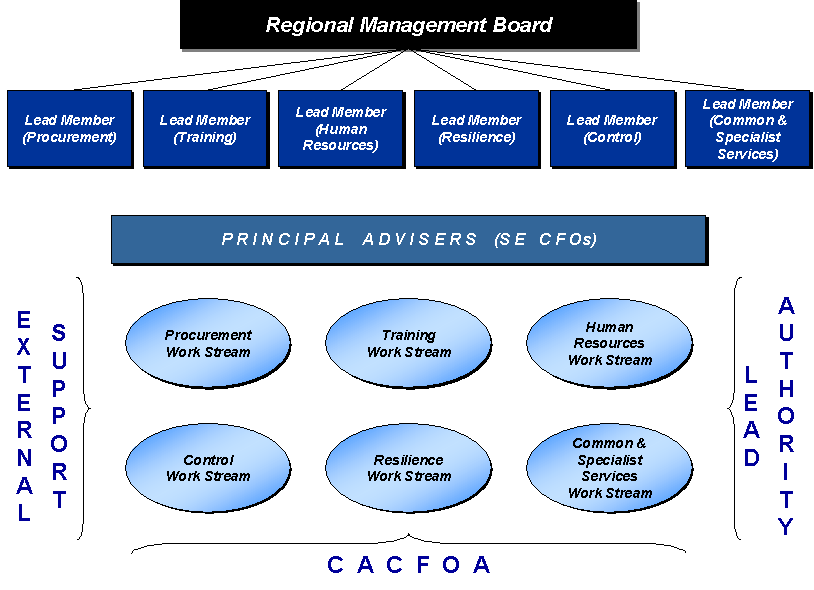
v) Adopt the working arrangements model attached at Appendix 2.
REASONS FOR RECOMMENDATIONS |
As more guidance emerges it is inevitable that the action plan will continue to evolve. However, at this stage it is important that the Board is able to demonstrate both the willingness and the capacity to deliver the outcomes in the six identified work areas. Any opportunities to identify and action `quick wins' should be brought forward, particularly in relation to delivering savings. The working arrangements model captures the most immediately available options and uses current resources of the constituent authorities.
LEAD/CONTACT OFFICER:
TELEPHONE NUMBER:
EMAIL:
BACKGROUND PAPERS:
INTRODUCTION
Since the publication of the National Framework and the LGA guidance on Regional Management Boards (RMBs), the Regional Chief Officers Group has been considering a draft action plan and proposed working arrangements to enable the Region to demonstrate that it intends to take the regional agenda forward at a reasonable speed, and has arrangements in place to support this. Given the Board's agreement to a constitution that seeks to preserve local independence while meeting Government's expectations, it is essential that this is underpinned by credible working arrangements, an action plan, and deliverable outcomes. A previous draft of this paper was considered by the South East Fire and Rescue Services' Forum at its meeting on 10 March 2004.
The draft framework plan is drawn from the information outlined in the National Framework document, and includes the relevant actions relating to the creation of the regional control room for completeness. It identifies those items which are dependent on other events, mainly the promised production of other national models or documentation. Although it also includes some information produced by the initial working groups which were put in place last summer, the intention has been to develop a strategic framework which can be developed further in accordance with the outcomes of this meeting.
The National Framework document says:
"It is important that Regional Management Boards accomplish improvement in the service. Therefore, by 1 April 2004 Fire and Rescue Authorities must establish Regional Management Boards with:
· Clear aims and objectives
· Delegated powers that are appropriate to those aims and objectives
· Plans for meeting the requirements in each of the six key areas; and
· Sufficient evidence to demonstrate the capacity - both resource and expertise - to deliver those plans."
BACKGROUND
Regional Resilience Planning
Although the regional resilience agenda is well advanced, through the work that has been going on under the current regional arrangements co-ordinated by Government, it is also one of the six action areas identified for the RMB. Unlike the other five, however, the central arrangements for resilience are now well established and working to a centrally-determined timescale, at least for the roll-out of essential vehicles and equipment to support new responsibilities in relation to mass decontamination and urban search and rescue. Given the importance of the issue, the RMB needs to establish a greater degree of clarity over the relationship between central and regional responsibilities in a very short timescale. A report elsewhere on this agenda sets out the relevant considerations and the detailed working and monitoring arrangements needed to ensure this is dealt with properly.
Regional Control Centre
This initiative forms a part of the overall planning process and entails the earliest set of deadlines. The response of the Forum to the Minister on location and other criteria has already set out the serious concerns of the Region and invited ODPM to engage in early discussions as to potential locations. There is a range of issues which require clarification and there is also an expectation that the location of the proposed centre will be established soon. The framework action plan assumes that the overall project management arrangements will be run as a partnership between Government Office for South East (GOSE), ODPM and RMB. It will be up to the RMB to determine exactly what that involvement will be.
A further issue for consideration is that the Government, in its commentary on the Mott McDonald report, has stated that once the regional control room is operational, the RMB will become the employer of the control staff. This will entail detailed consideration of the various legal and contractual points involved.
Regional Training Centre and Strategy
Two meetings of the initial officer working group representing regional authorities have been held to consider how this theme could be taken forward. While the establishment of a regional centre was felt to be premature in advance of further national guidance on IPDS, work has started on the regional training strategy, through a scoping study of current training facilities, and a review of the delivery of practical skills training.
Regional Procurement
The ODPM has commissioned consultants to scope and produce recommendations on how to take forward procurement in the fire service. The research phase has been completed but, at the time of writing this report, the outcome has not yet been published. ODPM is seeking funding to set up an agency capable of dealing with national procurement issues. ODPM has also produced jointly with the LGA a proposal to create nine regional centres of excellence in procurement, to take forward the national procurement strategy for local government. It is not yet clear whether it is intended that this structure should support the fire service procurement strategy, but it may be useful as a provider of professional procurement advice. The nominated lead authorities were announced on 25 February, and the centre of excellence for the south east will be run by Kent County Council, supported by Hampshire and Surrey.
Regional Personnel Management
The initial CACFOA working group has met on a number of occasions and produced an inventory of areas for collaboration. This will need extension to cover IPDS requirements and there are clear links between work in this area and work on training issues.
Common Specialist Services
An initial officer working group on this theme has also met on a number of occasions. The eight areas of work [excluding resilience] listed in the framework document were examined and it was concluded that the work was, to a large extent, already within the remits of various existing CACFOA committees and working groups. The draft framework action plan identifies specific areas to be worked upon as a matter of priority and has tried to set out this element as a more detailed template for the Action Plan.
ANALYSIS AND COMMENTARY
Key Issues - Aims and Objectives
The Constitution of the RMB includes the Terms of Reference at Schedule 2.
These cover the development and implementation of approved arrangements for the strategic and co-ordinated delivery of the six action areas, together with communication between the constituent authorities and lobbying on behalf of the Board. However, it stops short of describing its purpose.
It would therefore be prudent to agree aims and objectives for the RMB which underpin the business plan and address the agenda set out in the National Framework. It is proposed that these should be:
a) Co-ordinating regional resilience planning for major emergencies
b) Supporting effective resource management within the Region
c) Improving the service through development and training
d) Identifying and promoting best practice within the Region
These would embody a declaration of intent to deliver outcomes, without compromising the independence of the constituent authorities. The powers delegated to the Board to deliver the plan are adequately set out in the Constitution, and do not need to be discussed further here.
Working Methods
If the RMB is to succeed in convincing Government that the agreed constitution will work, keeping the demands upon the RMB to an reasonable minimum, the action plan needs to be task and outcome-oriented. It is suggested that the Board's activity should be focused on:
· Commissioning reviews, where appropriate, and setting their terms of reference
· Agreeing the method of delivery, either for a review or plan
· Agreeing detailed action plans
· Monitoring progress against plans
· Agreeing outcomes and implementation arrangements
The `method of delivery' is intended to provide the principal advisers (the Chiefs of the South East region) a way of recommending to the Board how the elements of the plan can best be delivered. This should also go some way towards providing the evidence of capacity needed to meet the ODPM's requirements for the Board. The main possibilities are:
a) Joint Task Group; this has been used increasingly over recent years but has had variable results. It has the advantage of bringing together those with expertise and/or experience in a given field and can provide an opportunity for joint Member/Officer working in some cases.
b) CACFOA Committees and Working Groups; although there are clearly still some issues for the Association to resolve relating to its national working structures and the emerging regional management boards, CACFOA locally has now agreed to realign its working structures to meet the demand of RMB work.
c) Externalisation; it is also open to the Board to engage external contractors or consultants to discharge work on its behalf. If this route is taken, the funding arrangements for each contract would have to be agreed, in line with the general rule set by the draft Constitution that the RMB should approve the basis on which costs and expenses will shared between participating authorities. Sufficiently robust contract/client side management arrangements for the Board will also be important.
d) Lead Authority; the resources of each of the nine authorities vary considerably, and some may be well placed to undertake a lead role in certain areas where geography, experience, or internal resource capability suggest it can do so. Where it is decided that this is the best way to proceed it would still be possible for projects to be jointly funded.
It will be important to determine appropriate delivery methods as soon as possible, particularly for the main headings and those which are more urgent in terms of nationally-set deadlines. It also seems sensible to nominate a lead authority/officer for all methods of delivery, so that a check is kept on progress, for example where projects are being delivered through national working groups. This would also provide a route for supervising consultants or contractors, though a project board involving other authorities could also be added, depending on the scale of the project. It would be expected that project requirements would include regular reporting and monitoring arrangements at RMB level.
The Forum agreed to the principle of a Lead Member for the work areas, and the Board needs now to appoint such Lead Members for each theme who will review progress for each theme, maintain contact between Board meetings, and also develop a greater depth of knowledge among Board Members of the development of individual projects.
Progress against Plans
Different themes will have different reporting timescales depending largely on national priorities and the likely demands of the Comprehensive Performance Assessment process as applied to fire authorities. Regional Controls, Procurement and Human Resource strategies are obvious examples where early progress is vital. The draft Action Plan seeks to identify suitable timescales taking into account the relevant external demands. However, it will be critical to demonstrate some progress in all areas during this year. Where possible, limited action plans should be developed to identify and action `quick wins' particularly in delivering savings. This will also confirm our determination to achieve outcomes, and contribute to this element of CPA assessment.
Consultation with Trade Unions
The Forum agreed that a protocol would be helpful on consultation with Trade Unions in relation to projects included in the Board's action plan. While the responsibility for consultation over issues affecting its own staff must remain with each authority, clearly some issues, such as the implementation of the regional control room, will be of wider interest to the unions. Currently, the Fire Brigades Union's regional boundaries do not coincide with the South East region as defined by Government, although it is understood that this is under review. A paper elsewhere on this agenda reviews progress on this issue.
Relationship with Local Planning Processes and Budgetary Considerations
Given the impact of regional activity on local budget and planning processes within each authority it is suggested that the Board should agree its plan for each financial year by, at the latest, December of the preceding year. This will enable each authority to take regional activities and resource requirements into account in preparing its budget and business plan.
It is not expected that financial settlements for the foreseeable future will yield increased funding for the service. Furthermore, in his speech to the LGA Fire Conference in February 2004, the Minister made it clear that the pace of change would be maintained and that Government still expected modernisation to be funded through changes in working practices and the generation of efficiency savings. In pursuing `effective resource management' within the region, the plan needs, therefore, also to focus on generating savings through collaboration or efficiency improvements, which can contribute to the budget requirements of individual authorities.
IMPLICATIONS
In assessing the potential impact of the proposals in this paper, issues relating to equality and fairness, health and safety and the Human Rights Act have been considered. The recommendations in this report do not have any direct implications for any of these matters.
The resource implications and their relationship to the planning and budgetary processes of constituent authorities is set out already in this report. There are no direct resource implications in establishing the plan and the working arrangements, although as work progresses resource needs for delivery will be made clear to future meetings of the RMB as and when decisions are required.
CONCLUSIONS
The Board is asked to:
vi) Agree the draft aims and framework plan;
vii) Appoint Lead Members for each of the six work themes and to agree the most appropriate delivery method.
viii) Agree to prepare the draft Action Plan for 2005/06 by December 2004 to enable proper consideration by constituent authorities in their budget preparations.
ix) Adopt the Action Plan template at Appendix 1.
x) Adopt the working arrangements model attached at Appendix 2.
SOUTH EAST FIRE AND RESCUE SERVICE REGIONAL MANAGEMENT BOARD
ACTION PLAN 2004/05
WORK AREA 6 COMMON AND SPECIALIST SERVICES | |
SUMMARY | |
This element of the Regional Management Board's Action Plan addresses the area of Common and Specialist Services. It includes those areas previously referred to in the draft National Framework, issued by the Office of the Deputy Prime Minister, and draws upon guidance issued by the Local Government Association in January 2004 (Developing Regional Management Boards for Fire Authorities: Part Two). The Action Plan sets out broad outcomes, or objectives, together with estimated timescales for delivery. It is intended to ensure two overall objectives: a) that all Fire and Rescue Services in South East region adopt common practices and procedures, that take account of the risks in each area, to ensure that specialist services are effectively and consistently delivered; b) that efficient use of resources is achieved across the region by drawing on good practice and identifying cost-effective solutions. These objectives provide the framework of the Action Plan. The work to deliver specific outcomes in each element draws on the Best Value framework, where service provision is subjected to the 4 Cs - Challenge, Compare, Compete and Consult. Some elements within the Action Plan will extend beyond 2004/05 due to the work needed and the resources available. The Plan highlights those areas where some elements are prioritised for action, either because the need is more urgent or because the evidence suggests there may be "quick wins" to be achieved in terms of improved service delivery of increased efficiency across the region. Reporting progress on the Action Plan will be the responsibility of the designated Lead Member, who will be supported by a Lead Adviser. The Regional Management Board retains overall responsibility for the delivery of the Action Plan, for allocation of any resources needed, and for agreeing the most appropriate method of delivery. | |
Lead Member |
Mr D Dolding Chair, Kent and Medway Fire and Rescue Authority |
Lead Adviser |
Mr P Coombs Chief Fire Officer, Kent Fire and Rescue Service |
ELEMENT 1 E1.1 |
COMMUNITY FIRE SAFETY Partnership Working | ||
Objective |
To develop a model for SE Fire and Rescue Authorities to enable them engage constructively and productively in local partnerships to deliver safer communities. | ||
Complete by |
Lead Officer | ||
Actions |
a) Review existing partnership arrangements in constituent authorities and other regions. |
||
b) Compare existing arrangements against known good and best practice and guidance. |
|||
c) Develop a simple, easy to use model for establishing and developing constructive relationships. |
|||
d) Develop regular update communications on notable successes to be shared with all authorities. |
|||
E1.2 |
Initiatives for Education | ||
Objective |
To develop a common approach to ensuring life-long learning for community fire safety. To ensure that all school children between the ages of X and X receive ............? | ||
Complete by |
Lead Officer | ||
Actions |
a) Review existing initiatives in constituent authorities and other regions. |
||
b) Evaluate the relative success of initiatives for education and report with recommendations. |
|||
c) Develop a model for constructive engagement with mainstream educational processes to ensure appropriate learning opportunities are available at every Key Stage. |
|||
d) Develop standard packages for delivery in all authorities across the region and evaluate their success against targets. |
|||
e) Undertake an efficiency review to examine the potential for shared delivery resources for education initiatives. |
|||
E1.3 |
Initiatives for Domestic Safety | ||
Objective |
To develop a common approach to domestic safety campaigns and initiatives. To reduce the incidence of accidental domestic fires by X% in every constituent authority. | ||
Complete by |
Lead Officer | ||
Actions |
a) Review existing initiatives in constituent authorities and other regions. |
||
b) Evaluate the relative success of initiatives for domestic safety and report with recommendations. |
|||
c) Develop a range of intervention materials for campaigns and initiatives, with common formats, and consistent with relevant national campaigns from National Fire Safety Centre. |
|||
d) Keep under review, and report, the outcomes of initiatives against targets across the region. |
|||
e) Undertake an efficiency review to examine the potential for shared delivery resources for initiatives for domestic safety. |
|||
E1.4 |
Initiatives for Fire Setting/Youth Diversion | ||
Objective |
To develop a common approach to anti-fire setting initiatives and to engage in youth diversion work in partnership with other relevant agencies. To reduce the incidence of deliberate fires by X% in every constituent authority. | ||
Complete by |
Lead Officer | ||
Actions |
a) Review existing initiatives in constituent authorities and other regions. |
||
b) Evaluate the relative success of initiatives for fire setting/youth diversion and report with recommendations. |
|||
c) Develop a range of intervention strategies, drawing on best practice locally and nationally. |
|||
d) Keep under review, and report, the outcomes of initiatives against targets across the region. |
|||
e) Undertake an efficiency review to examine the potential for shared delivery resources for initiatives for fire setting/youth diversion. |
|||
ELEMENT 2 E2.1 |
TECHNICAL FIRE SAFETY MANAGEMENT, ENFORCEMENT AND ADVICE Preparation for Regulatory Reform Act | ||
Objective |
To ensure that all constituent authorities in the region have appropriate structures, policies and procedures in place to implement the requirements of the Regulatory Reform Act consistently across the region. | ||
Complete by |
Lead Officer | ||
Actions |
a) Review the progress to date in all constituent authorities, other regions and the development of relevant national guidance. |
||
b) Develop a common risk assessment methodology to be applied. |
|||
c) Develop common policies and procedures to implement the requirements of the new Order. |
|||
d) Develop common approaches to the skills and training required for management, enforcement and advice. |
|||
e) Develop a common staffing and resourcing model for management, enforcement and advice. |
|||
E2.2 |
Collaboration on Major Projects | ||
Objective |
To enable a consistent approach to management, enforcement and advice on major development projects. | ||
Complete by |
Lead Officer | ||
Actions |
a) Define the criteria for major development projects. |
||
b) Review the lessons learned from major development projects across the region and report with recommendations. |
|||
c) To develop a regional protocol for the management of major development projects, including consultancy, advice, charging and enforcement. |
|||
ELEMENT 3 |
MUTUAL ASSISTANCE | ||
Objective |
To ensure efficient and effective arrangements for the delivery of operational services, including day to day operations, specialist operations, major incident management, across the region. | ||
Complete by |
Lead Officer | ||
Actions |
a) Review the arrangements for operational service delivery reflected in the Integrated Risk Management Plan for each constituent authority and to review good practice nationally. |
||
b) Assess the risk and the need for specialist operations (including provision of height vehicles, specialist rescue capability and cross-border fire and rescue cover) and make recommendations where efficiency or effectiveness could be improved. |
|||
c) Review the arrangements for incident management and ensure that common policies and procedures, based on the national Incident Command System, are in place in all authorities. |
|||
d) Review the currency and accuracy of the agreement on Mutual Assistance. |
|||
ELEMENT 4 |
CO-RESPONDING | ||
Objective |
To develop a common approach to working with other agencies across the region to deliver co-responding arrangements for medical emergencies. | ||
Complete by |
Lead Officer | ||
Actions |
a) Review current schemes for co-responding in constituent authorities and in other regions. |
||
b) Evaluate their effectiveness and impact on other services. |
|||
c) Assess the risk and the need with other relevant agencies across the region and report with recommendations. |
|||
d) Develop common procedures for co-responding and protocols/memoranda of understanding with other agencies. |
|||
e) Review and report on effectiveness in meeting locally agreed targets. |
|||
ELEMENT 5 |
UNWANTED AND HOAX CALLS | ||
Objective |
To develop methods of reducing the incidence of unwanted and hoax calls to meet a target of X% reduction in such calls in each Authority | ||
Complete by |
Lead Officer | ||
Actions |
a) Review current practices and initiatives in constituent authorities and other regions. |
||
b) Review developing good practice guidance from ODPM, CACFOA and elsewhere. |
|||
c) Develop intervention strategies that can be applied consistently across the region. |
|||
d) Review and report on progress against targets. |
|||
ELEMENT 6 |
FIRE INVESTIGATION | ||
Objective |
To develop efficient and effective means of delivering fire investigation services across the region. | ||
Complete by |
Lead Officer | ||
Actions |
a) Review current arrangements in constituent authorities and other regions. |
||
b) Develop an agreed standard of service to be applied across the region. |
|||
c) Review the provision of current resources against that standard, and report with recommendations. |
|||
d) Undertake an efficiency review to examine the potential for shared delivery of fire investigation activities. |
|||
ELEMENT 7 |
MANAGEMENT OF HEALTH AND SAFETY | ||
Objective |
To ensure that best practice in the management of health and safety and the protection of firefighters is shared effectively and efficiently across the region. | ||
Complete by |
Lead Officer | ||
Actions |
a) Review the current arrangements within constituent authorities and other regions. |
||
b) Identify good and best practice, with regard to guidance from HSE, HMI, ODPM, CACFOA and other relevant agencies. |
|||
c) Review the currency and consistency of generic risk assessments across the region and identify common policies, procedures and training to ensure effective management of health and safety. |
|||
d) Develop common and consistent incident reporting protocols across all constituent authorities in order to develop meaningful comparative statistics. |
|||
e) Undertake an efficiency review of the provision of competent health and safety advice against the requirements of the Management of Health and Safety Regulations 1999 and report with recommendations. |
|||
f) Introduce regular health and safety bulletins and communications to disseminate good practice and performance information across the region. |
|||
ELEMENT 8 |
CONTINGENCY PLANNING FOR INDUSTRIAL ACTION | ||
Objective |
To develop a common, strategic contingency plan for the event of industrial action, or other major service disruption that enables constituent authorities to discharge their statutory duties. | ||
Complete by |
Lead Officer | ||
Actions |
a) Review the current contingency plans in constituent authorities and other regions. |
||
b) Develop a common, strategic contingency plan for industrial action, or other major service disruption, in one or more constituent authorities, and report with recommendations. |
|||
c) Develop an agreement governing the resourcing considerations for the contingency plan, and report with recommendations. |
|||
 Appendix 2 - Working Arrangements Model