
Archived decisions
 Item 8
Trading Standards National Performance
Service Plan
2004 - 05
This Service Plan is issued under the authority of:
...............................................
Tony Langstone
Head of Safety & Standards
This Service Plan forms part of the Official Quality System of Hampshire County Council's Regulatory Services. It is Service confidential.
Copy Number: -------------------
Issued to:----------------------------------------
Regulatory Services, Mottisfont Court, High Street, Winchester SO23 8ZE
Tel: 01962 841841. www.hants.gov.uk/regulatory
National Performance Framework Service Plan
Contents
Page
Part 1 - Context and Comparative Factors
1. Introduction and Profile of Hampshire 3
2. Community and Corporate Objectives 4
3. Aims, Objectives and Strategic Thinking 6
4. Local Authority Organisation, accountability
and wider links, Partnerships 8
5. Trading Standards Expenditure (CIPFA) 12
6. Staffing Allocation 12
7. Accessibility 12
8. Needs and expectation of Consumers 13
9. Needs and expectation of local businesses 17
10. Local awareness of Trading Standards 20
11. Demand for Specialist Services 20
Part 2 - National and Local Policies
12. Informed Confident Consumers 21
13. Informed Successful Businesses 24
14. Enforcement of a Fair and Safe Trading
Environment 26
15. Efficient, Effective and Improving Trading
Standards Services 29
Part 3 - Review, Assessment and Improvement
16. Quality Assessment and Review 33
National Performance Framework
Service Plan 2004/05
Part One: Context and Comparative Factors
A Trading Standards and the Community
1 Introduction and Profile of Hampshire.
1.1 This service plan sets out the work of the County Council's Trading Standards Service in accordance with the DTI's National Performance Framework for the service.
1.2 A Profile of Hampshire was set out by the County Planning Department in December 2001. Hampshire County Council is England's third largest county with a population of 1.25 million. Its economy is estimated at £16.3 bn, making it the second largest shire economy. The county is predominantly rural, with 87% of the population living in the 10% of the county classified as urban, mainly in the northeast and along the M3 and M27 corridors. Hampshire is generally affluent with higher than national average earnings and low unemployment levels. However, there are pockets of deprivation with a number of wards falling within the worst 20% of deprived areas nationally. Significant rural areas are subject to national and international environmental designations, including the proposed new National Parks for the New Forest and South Downs. These, together with the historic city of Winchester and the extensive coastline, make Hampshire a popular tourist destination. Portsmouth and Southampton also have an important effect on the local economy.
1.3 Many parts of the county are significantly more prosperous than the national average, particularly Basingstoke and Deane, East Hampshire, Hart, Test Valley and Winchester. The New Forest has a unique rural character and a notable incidence of prosperous pensioners. Havant and Gosport are identified as the least affluent, most deprived parts of Hampshire.
1.4 The total economy of Hampshire is worth £16.3 billion and is the sixth largest economy in England. However, in terms of GDP per head, the most common measure of prosperity, Hampshire is only slightly above the national average. South East Hampshire has the highest representation of large firms, followed by North Hampshire. Generally the county has a high proportion of employment in high technology industries, having twice the national percentage.
1.5 Hampshire's age profile is broadly similar to the national picture but with a slightly larger proportion of persons in the 45-74 age group. From 1996 to 2011 the population is expected to decline in the younger age groups, with growth mainly in the 45-64 age band. There is a relatively low proportion of ethnic minority populations compared to the national average. The largest minority groups are people of Indian origin in Basingstoke and Eastleigh, and people of Black Caribbean origin, again in Basingstoke and in Rushmoor. People of Chinese ethnic origin are relatively well represented in all Hampshire districts.
2 Community and Corporate Objectives
2.1 The County Council is part of a county Local Strategic Partnership (LSP) that is working with the eleven district councils and related LSPs in the county to produce an overall plan relating to cross-cutting issues. A draft Community Strategy has been issued for consultation with the following vision and themes:
`Hampshire will be a prosperous and attractive county for all, where economic, social and environmental needs are met in the most sustainable way and the quality of life and sense of community of present and future generations is improved'.
The key themes are:
· Strong and Safe Communities with fewer inequalities, tackling deprivation and where young people play an active part
· Health and Well being is supported and there is equal access to services
· Economic Prosperity and fostering Lifelong Learning and supporting the needs of local businesses
· Hampshire has an Environment to be proud of and an efficient and effective infrastructure and transport system.
2.2 The County Council's corporate strategic aims are:
Aim 1 |
Maximising life opportunities |
Aim 2 |
Stewardship of the environment |
Aim 3 |
Achieving economic prosperity |
Aim 4 |
Building strong and safe communities |
Aim 5 |
Improving services |
Aim 6 |
Developing Councillors and staff |
The Trading Standards Service links to the above aims are summarised below.
Aim 1. The Service provides a Consumer Advice Service that deals with over 21,000 enquiries from the public and businesses each year. It also participates in Junior Citizen, a multi-agency initiative for younger Key Stage 2 children, and provides consumer education through a special education package for Key Stage 3 and 4 pupils. Trading Standards works with businesses and young people to reduce access to age-restricted products
Aim 2. The service plays a key role in supporting the rural economy by enforcing laws on animal health and welfare, fertilisers and animal feed. A priority area of work relates to the correct disposal of animal by-products. In addition it supports the manufacture of local produce and agriculture through Hampshire Fare and Farmers' Market schemes. The service also plans to help reduce the eye-sore of vehicles offered for sale at the roadside and in lay-bys. As part of its enforcement duties the service helps to reduce packaging waste and protect water sources from petroleum pollution.
Aim 3. Support for the local economy is provided by specialist and general advice to all local businesses to help them comply with Trading Standards legislation and consumer law. The service runs the largest trader approval scheme in the country, `Buy with Confidence', which promotes local businesses. The service also assists consumers by making them more informed and confident, thus encouraging knowledgeable purchasing and action for redress, which in turn promotes competition. As stated above it also actively supports Hampshire Fare, and Farmers' Markets.
Aim 4. The primary link to this aim is by improving health and safety through food and product safety sampling programmes and business inspection. A key aim this year is to educate consumers regarding food labelling to promote healthy eating. The sale of age-restricted products, particularly those related to health issues, is another key priority. The service also works with other local authorities and agencies, together with community groups, to reduce accidents and improve health.
Support for Aims 5 and 6 is demonstrated by:
· a commitment to Investors in People
· accreditation to recognised quality systems
· an emphasis on communicating with the public and business
· a reliance on outcome-based service planning techniques
· a culture of continuous improvement and striving for excellence
2.3 The County Council Member's key local priorities are:
· Education and Skills Development
- improving educational attainment
- reducing truancy/exclusion/widen educational relevance
- expand vocational skills
· Older People
- improve care at home
- achieve CPA/PSA targets
- improve the quality of life
· Transportation (Mobility/Accessibility) and Economic Housing
- improve access to housing for targeted people
- improve footways/rural roads
- reduce congestion
- reduce rural isolation
- achieve CPA/PSA targets
· Crime, Youth and Deprivation
- achieve maximum ratings for young (CPA/PSA)
- schemes to reduce crime & vandalism,
- youth isolation and disaffection,
- anti-social behaviour
2.4 The above aims and objectives take account of consumer needs by research conducted through a Citizens' Panel of 1,600 residents, supported by focus group work, County Councillors, information from Departments and Government policies. The service links to these through its consumer education and advice service work; protection for older persons and the vulnerable; and the enforcement of under-age sales legislation.
2.5 The Government's national priorities for the Trading Standards Service are to work towards achieving:
· Informed Confident Consumers
· Informed Successful Business
· Enforcement of a Fair and Safe Trading Environment
· Efficient, Effective and Improving Trading Standards services
These aspirations were covered by the Best Value review of the service and the following plan sets out how the service intends to meet them.
3 Aims, Objectives and Strategic Thinking
3.1 Hampshire County Council was the first in the UK to form an integrated Regulatory Services by combining the expertise of Trading Standards Officers, Public Analysts and Registration Service under a single management team. The service benefits from an integrated, project managed approach to enforcement, advice, inspection, sampling and analysis.
3.2 The Trading Standards service has four key functional teams:
· Advice, Community, Education and Business Support Team (ACE)
· Fair Trading Team (FT)
· Food and Agriculture Team (FAST)
· Safety and Standards Team (SAS)
Resources are allocated to each team according to the estimated workload and priority allocated to an area of work. All work is carried out on a project basis, including reactive work, with time allocated in officer days based on estimated times. The functional teams each produce operational project plans, and these are attached as appendices to this plan. Project leaders then generate project protocols with details of the work to be carried out, performance indicators, and expected outcomes. At the end of the project a report is produced summarising the results and recommending further action. In many cases a press release is produced to increase awareness and understanding of the service's operations. The FAST team also produces a Food Service Plan for the Food Standards Agency, attached at Annex 1 to this plan. There is also an umbrella Service Plan for Regulatory Services as a whole.
3.3 Trading Standards Service vision and aims are as follows:
Vision
To be recognised as leaders of service excellence
This simple statement carries four key messages:
· Recognition - we want to achieve high awareness and trust with our key stakeholders by providing maximum impact, accessible and valued services.
· Leaders - we want to innovate and engage enthusiastically with the modernisation agenda.
· Service - we want to focus on service delivery, driven by customer needs not professional interests
· Excellence - we want to strive for continuous improvement through high quality staff, who are trained and developed to reach their full potential.
The vision therefore ties in with the corporate strategic aims of Improving Services (Aim 5) and Developing Staff (Aim 6). It also corresponds with the Government priority of an efficient, effective and improving Trading Standards service.
Mission Statements
· Provide an Advice Service to assist in life long learning by encouraging confident and knowledgeable consumers and business
· Provide a Trading Standards Service to achieve a fair, safe and equitable trading environment
The above link to the corporate strategic aims of maximising life opportunities (Aim 1); stewardship of the environment (Aim 2); achieving economic prosperity (Aim 3) and building strong and safe communities (Aim 4). They also connect directly to the Government's national priorities of informed confident consumers; informed successful businesses and enforcement of a fair and safe trading environment.
Key Objectives
· To protect and support the public and businesses by promoting and enforcing Trading Standard laws and working in partnership to improve health and reduce accidents in Hampshire
· To provide advisory, business and education services to our clients
· To continuously improve our service
These key objectives correspond with the corporate aims and government priorities as stated above.
3.4 The Institute of Public Finance reported that Hampshire was above the upper quartile for planning and modernisation in 2003/04. It will continue to strive to be among the best Trading Standards services in the country. The service is piloting the DTI's new peer review process for the south-east region. Linked to the peer review process it will maintain continuous improvement by following the European Foundation Quality Model (EFQM). The Service has achieved 100% in Best Value Performance Indicator 166 and will strive to maintain this in 2004/05. It also aims to be in the upper quartile against new DTI performance measures. The Service has implemented most of the improvement plan resulting from the Best Value review conducted in 2002, and the remaining issues are included in this plan.
B Local Structure and Resources
4 Local Authority Organisation, accountability and wider links
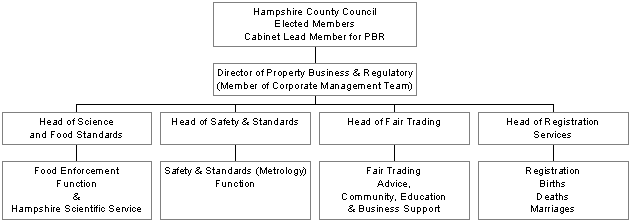
4.1 The County Council has eight main departments and the Corporate Management Team is comprised of the Chief Executive and seven Department Directors. The authority has adopted a Leader and Cabinet structure, with ten County Councillors, nine of which have a portfolio covering a major service area. The Leader's portfolio includes the Property, Business and Regulatory Services Department, of which Trading Standards is part. The organisational structure of the Trading Standards Service and how it fits into the Corporate Structure is shown below.
4.2 Trading Standards provides the following services in partnership with other agencies:
Activity |
Description |
Partners |
Community Safety - Protecting Older People |
Leading a project designed to protect older and vulnerable people against rogue doorstep traders and distraction burglary. |
Social Services Police Primary Care Trusts Neighbourhood Watch and Charities |
Junior Citizen |
Part of multi-agency approach to educating Key Stage 2 school children. Focus on age-restricted products, healthy eating and product safety |
Education Dept, Police, Fire and Rescue and other agencies. |
Citizenship Education Package |
Educating Key Stage 3 and 4 school children in consumer rights and responsibilities |
Education Department and local teachers |
Safety of Child Car Seats |
Lead authority ensuring correct fitting and use of child car seats |
Britax; HCC Road Safety Unit; District Councils and Child Accident Prevention Trust |
Electric Blanket Safety |
Lead partner with Fire and Rescue Service offering free tests on electric blankets to reduce accidents and fires. Also linked to advice on grants and environmental home improvements. |
Fire & Rescue Service; District Councils; Age Concern and Environment Agency. |
Responsible Tobacconist Award Scheme |
Lead authority reducing cigarette sales to under-age children by linking law & health and promoting best practice |
Primary Care Trusts -Health Promotion Service and District Councils |
Under-age sale of alcohol |
Joint partner in control of under-age purchasing of alcohol |
Hampshire Constabulary |
Hampshire and IoW Tobacco Alliance |
Partner in joined up working on smoking prevention and cessation |
Primary Care Trusts Environmental Health Armed Services |
Petrol leakage |
Support agency in protecting water sources from pollution |
Formal partnership agreement with the Environment Agency |
Good Trader Scheme (Buy with Confidence) |
Lead authority sponsoring compliance with TS law and promoting local businesses |
Business Link Hampshire Businesses Referenceline |
Buy with Confidence |
Reducing second-hand car complaints |
Retail Motor Federation Industry (RFMI) |
Buy with Confidence |
Home improvements and repairs (as above) |
Age Concern Electrical Contractors Assoc (ECA) and Assoc Of Plumbing & Heating Engineers (APHC) |
Consumer Advice |
Lead authority linking advice agencies |
Consumer Support Network |
Horse-Watch |
Joint working to reduce crime related to horses and equipment |
Hampshire Constabulary farmers and horse owners |
Animal Health & Welfare |
Lead authority enforcing laws on health and welfare |
DEFRA RSPCA |
Animal Health |
Compliance with animal health legislation |
Contract with Southampton City Council to enforce laws in city |
Social exclusion in Havant |
Community out-reach work in deprived area |
Havant and Test Valley (Andover) District Councils |
Farmers' Markets |
Partner promoting sale of local produce and crafts |
Hampshire farmers NFU |
Hampshire Fare -promote locally produced products |
Partner in origin approved scheme to promote Hampshire foods and craft products |
Hampshire Fare Limited |
Overloaded vehicles |
Joint agency providing tests and accuracy reports on weighbridges used by police for weighing vehicles. |
Hampshire Constabulary |
Metrology Services |
Providing weighbridge, bulk fuel tanker and specialist EC weighing testing services. |
Contracts with Soton and Portsmouth City Councils. Services provided to numerous local authorities and commercial operators. |
Community Service Orders |
Promoting provision of labour for community projects. |
National Probation Service |
4.3 Hampshire Trading Standards Service takes part in the following forums for the exchange of information and best practice etc.
· South-East Trading Standards Authorities (SETSA) Regional Liaison Group. As part of this group Hampshire is the lead authority for food, metrology and legal procedures and provides the Chair for each group and the secretaries for the first two. The authority also provides the Chair for the Consumer Advice Focus Group and takes part in all other Focus Groups
· Lead authority for Hampshire Consumer Support Network
· Local Authority Co-ordinating Body on Regulatory Services (LACORS) - provides advisors in relation to Food Labelling; Metrology; Explosives and Product Safety Advisory Groups
· National Weights and Measures Laboratory (NWML) and DTI Metrology Group - provides an advisor.
· Member of Hampshire Charity Commission forum
· Member of Government Agencies Information Network (GAIN)
· Trading Standards Institute Southern Branch - provides Branch Executive representative
· Member of South East Liaison Co-ordinating Group on Petroleum Licensing (SELCOG)
· Member of Petroleum Enforcement Liaison Group (National Body)
· Association of Petroleum Enforcement Agencies - authority provides Branch Secretary
· Regional Animal Health and Welfare Panel
· Divisional DEFRA/Local Authorities Animal Health & Welfare Forum
· Memorandum of Understanding with Hampshire Constabulary for the exchange of information
· Trading Standards Institute Consumer Education Liaison Group (CELG)
· Officer participation in the European Commission's programme for EU enlargement
4.4 The Trading Standards service is a member of Basingstoke and Deane, East Hampshire and North Hampshire Local Business Partnerships and regularly contributes to their newsletters, which reach over 7,000 businesses. The service was also instrumental in the establishment of Farmers Markets in the county and Hampshire Fare, an origin accreditation scheme for local food and products. It continues to support both these initiatives and also has an informal association with Wessex Business Link.
5 Local Authority Trading Standards Expenditure
5.1 This information will be reported via the Chartered Institute of Public Finance and Accountancy (CIPFA) return.
5 Staffing Allocation
6.1 Staffing details will be reported via the CIPFA return.
6 Accessibility
6.1 The following provides a summary of service provision and accessibility.
Contact can be made in person, letter, telephone, fax, textphone, e-mail or via the internet. Offices are open from 8.30am to 5.00pm Monday to Friday.
· Consumer & Business Advice Service Contact Centre at HQ. Minimum of four officers available by telephone (Lo-call 0845 telephone number) - 9.00am to 5.00pm Monday to Friday. Fax and textphone also available. Outside normal office hours clients can use a wide-ranging recorded advice service or an answer phone message facility.
· Comprehensive website with a wide range of information, advice, factsheets and leaflets for consumers and businesses, together with links to related information and agency sites. Now includes large range of frequently asked questions and answers. Available 24/7.
· E-mail facility linked through to Advice Service for consumer and business advice. Also connected to Consumer Complaints national network.
· Trading Standards Officer available in two Divisional Offices to deal with personal callers, emergency enquiries and business advice.
· Dedicated telephone number for petroleum, animal health and welfare enquiries staffed from 8.30am to 5.00pm.
· 24 hour emergency service for animal health complaints, illegal landings (rabies) etc.
· 24 hour emergency service in relation to petroleum licensing, leaks and spillages.
· Interpretation services are available 24/7 by means of a corporate contract with Language Line, a private company that provides the service directly over the phone. Translation services are also available as required.
· Factsheets and leaflets are available in alternative languages or large print on request.
· Work is being carried out to enable businesses to apply and renew their petroleum licences and firework registrations using the internet.
C Assessment of Community Expectations and Feedback
8 Needs and expectations of consumers
8.1 Community expectation is assessed by a number of methods, including:
· Analysis of consumer complaints and OFT Code data
· Analysis of consumer satisfaction questionnaires
· Corporate Citizen Panel (1,600 Hampshire residents) conducted by MORI.
· Comparison with best practice authorities as part of Best Value review
· Complaints relating to the service
· Review of Service Plan projects
· Investigation of individual incidents reported by the public
· Authority initiated projects and investigations
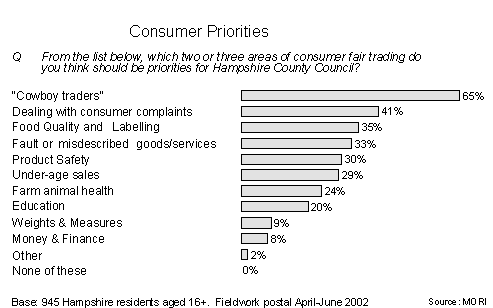
The last survey using the Hampshire's Citizen's Panel survey in 2002 gave the following results:
Estimate of reactive work
The survey also gave the following information:
· 58% awareness of Advice Service and high satisfaction levels
· Mainly use telephone directory to find out about Trading Standards
· 75% prefer to use the phone for advice
· 61% asked for more publicity about Trading Standards
The Citizen's Panel is only used about every two years and it is not feasible for the service to carry out such a consultation annually by other means. The Management Team also believe that the public can suffer from survey fatigue and do not consider it necessary to ask the public for their opinion on priorities every year. A follow up survey is due in 2004.
Satisfaction surveys of Advice Service customers in 2003/04 gave the following results:
· 35% rated the overall service as excellent (66% good/excellent)
· 66% found it easy to access the service or
· 66% found the service useful or very useful
The Advice Service reacts to a constant flow of complaints and enquiries from the public and businesses and dealt with over 21,000 last year. The advice given is therefore demand driven and consultation provides opportunities for improvement rather than changes to the type of service.
The majority of consumer complaints that are dealt with by enforcement staff relate to fair trading issues and the service received nearly 4,000 such enquiries in the past year. During the Best Value Review comparison with best practice authorities indicated that an intelligence led approach targeted on key trade sectors could lead to reductions in complaints and improvements for consumers.
This approach was therefore introduced in 2003.
Incidents relating to product safety increased 45% in 2003/04, from an expected 1,000 to 1,450 complaints. The service had the highest number of complaints in the south-east in relation to traders suspected of selling alcohol to youngsters, showing this to be a key area of public concern. This is believed to be due to a greater awareness of the service through increased publicity, in particular in respect of under-age sales.
There has been a considerable increase in complaints relating to metrology, up over 250% to 180. This is due to the introduction of display signs promoting the service and county council during petrol pump inspections at garages.
It is estimated that the food team will deal with over 400 consumer complaints and enquiries relating to food businesses. The new DEFRA Framework Agreement has led to a major increase in animal health investigations. In the area of animal welfare a number of pressure groups are particularly active, which makes this an important area of work.
Proactive Work
One means of meeting the public's number one concern relating to rogue traders has been the production and launch of the `Safe and Sound' booklet to the elderly and vulnerable. Over 30,000 copies have been distributed over the last 20 months, funded in part by the Consumer Support Network.
In 2003 the service implemented a major conference under the `GM Nation' initiative in relation to genetically modified food. This was in response to a large number of enquires and requests from the public. The conference was addressed by Professor Grant, who produced the government report on GM Good, and it was attended by about 180 people. The response to the event was excellent and has raised the profile of GM crops in Hampshire. The service will continue to advise the authority and community on this issue.
County Council research has identified protecting vulnerable groups and individuals as a priority. In recognition of this the service produced a report highlighting the support it could provide to protect this group from rogue doorstep traders and distraction burglary. This has resulted in a partnership with Social Services, the police, care workers and Neighbourhood Watch.
Another important area highlighted by Members and partners in the NHS is the issue of under-age sales. Project results also show a continuing high level of unsatisfactory food samples and consumer products.
As stated above, consultation with the public showed `cowboy traders' and dealing with consumer complaints were their two highest priorities for the service. One approach to dealing with these areas of concern is to provide consumer education to the public so that future purchasing difficulties are avoided. The Buy with Confidence trader approval scheme has also been targeted at the trade sectors that generate most public complaints.
Complaints and Enquiries
Analysis of complaints and enquiries are shown below under the main team headings.
Advice Team
The top ten areas of complaint for Hampshire consumers are:
· Home improvements and repairs
· Secondhand vehicles
· Personal computers
· Large `white' goods
· Upholstered furniture
· Food and drink
· Radio, tv and audio visual products
· Vehicle repairs and servicing
· Mobile phones
· Furniture in general
Experience shows that the public wants advice on which businesses are reliable, particularly in the area of home improvements and repairs. There is also a growing expectation for consumers to be educated on their rights and responsibilities. In addition there is a clear need for information and advice when consumer rights change due to new legislation.
Fair Trading Team
The top ten areas were:
Scams (Homeworking, Get Rich Quick etc) 1,592
Other Fair Trading Complaints 482
Misleading Price Indications 417
False description of goods 341
False description of services 257
Counterfeit goods 109
Distance Selling Regulations 136
Unroadworthy Vehicles 117
Consumer Credit Act 109
Unsolicited Goods & Services 92
Total of All Complaints 4,216
(Some of these were dealt with by
other teams as part of our
comprehensive service)
Safety and Standards Team
Top areas of complaint were:
Product Safety 675
Environmental 549
(These are almost entirely business
enquiries relating to petroleum licensing)
National Home Authority Company 224
Metrology 157
(Half of these are dealt with by
the Food Team)
Alcohol Under-age sales 131
Tobacconist Award Scheme 83
Food and Agriculture Team
Consumer complaints/enquiries
Food and Animal Feeds 276
Metrology 36
Animal Health & Welfare 111
There was also a high demand on the team to publicise Food Standards Agency food hazard warnings to local businesses. The service carries out an extensive programme of food sampling (1,900 samples) due to public concern with the safety and quality of food and high levels of unsatisfactory results. All teams had a high demand for consumer factsheets and leaflets.
9 Needs and expectations of local business
9.1 Business need and expectation is based primarily on business enquiries and complaints; new legislation; inspection and sampling results and consultation.
The main findings from consultation with businesses as part of the Best Value Review were:
· Trading Standards were customer focused, knowledgeable and helpful
· Home Authority companies were particularly appreciative of the advice and support received
· Businesses valued the relationships built up with their named officer
· Businesses praised the weights & measures calibration service
· Visits following a complaint were seen as constructive
· Businesses were interested in "Legislation Seminars"
The following results came from a survey of 300 members of the Buy with Confidence Scheme :
· 80% found the officer they dealt with helpful or very helpful
· 72% were satisfied that there was a distinction made between what was the law, and what was good practice
· 56% had read the service's enforcement policy
The most popular forms of receiving advice from the service were
· By telephone
· Business factsheets
· One to one advice.
The Buy with Confidence (BWC) scheme continues to grow and now has 500 members. The scheme has been adopted by Brighton and Hove, Southampton and the Isle of Wight and is expected to be taken up by Surrey and East Sussex. The level of demand has made it impossible to carry out necessary re-audits of businesses in Hampshire. Consultation with businesses has shown a willingness to pay for membership and a fee system is to be introduced. The income will be re-invested into expanding and maintaining the scheme.
The top priority areas identified by businesses were:
· Falsely described goods and services
· Underage sales
· Responding to consumer complaints
· Misleading pricing and credit
· Responding to complaints from businesses.
The service has worked to meet these priorities and continues to do so.
Petroleum licensing enquiries and demand for metrology verifications reduced slightly in 2003/04 (down 10%). There is continuing high demand from home authority businesses for advice on food labelling and composition; product safety and fair trading issues. A number of companies need officers with specialist knowledge e.g.
· Mineral water producers
· Cosmetic manufacturers
· National DIY chain
· National Internet Service Provider
· Consumer Credit companies
· Product Safety manufacturers and importers
· Pony Sales
The Service aims to ensure a high level of compliance with Trading Standards legislation at the same time as supporting the Corporate Aim of Achieving Economic Prosperity. Our underlying philosophy is based on advising and working with businesses, with increasingly robust action for continued non-compliance.
Consultation with business in 2003 gave the following as key priorities:
· Advice to consumers (91%)
· Advice to businesses (90%)
· Sampling and analysis of products and services (88%)
· Visits to businesses (85%)
· Investigating complaints about businesses (80%)
Businesses also indicated that the most helpful methods of supporting them were through advice leaflets (94%); telephone advice line for businesses (85%); e-mail (79%); and visits by appointment ((78%). This was verified by a survey in late 2003 relating to food labelling (honey) that showed a very positive response to receiving direct mailshots about changes in the law. Business seminars were only supported by 62% of respondents. Consultation indicated that businesses supported our approach, especially the continuation of our `Home Authority' (HA) business support and the development of our trader approval scheme `Buy with Confidence'.
Reactive Work
An analysis of business related complaints and enquiries is shown below.
Advice Team
Trader enquiries 990
Fair Trading
Trader Complaints re competition 730
Trader Enquiries 540
Home Authority Referrals 450
Other 820
Safety and Standards
Petroleum Licensing 550
Metrology 160
National HA Retailer 250
The main business demands relate to petrol site developments; metrology verification services and referrals regarding a national DIY retailer. In addition there is a need to educate retailers regarding under-age sales, in particular alcohol and solvents, together with changes to the law on fireworks.
Food and Agriculture
Food and Animal Feeds 180
Metrology 30
Animal Health & Welfare 25
Home Authority enquiries 60
Proactive Work
In addition to the above there were 450 authority initiated incidents mainly relating to unsatisfactory food samples. Other business needs identified are:
Provision of free livestock record books
Trader factsheets
Advice at time of visits
Mail drops to specific trades eg honey packers and meat product manufacturers;
Advice on GM labelling
Notifying local businesses on food hazard warnings
Counterfeit goods, particularly clothing and software, continue to give rise to complaints from businesses and trade mark holders and Blackbushe market is a particular area of concern.
High levels of adverse results on food (35%) and product safety demonstrate the need for continuing action. Inspections of weighbridges and bulk fuel meters also show a high percentage of equipment to be outside permitted tolerances. Livestock farmers, butchers and retailers require advice on new animal by-products regulations. 8% of EC scales were found to be incorrect.
Hampshire is close to the national average for large firms with over 100 employees but below average for knowledge based services. There are 31 businesses per thousand population, slightly above the national average of 28. A large proportion of employees are in high tech, `knowledge based' industries, with twice the percentage of manufacturing employment than nationally.
10 Local awareness of Trading Standards
10.1 A Hampshire Citizens' Panel survey in 2002 showed an increase from 41% (2001) to 58% in consumer awareness of the Trading Standards Advice Service. 14% had used the Advice Service.
· 75% preferred to contact the service by phone;
· 8% by phone; 8% by e-mail
· 61% opted for more publicity about the service.
Greater awareness of the service is being promoted through press releases, radio and television interviews and articles in the County Council's magazine, `Hampshire Now', which is sent to all households in the county at least three times a year.
Consultation with business via a Local Business Partnership (LBP) and Enterprise Trusts resulted in a very low response rate (1%) from non-service users, suggesting a lack of interest. Adding Home Authority businesses to the survey increased the response rate to just over 10%.
Awareness is high at food premises and among farmers due to an extensive food inspection and sampling programme and licensing respectively. Among businesses targeted by the service or affected by licensing e.g. product safety premises and petroleum sites, awareness is reasonably high. Knowledge of the service across the car trade is known to be high from inspection and investigation activities. Press releases; articles in LBP and Federation of Small Businesses newsletters and trade seminars aim to further increase awareness of the service.
11 Demand for specialist services
11.1 The Weighbridge Test Unit is hired out to other authorities and commercial operators. Demand from commercial users has grown over 50% in the last year and hire by local authorities has also increased. The high level of weighbridges found to be incorrect on inspection in Hampshire makes this a priority area of metrology work.
11.2 The bulk fuel unit is used by Southampton and Portsmouth unitary authorities for six days a year and occasionally by the Isle of Wight. Use of the unit within Hampshire is a priority due to the lack of controls and checks available to consumers and relatively high failures found on inspection.
11.3 There is a small but steady need from businesses for the service to verify EC equipment and therefore the authority will maintain its approved body status under the Non-automatic Weighing Instruments Regulations. This service is also provided to neighbouring authorities who are not approved.
Part 2: National and Local Priorities
D Policies on National and Local Priorities
12 Informed Confident Consumers
Planned activities to inform and educate consumers during 2004/05 are shown below. The headings relate to DTI standards. All activities link to one or more of Corporate Aims 1, 4, 5 and 6, as well as Member priorities relating to education, older people and crime, youth and deprivation.
12a Providing quality advice and information, using modern technology and appropriate media
· We will maintain a core team of well trained, dedicated Advice Officers accessible to all via a lo-call telephone service and textphone, backed by an out-of-hours pre-recorded advice service and comprehensive website.
· We will maintain our quality mark status with the Community Legal Service.
· We will maintain functional teams of Trading Standards Officers to offer specialist advice to consumers on all enforcement issues and matters of public concern eg genetically modified food.
· We will produce media information on a regular basis through our corporate communications team and respond to requests for interviews.
· We will contribute to the corporate publication "Hampshire Now", which is delivered to every household in the county, and to the staff newsletter, "Spotlight", distributed to over 32,000 County Council staff.
· We will maintain an extensive range of leaflets and factsheets.
· Our website (Winner of the County Council's Best Hantswebsite award in 2003) will continue to be developed by offering on-line licensing for petroleum storage and explosives/fireworks.
· We plan to launch the first Hampshire County Council text messaging service to engage young people.
· We will seek to identify gaps in the service and reach non-users.
· We will promote healthy eating by educating the public on food labelling by means of displays and information on our website.
12b Informing consumers to enable them to deal with new or difficult trading activity.
· We will promote and develop the `Protecting Older People' (POP) project as a primary means of alerting and educating vulnerable consumers to deal with local "rogue trader" activity, and initiate other partnerships as needed.
· We will promote and recommend those traders who are part of our Buy with Confidence scheme, particularly to vulnerable people.
· We will produce media information on a regular basis through our corporate communications team.
· We will provide talks to community groups.
12c Creating confidence in e-commerce issues
· We will monitor developing trends in e-commerce and other trading formats or schemes eg bogus money making schemes, and respond accordingly.
· We will produce media information on e-commerce matters on a regular basis through our corporate communications team.
· We will continue to apply and develop an intelligence led approach to consumer complaints and information to identify trends.
· We have specialist officers for e-commerce matters, who work across teams when appropriate
12d Developing and delivering pro-active education programmes to vulnerable groups.
· We work in partnership to develop and deliver education programmes for adults, vulnerable groups and young people. This includes working with other agencies on the `Junior Citizen' initiative, which reaches 7,000 Key Stage 2 pupils .
· We provide a special education package designed with Educational staff as part of the Citizenship Curriculum for Key Stage 3 and 4 pupils.
· We will continue to provide and develop our `Safe and Sound' booklet to vulnerable and older people.
· We contribute articles to a countywide safety magazine, `Casey's Crew', that goes to all junior school children.
· We will initiate the County Council's first text messaging service for young people in relation to under-age sales.
· We will develop and expand our `POP' project to deliver information direct and through our partner organisations.
· We will continue to deliver talks and presentations on the work of the trading standards service on request.
12e Joined-up working through Trading Standards regional co-ordinators or with other organisations, to improve service delivery through increased coverage, improved efficiency etc.
· We will maintain an active role in the SETSA partnership, taking part in project work to provide both economies of scale and to produce meaningful regional data.
· We will pilot the DTI's new peer review process for the SETSA region.
· We will work with the Police, Social Services, Library Service and Neighbourhood Watch to protect vulnerable people.
· We will maintain an active participation in the Hampshire Community Legal Service Partnerships (CLSPs), linking with the eleven District Councils.
· We will seek approval from the Office of Fair Trading for our Buy with Confidence scheme under their new Consumer Codes Approval Scheme.
· We will contribute to the twelve Local Strategic Partnerships set up under the Hampshire Community Planning strategy as appropriate.
· We will continue to support LACORS, PELG, SELCOG and NWML through the provision of specialist advisors to promote best practice, better regulations and develop enforcement and advice strategies.
· We will work with the Hampshire and Isle of Wight Tobacco Alliance to help reduce the effect of tobacco on the health of the community.
· We will play an active role in the service's professional bodies, the Trading Standards Institute (TSI), and the Society of Chief Trading Standards Officers (SCTSO).
12f Participation in local Consumer Support Network.
· We will lead and administer further development of the Hampshire Consumer Support Network (CSN), using modern technology as appropriate e.g. web based communication.
· The Trading Standards website is under continual improvement and will form a key part of the CSN development process.
12g Improved accessibility and availability of the service to local consumers including action to identify gaps in the service and reach non-users.
· We plan to conduct research to identify non-users of the service, awareness and accessibility of the service, and any gaps in the service delivery.
· We will work with LSPs under the Hampshire Community Strategy to promote trading standards and improve access to our services.
· We will carry out a management review of the trading standards service during 2004.
12h Measuring use and effectiveness of education, advice and information services.
· We plan to conduct further consultation to measure and record the use of our advice, information and education services.
· We will continue to analyse the effectiveness of projects eg Junior Citizen, talks and presentations to consumers and trade organisations using feedback forms.
12i Encouraging participation in consultation processes.
· We will take part in the Hampshire strategy for consultation by working with the County Council's Corporate Communications and Equalities team.
· We plan to conduct a consumer and business survey during 2004.
· The authority and the service carry out regular staff surveys.
13. Informed Successful Businesses
Planned activities to achieve informed successful businesses are outlined below. The headings relate to DTI standards.
13a Providing quality advice and information, using modern technology and appropriate media.
· We will maintain functional teams with specialist officers available to give expert advice on all aspects of Trading Standards legislation.
· We provide proactive education, advice and information on legal and technical issues for businesses through direct mailings, media activities, visits to businesses, web-based business advice, e-mail bulletins, and by our Buy with Confidence approval scheme.
· We will provide named officers for 700 Hampshire Home Authority businesses.
· We will audit product labels and advertisements for legal compliance on request by businesses prior to their publication.
· We will provide a comprehensive range of literature and a business focused website.
· We provide a regular newsletter for members of Buy with Confidence.
13b Developing and delivering a pro-active education programme to business
· Each team will identify key changes in the law and communicate these to businesses by the most appropriate means eg disposal of animal by-products; changes to the environmental impact of boat engines in 2004/05.
· Provide information and articles via Business Partnership newsletters.
· We will deliver trader seminars based on needs analysis.
13c Working with business to improve compliance and minimise non-compliance.
· We actively support and implement the LACORS "Home Authority" principle and the principles of the Enforcement Concordat.
· We carry out a risk assessed programme of inspection and sampling and investigate serious breaches of legislation.
· We will develop our Buy with Confidence scheme by encouraging consumers to use local traders and auditing applicants and investigating complaints about members.
· We will seek approval from the Office of Fair Trading for Buy with Confidence to approved under their new Consumer Codes Approval Scheme to give it added value to members.
· We will continue to involve businesses in initiatives likely to provide mutual benefits for all eg our Responsible Tobacconist Award (RTA) scheme.
· We will develop the RTA scheme into a general scheme to cover all age-restricted products.
· We produce key business advice information, including statutory notices, in different languages where a need is identified. These can be delivered in hard copy (in various formats) or by e-mail and will be available on the website.
13d Participation in Local Business Partnerships, forums and local Business Link.
· We will continue to take part in the Local Business Partnerships in Hampshire.
· A specialist Business Support Officer in the ACE team promotes business support activities.
13e Joined-up working through Trading Standards regional co-ordinators or with other organisations to improve service delivery through increased coverage, improved efficiency etc.
· We maintain an active participation in SETSA. Planned activities for 2004/05 include co-ordinated sampling plans, training provision, uniformity of approach to Enterprise Act enforcement orders and continued regional partnership with DEFRA for animal health and welfare work. Also joint working on Consumer Direct and development of the DTI's Consumer Protection Strategy Review and peer review process
13f Exploiting existing links between business, local authorities and government agencies to give information and advice.
· We will support Small Business Service initiatives and other initiatives and/or organisations likely to have an influence on business vitality.
· We will maintain the direct links on our website to other agencies.
· We will continue to work with the Hampshire Tobacco Alliance, NHS and District Councils to promote smoking cessation and prevention work.
· We will work with the police in relation to the under-age sales of alcohol from off-licences.
· We will work with the Environment Agency in respect of petroleum stores in proximity to water sources.
· We will provide free safety checks on child car seats and electric blankets in conjunction with the HCC Road Safety Unit, Fire and Rescue Service, District Councils and Environment Agency. This links to the promotion of safety information to reduce road and home accidents, and the availability of grants for energy efficient home improvements.
· We will give local publicity to Food Standards Agencies food hazard warnings and follow up with advice to local businesses.
· We will work with DEFRA to ensure high levels of compliance on animal health issues.
· We will continue to support Hampshire Fare and Hampshire Farmers Markets.
13g Improved accessibility and availability of the service to local business including action to identify gaps in the service and reach non-users.
· We will provide a responsive verification service to meet business needs.
· We will work with the retail petroleum industry to ensure licensed petrol stores are safe.
· We will provide specialist metrology services to other local authorities.
· We plan to conduct research to identify non-users of the service and any gaps in the service delivery.
· We will maintain and review our service standards for accessibility and availability of the service, setting the shortest response times for issues of safety.
13h Measuring the use and effectiveness of education, advice and information services
· We will continue to consult with our Home Authority companies.
· We will revisit traders to check compliance after issuing advice or warnings on trade practices.
· We will analyse the effectiveness of talks or presentations to business forums using feedback forms.
· We will monitor the use of our website.
13i Encouraging participation in the consultation process.
· We will continue to analyse feedback from Hampshire Business Partnership events.
· We will work to ensure surveys are user friendly and relevant and consult with BWC members.
14. Enforcement of a Fair and Safe Trading Environment
The following provisions are in operation to secure a fair and safe trading environment. The headings relate to DTI national standards.
14a Provision for good enforcement principles that meet the requirements of the Enforcement Concordat and take into account the Code of Crown Prosecutors.
· We will maintain our procedures relating to good enforcement e.g. RIPA and CPIA. We will consider all procedures with reference to Human Rights legislation.
· We will maintain and evaluate our Enforcement Policy to ensure it meets the requirements of the Government's Enforcement Concordat.
· We will carry out an annual review and develop our Prosecution and Investigation Protocol.
14b The operation of the Home Authority Principle in accordance with LACORS guidance including responding to queries from other authorities.
· We will continue to fully support and implement the LACORS Home Authority Principle, giving support and guidance to relevant businesses and responding to queries from other authorities.
· Each Home Authority company has a dedicated officer to provide advice and deal with enquiries from other authorities.
14c A programme of enforcement activity informed by and linked to recognised risk assessment analysis, and which reflects appropriate levels of enforcement.
· We will carry out programmed enforcement activities based on the new LACORS risk assessment scheme. Also taken into consideration is analysis of previous project work, trends in complaints and enquiries, staff feedback, new or amended legislation and other relevant sources.
· The revised LACORS risk assessment scheme will be adopted and work has begun with the implementation on the "ITECS" database.
· Detailed project schedules are prepared for each function of the service - Fair Trading; Product Safety and Metrology; Food and Agriculture; and Advice, Business, Community and Education. These are attached as Appendices.
· We will maintain a high level of food and product safety sampling in response to public concern in these areas.
· We will continue to deal with counterfeiting in response to business demand.
· We will focus safety resources on age-restricted products to protect the health of the young and reduce anti-social behaviour in relation to alcohol.
· We will investigate complaints that indicate breaches of legislation, using an intelligence led approach to target resources where appropriate.
· We will work with the Police, Neighbourhood Watch and Social Services to protect vulnerable and older people.
· We will develop our work for the DEFRA Animal Health and Welfare Framework Agreement.
· Our Responsible Tobacconist Award scheme will be developed to cover all age-restricted products.
· Our Buy with Confidence scheme will be promoted in problem trade sectors.
· We will identify our `top ten' problem traders and target rogue traders in response to public demand.
· Where necessary we will use enforcement orders under the Enterprise Act to improve the conduct of difficult traders.
14d Enforcement arrangements for e-businesses/e-commerce.
· We will monitor developments in e-business, support regional initiatives in this field and identify opportunities to help achieve our service objectives.
· We will take part in national and international enforcement agency "internet sweeps".
· We will check foods for medicinal claims being sold over the internet.
· We will continue to contribute to the Office of Fair Trading's development of their Consumer Regulation Website.
· We have a specialist Trading Standards Officer who is a member of the LACORS e-commerce advisory panel.
· We will train and update specialist staff on the internet investigation techniques.
14e Targeting traders or business sectors known to give rise to high levels of problems.
· We will give investigation priority to traders that persist in unsatisfactory trade practices - identified through market surveillance and through feedback from our advice service and from other partners in our CSN.
· We will make use of the many links with local branches of relevant business groups to alert others to this action.
· We will carry out a monthly analysis of trends in consumer and business complaints to target the trade sectors causing most consumer or business detriment.
14f Tackling practices which target the vulnerable and socially excluded.
· We will develop our POP project, which primarily protects the more vulnerable groups in the community and genuine businesses operating in that trade sector.
· We will issue leaflets warning communities when rogue traders are operating in their area.
· We will operate a rapid response team to deal with rogue traders who prey on the vulnerable and socially excluded.
· We will continue to distribute our `Safe and Sound' booklet to provide advice and contact information.
· We will use new legal powers to respond to new trading malpractice. This will include enforcement orders legislation and the Unfair Terms in Consumer Contracts legislation in partnership with the OFT
14g Arrangements through regional co-coordinators/other enforcement agencies (inc. central govt. agencies) to target rogue traders and unsafe or misdescribed goods to avoid duplication.
· We will play an active role in the delivery of the SETSA regional plan.
· We will work with SETSA to identify the regional business generating the most complaints and to improve its compliance.
· We are partners in the county Food Liaison Group.
· We are partners in a regional animal health contingency plans eg foot and mouth, rabies etc.
· We will continue to provide officers to chair or support regional focus groups sharing best practice and implementing cross-boundary projects.
· We have a joint working protocol for enforcement of alcohol sales with Hampshire Constabulary, Southampton and Portsmouth City Councils.
14h The inspection of metrological equipment and goods based on risk assessment. Verification of equipment and arrangements for joined-up working on legal metrology issues.
· We will continue to provide a comprehensive verification service.
· We will provide specialist metrology equipment and support for other local authorities on a business basis.
· We have officers trained in and updated on the ISO 9000: 2000 series for auditing purposes.
· We will maintain our approved body status for non-automatic weighing instruments.
· We will maintain and promote our weighbridge test unit and bulk fuel meter measuring system.
E: Efficient, Effective and Improving Trading Standards Services
15. Four key processes underpin the development and modernisation of our service.
These processes are directly linked to the County Council's corporate aims and the Government's national priorities.
· Advising and educating consumers and businesses.
· Compliance with Trading Standards legislation through market surveillance by inspection, sampling, testing, auditing etc.
· Intelligence led enforcement and responding to complaints and enquiries.
· Consulting with and reporting to our stakeholders.
The following action is taken to ensure an efficient, effective and improving service. The heading are DTI national standards.
15a Provisions for communicating and raising the profile of the service.
· We will continue to raise the profile of the authority and service locally and nationally by maximising media coverage in partnership with our Corporate Communications colleagues.
· We will draw up a media diary of key planned initiatives in partnership with Corporate Communication colleagues
· We will ensure that elected members are regularly consulted and informed through our Cabinet Member, the Policy and Resources PRC and the Director of PBR.
· We will take part in SETSA projects where a regional approach will provide greater impact and economies of scale.
· We will produce an annual report for Members, staff and the media.
15b Ensuring that staff know which part of the plan they are responsible for and how their performance against the plan will be measured.
· We use detailed functional team activity plans together with project protocols. Regular Performance Development Reviews (PDRs) ensure that all staff members understand how their work contributes to service and corporate aims.
· Training and development of staff is managed in line with the principles of the Investors in People standard.
· We have a senior manager with responsibility for training and development and contribute to the Department's Training and Development Plan.
15c Consulting users on developing the service
· We will continue to consult with consumers who have used the service by random postal and e-mail questionnaires.
· We will consult with both service users and non-users using the authority's 1,600 members of its Citizen Panel.
· We will consult with businesses using links with Local Business Partnerships; membership of our Buy with Confidence scheme and random surveys of Home Authority companies and businesses who have contacted the service. We will use postal and e-mail questionnaires.
· We have consulted staff in 2003 and have a 14 point plan to deal with the issues raised.
15d Dealing with complaints about the service.
· We follow the authority's "Complaints and Compliments" procedures as a way of improving and valuing our service.
· We have developed a database for use in monitoring complaints and identifying issues requiring correction and future prevention. This system also captures any equality and diversity issues.
· The complaints system is audited by BSI as part of our accreditation to ISO 9001.
· We provide a leaflet explaining the complaints procedure and giving the relevant contacts.
· We have a senior officer who has responsibility for implementation and training on the Freedom of Information Act.
· We have carried out a racial impact assessment to consider allegations of discrimination in enforcement and advice, and adapted the service for ethnic minority groups.
15e Developing and training staff to ensure that they have the skills required to deliver the service.
· The Trading Standards service plan flows from the corporate strategic aims and government priorities. Individual officer's objectives are directly linked to the team plans and are formally recorded at their PDRs. Training needs are identified and linked to both professional needs and those competencies and skills recognised by the service and the authority.
· We are corporately certified as complying with the national Investors in People scheme.
· We support a trainee working towards the Diploma in Trading Standards and two officers using the Applied Experience and Learning (APEL) route to the same professional qualification.
· We actively encourage and support officers to study for the Diploma in Consumer Affairs to improve their knowledge and competence.
· We support administrative staff in their development through in-house training.
· A senior manager has responsibility for training and development and a detailed Training and Development Plan is produced for the service.
· We provide training in equality and diversity issues eg cultural awareness.
· We provide training in Health and Safety.
15f Developing all aspects of the service from delivery to internal procedures to reflect current recognised good practice.
· The senior management team holds an annual review of the service, analysing trends, staff allocation, new legislation and corporate requirements.
· The service maintains an all-inclusive quality system relating to policies and procedures, which is accredited to ISO 9001. Procedures and quality system documents are regularly audited and reviewed. The senior managers hold an annual quality review to identify areas for improvement.
· The service has volunteered to be the pilot authority for the SETSA region in relation to the DTI's new peer review process.
· As members of SETSA we benchmark activities against good practice.
15g Maximise efficiency through the use of IT and other modern technology.
· All staff have access to a computer and the County Council's extensive corporate network, which includes a variety of IT applications eg Excel, Powerpoint etc.
· We have a comprehensive range of frequently asked questions and answers for consumers and businesses on our website.
· We subscribe to TS Broadcast, which provides an extensive range of factual information for consumers and businesses.
· We use "ITECS" software and are active members of their users group.
· All staff have access to the internet and we plan to make ITECS available via the web to give greater access to officers.
· Laptop computers are available for out of office work and where appropriate eg for home working, officers have remote access to the corporate network.
· Mobile telephones are provided on a personal basis for certain officers eg animal health and petroleum, to improve communications, personal security and operational flexibility. There is a pool of phones available to staff as operations demand.
· We subscribe to Technical Indexes for continual up-to-date information on British Standards etc.
· The service maintains its leaflets via the internet and subscribes to TS Broadcast to supplement the information available.
· The Advice Service uses Q Call recorded advice to provide an out of hours service.
· The service has an extensive website offering information, advice and media information on the full range of its work.
· We plan to introduce a text messaging service for young people.
· Digital cameras and camcorders are available to officers to record evidence and to facilitate e-communications between authorities.
· We plan to introduce on-line applications and renewals of petroleum and explosive licences/registrations in the next year.
15h Evaluating and improving joined-up working and co-ordinated activities for enforcement, advice and information sharing.
· We maintain and support the concept of joined-up working and co-ordination of activities, within the service and outside, as detailed elsewhere in this plan.
· We are developing a small group to encourage continuous improvement through staff ideas.
15i Plans to respond to emergencies effectively.
· We train relevant staff in risk management and maintain emergency plans eg for "notifiable" animal disease outbreaks (rabies, foot and mouth etc) and food safety hazards.
· The service has an emergency plan relating to petroleum licensing that has been approved by the County Council's Emergency Planning Officer.
· The County Council has a Risk Management Register and the Trading Standards elements are reviewed annually.
· Staff duties are changed as necessary in order to respond to emergencies effectively.
15j Allocating resources appropriately.
· The senior management team hold an annual review of the service, analysing the budget, trends, staff allocation, new legislation and corporate requirements. Budget review is carried out regularly at senior management meetings with a member of corporate finance.
· We review incoming consumer and business complaints using an intelligence led approach, giving priority to high risk, high impact issues.
· A "nomograph" risk assessment tool is used for product safety complaints and investigations.
· Each operational function has its own cost centre for staff and testing resources.
15k Ensuring formal reporting procedures are carried out in an efficient manner.
· Reports are produced for management team meetings where they are considered and reviewed.
· Individual senior managers are responsible for defined reporting areas. Six monthly reports are produced by managers of each team and an annual report is produced for members, media and the public.
· We are taking action to ensure that we can collect all the information required for the government's new performance measures.
· Reports are produced giving the results of each project, thus covering all the work of the service.
· Performance is measured against Best Value PI 166.
Part 3 Review, Assessment and Improvement
16 Quality Assessment and Review
16.1 Provision for ensuring the work of the service is assessed against the Service Plan and ISO Standard include the following.
We will continue to:
· work to an accredited ISO 9001 Quality System
· work to an accredited IIP Quality System
· work to an accredited CLSP Quality System
· develop an approach that matches the EFQM Excellence model
· monitor performance against BV 166
· monitor service projects at team level on a quarterly basis
· monitor project leaders' effectiveness at Performance Development Reviews
· develop further consultation processes with stakeholders to inform future policies
· conduct peer assessment of specific service aspects
· compare performance by reference to CIPFA information; IPF benchmarking information; best practice reports and regional benchmarking
· develop service delivery methods to ensure equality of service provision
Current Awards
As indicated on the Profile Form, Hampshire already holds the following awards:
IIP ISO 9001 CLSP Quality Mark
16.2 Benchmarking and Peer Assessment
Hampshire is a member of SETSA, the South East regional Trading Standards liaison group of 10 neighbouring authorities, which operates benchmarking and focus groups to share best practice. It also undertakes peer assessment of metrology, food enforcement and health and safety issues with partners in the group. Benchmarking on CIPFA statistics against the six shire counties in England with a population exceeding 1 million, and English counties as a whole, is carried out. Best Practice and statistical comparison was also conducted with four other county councils that were commended or received the Office of Fair Trading Excellence Award, or Beacon Status. A comprehensive assessment against the EFQM model was been conducted as part of the Best Value Review and this work will continue to be developed. The service has volunteered to be the pilot authority in the south-east for the government's proposed peer review system
16.3 Performance against Service Plan
Monitoring the progress of service plan projects is measured on a monthly basis by TS Managers and Team Leaders and at quarterly specialist officer team meetings. It is also reported to the Regulatory Services Management Group at six months and an annual report is produced. Quarterly reviews are used:
· To identify any significant variations from the plan and the reasons and action to be taken
· To analyse complaint statistics and trends and identify any amendments required to enforcement programmes or service delivery
· To take account of any external influences that were not considered when the plan was prepared e.g. changes in local or national policy; new opportunities etc
· To identify good practice and successful projects and build on these
· To identify additional non-planned work that has met objectives
· To review the balance of pre-planned and reactive work
· To ensure that the overall plan is achievable by resource planning
16.4 ISO 9001
As part of its Quality System the Service has procedures covering nearly all aspects of its work. The Service Plan includes a programme of internal audits against the procedures with subsequent reporting and remedial action. TS Managers are responsible for ensuring that the Quality System is followed and kept up to date by specialist officers. The Quality System is subject to an annual management review and action plan. The Service Plan is available to all officers on the IT network and they are aware of how their individual work feeds into the aims and objectives of the Plan.
16.5 Key issues over the next three years impacting on the service will be the rollout of Consumer Direct and the DTI Review of Trading Standards. The Plan will also need to take account of changes necessary following the Service Level Agreement with DEFRA. The Service Plan was finalised in March and no other significant changes have been identified at this stage.