
Archived decisions
Contact: Peter Robertson, ext 7300
1 Summary
The last report to Cabinet on the Children Bill outlined a corporate approach to dealing with issues set out in the Bill. This report sets out actions taken since that time in order to put arrangements in place to discharge the County Council's responsibilities, assuming that the Bill becomes an Act during the Autumn broadly in its current form.
2 Introduction
2.1 The Bill was published in the House of Lords on 3 March 2004 and had its second reading on 30 March 2004. The Bill requires councils to appoint a Director of Children's Services and a lead Member for Children's Services. Accountability and responsibility are the critical issues in the Bill - local authorities are designated as the accountable local body for children's services across all key local agencies.
2.2 The principal themes in relation to children indicate that the County Council should develop its key objectives, priorities and performance indicators around the five primary objectives set out in the Bill, which are intended to promote integrated services, targeted to ensure improved outcomes for all children. These objectives are:
· physical and mental health - enjoying good physical and mental health and living a healthy lifestyle.
· protection from harm and neglect - being protected from harm and neglect
· education and training - getting the most out of life and developing skills for adulthood
· contribution to society - being involved with the community and society and not engaging in anti-social behaviour or offending
· social and economic well-being - not being prevented by economic disadvantage from achieving their full potential.
2.3 One of the issues which will need to be addressed early on as we roll out our response to the requirements of the Bill, is whether we agree that the outcomes sought under these objectives are sufficiently comprehensive and that the County Council, its partners and users accept them.
2.4 The Lead Member role envisaged in the Bill will need to be developed alongside the approach in this report, with Cabinet overseeing the County Council's strategic response.
3 Progress since the initial report
3.1 The initial report suggested a Corporate Board approach to ensure multi-disciplinary input to the County Council's response. Key strategic drivers for the Board approach should revolve around performance. It was agreed that consultancy support should be sought in order to develop performance related data. In furtherance of this, three consultants have been interviewed and a three-month contract (with an option to extend) has been entered into in order to further this work with one of the consultants, Mark Perfect Ltd. This phase of the work, which revolves around consideration of the outcomes that should be sought by the County Council and the Children's Services Board, and how performance will be measured, will be completed between 22 June and 30 September 2004. A large part of this work will involve a detailed analysis of the wide range of partners the County Council engages with, which includes public bodies and voluntary organisations working with children and young people in the county. Each of them will have their own performance management arrangements in place. Performance management proposals for the potential development of a combined service approach will need to reflect their work and command their support if the project is to be a success.
3.2 Initially therefore, an extensive consultation exercise will be undertaken
and this will conclude in a report with recommendations covering:
· the outcomes to be sought;
· whether it is clear which service deals with which child and young person;
· how the needs of children and young people in Hampshire are assessed and measured, what gaps there are and what plans to fill them;
· how services measure whether and how far they are meeting those needs, what gaps there are and what plans to fill them;
· proposals on the structure and timeliness of reports to the Children's Services Board on the level of, and changes in, the needs of children and young people and the outcomes of services meeting them. Where measures of outcomes are not available outputs, processes or inputs will be identified;
· the main risks identified to delivery with proposals for how to manage them;
· proposals for taking the work forward with partners.
4. The Board
4.1 It is proposed to hold the initial Board meeting at the beginning of July. In addition to the core membership of the Chief Executive, County Education Officer, Director of Social Services and County Treasurer, as discussed at the previous Cabinet meeting, there will be three school representatives from the Special, Primary and Secondary sectors, representatives from Health (one from the Strategic Health Authority and one from the PCT sector when the current re-organisation has been completed), a young person and a representative from the community and voluntary sector. The latest position on actual appointments will be reported to the meeting.
5. Internal arrangements for reconfiguring and integrating services.
5.1 As work proceeds, to assess where the integration of existing services and the development of new early intervention services could achieve advantage for consumers, it will be necessary to identify the nature of integration. e.g. fully integrated teams, better joint working arrangements between services, or networks of specialist services coordinated to meet individual and community needs. It will also be important to identify the statutory functions and governance arrangements that must be maintained and developed in order to ensure that services are safe and fully meet the expectations of consumers and the obligations of partners.
5.2 Some initial analysis of the potential to develop a more integrated approach to meeting the needs of children has been undertaken adopting the framework for `targeted' services in the Green Paper - Every Child Matters as follows:-
· Services to families with complex problems
· Services for children and families with identified need, including special educational needs and children with disabilities, health or development needs,
· Services for all children in targeted areas.
5.3 In this context an integrated approach may include some, or all, of the following
features.
· Co-location
· Single management arrangements
· Professional leadership responsibilities
· Common priorities and objectives
· Shared or common schemes of delegation, supported by policies, procedures and operational guidelines
· Common processes for receiving referrals, service eligibility and sharing records.
· Agreements for allocating lead responsibilities
· Shared or pooled budgets
· Shared or common recording systems and management data.
· Coordinated information to consumers and communities
5.4 Those existing services that may be included in locally integrated `full service' teams are identified below and any developments of additional early intervention services should also adopt an integrated approach. Additionally some services are subject to Best Value and operational reviews and it is important to ensure that these reviews are coordinated and take account of emerging proposals to develop an integrated approach to service delivery at a local level.
The following indicative schedule is subject to consultation and analysis and it will be important to confirm the relationship between integrated `full service' teams, more specialist Education and Social Care Services and existing integrated services (e.g. Child and Adolescent Mental Health Trust, YOT, Connexions, some preventative services and Children's Fund projects and Early Education and Child Care services) :
· Education other that at school
· Behaviour support service
· Inclusion Social Workers (some based in schools, family support teams and behaviour support teams)
· Education Welfare Services-including work with courts
· Potentially some part of the service provided to children with special educational needs. e.g. portage and special educational needs staff
· Part of the Education Psychology Service functions.
· Part of the Youth Service for disaffected young people
· Reception and assessment services
· Family support services (including former education support service)
· Looked After Children services
· Children with a disability teams
· Corporate unit for education of looked after children
· Permanence teams
· Leaving care teams
· Out of Hours service, including `contact centres' for the provision of information
5.5 To support this approach it will be necessary for partners to agree a number of guiding principles, which may include:
· Support to maintaining and developing consultation with children and young people
· Priority to ensure coherent and coordinated services to children and families in target areas
· `One stop shop' approach where possible
· Management accountabilities and professional leadership to support integrated working
· County approach with local delivery to agreed standards.
· Information sharing protocols to support service integration.
· Managed interface between universal, targeted and specialist services
· Maintaining the governance responsibilities of partners
6. Management and governance
6.1 In developing the necessary management, governance and professional leadership arrangements for integrated services delivered locally it will be necessary to pay attention to a number of existing organisational arrangements in partner agencies which are identified below and in some cases subject to change over time.
· Primary Health Care Trusts and the potential development of lead responsibilities across existing PCT boundaries currently subject to a major management reorganisation
· School catchment areas and community identity
· District Council boundaries and existing strategic partnerships
· Location of physical resources to support communities
· Needs analysis, service gaps and priorities to address performance deficits.
· Existing funding streams (including some targeted grants).
6.2 It will be necessary to complete a full needs analysis, resource audit and options appraisal before any final service configuration can be identified.
6.3 The initial management arrangements for locally integrated services are being developed around the following model, within which it will be necessary to ensure resources are related to assessment of need, including any necessary improvements in educational standards and improvements against performance indicators. This `concept' structure should be developed to support integrated services and to ensure progress is made on all aspects of responding to the Children Bill.
Cabinet, Children and Young Persons Strategic Partnership and NHS governance

Children's Services Board


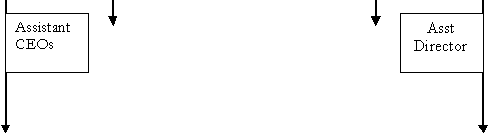
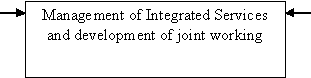

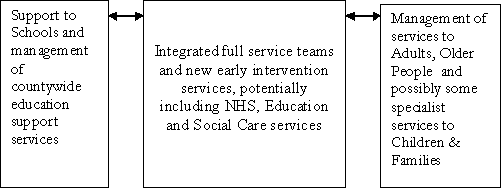
7. Timescales
7.1 The following timeline indicates overall priorities up to March 2006 and includes the implementation of integrated `full service' teams and new early intervention services together with the necessary interim management arrangements during 2005/6. There are three critical areas of development:
· Identifying those existing services where integration would ensure better outcomes for vulnerable young people and establishing the necessary change and governance processes.
· Development of new early intervention services.
· Coordination of existing and emerging work streams to support partnership working in response to the Children Bill, including mapping services, functions and resources.
7. May 2004 to September 2004.
· Develop clear view on intended outcomes under a new approach
· Establish consultation and briefing structures
· Commence initial briefings and consultation on objectives, needs, priorities and options for the development of integrated teams and joint working.
· Establish Children's Services Board
· Complete work on joint performance management data
· Identify integrated service framework options
· Develop proposals for new early intervention service
· Identify service priorities and objectives
· Complete analysis and map existing services, functions, resources and needs indicators
· Assess the support service needs of integrated teams
· Progress work to implement information sharing protocols
· Progress work to develop information management IT system
· Progress work to implement common assessment and recording framework
· Progress work to implement preventative strategies
· Establish any necessary secondments and release from current roles to support priority work streams
· Identify potential management arrangements for integrated services
· Agree with PCTs the process to establish a joint commissioning strategy for Children's Services
· Confirm arrangements to establish a Safeguarding Board
9. October 2004 to March 2005.
· Conclude briefing and consultation with Schools, Governors, young people and other stakeholders
· Conclude briefing and consultation with key staff groups potentially to be included in integrated teams
· Apply needs analysis and resource distribution options to integrated team service frameworks and agree operational boundaries
· Determine and start to put in place the management and governance arrangements for integrated teams
· Agree policies, procedures and operational guides for integrated services
· Determine resource base for new early intervention service
· Commence implementation of integrated team and early intervention service
· Put in place initial management arrangements for integrated services
· Establish management and performance data requirements for integrated teams.
· Draft joint commissioning strategy and plans agreed with stakeholders
10. April 2005 to April 2006
· Complete implementation of locally integrated services, including early intervention service.
· Establish monitoring and evaluation arrangements for integrated teams and new services
· Put in place any consequential changes to existing management and governance responsibilities.
· Have in place a Safeguarding Board
· Put in place operational implementation plans to respond to joint commissioning strategy.
11. Conclusion
11.1 Much remains to be done, but progress to date is satisfactory. The Children Services Board has been established; a consultant has been appointed to assist the Board to develop a performance-led approach to improved outcomes for children based on the 5 key objectives in the Bill; and work to integrate services and consider an evidentially based service configuration is well in hand.
11.2 Regular reports will be submitted to Cabinet charting progress against the timetable set out.
Recommendation
The report be noted
Section 100D - Local Government Act 1972 - Background Papers
The following documents disclose facts or matters on which this report, or an important part of it, is based and has been relied upon to a material extent in the preparation of this report.
N.B. the list excludes:
1. Published works
2. Documents which disclose exempt or confidential information as defined in the
Act.
None