Archived decisions
Hampshire County Council
Cabinet 26 July 2004
Accredited Community Safety Officers
Report by the Director of Property, Business and Regulatory Services
|
Contact: Tony Langstone Ext: 6619 [email protected]
1 |
Summary |
1.1 |
The following decisions are sought: |
1 2 3 4 5 6 |
That approval be given to: The planned underspending in 2004/5 being carried forward to 2005/6 and beyond. Naming the scheme the Community Safety Service. Granting the service the powers detailed in Appendix 3 and, subject to approval by the Chief Constable, those powers detailed in paragraph 6.3. The service being piloted initially in specific District council areas, to be finalised after further discussions with CDRPs, the police, District Councils and Cabinet. The service consider joining the Ambulance Service's network of providers of automatic defibrillators at an appropriate time. The proposed badge at Appendix 5 and the uniform (to be displayed at the meeting) |
2 |
Reason(s) |
2.1 |
To enable the development of the ACSO scheme to proceed. |
2.2 |
This decision supports Aim 4 of the Corporate Strategy by building strong and safe communities. |
3 |
Other options considered and rejected |
3.1 |
None |
4 |
Conflicts of interest declared by the decision-maker or other Executive Member consulted |
4.1 |
Not applicable |
5 |
Dispensation granted by the Standards Committee |
5.1 |
Not applicable |
6 |
Reason(s) for the matter being dealt with if urgent |
6.1 |
Not applicable |
Approved by: |
.......................... |
Date of decision: |
......................... |
Councillor T K Thornber |
Contact: Tony Langstone Ext: 6619 [email protected]
| How the conclusion in this report fits with the Corporate Strategy This scheme will impact on the delivery of all Corporate Aims, focusing most immediately on: |
1 Summary
1.1 This report outlines progress on a number of issues relating to the development of the Accredited Community Safety Officer (ACSO) scheme following the report to Cabinet on 27 April 2004:
1.2 The report seeks approval to:
· Carrying forward any underspending in 2004/5 to cover the potential over commitment in 2005/6 and 2006/7
· Calling the scheme the Community Safety Service
· Granting of specific powers
· The scheme being piloted initially in specific District Council areas
· badging and uniform proposals
2 Budget
2.1 The budget for 2004/5 included recurring growth of £1m per annum for the service. It is estimated that the ultimate cost of employing 34 frontline ACSOs would be in the region of £750,000 in 2004/5, ultimately rising to £1.1m p.a. This is detailed in Appendix 1. It should be noted that, owing to this being a new County Council service, the costs are still being refined as final operating procedures have not been agreed. For example, the implications of unsocial hours working from shift patterns are still being finalised, and currently stand at £69,000 p.a. - 6% of total expenditure. It should be noted that no additional expenditure on office accommodation will be incurred, as existing bases will be used.
2.2 The fact that the 2004/5 provision will be underspent offers the opportunity to cover the overcommitment for the next two financial years, thus ensuring that the service is adequately funded until March 2007. If the cost of the service were to be restricted to £1m per annum, it would be necessary to reduce the number of officers by four or five. If the 2004/5 underspending can be carried forward, allowing for factors such as staff turnover, the risks associated with appointing 34 frontline officers initially would be relatively low.
3 Recruitment
3.1 The recruitment process has begun with advertisements for the manager, team leaders and officer posts placed in the local press at the end of June. Advertisements have been produced on the basis that the recruitment phase is also part of the public relations exercise. It is intended to interview candidates and following the required enhanced Criminal Records Bureau (CRB) checks
(as required by the accreditation scheme), it is anticipated that formal offers of employment will be made towards the end of August.
3.2 It is anticipated that the appointed staff will start during early October. Training is expected to take four to six weeks, with some `work shadowing' in Southampton and with District wardens and the police. The officers should therefore be actively enforcing their new role in early to mid November.
4 Consultation
4.1 As proposed in the previous report to Cabinet, Regulatory Services has been discussing our proposals with the District Councils. A number have been visited individually and all District Councils were invited to a special forum, together with representatives from the eleven Crime Reduction and Disorder Partnerships (CDRPs) - known in Hampshire as Community Safety Partnerships. Fareham and New Forest are considering introducing similar ACSO schemes while others already have established neighbourhood warden schemes - notably Basingstoke and Test Valley. Wardens do not have any enforcement role but are said to have been successful in reducing anti-social behaviour through community working and being a visible deterrent. Others are planning to introduce wardens, while some Districts are not sure about their future plans. A summary of the position in the Districts is attached as Appendix 2.
4.2 At the individual meetings with Districts, and the forum held for the CDRPs and Districts on 14 June, concerns were raised on the lack of consultation on the proposed scheme. There appears to be some anxiety on how the county scheme will fit with District schemes and the potential for confusion for the public on the varying roles. There was also a view that the ACSO scheme should be delayed until full consultation has been made through the statutory CDRPs and Local Strategic Partnerships. Senior officers from Regulatory Services have responded to this by offering to visit all the CDRPs to explain the proposals. However, it has been made clear that the plan to have the ACSO scheme in place by October would proceed. It should be noted that the CDRPs are currently undertaking their three yearly crime audit and the results in the autumn will assist in deciding the operational priorities of the ACSOs.
4.3 Despite the issue of consultation, all Districts are generally very positive about additional resources for community safety, and recognise the need to work together. They were anxious to know how work would be prioritised given the limited number of officers for a county the size of Hampshire. It was agreed that the local knowledge of neighbourhood wardens would be invaluable to the County Council's ACSOs. It is also vital to the success of the County Council scheme that it presents a consistent approach to that of ACSOs planned in Fareham and the New Forest. Most Districts with schemes are keen to work in partnership in varying forms eg with our ACSOs operating in different geographic areas to their wardens, joint working, acting as professional witnesses in cases of breaches of Anti-Social Behaviour Orders (ASBOs) etc. Havant, Gosport and East Hampshire are keen to have deployment in their areas. Other Districts without wardens are likely to be keen to have ACSOs operating in their areas.
4.4 Each CDRP will have an ASBO co-ordinating officer funded by the Home Office for two years and will be a key link for the County Council's ACSO Manager and Team Leaders. It should also be noted that Housing Associations that are Registered Social Landlords (RSLs), are also legally entitled to apply for ASBOs against problem tenants. It is understood that there are over 200 Housing Associations in Hampshire. Again the ACSO Manager and Team Leaders will need to liaise with these agencies.
4.5 During the consultation process the Hampshire and IoW Ambulance Service requested that consideration be given to using the ACSOs as part of a network being developed to respond to high sudden cardiac related incidents. The Ambulance Service is working with the Fire & Rescue Service, security organisations in shopping centres etc. with the aim of rapidly getting light weight automatic defibrillators to victims. Although they recognise this is not related to enforcement they believe that it would be beneficial in promoting some of the softer skills that might be provided by our officers. This is a development that could be considered once the service has been operating for, say, 6 months. It would provide a very useful service, in particular for the elderly, and would be an excellent public relations opportunity for the County Council, subject to operational, safety and training issues being resolved.
5 Links with the Hampshire Constabulary
5.1 High levels of co-operation have been received from Hampshire Constabulary, The police will be responsible for the accreditation of individual ACSOs on receipt of proof that they have received sufficient training on legal and health and safety issues. As part of the accreditation process the police will carry out `enhanced' CRB checks, which covers not only the background of the individual but also their family and friends. The police will also advise on authorisations, ID cards and uniforms.
5.2 During the consultation process with the Districts and the police it became clear that links to operational police divisions within Hampshire, known as Basic Command Units (BCUs), are a key to the deployment of the ACSOs. Every fortnight, in each BCU, a meeting attended by local District Community Safety Managers considers issues and events arising over the previous two weeks. The meetings, known as Task and Co-ordination Groups (TSGs), then decide the appropriate priority and response. The TCGs are covered by the Official Secrets Act as frequently highly sensitive information is discussed. In the agreed intelligence led approach to the deployment of ACSOs the TCGs would be the primary source of information and prioritising areas of work.
5.3 The police inspectors who attended the forum welcomed the new service and stated that trouble spots in Hampshire were already well known. It is suggested that calls be directed through the normal Regulatory Services Advice line during office hours with the public using the normal police non-emergency 0845 line at other times. This will ensure that the police maintain a record of anti-social incidents. The alternative would be to have two ACSOs staffing phone lines during the evening and deciding on which incidents the officers on the ground should respond to. This would suggest to the public that the ACSOs are an emergency service and militate against the decision to have an intelligence led approach.
5.4 The police are currently working on a protocol with Southampton City Council to clarify the division of work between them. This will then be adopted by the County Council and across the force area. It is worth noting that all the advice received during the consultation process is that ACSOs should not get involved in the `night-time economy' as they do not have the powers, training or back-up to deal with potentially violent situations.
6 Powers, Structure and Operational Issues
6.1 It is proposed that the scheme is called the `Community Safety Service' and officers are granted all the powers listed in the April report with the following exceptions:
· dog fouling (90% of Hampshire is controlled by District dog wardens)
· power to stop vehicles for emissions testing (aimed at Vehicle Inspectors)
· power to control traffic for purposes of escorting exceptional loads (primarily a police role)
· and, subject to views from Education, the power to issue fixed penalty notices (FPNs) for failure to secure regular attendance at school of a registered pupil (this is likely to be the function of Education Welfare officers).
This will enable officers to deal with more high impact issues and concentrate on anti-social behaviour elements. A list of the recommended powers is attached at Appendix 3.
6.2 Arrangements will need to be introduced to manage the payment and the issuing of fixed penalty notices. Legal procedures for non-payment and contested cases will also need to be devised, stationery will be provided that meets the requirements of Legal Services. Regulatory Service prosecutors will deal with contested cases and process action against non-payers as far as possible.
6.3 A different process applies to offences under the Anti-Social Behaviour Act 2003, which allows ACSOs to issue Penalty Notices for Disorder (PNDs) for the following offences:
· behaviour likely to cause harassment, alarm or distress
· throwing fireworks in the street
· trespassing on a railway
· throwing stones at trains
· consumption of alcohol in a designated place
These powers are granted at the discretion of the Chief Officer of police who has accredited the officers and who must take into consideration the functions of the ACSOs and views of relevant local partners. It will therefore be necessary to gain the support of local CDRPs in extending the powers for these offences. It should be noted that there is detailed Home Office guidance on the issuing of PNDs and this is a new area for the police themselves. Hampshire Constabulary has not yet issued any PNDs. If such powers are granted to the County Council's officers any notices that are contested or unpaid will be the responsibility of the police.
6.4 Subject to budgetary commitments, it is planned to have four teams of 8 to 9 officers working shifts between noon and 10.00 pm all week, including weekends or other such hours as specified, depending on operational needs. However, some flexibility will be built in to vary the hours according to need. For example new regulations under the Fireworks Act 2003 are expected to introduce a curfew on the use of fireworks after 11.00 pm for most of the year. It is likely that a power to enforce the curfew could fall on ACSOs.
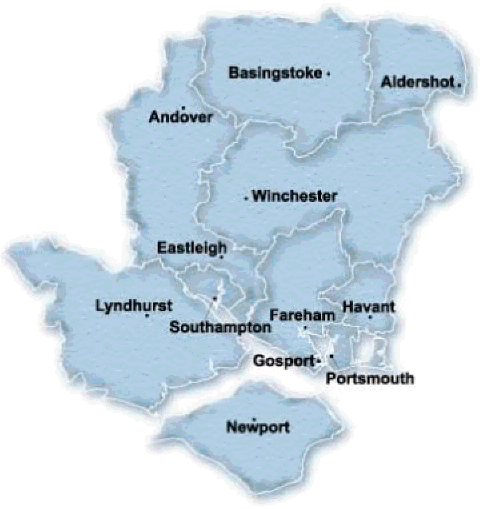
6.5 The four teams will link to the seven police BCUs shown in Appendix 4. However, the logistics of operating across such large areas will make this difficult. For operational convenience it is proposed to have some overlaps ie
· south-west team to cover the New Forest, Romsey and Eastleigh;
· south-east team to take Fareham, Gosport and Havant plus Hedge End;
· central team with take Winchester and Andover;
· north-east team to cover Basingstoke and Aldershot.
6.6 It is unlikely that all the officers will be recruited from the first phase of recruitment, it is therefore proposed to pilot the service in specific Districts, targeting areas that rated community safety as a high priority in the MORI residents survey. Cabinet views on this idea would be helpful and on the specific areas for the pilot work.
6.7 The County Council has formally endorsed to the government's Enforcement Concordat and Trading Standards has developed an associated Enforcement Policy that has been approved by members. The role of the Community Safety Service requires a different type of policy to cover situations when officers deal with young people.
6.8 In the deployment and operation of the service the safety of officers and the public will be paramount. Officers will always carefully evaluate any incident to assess whether their intervention is likely to be successful or whether the full powers of a police officer are required. ACSOs do not have the power to arrest or detain anyone, unlike Accredited Community Support Officers embedded with the police, who have the power to detain for 30 minutes.
7 Public relations
7.1 The launch of the service will require a prolonged public relations campaign to ensure that the community is aware and understands the role of the new officers. Crime statistics show that Hampshire is a relatively safe place and the campaign needs to be implemented sensitively to ensure that it does not create undue fear, especially among the elderly and more vulnerable members of society. Regulatory Services are working with Corporate Communications to promote the new service and a key element will be to use the official accreditation badge that officers are required to wear at all times (Appendix 5). This will help to build up recognition of officers and associate the badge with the County Council and the service. Subject to approval by the police it is planned to use the badge in advertising, features and vehicles used by officers.
Vehicles will also be badged with the Regulatory Services Advice Line telephone number and a website will be established. Officers' uniforms will be similar to police officers to give them an appearance of authority and distinguish them from wardens.
7.2 Key milestones in promoting the service will be:
Appointment of the manager - late July
Appointment of the officers - early September
Delivery of vehicles - early October
Accreditation of the officers - mid/late October
Launch of service - early November
7.3 Articles in the local media and Hampshire Now are planned and national publicity will be sought as the first County Council to adopt such a scheme.
Regional television will also be used to raise the profile of the scheme and create public awareness.
8 Success factors
8.1 The main purpose of the service will be to provide a visible presence on the streets to deal with low level anti-social behaviour and give reassurance to the community. It should also deal with environmental crime in relation to litter, graffiti, fly tipping and abandoned vehicles. The service will concentrate on geographic areas highlighted through TCGs, CDRPs and issues raised by the public, District councils and Members. Measuring reductions in incidents of anti-social behaviour will rely on benchmarking data held by the police, CDRPs and also a Federal Database run by the County Council. However, it is understood that police data is not readily available. District councils will be encouraged to input data onto the Federal Database.
8.2 The following are suggested as success factors:
Key outcomes - reduction in incidents of anti-social behaviour
response from MORI survey of Hampshire residents
response from Citizens Panel
results of satisfaction surveys
Charter of Service results
Key outputs - number of contacts with the public
number of complaints and enquiries actioned
number of fixed penalties issued
number of partnerships established
number of ASBO related incidents
number of media contacts
9 Recommendations
That approval be given to:
1. the planned underspending in 2004/5 being carried forward to 2005/6 and beyond
2. naming the scheme the Community Safety Service
3. granting the service the powers detailed in Appendix 3 and, subject to approval by the Chief Constable, those powers detailed in paragraph 6.3
4. the service being piloted initially in specific District Council areas, to be finalised after further discussions with CDRPs, the police, District Councils and Cabinet.
5. the service considers joining the Ambulance Service's network or providers of automatic defibrillators at an appropriate time
6. the proposed badge at Appendix 5 and the uniform (to be displayed at the meeting)
Section 100 D - Local Government Act 1972 - background papers
The following documents disclose facts or matters on which this report, or an important part of it, is based and has been relied upon to a material extent in the preparation of this report.
NB the list excludes:
1 Published works
2 Documents which disclose exempt or confidential information as defined in the Act.
The estimated costs of the service are as follows:
2004-05 £'000 |
2005-6 £'000 |
Full Year £'000 | |
Recurring costs |
|||
Staffing |
471 |
966 |
998 |
Transport |
58 |
117 |
117 |
Other running expenses |
23 |
50 |
50 |
Total recurring costs |
552 |
1,133 |
1,165 |
One-off costs |
|||
Recruitment and training |
40 |
||
Transport |
138 |
||
Other set-up costs (uniforms, etc) |
17 |
||
Total one-off costs |
195 |
||
TOTAL COSTS |
747 |
1,133 |
1,165 |
APPENDIX 2
District Council situation regarding Community Safety Schemes
June 2004
Basingstoke and Deane Borough Council
10 Community Wardens + Co-ordinator
ASBO co-ordinator and Logistic Support.
No enforcement role. Mon to Sat 9am to 10pm and some Sundays.
May consider accredited scheme.
Eastleigh Borough Council
Community Safety Co-ordinator.
Proposing to suggest warden scheme to Community Safety Partnership (CDRP). Approach yet to be decided.
East Hampshire District Council
No current scheme and `not sure' about having one.
Fareham Borough Council
Close to advertising Supervisor post with 3 CSOs + 1 officer for travellers and abandoned vehicles to follow. Hope to have in place by autumn.
CSOs to be accredited - will deal with environmental issues especially litter.
Will not do anti-social behaviour per se
Gosport Borough Council
1 Neighbourhood Warden in Seafield until March 2004.
Considering a scheme.
Hart District Council
Use private sector company for parks, open spaces - intelligence gathering, public reassurance.
In-house scheme under review - funding in place for 1 warden - targeted areas.
Havant Borough Council
No scheme in operation and none under consideration.
New Forest District Council
6 Officers planned - 3 in Hythe and 3 in New Milton. To be accredited and gradually take on enforcement role over 2 years.
County ACSOs could assist and act as professional witnesses regarding ASBOs.
Rushmoor Borough Council
3 Neighbourhood Wardens funded by CRDP - employed by Pavillion Housing - inc. anti-social behaviour r work.
Plan to have CSOs.
Test Valley Borough Council
8 Neighbourhood Wardens + Manager. 4 in Andover - 4 in Romsey mainly on specific estates. Main shift 12 - 10pm all week. No plans for enforcement role.
County ACSOs would have a role in Andover Town Centre (+ Romsey).
Winchester City Council
Plans at job description stage to have 2 Neighbourhood Wardens based in social housing areas in Winchester from September
APPENDIX 3
Powers to be granted to Accredited Community Safety Officers:
· Power to request name and address for FPN offences and offences that cause injury, alarm and distress to another person or damage or loss of another's property
· Power to request the name and address of a person acting in an anti-social manner
· Power to confiscate alcohol from young people or being consumed in a certain public place
· Power to confiscate cigarettes and tobacco from young people
· Issue FPNs for littering
· Issue FPN for graffiti
· Issue FPN for fly-tipping
· Power to stop cycling on footpaths and issue of FPN
· Power to require the removal of abandoned vehicles
· Power to issue FPN in respect of failure to secure regular attendance at school of a registered pupil*
* Officers to be authorised but no action to be taken except in liaison with County Council Education Welfare Officers
APPENDIX 4
APPENDIX 5